

The national average real estate photography cost is about $230 for a standard shoot, and that usually covers 10 to 25 MLS-ready photos for a 1,500 to 3,000-square-foot home. In the broader U.S. market, a standard package typically lands around $175 to $550, so the question isn't just what a photographer charges, it's what the quote includes and whether the scope fits the property.
Why do some Fresno sellers still treat photography like a checkbox when the first image can decide whether a buyer clicks at all? In the Central Valley, that mistake shows up fast, because a clean, well-lit listing often feels more credible than one that looks rushed, even before a showing is booked.
Why Professional Photography Matters for Your Listing
Could a flat photography quote hide a larger cost for a Fresno seller? The question is what the images do for the listing's return. A phone snapshot may save a fee, yet it can make a well-kept Central Valley home look ordinary beside professionally presented properties. Buyers usually encounter the listing online before they ever reach the front door.

Professional images show proportion, light, flow, and condition more accurately. They also signal preparation. Buyers may read a carefully presented listing as evidence that the seller and agent are managing the transaction with similar care. In competitive Central California neighborhoods, that impression can determine whether someone saves the property, shares it, or skips it.
Buyers judge a home in seconds, and weak photos create doubt before they create interest.
Before booking, sellers can use a practical pre-shoot checklist for Fresno sellers to decide whether each room needs decluttering, staging, or better light. That preparation matters because a photographer can improve the presentation, but cannot correct every condition left in the room.
For a deeper look at how professional images perform on active listings, review Vancouver listing photography tips. The market differs, but the trade-off is familiar: a lower flat rate is not automatically the lower-cost choice if weak images reduce online interest and delay serious showings.
A local broker sees this gap often. Sellers may skip professional coverage to save a modest amount, then lose momentum because the listing earns too little attention. Upgrades deserve consideration when the home has strong light, distinctive features, or meaningful competition. Skip extras that do not improve how buyers understand the property, but do not confuse a basic shoot with an avoidable presentation problem.
Understanding the National Average and Local Rates
The cleanest benchmark for real estate photography cost is still the national average, but sellers shouldn't stop there. A standard shoot is commonly priced at about $230, and that figure usually includes 10 to 25 MLS-ready photos for a typical 1,500 to 3,000-square-foot home, according to the national benchmark from PhotoUp's pricing guide. The same source places the broader U.S. range for a standard package at roughly $175 to $550, which shows how much geography and service scope can move the final quote. You can review that benchmark in PhotoUp's real estate photography pricing guide.
What the base price usually means
A flat listing price often covers the core deliverable, interior and exterior stills with basic editing. That sounds simple until you compare one quote to another and realize one photographer includes more images, better retouching, and faster delivery.
A second pricing frame puts standard daytime packages around $150 to $350, with published examples at $159, $189, and $329 for different photo counts and service tiers, as outlined in RealEstatePhotography.com's pricing overview. That spread isn't random. It reflects how much labor goes into the shoot itself, not just how many files come back.
A low quote isn't a bargain if it leaves out the edit time, delivery speed, or enough images to market the full property.
Hourly pricing offers a different lens. In the U.S. market, photographers are commonly priced around $123 to $272 per hour, with a reported median near $150 per hour, as summarized by Thumbtack's real estate photography pricing page. Hourly rates matter less for sellers than for photographers, but they explain why complex jobs climb quickly when the property needs more time on site and in post-production.
For Fresno and the surrounding Central Valley, the useful benchmark is not the cheapest quote in town. It's whether the package aligns with the home's size, the likely buyer pool, and the level of polish the listing needs to compete. A modest home with straightforward rooms may do well at the low end of the market. A larger property, a custom build, or a home with strong architectural details usually needs a broader package to look complete.
Factors That Influence Your Total Photography Bill
What drives a real estate photography bill beyond the flat package price? In the Central Valley, the answer is usually the time required to present the property accurately, not just the number of delivered images. Site conditions, shooting difficulty, and editing demands determine whether an upgrade supports the listing or adds cost without much return.
Property size and layout
A compact home with clear sightlines takes less time than a larger property with several living areas, stairwells, detached spaces, or notable outdoor features. More square footage means more rooms to cover and more decisions about which angles explain the layout. A broad floor plan can justify a larger package when missing spaces would leave buyers with an incomplete impression.
Property complexity and edit volume
Custom architecture increases the workload. Vaulted ceilings, reflective surfaces, dark corridors, narrow rooms, unusual angles, and mixed natural and artificial light can require more careful shooting and editing. The final bill therefore reflects both time at the property and the post-production needed to show its condition and proportions accurately.
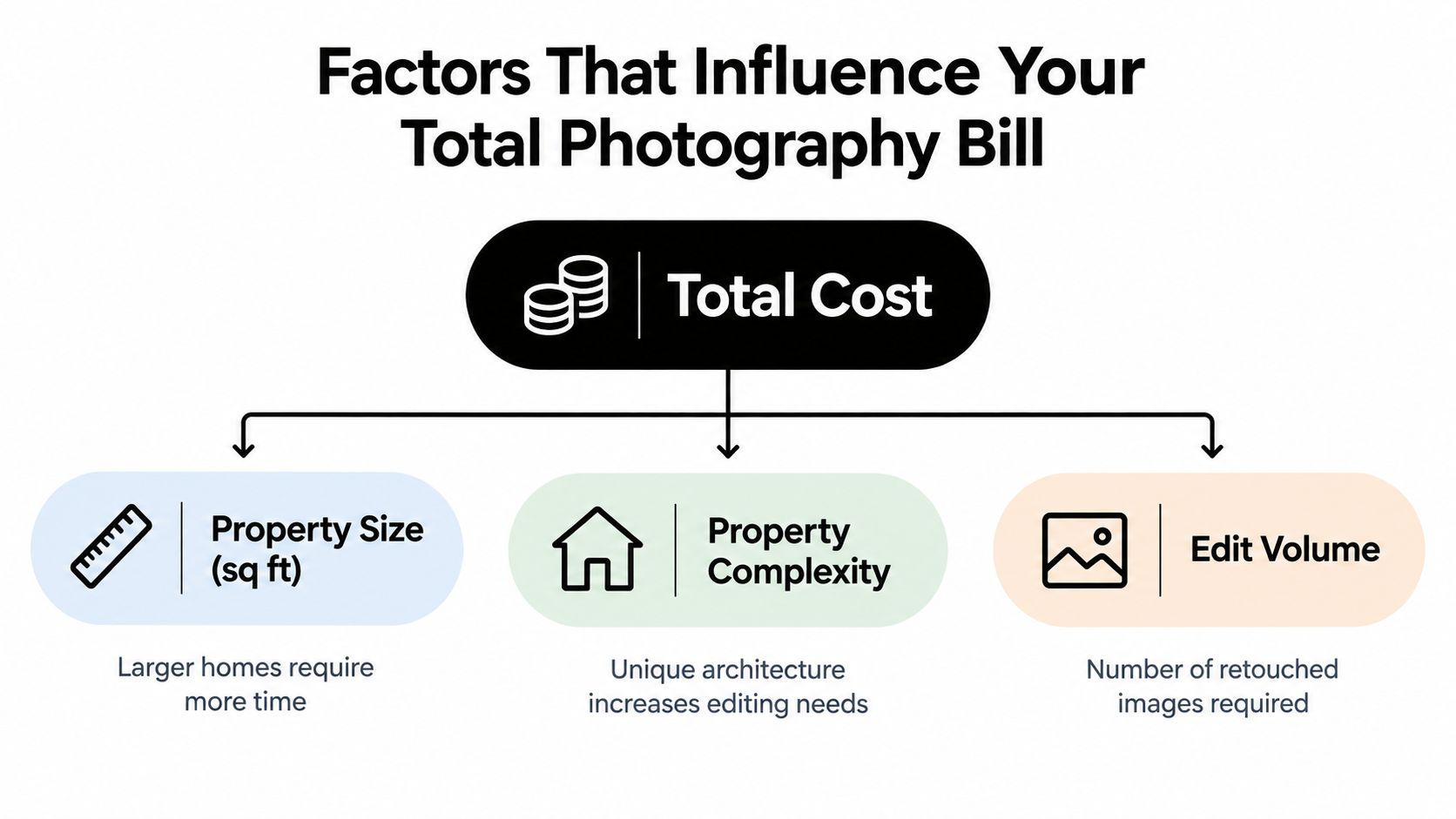
Practical rule: Unusual architecture, tight rooms, and extensive glass can raise editing time as much as shooting time.
Flat-fee pricing gives sellers a predictable budget, while hourly pricing can fit unusual properties when the scope is clearly defined. Before booking, confirm what the photographer considers a standard deliverable, including coverage, editing, image count, and turnaround. A low base rate may look attractive until necessary coverage or preparation work appears as an extra charge.
Presentation also affects return. Sellers preparing a home for market should compare the photography plan with this guide to home staging photography. Staging may make an upgrade worthwhile when it improves how rooms read online. A fuller walkthrough can help when the property has features that are easier to understand in motion, but it is not needed for every listing. In the Central Valley, spend more when an add-on explains a meaningful selling point, and skip it when standard stills already communicate the home clearly.
Common Add-Ons and Their True Value
The add-ons that look flashy on a price sheet don't all earn their keep equally. Some make sense only for certain property types, while others are more optional than most sellers realize. The right call depends on what the home offers and what buyers need to understand quickly.
Drone coverage tends to matter most when the lot, exterior setting, or surrounding grounds are part of the value. A sprawling property, a distinctive roofline, or a home with visible outdoor features can benefit from aerial context. A downtown condo usually doesn't need that same treatment.
Twilight photography is different. It creates a polished exterior mood that can help homes with strong curb appeal or dramatic lighting, but it isn't automatically worth paying for on every listing. If the exterior is ordinary and the budget is tight, daylight images usually do the job.
Video walkthroughs and virtual tours help when you need to show flow, scale, or layout in a way still photos can't. They're especially useful for buyers comparing properties remotely. The same goes for virtual property tours, which are most effective when a home's layout is a selling point rather than a distraction.
The best add-on is the one that explains the property faster, not the one that looks the most expensive.
A simple way to judge value is to ask whether the add-on helps a buyer understand the home more clearly in the first online pass. If the answer is yes, it may earn a place in the package. If it only adds polish without adding clarity, it's often a nice-to-have rather than a necessity.
For sellers in the Central Valley, that distinction matters because budgets are finite. You don't want to pay for a bundle just because it sounds complete. You want to spend on the pieces that make the listing easier to trust and easier to tour.
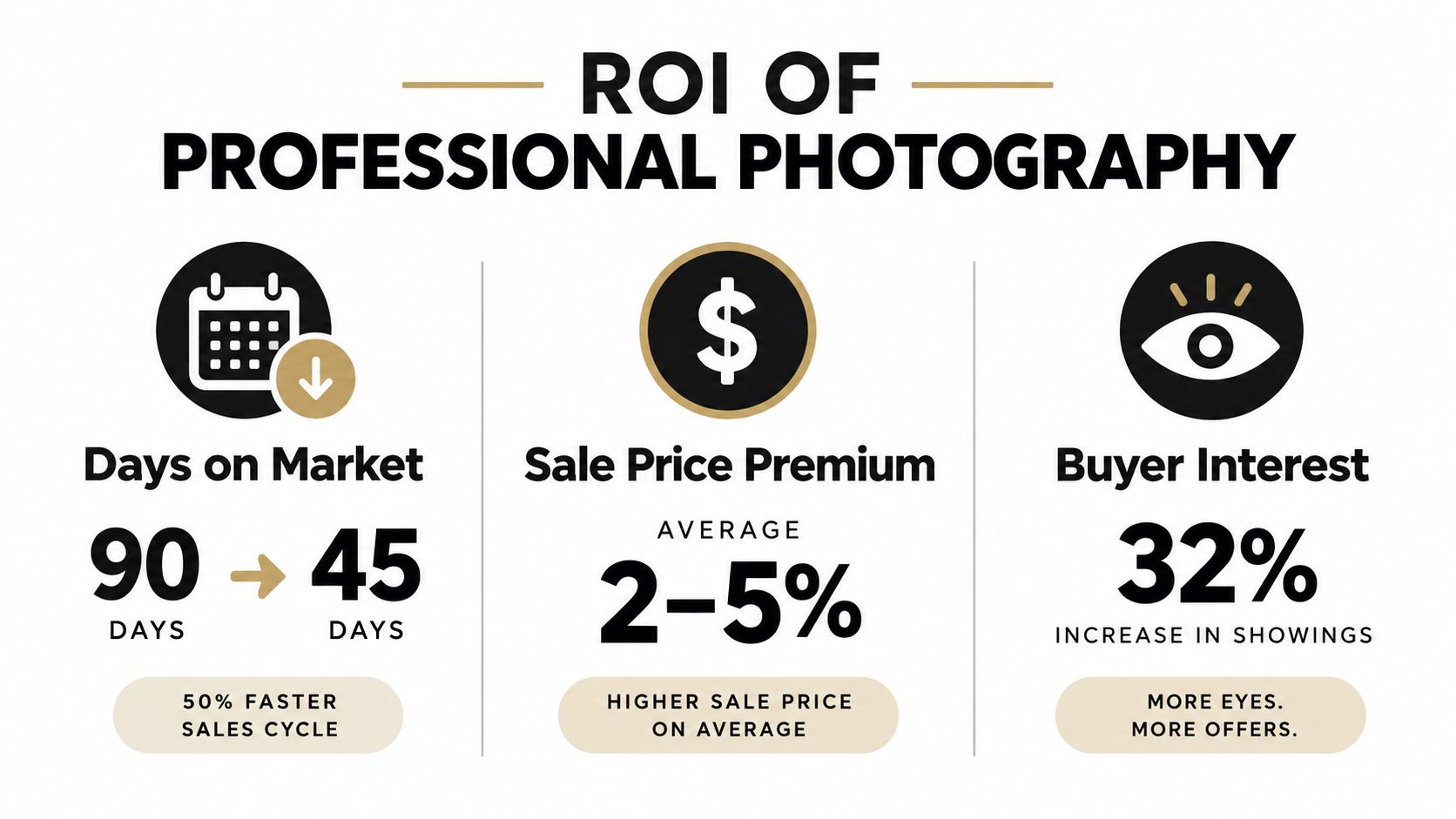
Calculating the Return on Investment for Photography
The return on photography isn't measured by how pretty the listing looks in a folder. It shows up in buyer behavior, faster engagement, and the number of people willing to take the next step. That's why photography should be treated as a marketing decision, not a decorative expense.
Recent pricing data show national averages clustering around about $230 per standard shoot, but the same sources also note broad variation by city and service bundle, from $110 to $500+ for standard packages, as discussed in Pinnacle Real Estate Marketing's cost guide. The key unanswered question is whether a more expensive package pays back in the local market. In Central California, the answer depends on how much the property needs help standing out in crowded search results.
A practical way to judge value
Start with the listing itself.
- Review the home's strengths. If the layout, finishes, and light already photograph well, a standard package may be enough.
- Look at the buyer pool. If buyers are comparing several similar homes, stronger visuals can help the property earn attention sooner.
- Check the deliverables. Ask how many final images you get, whether editing is included, and how quickly the files are delivered.
- Match add-ons to the property. Drone work, video, and twilight should support the listing, not inflate it for no reason.
- Compare portfolio consistency. A photographer who gets one room right but struggles with kitchens or exteriors isn't a safe choice.
If you want a simple rule of thumb, the right photographer should make the home look accurate, inviting, and complete. Not over-processed. Not flat. Just compelling enough that a buyer wants to know more.
A smart budget decision usually comes down to matching the package to the selling problem. If the home is already strong, keep the package clean and focused. If the property needs help telling its story, pay for the tools that explain it better.
How to Choose the Right Photographer in Central California
A fair quote is only useful if the photographer can deliver for your property type. In Fresno, Clovis, and the surrounding Central Valley, that means looking beyond the headline number and judging whether the work fits the local market. The cheapest option often costs more later if the images underperform.
What to look for first
Portfolio consistency matters more than a single standout image. You want to see kitchens, living rooms, exteriors, and awkward spaces handled with the same control. If a photographer only posts glamour shots, ask to see a full listing set.
Turnaround speed matters too, because listings lose momentum when media sits in inboxes. A photographer who delivers quickly helps the home reach the market while interest is fresh. That's especially useful when sellers are trying to coordinate showings, staging, and launch timing.
Familiarity with the Central Valley also helps. A photographer who understands how to handle harsh sunlight, warm interiors, and strong exterior contrast is usually easier to work with than someone using a one-size-fits-all approach from another market.
Ask for the same things every time, portfolio, deliverables, turnaround, and how they handle revisions.
Some sellers also prefer a marketing partner that can connect photography with staging, pricing, and listing prep. Edinhart Realty and Property Management is one option in Fresno that combines real estate services with in-house staging, photography, and strategic pricing support, which can simplify the process for owners who want one team handling the presentation side.
A short comparison that helps
- Best fit for a standard home: a photographer who offers clean stills, reliable editing, and MLS-ready delivery.
- Best fit for a home with strong exterior appeal: a photographer who can add drone or twilight selectively.
- Best fit for sellers who need coordination: a team that can align photography with staging and listing preparation.
The right choice is rarely the flashiest package. It's the one that makes the property easier to sell without wasting money on features the home won't use well. For Fresno sellers, that balance matters more than ever because the market rewards listings that look prepared from the first click.
If you're pricing a sale or rental in Fresno, Edinhart Realty and Property Management can help with the marketing side through photography, staging, pricing support, and property services that keep the listing process organized. Visit Edinhart Realty and Property Management to see how their local team can help you decide which upgrades are worth paying for and which ones you can skip.


