

Investing in California real estate can feel like chasing a blue-chip stock. The price of admission is steep, no doubt, but the potential for genuine, long-term growth and stability is hard to ignore. Even with the market's inevitable ups and downs, the Golden State continues to be a magnet for smart investors from all over the world, thanks to its beast of an economy and an absolutely relentless demand for housing.
Why California Real Estate Remains a Top-Tier Investment

The headlines love to scream about high prices and bidding wars, but if you look past the noise, the fundamental reasons for investing in California real estate are as solid as ever. It helps to think of it less like a speculative gamble and more like buying a piece of one of the most dynamic economies on the planet.
California's economic engine isn't just running on one cylinder. It’s a true powerhouse fueled by tech, entertainment, agriculture, and global logistics all at once. This incredible diversity creates a resilient job market, which in turn fuels an unwavering demand for a place to live. Simply put, more people wanting to work and live here means a constant need for rentals and a strong foundation for property values to climb over time.
The Power of Persistent Demand
At its core, the market runs on a simple, almost brutally effective principle: supply and demand. For decades, California has been dealing with a chronic housing shortage. New construction just hasn't been able to keep up with the number of people and jobs pouring into the state.
For an investor, this imbalance is actually a huge advantage. It creates a natural floor for property values and gives landlords some serious leverage.
Here's what that looks like in the real world:
- Lower Vacancy Rates: When demand is this high, properties get filled faster and stay occupied longer. That means more consistent rental income in your pocket.
- Strong Rent Growth: With a long line of potential tenants for every available unit, landlords can typically increase rents at a healthy pace, boosting cash flow year after year.
- Long-Term Appreciation: This constant tug-of-war between high demand and low supply is the primary engine behind California's incredible history of property value growth.
To really understand what makes California such a unique and powerful market, it helps to look at the foundational pillars that support its long-term investment appeal.
Key Pillars of California Real Estate Investment Success
| Investment Pillar | Description | Relevance for Investors |
|---|---|---|
| Economic Diversity | The state's economy is a mix of tech, entertainment, agriculture, and logistics, preventing reliance on any single industry. | A diverse economy creates a stable job market, which means consistent tenant demand and lower risk of widespread vacancies during downturns. |
| Chronic Housing Shortage | For decades, new home construction has not kept pace with population and job growth, creating a persistent supply-demand imbalance. | This shortage puts upward pressure on both rental rates and property values, directly benefiting landlords and property owners. |
| Population and Job Growth | As a global hub for innovation and culture, California continues to attract new residents and businesses, fueling population growth. | A growing population translates directly into a larger pool of potential renters, ensuring properties remain in high demand. |
| Geographic Desirability | From its iconic coastline to its vibrant cities, California's natural beauty and lifestyle are a major draw for people worldwide. | This desirability factor helps maintain strong property values, as people are willing to pay a premium to live in the state. |
These pillars work together to create a market that, while challenging, offers a foundation for building serious, lasting wealth.
A History of Resilience and Growth
California’s real estate market isn't just strong; it's tough. It has proven its resilience time and again, weathering various economic storms. Over the last 50 years, it has delivered truly remarkable long-term appreciation.
Consider this: the U.S. Federal Housing Finance Agency's House Price Index for California went from 41.69 in Q1 1975 to 959.06 by Q2 2024. That’s a staggering 23-fold increase. This kind of historical performance is exactly why savvy investors trust professional managers to help them find and maximize opportunities in robust markets like Fresno and Clovis. You can see the historical data on California's market performance here.
Key Takeaway: Investing in California is a long game. It's built on a rock-solid foundation of economic strength and relentless housing demand, not on trying to time the market for a quick flip. The real secret is finding value where others aren't looking.
This guide is here to help you do just that. We'll show you how to look beyond the overheated coastal cities and uncover the high-growth potential waiting in regions like the Central Valley. Success here demands a smart strategy, a solid grasp of factors like the current interest rates for homes in California, and more often than not, a little local expertise.
Decoding the Current California Housing Market
To get a real estate investment in California right, you have to learn to read the market’s story, not just its price tags. What we're seeing right now is a fascinating mix—high prices, shifting interest rates, and a buyer demand that just won't quit. It's a complex picture, but it’s full of strategic openings for investors who know where to look.
It’s all about seeing the "why" behind the numbers. Affordability is a huge concern, no doubt. But the deep-seated desire to own a piece of the Golden State keeps the market moving, preventing the kind of freefall some people were expecting. That tension is the central theme right now.
Instead of getting bogged down by the headlines, let's look at what these trends actually mean for your investment strategy. A market in flux often reveals opportunities that a stable, predictable one keeps hidden.
The Story of Resilience and Rebound
After a few years of adjustment, the California housing market is showing real signs of life. We're seeing a solid rebound in sales volume, which is a powerful sign of just how much underlying demand is still out there. This isn't just a minor blip; it's a signal that buyers are adapting to the new reality of interest rates and are jumping back in.
In 2024, sales of existing single-family homes saw a 4.3% increase to 269,030 units—the first annual sales gain in three years. Here’s the kicker: this happened while statewide median prices were hovering near record highs between $850,000 and $880,000. Seeing sales rise alongside strong prices tells us the market has a solid foundation, held up by limited supply and buyers who are still serious.
The story here for investors is pretty clear: waiting on the sidelines for a major market crash is probably a losing game. The real opportunity is in finding the pockets of value that exist right now, even in a high-cost environment.
Navigating High Interest Rates and Inventory Levels
Today’s higher interest rates are a double-edged sword. Yes, they increase borrowing costs and can squeeze your profit margins. But they also sideline some of the more casual homebuyers, which thins out the competition and can create a more balanced negotiating table for investors with solid financing.
At the same time, inventory is still incredibly tight across most of the state. This isn’t just a leftover pandemic issue; it’s a structural problem in California that’s been brewing for years.
- Limited New Construction: It’s incredibly expensive and slow to build in California, so supply almost never catches up with demand.
- The "Lock-In" Effect: So many homeowners are sitting on mortgages with ridiculously low rates from a few years ago. They have very little incentive to sell and give up that amazing financing.
This low supply acts as a strong floor for property values. For an investor, it means that while finding the right deal takes more digging, the asset you buy is far more likely to hold its value over the long haul.
A savvy investor sees higher interest rates not just as a cost, but as a filter that weeds out the less serious competition. The key is to have your financing strategy buttoned up before you even start looking.
Connecting Statewide Trends to Local Opportunities
While the big-picture data is a great starting point, the most successful real estate investments are always made at the local level. The trends driving the market in Malibu or Los Angeles look completely different from what's happening in high-growth areas like the Central Valley.
Take affordability. It’s a massive hurdle on the coast, but places like Fresno and Clovis offer much more attractive price-to-rent ratios. That means your rental income has a better shot at covering your mortgage and expenses, putting you on the path to positive cash flow from day one. To nail these local assessments, you absolutely need to use professional real estate market analysis tools that let you drill down into specific neighborhoods.
By understanding the broad statewide forces and then zooming in on a local market's unique dynamics, you can turn market complexity into your competitive advantage and position your California real estate investment for success.
Navigating California's Landlord and Tax Regulations
If you're going to invest in California real estate, you've got to speak the language—and that means understanding its unique regulatory landscape. The state's landlord-tenant laws and tax system might look intimidating at first, but with a little guidance, they're completely manageable.
Think of it less like a maze and more like a roadmap. Knowing the rules isn't just about checking boxes; it's about protecting your investment and sidestepping costly mistakes that can trip up even experienced investors.
Successfully managing a rental here means getting a handle on both statewide laws and local city ordinances, which can change dramatically from one zip code to the next. From handling security deposits to navigating the eviction process, every move you make has a legal script. Getting it wrong isn't a minor slip-up—it can lead to serious financial penalties and legal headaches that put your entire asset at risk.
Understanding California Landlord-Tenant Law
At the core of California’s rental rules is an attempt to balance the rights of landlords and tenants. The game really changed with the Tenant Protection Act of 2019 (AB 1482), which brought in statewide rent caps and "just cause" eviction rules for a lot of properties.
But the statewide laws are just your starting point. Many cities, especially in places like the Bay Area and Los Angeles County, have their own, often much stricter, rent control ordinances. This is a critical detail. If a local rule offers more protection to tenants, it trumps the state law.
Here are the key legal areas you absolutely need to master:
- Lease Agreements: Your lease needs to be a fortress—comprehensive, compliant with California law, and packed with all the required disclosures.
- Security Deposits: The state is very specific about this. You're generally limited to two months' rent for an unfurnished unit, and there are strict deadlines for returning it.
- Eviction Process: California has a very precise legal process for evictions. You have to follow it to the letter, starting with serving the correct legal notice.
The Foundation of California Property Taxes
For anyone playing the long game, California's property tax system has a powerful advantage built right in: Proposition 13. This law, passed back in 1978, is the bedrock of financial predictability for property owners in the state.
Think of Proposition 13 as a "locked-in price tag" for your property taxes. Your initial tax bill is based on the property's assessed value when you buy it. From there, the taxable value can only go up by a maximum of 2% per year—no matter how much the market value shoots up.
This creates incredible stability over the long haul. While new buyers are paying taxes based on today's high prices, investors who hold onto their properties for years benefit from predictable, manageable tax bills that don't swing wildly with the market. That stability is a cornerstone of any good buy-and-hold strategy, making it much easier to forecast your finances for years to come.
Maximizing Returns Through Tax Deductions
Beyond property taxes, the smartest investors know how to work every tax benefit to their advantage to boost their bottom line. Your rental income is taxable, of course, but the IRS lets you deduct a whole host of expenses tied to owning and running your investment property. To really make your investment work for you, you have to understand the crucial tax deductions for real estate investors.
Some of the most common deductions include:
- Mortgage Interest: This is usually the single biggest deduction on the list for investors.
- Property Taxes: What you pay in state and local property taxes is deductible.
- Repairs and Maintenance: The cost of keeping the property in good shape, from fixing a leaky pipe to a fresh coat of paint.
- Depreciation: This is a big one. You can deduct a portion of your property's value over 27.5 years, creating a significant "paper loss" that can lower your taxable income.
Let's be honest—staying compliant and financially sharp isn't something most investors should try to DIY. Getting professional help is key to navigating these complex rules. It ensures every lease is airtight and every possible deduction is claimed, which is how you truly protect and grow your real estate investment in California.
Choosing Your California Investment Strategy
Let’s get one thing straight: there is no secret, one-size-fits-all formula for a successful real estate investment in California. The best strategy isn't something you find in a textbook; it’s the one that clicks with your personal finances, your timeline, and frankly, how much risk you’re comfortable taking on. Figuring out your path is the most important decision you'll make.
We're going to break down the three most common ways investors make money in the Golden State. Think of them as different vehicles for getting to your financial destination—some are built for a slow and steady journey, while others are all about speed.
Comparing California Real Estate Investment Strategies
To get a clear picture, it helps to see these strategies side-by-side. Each one has a different goal, timeline, and level of involvement.
| Strategy | Primary Goal | Risk Level | Best For | Example Property (Central CA) |
|---|---|---|---|---|
| Buy-and-Hold | Long-term wealth building & passive income. | Low to Moderate | Investors focused on retirement, steady cash flow, and building a legacy. | A well-maintained single-family home in a desirable Clovis school district. |
| Fix-and-Flip | Quick, short-term profit from renovations. | High | Hands-on investors with construction knowledge and a high risk tolerance. | A dated, structurally sound house in an up-and-coming Fresno neighborhood. |
| Multifamily | Scalable cash flow and diversified income. | Moderate | Investors who want to scale their portfolio efficiently and reduce vacancy risk. | A duplex or fourplex near Fresno State or Community Regional Medical Center. |
Seeing them laid out like this really highlights how different the approaches are. The right choice for you depends entirely on what you want to achieve.
The Buy-and-Hold Approach
The buy-and-hold strategy is the marathon of real estate investing. The idea is simple but incredibly powerful: buy a solid property, hold onto it for years, and let it generate a steady stream of rental income while its value (hopefully) climbs over time. This is the classic path to building real, long-term wealth.
This approach is perfect for investors who value stability and passive income over a quick buck. It’s less about timing the market perfectly and more about time in the market. In a state like California with a chronic housing shortage, a good rental property can become a very reliable cash-flow machine.
- Pros: Generates consistent monthly income, builds equity as you pay down the mortgage, and benefits from long-term market appreciation.
- Cons: It requires patience and active management (or hiring a professional property manager), and your capital is tied up for the long haul.
- Best For: Investors planning for retirement, seeking passive income, and looking to build a legacy for their family.
The Fix-and-Flip Strategy
If buy-and-hold is a marathon, then fix-and-flip is an all-out sprint. This strategy is all about buying a property that needs work—something undervalued or distressed—renovating it to boost its value, and then selling it quickly for a profit. This is an active, hands-on game that demands a sharp eye for deals and serious project management skills.
A flipper's success really depends on the market. It thrives when home prices are on the rise. The whole point is to get in, add value through renovations, and get out before the market takes a turn, capturing profit from both your work and the market's upward swing.
Key Insight: Flipping isn't a passive investment; it's a full-on business. You need a deep understanding of local construction costs, what buyers in the area want, and the discipline to execute a renovation on time and on budget.
Just look at the Bay Area's real estate cycles over the past 30+ years for a masterclass on this. Between 2000 and 2006, lower-priced homes shot up 119% before a major crash. This history lesson shows how vital it is to match your strategy to what the regional economy is doing, whether that’s flipping in a hot market or holding for stability in uncertain times.
The Multifamily Investing Path
Multifamily investing means buying properties with more than one unit, like duplexes, triplexes, or small apartment buildings. This strategy is a fantastic way to scale up your portfolio and multiply your cash flow without multiplying your headaches.
Think of it as built-in diversification. If one tenant moves out of your fourplex, you still have income from the other three units to cover your mortgage and expenses. That built-in protection against vacancy makes multifamily properties incredibly resilient. Plus, getting a loan for and managing one four-unit building is usually way more efficient than juggling four separate single-family homes.
This flowchart gives you a simplified look at the decision-making process for navigating some of California's key regulations—a must-know for any investor.
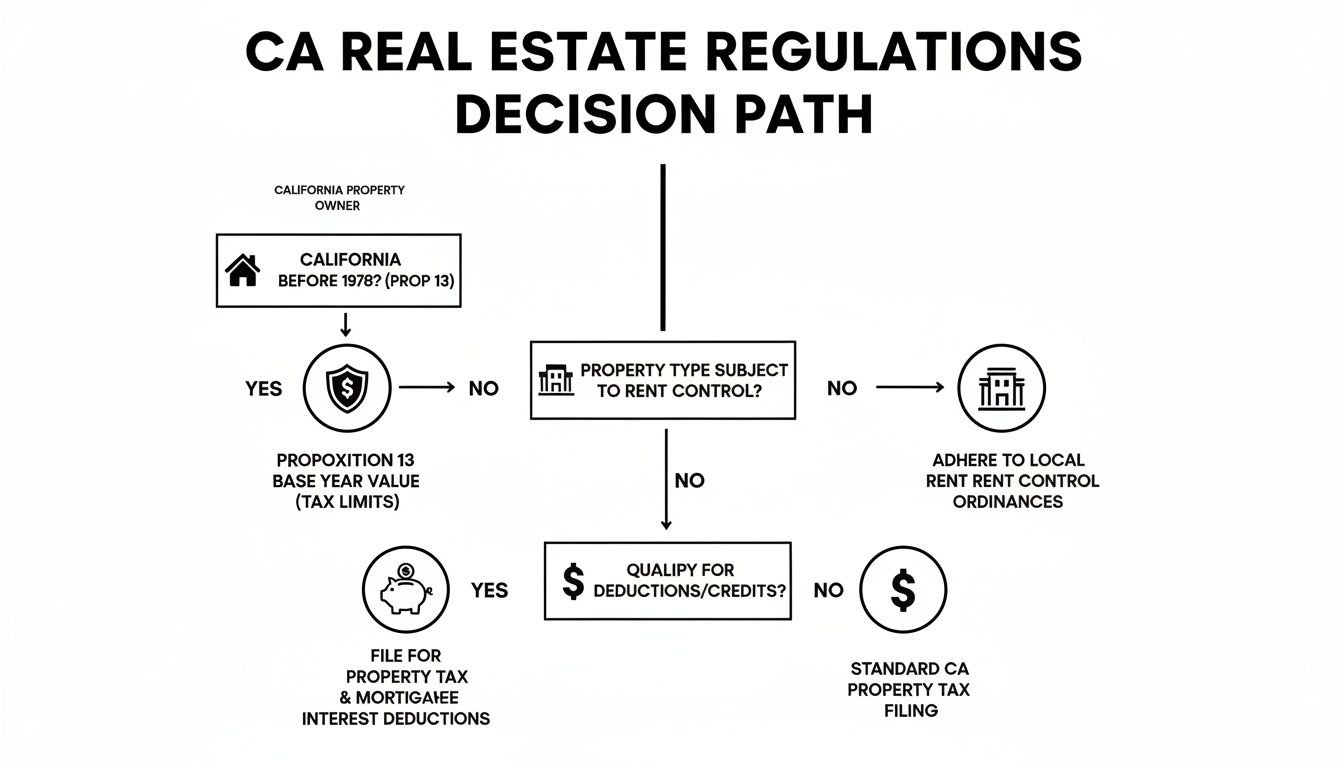
As the visual shows, getting a handle on rules like Prop 13 and local rent control is step one—before you can even think about maximizing profits and deductions.
Choosing the right path forward requires a hard look at your own finances and what's happening in your local market. To get your numbers right, it's worth exploring some of the Top Real Estate Investment Analysis Tools to compare potential deals. Whether you’re aiming for steady rental checks or a quick profit, a clear strategy backed by solid data is your best friend in this game.
Finding Opportunity in the Central Valley
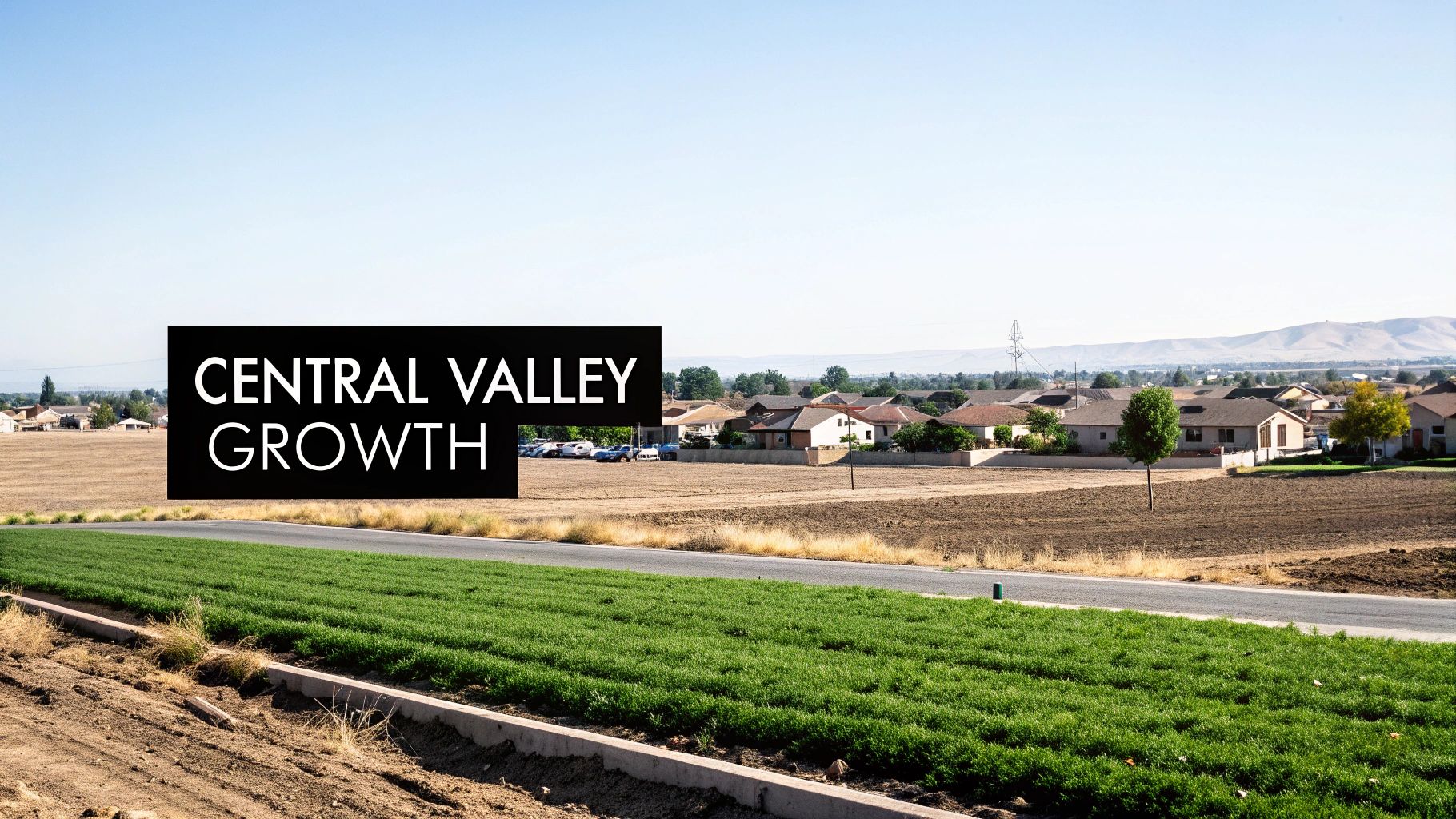
When people think of California real estate, their minds usually jump to the glamour of Malibu or the hustle of Los Angeles. But while those coastal markets grab the headlines, a much more grounded success story is being written in the heart of the state. For investors who care more about solid fundamentals than flashy postcodes, the Central Valley is where the real action is.
Markets like Fresno, Clovis, and Friant offer a refreshing alternative to the coast's eye-watering prices. Here, the investment math just works better. You're looking at a landscape with relative affordability, a growing population, and an economy that's getting more diverse by the year. That’s a powerful recipe for both immediate cash flow and long-term growth.
Don't think of the Central Valley as a second-tier market. Think of it as a strategic one, where the classic laws of supply and demand are playing out in a way that directly benefits landlords and property owners.
The Economic Engine Fueling Housing Demand
So, why is the Central Valley growing? It all comes down to its robust and evolving economy. While it's long been the nation's agricultural breadbasket, the region's economic foundation has expanded far beyond the farm. Today, it has several strong pillars that keep the demand for housing consistent and strong.
This economic diversification is what gives the area its resilience, making it a prime target for smart investors.
Key drivers include:
- Logistics and Distribution Hubs: Its central location is a massive advantage. Major players like Amazon and Ulta Beauty have set up huge distribution centers here, creating thousands of steady jobs.
- Expanding Healthcare Sector: Major medical centers, like Community Regional Medical Center in Fresno, are huge employers that are constantly expanding and pulling in skilled professionals who need a place to live.
- A Booming Agricultural Industry: Agriculture is still a cornerstone. It provides a massive employment base and economic stability that props up the entire regional economy.
This mix of industries ensures a steady stream of new residents looking for quality housing, which in turn puts upward pressure on both rental demand and property values.
Why the Numbers Work in Fresno and Clovis
For a real estate investor, the only numbers that truly matter are the ones that lead to profit. In the Central Valley, the price-to-rent ratios are just flat-out better than what you’ll find in coastal cities. This is a critical metric because it directly impacts your ability to generate positive cash flow.
In plain English, a lower purchase price compared to the rent you can charge means your investment can start paying for itself almost immediately. It’s the difference between a property that bleeds you dry every month and one that puts money back in your pocket from day one.
This favorable financial climate means investors can get into the market with less capital while still aiming for strong returns. For instance, the down payment on a great rental property in Clovis might be a fraction of what you'd need for a similar place in Southern California, but the potential for cash flow and appreciation is just as real. It's simply a more accessible way to start building a profitable portfolio.
This combination of economic momentum and attractive investment numbers is exactly why so many investors are looking inland. But capitalizing on this trend takes more than just recognizing the opportunity—it requires local expertise to understand the nuances of each neighborhood and pinpoint the properties with the most upside.
Here’s the rewritten section, crafted to sound like it was written by an experienced human expert.
How Professional Management Maximizes Your Investment
Here’s a lesson every smart investor learns, often the hard way: when you buy an investment property in California, you’re not just buying a building. You’re buying a small business.
And just like any business, it needs sharp management to actually make money. Professional property management isn't just another cost to deduct; it's the strategic move that turns a potential hands-on nightmare into a genuinely passive investment. It’s how you maximize returns while minimizing your own stress.
The gap between a DIY landlord and an investor with professional management is all about efficiency and experience. Sure, you can probably figure out how to fix a leaky faucet or chase down a late rent check. But a professional firm has proven, battle-tested systems for everything. That operational edge translates directly into a healthier, more profitable bottom line.
The Real Value of Expertise
Think of your property manager as the CEO of your investment. Their entire job is to oversee the business—marketing, finance, operations, customer service, the whole nine yards. This frees you up to do what you do best: scout the next great deal.
A professional firm brings some serious advantages to the table:
- Rock-Solid Tenant Screening: They run comprehensive background checks, pull credit reports, and verify every piece of an applicant's rental history. Their goal is to find reliable tenants who pay on time and treat your property with respect. This one step prevents 90% of future headaches.
- Efficient Maintenance Handling: With a trusted network of vetted, insured, and affordable contractors, a manager can get repairs done fast. This keeps tenants happy, protects the value of your asset, and saves you from those late-night emergency calls.
- Airtight Financials: You get clean, easy-to-read monthly and annual statements. Tax time becomes a breeze, and you always have a crystal-clear picture of how your investment is performing.
The Bottom Line: A good property manager’s goal is to boost your net income, not just collect rent. By slashing vacancy times, securing better tenants, and keeping maintenance costs in check, they more than earn their fee.
Understanding what is property management in detail shows you just how these services protect your asset. Their expertise ensures every single decision, from the day a lease is signed to the day a tenant moves out, is handled with professional precision.
Choosing the Right Service Model
Not every investor needs or wants the same level of support. That's why smart firms offer a couple of different service models, letting you pick the one that fits your goals and how hands-on you want to be. You get the exact help you need without paying for anything you don't.
The two most common setups are:
- Full-Service Management: This is the go-to for investors who want a truly hands-off, passive experience. The management company handles absolutely everything—marketing the vacancy, screening tenants, collecting rent, coordinating all maintenance, and sending you the financial reports. It’s the perfect solution for out-of-state investors or anyone who values their time more than anything.
- Placement-Only Service: This model is a great fit for seasoned landlords who are comfortable with the day-to-day grind but want expert help with the most critical step: finding a fantastic tenant. The firm handles all the marketing, screens every applicant, and drafts a bulletproof lease. Once the tenant signs and moves in, you take the reins.
At the end of the day, partnering with a professional manager is a strategic decision to protect your time, your sanity, and your capital. It’s what transforms your property from a demanding side hustle into a high-performing asset, letting you focus on what really matters—growing your portfolio.
Answering Your California Real Estate Investing Questions
We’ve covered a lot of ground, from market dynamics to specific strategies. Now, let's tackle some of the practical, nuts-and-bolts questions that pop up when you're getting serious about investing. Getting these answers straight is often the final step before you feel confident enough to jump in.
How Much Capital Do I Need to Start?
While the coastal markets can feel impossibly expensive, the entry points here in Central California are a different story. For an owner-occupied multifamily property, you might get in the door with an FHA loan for as little as 3.5% down.
For a more traditional investment property, you're usually looking at a 20-25% down payment. So, on a $400,000 property in Fresno, a 20% down payment comes out to $80,000. Just remember, that’s not the whole picture. You absolutely have to budget for closing costs, a fund for initial repairs, and a healthy cash reserve for those inevitable surprises.
Is a Single-Family or Multifamily Property Better?
Honestly, the "better" choice comes down to your personal goals. There's no single right answer.
A single-family home is often a simpler starting point. It tends to attract long-term tenants who treat the place like their own and can see some really solid appreciation over time. On the other hand, a multifamily property like a duplex or fourplex gives you multiple streams of rent. That’s a huge plus—it cushions the financial blow if one unit is vacant and generally ramps up your cash flow much faster.
Investor Insight: Brand-new investors often feel more comfortable starting with a single-family home because it's more straightforward. But if your goal is to scale up and build a serious portfolio, you’ll probably find yourself drawn to multifamily properties to accelerate your rental income.
How Can I Manage a Property from Out of State?
Trying to manage a California rental from hundreds of miles away is tough. I'm not going to sugarcoat it. Between our state's complex landlord-tenant laws and the simple reality of handling maintenance calls, it's a massive headache. This is exactly why a great local property management company is non-negotiable for a successful out-of-state real estate investment in California.
A full-service manager is your person on the ground. They're your local expert, handling everything from collecting rent and fielding late-night emergency calls to making sure you're compliant with every local rule. They give you clean financial statements and, more importantly, peace of mind. It’s what makes long-distance investing not just possible, but profitable.
What Makes a Good Rental Property?
Beyond the price tag, there are three things that make or break a rental investment. Get these right, and you're on your way.
- Location: You want to be near good schools, jobs, and things people want to live near. This is what drives tenant demand and pushes up your property's value over the long haul.
- Condition: A property in great shape attracts better tenants, lets you charge higher rent, and keeps your ongoing maintenance bills down.
- Cash Flow: This is the bottom line. After you’ve paid the mortgage, taxes, insurance, and set aside money for repairs, the property absolutely must put money in your pocket each month.
Drilling down on these three factors is the bedrock of building a rental portfolio that actually works.
Ready to put these ideas to work? Edinhart Realty and Property Management has the on-the-ground expertise you need to make your mark in the Central Valley. Whether you’re looking for someone to handle everything or just need help placing the perfect tenant, we’re here to protect your investment and boost your returns. Start your California real estate investment journey with us today.


