

An owner in Colorado calls about a Fresno rental on a Monday morning. The tenant has reported a failing water heater, the property has been vacant since the last move-out, and a lender has sent a refinance proposal. Three decisions are sitting on the same desk, but they don't belong to the same job.
The repair and vacancy require property management. The refinance requires asset management thinking. If you treat both as routine operations, you may approve a short-term fix when replacement makes more sense, or accept financing that improves this year's cash flow while weakening the property's long-term position.
That's the practical difference in property management vs asset management. One keeps the real estate functioning today. The other decides how the investment should perform over time. Smaller owners often need both functions, even when they hire only one firm.
Why Two Roles Show Up on Every Real Estate Decision
Property ownership creates two streams of work that overlap but shouldn't be confused. The first is immediate and visible: a vacancy needs marketing, a tenant needs a response, rent must be collected, and a vendor needs access. The second is quieter: whether to renovate before leasing, preserve cash for a roof replacement, refinance, sell, or hold.
An out-of-state owner can easily send every question to a property manager because that person is closest to the asset. That works for execution. It becomes risky when the manager is expected to make an investment decision without an agreed business plan, approval threshold, or understanding of the owner's return objectives.
A useful comparison is the distinction between a landlord's direct responsibilities and delegated operating work. This landlord vs property manager guide offers helpful context on where day-to-day duties commonly shift from the owner to a professional manager. The same principle applies when separating operations from portfolio strategy.
The desk test
Ask where the decision lands:
- Property-level decisions: How quickly should the repair be completed? What documentation is required? How should the vacancy be marketed? Which lease terms and screening procedures apply?
- Capital decisions: Should the water heater be replaced rather than repaired? Does the renovation support higher rent or lower operating friction? Is refinancing appropriate?
- Governance decisions: What can the manager approve independently? When must the owner sign off? What information should trigger a larger review?
The most expensive mistake isn't choosing property management over asset management. It's assigning the wrong decision to the wrong level. A local owner with one rental may need a capable operator and a brief annual review. An investor living outside California or managing several properties needs clearer separation, regular reporting, and an escalation process.
Distance, available time, debt, property condition, and investment goals all matter. The right question isn't which role sounds more complex. It's who should decide what, using which information, and on what timetable.
Defining Property Management and Asset Management
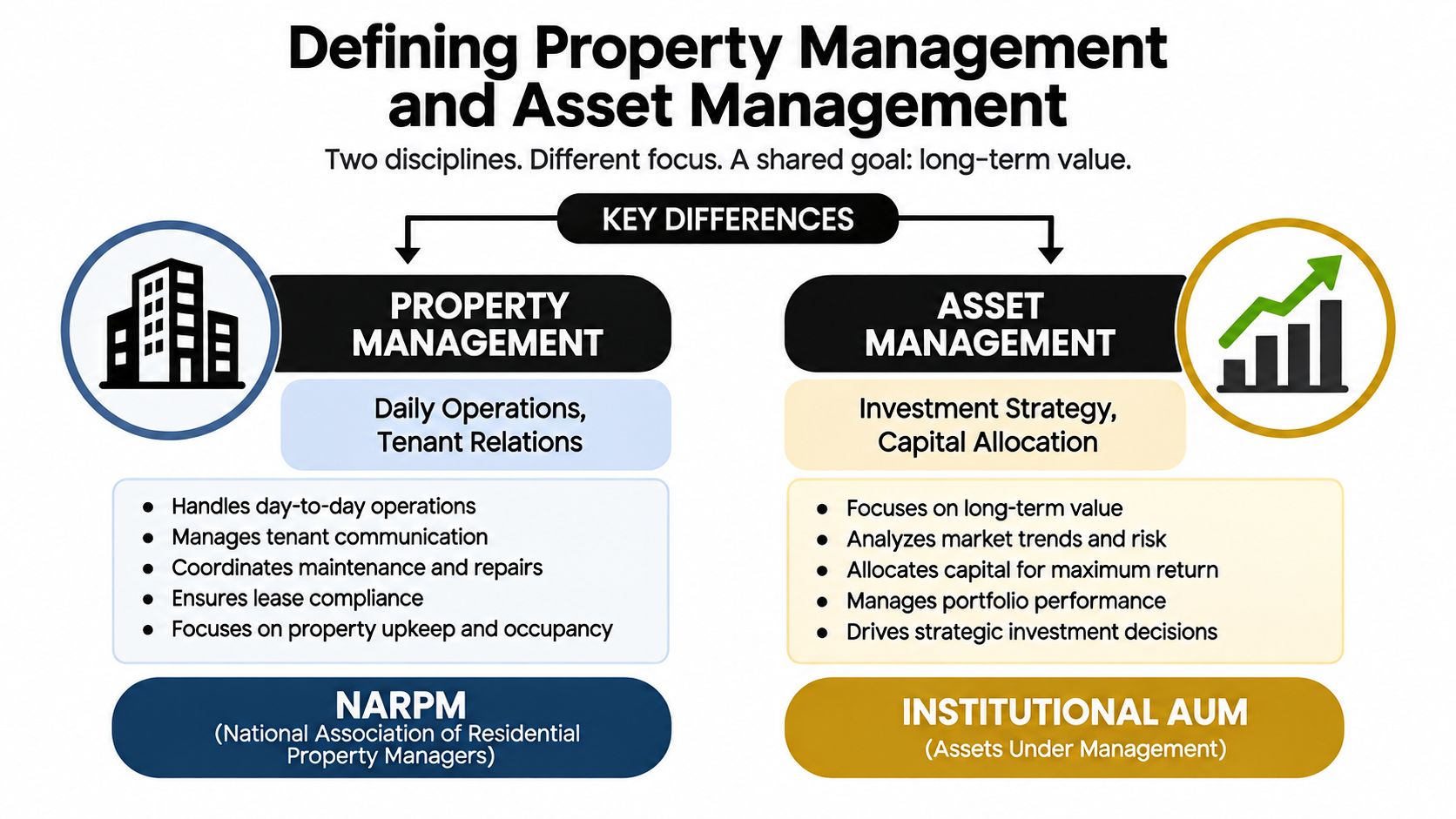
Property management is the operating discipline responsible for the day-to-day performance of occupied or rentable real estate. A property manager markets vacancies, screens applicants, collects rent, coordinates repairs, communicates with tenants, administers leases, and maintains financial records.
The scale of outsourced operations is clear in a National Association of Residential Property Managers survey covering more than 1,700 property managers, 1,100 tenants, and 600 owners or investors across more than 50 cities. The survey found that 86% of surveyed managers handled properties owned by other people, while roughly three out of four handled single-family rentals and two out of three handled multifamily rentals. It also identified a 10% increase in demand for property managers as housing prices, operating costs, and compressed capitalization rates affected the sector. These findings are reported in the NARPM industry survey.
The question each role answers
Property management asks, “Is this property running properly today?” The answer appears in leasing activity, collection records, work orders, inspection notes, tenant communication, and reconciled statements. A strong operator reduces avoidable surprises and gives the owner reliable facts.
Asset management asks, “Is this investment earning what it should over time?” The work includes acquisition and disposition decisions, capital budgeting, financing, refinancing, renovation or repositioning, portfolio diversification, performance benchmarking, and exit planning.
Institutional real estate shows how large that second discipline can become. Institutional Real Estate, Inc.'s 2025 Real Estate Managers Guide reported that listed global real estate investment managers were responsible for more than $5.1 trillion in assets under management. The top 10 managers held nearly $2.2 trillion at the end of 2024, up from $2.0 trillion in the prior survey, while the top 50 held more than $4.4 trillion, up from $4.1 trillion, as described in Institutional Real Estate's global managers report.
A Fresno owner doesn't need an institutional department to apply the distinction. The owner may use Edinhart's property management overview to understand the operating function, then create a smaller asset review around reserves, financing, improvements, and the eventual hold-or-sell decision.
The difference also appears in specialized tasks. For example, pest prevention is an operating responsibility with safety, access, and documentation implications. A resource such as this landlord pest control guide for Miami can help clarify how owners and managers divide that work, even though local California requirements and property conditions must be reviewed separately.
Side by Side Comparison of Core Responsibilities
Owners usually understand the distinction faster when the roles are compared by decisions rather than titles. Property management lives close to the tenant, vendor, lease, and monthly statement. Asset management lives closer to the business plan, financing structure, capital budget, and exit decision.
Property Management vs Asset Management at a Glance
| Criterion | Property Management | Asset Management |
|---|---|---|
| Primary objective | Keep the property leased, maintained, compliant, and financially organized | Improve risk-adjusted returns and long-term value |
| Time horizon | Daily, monthly, and lease-cycle execution | Annual, multi-year, and portfolio planning |
| Daily tasks | Marketing, screening, collections, repairs, tenant communication, inspections, lease administration, accounting | Usually not daily tenant administration. Reviews performance, capital needs, financing, and strategic options |
| Key decisions | Vendor coordination, repair response, leasing workflow, documentation, routine operating approvals | Acquire, refinance, renovate, reposition, hold, sell, or allocate capital elsewhere |
| Typical client | Homeowner, landlord, or investor delegating operations | Owner, investment group, family office, or portfolio sponsor |
| Common compensation model | Management fee tied to rent collected or operating services, plus possible leasing or other charges | Fee tied to assets under management, portfolio oversight, or performance, depending on the arrangement |
| Core evidence of success | Occupancy, collections, completed work, tenant experience, accurate reporting, property-level NOI | Return, risk control, value creation, capital efficiency, and portfolio outcomes |
| Decision rights | Acts within the management agreement and owner-approved limits | Recommends or makes strategic decisions under an investment mandate |
The time horizon is often the cleanest dividing line. A property manager may deliver a monthly statement showing rent, repairs, utilities, and owner distributions. An asset review asks whether the current operating result supports the property's longer-term plan, including reserves, debt, renovation timing, and market position.
Fee structure follows the work. Property management is commonly priced around operating activity and collected rent, while asset management may be tied to assets under management or investment performance. The actual agreement matters more than the label, because firms can bundle services or use different pricing models.
Where decision rights become practical
An owner should put approval limits in writing. Routine repairs, leasing actions, and vendor coordination may sit with the property manager. Large capital projects, refinancing, disposition, and material changes to the business plan should require owner approval or an asset-level review.
A broader UK property management guide provides another useful perspective on how management companies are evaluated and what owners delegate. The legal setting differs from California, but the governance lesson travels well: define the service, authority, reporting, and exclusions before work begins.
KPIs and Cost Structures Owners Actually See
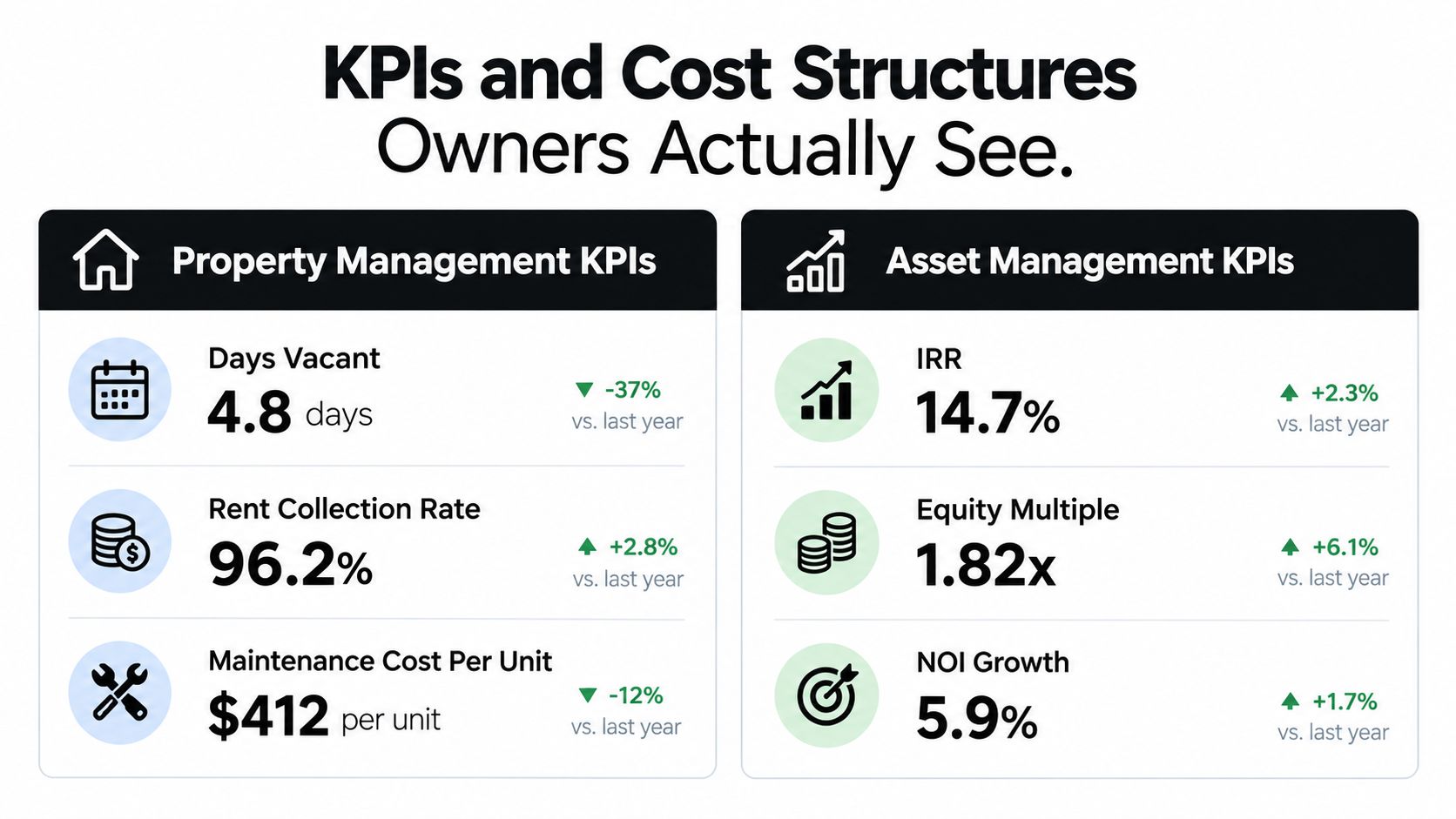
A property manager and an asset manager can both discuss “performance,” but they measure different layers of it. The property manager's dashboard is close to the lease and operating account. The asset manager's review tests whether the property or portfolio is producing an appropriate return for the capital and risk involved.
Operating metrics on the monthly statement
Property-level KPIs include days vacant, on-time rent collection, maintenance cost per door, tenant retention, and net operating income. Each metric needs context. A short vacancy achieved through underpricing may look efficient while weakening income. A low repair total may reflect deferred work rather than good maintenance.
Owners should read the monthly report as an operating diagnosis:
- Vacancy: Review the reason for the gap, the marketing response, showing activity, and the price position.
- Collections: Look for patterns, documented follow-up, and whether lease administration supports consistent enforcement.
- Maintenance: Separate recurring repairs from isolated incidents. Repetition can signal a capital problem.
- Retention: Consider renewal decisions alongside turnover cost, property condition, and tenant communication.
- NOI: Confirm that income and controllable expenses reflect the property's actual operation.
Investment metrics on the annual review
Asset-level and portfolio-level measures include cash-on-cash return, cap rate, internal rate of return, equity multiple, debt service coverage ratio, and portfolio NOI. These measures answer different questions. Cap rate helps compare operating income with value, cash-on-cash return focuses on invested cash, and debt service coverage ratio tests the property's ability to support debt obligations.
The asset manager also evaluates alternatives. Would a renovation improve income enough to justify the capital? Does refinancing reduce risk or merely extend debt exposure? Should the owner keep capital in this property rather than deploy it elsewhere?
The fee conversation should follow those responsibilities. A management agreement may charge a percentage of collected rent, with separate leasing or service charges. An asset-management arrangement may use a percentage of assets under management or a performance-related fee. Owners should compare the total cost with the decisions being delegated, not assume a strategic label justifies a higher charge.
Edinhart's property management KPI guide can help owners build a more disciplined operating review. The central distinction remains simple: property managers protect income by executing well, while asset managers try to improve the investment outcome through capital and portfolio decisions.
How Operating Data Connects to Investment Decisions
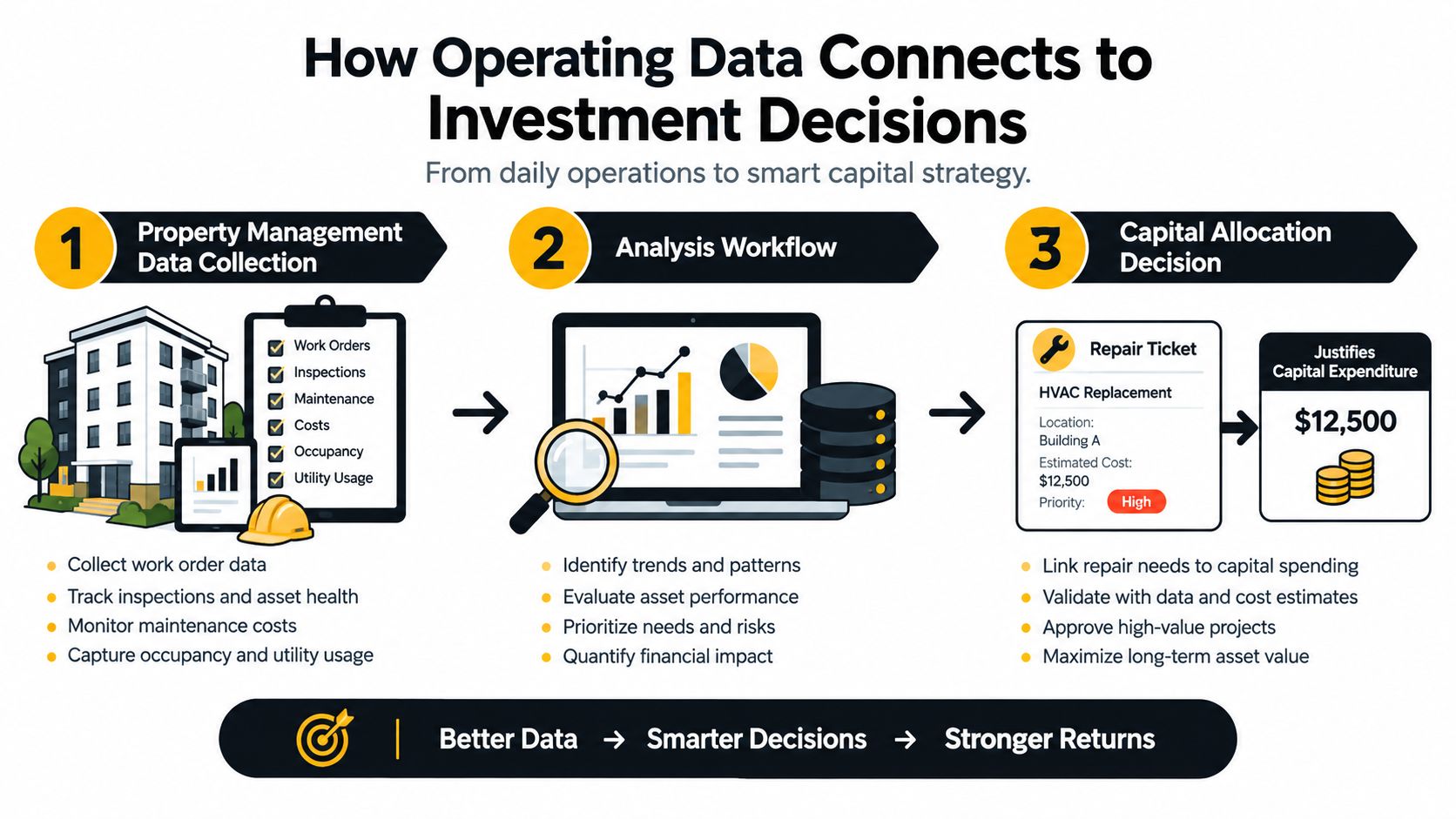
The operating handoff is where many owners lose value. A work order is not merely an expense, and a vacancy is not merely a leasing inconvenience. Each event can contain evidence about the property's condition, pricing, tenant experience, and future capital needs.
Consider recurring repair tickets. If the same plumbing issue returns, repeated service calls may justify replacing a system rather than authorizing another temporary repair. The property manager supplies the history, invoices, response times, and tenant impact. The owner or asset adviser decides whether the replacement fits the reserve plan and expected return.
Energy and utility records can support a retrofit review. Leasing friction can signal that the asking rent, floor plan, finishes, photography, or marketing position needs attention. Renewal patterns can prompt a hold-versus-sale discussion, particularly when the property requires capital that may be better deployed elsewhere.
Build a light asset-management layer
Smaller owners rarely need an institutional committee. They do need a repeatable review that turns operating facts into decisions. A practical annual process can include:
- Business plan review: Confirm the property's target use, expected hold period, debt position, and leasing strategy.
- Reserve planning: Identify near-term systems and establish a reserve target based on condition and ownership goals.
- Renovation analysis: Compare estimated capital cost with realistic effects on rent, vacancy, maintenance, and resale appeal.
- Rent-versus-sale review: Examine current income, likely capital needs, financing, tax considerations, and the owner's alternatives.
- Escalation rules: Define the repair amount, recurring issue, vacancy pattern, or financing event that requires owner approval.
The McKinsey discussion of real estate in its Global Private Markets Report supports the broader principle that operating execution and capital allocation should connect. For a Fresno owner, that connection might be a simple annual meeting supported by a clean ledger, maintenance history, leasing report, market observations, and a written recommendation.
Practical rule: The manager should report the pattern, not just the transaction. The owner should decide whether the pattern changes the investment plan.
This stack avoids two opposite failures. Over-delegation gives an operator authority over capital decisions without a clear mandate. Micromanagement forces the owner into every vendor call while no one evaluates the property's long-term position.
When Automation Helps and When the Firm Has to Step In
Software improves operations when it removes delay and creates a dependable record. Faster work-order routing, consistent applicant workflows, automated rent collection, real-time occupancy information, and organized reporting can help a manager respond with fewer gaps.
Property-technology surveys identify maintenance, tenant issues, vendor management, energy, and reporting as major operator priorities. The same coverage notes that automated rent-pricing systems have faced scrutiny because they may use proprietary and public data in ways that reduce housing accessibility or contribute to displacement, as described in Building Engines' property-management technology report.

Automation needs a decision owner
A pricing recommendation may increase projected income while also increasing turnover, vacancy risk, legal exposure, or resident hardship. That trade-off belongs in governance, not in a software setting that nobody reviews. The property manager can operate the tool and document the outcome, but the owner or asset adviser must establish the acceptable boundaries.
Before assigning a consequential decision to software, ask:
- Pricing oversight: Who reviews rent recommendations, exceptions, and market inputs?
- Screening validation: Are criteria applied consistently, reviewed for legal compliance, and documented?
- Resident outcomes: Does the owner track retention and complaints alongside NOI?
- Human review: Can a qualified person override a recommendation and record why?
- Data discipline: Are inputs current, relevant, and limited to an appropriate business purpose?
Edinhart's overview of automation in property management is a useful starting point for evaluating where software can support execution. It shouldn't replace judgment in decisions that affect housing access, tenant treatment, or the asset's reputation.
Responsible oversight isn't only a compliance burden. It can protect long-term value by preserving trust, reducing avoidable turnover, and giving owners a clearer record of how operating decisions were made.
A Decision Checklist for Homeowners and Small Investors
The right service depends less on the property count than on the owner's operating capacity and decision style. A local owner who enjoys managing vendors has different needs from an investor who lives outside California and wants one accountable point of contact.
Match the service to the owner
The local homeowner with one rental usually needs dependable operations first. Full-service management can cover collections, repairs, tenant communication, move-in and move-out coordination, lease renewals, and accounting. Add an annual review of reserves, rent position, property condition, and likely capital work.
The experienced landlord who wants leasing help may prefer placement-only service. In that model, the provider handles professional marketing, applicant screening, and lease drafting, while the owner retains rent collection, maintenance, tenant communication, renewals, and ongoing compliance responsibilities. The lower delegation comes with a higher need for owner availability.
The out-of-state or multi-property investor needs both layers, even if the provider formally delivers property management. Require clear approval limits, monthly reporting, maintenance history, annual property reviews, and a defined process for financing, renovation, and sale decisions.
Use this checklist before signing:
- Availability: Can you respond promptly to tenant, vendor, and compliance issues?
- Local presence: Who will inspect, coordinate access, and verify completed work in Fresno or nearby markets?
- Authority: Which expenses and lease decisions can the manager approve?
- Reporting: Will statements show income, expenses, work orders, renewals, and owner distributions clearly?
- Strategy: Who reviews reserves, improvements, rent positioning, financing, and disposition?
- California process: Does the provider use current California Association of Realtors forms and maintain ongoing legal updates?
For owners who want both operating options and real estate support, Edinhart Realty and Property Management offers full-service monthly management and placement-only service, along with in-house design, staging, and photography capabilities that can inform renovation, repositioning, rental marketing, or sale decisions. Owners should still confirm the exact agreement, fees, authority limits, and legal responsibilities before delegating work.
California and Fresno Specific Questions Owners Ask
What should a Fresno owner expect to pay for full-service management?
There isn't one universal fee that applies to every Fresno property. Pricing depends on the service scope, rent collection structure, leasing work, inspections, maintenance coordination, renewals, reporting, and any additional charges. Ask for a written schedule that separates recurring management from placement, repair, and other services, then compare it with the time and risk you're retaining.
How does placement-only differ from full-service management?
Placement-only ends after the leasing workflow is completed, typically including marketing, applicant screening, and lease preparation. You remain responsible for collections, maintenance, tenant communication, renewals, inspections, and ongoing legal administration. Choose it when you have the time, local vendor relationships, and systems to run the tenancy after move-in.
Do California rent rules change the property-management versus asset-management split?
They change the decisions and documentation required, but not the basic division of labor. Property management applies current leasing, notice, screening, and administration procedures. Asset management evaluates how regulatory constraints, rent limits, operating costs, taxes, capital needs, and financing affect the property's long-term plan. California owners should obtain current legal and tax advice rather than rely on an old lease or informal rule.
When should an owner move from placement-only to full management?
Escalate when tenant issues begin consuming your workday, maintenance requires repeated local coordination, reporting becomes inconsistent, or distance prevents timely decisions. A growing portfolio also needs standardized approvals and consolidated reporting. Ask the provider to explain exactly what changes operationally, financially, and contractually before switching.
Edinhart Realty and Property Management can help Fresno, Clovis, Friant, and Central California owners separate daily operations from longer-term investment decisions through full-service monthly management or placement-only leasing support. Visit Edinhart Realty and Property Management to discuss your property, decision rights, reporting needs, and the management structure that fits your ownership plan.


