

You're probably not struggling with the big decisions. You're struggling with the pileup.
A tenant emails about a leaking disposal. Another texts about a late fee. A vendor wants approval. A showing needs to be confirmed. A lease renewal is sitting in draft form because you haven't had a clean hour to review it. By the end of the day, nothing catastrophic happened, but you still didn't get to the work that drives portfolio growth.
That's where a property management virtual assistant becomes useful. Not as a gimmick. Not as a replacement for judgment. As an operating layer that takes repetitive, remote-friendly work off your plate so your local team, or you as the owner, can focus on leasing decisions, resident issues, vendors, compliance, and asset performance.
The Modern Solution to Landlord Overload
Most landlords don't break because of one major problem. They get worn down by constant context switching.
You start the morning planning to review owner statements or evaluate rent positioning. Then the day gets hijacked by inbox cleanup, resident follow-ups, contractor scheduling, listing edits, and calendar coordination. If you self-manage, that clutter eats your evenings. If you run a firm, it buries your staff in administrative work.
A property management virtual assistant solves a specific problem. It removes remote, process-driven tasks from the person who should be making higher-value decisions.
That distinction matters. A VA is not your property manager. A VA is not your leasing judgment. A VA is not your compliance officer. A VA is the person who keeps the machine moving.
For many owners, the tipping point comes when they realize they're still acting like a solo landlord after their portfolio has outgrown solo-landlord systems. If you've compared the realities of self-management against professional support, you've already seen where time disappears in the property management vs landlord decision.
The work that feels small is usually the work that creates the most drag.
What overload actually looks like
In practice, overload usually comes from tasks like these:
- Inbox triage: Sorting routine tenant, owner, and vendor messages from the ones that need direct action.
- Maintenance intake: Logging requests, collecting photos, confirming access, and chasing status updates.
- Leasing admin: Scheduling showings, updating listings, sending follow-up messages, and tracking applicant documents.
- Record organization: Filing leases, invoices, inspection notes, and repair logs where they can be found later.
None of that is glamorous. All of it matters.
Why this has become a standard operating move
This isn't niche anymore. One 2026 industry estimate places this real estate VA services market at $1.2 billion in 2024 and projects it to reach $3.5 billion by 2033, with a projected 12.5% CAGR from 2026 to 2033. The same dataset projects that about 75% of real estate businesses will use VAs by the end of 2026, and estimates property management companies use roughly 2–5 VAs per 100 doors under management (real estate VA market projections and usage estimates).
That lines up with what operators see on the ground. Once your processes live inside software instead of scattered texts and spreadsheets, remote support becomes practical fast.
Core Tasks and Workflows for a Property Management VA
Monday at 8:15 a.m., a Fresno owner wants an update on a turnover, two tenants are asking about repair timing, a vendor needs access confirmed, and an application is missing pay stubs. None of those items are hard on their own. Together, they slow the person who should be making decisions.
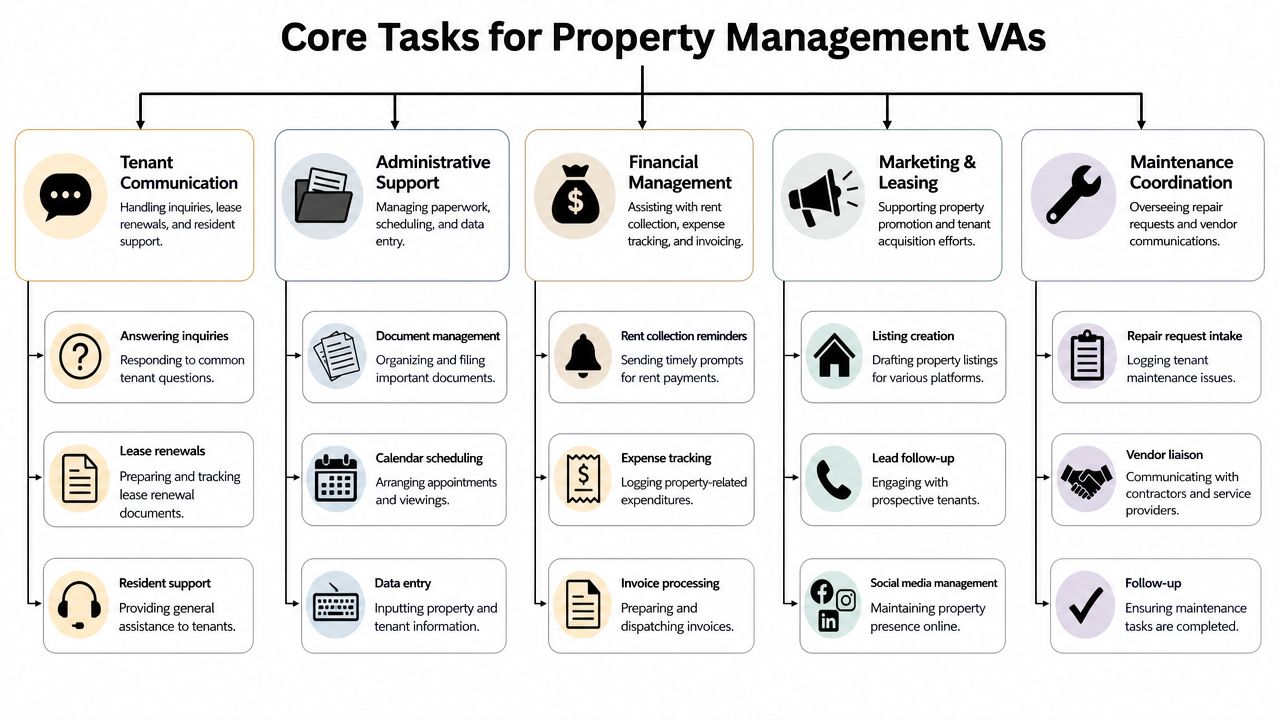
A good property management virtual assistant takes ownership of that flow. The role works best when the VA is assigned a lane with clear triggers, deadlines, and escalation rules.
At Edinhart, that matters because the workflow changes by service model. In a Full-Service plan, a VA can support the daily movement of maintenance, leasing coordination, documentation, and owner communication. In a Placement-Only plan, the same VA is usually focused on listing support, showing coordination, applicant follow-up, file collection, and move-in paperwork. The task list is different because the operating model is different.
Administrative support that keeps records usable
Administrative work is usually the first category to hand off because it follows rules and leaves an audit trail.
That includes:
- Document filing: Uploading leases, notices, invoices, inspection reports, and renewal documents into the right unit or owner file
- Calendar management: Scheduling showings, inspections, owner calls, and vendor appointments
- Data updates: Keeping tenant profiles, vendor records, unit notes, and checklist items current
- Task tracking: Updating boards, statuses, and due dates so managers are not chasing internal answers
This only works if the system is clean. A VA should operate inside one source of truth, not bounce between inboxes, texts, and side spreadsheets. If your process is still fragmented, fix the system before adding headcount. Start with a tighter workflow inside your property maintenance management software.
Communication workflows that are safe to delegate
A VA can handle a meaningful share of communication if the rules are tight.
Good VA-owned communication usually includes:
- Tenant process questions: Portal access, required documents, timing, and next steps
- Renewal follow-up: Reminders, response tracking, and handoff when a decision is needed
- Owner update prep: Pulling status notes, organizing open items, and sending routine follow-ups
- Maintenance intake communication: Confirming receipt, requesting photos, confirming access windows, and sharing status updates
The line is simple. Scripted communication can be delegated. Legal interpretation, rent dispute handling, lease exceptions, fair housing judgment calls, owner conflict, and negotiation should stay with licensed staff or senior in-house operators.
Leasing support that prevents vacancy drift
Vacancies often sit longer because nobody owns the small follow-through steps.
A VA can keep leasing moving by drafting or updating listings, posting to syndication channels, responding to inquiry volume, scheduling showings, collecting missing application items, updating the CRM, and preparing files for review. For out-of-state investors using Edinhart's Placement-Only service, a VA often provides the most significant value. The investor gets a faster, more organized leasing pipeline without paying for a full local admin bench.
The trade-off is judgment. A VA can manage process and speed. Pricing decisions, application approvals, denial language, and local market calls should stay with the property manager.
Maintenance coordination that stays visible
Maintenance is one of the best uses for a VA because much of the work is intake, scheduling, documentation, and follow-up.
A VA can:
- Log requests correctly: Unit, issue type, urgency, photos, access notes, and resident contact details
- Coordinate scheduling: Contact vendors, confirm availability, and lock in appointment windows
- Track progress: Request updates, photos, invoices, and completion notes
- Close documentation: Confirm the resident was updated and store the record where staff can find it later
For Full-Service management, this support keeps Fresno-area operations from getting buried in message traffic. For out-of-area owners, it creates a cleaner record of what happened and when. That record matters when an owner asks why a repair took four days instead of one.
Industry teams that manage distributed support usually formalize this kind of handoff with documented SOPs, role boundaries, and escalation paths. That approach is consistent with Synopsix's contingent workforce strategy, and it matches what works in property management too. A VA should run the process. A manager should own the decision points.
What should never be casually delegated
Some firms make the mistake of handing off anything that feels repetitive. That is where problems start.
Keep these tasks under direct local or senior control:
- Lease interpretation and legal notices
- Fair housing decisions and applicant approvals
- Rent negotiations and exception handling
- Disputes involving habitability, chargebacks, or liability
- Vendor performance issues that require local judgment
- Any task that requires a physical inspection or in-person presence
A property management VA is most useful when the role is narrow enough to be reliable and broad enough to remove real operational drag. Done right, the VA does not replace your property manager. The VA protects your property manager's time for work that actually requires experience.
Virtual Assistant vs In-House Support A Cost and Efficiency Breakdown
The right comparison isn't “Which is better?” It's “Which role belongs where?”
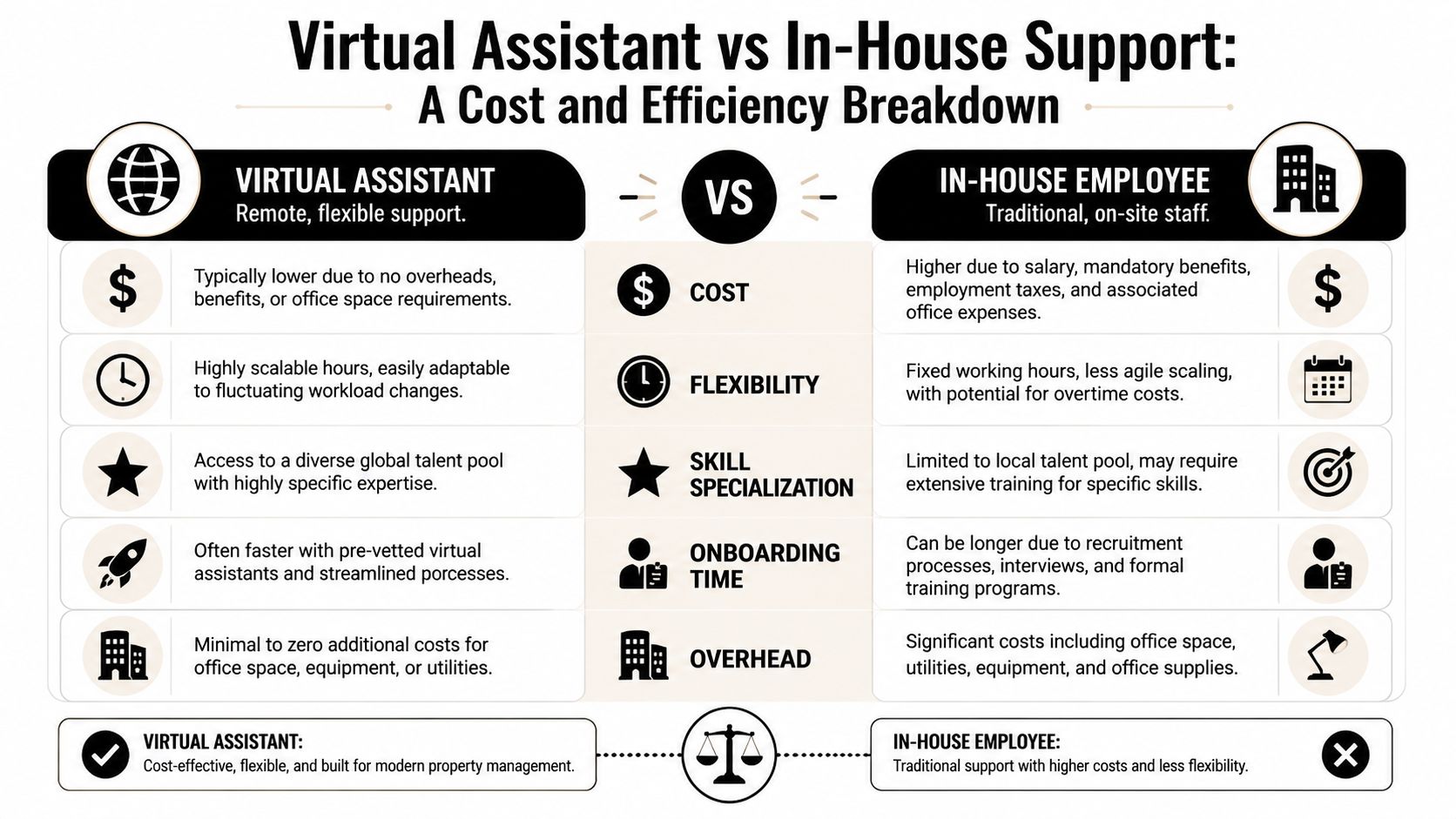
A property management virtual assistant is usually the better fit for remote, repeatable, software-based work. An in-house employee is usually the better fit for tasks that require physical presence, local market judgment, direct supervision, or high-trust handling of sensitive issues.
Where a VA usually wins
A VA tends to outperform when the workload fluctuates and the work can be standardized.
A 2026 industry summary reports that real estate and property management teams spend 30–40% of their time on admin tasks. The same source says VAs can improve lead response times by up to 25% and increase conversion rates by around 20%. It also notes that 59% of businesses using outsourced workers cite cost savings as the main reason, with some firms reporting operating-cost reductions of up to 78% compared with in-house staffing (virtual assistant efficiency and cost data).
That doesn't mean every outsourced setup is automatically efficient. It means the opportunity is real if the task mix is right.
A VA usually makes sense when you need:
- Flexible coverage: More help during leasing season, less during quiet periods.
- Process consistency: Someone to execute the same workflow the same way every time.
- Specialized admin support: CRM upkeep, listing coordination, inbox management, and maintenance tracking.
- Less fixed overhead: No need to build every support role as a traditional in-house seat.
If you manage staffing as a mix of core employees and flexible contributors, the operating principles in Synopsix's contingent workforce strategy are useful. Property management has the same challenge. You need role clarity, access control, performance tracking, and escalation rules.
Where in-house support still wins
Some functions should stay local and internal because the downside of getting them wrong is too high.
In-house support is stronger for physical inspections, high-conflict resident interactions, final leasing judgments, sensitive owner conversations, court-related coordination, and any task that depends on local relationships or immediate on-site action.
A simple comparison helps:
| Role type | Better with a VA | Better in-house |
|---|---|---|
| Inbox triage | Yes | Sometimes |
| Showing scheduling | Yes | Sometimes |
| Maintenance dispatch follow-up | Yes | Sometimes |
| Move-out inspections | No | Yes |
| Final applicant approval | No | Yes |
| Vendor site supervision | No | Yes |
The cost question most owners ask too late
Many owners compare wages and stop there. That's incomplete.
Comparison includes payroll burden, office overhead, recruiting time, software training, supervision load, and how much work the role can absorb without creating bottlenecks. That's why the broader budget discussion around how much property management should cost matters. Labor structure is part of management economics, not a separate issue.
If the role requires local judgment, keep it local. If the role requires disciplined follow-through inside software, a VA often wins.
Your Guide to Hiring an Effective Virtual Assistant
Most hiring mistakes happen before the first interview. Owners post a vague job ad, attract generalists, then wonder why the person can't handle property management workflows.
You need specificity. A property management virtual assistant should be hired against tasks, systems, and decision boundaries, not generic language like “must be organized.”
Start with the job scorecard
Before you look at candidates, write down three things:
- The exact workflows they will own
- The software they must use
- The tasks they are not allowed to handle
That last one matters as much as the first two. If your assistant can touch maintenance coordination but not approve vendor spend, say so. If they can collect application documents but not make screening decisions, say so.
A strong job post usually asks for experience with property management software, communication discipline, documentation habits, and comfort working from SOPs. If your operation touches bookkeeping workflows, it also helps to understand how candidates think about digital process tools. Resources on perfect digital financial tools can help clarify the difference between someone who merely enters data and someone who works cleanly inside finance-related systems.
Sample virtual assistant job description template
| Field | Example Content |
|---|---|
| Job Title | Property Management Virtual Assistant |
| Primary Objective | Support leasing, maintenance coordination, tenant communication, and administrative workflows for a residential rental portfolio |
| Core Responsibilities | Inbox triage, showing coordination, maintenance ticket intake, vendor follow-up, lease renewal tracking, document filing, CRM updates |
| Required Software | Property management platform, shared calendar, cloud storage, communication tools, basic spreadsheet and accounting access as assigned |
| Required Experience | Prior remote support in real estate or property management, strong written communication, comfort following SOPs |
| Not in Scope | Final tenant screening decisions, lease drafting without review, direct handling of trust funds, legal notices without approval |
| Success Metrics | Timely response handling, accurate record updates, complete task documentation, clean handoff of escalations |
| Reporting Line | Property manager, portfolio manager, or owner |
| Work Style | Remote, process-driven, responsive during defined coverage hours |
Interview for judgment, not charm
A polished candidate who hasn't worked inside a real workflow will create more work, not less.
Ask questions like these:
- “Walk me through how you'd handle a maintenance request with incomplete information.”
- “How do you decide when to answer directly and when to escalate?”
- “What property management or CRM systems have you used, and what exactly did you do inside them?”
- “How do you document a conversation so another team member can pick it up without confusion?”
- “Tell me about a process you improved after noticing repeated errors.”
Then give a short skills test. Ask them to draft a tenant follow-up, organize a sample inbox, or convert a messy maintenance email into a clean ticket summary.
Hire the person who writes clearly, follows instructions, and knows when to stop and ask. That person is usually more valuable than the most confident candidate in the interview.
Setting Up Your VA for Success Onboarding and Security
A bad onboarding process can make a good hire look weak.
Most failures don't come from lack of talent. They come from vague instructions, bad system setup, and careless access permissions. If you want a property management virtual assistant to help operations, you need a structured first month.
What the first 30 days should look like
The first phase is observation and repetition.
Week one should focus on systems, naming conventions, templates, escalation paths, and communication rules. Give the VA recorded walkthroughs for your property management platform, shared inbox, maintenance board, and document storage. Show them what “done” looks like.
Weeks two and three should shift into supervised execution. Let them handle low-risk tasks with review. Correct early. Don't save feedback for the end of the week if the mistake is already multiplying across records or messages.
By the end of the first month, the VA should be able to run a defined set of workflows without constant intervention.
A basic onboarding checklist should include:
- Platform access: Only to the tools they need
- Message templates: For tenant, owner, and vendor communication
- Escalation rules: What requires manager approval
- File structure: Where every lease, invoice, photo, and note belongs
- Response standards: Tone, timing, and documentation expectations
Security is not optional
Remote help changes your risk profile. Act like it.
Industry guidance notes that property managers need clear scope definitions, experience requirements, and performance monitoring because tasks with legal or financial implications may be better kept in-house. It specifically raises concern around sensitive areas such as final tenant screening decisions, lease drafting, rent collection, and financial records, where errors can create Fair Housing, privacy, or accounting risk (risk and compliance guidance for property management VAs).
That means you should set hard boundaries.
Keep these functions in-house unless you have a tightly controlled review process:
- Final approval decisions: Applicant acceptance, denial, conditional terms
- Legal drafting: Leases, notices, and compliance-sensitive documents
- Money movement: Direct collection handling, bank access, trust accounting actions
- Exception management: Situations involving disputes, accommodations, or legal threats
Access should follow role, not convenience
Don't hand over master logins. Use role-based permissions, separate accounts, shared password tools, and audit trails wherever possible.
If a VA only needs to log tickets and send updates, they don't need financial visibility. If they prepare files for manager review, they don't need signing authority. Good access design protects the company and makes performance easier to evaluate because you can see exactly who did what.
Understanding the True Cost and Return on Investment
A property management virtual assistant is cheap only on paper if you ignore setup costs and management time.
The financial question is narrower. Does this role remove enough low-value work from higher-value people to create a measurable gain?
Count the full cost, not just the hourly rate
Your actual cost includes onboarding time, SOP creation, software seats, communication tools, quality control, and the manager time required for review. If your process is sloppy, the hidden cost rises fast because the VA spends time asking preventable questions and your team spends time fixing preventable errors.
That's why the economics depend on work design. Recent industry guidance frames the decision correctly. The issue isn't just whether a VA is cheaper. It's whether the delegated work creates an efficiency gain that outweighs the supervision and training overhead (economics of VA ROI in property management).
Where the return usually shows up
The return usually appears in operational pressure points such as:
- Faster follow-up: Leads, tenants, vendors, and owners don't sit waiting in the queue.
- Cleaner records: Fewer missing files, less duplicated work, better auditability.
- Less interruption: Managers spend more time on approvals and exceptions, less on intake and chasing.
- Better throughput: Vacancies, renewals, and maintenance workflows keep moving.
How to evaluate whether it's working
Don't rely on a feeling. Review the role by workflow.
Track whether the VA is reducing backlog, shortening response lag, improving record completeness, and lowering the amount of owner or manager time spent on repeatable admin. Also look at what it's costing your senior team to supervise the role. If that oversight burden stays high after onboarding, the problem is usually one of scope, training, or process design.
A VA is a strong investment when it removes friction from work that already has clear rules. It becomes a weak investment when you use it to patch a broken operation.
How a VA Complements Edinhart's Management Models
A Fresno owner gets the leasing report, three maintenance updates, and a month-end statement in the same afternoon. An out-of-state investor gets the same information, but without a local team or an internal process, it often sits in email until a decision is overdue. The right VA setup fixes that gap, but the role looks different depending on whether the property is under full-service management or a placement-only plan.
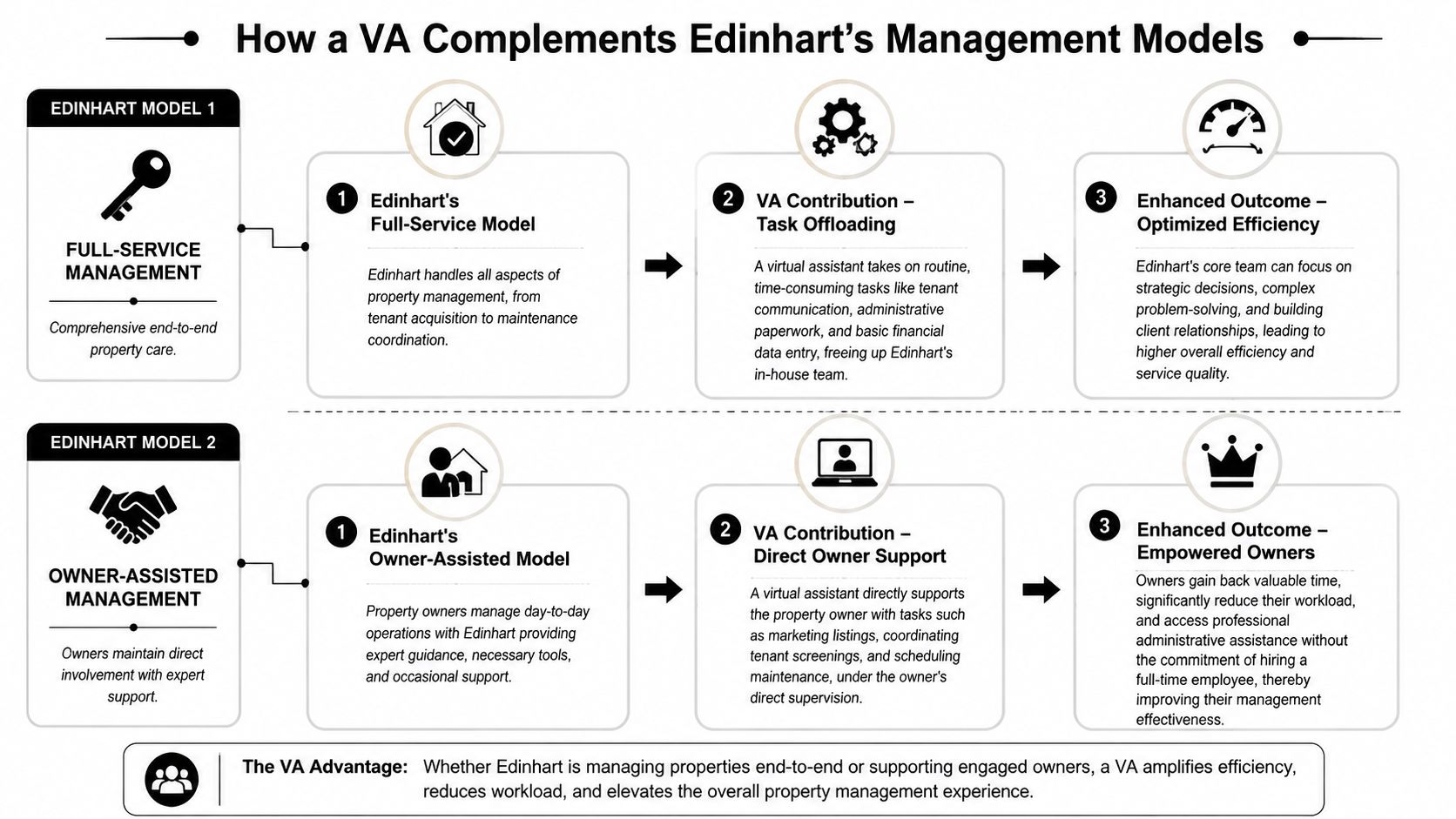
Edinhart's two service models create two different lanes for a VA. Owners get the best result when they match the VA to the service structure already in place, instead of asking one remote hire to cover local execution, judgment calls, and admin all at once.
In a full-service setup
Under full-service management, Edinhart handles the local operating work. That usually means resident communication, rent collection, repair coordination, inspections, renewals, and accounting delivery. In that model, a VA works best on the ownership side, not as a substitute for the manager.
That owner-side VA can organize statements by property or entity, maintain insurance and tax files, prep questions before owner calls, reconcile documents across multiple assets, and keep decision-makers updated without pulling the management team into every minor request. For investors with several properties, that layer matters. It keeps the owner informed without creating extra noise for the people handling field operations.
The trade-off is straightforward. A VA should have visibility into reports, communications, and document storage, but not authority to direct vendors, approve repairs outside preset limits, or make leasing decisions that belong with the manager and owner. Good role design protects speed and accountability at the same time.
In a placement-only setup
Placement-only shifts more daily responsibility back to the owner after the tenant is placed and the lease is signed. That changes the value of a VA completely.
Here, the VA often becomes the owner's back-office coordinator. The owner still makes the calls and stays responsible for compliance, vendor approvals, disputes, and any issue that requires local judgment. The VA keeps the workflow moving between those decisions.
Typical placement-only VA work includes:
- Tenant message triage: sorting routine questions, scheduling callbacks, and keeping written records clean
- Maintenance intake: collecting details, requesting photos, opening vendor requests, and tracking status for owner review
- Lease and file administration: storing signed leases, invoices, inspection photos, and notice history in one system
- Renewal support: preparing drafts, reminders, and document packets before the owner approves next steps
For Fresno-area landlords who want to keep control, this setup can reduce the admin drag without handing off the parts of management that carry legal or financial risk. For out-of-state owners, it can create a workable middle ground between self-management and full-service oversight.
Where the fit is strongest
The strongest fit usually comes from two owner profiles.
The first is the local landlord using Edinhart for tenant placement but not monthly management. That owner still needs someone to keep communication organized, log maintenance issues, and keep records in order after move-in. A VA can cover that desk function while the owner retains approval authority.
The second is the out-of-state investor under full-service management. In that case, the VA supports reporting, document control, and owner-side coordination across properties or LLCs. The local management company handles the work on the ground. The VA keeps the ownership side disciplined and responsive.
That distinction matters. Full-service owners use a VA to process information better. Placement-only owners use a VA to keep day-to-day administration from taking over the week.
Edinhart Realty and Property Management fits into that structure as the local operator for leasing and management in the Fresno area. The VA fits around that relationship, either as an owner-side admin partner in a full-service plan or as a remote operations assistant in a placement-only plan. Used that way, the VA supports the model you chose instead of creating confusion about who owns which task.
If you're deciding whether a property management virtual assistant fits your rental operation, the right next step is to match the role to your management model, not force it into the wrong one. Edinhart Realty and Property Management works with Central California owners through both full-service and placement-only structures, which makes it easier to build a support system that fits how involved you want to be.


