

A lot of owners start thinking about a property management vendor application after something has already gone wrong. A ceiling leak turns into drywall damage. A tenant calls twice because the first repair didn't hold. An invoice arrives with vague labor charges and no clear paper trail. At that point, the deeper problem usually isn't the single repair. It's that there was no system behind the call.
That's fixable.
A professional vendor program gives you a repeatable way to decide who can work on your property, under what terms, with what insurance, and with what ongoing oversight. In California, that matters even more because maintenance decisions can quickly turn into liability issues, habitability issues, and tenant-retention issues if the wrong contractor shows up.
Beyond the Emergency Call The Need for a Vendor System
When an owner calls after a late-night plumbing emergency, the same pattern shows up again and again. They found someone fast, not someone vetted. The person answered the phone, promised an immediate response, and either overcharged, underperformed, or created a second problem that had to be fixed later.
That's where a property management vendor application stops being “just a form.” It becomes the entry point into a controlled vendor relationship.
What the application actually does
A strong vendor application should do three things at once:
- Screen for capability: You need to know what trades the vendor performs, where they work, and whether they can handle occupied residential properties.
- Screen for risk: You need insurance information, licensing details where required, tax documents, and agreement to your operating standards.
- Create a file you can manage later: The initial packet should make future renewals, insurance tracking, and performance review much easier.
Owners sometimes think this level of structure is only for large apartment portfolios. It isn't. Even a small portfolio needs a stable list of approved plumbers, electricians, HVAC vendors, general handymen, cleaners, and emergency responders.
A random contractor list is not a vendor system. A vendor system has standards, records, and enforcement.
Why this has become standard practice
The industry is already moving toward centralized digital vendor management. The property management software market was estimated at $3.61 billion in 2025 and is projected to reach $5.89 billion by 2033, with North America accounting for 39.4% of revenue in 2025 and cloud-based systems representing 61.4% of deployments according to Grand View Research's property management software market analysis. That matters because vendor applications don't live in a filing cabinet anymore. They live inside operating systems that connect maintenance, compliance, dispatch, and accounting.
The practical takeaway is simple. Professional property management now treats vendor controls the same way it treats tenant screening. You don't skip screening because the applicant sounds nice on the phone. You don't skip vendor review because a contractor says he can come out tonight.
What works in real operations
The owners who avoid repeat maintenance chaos usually do a few basic things well:
- They approve vendors before the emergency. Waiting until a pipe bursts is too late.
- They separate urgent dispatch from open-ended authority. A vendor can be cleared for emergency stabilization without getting automatic approval for every future project.
- They treat residential work as resident-facing service. The vendor isn't just fixing an asset. The vendor is entering someone's home.
That last point gets overlooked. Residential portfolios generate steady repair, inspection, and turnover work. If your vendor system is weak, your tenants feel it first.
Why a Formal Vendor Application is Non-Negotiable
Informal vendor hiring usually sounds efficient. A tenant reports a problem, the owner texts a contractor, the work gets done, and everyone moves on. But that only works when nothing goes wrong. Property management has to be built for the situations where something does go wrong.
The risks owners usually underestimate
A formal application process creates friction up front. That's a good thing. It forces the hard questions before a vendor enters an occupied property.
Risk to remember: If an unvetted contractor causes injury, property damage, unsafe work, or a tenant complaint trail, the savings from “moving fast” disappear quickly.
The biggest exposure points are usually these:
- Insurance gaps: If a vendor's coverage is missing, expired, or too narrow, the owner can get pulled into the mess.
- Licensing problems: Work performed without required licensing creates serious downstream headaches.
- Poor workmanship: Cheap repair calls often become expensive correction projects.
- Inconsistent tenant experience: Residents rarely distinguish between the contractor and management. They blame the property.
- Invoice disputes: Without written expectations, labor scope and billing can become subjective.
A good approved-vendor program prevents a lot of this before the first work order is sent.
It's also an operating efficiency issue
This isn't only about protection. It's also about labor. Vendor coordination takes a surprising amount of staff time when there's no structured system behind it.
Industry benchmarks cited in USTech Automations' ROI analysis of vendor coordination automation show that vendor coordination can consume 23% of staff hours. Firms using automated vendor systems reported a 60% reduction in that time, average annual savings of $18,400 per 500 units managed, and 28% improvement in work order completion rates.
That data lines up with what many operators see in practice. When your team isn't chasing insurance certificates, calling three vendors for status updates, and manually sorting who covers which territory, response times tighten up.
A quick visual helps frame the issue:
What a formal program gives you
A real vendor application process supports day-to-day management in ways owners feel immediately:
- Faster dispatching: You already know who handles the trade, service area, and urgency level.
- Cleaner documentation: W-9s, insurance records, and service agreements are already in file.
- More consistent pricing conversations: Even when rates vary by scope, expectations are clearer.
- Better tenant communication: Your team can give residents a realistic update because the vendor relationship is already active.
Owners often ask whether this is too much structure for a modest portfolio. It usually isn't. The smaller the team, the more each bad vendor decision hurts.
California Vendor Compliance Essentials
California owners need a tighter vendor file than owners in many other states. The combination of licensing rules, insurance expectations, and resident protection issues means “good enough” paperwork is not enough.
The first standard is simple. Don't approve a vendor based on a business card, a verbal referral, or a certificate that nobody has read carefully.
Insurance and licensing basics
For most portfolios, the vendor packet should confirm insurance, business identity, tax documentation, and licensing status where required. California also raises practical questions around work thresholds, trade classifications, and who is covered under the policy.
Here is a working checklist owners can use:
| Requirement | Details & Minimums | Verification Method |
|---|---|---|
| General Liability Insurance | Confirm active coverage and review whether the limits fit the property and work type. Some property managers require higher minimums before considering a vendor. | Request a current Certificate of Insurance and review the named insured, effective dates, and carrier information. |
| Workers' Compensation | Confirm active workers' compensation coverage, or written exemption documentation where legally applicable. Don't rely on assumptions about sole proprietors. | Request policy proof or exemption documentation in writing and keep it in the vendor file. |
| Auto Liability | If the vendor drives to properties as part of the work, verify commercial auto coverage where appropriate. | Request proof of coverage and confirm it matches the operating entity. |
| Additional Insured Status | Require the owner and/or management company to be added where appropriate for the work being performed. | Review the COI and any endorsement language, not just the face certificate. |
| Contractor License | Check whether the vendor's scope of work requires a California contractor license. California licensing rules are a major screening item for repair and project work. | Verify status directly through the California Contractors State License Board. |
| W-9 and Legal Business Information | Collect taxpayer information and confirm the entity name used for invoicing and payment. | Match the W-9 to invoices, insurance, and agreement records. |
| Service Agreement | Set written expectations for scope approval, emergency procedures, invoicing, indemnity terms, and conduct on occupied properties. | Use a signed agreement and store it with the vendor file. |
The California points owners can't gloss over
California owners should pay close attention to these issues:
- License threshold: Contractors generally need a CSLB license for projects over $500, including labor and materials combined. That's a bright-line screening issue for many repair and renovation jobs.
- Additional insured language: A certificate alone doesn't always tell the whole story. You want confirmation that the owner or management company is added properly when your agreement requires it.
- Workers' comp assumptions: Owners get into trouble when they accept “I'm a solo operator” as a substitute for documentation.
- Trade-specific fit: A handyman may be fine for minor tasks but not for higher-risk or regulated work.
For broader California landlord-tenant law guidance, it helps to understand how maintenance, habitability, and documentation fit together. Vendor compliance isn't separate from landlord obligations. It supports them.
A practical review standard
I prefer a file that answers three questions immediately: Is this vendor legally eligible, properly insured, and operationally usable? If one answer is unclear, the vendor stays pending.
For owners who want a plain-language legal overview of how organizations can structure compliance systems, this expert compliance advice for businesses is a useful companion read. The legal framing is broader than property management, but the discipline applies directly to vendor controls.
If your team has to “figure out later” whether the vendor was properly documented, the approval happened too early.
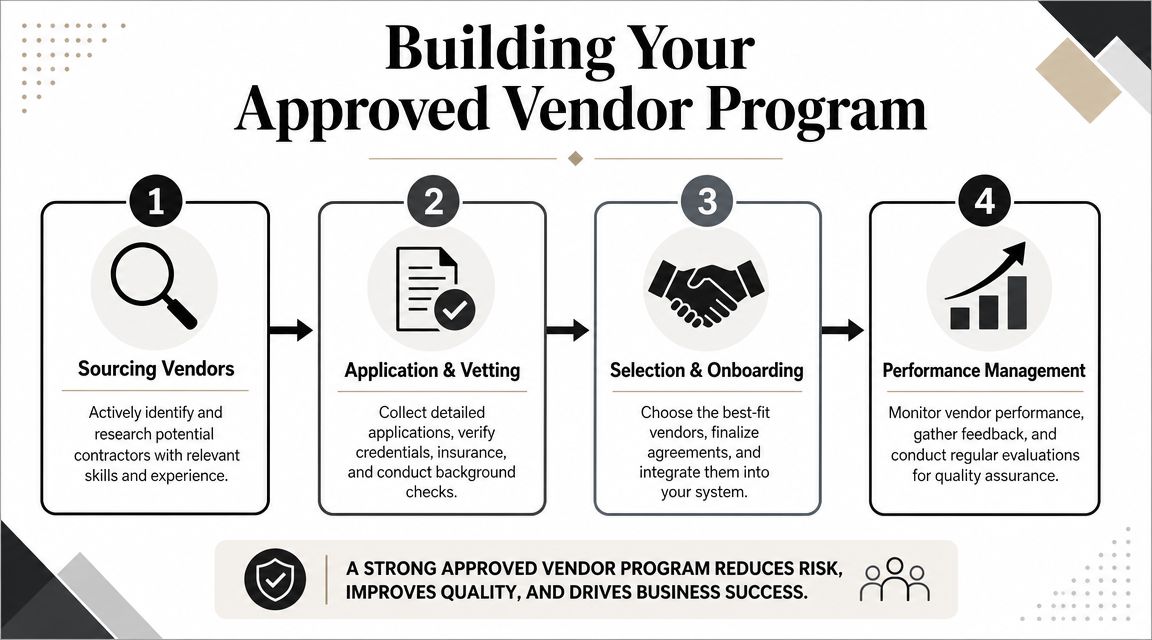
Building Your Approved Vendor Program Step by Step
A vendor program should start narrow and get sharper over time. Don't try to create a giant network on day one. Build a controlled bench by trade, territory, and urgency level, then improve it through actual field performance.
Start with sourcing that reflects your portfolio
The best vendor list for a Fresno single-family portfolio won't look exactly like the best vendor list for a larger multifamily operation. Start with the trades you use repeatedly. Plumbing, electrical, HVAC, appliance repair, cleaning, lock services, landscaping, turnover work, and general maintenance are usually the core.
Useful sourcing channels include:
- Referrals from trusted operators: Ask other managers which vendors communicate well, not just which ones are cheap.
- Trade-specific local searches: Look for vendors who already work in occupied residential settings.
- Existing maintenance history: Review who has already done acceptable work on your properties.
- Seasonal gaps: Build bench strength before peak HVAC or turnover periods.
If you already use maintenance planning tools, a resource like this rental property maintenance checklist can help identify which trades you need on standby instead of sourcing reactively.
Build the packet, not just the form
A weak property management vendor application asks for name, phone number, and trade. A strong packet creates operating rules.
The packet should usually include:
- Vendor application form: Legal business name, DBA if any, contact structure, service categories, service area, emergency availability, and billing details.
- Insurance requirements sheet: Spell out what policies and endorsements you require before approval.
- W-9 request: Match tax identity to payment records from the start.
- Service agreement: Define approval authority, invoice timing, change-order procedure, and conduct standards.
- Performance expectations: State response windows, update requirements, photo documentation standards, and close-out expectations.
Many owners under-document. They gather credentials but fail to define behavior.
Review vendors in the right order
A lot of dispatch errors come from evaluating vendors backwards. Owners often compare price first, then discover the contractor doesn't cover the area, can't respond quickly, or isn't the right trade.
The better sequence is already established in field guidance. USTech Automations' implementation guide for vendor automation recommends filtering by trade specialty and service area first, then checking availability, urgency-based response time, performance rating, and only then cost. That structured sequence was reported to reduce coordination time by 60%.
That order matters because it mirrors real operations:
- Can this vendor do this type of work?
- Will they go to this property?
- Can they respond in the required window?
- Have they performed reliably before?
- Does the price fit the job and market?
Cost belongs at the end of the filter, not the beginning. The cheapest vendor who can't execute is the most expensive option.
Onboarding should remove ambiguity
Once approved, vendors need a clean onboarding conversation. Don't assume they understand your process just because they've worked with property managers before.
Cover the points that create friction later:
- Work authorization rules: What can they do without additional approval, and what requires a revised estimate?
- Resident communication standards: Who contacts the resident, and what tone is expected inside occupied homes?
- Photo and invoice requirements: What documentation must be attached before payment review?
- Emergency escalation: If a resident is unreachable or the scope changes on site, who gets called first?
This is also the stage where tools matter. Some firms manage the workflow in a property management platform, some use a shared document system and dispatch board, and some use hybrid setups. Edinhart Realty and Property Management, for example, operates with structured management processes that include repair coordination and detailed accounting, which is the kind of integrated workflow owners should look for when evaluating how vendor records connect to actual operations.
Keep the bench active
An approved list that never gets reviewed goes stale fast. Keep backup vendors in each major trade. Rotate non-emergency work occasionally so your secondary vendors stay familiar with your standards. A bench only helps if it's current.
The Vendor Application Template and Screening Best Practices
The application itself should be detailed enough to support approval, dispatch, payment, and re-verification. If the form only captures contact information, your team will spend the rest of the year chasing missing documents.
What to include in the template
A practical property management vendor application should ask for the following:
Business identity
- Legal entity name
- DBA name if used
- Business address
- Primary contacts for scheduling, billing, and emergencies
Service profile
- Trades performed
- Service areas
- Normal business hours
- Emergency availability
- Whether work is performed by employees, subcontractors, or both
Compliance documents
- W-9
- Business license if applicable
- Contractor license information where applicable
- Certificate of Insurance
- Workers' compensation proof or exemption documentation where applicable
- Auto coverage information if vehicles are part of field operations
Commercial terms
- Rate sheet or billing method
- Trip charge policy if any
- Estimate approval process
- Invoice submission contact and requirements
Experience and references
- Prior property management clients
- Residential versus commercial work mix
- References who can speak to reliability, communication, and closeout quality
Screening starts after the form is submitted
A completed form is not approval. It's the start of verification.
Good screening usually includes:
- Reference checks: Ask whether the vendor communicates clearly, honors approval limits, and closes punch-list items without drama.
- License verification: Confirm status directly through California's licensing system where licensing applies.
- Insurance review: Match the named insured on the certificate to the entity on the W-9 and agreement.
- Document consistency: If the invoice name, insurance name, and tax name don't match, stop and clarify it.
Many small portfolios cut corners by accepting documents but not reconciling them.
Approval should be evidence-based. If the file contains contradictions, the answer is pending, not approved.
The part most owners miss
Ongoing compliance matters more than first approval. NetVendor's discussion of vendor selection in property management makes the point clearly: vendor management is a matter of continuous risk control, with ongoing screening, insurance tracking, and license verification because many vendor failures happen after initial approval through lapsed compliance.
That's exactly right in practice. The vendor who looked fine last spring may have an expired policy, changed entity structure, or dropped a required endorsement by the time the next emergency call comes in.
A workable re-check process often includes:
- Insurance renewal tracking: Don't wait for a claim to discover the policy expired.
- License status review: Reconfirm before larger projects or periodically across the vendor list.
- Performance review notes: Track missed appointments, repeat repairs, and invoice disputes.
- Agreement refresh: Update terms when your scope approval rules or compliance standards change.
Be strict, but stay realistic
There's a real trade-off here. Credentialing requirements are getting heavier. Annual compliance requests, W-9s, signed agreements, background checks, insurance endorsements, and license documentation can discourage smaller local vendors, especially specialty trades.
That doesn't mean you should lower standards carelessly. It means you should write standards that fit the actual risk of the work and explain them clearly. Owners who create confusing or excessive onboarding requirements sometimes shrink their vendor pool unnecessarily and then wonder why lead times get worse.
For a broader operational perspective, this guide for facility managers on contractor risk is useful because it frames contractor oversight as an active management responsibility, not a paperwork exercise. That mindset translates well to residential property work.
Integrating Vendors into Your Property Management Workflow
A vendor program only works if your staff can use it quickly on a normal Tuesday. The approved file should feed dispatch, work-order follow-up, invoice review, and owner reporting.
Turn records into a working system
Store each vendor's application, insurance, W-9, agreement, and renewal dates in one consistent place. If your team has to search email threads for the latest COI, the system isn't working.
For day-to-day operations, keep these habits:
- Dispatch from the approved list only: Don't bypass the system because one person answers the phone faster.
- Track work from assignment to completion: Every job should show who was assigned, when they accepted, what they reported, and when the work closed.
- Tie billing to documentation: Match invoices to the approved estimate, photos, and work-order notes before payment.
- Review exceptions: Emergency jobs, after-hours authorizations, and scope overruns should be visible to management.
Many owners benefit from using property maintenance management software to connect vendor records with maintenance requests and accounting workflows. The main advantage isn't just convenience. It's consistency.
Keep owners and residents out of the gray area
The cleaner the workflow, the fewer disputes you'll have. Residents get clearer scheduling. Owners get cleaner records. Vendors know how to get paid. Management can spot recurring problems before they become expensive patterns.
A good property management vendor application isn't just an intake document. It's the front door to a controlled maintenance operation.
If you want help building a vendor management process that fits California properties, Edinhart Realty and Property Management works with owners across Fresno, Clovis, Friant, and the surrounding Central California region on structured maintenance coordination, documentation, and day-to-day property operations.


