

The most popular advice for tired landlords is simple. Hire a manager and hand over the headaches. That advice is incomplete, and in California it can mislead you.
A manager can collect rent, call vendors, and send notices for you. The manager can't take ownership of your legal exposure. If a deposit is mishandled, a unit isn't habitable, or a notice is defective, you're still the owner in the dispute.
Think of property management requirements as a system built around your specific property. Your job is to make sure that system exists and leaves evidence. That's true whether you own one house in Fresno or several rentals across the Central Valley.
Why Property Management Requirements Are Not a Static Checklist
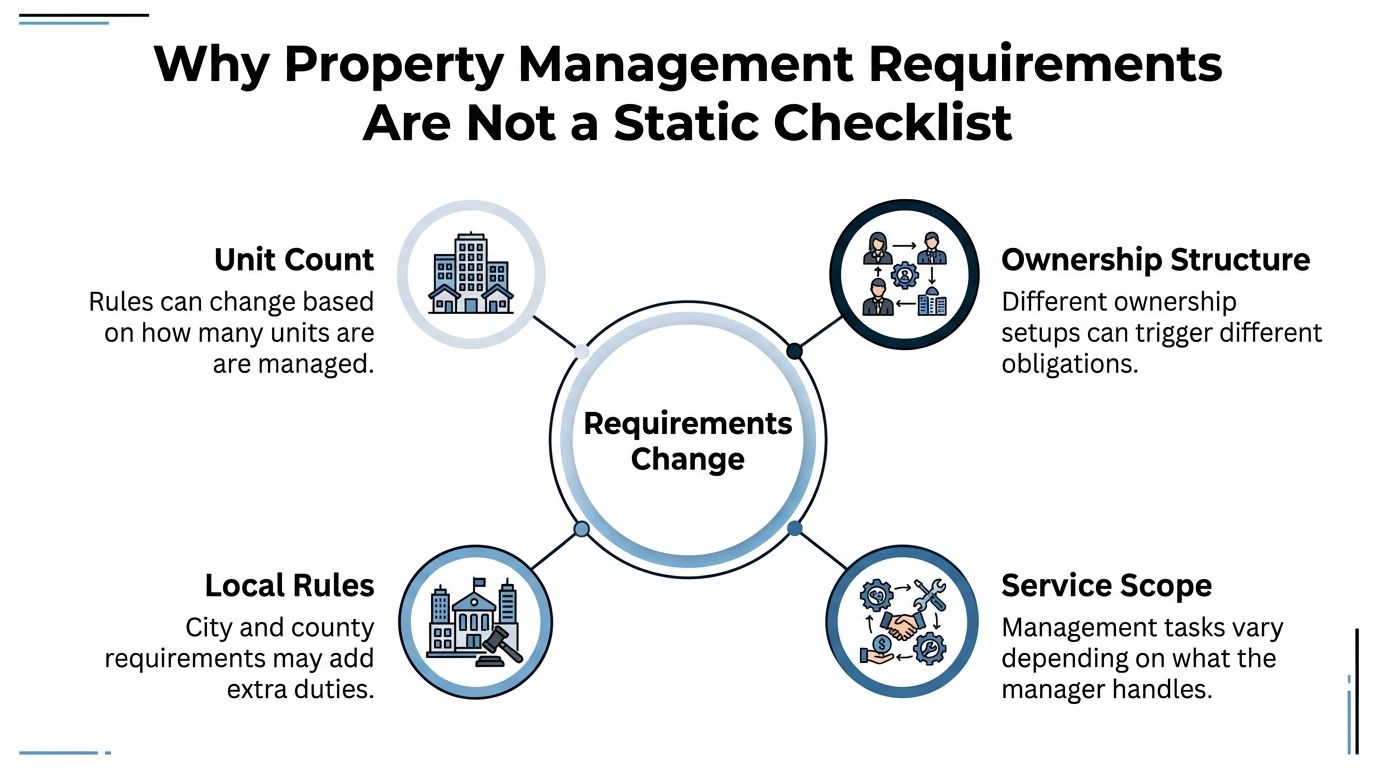
Owners often ask for one list that covers every rental. No honest list can do that. A newer single-family home in Clovis, an older duplex near downtown Fresno, and a small multi-unit property don't trigger identical duties.
Requirements shift with unit count, property type, build year, local ordinance, tenancy duration, and owner profile. They also shift with your service model. A manager who only places a tenant doesn't handle the same day-to-day records as a manager who holds rent and deposits every month.
What Changes From Property to Property
Start with four questions before you look at any checklist.
- How many units and what type: Unit count and property type can affect which statewide and local rules apply to a tenancy.
- When was it built: Build year drives disclosure duties, especially for older housing stock common in established Fresno neighborhoods.
- Who owns it and how: Owner profile can change deposit limits and exemptions, so you can't copy another landlord's practice.
- Who does the work: Full-service and placement-only arrangements split screening, accounting, repairs, and notices differently.
California adds another layer. Statewide rent-cap and just-cause rules shape increases and terminations for many rentals, and local rules can add duties on top of state law. A rule that fits your neighbor's property may not fit yours.
Hiring a manager delegates tasks. It doesn't delegate your status as the owner responsible for a habitable home, lawful notices, and deposit accounting.
That distinction confuses many first-time clients. Your manager acts as your agent, so the paperwork should show who approved what, who sent each notice, and where the money went. If records are thin, good intentions won't reconstruct a decision months later.
This is why experienced Fresno brokers build a property-specific compliance file at onboarding. The file is organized by address and tenancy, not by a generic binder of forms. Every later section in this guide adds one part of that file, from trust accounting to screening records.
You're not collecting rules for their own sake. You're creating an operating standard you can audit. When a tenant disputes a deduction or a regulator asks for records, you want dates, documents, and balances that line up.
Licensing, Business, and Trust-Fund Requirements for California Managers
A manager's license does not tell you how carefully the business handles your rent. In California, rents, security deposits, and other money held for an owner are generally trust funds. They belong to the owner or tenant, not the manager's operating business.
California Department of Real Estate guidance connects the handling of trust funds to Business and Professions Code §10145 and Regulation 2832. Funds must go into properly designated trust accounts, rather than a general business account. For an owner, that distinction is practical: the account should make clear whose money is being held and where it goes.
The Records Behind the Bank Account
A separate bank account is only the starting point. Regulations 2831 and 2831.1 require records of money received and disbursed, along with separate accounting for each beneficiary. Regulation 2831.2 requires monthly trust-account reconciliation. California law also bars brokers from mixing their own funds with trust funds.
Consider two Fresno owners whose homes rent in the same month. A repair at one address should not appear as a charge against the other owner's funds. Separate beneficiary ledgers let the manager trace each transaction to the correct owner, tenant, and property.
California DRE 2024 Audit Findings
| Audit Metric | Result |
|---|---|
| Audits completed | 361 audits were completed, according to the California DRE 2024 audit reporting |
| Recordkeeping violations | Approximately 57% identified recordkeeping violations |
| Trust-account shortages | Approximately 32% found shortages totaling about $3.5 million |
The audit results point to everyday risks: missed reconciliations, unclear ledgers, and deposits that do not match bank activity. A small bookkeeping error can become a shortage when nobody checks the balances each month. A manager's process should make those checks routine and leave a record of them.
What to Ask Before You Sign
Ask a prospective manager to walk you through a sample month. Find out how rent is collected and deposited, when owner statements are prepared, and who reconciles the trust account. If your property has a different service arrangement, clarify which steps the manager handles and which remain with you.
- Account separation: Confirm that owner and tenant funds stay apart from operating money.
- Beneficiary ledgers: Ask how the manager tracks each owner's balance within the trust account.
- Monthly reconciliation: Find out who completes it and how a mismatch is investigated and recorded.
- Owner reporting: Review a sample statement before signing, and check that transactions can be traced to your property.
Automated rent collection can simplify payments, but automation alone does not establish compliance. Look for transaction records, reconciled statements, and accounting that identifies the funds held for each owner. Hiring a manager can delegate daily work; it does not transfer the owner's regulatory exposure.
Habitability, Repairs, Disclosures, and Security Deposit Rules
A manager can coordinate repairs, but the owner remains responsible for the property's legal condition. Habitability is an ongoing obligation, not a box checked at move-in. A unit that passes an inspection can still develop a plumbing leak, lose heat, or have another failure that needs prompt attention.
California's habitability standards cover basics such as working plumbing, heating, and weather protection. Appliance duties depend on the property and the rental agreement, so don't assume that every unit has the same stove or refrigerator requirement. Put appliance responsibilities in writing and confirm that the agreement matches the unit's condition. The California DRE 2026 landlord and tenant guide provides state guidance on landlord and tenant responsibilities.
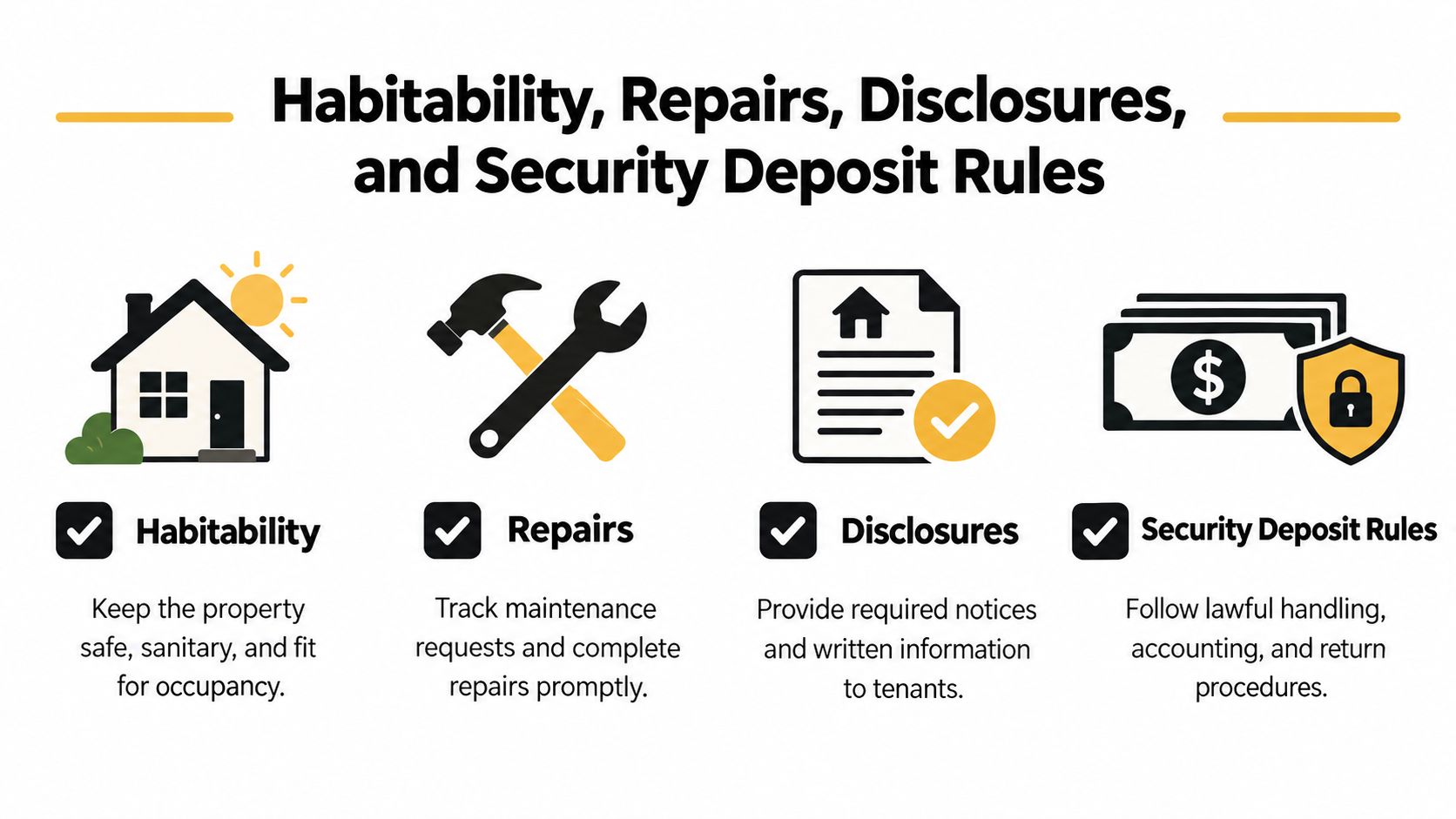
Security deposits need the same property-level attention. The guide describes a statewide ceiling of one month's rent for most furnished and unfurnished residences, effective July 1, 2024. Record the amount collected, where it is held, and any deductions in the unit's file. Those records help show how the deposit was handled from move-in through move-out.
Before assigning repairs to a manager, clarify which decisions they can make, how quickly they must alert you, and when they need approval to hire a vendor. This guide to repairs landlords are responsible for in a rental home can help you set those boundaries.
Older Homes and Lead Disclosure
A property's build year can change its disclosure duties. For most residential housing built before 1978, federal lead rules apply. Before a renter signs, provide the EPA-approved lead-hazard pamphlet, disclose known lead-based paint information, share available reports and records, and include the required lead-warning statement. Keep the signed disclosure documentation for three years after the lease begins. Review the EPA guidance on real estate disclosures about lead hazards and confirm the requirements for each property.
The EPA reports that 87% of homes built before 1940 contain some lead-based paint, compared with 24% of homes built from 1960 through 1978. Some housing, including certain elderly or disability housing and zero-bedroom dwellings, may qualify for limited exemptions. Check the specific property rather than assuming its age alone settles the question.
Build an Asset-Level Record
Keep each unit's appliance condition, repair requests, inspection dates, vendor invoices, tenant notices, and deposit accounting together. For example, if a refrigerator fails in July in Fresno, record when the tenant reported it, when a vendor was dispatched, and what was repaired or replaced.
That timeline helps a manager respond to habitability problems and gives the owner a clear record of the work. It also supports deposit accounting at move-out. Delegating service does not erase the owner's exposure, so review the records and make sure the manager's process fits the property.
Tenant Screening and Fair-Housing Compliance
Good screening doesn't start with a gut feeling about an applicant. It starts with written criteria you settled before applications arrive. If criteria change from person to person, you can't show that decisions were consistent.
A consistent review process also helps every adult applicant move through the same sequence.

HUD guidance describes screening as evaluating an otherwise eligible household's ability to pay rent on time and meet lease requirements, and it emphasizes uniform application of written criteria in the HUD multifamily housing handbook chapter on occupancy requirements. That guidance also notes that lack of credit history alone is not sufficient grounds for rejection.
Owners who want the broader compliance picture should read about fair housing compliance for rental property owners and then compare it with their manager's written screening sheet. The two documents should tell the same story.
Define the Criteria in Advance
Write down how you'll verify income, what rental-history information you'll review, how identity is confirmed, and what occupancy limits and documentation you accept. Also define how exceptions are approved and how adverse decisions and required notices are handled.
- Same inputs: Collect the same core documents from each adult applicant.
- Same order: Review applications through the same documented sequence.
- Same record: Save the data reviewed, criterion applied, decision, and any required notice.
- Same review cycle: Revisit criteria when federal, state, or local fair-housing rules change.
Practical rule: If a criterion isn't written before screening starts, don't invent it during screening to justify a decision.
Traceability is the operational payoff. Standardized inputs reduce inconsistent approvals between applicants. An auditable record helps show the outcome rested on legitimate tenancy criteria, not protected characteristics or ad hoc assumptions.
The short video below is a useful pause point before you build or review your own screening sequence.
Confusion often starts with informal pre-screening conversations. Keep showing and phone discussions consistent with the written criteria, and don't promise approval before verification is complete. What staff say informally can undermine an otherwise careful file.
Lease, Notice, and Eviction Basics Every Owner Should Know
A lease isn't just a rent amount and a move-in date. It's the document that connects your screening decision, deposit, repair duties, rent increases, and termination rights. Weak templates create gaps that show up at renewal, nonpayment, or move-out.
California's Tenant Protection Act guidance states that annual rent increases for covered properties are generally limited to 5% plus inflation or 10%, whichever is lower, and willful violations can expose owners to actual damages, attorney fees, and up to treble damages, as summarized by the California Attorney General guide for landlords and property managers. The same guidance framework explains that qualifying small-scale landlords may request up to two months as a security deposit in limited circumstances, while the general cap addressed earlier is lower.
What a Defensible Package Contains
Review templates against current rent-cap and just-cause rules before a vacancy forces speed. Just-cause requirements affect what a termination notice must state and whether a tenancy can be ended at all. A manager's habit of reusing an old notice form is a quiet source of risk.
Compliant Lease and Notice Package vs Common Gaps
| Requirement | Compliant Practice | Common Gap |
|---|---|---|
| Lease terms | Current form matches property status and deposit rules | Old template copied from another property |
| Rent increases | Increase checked against the applicable cap before notice | Percentage chosen from market rent alone |
| Termination notices | Reason, timing, and delivery documented | Notice sent without proof or required content |
| Move-out accounting | Deductions tied to inspections, invoices, and photos | Deposit statement with no supporting records |
| Owner authority | Manager authority and owner approvals stated in writing | Verbal instructions that nobody can later verify |
Eviction basics start long before court. Lawful notices, accurate ledgers, and service records determine whether a case can move cleanly. If rent accounting is disputed, the property file discussed earlier becomes evidence, not office paperwork.
Owners sometimes assume delegation changes these rules. It doesn't. A manager may prepare and deliver documents as your agent, but the lease, notice, and deposit accounting still affect your property and your exposure.
Ask who updates forms when law changes, who reviews notices before delivery, and where proof of delivery is stored. Those three answers reveal whether eviction prevention is a process or a hope.
Full-Service vs Placement-Only Management and How to Choose
Choosing a service model is a workload decision and a compliance decision. The cheaper-looking option can cost more if it leaves you handling rent accounting, emergency calls, and notices without a system.
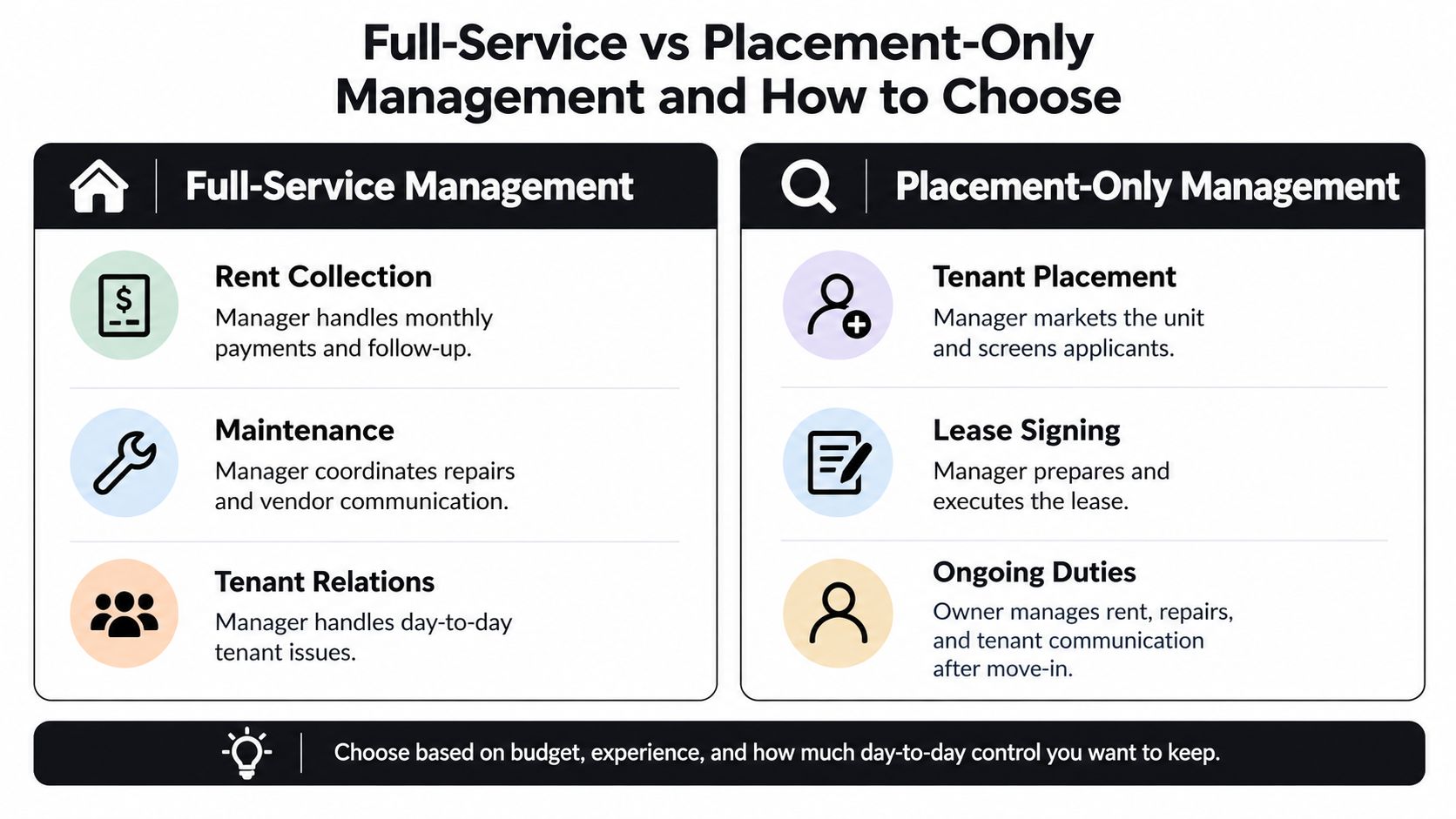
Full-service monthly management typically covers rent collection, repair coordination, tenant communication, move-in and move-out coordination, lease renewals, and detailed accounting statements. You still approve major decisions, but the manager runs daily operations and maintains the records.
Placement-only service covers professional marketing, applicant screening, and lease drafting. After move-in, you handle rent, repairs, tenant communication, renewals, and records yourself. That model suits a nearby, hands-on owner who's comfortable with those duties.
Match the Model to Your Situation
Distance is often the deciding factor. An out-of-state investor with a Fresno rental can't easily meet a plumber, document a move-out, or respond to a refrigerator failure. Full-service management gives that owner local execution and a single record system.
Time matters just as much. If tenant texts during your workday will sit unanswered, placement-only service leaves a gap after the lease is signed. If you enjoy direct tenant relationships and already keep clean books, placement-only help may be enough.
- Choose full-service if: You're remote, own multiple doors, dislike collections, or don't want trust-fund accounting on your plate.
- Choose placement-only if: You're local, responsive, organized, and mainly need marketing, strict screening, and a solid lease.
- Reconsider both if: The agreement doesn't state who holds deposits, approves repairs, sends notices, and stores records.
Edinhart Realty & Property Management, based in Fresno and serving Fresno, Clovis, Friant, and the greater Central California region, offers both full-service monthly management and placement-only service. Its stated features include automated rent collection, on-call agents, multi-property discounts, transparent financial reporting, California Association of Realtors forms, and ongoing legal updates.
Don't choose by label alone. Ask for a duty matrix for your property. The matrix should name who markets, screens, signs, collects, reconciles, dispatches vendors, renews, and closes the deposit.
The right model is the one that leaves no required task unassigned after move-in day.
Owners transitioning from self-management often underestimate handoff work. Existing leases, deposits, notices, and repair histories need review before a new manager can operate cleanly. Build that transition into your decision, not as an afterthought.
Insurance, Liability, Accounting, and Recordkeeping Requirements
Back-office records hold the whole system together. Insurance questions, liability disputes, refinancing, and a future sale all ask for the same core evidence. What condition is the home in, what work was done, and can you prove it?
A property data room answers those questions by address. The UK regulator's 2025 review states landlords need reliable data across operations, tenant-home safety and quality, assets, liabilities, and legal obligations, and it describes property-level records and periodic stock-condition surveys as essential in the UK regulatory casework review 2025 guidance. That review is not California law, but the recordkeeping logic translates directly to a Fresno portfolio.
You can adapt that workflow using compliance documentation practices for property records as a starting structure. Keep the structure simple enough that staff will maintain it during busy turnover weeks.
What Belongs in the Data Room
Start at onboarding with build year, appliance inventory, condition photos, permits or reports you have, insurance details, vendor history, and known safety issues. Add leases, disclosures, screening records, notices, ledgers, invoices, and inspection reports as the tenancy progresses.
- Condition evidence: Dated move-in, periodic, and move-out photos with written notes.
- Work evidence: Scope of work, vendor invoice, receipt, and before-and-after photos.
- Communication evidence: Tenant repair requests, approvals, notices, and delivery proof.
- Financial evidence: Rent ledger, deposit record, owner statements, and reconciliations.
- Legal evidence: Signed lease, disclosures, screening decision record, and renewal documents.
Fast vendor dispatch reduces tenant frustration. It doesn't demonstrate compliance without timestamps and completion proof. A closed work order should show the problem, authorization, vendor, cost, result, and tenant communication.
Insurance and liability reviews benefit from the same file. If a claim follows water damage or an injury, you'll need dates and maintenance history quickly. Clean records also support rent pricing, refinance conversations, and buyer due diligence because another party can verify income and condition.
Review the data room on a schedule, not only at turnover. Missing invoices and unsigned disclosures are easier to fix while the tenancy is active. Treat recordkeeping as asset management, because buyers and insurers will.
Your Compliance Checklist and Next Steps for Hiring a Manager
Build your final checklist by property, not by topic. One address should have one file you can open and audit.
- Confirm build year: Save proof and complete any required pre-1978 lead disclosure before signing.
- Verify money handling: Confirm designated trust accounting, separate beneficiary ledgers, and monthly reconciliation.
- Document habitability: Record stove, refrigerator, plumbing, heat, electrical, and safety condition with dated photos.
- Confirm deposit cap: Match the amount to your owner profile and save the calculation.
- Review screening: Keep the written criteria with each application decision record.
- Check lease templates: Confirm rent-cap, just-cause, notice, and delivery procedures are current.
- Assemble the data room: Store inspections, invoices, communications, ledgers, and disclosures by tenancy.
For each item, write down what evidence proves completion and when it gets refreshed. A checked box without a document behind it isn't an operating standard.
Your next step is to request a management proposal for your Fresno, Clovis, Friant, or Central California property and state whether you want full-service monthly management or placement-only service. Bring your current lease, deposit record, and repair history if the home is already rented. The manager's job is to keep the evidence current after handoff.
If you want a property-specific compliance system instead of a generic checklist, review your options with Edinhart Realty and Property Management for full-service monthly management or placement-only marketing, screening, and lease preparation. Bring your Fresno-area property details, current lease or vacancy plans, and questions about trust accounting, habitability records, and screening standards. Ask for a proposal that names who handles each duty and what evidence you'll receive every month.


