

At 2 a.m., a tenant calls because water is pooling beneath the kitchen sink. You shut off the supply, call a plumber, and discover the braided line had been slowly leaking for weeks. A small service visit has become soaked subflooring, a damaged cabinet base, drywall and flooring work, and a vacancy while the unit is restored.
That's the part of property management maintenance new landlords often miss. The expensive event usually isn't the first problem. It's the unattended condition that allowed a minor issue to become an emergency. A practical maintenance system focuses attention on the few preventive tasks that protect rental income, tenant confidence, and the building itself, instead of treating every possible task as equally important.
The Late-Night Call That Costs Less Than You Think
The landlord in that scenario had a chance to catch the leak during the last turnover. A quick inspection of the braided supply line could have revealed corrosion, swelling, or moisture around the connection. The replacement itself might have been routine. Once the line failed behind an occupied sink, however, the owner had to think about water extraction, materials, scheduling, tenant disruption, and lost rent.
The lesson isn't that every repair can be prevented. Plumbing connections fail, appliances wear out, and storms damage roofs. The lesson is that small, visible, repeatable checks often carry more financial value than a long list of low-priority chores.
Practical rule: Inspect anything that can release water, stop heating or cooling, create a safety hazard, or block the property from being rented.
A seasoned property manager looks at the home as an income-producing system. During a turnover, that means checking supply lines, shutoff valves, toilets, water heaters, filters, detectors, windows, gutters, and signs of roof or exterior moisture. During occupancy, it means tracking reports, documenting patterns, and scheduling service before predictable wear becomes a tenant-facing failure.
The broader operating context supports that approach. A U.S. Census Bureau and HUD rental housing survey found that 88% of rental owners and managers reported handling maintenance immediately and practicing preventive maintenance, while only 4% reported postponing most maintenance and addressing major problems as quickly as possible. Maintenance has long been an operating discipline, not an occasional expense.
This guide uses that practical lens. It separates high-return preventive work from background noise, explains how to budget and assign decisions, and shows how Edinhart's Full-Service and Placement-Only models handle the work differently.
What Property Management Maintenance Really Means
A rental home works like a group of connected subsystems. The HVAC system controls comfort and airflow. Plumbing moves water in and waste out. Electrical components power the home. The roof, siding, windows, and drainage manage weather exposure. Appliances and grounds affect daily usability and the property's presentation.
When one subsystem is ignored, another may carry the consequences. A blocked gutter can send water toward a wall. Poor airflow can strain HVAC equipment. A small plumbing leak can damage cabinets, flooring, or subflooring. Property management maintenance is the scheduled stewardship of these connected systems, not a response to whatever a tenant reports.
A repair is usually an unscheduled failure. Maintenance is the planned work that reduces the chance, severity, or cost of that failure. The distinction matters because a work-order inbox alone tells you what has already gone wrong. A maintenance calendar tells you what deserves attention before it does.
The four operating pillars
Routine inspections reveal wear, moisture, safety issues, and deferred work. The inspection should produce dated notes and photographs, not a vague statement that the property “looks fine.”
Preventive service keeps critical components within a reasonable operating condition. Filter changes, HVAC tune-ups, gutter clearing, detector checks, and water-system inspections belong on a recurring schedule.
Work-order tracking records the complaint, priority, vendor, authorization, invoice, completion date, and follow-up. A ticket that can't be audited is difficult to manage.
Vendor coordination turns a maintenance need into a controlled job. Someone must select the trade, confirm scope, set access instructions, communicate with the tenant, and verify completion.
These pillars protect three owner priorities. Fast, organized work supports rental income continuity by limiting downtime. Clear communication supports tenant retention because residents can see that a problem is being handled. Documented upkeep protects asset condition and resale value by reducing hidden deterioration and showing a history of care.
The U.S. Census and HUD survey also found that maintenance represented 13% of rent in small properties and about 17% in medium-size and large properties, reinforcing that upkeep is a material operating cost, not a minor line item. A maintenance plan should therefore connect every recurring task to risk, habitability, tenant experience, or future capital expense.
Preventive vs Reactive Maintenance in Real Dollars
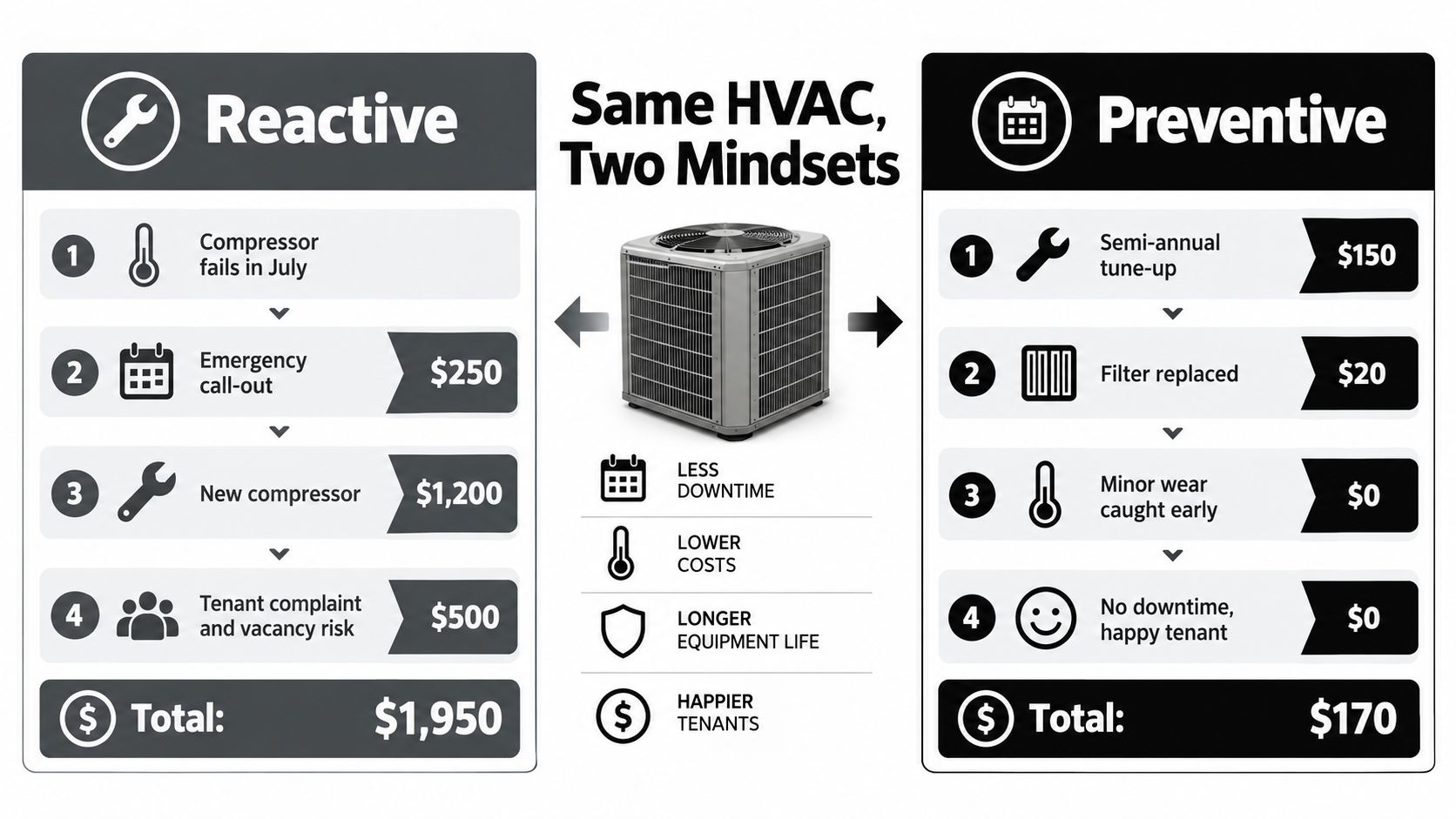
Consider the same forced-air HVAC system under two management styles.
With a reactive approach, the owner waits until the compressor fails during a hot spell. The tenant reports that the home isn't cooling. The manager searches for an available technician, the vendor diagnoses the problem under time pressure, parts may need to be rushed, and the tenant may face uncomfortable conditions while the repair is arranged. The final bill can include more than the failed component. It can include an emergency visit, after-hours labor, temporary accommodation, or rent-related disruption.
With a preventive approach, the owner schedules a spring inspection, replaces filters on a defined cycle, checks coils and airflow, and completes a fall review where the climate and equipment require it. A technician may identify a weak capacitor, a loose electrical connection, restricted airflow, or unusual operating noise while the system still works. The owner can then approve a controlled repair during a normal scheduling window.
The difference is not that preventive maintenance makes ownership free. It changes when the owner spends money and how much control the owner has over the work.
The decision comparison
| Reactive approach | Preventive approach |
|---|---|
| Begins after a tenant loses a function | Begins while the system still operates |
| Often requires urgent scheduling | Can use a planned vendor visit |
| May combine repair and damage-control work | Separates minor service from larger failures |
| Creates uncertainty for the tenant | Gives the tenant a clearer timeline |
| Can interrupt occupancy | Reduces avoidable downtime risk |
Commercial HVAC deserves special attention because HVAC systems commonly account for 40% to 60% of total building energy consumption, according to HVAC maintenance guidance for commercial real estate portfolios. Owners of larger or HVAC-heavy portfolios should collect interval utility data, heating and cooling degree days, and operating hours so they can spot performance drift instead of judging equipment only after a breakdown.
Roof condition deserves the same early-warning mindset. During inspections, owners should document ceiling stains, missing or damaged shingles, lifted flashing, blocked drainage, and soft exterior areas. For a visual reference when reviewing warning signs of roof damage, use a roof-focused inspection guide rather than waiting for interior water damage.
The practical rule is simple. Schedule preventive work whenever the cost of a predictable service visit is lower than the combined risk of emergency labor, damage, tenant disruption, and vacancy.
The Core Tasks and What They Cost Per Unit
A landlord may budget for a routine service visit, then face a much larger bill after a leak, failed system, or missed turnover. A single annual maintenance figure hides those differences. Property age, building complexity, climate, deferred repairs, and emergency frequency all change the result.
Recent rental housing analysis reported a median of $1,600 per unit for maintenance and repairs in 2023, compared with a mean of $2,782 per unit, because spending varied sharply between properties. It also found that maintenance represented 42% of operating costs, according to this rental property maintenance cost analysis.
Use those figures as context rather than a promise for a particular home. Newer properties with dependable systems may need less routine work, while older buildings with recurring plumbing, HVAC, or exterior problems may require more. Another industry benchmark places routine multifamily maintenance at roughly $1,000 to $3,100 per unit per year, with older and more complex buildings tending toward the higher end, as described in this property maintenance cost benchmark.
Build the calendar by season
| Season | Task | Per-Unit Cost Range | Frequency |
|---|---|---|---|
| Spring | HVAC tune-up, filters, exterior moisture check | Obtain local vendor quote | Seasonal |
| Summer | Landscaping review, pest monitoring, drainage check | Obtain local vendor quote | Monthly or seasonal |
| Fall | Gutter clearing, weatherproofing, heating review | Obtain local vendor quote | Seasonal |
| Winter | Freeze protection, shutoff review, emergency readiness | Obtain local vendor quote | Seasonal |
Verified benchmarks do not provide task-level price ranges, so a precise line-item budget would create false confidence. Ask vendors to separate labor, materials, trip charges, minimum fees, and follow-up visits. Then compare actual spending with the property's per-unit benchmark using an rental property maintenance costs worksheet.
Full-Service management can keep this calendar visible, coordinate recurring vendors, and document follow-up. With Placement-Only service, the owner retains that routine tracking and vendor coordination. The model changes who performs the work, not which preventive tasks protect income.
Prioritize the work that protects income
Begin with systems that can cause property damage, habitability problems, or a missed lease cycle:
- Water systems: Inspect supply lines, shutoffs, toilets, water heaters, and visible connections. Follow the manufacturer's service requirements and local conditions for water-heater work.
- HVAC airflow: Replace filters on a documented schedule, inspect condensate drainage, and arrange seasonal service when appropriate.
- Life-safety equipment: Test smoke and carbon monoxide detectors, confirm placement, and follow local compliance requirements.
- Exterior water management: Clear gutters and downspouts, inspect seals and flashing, and check whether drainage sends water toward the building.
Rank tasks by consequence. A detector check protects safety. A filter change supports comfort and equipment airflow. Gutter clearing reduces exposure to water intrusion. These jobs deserve attention before cosmetic improvements that do not affect habitability, damage risk, or leasing readiness.
Who Actually Owns Each Maintenance Decision
Maintenance problems become slower and more expensive when the owner and manager assume the other person is responsible. Put the decision rules in the management agreement, lease materials, and operating notes. Define who receives the request, who can dispatch a vendor, who approves larger work, and who communicates with the tenant.
The owner normally controls the budget, capital improvements, insurance-related decisions, and major system replacement. The manager generally handles routine coordination, tenant communication, inspection records, and vendor scheduling within the authority the owner has granted. Legal duties still depend on the property, lease, and applicable law, so the written process should support local compliance rather than replace legal advice.
Make the authority visible
| Decision Area | Owner Role | Manager Role | Edinhart Full-Service | Edinhart Placement-Only |
|---|---|---|---|---|
| Budgeting | Set reserves and spending limits | Track actuals and flag trends | Monitors recurring maintenance activity within the agreed process | Owner monitors day-to-day maintenance costs |
| Vendor approval | Approve major or unfamiliar vendors when required | Pre-qualify and coordinate trades | Coordinates repair vendors and follow-up | Provides guidance, while owner manages calls |
| Capital repairs | Approve replacements and improvements | Scope and present options | Escalates capital decisions for owner approval | Routes decisions to the owner |
| Routine work | Fund approved routine tasks | Schedule inspections and service | Absorbs daily triage and coordination within written authority | Owner schedules or directs routine work |
| Tenant communication | Set service expectations through the agreement | Give updates and arrange access | Handles tenant communication tied to managed repairs | Owner communicates directly |
| Compliance | Maintain owner-level oversight | Keep records and escalate issues | Supports inspections, records, and coordination | Owner retains operational responsibility |
An owner using Full-Service management should establish a spending authority that lets the manager address routine failures without waiting for approval during every call. A Placement-Only owner should expect maintenance calls to come back to them after the tenant takes possession, with the manager's role concentrated on the leasing and placement process.
Owners who want to understand how professional operators structure relationships with owners can review this resource for SuperiorPRO property owners. The same principle applies at a smaller scale. Clear expectations prevent confusion about access, approvals, invoices, and communication.
Write the threshold before the weekend
Your written policy should answer practical questions:
- What work can the manager authorize without calling?
- What dollar limit triggers owner approval?
- Which conditions qualify as emergencies?
- Can the manager use a backup vendor if the preferred vendor is unavailable?
- Who receives photos, invoices, and completion notes?
- How quickly must the owner be notified?
A strong agreement doesn't eliminate every disagreement. It prevents the tenant, manager, and owner from making three different assumptions while water is entering the unit.
Vendors, Emergencies, and the 24-Hour Playbook
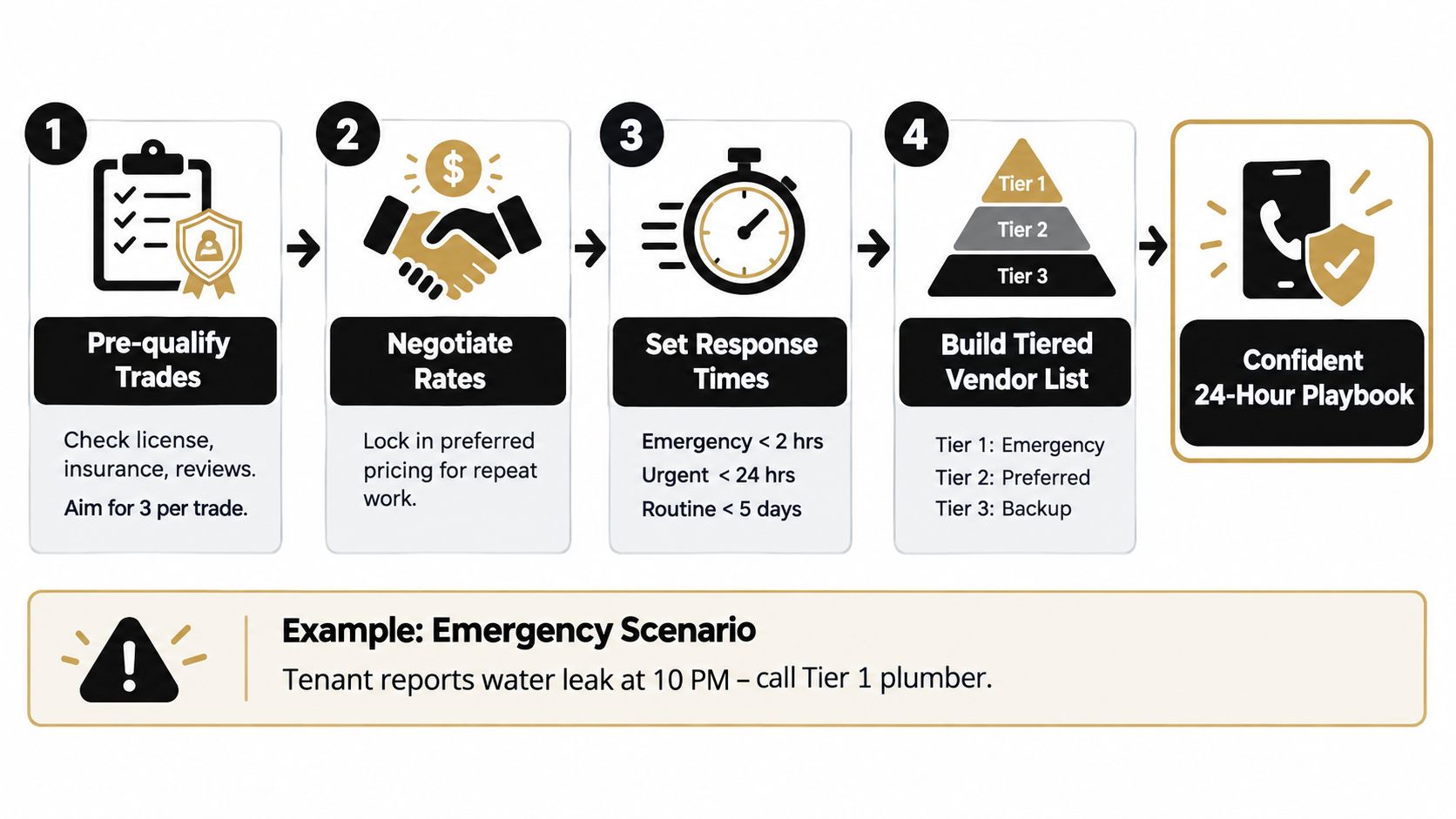
Vendor coordination works best as a repeatable workflow, not a collection of phone numbers. Pre-qualify licensed and insured trades, review references and workmanship, clarify billing, and ask how the vendor handles access and documentation. Maintain a tiered list for plumbing, HVAC, electrical, roofing, and general handyman work so one unavailable contractor doesn't stop the response.
Negotiate preferred pricing where repeat work justifies it, but don't choose solely by the lowest quote. A low initial price can lose its value if the contractor misses appointments, leaves poor documentation, or requires repeated callbacks. Set expectations for arrival, communication, photographs, invoice detail, and warranty follow-up before dispatching the first job.
Triage the issue before spending
A true emergency involves immediate danger, active property damage, or a serious habitability concern. Examples include active water intrusion, a gas leak, a sewer backup, an electrical hazard, or loss of heat during freezing conditions. A nonworking appliance, cosmetic drywall damage, or a dripping faucet may need prompt scheduling, but it may not justify an after-hours premium.
When an HVAC failure occurs in extreme weather, a specialized AC emergency repair resource can help an owner understand what information a technician may need before dispatch. The manager should still verify the actual condition, protect the tenant, and follow the property's emergency policy.
Use a documented response sequence
- Tenant report: Capture the location, severity, photos, access details, and whether the tenant has taken a safe temporary step, such as using a shutoff.
- Manager triage: Review the report promptly, classify it as emergency, urgent, or routine, and confirm the next update time.
- Vendor dispatch: Contact the appropriate tier, provide the scope, and record the acceptance and expected arrival.
- Tenant update: Explain what happens next without promising a completion time the vendor hasn't confirmed.
- Work-order record: Add the diagnosis, authorization, invoice, photos, and materials used.
- Verification: Confirm that the original problem is resolved, the area is safe, and the tenant knows whether follow-up work remains.
- Owner notification: Send the owner a concise summary, cost, cause, and recommendation within the agreed reporting window.
For owners evaluating software or outsourcing, contractor management should include more than contact storage. The useful record connects the vendor, work order, approval, tenant update, invoice, and final verification in one place.
The KPIs That Tell You If Maintenance Is Working
A maintenance dashboard shouldn't overwhelm an owner with activity counts. It should answer five questions: Are requests being resolved promptly? Is the team preventing failures? What does upkeep cost? Are vendors doing quality work? Do tenants trust the process?
Mean time to resolve measures the elapsed time from a valid request to confirmed completion. Review it monthly, and separate emergencies from routine jobs. A rising figure can indicate weak triage, vendor capacity problems, access issues, or slow approvals.
Preventive-to-reactive ratio compares planned work with failure-driven work. Review it monthly by property and system. A portfolio dominated by reactive tickets may need inspections, better scheduling, or a closer look at deferred repairs.
Cost per unit per month converts irregular invoices into an operating view. Compare it with the property's age, condition, and historical pattern instead of treating a single expensive month as proof of poor management. A useful property maintenance management software system can organize those records and expose recurring categories.
Vendor callback rate measures how often a completed job returns because the repair didn't hold or the original diagnosis was incomplete. Review it monthly by vendor and trade. A high callback pattern can justify changing vendors even when individual invoices look inexpensive.
Tenant satisfaction tied to maintenance connects service quality to resident experience. Ask whether the tenant received updates, understood the timeline, and considered the issue resolved. Review trends monthly, then connect them with renewals and move-outs during the annual review.
| KPI | What It Measures | Review Cadence | Benchmark Target | Dollar or Retention Impact |
|---|---|---|---|---|
| Mean time to resolve | Speed from report to verified completion | Monthly | Set a property-specific target | Limits disruption and vacancy risk |
| Preventive-to-reactive ratio | Planned work compared with failures | Monthly | Increase planned coverage over time | Helps control emergency exposure |
| Cost per unit per month | Operating spend normalized by units | Monthly | Compare with property history | Supports realistic reserves |
| Vendor callback rate | Repeat visits after completion | Monthly | Reduce avoidable repeat work | Protects labor and tenant goodwill |
| Maintenance satisfaction | Resident view of service quality | Monthly and at renewal | Track trend, not one response | Informs retention decisions |
Don't invent a universal benchmark target where the property has no reliable baseline. Establish a starting point, then investigate sudden changes, repeated failures, unresolved tickets, or growing emergency work. KPIs are early-warning sensors, not vanity numbers.
Your First 90 Days of Smarter Maintenance
A tenant reports water under the sink on a weekend. You need to know whether it is an emergency, who can approve the visit, which vendor should respond, and how the tenant will receive updates. The first 90 days should build that chain before a small defect becomes property damage or a service complaint.
Days 1 through 30, establish the system
Create a digital inventory for each property. Record equipment, shutoff locations, filter sizes, detector locations, appliance details, roof observations, and existing defects. Build work-order templates that capture priority, photos, access, vendor assignment, approval, invoice, and completion verification.
Self-managing owners can use a maintenance platform or a disciplined shared record. Placement-Only clients should confirm when maintenance responsibility returns to them after placement. Full-Service clients should review how repair requests, inspections, tenant messages, and owner statements are recorded by the management team.
The aim is a reliable property record, not a longer checklist.
Days 31 through 60, build the vendor pipeline
Pre-qualify vendors by trade, verify insurance and licensing where applicable, and request written service terms. Ask how each vendor handles emergency calls, tenant access, photographs, invoices, and warranty issues.
Create primary, preferred, and backup options for critical trades. Set approval thresholds in writing, then test the process with a hypothetical leak or HVAC failure. If no one knows who may authorize the call, the workflow is incomplete.
Days 61 through 75, prepare tenant communication
Give tenants one maintenance request path and separate emergency instructions. The request form should ask for the location, description, photos, access availability, and immediate safety concerns. State when residents can expect acknowledgment and how updates will arrive.
Full-Service management can centralize these messages, coordinate vendors, and document completion. Placement-Only owners need their own process ready before the first request arrives.
Days 76 through 90, install budget guardrails
Review existing invoices, identify recurring tasks, and create a property-specific annual maintenance budget. As noted earlier, annual repairs often run 5% to 8% of gross rent, while routine maintenance planning may use roughly 5% to 15% of rental income, depending on property condition. Adjust the working budget for building age, deferred work, and local vendor pricing.
Schedule the first full preventive cycle and review maintenance performance monthly. Reserve time each year for larger system decisions, such as replacement planning rather than repeated repairs.
The goal isn't to spend more on maintenance. It's to spend earlier and more selectively on work that protects occupancy, safety, and the building's earning ability.
Edinhart Realty and Property Management offers Full-Service management with repair coordination, tenant communication, inspections, move-in and move-out support, and owner reporting. Its Placement-Only service leaves ongoing operations with the owner after leasing. Visit Edinhart Realty and Property Management to discuss which model fits your maintenance responsibilities and rental property plan.


