

You bought or inherited a rental in Rancho Cordova, or you're close to closing on one. On paper, it looks straightforward. List the home, screen a few applicants, collect rent, and let the asset do its job.
Then the demanding work begins. Prospective tenants want fast responses. Maintenance calls don't arrive on your schedule. California compliance isn't forgiving. And if you're trying to self-manage from another part of Sacramento, another county, or another state, every small delay starts to cost money.
That tension is why property management in Rancho Cordova CA deserves a more practical discussion than the usual "we handle everything" pitch. This market has real upside, but it also punishes sloppy operations. The owners who do well here usually get three things right: they set the property up for the right tenant, they run tight financial controls, and they treat legal compliance as part of asset management, not as an afterthought.
Investing in Rancho Cordova The Opportunity and The Challenge
A familiar scenario looks like this. An owner closes on a newer single-family home, sees how much construction is happening around the city, and assumes demand will carry the investment. Sometimes that works for a while. But new supply also changes renter expectations fast. If the property isn't priced correctly, shown well, and managed tightly, the home sits longer than it should.
Rancho Cordova isn't a sleepy suburban market anymore. The city led the North State Building Industry Association region in 2024 with 620 new home sales and a record 1,100 permits, and the city says that performance helped place it among California's top five fastest-growing cities in that period, according to the City of Rancho Cordova's 2024 housing update.
For investors, that creates a real opening. More housing, more residents, and more mobility usually mean more rental activity. It also means more direct competition from newer homes, fresh finishes, and landlords who are willing to spend on leasing and maintenance.
Why growth doesn't guarantee easy returns
Owners often mistake demand for margin. They're not the same thing.
A growing city can support strong leasing activity while still exposing weak operators. If your response times are slow, your screening is loose, or your maintenance standards drift, tenants will choose another home. In a market with expanding inventory, they have options.
Practical rule: In a fast-growth submarket, operational quality becomes part of pricing power.
That matters in Rancho Cordova because many renters are comparing convenience, condition, and professionalism as much as they are comparing square footage. A well-run property tends to attract better applications. A poorly run one attracts delay, negotiation, and more turnover risk.
What owners usually underestimate
The challenge isn't only filling a vacancy. It's protecting income after move-in.
The pressure points are predictable:
- Leasing speed: Every day a home sits empty reduces annual return.
- Tenant fit: A rushed approval can create months of collection, repair, or legal headaches.
- Repair coordination: Deferred maintenance almost always gets more expensive.
- Documentation: California owners need clean records, consistent notices, and disciplined processes.
Rancho Cordova rewards owners who treat management as a system, not a side task. That's why many investors eventually stop asking, "Can I manage this myself?" and start asking a better question: "Where does professional management improve my net return and reduce avoidable risk?"
Understanding the Rancho Cordova Rental Market
Rancho Cordova attracts a broad renter pool because it gives people something many Sacramento-area tenants want: practical livability. Residents can find neighborhoods near parks, schools, and shopping, and that everyday convenience matters more than many owners think. A property doesn't need luxury branding to perform well here. It needs to feel functional, well-kept, and easy to live in.
From an investor's standpoint, the market isn't one single lane. A newer single-family home in a developing area competes differently than an older rental with value-add potential. A condo or townhome attracts a different applicant profile than a detached house with a yard. Owners who lump all of Rancho Cordova together usually misprice the asset or improve the wrong things.
What tenants are usually looking for
Most renters in this part of the Sacramento region aren't shopping only on rent. They compare commute convenience, layout, parking, storage, condition, and whether the property looks like it will be managed professionally after move-in.
That last point matters. Good tenants notice operational signals during leasing:
- Response quality: Did someone answer questions clearly and quickly?
- Showing experience: Was the property clean, secure, and ready to tour?
- Application process: Were standards clear and consistent?
- Move-in confidence: Does the home look like repairs will be handled properly?
When owners miss those basics, they don't just lose applicants. They often lose the very applicants they want.
Property type changes the management approach
Single-family rentals in Rancho Cordova often lease on lifestyle. Yard condition, garage usability, appliance reliability, and neighborhood feel can carry more weight than cosmetic extras. For these homes, the strongest returns often come from durable upgrades and tight maintenance follow-through rather than trendy finishes.
Multifamily units and smaller attached properties compete more on efficiency. Clean turnover work, updated flooring, simple lighting, and a frictionless application process often matter more than trying to make the unit look high-end.
A rental performs best when the finish level matches the neighborhood, the tenant profile, and the owner's hold strategy.
That's where many owners overspend. They renovate for resale taste when they should renovate for rental durability.
What the local setting means for leasing
Rancho Cordova's appeal isn't only inside the property line. The broader lifestyle package helps. The city's mix of residential growth and everyday amenities supports steady renter interest, especially for homes that are clean, well-located, and easy to maintain.
For owners, that creates two practical implications:
- Presentation matters early. In a growing market, tenants compare listings quickly. Weak photos, vague descriptions, or delayed follow-up can push a solid property behind better-marketed competition.
- Condition matters after move-in. Newer housing activity raises the standard. If your rental feels neglected next to newer alternatives, residents are less likely to renew.
What not to assume
Don't assume every property can command a premium just because the city is growing. Don't assume a recent purchase price automatically supports your desired rent. And don't assume renters will overlook clunky management because inventory is moving.
A better way to think about this market is to separate the asset into three parts:
| Rental factor | What helps | What hurts |
|---|---|---|
| Location fit | Access to daily amenities and neighborhood appeal | Overestimating a marginal pocket |
| Property condition | Durable finishes and clean turnover | Deferred repairs and cosmetic patchwork |
| Management quality | Fast communication and consistent standards | Slow leasing, inconsistent screening, poor follow-up |
Owners who understand those three variables usually make better decisions on upgrades, pricing, and whether to use full management or only leasing support.
What Professional Property Managers Actually Do
A lot of owners think property management is mainly rent collection and repair calls. In practice, the job is closer to risk control. Good managers protect income by controlling the parts of ownership that most often go wrong: leasing, screening, collections, vendor coordination, records, and compliance.

The strongest managers don't just "handle issues." They build repeatable processes so fewer issues become expensive in the first place.
Leasing and tenant placement
Marketing is more than putting a home online. A manager should coordinate photos, set a defensible asking rent, write a useful listing, handle inquiries, schedule showings, and keep prospects moving through the pipeline.
Owners often lose time when they self-manage casually. They answer messages in bursts, show the property inconsistently, or fail to pre-qualify applicants before investing time. That usually leads to more vacancy and weaker applications.
A professional manager should also know how to position the home realistically. Overselling creates bad fit. Underselling leaves money on the table.
Screening that protects the asset
Screening is the point where optimism has to stop and standards have to take over. Rancho Cordova gives owners a useful real-world signal here. Some long-standing local firms report a 99.8% eviction-free record, and the area also saw a 61% decrease in combined violent and property crime from 2004 to 2019 when adjusted for population, as noted on Tiner's Rancho Cordova property management page.
That doesn't mean every applicant is low-risk. It means disciplined screening works, and the local operating environment supports stable tenancy when managers stay selective.
A solid screening process usually includes:
- Identity and application consistency: Names, addresses, income claims, and supporting documents should align.
- Income and employment review: The manager should verify the applicant can support the lease terms.
- Rental history review: Prior landlord references matter most when the questions are specific.
- Credit and behavior review: Credit alone never tells the full story, but it helps identify patterns.
Owner warning: Most bad tenancies don't start with one obvious red flag. They start with several small ones that an impatient landlord talks themselves into ignoring.
Here's a practical look at the big five functions:
| Function | What a manager does | Why it matters |
|---|---|---|
| Marketing | Lists, shows, follows up | Reduces vacancy drag |
| Screening | Verifies applicant quality | Lowers eviction and damage risk |
| Collections | Tracks rent and late payment activity | Protects cash flow |
| Maintenance | Dispatches vendors and documents work | Preserves property condition |
| Compliance | Uses correct notices and records | Reduces legal exposure |
Rent collection and accounting discipline
Collection isn't just about getting paid eventually. It is about enforcing lease terms consistently and documenting the process from the first day of delinquency. The longer owners wait to respond to late payment patterns, the harder collection gets.
That same discipline applies to owner reporting. A good monthly statement should let you see what came in, what went out, what work was completed, and what issues need a decision.
A short explainer on operational expectations is useful here:
Maintenance and legal follow-through
Good maintenance coordination isn't "call a handyman when something breaks." It means triaging urgency, assigning the right vendor, checking the quality of the work, and keeping a record of what happened.
Legal compliance sits underneath all of it. Lease execution, notice handling, habitability issues, security deposit documentation, and communication standards all affect owner risk. A manager who is sloppy with paperwork can cost more than a manager who charges more but documents everything properly.
In Rancho Cordova, that operational discipline is what separates a rental that produces steady returns from one that turns into a second job.
Full-Service Management Versus Placement-Only Models
Not every owner needs the same type of help. Some want a completely hands-off structure. Others are comfortable handling day-to-day issues but want professionals to take care of the highest-risk part of the process, which is getting the right tenant into the property.
That's the difference between full-service management and placement-only service. One is an operating platform. The other is a leasing solution.
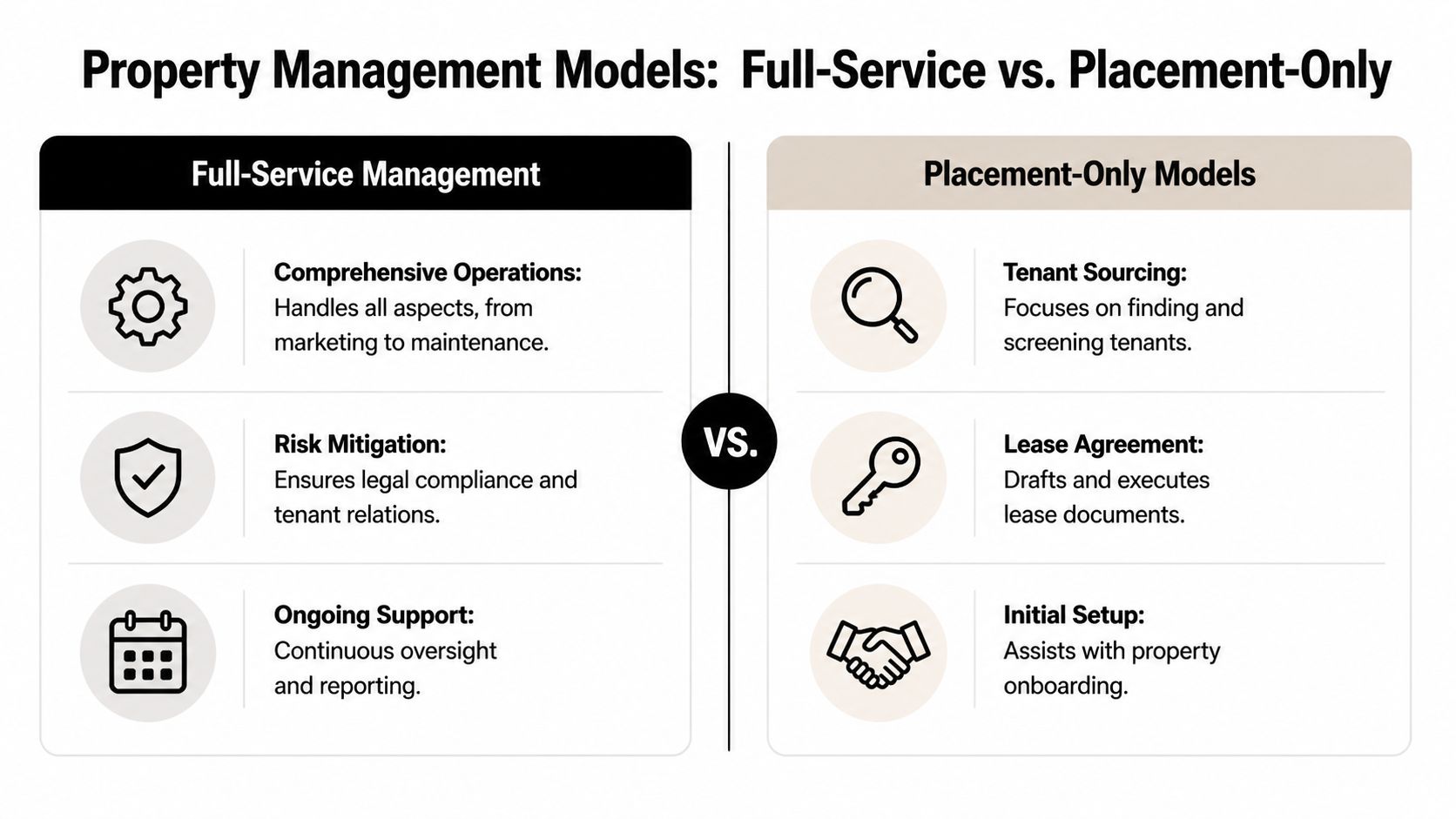
Full-service works best when ownership is the investment, not the job
With full-service management, the manager handles the recurring work: marketing, showing, screening, leasing, rent collection, repair coordination, tenant communication, renewals, move-in and move-out processes, and owner accounting.
This model usually fits owners who:
- Live out of area: Distance makes fast response harder.
- Own multiple properties: Time and decision fatigue start to compound.
- Value legal insulation: They want a professional process around notices, records, and communication.
- Prefer predictable involvement: They want approvals on major decisions, not daily interruptions.
The upside is obvious. You offload operations. The trade-off is cost and some loss of direct control over the resident relationship.
Placement-only works when you can actually operate the property
Placement-only is attractive because it solves the most dangerous early-stage tasks. A professional handles marketing, applicant screening, and lease preparation, then the owner takes over after move-in.
That can work well if the owner has the time, local presence, and systems to manage the rest. It tends to fit people who are comfortable with phone calls, vendor scheduling, rent follow-up, renewal discussions, and recordkeeping.
It tends to go badly when owners choose it for the wrong reason. Saving the monthly fee only helps if you can perform the monthly job.
Placement-only is not a lighter version of management. It's a transfer point. Once the keys are handed over, the operational burden belongs to the owner.
Full-Service vs. Placement-Only At a Glance
| Service Feature | Full-Service Management | Placement-Only Service |
|---|---|---|
| Marketing the vacancy | Manager handles it | Manager handles it |
| Property showings | Manager handles it | Manager handles it |
| Applicant screening | Manager handles it | Manager handles it |
| Lease drafting | Manager handles it | Manager handles it |
| Rent collection after move-in | Manager handles it | Owner handles it |
| Repair coordination | Manager handles it | Owner handles it |
| Tenant communication | Manager handles it | Owner handles it |
| Lease renewals | Manager handles it | Owner handles it |
| Accounting statements | Manager provides them | Owner creates or tracks them |
| Notices and ongoing compliance steps | Manager typically handles process administration | Owner remains responsible for ongoing management actions |
The hidden trade-offs owners often miss
The decision isn't only about personality. It's about capacity.
An owner may be detail-oriented and still be a poor fit for self-management if they travel often, work long hours, or don't have reliable vendor relationships. Another owner may do fine with placement-only because they already run local rentals and have a solid maintenance bench.
Use this quick self-check:
- Choose full-service if you want tighter income protection, less interruption, and structured reporting.
- Choose placement-only if you want help securing the tenant but are ready to enforce lease terms and manage operations yourself.
- Avoid placement-only if you tend to delay uncomfortable conversations, don't document well, or can't respond quickly when issues come up.
A practical decision lens
Think about what happens after month one. Leasing is visible. Ongoing management is where most owners either preserve return or gradually lose it.
If the idea of handling late rent, emergency coordination, vendor follow-up, renewal strategy, and California compliance sounds like a drain, full-service is usually the better economic choice even before you attach a fee to your own time. If you already have the systems and discipline, placement-only can be efficient.
The right answer isn't the cheaper model. It's the model that you can execute without creating vacancy, friction, or legal mistakes.
Calculating Property Management Costs and Your ROI
A Rancho Cordova owner buys a rental at a decent price, sets rent close to the neighborhood average, and then loses a month of income to a bad turnover, a preventable repair, or a tenant who gets behind and never catches up. That is usually where the main cost sits. The management fee is visible. The expensive mistakes show up later on the owner statement.

In Rancho Cordova, the ROI question is practical. Can a manager protect enough income and reduce enough legal and operational risk to more than cover the fee?
What you're actually buying
Owners are not paying only for rent collection and repair calls. They are paying for tighter execution.
That includes pricing the unit correctly at turnover, getting it back on the market fast, screening with California compliance in mind, documenting notices, coordinating vendors, tracking invoices, and keeping financial records clean enough to make tax time easier. On a Sacramento-area rental, one extra week of vacancy can cost more than a meaningful chunk of the monthly management fee. One poorly handled notice or habitability issue can cost far more.
Keyrenter Folsom describes the value of professional systems in terms of better reporting, rent tracking, and reduced operational errors on its Rancho Cordova property management page. The useful takeaway for owners is simple. Better systems support faster decisions, cleaner books, and fewer preventable misses.
If you want a clearer benchmark for local fee structures, this guide on how much property management should cost lays out the common pricing models in owner terms.
A simple way to calculate ROI
Run two scenarios. Self-managing is one. Professional management is the other.
Use actual numbers from your property or a realistic pro forma:
- Gross scheduled rent
- Vacancy loss
- Delinquency or collection loss
- Turnover cost
- Repairs and maintenance
- Management fees
- Your time, especially after-hours coordination and legal follow-up
Here is a Rancho Cordova example. If your property rents for $2,300 per month, a two-week vacancy costs about $1,150 in lost rent before utilities, cleaning, or leasing costs. If a good manager shortens turnover by even a week, improves collections, and prevents one avoidable repair escalation over the year, the fee can pay for itself quickly.
That is the right lens. Owners should compare net income after friction, not just line-item fees.
Where owners in Rancho Cordova usually gain or lose margin
The big swings in return usually come from ordinary operating decisions.
- Turnover speed: A vacant unit in summer may move fast. A vacant unit in a slower window, priced wrong or marketed poorly, burns cash every day.
- Collections discipline: Late rent that is addressed on day two is different from late rent that drifts for weeks.
- Maintenance triage: A small leak under a sink is a small invoice. Water damage, cabinet replacement, and mold concerns are not.
- Material selection: Cheap finishes often cost more over two or three turns than durable rental-grade materials.
- Documentation: In California, weak records can turn a simple lease issue into a larger legal problem.
Flooring is a good example of ROI thinking. Owners who choose based only on upfront price often regret it at the next turnover. This LVP, tile, and laminate comparison for rentals is a useful reference because replacement cycles, cleaning time, and appearance after two years all affect return.
Include legal risk in the math
A lot of owners leave this out. They should not.
Rancho Cordova landlords operate under California rules that can make casual management expensive. Notice handling, habitability response, fair housing compliance, security deposit accounting, and repair documentation all carry financial consequences. A manager who keeps clean files and consistent procedures is not just saving time. That manager is reducing the odds of a dispute that wipes out months of profit.
That risk reduction has value even when it does not show up as a separate line item.
What to review each month or quarter
The report should help you make decisions, not just confirm that rent hit the account.
| Question | Why it matters |
|---|---|
| How many days vacant was the property this period? | Shows whether leasing speed is hurting annual return |
| Are tenants paying on time or sliding later each month? | Early payment drift often predicts larger collection issues |
| Which repairs are repeating? | Repeats usually point to a bigger system issue or a weak vendor fix |
| What did the last turnover cost all-in? | Helps you budget make-ready reserves and test whether rent strategy is working |
| Is current rent still competitive for this part of Rancho Cordova? | Supports renewal decisions and protects occupancy |
If your manager cannot tie operations to cash flow, reserve planning, and risk control, you are outsourcing tasks without getting the full financial benefit.
Your Checklist for Hiring a Rancho Cordova Manager
Hiring the wrong manager creates a second layer of problems. You don't only have tenant risk anymore. You also have manager risk. That means your screening process for a property manager should be as disciplined as the screening process they use for applicants.
A strong hiring process doesn't need to be complicated. It does need to be direct.
Start with a document review, not a sales call
Before you spend time on calls, look for operating evidence. You want to know how the company communicates, how clearly it explains services, and whether it appears to run a system rather than a personality-driven operation.
Check these first:
- License and business identity: Verify you're dealing with a legitimate California real estate operation where required.
- Service scope: Confirm whether they offer full-service, placement-only, or both.
- Sample reporting: Ask what owners receive each month.
- Maintenance process: Find out who takes calls, who approves work, and how invoices are documented.
A useful starting point is this guide on how to select a property management company. It helps owners ask sharper questions before they get attached to a polished presentation.
Interview for process, not personality
A friendly manager isn't enough. You need someone who can describe exactly how they operate in ordinary and unpleasant situations.
Ask questions like these:
- How do you set asking rent for a Rancho Cordova single-family home without overpricing the vacancy?
- What are your screening standards, and how do you apply them consistently?
- How do you handle late rent the moment a payment is missed?
- Who coordinates repairs, and how are owners notified on larger items?
- What does your move-out documentation look like?
- How do you handle lease renewals and resident retention?
- What records do you maintain if a dispute develops?
The quality of the answer matters more than the answer itself. Vague confidence is a warning sign. Clear workflow is what you want.
If a manager can't explain their process step by step, they probably improvise more than you should be comfortable with.
Press on California compliance
Some owners become hesitant during interviews at this stage. Do not let that happen. California property management requires discipline around forms, notices, habitability, deposits, fair housing practices, and communication standards.
Ask directly:
- How do you stay current on California landlord-tenant changes?
- What is your notice process when lease violations happen?
- How do you document habitability-related maintenance?
- Who handles communication if a resident disputes charges or requests accommodation?
A capable manager won't dodge those questions. They should answer calmly and specifically.
Review the agreement like an operator
The management agreement tells you what the relationship will feel like after the sales process ends. Read it closely.
Focus on these points:
| Contract issue | What to check |
|---|---|
| Authority limits | When can they approve repairs without you? |
| Fee events | What triggers leasing, renewal, or admin charges? |
| Termination terms | How easy is it to exit cleanly? |
| Communication standards | How and when do they update you? |
Call references with better questions
Don't ask, "Do you like them?" Ask, "What happened when something went wrong?" That's the question that reveals whether the manager protects owners under pressure.
Strong reference questions include:
- How did they handle a difficult maintenance issue?
- Did financial reporting make sense without extra explanation?
- Were there surprises in billing or repairs?
- Would you trust them again with a vacant property?
The right Rancho Cordova manager should make ownership more predictable, not just more convenient.
Frequently Asked Questions for Rancho Cordova Landlords
Can I use a property manager in Rancho Cordova if I live out of state
Yes. In many cases, that's when professional management makes the most sense. Distance makes showings, inspections, maintenance follow-up, and notice handling much harder to do well. Out-of-state owners usually benefit most from strong reporting, rent monitoring, and a manager who documents everything cleanly.
What upgrades usually improve rental performance most
Durability beats flash. Focus on flooring, paint, lighting, fixtures, hardware, and any repair item that affects day-to-day function. A clean, sturdy rental with easy-to-maintain finishes often performs better than a half-luxury remodel that becomes expensive to keep up.
Is placement-only a good fit for a first-time landlord
Usually not, unless you're highly organized and ready to handle operations after move-in. Placement-only can be efficient, but it assumes you'll manage collection, maintenance, renewals, documentation, and tenant communication consistently.
What should I worry about most from a legal standpoint
Documentation and process. Owners get into trouble when they act informally, delay habitability-related issues, or send inconsistent messages to tenants. If you need a plain-English starting point, this overview of California landlord-tenant law is a helpful reference.
How should I judge whether a manager is helping my ROI
Look at outcomes you can use. Are payments being tracked closely? Are repairs handled early instead of late? Do statements help you make decisions? Is turnover managed with discipline? A good manager should improve the predictability of income, reduce operational friction, and lower the chance of expensive mistakes.
If you want help choosing the right management approach for your rental, Edinhart Realty and Property Management offers both full-service management and placement-only support. That gives owners a practical choice between fully outsourced operations and professional leasing help, depending on how hands-on they want to be.


