

You’re probably in one of two spots right now. You own a home in Lompoc and you’re deciding whether to rent it instead of sell it, or you’re an investor looking at the Central Coast and wondering whether Lompoc is steady enough to justify another door.
That’s a fair question. Lompoc can look simple from the outside. It’s smaller than Santa Barbara, less talked about than San Luis Obispo, and easy to dismiss if you only scan listings. But from an operations standpoint, property management in lompoc ca is its own category. The local tenant mix, the influence of Vandenberg Space Force Base, the appeal of coastal access, and the choice between long-term and short-term rental strategy all make management decisions more important here than many owners expect.
The mistake I see most often is treating management as a yes-or-no decision. It’s not. The better question is which model fits your property, your time, and your risk tolerance. Some owners should self-manage. Some should pay for placement only. Some should hand off the whole job because the cost of one bad tenancy, one mishandled repair, or one compliance mistake wipes out whatever they saved on fees.
Is Professional Property Management Right for Your Lompoc Home
If you’ve never rented out a property before, your first instinct is usually to run the math on monthly rent and compare it to your mortgage, taxes, insurance, and repairs. That’s necessary, but it’s incomplete. The operational side is what turns a decent rental into either a stable asset or a constant interruption.
Lompoc attracts a mix of long-term residents, military households, commuters, and renters who want Central Coast access without paying Santa Barbara pricing. That sounds positive, and it is. It also means turnover patterns, showing schedules, lease timing, and maintenance response all matter more than owners think at the beginning.
A useful starting point is asking yourself three direct questions:
Can you respond quickly enough?
If a tenant has a repair issue, a lease question, or a payment problem, delayed response creates friction fast.Can you screen consistently?
Most owners can spot an obviously weak application. Fewer can apply fair, documented, repeatable screening standards every time.Can you stay organized for a full lease cycle?
Listing the home is the easy part. Renewals, notices, vendor coordination, accounting records, and move-out reconciliation are where small errors pile up.
When management makes sense
Professional management is usually worth serious consideration if you live out of the area, own more than one property, have a demanding day job, or don’t want to be the one answering tenant calls. It also makes sense if your property sits in a part of the market where strong presentation, fast placement, and local vendor relationships affect performance.
If you’re weighing the bigger cost-benefit question, this guide on whether property management is worth it is a good companion to the decision.
Practical rule: If you already feel behind before the property is even listed, full self-management probably isn’t the best fit.
When self-management can still work
Self-management isn’t automatically a mistake. It can work well if you’re local, you know California landlord obligations, you have reliable contractors, and you’re comfortable documenting everything. It also helps if your property is straightforward. A clean single-family home with low deferred maintenance is a much easier DIY assignment than a unit with recurring repair history or a tenant base that turns over often.
The real decision
Most owners don’t need a philosophical answer. They need a framework.
- Choose self-management if you want full control and have time, systems, and local availability.
- Choose placement-only service if you can handle the day-to-day but want help with marketing, screening, and lease setup.
- Choose full-service management if you want the investment to behave more like an asset and less like a side job.
That’s the lens that matters in Lompoc. Not “Should I hire a manager?” but “Which management structure protects my income and time best?”
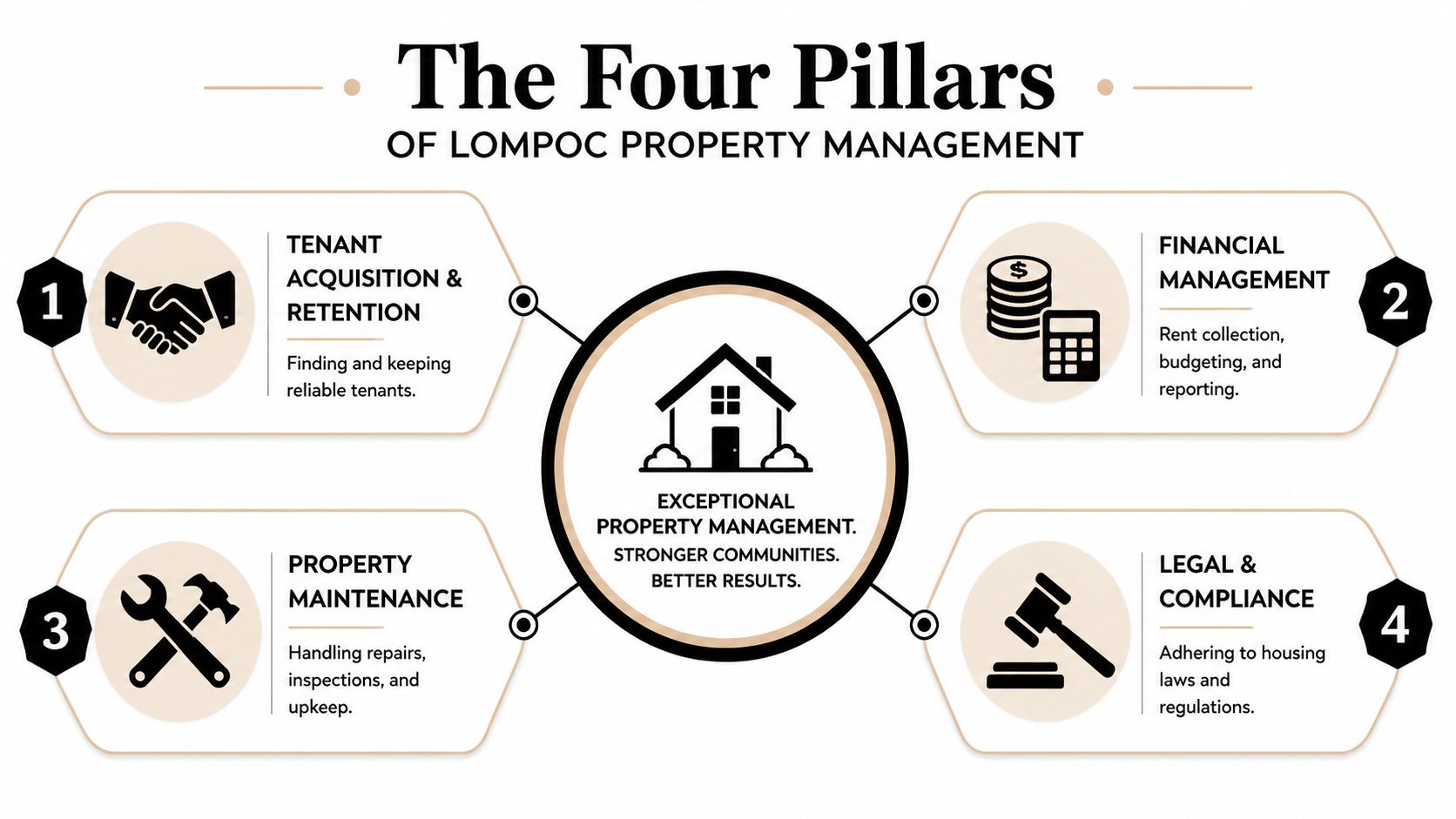
The Four Pillars of Lompoc Property Management Services
A Lompoc rental can look easy on paper. Then a launch schedule shifts activity near Vandenberg, showing requests bunch up over three days, one applicant has strong income but weak rental history, and a small plumbing issue turns into a tenant-retention problem because no vendor can get there until next week. That is why property management has to be built around a few core operating functions, not just rent collection.
Marketing and tenant placement
Placement starts with positioning the property for the renter pool that exists in Lompoc. That means paying attention to commute time to Vandenberg, school preferences, parking, garage use, pet rules, storage, and whether the floor plan fits a military household, a civilian contractor, or a local family staying longer term.
Pricing matters just as much as presentation. Owners who set rent by gut feel usually miss one of two ways. They either sit too high and lose momentum, or they price low and lock in weaker returns for a full lease term. Using local average rental rates by ZIP code helps narrow the range before you adjust for condition, location, and amenities.
Good placement work usually includes:
- Market-based pricing: Rent is set against current competition, not last year's number.
- Clear listing details: The ad answers common questions before the first showing.
- Fast lead handling: Qualified renters often decide quickly.
- Tight lease setup: Approved terms, deposits, and move-in documentation are handled correctly from day one.
Screening that reduces expensive mistakes
Screening is less about finding a perfect applicant and more about filtering out preventable risk. A solid process checks income, employment, rental history, application consistency, and legally permitted background items. It also tests whether the applicant's timeline, household size, and stated needs match the property.
That matters in Lompoc because demand is not all the same. Some applicants are tied to military orders or base-related contract work. Others are local households looking for stability and lower turnover. Those profiles can both work well, but they need different questions and different expectations around lease term, documentation, and renewal probability.
A polished application proves very little by itself.
Maintenance and repairs
Maintenance controls more of the owner's return than many first-time investors expect. The direct invoice is only part of the cost. Delayed response can lead to resident frustration, property damage, missed work, vacancy risk, and larger repairs later.
In Lompoc, vendor management is a real operating skill. The right manager has plumbers, HVAC techs, handymen, and cleaners who answer the phone, show up, and document the work. That matters more if you live out of area or own an older property where small issues come in clusters instead of one at a time.
The trade-off is straightforward. A cheaper repair that takes too long can cost more than a faster repair done right the first time.
Accounting and reporting
Every rental needs clean books. Owners should be able to see collected rent, unpaid balances, repair costs, vendor invoices, reserve use, and month-to-month performance without chasing paperwork.
Here’s what competent financial handling should provide:
| Function | What it should provide |
|---|---|
| Rent tracking | Clear records of collected rent, due dates, and any delinquencies |
| Expense records | Invoices, receipts, and categorized operating costs |
| Monthly reporting | A readable summary of income, expenses, and net cash flow |
| Year-end support | Organized statements that make tax prep easier |
Legal compliance runs through all four pillars. Marketing has to follow fair housing rules. Screening standards have to be consistent. Repairs have to support habitability. Accounting records have to hold up if a dispute shows up later. In practice, weak management rarely fails in one isolated area. It shows up as a bad placement, a late repair, poor records, and unnecessary loss of income.
Understanding the Lompoc Rental Market in 2026
You buy a three-bedroom in Lompoc expecting a standard Central Coast tenant pool. Two weeks later, your strongest inquiry comes from a household tied to Vandenberg with a hard move-in date, housing allowance constraints, and little patience for a slow make-ready. That is a normal Lompoc leasing scenario, and it changes how owners should price, prepare, and manage property.
Lompoc does not behave like a generic beach-adjacent rental market. The city gets demand from local workforce renters, military households, defense contractors, and people who want more space at a lower price point than Santa Barbara County’s more expensive submarkets. That mix creates opportunity, but it also creates uneven turnover patterns and faster decision windows.
Vandenberg Space Force Base is the biggest reason. Base activity supports recurring housing demand, and that demand is practical, deadline-driven, and often tied to assignment timing rather than long local search cycles. Owners who understand that usually lease faster. Owners who price late, delay repairs, or let a unit sit half-ready often miss the best applicants.
For an investor, the key question is not whether demand exists. It does. The better question is what kind of demand your property is built to capture.
A clean apartment near common commute routes to Vandenberg may perform best as a long-term rental aimed at military and contractor households who want a simple move. A larger single-family home may attract families who care more about school routines, garage space, yard use, and lease stability. A furnished unit may look appealing for higher-income temporary demand, but only if the owner is prepared for tighter operations, more frequent coordination, and local rule compliance.
That is why broad citywide averages have limits. In Lompoc, small differences in location, bedroom count, parking, and condition can change the renter profile quickly. Owners who want a better pricing baseline should start with average rental rates by zip code and then compare that range against current competing listings, commute convenience, and property condition.
The management decision should follow the economics.
If the property is newer, close by, and likely to attract stable long-term tenants, self-management can work for an owner who has time to answer calls, coordinate vendors, and stay current on California rules. If the owner is comfortable handling day-to-day issues but wants help finding a qualified tenant fast, placement-only service often fits best. If the property serves military-related demand, has frequent turnover, or the owner lives out of area, full-service management usually makes more financial sense because speed and execution protect income.
Here is the practical framework I use with Lompoc owners:
| Ownership situation | Best fit | Why |
|---|---|---|
| Local owner, newer unit, low expected maintenance | Self-management | Lower operating cost if you can handle leasing, compliance, and repairs yourself |
| Local or semi-local owner, wants help filling vacancies | Placement-only | Good fit when leasing is the weak point but daily management is still manageable |
| Out-of-area owner, older property, military-heavy tenant base, or frequent turnover | Full-service management | Faster response times, tighter turnover control, and less income loss from delays |
Short-term rentals are a separate decision, not an automatic upgrade. Gross revenue can look attractive on paper, but Lompoc is not a passive short-term rental market for most owners. Furnishing costs, cleaning coordination, guest messaging, occupancy swings, and calendar management can eat into returns fast. For many investors, a well-run long-term rental tied to Vandenberg-related demand produces a cleaner workload-to-cash-flow ratio.
Compliance also affects market performance here. California notice rules, habitability standards, screening consistency, and documentation practices all shape what your real return looks like after a vacancy, repair dispute, or nonpayment issue. In Lompoc, good market knowledge helps you set rent. Good operations protect the rent you set.
The owners who do well in this market usually make one clear choice. They either commit to managing actively, use placement-only for better leasing execution, or hire full-service help because their time, distance, or property type makes delay too expensive.
Full-Service vs Placement-Only Management Fees and Services
A common Lompoc scenario looks like this. An owner closes on a single-family rental near Vandenberg demand, gets the unit leased quickly, then realizes the true question was never whether to hire help. It was how much of the work to keep.

In this market, the fee model has to match the property and the owner’s operating style. Lompoc is shaped by government and aerospace employment, especially Vandenberg Space Force Base. That creates steady rental demand, but it can also create compressed move-in timelines, military-related relocations, and turnovers that punish slow response. If an owner can manage those handoffs well, placement-only can work. If delays regularly cost rent, full-service usually pays for itself.
What full-service actually covers
Full-service management means the manager stays involved after the lease is signed. That usually includes marketing, showings, applicant screening, lease execution, rent collection, maintenance coordination, tenant communication, notices, renewals, and owner reporting.
The main value is operational speed and consistency. In a Lompoc rental, one missed maintenance call or one slow turn between tenants can erase a meaningful share of the monthly cash flow. Full-service is often less about convenience and more about protecting income during the parts of ownership where small delays get expensive.
One local pricing example comes from Beach Front Property Management’s Lompoc page. It lists a $150 monthly base management fee, $100 per additional property, and $1,500 for tenant placement. Firms with a structure like that are usually a better fit for owners who want one point of accountability for leasing, collections, repairs, and monthly statements.
Accounting matters here too. Owners should ask what reports are included, how repair invoices are documented, how reserve balances are handled, and how year-end records are delivered. That affects tax prep and cash-flow tracking more than the headline fee does. Good records also make it easier to sort out what rental owners can claim when expenses start stacking up across repairs, turnover work, and management charges.
What placement-only covers
Placement-only is a narrower service. The manager handles the leasing side, typically marketing, inquiry response, showings, screening, and lease preparation. After possession is delivered, the owner takes over.
That means the owner is responsible for rent collection, repair coordination, renewals, notices, habitability follow-up, and day-to-day tenant communication. For a local owner with reliable vendor contacts and enough time to respond quickly, that can be a sensible way to control costs.
For an owner who travels, works long hours, or owns an older home that needs more touchpoints, it often creates a weak handoff. The leasing work gets done professionally, but the income can still slip later if maintenance response, documentation, or enforcement is inconsistent.
Here is the practical split:
| Service area | Full-service | Placement-only |
|---|---|---|
| Marketing | Manager handles it | Manager handles it |
| Screening | Manager handles it | Manager handles it |
| Lease drafting | Manager handles it | Manager handles it |
| Rent collection | Manager handles it | Owner handles it |
| Maintenance calls | Manager handles it | Owner handles it |
| Renewals and notices | Manager handles it | Owner handles it |
| Monthly accounting | Usually included | Usually owner-managed |
A quick visual helps when you’re thinking through that split:
How to choose based on return, not preference
Start with three questions.
How far are you from the property? How fast can you approve and solve problems? How much vacancy or operational drift can the property absorb before the fee savings disappear?
If the home is newer, the owner is local, and the plan is to stay involved, placement-only often makes sense. If the property serves tenants tied to Vandenberg-related moves, has tighter turnover timing, or needs active repair coordination, full-service is usually the better financial decision even if the monthly fee looks higher at first glance.
Owners get in trouble when they compare fee percentages without pricing the workload behind them. In Lompoc, the right service level is the one that protects rent collection, shortens vacancy, and keeps the property stable through the next turnover cycle.
The True Cost of DIY Property Management vs Hiring a Pro
A Lompoc owner buys a rental expecting steady income, then gets a 9:15 p.m. maintenance call during a launch week at Vandenberg. The tenant wants an answer now, the vendor cannot get there until morning, and the owner is trying to decide whether saving a management fee still makes sense.
That is the comparison in Lompoc. Owners are not choosing between “free” and “paid.” They are choosing who handles leasing speed, tenant communication, repair coordination, compliance, and turnover risk when the property needs attention at the wrong time.
DIY can work. Local owners with one well-maintained house, reliable vendors, and time during business hours often do fine. The savings are real if the property stays occupied, the tenant pays on time, and repairs stay manageable.
The problem is that first-time investors usually price DIY against the monthly fee alone. The actual cost sits in the gaps.
Where DIY gets expensive in Lompoc
The first gap is response time. In a market influenced by Vandenberg Space Force Base, some tenants move on a tighter timeline than a typical long-term renter. Delayed follow-up on an inquiry, a slow showing schedule, or a repair that drags out over several days can turn into extra vacancy or a weaker renewal.
The second gap is judgment. Screening sounds simple until an application lands with mixed income, inconsistent employment, or incomplete documentation. Lease enforcement looks easy until the first late-payment pattern starts. At that point, the owner is no longer saving time. The owner is managing risk.
The third gap is coordination. A small repair rarely stays small from an operations standpoint. Someone has to take the call, approve the scope, confirm access, track the invoice, and document the expense. Repeat that process a few times in one quarter and the fee savings start shrinking.
Time still has a cost
Self-managing owners usually absorb four kinds of labor:
- Lead response and showing coordination
- Vendor scheduling and repair approvals
- Payment tracking, notices, and lease paperwork
- Bookkeeping and year-end documentation
That last item gets overlooked. Good records matter for taxes, insurance questions, and owner reporting. If you want a practical outside reference on deductions and documentation, this overview of what rental owners can claim is worth reviewing.
I see owners abandon DIY for the same reason. Not because of one catastrophic event, but because the property keeps interrupting their primary job, evenings, and weekends.
Where professional management earns its fee
Professional management pays for itself when execution affects revenue more than the fee affects margin.
That usually happens in three situations in Lompoc. First, the owner lives out of town. Second, the property needs tighter turnover control because tenant demand is tied to local job movement, including military and aerospace-related relocation. Third, the owner wants rental income to act like an investment, not a second job.
A good manager does more than collect rent. They protect days-on-market, keep repair timelines from drifting, document problems early, and handle tenant issues before they grow into payment or legal trouble. That process matters more in a market where one extra vacant week can wipe out a meaningful share of the annual fee.
Use a simple decision framework
Start with the return, not the preference.
| Situation | DIY is usually reasonable | Hiring help is usually the better call |
|---|---|---|
| You live close to the property | Yes | Maybe |
| You can respond during the workday | Yes | If not, usually hire help |
| You already have trusted local vendors | Yes | If not, hire help |
| The property has older systems or frequent repair needs | Rarely | Usually yes |
| You want low involvement | No | Yes |
| You expect fast turnovers or tenant moves tied to Vandenberg-related demand | Only if highly available | Usually yes |
A practical rule helps. If one preventable vacancy gap, one mishandled repair, or one poor tenant placement would cost more than several months of management fees, full-service management is usually the better financial choice. If the home is stable, the owner is nearby, and the owner can consistently handle leasing and maintenance, DIY or placement-only can pencil out.
Before deciding, it helps to review a solid list of questions to ask a property management company. That makes the comparison less emotional and more operational.
In Lompoc, the right choice depends on how much execution risk your property can absorb before the fee savings disappear.
How to Select the Right Lompoc Property Management Company
A new owner closes on a Lompoc rental, hands the keys to the first firm with a polished website, and assumes the rest is routine. Then the first turnover hits. The manager prices the vacancy like it would in Santa Maria, sends a vendor from outside the area, misses the timing of Vandenberg-driven demand, and the property sits longer than it should. That is usually where owners learn the difference between a company that collects rent and one that manages risk.
Lompoc is a small enough market that local judgment matters, but it is not so small that every company works the same way. Some firms are built for steady single-family rentals. Some are better at leasing than operations. Some do fine until there is a payment issue, an after-hours repair, or a rushed turnover between military-related moves.
Start by asking a simple question. Do they understand how demand changes by location, property type, and tenant profile in Lompoc?
Ask for Lompoc-specific judgment
A good interview gets concrete fast. Ask how they would price a property near Vandenberg compared with one aimed at longer-term local households. Ask what renter profile they expect for your unit. Ask how often they see compressed move timelines tied to base assignments, contractor work, or launch-related employment.
Generic answers are a bad sign. A manager who works this market should be able to explain trade-offs. For example, a home that appeals to base-related renters may need faster showing response and tighter turn scheduling. A property in a more traditional neighborhood may benefit more from stable renewal strategy than from chasing the top asking rent.
Test their leasing process, step by step
Good managers can explain how an applicant moves from inquiry to signed lease without speaking in generalities.
Ask about:
- Lead response time: Who answers inquiries, and how quickly?
- Showing process: Are showings staffed, self-guided, or mixed?
- Application standards: How do they verify income, rental history, and identity?
- Approval consistency: Who makes the final call, and how is fair housing compliance handled?
- Lease execution: What documentation do owners receive before move-in?
Use a real checklist during the interview. This list of questions to ask a property management company helps owners compare firms on process instead of personality.
Compare management style to the return profile of the property
This matters more in Lompoc than many new investors expect. If your margin is thin, a manager who prevents one extra vacancy week or one avoidable make-ready mistake can justify the fee. If the property is newer, stable, and likely to attract straightforward renewals, a placement-focused firm may be enough.
Ask each company what type of owner they are best suited for. Serious operators usually answer directly. Some firms are strongest at placement and marketing. Others are built for full-service execution, with tighter maintenance coordination and better reporting. A mismatch here shows up in cost creep, slower turns, and owner frustration.
Ask how they handle maintenance, because that is where margins move
Maintenance is not just a service issue. It is a control issue.
Ask who receives repair calls, who decides whether a vendor is dispatched, what spending limit applies, and whether they use in-house staff or outside vendors. Then ask how they supervise the work. A low management fee can get expensive if every repair comes with weak bidding, loose oversight, or unnecessary urgency.
A smaller local firm may have better vendor relationships and faster judgment. A larger office may offer cleaner systems and stronger backup coverage. Neither is automatically the better choice. The right choice depends on whether your property needs flexibility, tighter communication, or scale.
Press on the uncomfortable scenarios
Weak firms are exposed when faced with challenging scenarios. Ask what happens if rent is late, if a tenant violates the lease, if a move-out turns contentious, or if a water heater fails at 9 p.m.
A capable manager should give direct answers on timelines, notices, documentation, owner communication, and vendor dispatch. If the response sounds vague, overly sales-driven, or different each time you ask, keep looking.
| Question | What you are really testing |
|---|---|
| How do you handle nonpayment? | Process discipline and documentation |
| Who handles after-hours calls? | Actual coverage, not just a promise |
| What is your move-out inspection process? | Turn cost control and deposit support |
| How do you approve repair estimates? | Spending discipline and owner visibility |
Request proof, not reassurance
Ask for a sample owner statement. Ask to see how maintenance updates are communicated. Ask what the onboarding timeline looks like. Ask who your day-to-day contact will be.
Owners do not need a perfect sales pitch. They need clear reporting, consistent screening, fast leasing follow-through, and local decision-making that fits the economics of a Lompoc rental.
Choose the company that can explain its process in plain language, show how it controls vacancy and repair costs, and demonstrate that it understands how Vandenberg-related demand shapes leasing speed, tenant mix, and turnover timing in this market.
Preparing Your Lompoc Property to Attract Quality Tenants
Before you list the property, get honest about condition. Owners often focus on what they’ve gotten used to. Renters focus on what they see in the first few minutes. Those are not the same thing.
Start with the basics. The home needs to be clean, fully functional, and ready to show without explanation. If a door sticks, a faucet drips, or an outlet cover is missing, fix it before the listing goes live. Small deferred items make renters assume there are larger hidden ones.
Prepare for the first showing, not the last repair
Do the work in this order:
Handle safety and function first
Test fixtures, appliances, locks, windows, smoke and carbon monoxide devices, and anything else a renter will use immediately.Deep clean the property completely
A proper rental clean should make kitchens, bathrooms, flooring, windows, and baseboards feel move-in ready.Tighten curb appeal
The front entry, landscaping, exterior lighting, and house numbers all influence whether a prospect expects the interior to be well cared for.
Focus on what improves leasing speed
Not every upgrade produces a better return. In most rentals, clean paint, durable flooring, working blinds, updated light fixtures, and strong photos do more for leasing than decorative extras.
A few practical priorities:
- Neutral presentation: Clean, simple finishes appeal to a wider renter pool.
- Lighting: Dim rooms photograph poorly and show poorly.
- Storage clarity: Tenants care about closets, cabinets, garage use, and laundry setup.
- Pet policy readiness: If pets are allowed, set clear rules and prepare the property accordingly.
The best listing isn’t the one with the most features. It’s the one that removes the most renter hesitation.
Don’t skip photography and listing quality
Phone photos taken in bad light can drag down a perfectly good property. Professional photography changes how renters evaluate cleanliness, space, and value before they ever schedule a showing. Good staging also helps if the home has an awkward layout or several similar competing listings.
Finally, gather your documents before marketing begins. Have utility information, appliance details, lease terms, parking rules, maintenance expectations, and showing instructions ready. Good tenants notice when an owner runs a clean operation. So do bad ones.
Your Next Step Toward Passive Income in Lompoc
Lompoc rewards owners who treat rentals like operating assets, not side projects. The local math can work well, especially when you understand how Vandenberg shapes demand and when you choose the right management model for your time and risk tolerance. Self-management can work. Placement-only can be the right middle ground. Full-service is often the cleanest path when you want consistency, reporting, and fewer operational surprises.
If you’re preparing to market the property, it also helps to review strong listing and campaign ideas like these real estate ad examples for 2026 so your marketing doesn’t look generic in a competitive feed.
If you want help evaluating rent potential, choosing between placement-only and full-service management, or preparing your property for the Lompoc market, talk with Edinhart Realty and Property Management. They can help you turn a local property into a more predictable, better-run investment.


