

You probably didn’t buy a Fresno rental because you wanted to become an after-hours dispatcher, bookkeeper, leasing agent, and compliance officer.
But that’s the job once the property goes live.
A tenant texts about a leak on Sunday. An applicant looks solid until income documents don’t line up. A repair invoice arrives higher than expected. Renewal time comes around and you’re not sure whether the rent is still right for the neighborhood. None of that is unusual. It’s normal property operations.
That’s why property management for landlords matters so much in the Central Valley. The question usually isn’t whether the work exists. It does. The primary question is who handles it, how well they handle it, and whether the process protects your return or chips away at it month after month.
The True Job of a Landlord in 2026
It is 9:40 p.m. on a Sunday in Fresno. A tenant reports water under the kitchen sink, another lease renewal is coming up, and an applicant who looked fine at first now has income documents that do not quite line up. That is a normal week for a rental owner, not an outlier.
By 2026, the job of a landlord is operating a small housing business with legal exposure, cash flow pressure, and customer service demands. Rent collection is one task inside that job. The full workload also includes marketing, screening, documentation, maintenance response, vendor oversight, recordkeeping, and staying current on California rules that can get expensive fast if handled casually.
In the Central Valley, the margin for error is thinner than many owners expect. A delayed repair can grow into a habitability complaint. Weak screening can cost months of lost rent and turnover expense. Rent set without a clear read on the neighborhood can leave money on the table or push a vacancy longer than it should.
Owners usually feel the shift when the property stops behaving like a side investment and starts requiring operating discipline. That is the point where many start looking for a clearer explanation of what property management actually covers and whether they want to handle those functions themselves.
What catches landlords off guard
- After-hours issues: A minor leak at night can turn into damaged cabinets, flooring, and a tenant habitability problem by morning.
- Screening gray areas: The highest-risk applicant often passes the first glance test.
- Notice and documentation mistakes: Poor records can drag a simple enforcement issue into a longer dispute.
- Pricing errors: Rent set too high can extend vacancy. Rent set too low creates quiet losses every month.
A rental property can produce passive income. Managing it does not work that way.
Professional management does not remove ownership. It changes the owner’s job from constant reaction to structured oversight. For Fresno landlords, that shift often comes down to a practical question: is it better to spend time personally handling leasing, repairs, and compliance, or to pay for a system that protects the asset, limits preventable mistakes, and keeps the return more predictable?
What Property Management Is Really About
Property management isn’t just rent collection. It’s closer to assigning a CEO to your rental property.
The CEO analogy works because a good manager doesn’t only perform tasks. They coordinate decisions across leasing, maintenance, compliance, cash flow, and tenant experience. If one part slips, the rest gets more expensive.

If you want a plain-language breakdown of the role itself, this overview of what property management is is a useful starting point. The practical version comes down to four pillars.
Asset protection
This is the unglamorous work that preserves value.
It includes inspections, repair coordination, vendor communication, habitability awareness, and making sure a small issue doesn’t become a large invoice. In the Central Valley, that often means paying attention to seasonal wear, irrigation-related problems, HVAC strain, and deferred maintenance that gradually lowers tenant satisfaction.
A smart manager doesn’t just ask, “What broke?” They ask, “What pattern is this showing?”
Financial optimization
Collecting rent is only one piece.
Good property management for landlords also means setting rent based on real market behavior, tracking expenses cleanly, documenting owner statements, and watching whether the property is performing. A property can be occupied and still underperform if expenses drift or pricing is off.
That’s where discipline matters. A well-run property should produce records you can read quickly and trust.
Tenant relations
The tenant side gets underestimated all the time.
Screening, lease execution, communication, renewals, notices, and expectations all live here. Poor tenant handling creates turnover, conflict, and legal exposure. Strong tenant handling creates predictability.
Sometimes the best management decision is a fast, clear response that keeps a minor frustration from turning into a move-out.
Practical rule: The lease matters, but the day-to-day communication around the lease often decides whether the tenancy stays stable.
Marketing and leasing
Many owners often leave money on the table.
Listing quality, photography, showing process, application flow, and speed of follow-up all affect vacancy time and applicant quality. A weak listing attracts weak attention. A strong listing attracts better prospects and gives you more room to choose carefully.
Here’s the simple version:
| Pillar | What it looks like in practice | Why it matters |
|---|---|---|
| Asset protection | Repairs, inspections, vendor coordination | Prevents bigger losses |
| Financial optimization | Rent strategy, collection, statements | Protects cash flow |
| Tenant relations | Screening, communication, renewals | Reduces friction and turnover |
| Marketing and leasing | Photos, listings, showings, applications | Fills vacancies with better tenants |
The owners who do best usually stop asking, “Who fixes things?” and start asking, “Who manages the whole machine?”
Choosing Your Service Model Full-Service vs Placement-Only
Not every landlord needs the same level of help.
Some owners want complete delegation. Others are comfortable handling day-to-day operations but don’t want to gamble on marketing and screening. That’s a major fork in the road.
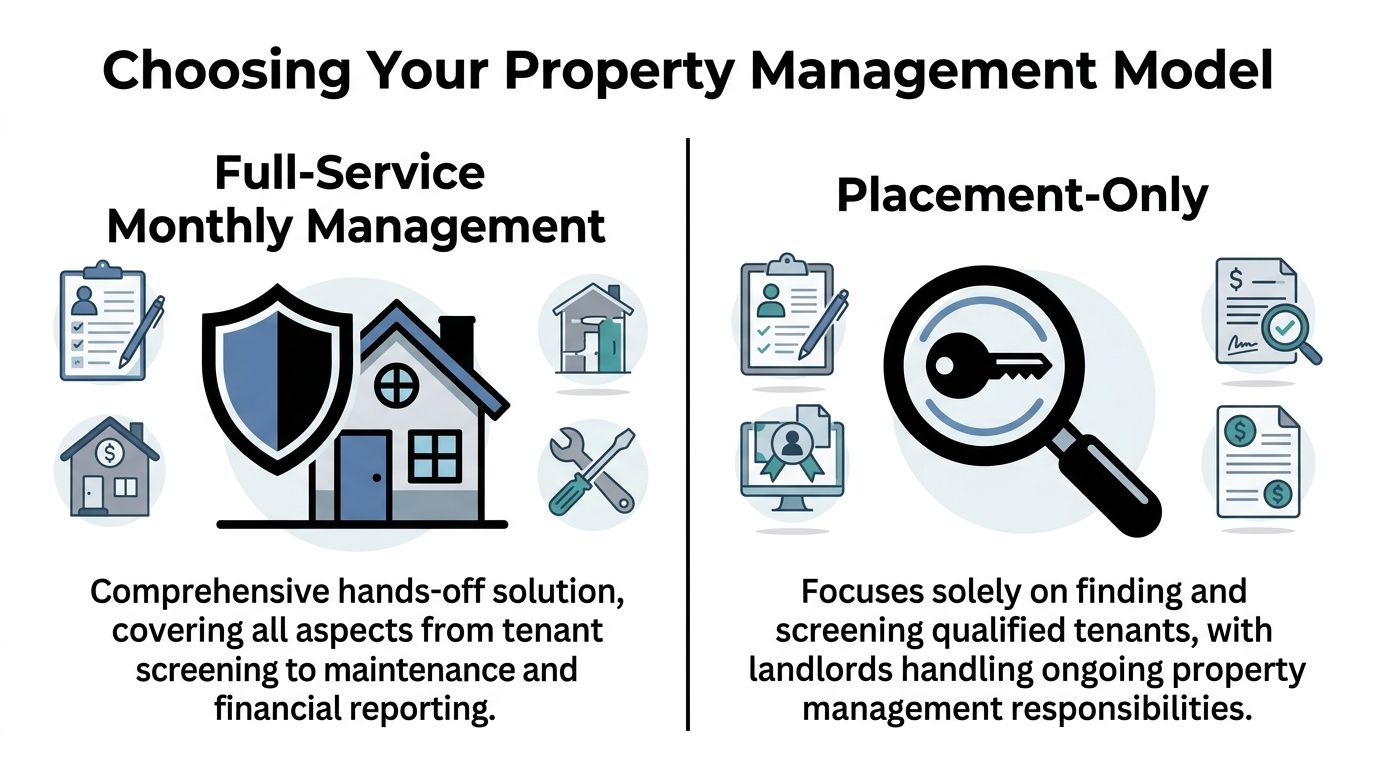
A lot of landlords assume there are only two choices: manage everything yourself or hand over everything. In practice, there’s a middle lane. As noted by MilitaryByOwner’s discussion of common landlord issues, the modern hybrid approach addresses the biggest risk, tenant selection, by using professional screening and marketing while the owner handles ongoing management.
That’s why the choice should be based on workload, risk tolerance, and how disciplined you are with follow-through.
Full-service monthly management
This model fits owners who want the property professionally run from leasing through renewals and ongoing operations.
Typical responsibilities handled under full-service management include:
- Marketing the vacancy: Professional photos, listing setup, showing coordination, and applicant follow-up.
- Screening and lease execution: Income review, background checks where applicable, rental history review, and lease documentation.
- Rent collection and records: Posted charges, payment tracking, owner statements, and documentation.
- Maintenance coordination: Tenant requests, vendor dispatch, repair follow-up, and recordkeeping.
- Routine tenancy management: Notices, renewals, communication logs, and move-in or move-out coordination.
This model tends to make sense for out-of-area owners, landlords with demanding jobs, inherited properties, or investors who don’t want operations to depend on their personal availability.
It also fits owners who know their weak spot. Some people are fine with numbers but hate conflict. Some are good with tenants but inconsistent with paperwork. Some don’t want midnight calls.
Placement-only service
Placement-only is narrower and more tactical.
You use professional leasing support to fill the property with a qualified tenant, then you take over the management side yourself. That means the owner generally handles rent collection, maintenance, notices, renewals, and tenant communication after move-in.
This model works best when the owner is:
- Comfortable managing details: You’ll need systems for maintenance, records, communication, and follow-up.
- Available enough to respond: A rental doesn’t care whether you’re in meetings, on vacation, or coaching Little League.
- Confident with landlord responsibilities: Not just the idea of them, but the repetitive execution.
For experienced landlords, placement-only can be efficient. It allows you to outsource the highest-risk front-end work, especially tenant selection, without paying for ongoing management you may not need.
A side-by-side way to decide
| Task | Full-service | Placement-only |
|---|---|---|
| Marketing and showings | Manager handles | Manager handles |
| Screening | Manager handles | Manager handles |
| Lease drafting and signing | Manager handles | Manager handles |
| Rent collection after move-in | Manager handles | Owner handles |
| Maintenance coordination | Manager handles | Owner handles |
| Notices and ongoing communication | Manager handles | Owner handles |
| Renewals and move-out process | Manager handles | Owner handles |
What usually works and what usually doesn’t
What works is matching the model to your actual behavior, not your intention.
A lot of owners choose placement-only because they like the lower upfront commitment. Then the first repair request, late payment issue, or documentation problem lands on a Tuesday they don’t have time for. The problem isn’t the model. The problem is mismatch.
What also fails is choosing full-service while still trying to direct every minor operational decision. That creates a confused chain of command. If you hire management, let the process work.
The right model isn’t the cheaper-looking one. It’s the one you can run consistently without creating avoidable vacancy, conflict, or compliance risk.
If you’re disciplined, available, and comfortable handling the long middle of a tenancy, placement-only can be a solid fit. If you want the property to operate without relying on your personal bandwidth, full-service usually wins.
The Financial Case for Professional Property Management
A Fresno owner can save 8% or 10% on a management fee and still come out behind for the year.
It happens in ordinary ways. Rent gets set a little low to fill the unit fast. A repair gets patched instead of fixed. A weak applicant looks acceptable after two vacant weeks. None of those decisions feels expensive in the moment. Together, they can cost more than the fee the owner was trying to avoid.

The right question is simple. Does professional management improve net income after vacancy, leasing, maintenance, turnover, compliance work, and owner time are all counted?
For many Central Valley rentals, the answer depends less on the visible monthly fee and more on whether the property is run with consistency. That is especially true in a market like Fresno, where rent sensitivity is real, repair costs can jump quickly in peak season, and one bad turnover can wipe out months of supposed savings.
The hidden cost of weak execution
Self-management can work well. It works best when the owner has time, local vendor relationships, clean systems, and the discipline to treat the property like a business instead of a side task.
The trouble starts when execution slips.
Common losses usually come from a few familiar places:
- Rent strategy misses: Price too low and the property fills fast while income lags market support. Price too high and vacancy eats the gain.
- Screening errors: A poor placement can lead to missed rent, property damage, conflict, and early turnover.
- Maintenance delay: A small plumbing issue in July can become drywall, flooring, and mold work if nobody acts quickly.
- Admin drag: Late notices, incomplete records, and inconsistent follow-up create extra cost even when they do not create a lawsuit.
That is why experienced owners judge management by net performance, not by fee percentage alone.
Use OER to measure whether the property is actually healthy
One metric I like owners to understand is the Operating Expense Ratio, or OER.
OER is operating expenses divided by gross operating income, expressed as a percentage. The formula is simple. Its value is practical. Gulf Income Properties' explanation of OER as a property management diagnostic gets to the core point. If two homes bring in similar rent but one burns more cash to operate, the issue is usually process, vendor control, repair quality, or rent positioning.
In Fresno, this is particularly relevant. Summer HVAC calls, irrigation issues, older housing stock, insurance renewals, and seasonal vendor bottlenecks can make a property look profitable on paper while expenses eat the margin.
OER helps answer the questions owners should be asking:
- Are repeat repairs showing that the original fix was incomplete?
- Are service vendors being priced and managed carefully?
- Is the rent level strong enough to support the property’s real operating costs?
Rent and occupancy get the attention. OER shows whether the income is holding up after the routine friction of ownership.
Owners who want cleaner books at year end should also coordinate with experienced Tax Accountants so rental income, repairs, capital improvements, and operating expenses are categorized correctly.
A short video can help if you want a broader owner-level view of the economics and workflow involved:
Occupancy only helps if the rent is right
A full property can still underperform.
Owners sometimes treat near-perfect occupancy as proof that operations are strong. In practice, a unit that never sits vacant may be priced below what the market would have supported. In Fresno, this shows up often with owners who renew reliable tenants too cheaply because avoiding a turnover feels safer than testing the market.
Good management looks at occupancy and pricing together. A property that stays occupied at the wrong rent can under-earn for a full lease term. A manager who reduces vacancy by a few days and improves rent discipline by even a modest amount may protect more NOI than the fee suggests.
Where professional management pays for itself
Professional management earns its keep in the routine parts of the job. Better screening. Better rent positioning. Faster maintenance coordination. Cleaner records. Fewer unforced errors.
Those items sound ordinary because they are ordinary. The money is made or lost there.
One option in this space is Edinhart Realty and Property Management, which offers full-service monthly management and placement-only leasing support for owners who want either complete delegation or help with tenant acquisition and lease setup. The financial benefit of any firm offering those services comes from stable systems that protect income and reduce preventable loss. The legal side matters too, especially once lease terms, notices, repairs, and deposits start interacting with California requirements. Owners who need that broader context can review this practical overview of California landlord-tenant law.
A management fee is easy to spot on a statement. The cost of inconsistent operations usually appears later, through vacancy, repairs, turnover, and avoidable disputes.
The strongest owners treat property management as a profit-control system. Convenience is part of it. Better execution is the primary financial argument.
Navigating California and Fresno Landlord-Tenant Laws
California doesn’t give landlords much room for casual paperwork.
That’s especially true once a tenancy has started. A screening shortcut is bad. A notice error after move-in can be worse.

For a Fresno landlord, legal compliance isn’t just about knowing the rule in theory. It’s about using the right forms, serving notices correctly, documenting communication, and handling deposits, repairs, and lease terms in ways that hold up if challenged. A practical primer on California landlord-tenant law can help frame the big issues.
The laws owners tend to underestimate
Most mistakes happen in routine situations.
Owners often run into trouble with:
- Security deposit handling: The issue usually isn’t intent. It’s documentation, timing, itemization, and what the owner can properly charge.
- Notices: A notice with the wrong content, timing, or service method can create delay and weaken your position.
- Entry and communication: Even justified entry needs to be handled properly and documented carefully.
- Lease enforcement: Rules need to be in the lease, communicated consistently, and enforced without improvisation.
In California, “I thought that was fine” is not much of a defense.
Why local practice matters
A lot of national landlord advice is too generic for this state.
Fresno owners need a manager or process that understands California forms, current requirements, and how local courts and local expectations shape real-world enforcement. Even when the property itself is straightforward, the people side rarely is.
One of the biggest practical benefits of professional management is consistency. The same process gets used for listings, applications, lease drafting, notices, maintenance records, and move-out documentation. That consistency lowers the chance that an owner says the wrong thing, waives a right unintentionally, or creates a file that doesn’t support the action they later need to take.
The legal risk in landlording usually doesn’t come from dramatic events. It comes from ordinary events handled sloppily.
A simple compliance checklist
If you’re self-managing, stay disciplined on the basics:
- Use current forms. Old templates and copied leases create expensive ambiguity.
- Document every material interaction. If it affects money, access, repairs, or lease compliance, record it.
- Treat notices as technical documents. Don’t wing them.
- Handle deposits with precision. Deposits are a frequent source of preventable disputes.
- Separate frustration from action. A tenant problem doesn’t justify a rushed legal move.
Many owners can self-manage operations. Fewer can self-manage legal process well under pressure. That distinction matters.
How to Vet and Hire the Right Fresno Property Manager
Hiring a property manager is less like hiring a handyman and more like hiring an operating partner.
You’re giving someone access to your income stream, your tenant relationships, and the records that matter if a dispute ever lands in front of a judge. The interview should reflect that.
If you want a starting list, these property manager interview questions are worth reviewing. Then go deeper.
Ask process questions, not sales questions
Most companies can sound polished for the first fifteen minutes.
What matters is whether they can describe how they work. Ask questions that force specifics:
- How do you screen applicants? You want to hear a real process, not “we do background checks.”
- How do you price a vacancy? Listen for local market reasoning, not a generic promise to get top dollar.
- How do you handle maintenance approvals? The answer should explain communication, thresholds, and documentation.
- Who talks to tenants? You need to know whether communication is centralized or scattered across staff.
- What does the owner statement include? If reporting is vague, your oversight will be weak too.
A good company should be able to explain the workflow in plain English.
Watch for operational discipline
The strongest clue isn’t charm. It’s structure.
Here’s a quick scorecard you can use during interviews:
| Question area | Strong answer sounds like | Weak answer sounds like |
|---|---|---|
| Screening | Clear criteria, consistent verification, documented standards | “We go with our gut” |
| Marketing | Professional photos, listing process, showing workflow | “We put it online” |
| Maintenance | Defined repair process, vendor coordination, approval rules | “We handle things as they come up” |
| Communication | Set channels, documented updates, response expectations | “Just call us anytime” |
| Accounting | Clean monthly statements, organized records | “We can send reports if you ask” |
Fee transparency matters
Don’t focus only on the headline management fee.
Ask what happens around the edges. Leasing fees, renewal fees, maintenance coordination charges, inspection charges, notice posting, and markups can change the economics if they aren’t explained clearly at the start.
You’re not looking for the cheapest contract. You’re looking for a contract you can understand before problems happen.
If a manager can’t explain their process clearly before you sign, they probably won’t make your property clearer after you sign.
Questions that reveal fit
Some final questions separate a workable relationship from a frustrating one:
- How many properties does each manager oversee?
- How do you handle owner disagreements about pricing or repairs?
- What happens if a tenant stops paying?
- How do you document move-in condition and move-out condition?
- Can I see sample statements and sample lease paperwork?
The right manager for your neighbor may be the wrong one for you. Some owners want hands-on collaboration. Others want minimal involvement and consistent reporting. The point of the interview is to find out whether the company’s operating style matches your expectations before your tenant becomes the stress test.
Preparing Your Home to Maximize Rental and Sales Value
Owners often ask whether they should spend money before listing.
The answer is yes, but only on the right things.
A rental or resale property doesn’t need luxury finishes to perform well. It needs to present cleanly, photograph well, and avoid raising immediate objections. Most of the return comes from removing friction, not adding flash.
Start with the items buyers and tenants notice first
The first pass should focus on surfaces, smell, light, and deferred basics.
Prioritize these:
- Paint in neutral tones: Loud colors narrow your audience fast.
- Lighting that works and matches: Inconsistent fixtures make a home feel patched together.
- Clean landscaping and curb appeal: The front exterior sets expectations before anyone walks in.
- Visible repairs: Loose hardware, damaged trim, stained caulk, and scuffed doors signal neglect.
If someone sees five small flaws in the first five minutes, they assume there are ten bigger flaws they haven’t found yet.
Choose durable finishes, not trendy ones
For rentals especially, durability usually beats design ambition.
Flooring is a good example. Owners often choose based on showroom appearance rather than turnover reality. That usually backfires. If you’re comparing options, this landlord's guide to the best flooring for rental properties is useful because flooring affects maintenance, cleaning, replacement timing, and how the property holds up after repeated move-ins and move-outs.
Think like a camera before you think like a contractor
Professional photography rewards simplicity.
A home tends to show better when it has:
- Clear counters and fewer personal items
- Open sightlines between rooms
- Consistent finish quality
- Good natural light and clean windows
That matters whether you’re renting or selling. Better presentation improves the quality of inquiry, not just the quantity.
Where owners often overspend
The common mistake is putting money into low-visibility upgrades while ignoring presentation and wear.
Custom touches, overly specific design choices, and high-end finishes that don’t match the neighborhood rarely carry the return owners expect. In most cases, clean, durable, neutral, and well-photographed wins.
A property should feel easy to say yes to. That’s what raises perceived value.
Frequently Asked Questions for Fresno Landlords
I live out of state. Is full-service management my only practical option
Distance changes the math.
An out-of-state owner can self-manage a Fresno rental, but only if the operation is already set up properly. That means reliable vendors who will pick up the phone, a clear process for approvals, solid bookkeeping, and someone local who can put eyes on the property when a repair call sounds bigger than it first appears. Placement-only can work for owners with those systems. For owners without them, the first plumbing leak, lease violation, or missed notice usually turns a fee-saving decision into a costly one.
How do you determine the right rent for a Fresno property
Start with current comparables, then adjust for the details that tenants respond to.
In Fresno and the surrounding Central Valley markets, small differences matter. A house in a stronger school area, a home with covered parking, or a property that shows clean and bright online can justify a different number than a similar floor plan a few streets over. Season matters too. So does the type of applicant the asking rent is likely to attract. Good pricing is not about squeezing for the highest number on paper. It is about finding the point where rent, days on market, and tenant quality line up.
Is higher occupancy always better
High occupancy sounds good, but perfect occupancy can hide underpricing.
If a unit rents immediately every time, with little resistance and multiple qualified applicants ready to sign at once, the market may be telling you the rent was set too low. The goal is not just to keep the property full. The goal is to keep it occupied at a rate that makes sense for its condition, location, and risk profile. In Fresno, one extra week of vacancy can be cheaper than locking in a full year at below-market rent.
What happens if a tenant stops paying or violates the lease
Process decides whether the problem gets contained or gets expensive.
The file has to be reviewed carefully. Notices have to be correct. Communication has to stay professional. Documentation has to be complete from the first missed payment or first confirmed violation. California law gives landlords remedies, but it also gives tenants procedural protections, and Fresno owners get into trouble when they act on frustration instead of on the lease, the timeline, and the notice requirements.
Can a property manager help if I decide to sell later
Yes. A good manager can help you weigh the three real options. Sell vacant, sell with the tenant in place, or hold off and improve the property first.
Each path has trade-offs. Selling vacant may improve showing conditions and buyer demand, but it can also create downtime and carrying costs. Selling with a tenant in place can appeal to an investor, but the lease terms, rent level, and property condition will shape the price. In practice, the better decision usually comes from reviewing the rent roll, maintenance history, lease timing, and likely buyer pool before the listing goes live.
What’s the biggest mistake new landlords make
They treat landlording like a series of exceptions instead of a repeatable operation.
The owners who struggle are often smart and well-intentioned. They just make one-off decisions on screening, repairs, notices, late fees, or renewals based on the situation in front of them. That creates inconsistency, and inconsistency is expensive. A rental performs better when the standards are clear and the response is the same each time.
If you want a practical conversation about your rental, your options, or whether full-service or placement-only makes more sense for your situation, talk with Edinhart Realty and Property Management. They work with landlords across Fresno, Clovis, Friant, and the wider Central California market, and they can help you evaluate the next step based on your property, your workload, and your goals.


