

Owning a rental in Fontana can feel deceptively simple until the first late-night maintenance call, lease renewal dispute, or vacancy stretch hits your cash flow. At that point, picking among the many property management companies in Fontana CA stops being a convenience decision and becomes an asset-protection decision. If you live nearby, you want fewer headaches. If you manage remotely, you need a company that can act fast, document everything, and keep you informed without chasing updates.
That choice matters even more in a city with a crowded management field. Zillow's Fontana directory lists 113 property management companies in Fontana, so owners aren't choosing from a tiny local pool. You're comparing firms in an active market where service models, communication quality, and fee structure can materially change your returns.
If you're still dialing in pricing before you hire anyone, start by learning how to calculate correct rent value so you can evaluate a manager's rental analysis with a sharper eye.
1. TrueDoor Property Management
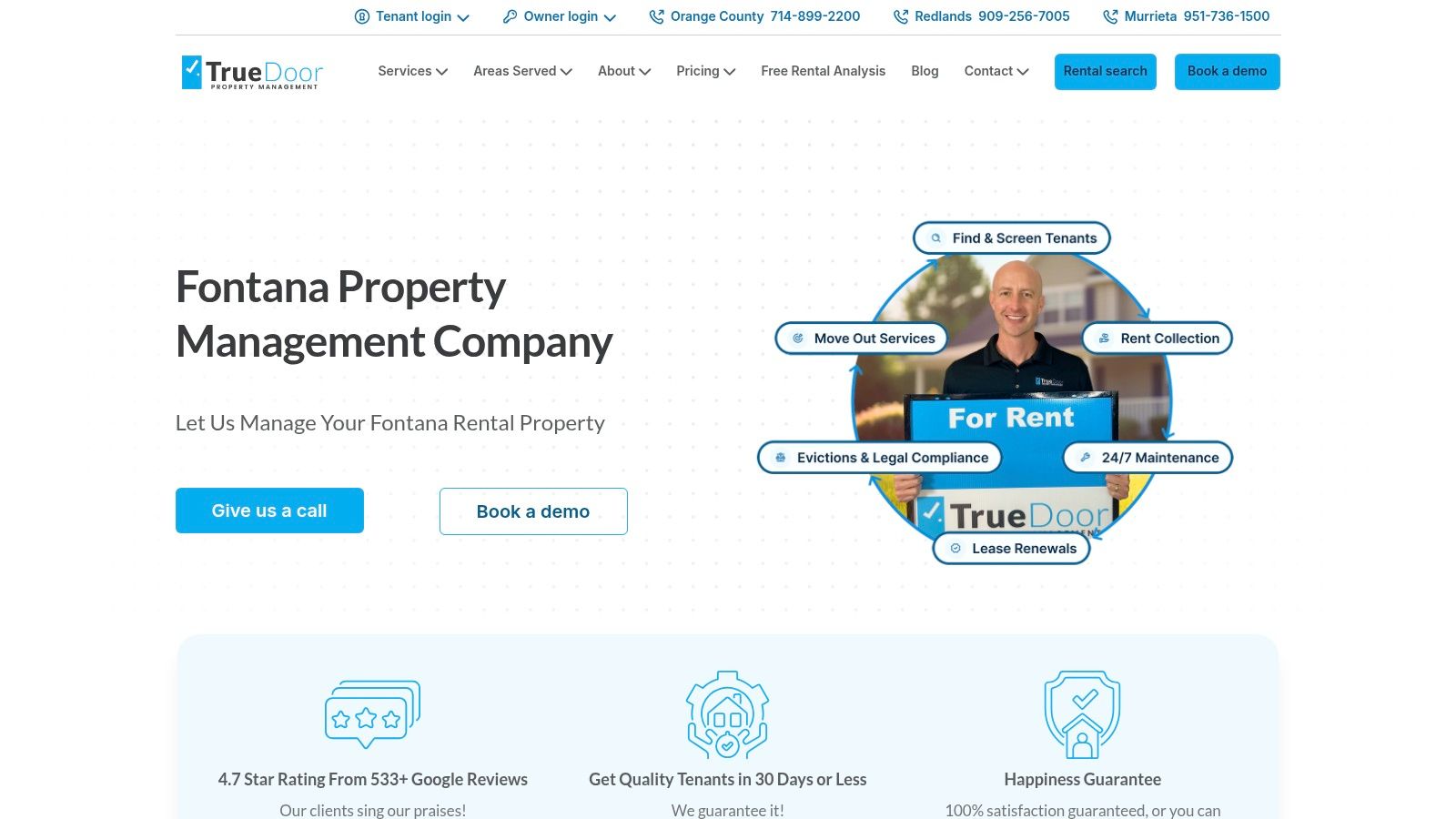
An owner living outside Fontana usually needs the same three things from a manager on day one. Fast leasing, clear reporting, and fewer surprises in the agreement. TrueDoor makes a stronger first impression than many local firms because its Fontana property management page gives owners enough detail to start comparing those points before a call.
That matters because a manager is not just collecting rent. The job includes leasing, maintenance coordination, tenant communication, documentation, and owner reporting. If you want a quick refresher on the full scope, this overview of what property management includes for rental owners is a useful baseline before you compare contracts.
Why TrueDoor makes the shortlist
TrueDoor is easier to evaluate than firms that hide the actual offer behind a contact form. Owners can review pricing structure, service options, and guarantees without guessing what the sales conversation will reveal later.
Its leasing presentation is also stronger than the standard local approach. The company highlights HD photography, 3D tours, and video walkthroughs. For owners trying to reduce vacancy, that matters because prospective tenants often decide which homes to tour based on online presentation alone.
Three parts of the offer stand out:
- Published pricing: Owners can review fee structure upfront and test how it affects net income.
- 24/7 owner portal: Statements, maintenance updates, and property activity are available without waiting for email replies.
- Guarantees: Lease-up and cancellation protections give owners a clearer way to compare risk transfer between firms.
Due diligence points to check before signing
TrueDoor scores well on transparency and remote-owner usability. That does not automatically make it the best fit.
Owners who prefer a smaller office with one primary point of contact may find the experience more system-driven than relationship-driven. That is not a flaw if you want consistency and documentation. It can be a trade-off if you expect a highly customized process or direct access to the same person for every issue.
The optional protection packages also deserve a close read. They may reduce downside in the right situation, but they can also add recurring cost. Review what triggers the guarantee, what remedy is offered, and whether the protection replaces owner risk or limits it.
Owner check: Ask for the management agreement and guarantee terms before you commit. A strong headline matters less than the exact conditions for payout, cancellation, or tenant replacement.
For owners using a consistent comparison lens, TrueDoor is one of the easier companies in this list to underwrite. It performs best with owners who value pricing visibility, polished marketing, and portal-based reporting over a boutique communication style.
2. Mesa Properties, Inc.
Mesa Properties leans into something most owners say they want but rarely get. Fee clarity. On its Fontana management page, Mesa pairs local Inland Empire coverage with a visible fee schedule and investor-oriented tools.
That alone puts it on the short list for owners who hate opaque proposals. Many Fontana pages promise a “free rental analysis” but never explain what the owner is likely to pay or how the fee model affects net income. That's a meaningful issue in a market where independent consumer guidance says property management commonly costs about $69 to $225 per month in Fontana, depending on service scope and property type.
Why owners compare Mesa carefully
Mesa is structured for landlords who want to run the numbers, not just hear marketing language. Its ROI and vacancy-loss calculators push the conversation toward ownership outcomes instead of generic service descriptions.
The company also advertises multiple owner guarantees, including leasing and placement protections. Those don't automatically make it the best fit, but they do make due diligence easier because you can test whether the promises match your risk tolerance.
- Fee schedule online: You can compare plans without waiting for a callback.
- Investor tools: Useful for owners deciding whether active management beats self-management.
- Screening detail: Credit, income, rental history, background, and ID checks are all emphasized.
Ask one direct question: “What costs appear between a signed lease and first disbursement?” That's often where “transparent” pricing still gets fuzzy.
Best fit and likely friction
Mesa makes sense for owners who want a more structured, numbers-driven relationship. That includes investors with multiple homes, out-of-area owners, and anyone who wants the manager's assumptions visible before committing.
The flip side is that highly systematized companies can feel rigid to first-time landlords who want exceptions made on the fly. If you're still deciding what level of support you need, this overview of what property management includes is a useful baseline before comparing Mesa's plans against simpler placement-only options.
3. Clockwork Property Management
Clockwork is one of the easier firms to evaluate from your laptop because it publishes a detailed fee page rather than forcing every owner into a contact form first. Its Fontana property management page and public pricing setup signal a company that expects owners to comparison shop.
That's a good posture in Fontana. Realtor.com's ZIP 92337 market snapshot shows a median rent of $3.1K, 16 rentals listed, 51 homes for sale, a median listing price of $599K, and 50 median days on market. For managers, that points to a market where pricing discipline, fast lead handling, and strong presentation can directly affect vacancy exposure.
What Clockwork does well
Clockwork's value proposition is operational clarity. It offers full-service leasing, rent collection, accounting, maintenance coordination, and compliance-focused support, then pairs that with a Reachability Guarantee tied to response time.
That guarantee is unusually practical because owners often judge managers on one thing after move-in. Responsiveness. If communication slips, everything else starts to feel riskier.
- Detailed public fees: Easier to compare line items before outreach.
- Placement and management options: Helpful if you're weighing lighter service against full oversight.
- 24/7 maintenance support: Important for remote owners who can't handle after-hours issues.
A manager's maintenance process matters more after the lease is signed than before. Ask who approves repairs, who dispatches vendors, and how invoices are documented.
Fine print matters here
Clockwork is attractive for owners who want a transparent process and clear expectations. But this is the kind of company where reading the pricing terms carefully matters. Intro rates, placement minimums, and conversion terms can change your actual cost over time.
That doesn't make the offer weak. It just means owners should benchmark every proposal against practical guidance on how much property management should cost before deciding that the lowest visible fee is the best long-term deal.
4. Jackson Property Management (Inland Empire)
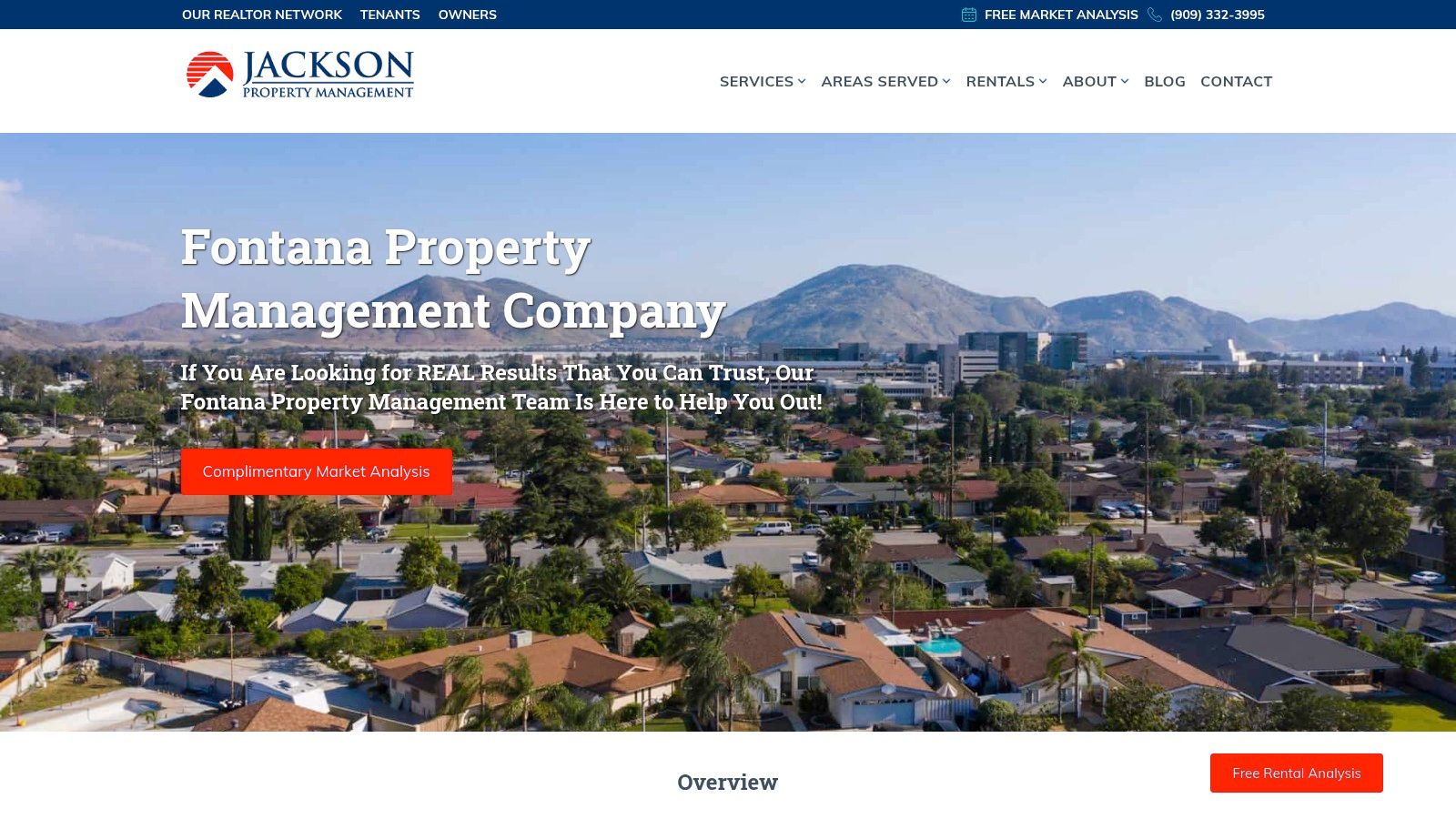
Jackson Property Management is a practical option for owners who care less about polished public pricing pages and more about whether someone can show up when something goes wrong. Its Fontana service page emphasizes local coverage, broad portfolio support, and around-the-clock availability.
That on-site angle is a real differentiator. Owners with older homes, mixed-use properties, or recurring maintenance issues often need response capacity more than they need slick dashboards.
Why it works for some owners
Jackson appears built for landlords who want a regional operator with local access across the Inland Empire. The company handles residential, multifamily, and commercial properties, which can be useful if your holdings don't fit neatly into a single-family template.
Its intake process also looks straightforward. You can request a rental analysis and quote without digging through a lot of packaged marketing.
- 24/7 support: Better suited to incident-heavy properties.
- Broad asset coverage: Helpful for owners with varied holdings.
- Quote-based pricing: Useful if your property needs custom handling.
Where you need more answers
The trade-off is obvious. You won't get the same public fee transparency here that you get from some competitors. That means the quality of your screening call matters more.
When a company doesn't publish pricing, ask these questions in writing:
- What's included monthly: Rent collection, inspections, repair coordination, and owner statements.
- What triggers extra fees: Leasing, renewals, notices, court coordination, and condition reporting.
- How they screen tenants: Income verification, rental history review, and decision standards.
Jackson is often a better fit for owners who value responsiveness and regional coverage over a self-serve online buying experience. If you're comparing property management companies in Fontana CA for a mixed portfolio, that's a valid trade.
5. Evernest (Inland Empire)
Evernest is the option on this list that most clearly targets the owner who values standardized systems across more than one market. Its Fontana and Inland Empire service page combines local service with a broader operating model built around repeatable reporting, maintenance coordination, and resident communication.
That setup can be especially useful if you live out of town or already own rentals in multiple cities. National-style infrastructure tends to reduce friction around statements, disbursements, and account visibility, even if it sometimes loses a little local texture.
Best use case for Evernest
If your priority is process consistency, Evernest deserves attention. The company publishes regional pricing, offers regular owner disbursements, and supports owners through an online portal with reporting features.
This is the kind of manager many portfolio owners prefer because the experience is easier to replicate property to property.
- 24/7 resident communication: Good for reducing owner involvement in routine issues.
- Owner portal and reporting: Useful when you want clean records without chasing updates.
- Scalable operating model: Better aligned with multi-property or remote ownership.
Some owners overvalue “local” and undervalue “repeatable.” If you own in several markets, a standardized reporting cadence can be worth more than a highly personalized but inconsistent experience.
Where owners should pause
The downside is predictable. A larger platform can feel less hyper-local than a boutique company that knows every block and leasing nuance by instinct. Add-on fees also matter here, especially for renewals or condition reporting, because standardized systems often separate core management from extras.
Evernest makes the most sense for owners who want dependable process, steady reporting, and lower operational involvement. It's less ideal if you want a highly customized relationship or deep hand-holding on every leasing decision.
6. Utopia Management
Utopia Management is one of the more versatile names in the Fontana field because it isn't limited to standard residential rentals. On its Fontana property management page, the company presents itself as a manager for residential, commercial, and industrial assets.
That broader scope won't matter to every owner. But if you hold a mixed portfolio, versatility can save you from hiring multiple managers with separate systems and reporting styles.
Why mixed-asset owners look here
Utopia emphasizes full financial management, tenant placement, retention, and maintenance coordination through licensed and insured vendors. For owners with different property types, that breadth can be more useful than a company that's highly polished in one niche but thin outside it.
This is also where local market context matters. California's property management industry generated about $18.2 billion in revenue in 2024, with 50,790 businesses offering property management services in the state as of 2024, and 78,600 workers projected by 2025. A firm like Utopia operates inside that mature, highly professionalized environment, where accounting systems, compliance habits, and maintenance networks are expected rather than optional.
Main pros and watchouts
Utopia is attractive when you need one company to handle more than a single-family rental. It also helps if vetted vendor access is a priority, especially for owners who don't already have a trusted repair network.
A few practical checks matter before signing:
- Ask about inspection cadence: Broad service language doesn't always mean frequent property checks.
- Clarify portfolio specialization: Commercial and industrial experience is useful only if the assigned team handles those assets regularly.
- Request sample reporting: Monthly and year-end statements vary a lot in depth and readability.
The biggest drawback is simple. No public fee table. You'll need a custom proposal, and that means careful side-by-side review against managers who publish their pricing more openly.
7. The LaBrada Group
A common Fontana owner scenario looks like this. The property is local, but the owner is not. What matters most is not flashy software. It is whether the manager can handle leasing, maintenance, notices, and tenant issues with sound local judgment.
That is the lane The LaBrada Group's Fontana property management page is aiming for. The firm presents itself as a local operator focused on marketing, maintenance coordination, and California legal familiarity. For owners comparing companies through a due diligence lens, that makes LaBrada easier to place in the market. It appears stronger on local hands-on management than on published pricing or visible tech stack detail.
Where LaBrada fits best
LaBrada stands out for owners who put local execution ahead of process transparency. That usually includes landlords who expect harder tenant conversations, older properties that need more vendor coordination, or out-of-area owners who want a manager with Fontana-specific leasing judgment.
That trade-off is real. A firm with stronger local involvement can be a better fit than a company with better software marketing if your property tends to produce compliance questions, repair approvals, or resident disputes.
Due diligence questions to ask before signing
This is not the easiest company on the list to evaluate from public information alone. Owners should expect to do more of the vetting themselves during the proposal call.
Ask these questions directly:
- Pricing structure: Is management priced as a percentage, flat fee, or a hybrid with lease-up and renewal charges?
- Inspection schedule: How often are occupied and move-out inspections performed, and do owners receive written reports with photos?
- Repair approvals: What dollar threshold triggers owner approval, and what counts as an emergency?
- Marketing process: Where are listings syndicated, who handles showings, and how quickly are listing updates made if a unit sits?
- Legal escalation: How are late rent, lease violations, and notice situations handled before outside counsel is involved?
- Owner reporting: What do monthly statements include, and how clean is year-end documentation for taxes?
Main advantage and main limitation
The advantage is clear. LaBrada looks well suited to owners who want local market familiarity and practical oversight.
The limitation is just as clear. Public-facing detail appears thin compared with managers that publish fee tables, guarantees, and platform features upfront. If you manage remotely, ask for sample reports, a draft management agreement, and a precise breakdown of all non-monthly fees before you commit.
Top 7 Fontana, CA Property Management Companies Compared
| Provider | Onboarding & Complexity 🔄 | Resource Needs & Pricing ⚡ | Expected Outcomes ⭐📊 | Ideal Use Cases 💡 | Key Advantages |
|---|---|---|---|---|---|
| TrueDoor Property Management | Moderate, full-service workflows and 24/7 owner portal 🔄 | Published pricing; optional add-on protections (monthly) ⚡ | High leasing velocity and marketing-driven vacancy reduction ⭐📊 | Owners who want aggressive media marketing and transparent online pricing 💡 | Media-forward marketing, 30-day & “Happiness” guarantees, 24/7 portal |
| Mesa Properties, Inc. | Low–Moderate, systematized processes with clear fee table 🔄 | Transparent flat monthly plan (may be premium for low-rent SFRs); investor calculators ⚡ | Predictable costs and measurable guarantees reduce owner risk ⭐📊 | Local Inland Empire investors valuing fee transparency and ROI tools 💡 | Clear fee transparency, investor calculators, multiple owner guarantees |
| Clockwork Property Management | Moderate, full-service with public fee page; read promo fine print 🔄 | Detailed fee table; 24/7 maintenance; intro fees convert later; placement minimum ⚡ | Reliable operations with formal response guarantee (waived fee if missed) ⭐📊 | Owners prioritizing responsiveness and clear line-item fees 💡 | Reachability Guarantee, detailed public fees, 24/7 support |
| Jackson Property Management (Inland Empire) | Low, streamlined intake and free rental analysis; pricing by quote 🔄 | No public fee table; requires outreach for pricing; local on-site resources ⚡ | Quick on-site incident response and useful initial cost comparisons ⭐📊 | Owners needing fast local emergency response or localized quotes 💡 | Local team with emergency on-site response; easy comparative quotes |
| Evernest (Inland Empire) | Moderate, national systems with local team; regional pricing posted 🔄 | Scalable systems, owner portal, twice-monthly disbursements; some services are add-ons ⚡ | Consistent reporting and capped fees attractive to portfolio/out-of-state owners ⭐📊 | Portfolio or out-of-state owners who want standardized reporting and scale 💡 | Scalable infrastructure, standardized reporting, competitive fee caps |
| Utopia Management | Moderate, customized proposals for mixed-asset portfolios 🔄 | No public fee table; handles residential, commercial, industrial; vetted vendors ⚡ | Comprehensive financial management and vendor access across asset types ⭐📊 | Owners with mixed assets (SFR + commercial/industrial) seeking one manager 💡 | Versatility across asset classes, vetted licensed vendors, full financials |
| The LaBrada Group | Low–Moderate, local Fontana focus; pricing by contact 🔄 | No public pricing; in-house legal resources may reduce external legal spend ⚡ | Strong compliance handling and locally targeted marketing outcomes ⭐📊 | Compliance-minded Fontana owners needing legal oversight and local expertise 💡 | In-house legal support, deep local market experience, high-quality advertising |
Your Checklist for Choosing the Right Fontana Manager
The right choice usually becomes clear when you stop asking, “Who offers full service?” and start asking, “Who fits my property, my risk tolerance, and my need for visibility?” That's the key filter. Plenty of property management companies in Fontana CA can collect rent and coordinate repairs. Fewer can explain their fee model clearly, document decisions well, and operate smoothly when you live hours away.
Start with pricing. Don't accept broad phrases like “competitive rates” or “custom management solutions” without a line-by-line breakdown. Ask whether the fee is flat-rate or percentage-based, what leasing costs are separate, whether renewals carry extra charges, and how maintenance coordination is billed. A cheap monthly fee can become expensive fast if every notice, inspection, or vendor dispatch creates another invoice.
Next, test the service model. Ask how the company handles tenant placement, how fast it responds to leads, what happens when a resident stops paying, and who communicates with you during a dispute. If you're out of state, make them show you their owner workflow. You want to know how statements are delivered, how repairs are approved, and what level of documentation you'll receive without asking.
It also helps to match the manager to your ownership style. Some owners need full monthly management. Others only need leasing and screening, then prefer to handle the day-to-day themselves. That's why flexible models matter. For example, firms such as Edinhart Realty & Property Management in Central California offer both full-service and placement-only structures, which is a practical model for owners who want to choose how much control to keep while staying grounded in sound process. If you're brushing up on the language owners and managers use during these conversations, this guide to real estate investment terms is worth keeping open during your comparisons.
The final check is simple. Read the management agreement. Read the repair authorization terms. Read the cancellation language. The best manager for your Fontana rental isn't the one with the flashiest pitch. It's the one whose contract, communication habits, and operating style protect your income and your property without creating new problems.
If you're comparing management models and want a practical benchmark for what clear service structure looks like, Edinhart Realty and Property Management is worth reviewing. Edinhart offers both full-service monthly management and placement-only service in Central California, which can help owners think more clearly about the level of support they need before signing with any property manager.


