

A tenant texts at 8 AM about water dripping from a ceiling. An owner emails asking for the latest rent roll. Three applications are waiting in the leasing inbox, and a maintenance request from last week has gone quiet. None of these messages can be handled well by just “responding quickly.” Each needs a different channel, owner, record, and next step.
That's the practical side of property management communication. The work isn't just answering calls or clearing an inbox. It's making sure the right person receives the right information, understands what happens next, and can find a reliable record later.
What Property Management Communication Solves
A ceiling drip arrives before breakfast, an owner asks for the rent roll, several applications need updates, and a maintenance ticket has gone quiet. Each message requires a different channel and a different record. Treating them all as inbox replies creates delays, confusion, and work that resurfaces later.
For a ceiling leak, start with triage. Confirm whether it is an emergency, assign the next action, acknowledge the tenant, and create a written trail. A call may clarify the situation fastest. Follow it with a message recording the address, photos, access instructions, responsible party, and immediate plan. Reusable script: “I've received your report. We are assessing the urgency now, and I will update you by [time].” Documentation rule: save the call summary and promised update in the property record.
An owner's rent-roll question usually belongs in a concise email. Provide the available information, identify anything still being reconciled, and state when the next update will arrive. Script: “Attached is the current rent roll. I am reconciling [item] and will confirm the final figure by [time].” Record the sent report and any unresolved item.
Applicants need consistent screening messages, while a silent maintenance ticket needs named ownership. Confirm receipt of documents without implying approval. For maintenance, contact the vendor, update the tenant, and explain any changed timeline. Script: “Your request is assigned to [vendor or staff member]. The next step is [action], and I will update you by [time].” Record the assignment, contact attempt, revised timeline, and completion evidence.
Practical rule: Every message should answer three questions: who owns the next action, what happens next, and when the recipient will hear from you again.
Weak communication creates repeat contacts. Tenants call because they cannot see whether a vendor was assigned. Owners request the same report when the first answer lacks context. Applicants resend documents when receipt was never confirmed. A delayed repair can become a complaint, disputed charge, security-deposit disagreement, or vacancy conversation when silence fills the gap.
Tenant research found 20% of respondents reported outstanding repairs, 13% reported slow or poor repair responses, and 13% specifically reported poor communication. Only 65% were satisfied that their landlord kept them informed, and 58% were satisfied that the landlord listened and acted on their views (tenant communication and repair findings). Keep residents informed from intake through completion.
A written policy turns a busy morning into repeatable channel, ownership, script, and documentation decisions. This step-by-step communication guide can help organize the structure, while rental operations need rules tied to urgency, responsibility, records, and resident expectations.
Building Blocks of a Written Communication Policy
A communication policy should be short enough for a new team member to use during a busy shift. It should also be specific enough to settle disagreements when someone asks whether a message should have been a call, an email, or a portal ticket.
Start with the operating standard
Write one paragraph explaining the purpose. For example: “We acknowledge every owner, tenant, vendor, and applicant request through an approved channel, assign responsibility, provide the next action and expected update, and preserve the communication in the property record.”
Then define the audiences separately:
- Owners: Financial performance, approvals, vacancies, risk, and property decisions.
- Tenants: Repairs, access, lease questions, notices, charges, and service updates.
- Vendors: Scope, access, authorization, scheduling, invoices, and completion evidence.
- Applicants: Application receipt, missing information, status, and formal outcomes.
The policy should define working hours, emergency routing, language preferences, and what happens outside normal coverage. It should distinguish first response from resolution. Acknowledging a repair doesn't mean the repair is complete, and telling an owner that a vacancy is being marketed doesn't mean a qualified applicant has been secured.
Give every message a record
Set one approved property record, whether that's a tenant portal, ticketing system, shared inbox, or controlled spreadsheet. Phone calls and in-person conversations belong there too. Record the date, participants, issue, decision, promised action, and next update.
Tone rules matter because consistency protects the relationship. Use plain language, avoid blame, don't speculate about legal outcomes, and don't promise a completion date that depends on a vendor or approval. Legal notices should use approved forms and a formal review process rather than casual wording.
A standard signature also helps recipients identify the right contact and escalation path. Teams that need consistent branding across staff can use hosted email signature templates, provided the signature includes the property-management office, contact route, and emergency instructions required by the policy.
Work one example through the policy
Suppose a tenant reports a ceiling leak by text. The policy directs the manager to call for immediate details, send written confirmation, create a portal record, classify urgency, assign the next owner, and state the next update time. If the tenant has limited digital access, the manager records the phone conversation and offers an accessible alternative.
The document should also define escalation tiers. A missed update moves from the assigned coordinator to the property manager. A safety concern or unresolved responsibility moves to the designated senior contact. The policy, not memory, becomes the standard for frequency, channel, tone, and recordkeeping.
Choosing Channels by Message Type and Message
A universal channel is convenient for the office and often wrong for the resident. Survey evidence indicates that approximately two-thirds of renters prefer a phone call for emergencies, while routine matters are more commonly preferred by email at 51% or text at 43%. Maintenance satisfaction was also higher among residents with online-portal access, 85% compared with 78% among those without access (renter channel and portal findings).
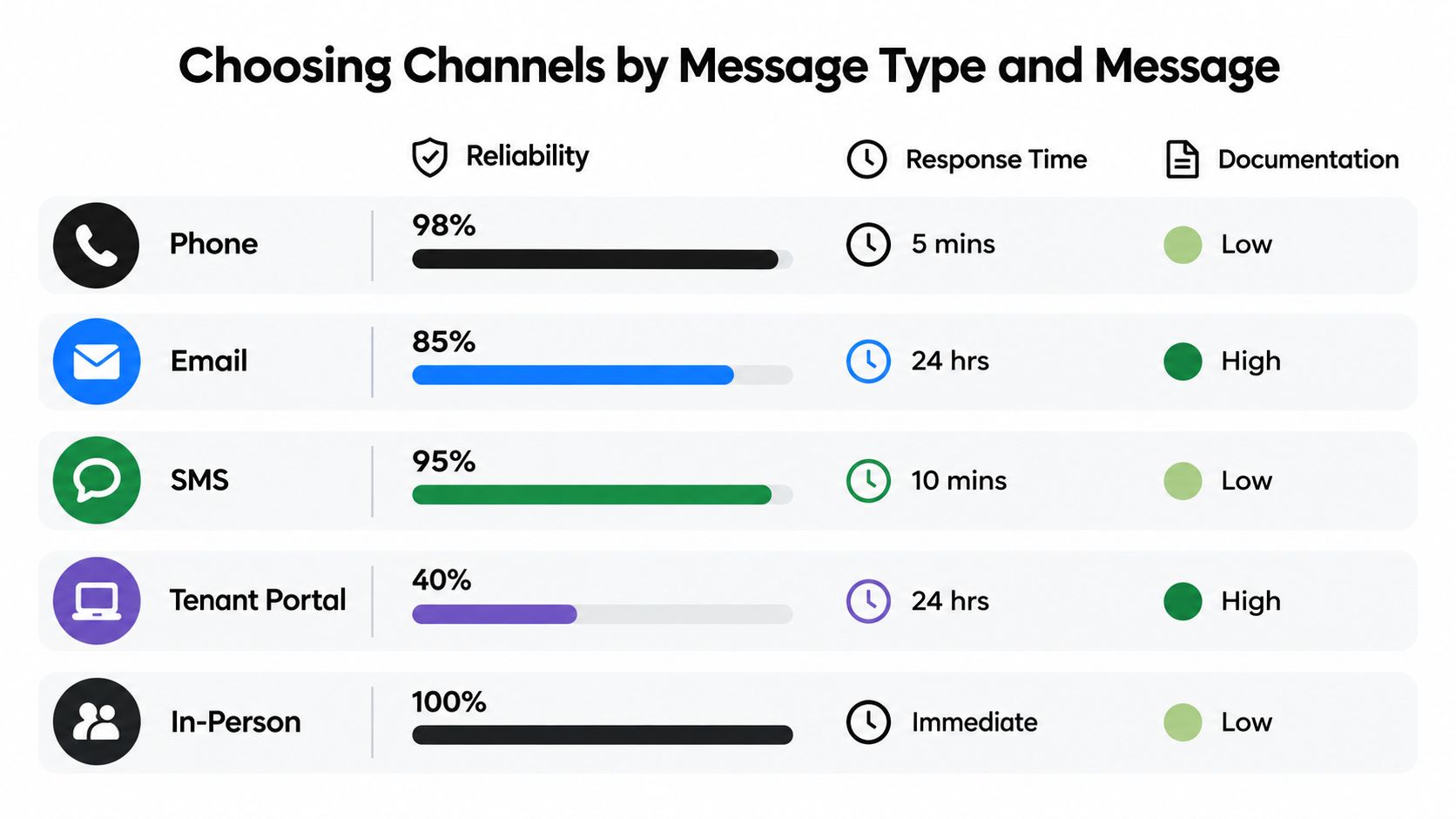
| Channel | Best fit | Strength | Main risk |
|---|---|---|---|
| Phone | Emergencies, sensitive disputes, complex explanations | Immediate clarification and human reassurance | Weak record unless documented |
| SMS | Arrival updates and time-sensitive coordination | Fast, familiar, easy to notice | Poor for long explanations and formal notices |
| Approvals, summaries, applications, and routine administration | Searchable written record | Can be missed during urgent situations | |
| Tenant portal | Repair requests, lease questions, and property history | Centralized documentation | Depends on access, adoption, and resident comfort |
| In-person | Support needs and difficult conversations | Rich context and immediate dialogue | Easy to leave undocumented |
| Letter | Formal notices and required written delivery | Physical record when appropriate | Slower and less useful for live coordination |
A strong policy uses channel triage. For an urgent maintenance issue, call first when immediate clarification matters, then send a written confirmation. For rent information, approvals, and lease administration, use email or the portal so the record is easy to retrieve. For vendor arrival coordination, text can be effective, but the confirmed appointment belongs in the property record.
Renters don't all prefer the same route. One survey found that email was favored by 70% of renters, phone calls by 64%, and in-person communication by 55%, while separate evidence found higher satisfaction among tenants using in-person, phone, or text communication than among those using email, web portals, or management apps (renter response-time and communication findings). Digital convenience and satisfaction aren't identical.
Channel decision: Match urgency, sensitivity, resident preference, and documentation need before choosing the medium.
Never use SMS as the only channel for a legally significant notice, and don't rely on email alone for an emergency. Avoid the silent handoff, where a tenant's message is forwarded to a vendor or owner without telling the tenant who owns the next step. Every message should identify the property or unit, issue, required action, responsible party, deadline or expected window, access instructions, and next update.
Scripts and Templates You Can Reuse This Week
A script should reduce hesitation without making communication sound robotic. Keep each message under 150 words so the recipient can understand it quickly, then customize the property, unit, dates, and responsibility. Store the approved versions in a shared drive with a named owner and revision date.
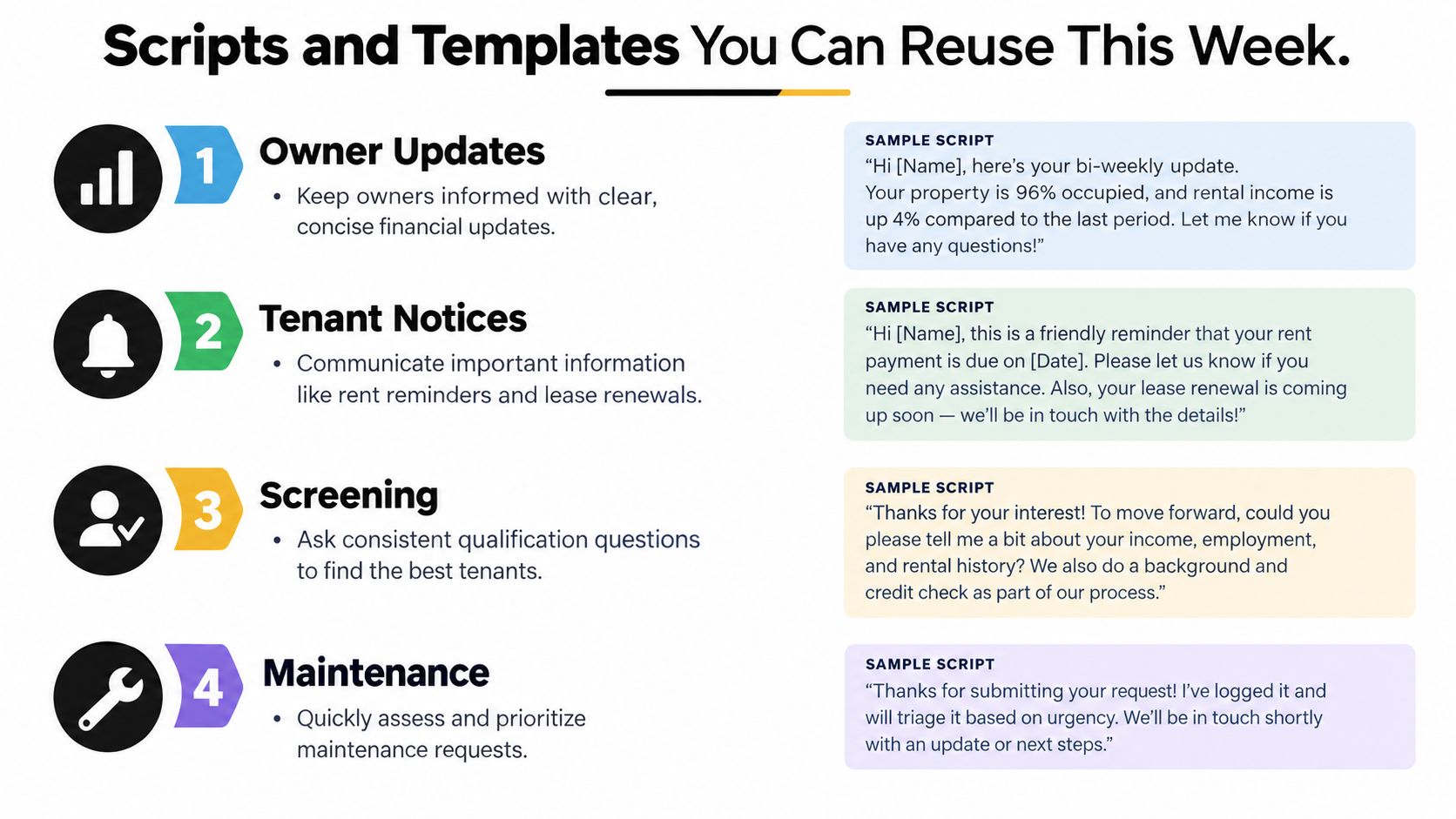
Owner updates
Subject: Property update for [property name]
“Hello [owner name]. Here's the current update for [property]. Rent collection is [status], open maintenance items are [summary], and leasing activity is [summary]. We need your decision on [specific item] by 2026. The next update will include [specific information]. Please reply with approval or questions.”
Customize with the property's actual issue, not a generic status label. The tone should be direct and decision-focused.
Documentation rule: Copy the assigned account or property contact when appropriate, save the message in the owner record, and attach the supporting report or approval.
Tenant notices
Opening: “Hello [tenant name]. This message concerns [property and unit].”
“Please review the attached notice regarding [rent, renewal, entry, or lease matter]. The required action is [action]. If you have a question or believe the information is incorrect, contact [approved contact] through [channel]. We'll record your response in the property file.”
Use the approved notice and service process for the specific matter. Don't add casual language, emojis, or promises that conflict with the formal document.
Documentation rule: Save the final notice, delivery information, recipient, and any response in the property record. For a general service update, log the message and the next expected contact.
Screening communications
Application received: “We received your application for [property]. We'll review the information under the published screening criteria. If anything is missing, we'll contact you through [channel]. Please don't send confidential information outside the approved application process.”
Decision message: “Your application status for [property] is [approved, conditionally approved, or not approved]. Any required next step is [step]. Please use [contact route] for questions about the process.”
Never improvise reasons or disclose information about another applicant. Apply the same written criteria consistently.
Documentation rule: Log the receipt, missing-item requests, status communications, and decision record in the application system. A property-management assistant or real estate VA can help maintain approved templates and records, but a manager should retain control over decisions and sensitive data.
Maintenance updates
Acknowledgment: “We received your request about [issue] at [unit]. We're reviewing the urgency and responsible party now. Please [access or safety instruction]. Your next update will cover [vendor assignment, scheduling, or temporary step].”
Delay update: “The repair is still open because [plain-language reason]. The current next step is [action], and we'll update you after [event]. If the condition changes or becomes unsafe, contact [emergency route].”
Don't promise a vendor completion date you can't control. Promise the next communication instead.
Documentation rule: Record every message, photo, authorization, vendor note, access arrangement, invoice, and completion confirmation in the maintenance ticket. For service standards and resident-facing practices, Edinhart's customer service excellence guidance provides a useful internal reference point.
Running Maintenance Communication as a Closed Loop
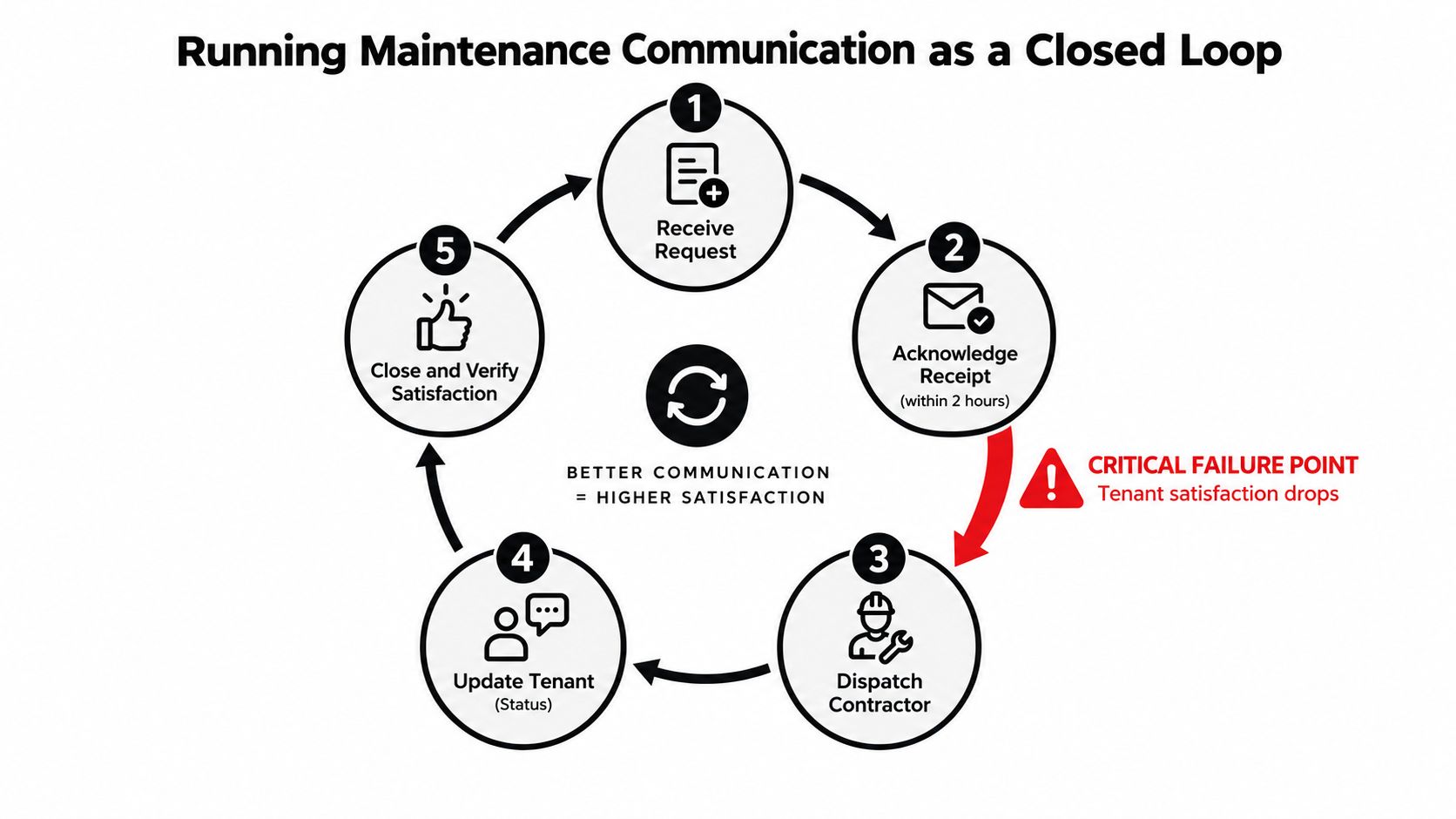
A resident reports a leaking toilet on Friday afternoon. The manager assigns a plumber, the plumber cannot reach the unit, and the ticket sits untouched until Monday. The operational failure is not the assignment itself. It is the missing update between assignment and completion, when the resident needs to know what happens next.
A reliable workflow gives each message a job, a channel, and an owner. Phone calls suit emergencies and access problems that need immediate clarification. The maintenance portal holds the formal request and supporting records. Text can handle a narrow scheduling update when the resident has agreed to that route. Email works better for owner approvals, disputed responsibility, and decisions that may need to be reviewed later.
Route the message to its purpose
For a routine request, send the acknowledgment through the resident's recorded channel and keep the ticket as the system of record.
Reusable script: “We've logged [issue] at [unit]. We're checking responsibility and urgency. Your next update will confirm [assignment or scheduling step].”
Documentation rule: Record the received time, issue description, attachments, contact route, and promised update in the ticket.
For a vendor delay, update the resident before the expected arrival window passes. A short text is useful when it delivers a specific change, while the ticket preserves the full history.
Reusable script: “The appointment changed because [plain-language reason]. The current next step is [action]. We'll update you after [event].”
Documentation rule: Add the vendor's explanation, attempted contacts, revised window, access status, and next follow-up date.
Confirm the result before closing
A vendor's completion note does not establish that the resident's problem is resolved. Ask for confirmation when practical, and keep unresolved limitations visible rather than closing a ticket to improve aging reports.
Reusable script: “The work is marked complete based on [vendor note or inspection]. Please reply if the reported condition remains or another issue appeared.”
Documentation rule: Store the work note, photos where appropriate, approvals, invoice details, resident response, and any remaining action. A documented workflow should connect these handoffs and resident updates, as reflected in this repair communication workflow and tenant findings.
Review open tickets for missed updates, repeat complaints, reopened work, and closures without resident confirmation. A property maintenance management software resource can help centralize those records when shared tickets are more reliable than scattered inboxes.
Here's a short video teams can use when reviewing how communication systems support property operations:
California Compliance Notices and Escalation Paths
California notices require more discipline than a standard customer-service email. The manager needs to identify the legal purpose, use the correct approved form or wording, confirm the applicable timing and service method, and preserve proof of what was delivered. The operational policy should require legal review when the facts are disputed, the tenancy is protected, or the manager isn't certain which rule applies.
The same communication principle still helps. A formal notice should tell the recipient what the document concerns, what action is required, where to direct questions, and what record the manager retained. It shouldn't mix casual speculation with legally significant language.
| Notice Type | Required Window | Approved Service Methods |
|---|---|---|
| Entry notice | Verify the applicable California rule and circumstances | Use the legally permitted method for the situation |
| Rent demand or termination notice | Verify the current statutory requirement and tenancy facts | Use an approved service method and preserve proof |
| Tenancy termination notice | Confirm tenancy length, just-cause applicability, exemptions, and timing | Use the method required for the notice |
| Habitability or retaliation-related communication | Get legal guidance where rights or defenses may be implicated | Document delivery, response, repairs, and escalation |
A missed rent conversation should begin with a factual ledger review and a clear request for payment or clarification. If a payment arrangement is appropriate, document the terms before deciding whether formal notice is required. Don't promise that an informal arrangement eliminates legal options unless the authorized decision-maker and counsel have confirmed that position.
A habitability complaint deserves a written acknowledgment, an assigned repair owner, an access plan, and a record of every status change. The manager should also review whether the complaint could raise retaliation concerns before taking an adverse action. California-specific notice practices and documentation questions can be organized with Edinhart's California notice to vacate resource, but a current legal review remains necessary for the actual notice.
Every served notice gets one method-of-service log entry with the timestamp, recipient, serving person, delivery details, and filed copy. That record protects the owner, the manager, and the resident from arguments about what was sent or received.
Measuring Results and Improving Every Quarter
Communication improves when the manager measures the handoffs, not just the volume of messages. A ticketing system can provide the data automatically. A shared inbox can support a simple label system, and a spreadsheet is enough to begin if every row has a request date, channel, owner, status, and closure record.
| Metric | How to Measure | Target Range | Reviewer |
|---|---|---|---|
| First-response time | Request received to acknowledgment | Set separate internal standards for emergency, urgent, and routine work | Property manager |
| Resolution time | Request opened to documented completion | Compare by issue type and responsibility | Maintenance lead |
| Resident satisfaction | Short survey after closure | Establish a baseline, then improve the weakest category | Operations lead |
| Channel deflection rate | Closed issues by phone, text, email, and portal | Track movement without forcing residents into one channel | Property manager and owner |
First-response time tells you whether requests enter the workflow. It doesn't tell you whether staff made progress. Resolution time exposes vendor delays, approval bottlenecks, and unclear responsibility. Satisfaction comments explain the reason behind the score, particularly when a resident says the repair was eventually completed but updates were missing.
Channel deflection should be interpreted carefully. A high number of text-based closures isn't automatically good if staff are copying details into the record later or residents can't find the history. Review whether the chosen channel matched urgency and whether the final record is complete.
A simple quarterly review
At the quarterly review, pull the metrics, read a sample of closed tickets, and identify the most repeated communication failure. Then make one policy change and test it through the next review cycle.
An owner-facing one-page report can include:
- Portfolio communication summary: Open requests, overdue updates, and recurring categories.
- Resident experience: Satisfaction themes and unresolved complaints.
- Channel review: Which channels handled routine work, urgent work, and escalations.
- Owner decisions: Approvals or policy changes needed.
- Next-quarter action: One change, one accountable person, and one review date.
The report turns communication into an operating line item rather than a vague claim that the office is “staying on top of things.” It also gives owners a clearer reason to discuss staffing, vendor performance, portal use, and service standards.
Edinhart Realty and Property Management offers full-service management with tenant communication, repair coordination, lease support, move-in and move-out coordination, rent collection, and financial reporting, along with a placement-only option for owners who retain day-to-day operations. Visit Edinhart Realty and Property Management to discuss a communication process that fits your Central California rental portfolio.


