

When a homeowner passes away without a living trust or other estate planning tool, their property often heads into a court-supervised process. This is what’s known as a probate sale.
Think of it as a real estate transaction with the probate court acting as a referee, making sure all the deceased's debts are settled and any remaining money from the sale goes to the rightful heirs.
What Is a Probate Sale and Why Does It Happen?
When someone dies, all their assets—including their home—are bundled into what’s called their "estate." If they left a will, a person they named as the executor takes charge of managing it all. If there wasn't a will, the court steps in and appoints an administrator to do the job.
The main goal here is simple: settle the deceased person’s financial affairs in a transparent and orderly way. A probate sale is often the only way to turn the property into cash, which is then used to pay off mortgages, taxes, and any other claims from creditors. Once every last bill is paid, the leftover money is distributed to the beneficiaries or heirs as directed by the will or, if there is no will, by state law.
The Role of the Court
The court’s heavy involvement is what truly sets a probate sale apart from a standard home sale. This supervision introduces a whole new layer of rules, paperwork, and strict timelines that you just don’t see in a typical transaction. This legal oversight is there for a reason—to protect the interests of the estate, the heirs, and the creditors.
Because of this, a probate sale isn't just about buying and selling a house; it’s a legal journey. It's a process that can dramatically affect the sale's timing and terms. In fact, it’s not uncommon for probate properties to sell for 10-20% below market value. This is often due to the added complexities and the fact that these homes are almost always sold "as-is."
Key Takeaway: A probate sale isn't just a property transaction, it's a structured legal process. The court's primary objective is to ensure the deceased's debts are fully paid before any assets are passed on to the heirs.
To give you a clearer picture, let's break down the key differences between a standard home sale and a probate sale.
Standard Home Sale vs Probate Sale Key Differences
This table quickly highlights what makes probate sales so unique.
| Feature | Standard Home Sale | Probate Sale |
|---|---|---|
| Authority | Homeowner or their agent | Court-appointed executor or administrator |
| Court Oversight | None | Required; court must approve the sale |
| Sale Timeline | Flexible, typically 30-45 days | Longer and less predictable, often 6-12 months |
| Offer Process | Standard negotiations | Subject to court confirmation and overbidding |
| Property Condition | Often prepared for sale; repairs common | Almost always sold "as-is," no repairs |
| Contingencies | Common (inspections, financing, etc.) | Very limited or no contingencies allowed |
| Asking Price | Set by seller based on market value | Must be at least 90% of the court-appraised value |
As you can see, the court's involvement creates a very different playing field for both buyers and sellers.
The Estate Sale Connection
It’s also important to remember that the executor is responsible for everything—not just the house, but all the personal belongings inside it, too. This often means they need to organize a separate event to clear out the home's contents before the property can even be listed.
For anyone in this position, knowing how to conduct an estate sale is a critical piece of the puzzle. Clearing out the personal items first is an essential step to prepare the property for its debut on the market and ensure the real estate transaction can move forward.
The Seller’s Roadmap Through a Probate Sale
If you're an estate executor or administrator, managing a probate sale can feel like you've been handed a complex map with no compass. The whole process is layered with legal requirements and court oversight, but it does follow a predictable path. This roadmap is designed to guide you, the seller, through each critical stage with clarity and confidence.
Your journey really kicks off the moment the court officially appoints you as the estate’s representative. This is what gives you the legal authority to act on behalf of the estate. One of your first major tasks is to hire a court-approved appraiser to get the property professionally valued and establish its fair market value. This appraisal isn't just a suggestion; it sets the baseline for the property's list price, which has to be at least 90% of that appraised value.
Preparing The Property And Listing
Once the value is locked in, it's time to get the property ready for market. For sellers, this often means clearing out decades of personal belongings. It's a big job, but checking out some essential methods to declutter before moving can make the home much more presentable to potential buyers.
After decluttering, you'll bring on a real estate agent—ideally one with real experience in probate sales—to list the home. A huge difference here is that probate properties are almost always sold "as-is." This means you aren’t typically required to make repairs, though you absolutely must disclose any known material defects.
Handling Offers And Seeking Court Approval
When an offer rolls in, it's not a standard negotiation. Think of the first accepted offer as a conditional starting point. It sets the opening bid for a future court hearing. The buyer will usually put down a 10% deposit, and the sales contract will be missing many of the usual contingencies you see in a traditional sale, like those for financing or inspections.
With that offer in hand, your attorney then files a "Report of Sale and Petition for Order Confirming Sale" with the court. This is the formal request for a hearing date to get the transaction approved. All interested parties, including the heirs, are notified about this hearing.
A probate sale is a transparent, public process. The court confirmation hearing is designed to ensure the estate receives the highest possible price for the property, protecting the interests of the heirs and creditors.
The infographic below helps visualize the pros and cons of this highly structured process.
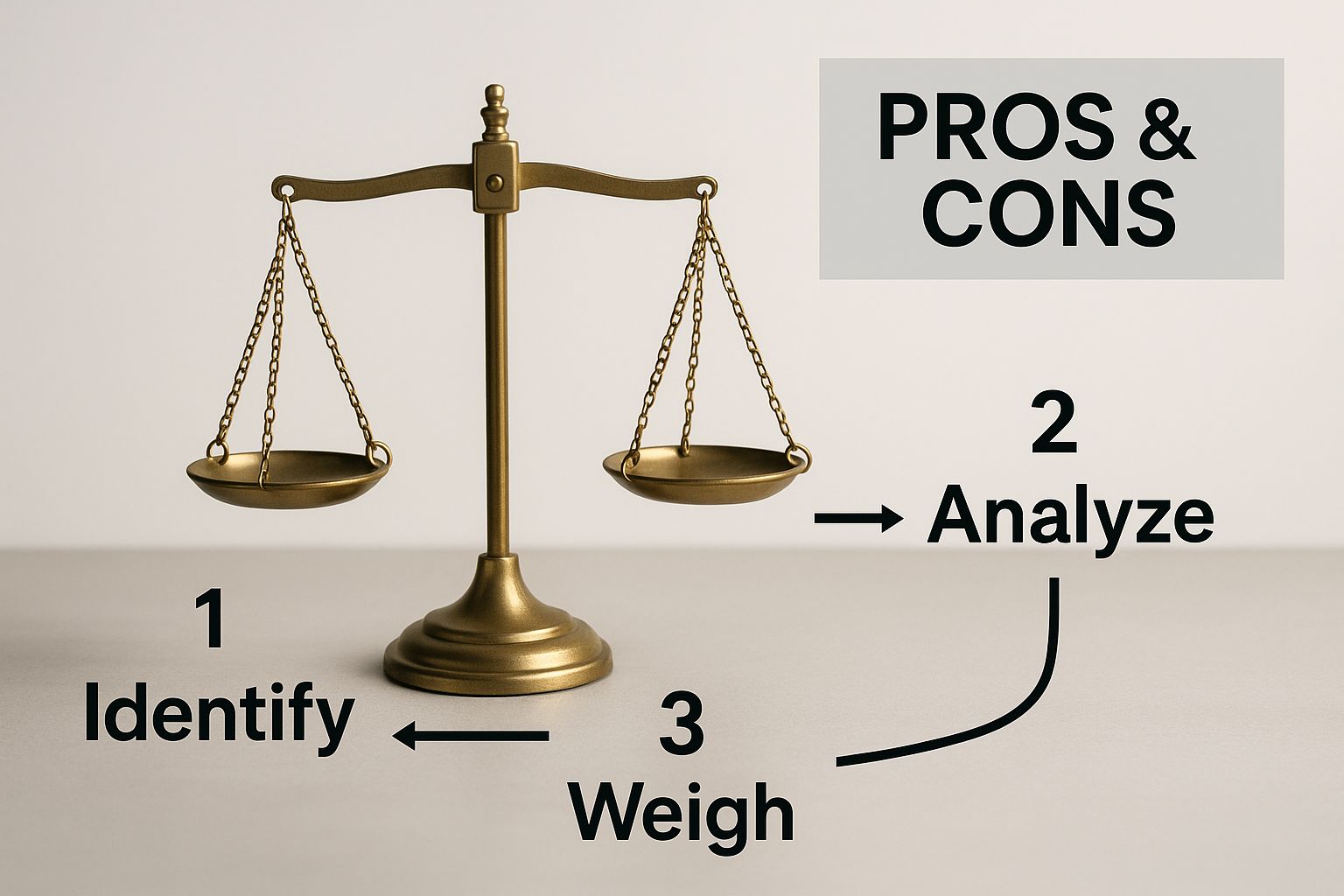
This balance really highlights the trade-offs. You might get a higher final sales price through the overbidding process, but you have to deal with the longer, more complex timeline the court requires.
The court confirmation hearing itself is basically a public auction. Other potential buyers can show up and "overbid" the original offer. The court even has a specific formula for the first overbid and any later increases. If the court accepts a new, higher bid, that person becomes the new buyer, and the original bidder gets their deposit back. It's the final step to make sure the estate's assets are maximized before the sale can officially close.
A Buyer’s Guide to Winning a Probate Property

Buying a probate property can feel like a savvy investment, but it’s a completely different ballgame than your standard home purchase. To come out on top in a probate sale, you’ll need a good dose of strategy, patience, and a solid grip on the unique rules of the process. With the right approach, though, you can turn this complex situation into a really rewarding opportunity.
The first step, of course, is finding these listings. You’ll often see them pop up on the Multiple Listing Service (MLS), but they’ll usually be flagged with terms like "probate," "subject to court confirmation," or "estate sale." A real pro tip? Connect with specialized real estate agents who focus on probate properties. They're an invaluable resource and can often clue you into opportunities before they even hit the wider market.
Preparing Your Winning Offer
Once you've zeroed in on a property, your next move is to put together an offer that can't be ignored. A probate sale offer has some very specific requirements that really set it apart from a typical one.
- The 10% Deposit: Your offer has to come with a cashier’s check for 10% of your offer price. This isn't just a gesture of good faith; it’s a non-negotiable deposit that proves you're a serious contender.
- No Contingencies: To make your offer as appealing as possible, it needs to be clean. That means no contingencies for inspections, financing, or having to sell your own property first. The estate is looking for a sure thing, and removing these conditions makes your offer shine.
- "As-Is" Acceptance: You have to be ready to buy the home exactly as it is. The estate isn't going to make any repairs, so it's absolutely crucial to get your inspections done before you make an offer. You need to know exactly what you're getting into.
Key Insight: In a probate sale, the real strength of your offer is its certainty. A clean, non-contingent offer with the required deposit is much more powerful than a slightly higher offer that’s bogged down with conditions.
It's also worth noting that properties in a probate sale are handled very differently from those held in a trust. While both deal with estate matters, the processes couldn't be more distinct. For anyone interested, learning the nuances of buying and selling real estate using a trust can give you a fuller picture of how these transactions work.
Mastering the Court Confirmation and Overbid Process
So, your offer was accepted by the estate’s executor. Great! But you're not at the finish line yet. The next major hurdle is often the court confirmation hearing. Think of it like a public auction where your accepted offer is now the starting bid. Other interested buyers can literally show up to court and "overbid" you.
The court sets very specific rules for how much the first overbid needs to be, and what the bid increments are after that. To even participate, these overbidders also have to show up with a cashier's check in hand, usually for their own 10% deposit. This high-stakes environment demands preparation. You have to walk into that hearing with a firm maximum price in your head and be ready to make split-second decisions. If you do get outbid, your deposit is returned, but the experience really highlights just how competitive a probate sale can be.
Decoding California’s Probate Sale Rules
While probate is a process found across the country, California plays by its own set of rules. The way a probate sale works here can be quite different, and it all comes down to a piece of legislation called the Independent Administration of Estates Act (IAEA).
Think of the IAEA as a legal framework that gives the person in charge of the estate more flexibility and, in many cases, helps speed up the sale of a property. But it’s not a one-size-fits-all situation. The IAEA creates two completely different paths for a probate sale, and which path you go down depends on the level of authority the court gives the executor or administrator. Getting a handle on this distinction is probably the single most important thing to know about a California probate sale.
Full Authority vs. Limited Authority
When the court grants full authority under the IAEA, it's a game-changer. It basically empowers the executor to act almost like a regular home seller. They can set the list price, review and accept offers, and move forward with the sale without needing the court to sign off on every single step. Naturally, this makes for a much faster and more straightforward process.
On the other hand, with limited authority, the executor's hands are tied. Their powers are, as the name suggests, restricted. They have to get the court's permission for nearly every major decision, including the final approval of the sale. This route always, without exception, leads to a formal court confirmation hearing, which can easily add months to the timeline.
In a nutshell, the type of authority granted by the court in California dictates everything. Full authority usually means a sale that looks and feels a lot like a standard transaction. Limited authority guarantees a longer, more complicated process with mandatory court oversight and a public bidding session.
Let's break down how these two paths stack up side-by-side.
Full Authority vs. Limited Authority in California Probate
Here’s a quick comparison of the two types of authority granted under the IAEA in California. As you'll see, the implications for the property sale are significant.
| Aspect | Full Authority (IAEA) | Limited Authority (IAEA) |
|---|---|---|
| Court Confirmation | Not required for the sale itself. | Mandatory. The sale must be confirmed in court. |
| Offer Process | The executor can accept an offer directly. | The executor accepts an offer, but it is subject to court approval. |
| Buyer's Deposit | Typically 3%, similar to a standard sale. | A 10% deposit is generally required. |
| Timeline | Faster; resembles a traditional real estate transaction. | Slower; delayed by the need to schedule a court hearing. |
| Public Overbidding | Does not occur as there is no court hearing for the sale. | The court hearing is a public auction where others can overbid. |
The differences are stark. For buyers and sellers, knowing which type of authority is in play from the outset is crucial for setting expectations around timelines, costs, and the overall process.
The Court Overbidding Process
So, what happens if a sale falls under limited authority and requires that court confirmation hearing? This is where things get really interesting.
California law has a very specific formula for what’s called "overbidding." The court hearing essentially turns into a live public auction. To even get in the game, the first overbid has to be at least the original accepted offer price plus 10% of the first $10,000 and 5% of the remaining balance.
For example, on a $500,000 accepted offer, the first overbid would need to be at least $525,500. From there, the judge sets the minimum increments for any subsequent bids. While this auction-style showdown is designed to make sure the estate gets the absolute highest price for the property, it creates a ton of uncertainty for the original buyer, who could easily lose the home they thought they had under contract.
The Pros and Cons of a Probate Sale
Deciding to jump into a probate sale, whether you're buying or selling, is a big move. It’s a unique corner of the real estate market that offers some serious financial upsides, but it’s definitely not for the faint of heart. This path is paved with potential hurdles that demand patience and a solid grasp of how it all works.
Think of it as a trade-off. Buyers are often lured in by the promise of a fantastic deal, while the estate gets the benefit of a court-supervised sale that keeps everything transparent and fair. But those perks come with strings attached.
Advantages for Buyers and Sellers
For buyers, the biggest draw is almost always the price. Probate properties can often be had for a steal compared to what they’d fetch on the open market, giving you a rare chance to get into a hot area for less. For the estate, the rigid structure of the probate process is a form of protection.
- Below-Market Prices: It’s not uncommon for buyers to snag a property for 10-20% below its current market value. This is largely due to the "as-is" condition and the estate's need to liquidate assets and close the books.
- Reduced Competition: The extra layers of complexity and the much longer timeline scare off a lot of typical homebuyers. This thins the herd, leaving fewer people to compete against.
- Transparent Process: On the seller's side, the court's oversight means every step is documented and approved. This goes a long way in minimizing arguments among heirs and provides a clean, legally sound way to settle the estate.
The Inherent Risks and Downsides
Of course, the road to a probate sale is far from smooth. Buyers need to brace themselves for an unpredictable journey, and sellers have to be prepared for a process that can drag on and get expensive.
The biggest gamble for a buyer is the "as-is" condition. You are buying the property with all its hidden flaws, which could range from minor fixes to major structural issues that require a significant investment to repair.
This risk gets even more complicated if the property has a tenant. If so, buyers have to step into the role of a landlord, a situation governed by its own set of very specific rules. Understanding your rights and obligations here is non-negotiable, and our guide on landlord-tenant law in California offers some crucial insights.
For sellers, the main headaches are the extended timeline and the mounting legal fees, which can slowly chip away at the estate's value. Plus, the entire process is a matter of public record, which can be a real issue for families who value their privacy.
This unique market is also shaped by larger demographic shifts. As the massive Baby Boomer generation ages, probate sales are projected to climb by 20-30% over the next decade, which could have a big impact on housing inventory. You can read more about these global real estate trends on ubs.com.
Frequently Asked Questions About Probate Sales
Diving into the real estate market can feel complicated on a good day. But when you add the court-supervised world of a probate sale to the mix, a whole new layer of questions and uncertainty pops up. For both buyers and sellers, the unique rules, timelines, and potential risks can be daunting.
This section is all about getting you direct, clear answers to the most common questions we hear. A probate transaction isn't just a home sale; it’s a legal process governed by strict rules meant to protect the estate of the person who has passed away. Let's clear up some of the biggest points of confusion so you can move forward with confidence.
How Long Does a Probate Sale Usually Take?
If you're involved in a probate sale, patience is more than a virtue—it's a requirement. A standard home sale might wrap up in a quick 30 to 45 days. A probate sale? You're looking at a timeline that often stretches from 6 to 12 months, and sometimes even longer. The pace isn't set by the buyer or seller, but by the court system and the specific details of the estate.
So, what causes the delay? It’s a multi-step process:
- Appointing an Executor: First, the court has to legally appoint a representative for the estate. This step alone can take one to two months.
- Property Prep and Listing: Getting the home appraised, cleaned out, and ready for the market easily adds another month or two.
- Court Confirmation: The time between accepting an offer and getting a date for the court hearing can be the longest wait, often taking an extra two to four months, all depending on how backed up the court's calendar is.
Can You Finance a Probate Property Purchase?
Yes, you can absolutely get a mortgage for a probate property, but be ready for some extra hurdles. The biggest challenge is that long, unpredictable timeline. Most lenders simply can't lock in an interest rate for the many months it might take for a probate sale to close.
On top of that, these homes are sold "as-is," which can make lenders nervous if the property needs a lot of work to meet their standards. My best advice? Work with a mortgage broker or lender who has specific experience with probate deals. Getting fully pre-approved right at the start is crucial—it shows the estate you're a serious, prepared buyer.
Pro Tip: When you're trying to finance a probate property, a rock-solid pre-approval letter from a lender who knows the ropes can make your offer shine. It tells the estate's representative that you're ready for the unique financial demands of the sale.
What Happens If You Are Outbid in Court?
This is one of the biggest risks for a buyer in a probate sale that requires court confirmation. Let’s say you're the original buyer whose offer was accepted by the estate. You show up for the court hearing, only to have another qualified buyer submit a higher bid right there in the courtroom. If that happens, the property essentially goes to auction, and the highest bidder wins.
The good news? If you are outbid, your 10% deposit is returned to you in full. The bad news? You lose the property, not to mention all the time and money you've already sunk into inspections and due diligence. This is why it’s absolutely critical to walk into that hearing with a firm budget and know the absolute maximum price you're willing to pay.
Does Every Deceased Person's Home Go to Probate?
No, not every home owned by someone who has passed away has to go through a probate sale. Probate is a specific legal process that only kicks in when other estate planning tools aren't already in place. A property can bypass the entire probate court system in a few common situations.
A home will typically avoid probate if it is:
- Held in a Living Trust: Assets in a trust are managed by a successor trustee and stay out of the court's hands.
- Owned in Joint Tenancy: If the property was owned with a "right of survivorship," the surviving co-owner automatically gets the whole property.
- Has a Transfer-on-Death Deed: In states where this is an option, this special deed automatically passes ownership to a named beneficiary when the owner dies.
Navigating the complexities of a probate sale in California demands expert guidance. Whether you're an executor responsible for selling an estate property or a buyer searching for an opportunity, Edinhart Realty and Property Management has the specialized knowledge to lead you through every step. Our team gets the local court requirements and the strategic pricing needed to deliver exceptional results. Contact us today to learn how we can help you succeed.


