

A tenant texts at night with a photo of droppings under the kitchen sink. Another says they saw roaches in the laundry room. By morning, you're not just dealing with pests. You're dealing with habitability, tenant confidence, vendor coordination, and the risk that a small issue turns into a building-wide problem because nobody had a system.
That's the job of pest control management in California rentals. It isn't just hiring an exterminator after a complaint. It's a repeatable operating process that protects the unit, documents your response, and keeps tenant communication calm and professional.
The Foundation of a Pest-Free Property
Most landlords start thinking about pest control when a tenant sees something moving. Experienced managers think about it earlier. They look at trash enclosure conditions, irrigation leaks, unsealed pipe penetrations, door sweeps, storage clutter, and whether tenants know how to report issues before an infestation spreads.
The reason is simple. Pest issues rarely stay isolated. A single neglected opening under a sink can become a recurring service call. One unaddressed moisture problem can keep drawing pests back after treatment. One frustrated tenant can turn a manageable repair item into a lease dispute because they feel ignored.
The market itself shows how central this work has become. The global pest control service market was valued at USD 22.64 billion in 2023 and is projected to reach USD 34.3 billion by 2030, growing at a 6.3% CAGR, according to Grand View Research's pest control services market analysis. That growth reflects a basic reality for owners and managers. Clean, hygienic housing needs an actual management system behind it.
Think like an asset manager
A professional pest plan does three things at once:
- Protects the structure: Rodents, moisture pests, and stored-product pests don't just annoy tenants. They can damage finishes, contaminate storage, and expose weak points in the building envelope.
- Protects your reputation: Tenants judge management by response speed and follow-through. Slow, vague replies cause more friction than the initial pest sighting.
- Protects the lease relationship: Clear expectations reduce finger-pointing about housekeeping, access, notice, and follow-up.
Practical rule: If your only pest plan is “call someone when a tenant complains,” you don't have pest control management. You have emergency spending.
This isn't only a California issue either. Building biology and hidden damage show up in different forms across markets. If you manage older housing stock or inherited properties, it's worth seeing how other regions assess concealed wood damage, such as these UK property woodworm issues, because the broader lesson is the same. Quiet problems become expensive when owners treat them as one-off nuisances instead of property risks.
Navigating Pest Control Duties in California
California landlords need a clear line between what they must provide, what they must maintain, and what a tenant may have caused. If that line is blurry in your files, it will be blurry in a dispute.
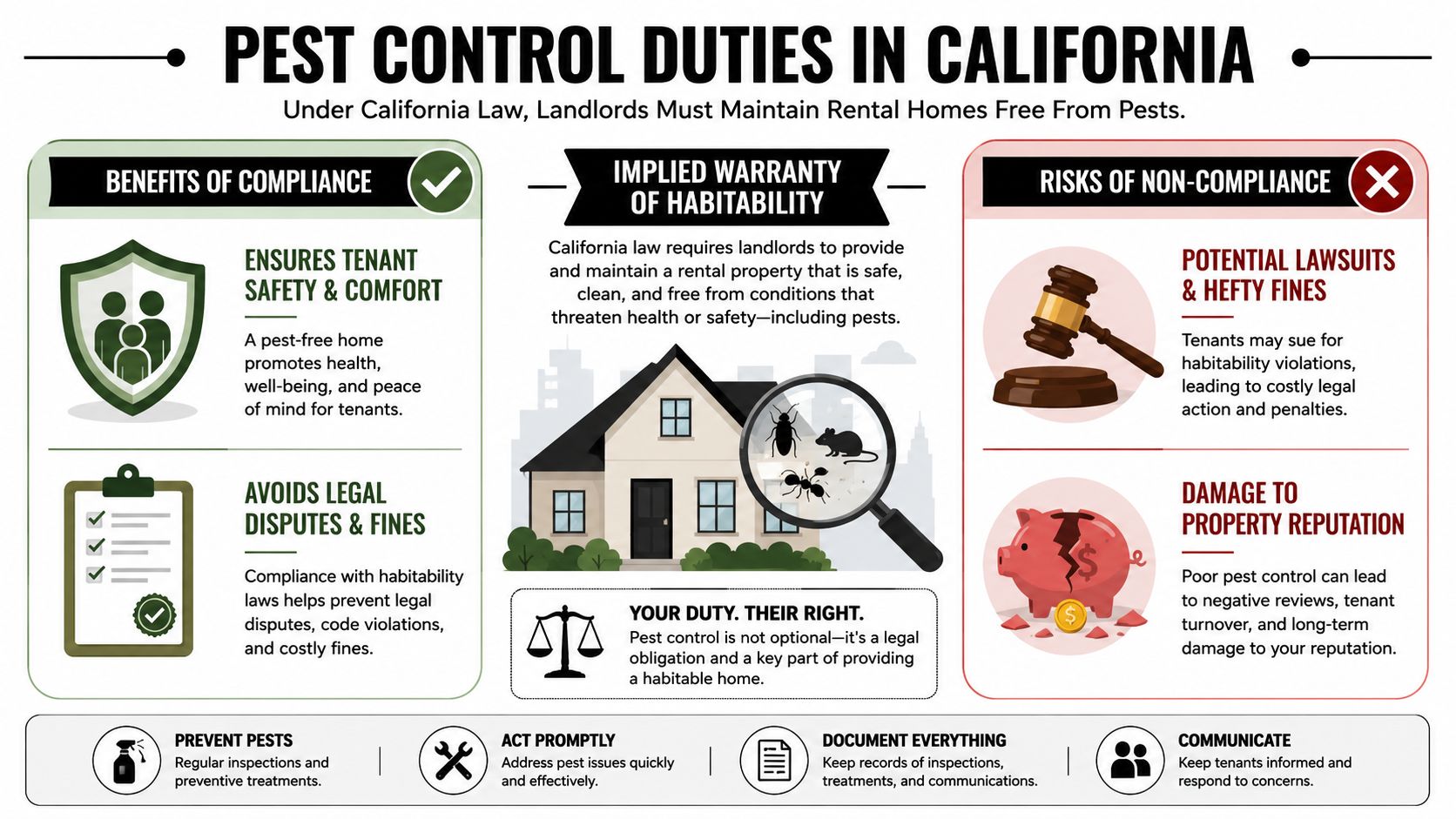
In practical terms, a landlord's starting point is habitability. A rental should be delivered in rentable condition at move-in, and pest conditions that make a unit unsafe or unsanitary usually fall on the ownership side unless the facts show the tenant created the issue. That's why pest complaints can't be handled casually. They belong in the same operational category as plumbing leaks, broken heat, and other conditions that affect the resident's use of the home.
The broader industry context matters too. The US pest control industry reached a market size of $29.7 billion in 2026, with 34,076 active businesses, according to IBISWorld's US pest control industry profile. That scale tells you two things. Pest issues are common, and there's no excuse for a landlord to act as if they're rare or impossible to address.
What usually falls on the landlord
In California practice, these situations usually point back to the property owner or manager:
- Building-wide infestations: Cockroaches in shared walls, common plumbing chases, trash rooms, or laundry areas rarely stay inside one tenant's control.
- Entry conditions created by the structure: Gaps at foundations, missing screens, failed door sweeps, open utility penetrations, and roof or wall access points are property conditions.
- Moisture-linked pest activity: Leaks under sinks, slab moisture, roof leaks, irrigation overspray, and poor drainage all create favorable conditions that management needs to correct.
- Problems present at possession: If the unit wasn't pest-free at move-in, the landlord starts on weak footing.
If you're reviewing broader owner maintenance duties, this breakdown of landlord repair responsibilities is useful because pest control obligations often connect directly to deferred repairs.
What may fall on the tenant
Tenant responsibility is more defensible when the facts are specific and documented. Examples include open food storage, chronic trash accumulation, failure to report leaks, or refusal to prepare a unit for treatment after proper notice.
That doesn't mean every ant trail or fruit fly issue is automatically “the tenant's fault.” It means management should investigate the source before assigning blame.
Here's a practical perspective:
| Scenario | Likely responsibility | Why |
|---|---|---|
| Roaches spreading through a multi-unit building | Landlord | Shared infrastructure and common-area migration |
| Rodents entering through unsealed plumbing penetrations | Landlord | Structural exclusion failure |
| Pantry pests in one unit tied to infested dry goods | Often tenant, with inspection | Source may be resident-controlled food storage |
| Ants around a sink with active plumbing leak | Landlord | Moisture condition drives recurrence |
| Repeated pest activity tied to heavy clutter and unbagged trash | May shift toward tenant | Housekeeping conditions can materially contribute |
A good file answers three questions fast: What was reported, what caused it, and who corrected the underlying condition?
The legal mistake landlords make most often
They jump straight to treatment and skip causation. Spraying first can calm the immediate complaint, but it doesn't answer whether the issue came from a building defect, a sanitation issue, or both. In California, that distinction matters because it shapes notices, chargebacks, follow-up inspections, and whether your response looks reasonable if it's later questioned.
Proactive Pest Prevention A Landlord's Checklist
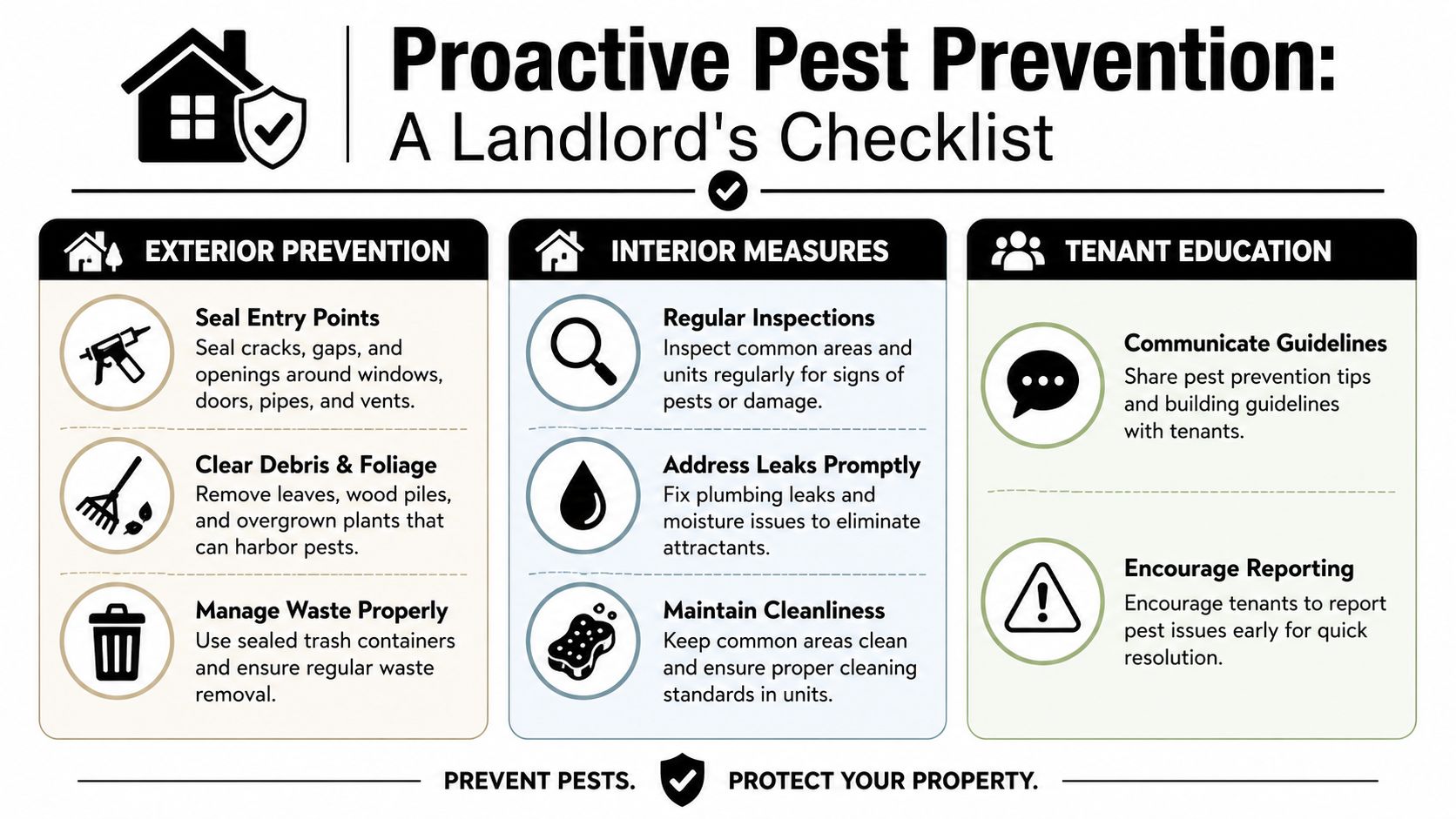
Prevention is where pest control management becomes manageable. If you standardize inspection points and tenant instructions, you'll catch conditions early and reduce repeat call-backs.
The technical details matter. Effective prevention includes covering vents with galvanized mesh with openings of 1/4 inch or smaller, using knitted copper mesh to block pipe openings, and maintaining storage room temperatures at or below 60°F where applicable, because many stored-product pests can't survive in cooler conditions, as outlined in The Habitat Group's IPM best practices.
Exterior and structure
Use this during quarterly walks, turnover inspections, and after major repairs.
- Check vents and penetrations: Cover HVAC vents, air intakes, and exhaust openings with the right mesh size. Large openings invite insects and rodents into wall and ceiling spaces.
- Seal utility entries: Look where pipes, wires, and conduits pass through walls. Seal gaps with appropriate materials instead of leaving open chases.
- Inspect door bottoms and thresholds: Light under exterior doors usually means access for pests. Install proper sweeps and adjust doors that don't sit tight.
- Manage roofline and gutters: Clean gutters and correct drainage issues. Standing water and constant moisture support pest activity.
- Control harborage near the building: Pull stored items, dense ground cover, and unmanaged debris away from the foundation.
If you want a practical consumer-facing reference on enclosure details, this guide to seal entry points is useful because it shows the kind of openings insects exploit around screens, frames, and small gaps.
Interior common areas and vacant units
These are the areas owners often neglect because no one tenant “owns” them.
- Laundry rooms: Check behind machines, floor drains, lint buildup, and wall penetrations.
- Trash areas: Verify lids close properly, the slab gets cleaned, and spills aren't left to sit.
- Storage rooms: Keep temperatures controlled where possible, reduce cardboard clutter, and follow FIFO inventory practices for any stored supplies.
- Vacant units: Open every lower cabinet, check around water lines, inspect behind the stove and refrigerator, and verify all prior treatment recommendations were completed before move-in.
Here's a solid visual overview of how maintenance teams approach basic pest-proofing in buildings:
In-unit standards and tenant communication
A good checklist includes tenant-facing expectations, not just maintenance tasks.
- Food storage: Ask tenants to use sealed containers for dry goods when possible.
- Trash handling: Require regular trash removal and closed liners, especially in warm months.
- Leak reporting: Tell residents to report drips, slow drains, and damp cabinetry immediately.
- Preparation cooperation: Explain that access for inspection and treatment is part of maintaining the property.
For recurring inspections and turnover planning, a broader rental property maintenance checklist helps keep pest prevention tied to the rest of your maintenance workflow.
Don't wait for visible infestation. Most properties tell you where pests will show up before tenants do. You just have to inspect the places pests actually use.
From Tenant Report to Pest Resolution
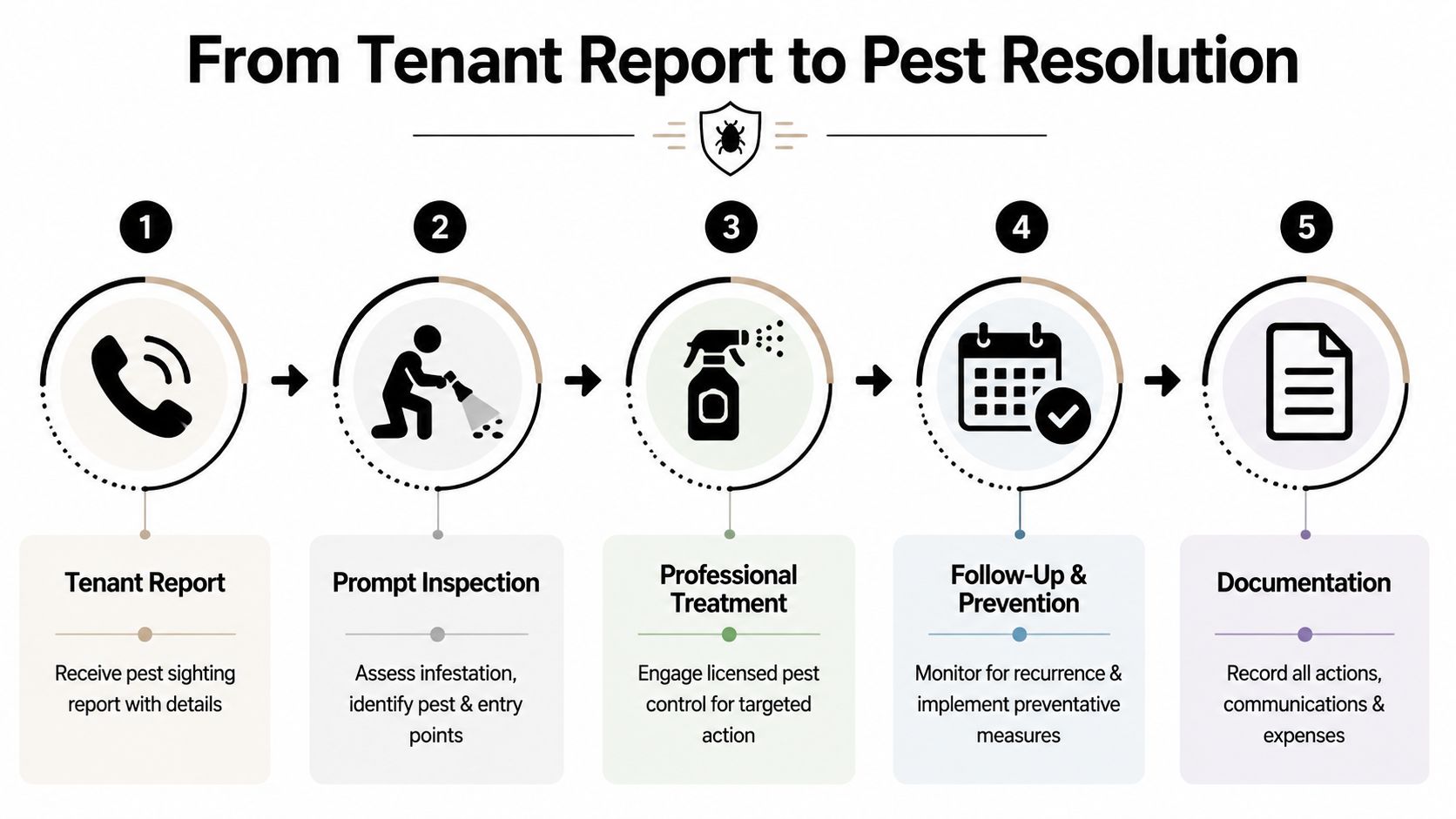
When a tenant reports pests, your response needs to be fast, calm, and documented. Tenants remember tone as much as timing. A defensive reply creates friction immediately.
Step one and step two
Start by acknowledging the report and collecting usable facts. Ask what was seen, where, when, and whether the tenant has photos. Log the report in writing, even if it came by phone or text.
Then inspect. In a single-family rental, that may mean checking the specific room and nearby access points. In a multi-unit building, widen the inspection fast. Shared plumbing walls, trash pathways, and neighboring units often matter more than the original sighting location.
A basic intake note should capture:
- Location details: Under sink, baseboard, pantry, attic access, patio, garage.
- Type of evidence: Live pest, droppings, nesting material, gnaw marks, dead insects.
- Timing pattern: Daytime, nighttime, after rain, after move-in, after landscaping.
- Contributing conditions: Food debris, leaks, clutter, gaps, standing water.
Step three and step four
If the problem appears isolated and minor, you may be able to pair a maintenance correction with a vendor visit. If there are multiple sightings, uncertainty about the pest type, or signs of spread, bring in a licensed professional immediately.
Coordinate treatment like a project, not a favor call. Send written notice for entry, explain prep requirements, and tell the tenant what happens if they don't prepare the unit. If the vendor requests emptied cabinets, laundered linens, pet removal, or cleared wall access, put that in plain language and confirm receipt.
Manager's rule: Never close a pest ticket on treatment day. Close it after verification.
Follow-up matters because many pest issues are really two jobs: kill the current activity and remove the condition that allowed it. Schedule a recheck, confirm tenant observations, and make sure repair items were completed. If the tenant reports continued activity, compare it against the vendor's expected post-treatment behavior instead of assuming failure or assuming the tenant is exaggerating.
Step five
Close the loop in writing. Your file should include:
| Record | Why it matters |
|---|---|
| Initial tenant complaint | Establishes notice and response timing |
| Inspection notes and photos | Shows cause analysis, not guesswork |
| Vendor work order and service report | Documents treatment scope |
| Entry notice and prep instructions | Supports lawful access and cooperation |
| Follow-up communication | Proves you verified the outcome |
That paper trail protects the landlord and reassures the tenant that the issue was taken seriously.
How to Choose the Right Pest Control Partner
The cheapest exterminator on a search page is rarely the best fit for rental housing. What you need is a vendor who understands occupied units, tenant communication, and recurring property conditions. That's different from one-time spray work.
The best long-term partners work under Integrated Pest Management, or IPM. The EPA describes IPM as a system that starts with action thresholds, monitoring, identification, and prevention before moving to controls. When treatment is necessary, IPM favors less risky methods such as pheromones or mechanical trapping first, with broad-spectrum pesticides as a last resort, as outlined in the EPA's IPM principles.
What to look for
A strong rental-property pest vendor should bring more than chemicals.
- Licensing and insurance: Ask for current credentials and proof of coverage. For owners who want to understand the insurance side more clearly, this overview of Coverage Axis pest control insurance is a helpful primer on what proper protection looks like.
- Rental experience: A vendor who works in occupied properties knows how to document access, prep failures, recurring conditions, and tenant-caused sanitation issues.
- Clear reporting: You want service notes that identify pest type, likely source, treatment used, and what maintenance should correct next.
- IPM mindset: If the entire recommendation is “spray more,” keep looking.
Questions worth asking
These questions separate a strategic partner from a commodity vendor:
- How do you identify the root cause before treatment?
- What non-chemical corrections do you recommend first?
- How do you handle tenant notices and preparation instructions?
- Can you provide sample inspection and follow-up reports?
- What happens if the problem involves building entry points or leaks rather than only treatment?
- How do you document tenant non-cooperation when access or prep is refused?
If you're formalizing vendor standards across your portfolio, a property management vendor application can help create a repeatable screening process instead of hiring ad hoc.
Good pest vendors don't just treat activity. They tell you what maintenance failed, what tenant behavior matters, and what should happen next if the issue returns.
What doesn't work
A few warning signs show up early:
- Vague promises with no inspection detail.
- No written prep instructions for occupied units.
- Recommendations that skip exclusion and sanitation.
- Reports that don't identify the pest or source.
- Poor communication with tenants or managers after service.
That kind of vendor creates repeat visits without creating control.
Protecting Your Asset with Smart Paperwork and Budgets
A solid pest program lives or dies on paperwork. If the lease is vague, the notice is sloppy, or the budget assumes every problem can be handled cheaply on demand, the property will absorb the cost one emergency at a time.
There's also a real information gap here. The University of Nebraska-Lincoln notes a key challenge for landlords is the lack of clear cost-benefit data comparing proactive IPM with reactive chemical treatment. Their guidance acknowledges that IPM can reduce long-term expenses, but owners often default to chemical responses because they feel immediate, even when prevention and monitoring may be more effective over time, as discussed in this IPM cost-benefit gap analysis.
Sample lease addendum language
Use counsel-approved California lease forms where appropriate, then add property-specific language like this:
Pest Control Addendum Sample
Tenant agrees to maintain the premises in a clean and sanitary condition, including proper food storage, regular trash removal, and prompt reporting of leaks, moisture, or pest sightings. Tenant must notify Landlord or Manager immediately upon observing rodents, cockroaches, ants, bed bugs, or other pest activity. Tenant agrees to cooperate with all reasonable inspection and treatment efforts, including preparing the unit as instructed, providing lawful access after notice, and following post-treatment directions. Failure to maintain reasonable housekeeping or failure to cooperate with required treatment preparation may constitute a lease violation where permitted by law.
That language does two jobs. It tells the tenant what to do, and it gives management something specific to point to later.
Sample notice to enter language
For occupied units, keep notices plain and operational:
24-Hour Notice to Enter for Pest Inspection or Treatment Sample
Date: [Insert date]
Premises: [Insert address and unit]
Landlord or Agent will enter the premises on [insert date] between [insert time window] for the purpose of pest inspection, pest treatment, and related maintenance or repair work associated with pest control management. Please complete the required preparation instructions provided separately, including access to treatment areas. If you have pets, contact management immediately for handling instructions.
Budgeting choices owners actually face
Most landlords end up choosing between two models.
| Model | Strength | Weakness | Best use |
|---|---|---|---|
| Proactive service contract | Scheduled inspections, recurring monitoring, earlier detection | Ongoing operating expense even when no complaint exists | Multi-unit properties, older stock, owners who value predictability |
| Reactive per-incident service | Easy to understand and simple to authorize | Encourages delay, fragmented documentation, and repeated emergency calls | Low-risk properties with strong maintenance discipline |
The trade-off isn't just money. It's control.
A proactive contract usually produces better routines: recurring inspections, standardized reports, and faster follow-up on exclusion and moisture repairs. A reactive model can work, but only if management is disciplined enough to inspect thoroughly, document every complaint, and fix building conditions quickly. Most owners overestimate how well that happens in real life.
The budgeting rule that keeps owners out of trouble
Don't treat pest work as a narrow line item. Tie it to turns, plumbing repairs, trash management, exclusion work, and common-area cleaning. Pest control management fails when the budget pays for treatment but not for the repairs that stop re-entry.
The smartest owners reserve funds for both categories. Treatment handles the immediate problem. Building corrections prevent the same invoice from coming back.
The Edinhart Approach to Proactive Management
Good pest control management isn't complicated, but it does require discipline. The property has to be delivered in rentable condition. Reports have to be documented. Entry has to be handled lawfully. Vendors have to identify cause, not just apply product. And maintenance has to correct the conditions that keep bringing pests back.
California landlords who handle this well don't rely on luck. They build routines. They inspect the same vulnerability points, use consistent tenant notices, and keep records that show they acted promptly and reasonably. That protects the building, but it also protects the landlord-tenant relationship. Tenants are far more cooperative when management is organized, specific, and transparent.
The owners who struggle are usually stuck in reaction mode. They wait for a complaint, send a vendor with limited context, and hope one treatment solves what is often a sanitation, moisture, exclusion, and communication problem all at once. It rarely does.
If you own rentals in Fresno, Clovis, Friant, or the surrounding Central California market, working with a manager who treats pest control as part of total asset protection can save time, reduce friction, and keep small problems from turning into expensive ones.
If you want a property management team that handles pest issues with clear documentation, strong vendor coordination, legally aware tenant communication, and a proactive maintenance mindset, connect with Edinhart Realty and Property Management. They help Central California owners protect their rentals, preserve tenant relationships, and run their properties with the kind of structure that keeps preventable problems from escalating.


