

A Monday morning in a Fresno-area rental property rarely starts with rent collection. It starts with parking. A resident in Clovis says a car has occupied their assigned stall since Saturday. An HOA president near Friant forwards another complaint about guests using resident spaces. The weekend tow bill is waiting in the inbox, along with a request to explain why the same vehicle keeps returning.
Most owners treat each incident as a separate annoyance. That's the mistake. Parking problems repeat because the property lacks a consistent system for permits, visitor access, enforcement, documentation, and reporting. The lot may be large, but the operating process is usually informal.
Central California properties face a practical challenge. Multifamily communities and HOAs often have expansive sites, multiple buildings, hot and bright conditions, mixed resident needs, and limited onsite staff. Parking has become an operating asset, not a passive amenity. The history of managed parking began with Carl Magee's first parking meter in Oklahoma City in 1935, and the underlying challenge remains substantial, with the Henry Ford Museum reporting that the United States may contain as many as 1 billion parking spaces. The Henry Ford's parking history shows how parking moved from informal curb use toward measurable management.
The Monday Morning Parking Problem in Central California
The property manager's first decision is usually tactical. Should the vehicle be warned, cited, booted, or towed? The board's first question is usually financial. Who authorized the tow, and will the association have to defend it? Residents want a third answer, which is simple and immediate: why can't management keep unauthorized cars out of their spaces?
That cycle consumes time because the property has no dependable record of what happened. A handwritten note, a blurry phone photograph, or an employee's memory may be the only evidence. When the resident disputes the violation, management starts over. The same process plays out with guest permits, abandoned vehicles, blocked fire lanes, and residents who register more cars than their leases or HOA rules allow.
Parking problems become operating costs
A community can run landscaping, pool access, package delivery, and maintenance through written procedures. Parking often gets left to signs and informal habits. That approach works until occupancy rises, residents change vehicles, a new tenant misunderstands the rules, or a visitor stays longer than expected.
For a small portfolio, the cost isn't limited to towing. Staff spend time answering complaints, checking plates, issuing warnings, updating resident records, coordinating vendors, and explaining decisions to board members. Those tasks also create inconsistent enforcement. One resident receives a warning, another gets towed, and neither understands the difference.
Practical rule: If staff can't show who was authorized to use a space, when the authorization began, and what rule applied, the property doesn't have parking control. It has parking arguments.
Central California needs deliberate management
Fresno, Clovis, and nearby communities don't need every feature marketed to major cities. They do need a clear operating model that matches the site. A smaller HOA may need digital permits and reliable enforcement records. A gated multifamily property may need controlled entry, visitor handling, and a dependable backup process when a gate or mobile service fails. A larger shared lot may need occupancy information before the owner considers reassigning spaces or adding paid access.
The right question isn't, “Which smart parking product should we buy?” It's, “What recurring parking decision are we trying to make more consistently?” Once that answer is clear, owners can select hardware, software, and policies that solve the actual problem instead of adding another dashboard to manage.
What a Parking Management System Actually Is
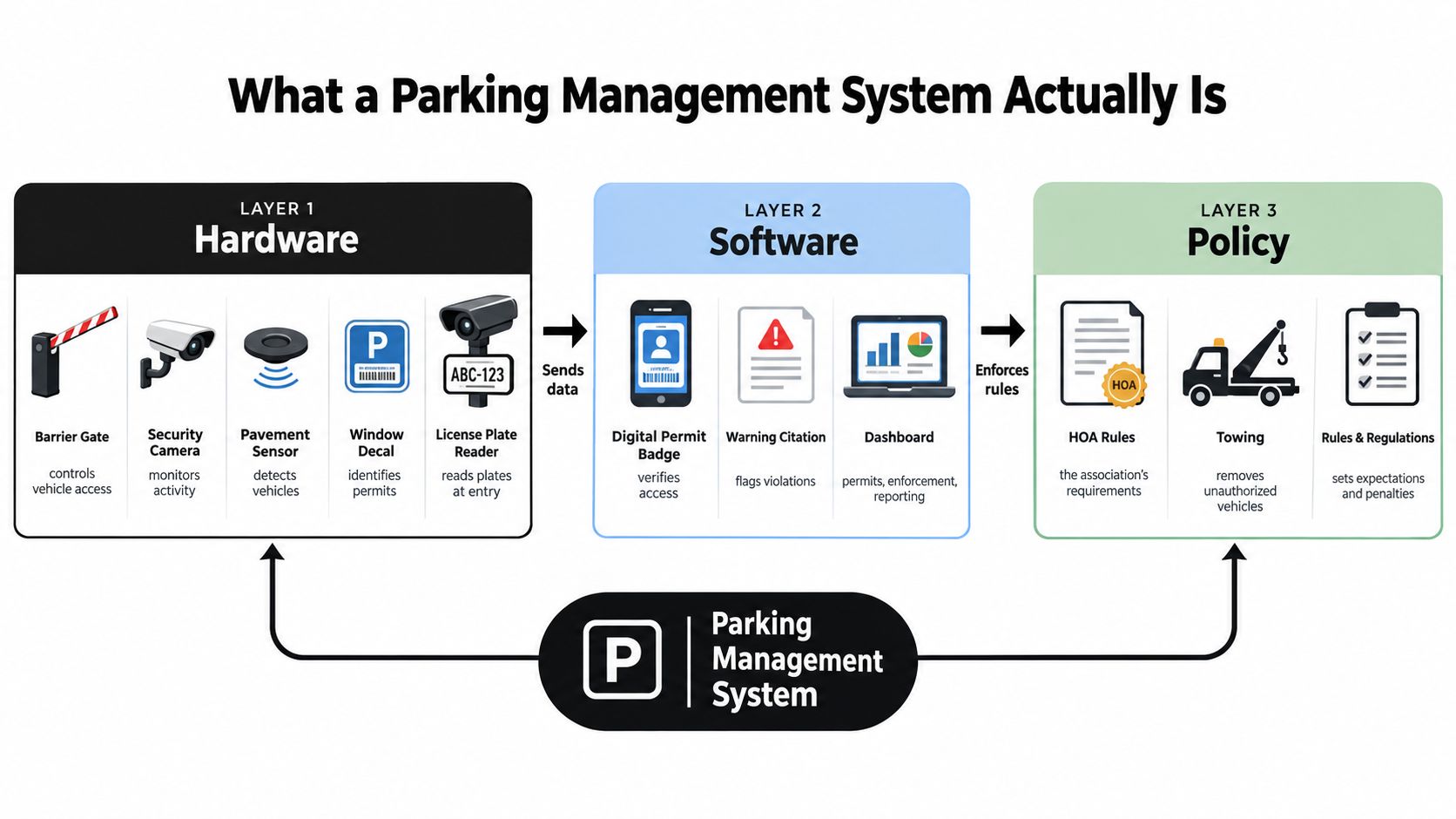
A parking management system has three connected layers. Hardware observes or controls vehicles and spaces. Software records permissions, activity, payments, and enforcement. Policy defines what residents, guests, staff, vendors, and visitors are allowed to do.
Think of the system like a restaurant. Hardware is the kitchen equipment, doors, and tables. Software is the point-of-sale system and reservation book. Policy is the operating standard that determines hours, seating rules, payment procedures, and what staff do when a customer breaks them. A restaurant with excellent equipment but no ordering process still fails. A parking property with cameras but unclear towing rules fails in the same way.
Hardware creates the evidence
Hardware may include gates, barrier arms, intercoms, cameras, pavement sensors, window decals, RFID credentials, and license plate recognition equipment. Owners don't need every item. They need the equipment that answers the property's operating questions.
If the problem is unauthorized entry, access control may matter more than space-level sensors. If the problem is resident disputes, a dependable permit record and enforcement photograph may matter more than an advanced entry gate. If the problem is a crowded shared lot, occupancy detection can help management see usage patterns that staff can't observe manually.
Software makes the information usable
The software layer should manage resident and vehicle records, issue permits, handle guest access, document violations, and produce reports that an owner or board can understand. It should also identify stale or incomplete data rather than presenting every availability signal as perfect.
A documented occupancy deployment reported forecast-model error of 13.49% during training and 15.29% during testing, which is why availability screens should show timestamps, data sources, and confidence information rather than imply flawless accuracy. The documented smart-parking occupancy model also supports a practical lesson for owners: reconcile sensor information with gate activity, permits, reservations, and occasional inspections.
Policy determines whether the system is defensible
The policy layer includes lease language, HOA rules, guest limits, accessible-parking procedures, towing authorization, appeal steps, data retention, and outage procedures. Put those rules in writing before installation.
Municipal smart-city systems often focus on public curb use, public payment, and citywide traffic information. An owner-side system has a different job. It should protect resident access, give staff an accountable enforcement process, and provide reporting that supports property operations.
The Four Main Types of Parking Management Systems
Owners usually choose among four practical categories. They can be combined, but each has a different operating burden and property fit.
Permit-based systems are the sensible starting point for smaller communities. Decals, hangtags, digital permits, or registered license plates establish who may use resident spaces. This approach suits an older Fresno neighborhood or a smaller HOA with limited visitor turnover. It's affordable to administer, but it depends heavily on accurate vehicle records and visible enforcement.
Access-control systems add a physical barrier to the permission process. Gates, RFID tags, key fobs, intercoms, or mobile credentials restrict entry to approved users. These systems fit gated multifamily properties in Clovis and north Fresno where residents value security and predictable access. They also create new responsibilities, including emergency access, guest entry, power outages, damaged gates, and credential replacement. For boards evaluating a controlled entry project, an HOA gate access system can provide useful context about resident and visitor workflows.
Sensor and IoT systems focus on visibility. Space sensors, cameras, entry counters, and occupancy dashboards help owners understand which areas are full, underused, reserved, or regularly blocked. They make the most sense for larger lots, mixed-use properties, or sites near Fresno State and commercial destinations where utilization data can guide allocation decisions. They're a poor fit when the property hasn't established basic rules or assigned responsibility for acting on the data.
Pay-to-park systems turn selected spaces into a revenue-producing resource. They may support guest parking, excess stalls, commercial users, or shared facilities. This model can work in a more urbanized or transit-adjacent setting, but it requires accessible payment options, clear pricing, enforcement, refunds, and an equity review. Charging for access without a plan for residents, visitors, disabled users, deliveries, and nearby spillover can create more conflict than revenue.
| System Type | Core Technology | Best Fit For | Typical Fresno-Area Property |
|---|---|---|---|
| Permit-based | Decals, hangtags, registered plates, digital permits | Communities needing authorization and basic enforcement | Smaller HOA or low-density apartment community |
| Access-control | Gates, RFID, key fobs, intercoms, mobile credentials | Properties needing restricted entry and resident convenience | Gated multifamily community in Clovis or north Fresno |
| Sensor and IoT | Occupancy sensors, cameras, counters, analytics | Owners making allocation and utilization decisions | Larger shared lot or mixed-use property |
| Pay-to-park | Payment software, permits, enforcement, pricing rules | Properties monetizing guest or excess capacity | Commercial or urbanized mixed-use site |
The best choice is usually the least complicated system that solves the property's main failure. Don't buy sensors to compensate for weak rules. Don't install a gate when the underlying issue is poor permit administration.
Benefits for Multifamily and HOA Properties
A parking system earns its place in the budget only when it improves a reportable operating result. The useful measures are not “smart” features. They're unauthorized-use incidents, unresolved disputes, staff time, permit accuracy, guest-space availability, payment reconciliation, and documented enforcement actions.
Owners can also look at the larger technology direction. A 2025 market analysis estimated the global smart-parking-systems market at $10.2 billion and projected $53.4 billion by 2033, with North America representing 35.7% of 2025 revenue. Those figures from Grand View Research's smart-parking market analysis show that parking technology has become part of real-estate and infrastructure planning, but market growth doesn't prove that a particular Fresno property needs an expensive deployment.
Measure the operational gains
A permit system can replace resident recollection with a searchable authorization record. An access-control system can reduce casual unauthorized entry. An occupancy dashboard can reveal whether one lot remains crowded while another sits underused. A payment workflow can make guest transactions easier to reconcile.
The board should ask for a before-and-after report built around the property's actual problems:
- Enforcement workload: How many staff hours go to parking complaints, warnings, and vendor coordination?
- Dispute volume: How often do residents challenge a citation, tow, or space assignment?
- Data quality: How many permits are expired, duplicated, or attached to vehicles no longer on site?
- Availability: Can residents and guests find authorized spaces without relying on informal favors?
- Financial control: Can management reconcile parking payments, refunds, and vendor charges?
Don't confuse visibility with improvement
A dashboard can display occupancy without changing behavior. A camera can identify a vehicle without giving staff a defensible enforcement policy. A payment app can collect money while creating accessibility or customer-support problems.
Parking guidance can reduce circulation when drivers receive reliable availability information before they enter a constrained facility. A University of Leeds review reports typical reductions of approximately 2% in carbon monoxide and hydrocarbons and about 1% in nitrogen oxides and particulate matter, while modeled conditions estimated larger reductions for shorter trips. These are scenario-dependent findings, not promises for every private lot. The University of Leeds parking guidance review is most useful as a reminder to measure search time, queues, occupancy balance, and false-availability incidents, not just total spaces.
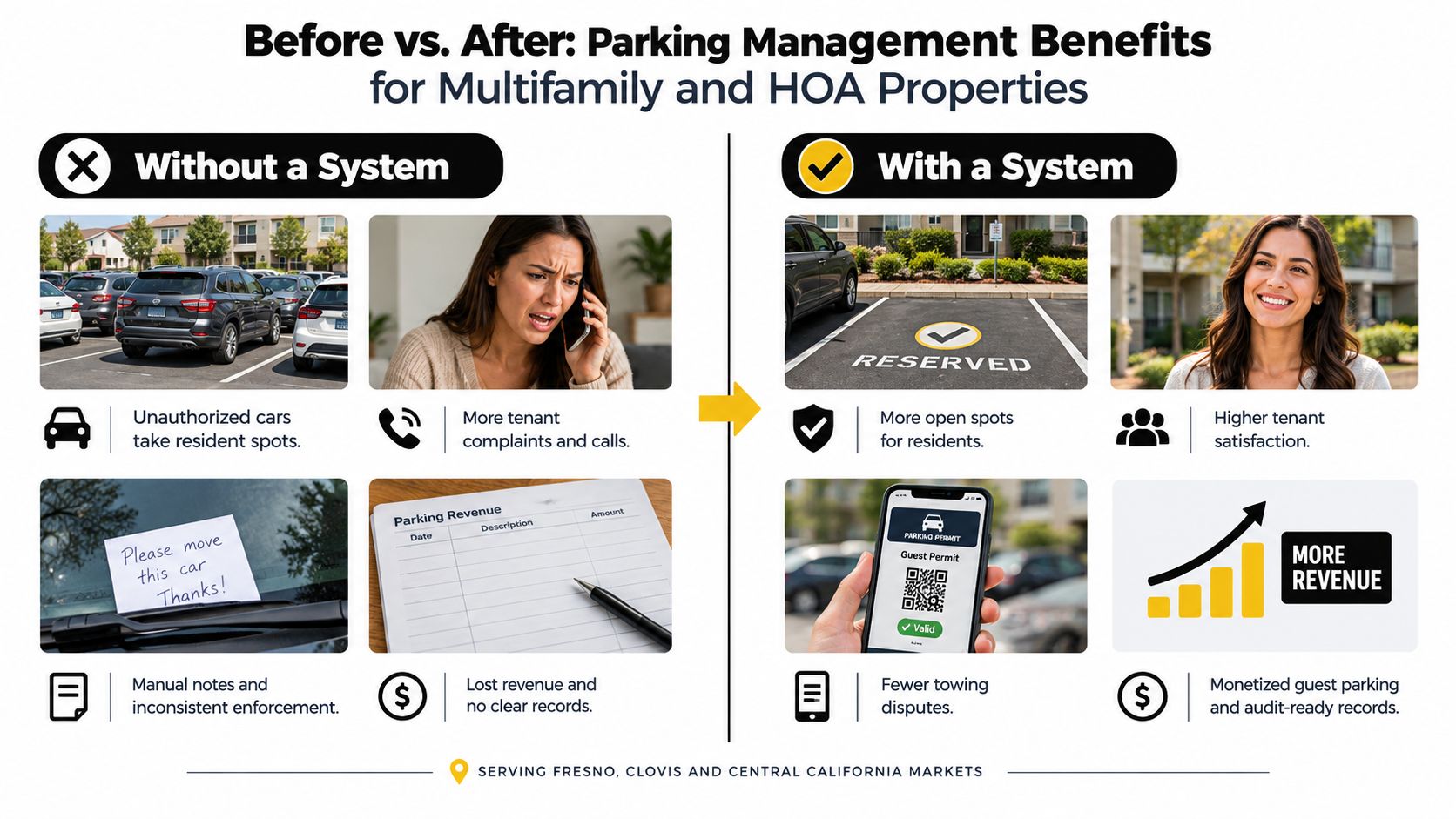
For properties with fewer stalls or limited staffing, the benefit may be consistency rather than dramatic utilization change. That's still valuable if the system reduces repeated disputes and gives the board a reliable record.
Key Features Worth Paying For and What to Skip
Start every vendor demo with your property's worst parking incident. Ask the vendor to show how staff would register the vehicle, verify authorization, document the violation, notify the resident, process an appeal, and export the record. If the representative only demonstrates a polished map, you haven't seen the product's operational value.
Features that deserve budget
License plate recognition should work under your conditions. Fresno-area sun, low angles, dust, glare, and nighttime lighting can affect performance. Ask for a live demonstration using comparable entrance geometry and lighting. If the vendor uses ANPR terminology, this ANPR guide from GM GROUP Services offers useful background on how automated plate detection fits into access and enforcement workflows.
Resident self-service matters. Residents should be able to update vehicles, request visitor access, and see relevant rules without creating a new staff ticket for every change. Mobile access is useful only if the fallback process works for residents who lack a compatible device or dependable connectivity.
Integrations reduce duplicate work. Ask whether the platform connects with Yardi, AppFolio, payment systems, and the property's existing resident records. Owners comparing broader management tools can review this property management software comparison before accepting a vendor's claim that an integration is available.
Reports must be audit-ready. Require searchable enforcement logs, timestamps, photographs where appropriate, permit history, user permissions, payment records, and exportable reports. A system that can't explain who changed a record is a weak system for an HOA dispute.
Features to question
Be cautious with AI citation claims that don't connect to actual staff action. A system may identify probable violations, but someone still needs to verify the rule, document the decision, and handle the appeal. Treat virtual attendants, immersive demonstrations, and elaborate resident interfaces as optional until the vendor proves they solve a real site problem.
Also scrutinize transaction pricing. Per-scan, per-report, or per-event fees can make an apparently inexpensive platform costly for an HOA with narrow operating margins. Ask for the total cost of ownership, data-export terms, equipment replacement policy, outage support, and the cost of leaving the platform.
Costs and Realistic ROI for Smaller Properties
The honest way to evaluate parking technology is to separate capital cost, recurring software cost, and operating labor. Hardware may include cameras, sensors, gates, signs, network equipment, and installation. Software may include permits, enforcement, payments, reporting, and support. Labor includes staff training, patrols, resident assistance, exception handling, and vendor coordination.
Don't approve a project because a vendor says it will pay for itself. First identify which financial lever will produce the return. In a Central California property, that lever may be guest parking revenue, avoided towing disputes, fewer staff hours, better use of existing stalls, or reduced vacancy caused by a poor resident experience.
A board-friendly break-even method
Suppose a board is considering a system for a property with a mid-sized parking area. The treasurer should list the project cost, then subtract only benefits the property can track. Don't count hypothetical revenue from every guest stall unless the rules, demand, payment process, and enforcement plan support it.
| Line Item | Year 1 Cost | Annual Lever |
|---|---|---|
| Entry equipment, cameras, sensors, or signage | Vendor proposal required | Better control of unauthorized use |
| Software and permit administration | Contract-dependent | Lower manual processing and clearer records |
| Installation and configuration | Site-dependent | Reliable launch and fewer setup errors |
| Enforcement or patrol service | Local service agreement | More consistent application of rules |
| Staff training and resident communication | Internal labor and materials | Fewer avoidable support requests |
| Payment processing, if applicable | Contract and transaction terms | Guest or excess-space revenue |
| Maintenance and replacement reserve | Vendor and equipment dependent | Reduced outage risk |
| Documented annual benefit | Property-specific | Revenue, avoided cost, or saved labor |
The break-even calculation is simple: add the project's one-time and recurring costs, subtract verified annual savings and revenue, then review the remaining balance against the owner's investment horizon. A system that depends entirely on optimistic parking revenue is fragile. A system supported by lower disputes, better compliance, and dependable records has a stronger operating case.
When the property is too small
A small HOA may not need sensors, gates, and payment software. It may need updated rules, numbered spaces, a permit register, clear signage, and a licensed enforcement process. Those improvements can resolve the main failure without creating hardware maintenance or subscription obligations.
For a larger property, start with a limited pilot. Test one entrance, one lot, or one permit workflow before committing across the site. The pilot should reveal actual data quality, resident support demand, gate reliability, enforcement workload, and total operating cost.
Privacy, Equity, and California Compliance Risks
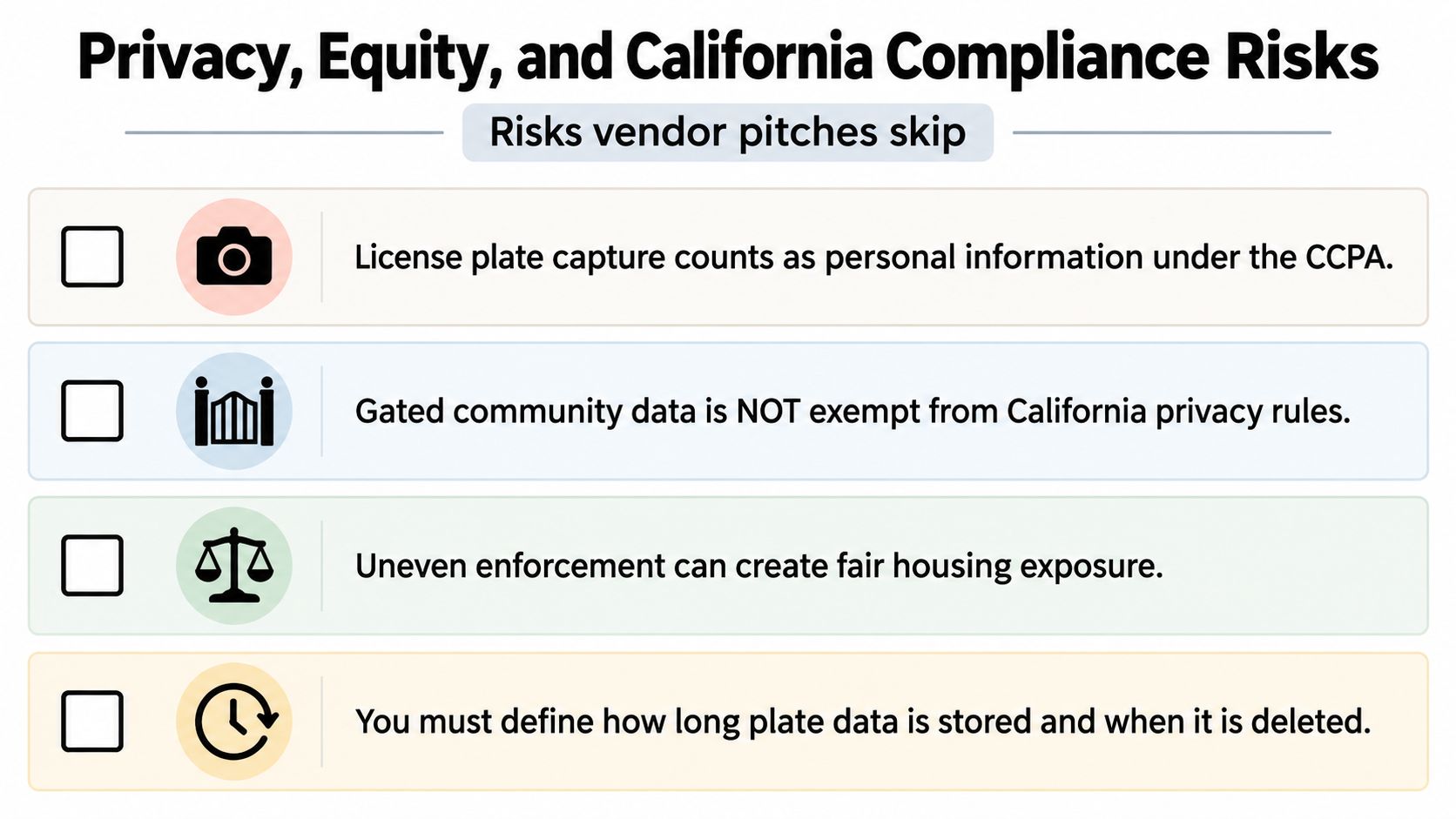
The most dangerous parking system is not the one with too few features. It's the one that collects more information than the owner can govern. License plates, vehicle movements, access logs, payment records, and resident identities can create a detailed record of activity. Owners should treat that data as sensitive, limit access, and establish retention and deletion rules before installation.
The California privacy framework deserves legal review rather than vendor reassurance. The implementation research provided for this guide notes that some cities avoided cameras because residents raised privacy concerns, while practitioners reported payment failures, account security issues, device compatibility problems, and weak customer support. The California-focused parking privacy research also identifies privacy, security, installation cost, and maintenance burden as barriers that affect smaller operators.
Write the rules before collecting data
Your policy should answer who can access vehicle records, what purpose justifies collection, how long records remain available, how residents request corrections, and what happens during an outage or incorrect charge. Don't assume a gated community sits outside California privacy obligations. Have counsel review the system's data flows, vendor agreement, notices, and security controls.
Access decisions also affect fairness. A resident who can't use a mobile app needs another way to obtain a permit or reach support. A payment failure shouldn't automatically become an enforcement action. Towing, guest fees, accessible parking, and charging access need consistent standards that don't penalize a particular group of residents.
Accessibility is an operating requirement
Accessible spaces, van-accessible spaces, signs, access aisles, and paths of travel require careful site review. Enforcement must protect authorized users without blocking the route from parking to the building. Use this accessibility requirements reference as a starting point, then confirm the property's obligations with a qualified professional.
Dynamic pricing creates another risk. California Air Resources Board guidance notes that parking charges can operate as a regressive cost for lower-income drivers and recommends evaluating pricing alongside discounts, accessible payment, permits, occupancy, turnover, emissions, safety, and local economic effects. The California Air Resources Board parking pricing brief supports a direct recommendation: don't measure success by revenue alone.
Implementation Checklist and the One Decision That Matters
A parking rollout should be treated like an operating change, not an equipment purchase. The board and owner need a baseline, a policy, a pilot, and a review date.
Build the operating baseline
Start by inventorying every stall, assignment, restriction, guest area, loading zone, accessible space, charging location, gate, sign, and known obstruction. Record current enforcement costs, complaint categories, vendor response times, and the rules staff apply in practice. A commercial parking lot inspection checklist can help prompt a physical review of pavement, markings, lighting, signs, drainage, and general lot condition.
Then ask residents, onsite staff, and board members where the process fails. Their answers usually identify whether the priority is access, unauthorized use, guest confusion, space allocation, safety, or administrative workload.
Pilot before expanding
Shortlist vendors that can provide Central California references and a live demonstration using comparable site conditions. Require clear answers about data ownership, outage procedures, support response, hardware replacement, integrations, enforcement appeals, and contract exit terms.
Launch the smallest useful pilot. Communicate the rules before enforcement begins, install readable signs, provide resident instructions, train staff, and create a non-digital fallback for access and support. Use automation in property management only where it removes repetitive work without eliminating human review for disputes, accessibility needs, and exceptions.
At the review point, compare the pilot against the baseline:
- Authorization: Are permits and vehicle records accurate?
- Enforcement: Are violations documented consistently?
- Resident service: Can residents obtain help when technology fails?
- Operations: Has staff time shifted away from repetitive parking disputes?
- Financial control: Are payments, vendor charges, and refunds auditable?
- Risk: Are retention, access, privacy, and accessibility procedures working?
The one decision that matters most is whether parking is a shared community resource or a monetized operating asset. If it's shared, prioritize equitable access, predictable rules, and resident trust. If it's monetized, build pricing, payment, enforcement, and equity protections into the model from the start. Every vendor, policy, and dollar follows that choice.
Edinhart Realty and Property Management helps Fresno, Clovis, Friant, and Central California owners manage the operational details behind stronger rental performance, including resident communication, repairs, leasing, accounting, and property coordination. Visit Edinhart Realty and Property Management to discuss whether your property needs a full-service management plan or a focused strategy for recurring parking and operational problems.


