

Your tenant is late again. Or you need the property back for a lawful no-fault reason. You sit down to draft a notice, thinking this is the simple part.
In California, it usually isn't.
A notice to vacate is not just a warning letter. It's the document that everything else depends on. If the notice is wrong, the service is sloppy, or the timing is miscounted, the rest of the case can collapse. That means lost rent, more delay, more filing costs, and often a second round of work you could have avoided the first time.
Most landlords don't get in trouble because they had no reason to terminate. They get in trouble because they used the wrong notice, omitted a required detail, or served it in a way the court won't accept. If you're dealing with a California tenancy, procedural precision matters from day one.
Navigating Tenant Issues in California
Landlords usually start looking up notice to vacate California rules when a situation has already become expensive. Rent is behind. Communication has gone cold. A lease violation keeps repeating. Or you need possession back and the tenancy is month to month.
At that point, many owners try the DIY route. They pull a form online, fill in a few blanks, tape it to the door, and assume they've started the process. Sometimes they have. Sometimes they've only created a future defense for the tenant.
A California notice to vacate is the formal legal notice that starts the possession process. If you're dealing with a no-fault termination, the notice period depends on how long the tenant has lived there. If you're dealing with nonpayment, the notice changes entirely. And if the property falls under state or local tenant protections, the notice often needs more than a simple demand to leave.
Practical rule: The notice is not paperwork after the real work. The notice is the real work.
Owners often underestimate the risk. A bad notice can delay the case before it even begins. A vague reason can sink an unlawful detainer later. A missing required disclosure can force you to restart from zero.
If the facts are messy or the unit may fall under just-cause rules, it's often smart to find a Los Angeles housing attorney before serving anything. Even when you're outside Los Angeles, getting the legal theory right before service is cheaper than fixing a defective filing later.
For a broader grounding in California tenancy rules, landlords should also review practical guidance on California landlord-tenant law. It helps to place the notice in the larger compliance picture, especially when the issue isn't just late rent but possession rights.
Why the first step carries so much weight
Three things decide whether your notice helps you or hurts you:
- The legal basis: Nonpayment, lease breach, and no-fault termination don't use the same notice.
- The content: The notice has to say the right thing, in the right level of detail.
- The delivery: Even a well-drafted notice can fail if it isn't served properly.
Landlords often focus on the tenant's conduct. Courts focus on the landlord's procedure. That's the mindset shift that matters in California.
Decoding California's Different Notice Types
A landlord serves a 30-day notice, files the case after the deadline, and then learns the tenant had been in possession for more than a year. The court does not treat that as a small paperwork problem. It treats the notice as defective, which means lost filing fees, more vacancy time, and a reset of the clock.
California notice practice is unforgiving for that reason. The notice has to match both the tenancy and the violation. If it does not, the tenant may never need to argue about the underlying facts because the procedure already failed.
No-fault termination notices
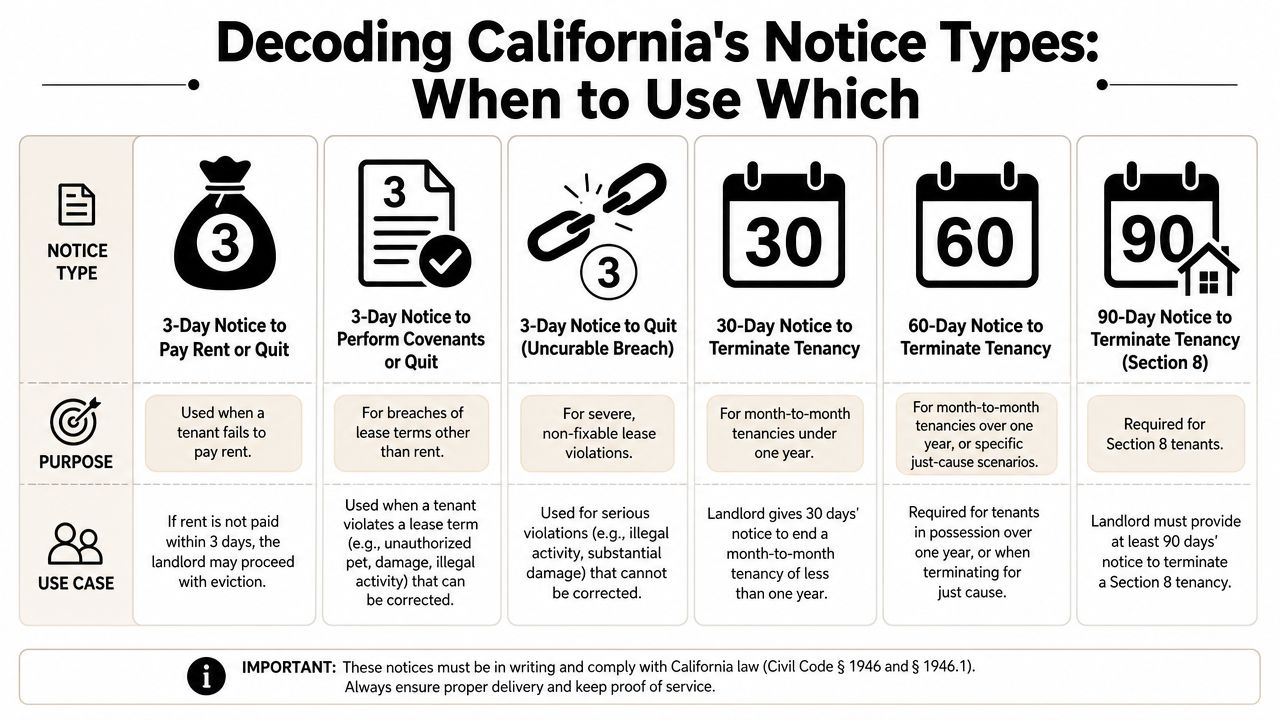
For a month-to-month tenancy, the notice period usually turns on how long the tenant has occupied the unit. Under Civil Code section 1946.1, a 30-day notice generally applies if the tenant has been there less than one year, and a 60-day notice generally applies once occupancy reaches one year or more. Tenants with Housing Choice Voucher assistance have added protections, and many owners miss that point. Good Life Property Management's California notice guide summarizes the 90-day rule for voucher tenants.
Commonly, DIY notices go off track when owners count from lease signing instead of actual occupancy, ignore whether the tenancy converted to month-to-month, or assume a shorter notice is harmless if the tenant already knows they need to leave. None of that helps in court. A notice period that is too short can invalidate the termination.
Use the comparison below as a starting point, then confirm whether local just-cause rules or rent-control ordinances add extra requirements:
| Notice type | Typical use | Key trigger |
|---|---|---|
| 30-day notice | End a month-to-month tenancy | Tenant has occupied less than one year |
| 60-day notice | End a month-to-month tenancy | Tenant has occupied one year or longer |
| 90-day notice | End tenancy for a voucher tenant | Tenant receives Section 8 / Housing Choice Voucher assistance |
The trade-off is simple. Serving the shortest notice possible feels faster. Serving the correct notice is what gets possession.
At-fault notices
At-fault cases require a different analysis because the question is no longer how much time to give before termination. The question is whether the tenant gets a chance to fix the problem, and if so, what exactly must be fixed.
The most common example is the 3-day notice to pay rent or quit. For nonpayment, the demand must be limited to rent that is legally due. Landlords create expensive problems when they add late fees, utility charges, repair bills, or other amounts that do not clearly qualify as rent under the lease and California law. A tenant who really is behind can still defeat the notice if the amount demanded is wrong. If late payment issues are recurring, tighten your process for handling late rent payments before they become possession cases.
Other lease breaches call for different notices. An unauthorized pet or unauthorized occupant often fits a perform covenant or quit notice because the issue may be curable. Serious misconduct may justify a straight quit notice with no opportunity to cure, but that is the type of decision that deserves careful review before service. Choosing a harsher notice than the facts support can backfire just as badly as choosing one that is too lenient.
Matching the notice to the problem
The safest approach is to match the legal theory to the exact conduct, not to the landlord's frustration level.
- Unpaid rent: Use a 3-day pay rent or quit notice, and demand only the rent that is properly due.
- Unauthorized pet: Usually use a perform-or-quit notice if the violation can be corrected.
- Unauthorized occupant: Often use a perform-or-quit notice, but check the lease language and any local occupancy rules.
- Serious non-curable conduct: A straight quit notice may be appropriate if the facts support it.
- Ending a month-to-month tenancy without alleging a breach: Use the correct 30-day, 60-day, or 90-day termination notice.
That distinction matters in real dollars. I have seen owners lose weeks because they served a pay-or-quit notice for charges that were not rent, and I have seen others restart the process because they used a curable notice where the facts called for a different theory. Professional management earns its keep here. It reduces the chance of serving the wrong notice first and paying for that mistake later.
Crafting a Legally Bulletproof Notice
Once you've chosen the right notice, the drafting has to be exact. Without such precision, landlords often lose cases they thought were straightforward.
A notice isn't persuasive writing. It's legal writing. The goal is clarity, not emotion.
What every notice should identify
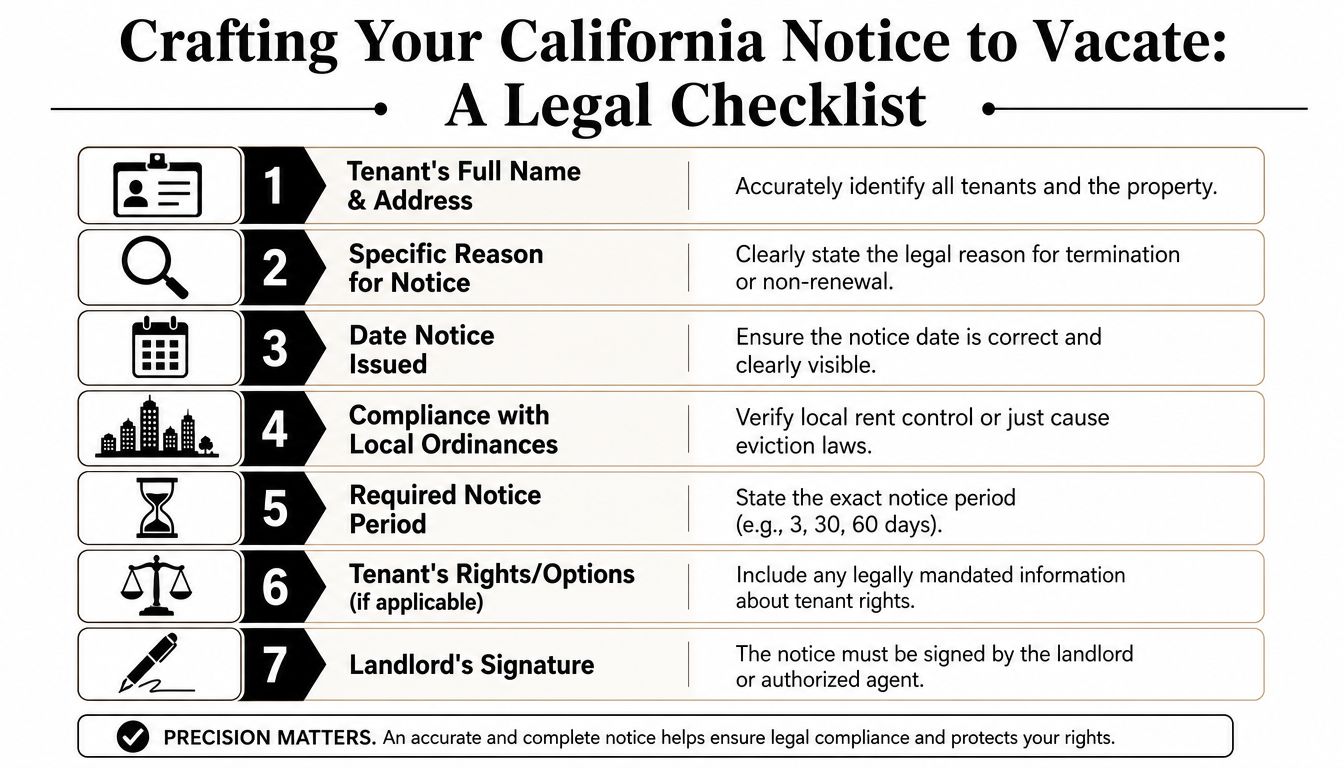
Start with the basics and get them exactly right:
- All adult tenants: Name every adult tenant you intend to bind with the notice.
- The full property address: Use the complete rental address, including unit number if there is one.
- The date of the notice: The date matters because it anchors the timing analysis.
- A clear statement of what must happen: Pay, perform, quit, or terminate.
- The deadline: State the exact end date or response period consistent with the governing notice.
- The landlord or authorized agent signature: Unsigned notices create needless arguments.
This isn't the place for casual language. Avoid wording like "please fix this soon" or "we'd like you out by the end of the month." A valid notice should read like a formal demand with a definite legal basis.
The details that trip landlords up
For a 3-day notice to pay rent or quit, the amount demanded has to be the exact amount of rent owed. The verified guidance above makes an important point: the rent figure must exclude late fees. If the amount is padded, you've weakened the notice.
For no-fault notices, another problem appears. A no-fault notice to vacate in California must include the specific relocation assistance amount or rent waiver required under Civil Code § 1946.2. Omitting that exact figure makes the notice legally defective, as described in DocDraft's California notice analysis.
That requirement catches DIY landlords all the time. They identify the reason for termination and think they're done. They aren't.
Drafting standard: If the law requires a reason, state the specific reason. If the law requires an amount, state the exact amount. General wording doesn't cure missing specifics.
What works and what doesn't
A good notice is specific enough that a judge can see the basis for it on the face of the document.
What works:
- Precise violations: Cite the conduct and, where relevant, the lease provision violated.
- Exact financial terms: State the correct rent amount or relocation figure.
- Unambiguous deadlines: The tenant should know exactly what the notice requires.
What doesn't:
- Vague accusations: "You violated the lease" is usually too loose.
- Rounded or estimated amounts: Close isn't good enough on a pay-or-quit notice.
- Missing statutory content: Especially on no-fault notices.
If you're drafting your own notice, read it as if the tenant's lawyer will attack every sentence. In California, that's the right editing standard.
Proper Service and Critical Timelines
A landlord can draft a technically correct notice, serve it the wrong way, and still lose the case. I have seen owners spend weeks preparing a notice to vacate in California, then watch the court dismiss the filing because service was sloppy or the deadline was counted from the wrong day.
Service is not paperwork theater. It is the step that gives the notice legal force.
The three service methods that matter
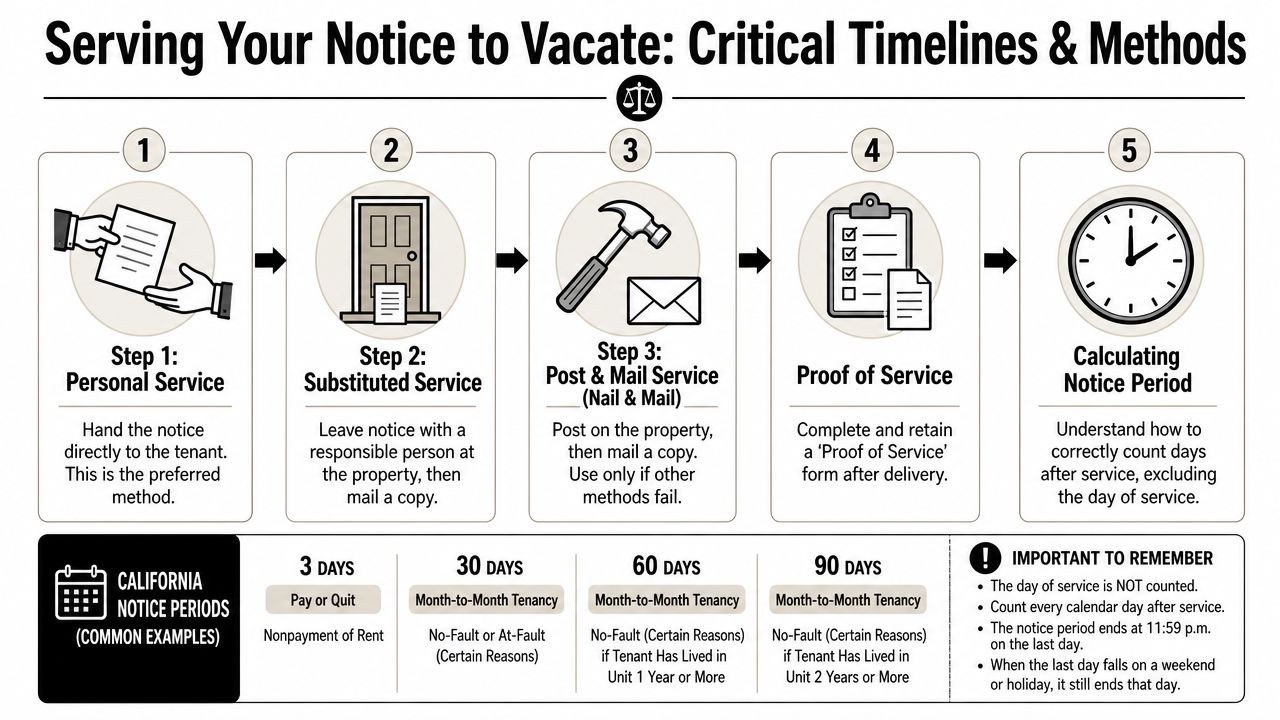
California practice generally recognizes three methods landlords rely on for enforceable notice service: personal delivery, substituted service, or posting and mailing, and verbal demands do not count, as explained in this California notice explanation on YouTube.
Each method creates a different risk profile:
Personal service
Hand the notice directly to the tenant. This produces the fewest disputes because there is little room for argument about whether the tenant received it.Substituted service
Leave the notice with a suitable person at the home or usual place of business, then complete the required mailing step. Frequently, DIY cases break down at this point. Owners leave the paper with another adult and stop there, but an incomplete substituted service can make the notice unusable.Post and mail service
Affix the notice in a conspicuous place and mail a copy. Use this method carefully. If the file does not show why personal or substituted service was not accomplished, the tenant's lawyer has an opening to attack service.
Text messages, emails, phone calls, and hallway conversations do not replace statutory service. They may help prove the tenant knew there was a dispute, but they do not reliably support an unlawful detainer filing.
Landlords who want the court process explained step by step can review this practical guide on how to evict a tenant in California.
This video gives a useful visual overview of the process:
Counting time correctly
The clock does not start the moment the notice is handed over. The day of service is excluded, so the count begins on the following day. Landlords miss this point constantly, especially when they serve late in the afternoon and start counting immediately.
For a 3-day notice, one bad date can wipe out the entire filing. File too early, and the tenant can argue the notice period never fully ran. Serve by a method that adds mailing time or changes the response period, and the calculation gets even more sensitive.
That is why experienced managers calendar the service date, the first day of the count, the last day to cure or quit, and the earliest lawful filing date at the same time. Guessing at the timeline is expensive.
Service starts the clock. Wrong service or wrong counting can force you to start over.
Proof matters as much as delivery
After service, document it immediately. Keep the signed proof of service, a copy of the exact notice served, the date, time, address, and the name of the person who completed service.
In court, credibility helps. Records win.
A judge usually will not accept a landlord's memory in place of clean documentation. If the proof of service is missing details, inconsistent with the notice, or unsigned, the tenant may gain an advantage that has nothing to do with unpaid rent or lease violations. That is the actual cost of DIY errors in California. The case gets delayed, rent loss grows, and the landlord often has to reserve and refile the notice before getting back to court.
Common Pitfalls That Derail Evictions
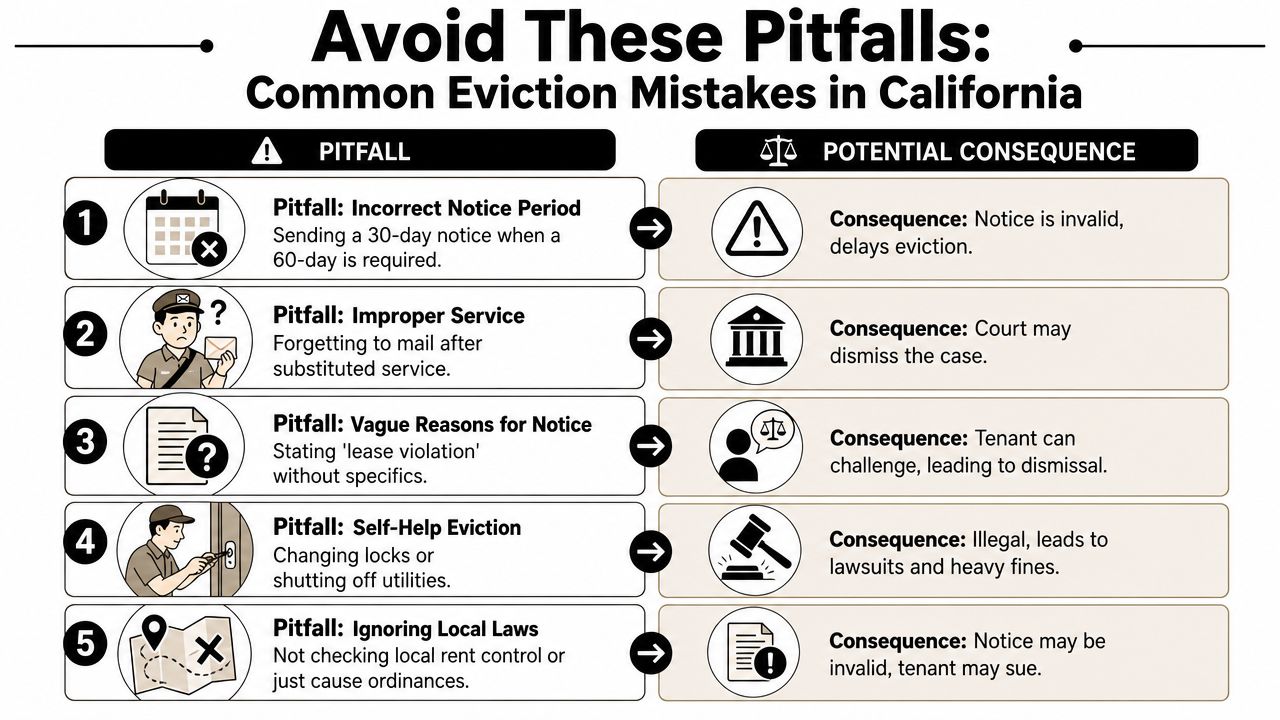
Most failed eviction cases don't fail because the tenant had a winning factual defense. They fail because the landlord created a procedural one.
The missing proof problem
A landlord serves the notice, keeps a copy, files the case, and assumes that's enough. Then the court record shows no original signed proof of service.
That isn't a technical annoyance. It's a primary reason cases get dismissed. One verified source states that failing to file an original signed Proof of Service is a major pitfall, and that if service is done by posting and mailing, the tenant's response window becomes 15 days instead of 5. The same source warns that any deviation in the violation description can result in a 100% case loss rate. That specific warning appears in this summary of California eviction notice pitfalls.
That's a brutal result, but it matches what experienced managers already know. Procedural defects don't get partial credit.
Vague wording that sounds fine until court
A landlord writes, "You have violated the lease by causing problems on the property." That may feel obvious to the owner. It isn't useful in litigation.
Courts want specifics. What conduct occurred. When. Why it violates the lease or just-cause standard. If the notice is vague, the tenant can argue they were never properly informed of what they had to cure or defend against.
Compare these approaches:
| Weak notice language | Stronger notice approach |
|---|---|
| "Lease violation" | Identify the specific violation |
| "Clean up the property" | Describe the condition or conduct at issue |
| "You owe money" | State the exact rent amount if using pay-or-quit |
Service shortcuts and self-help mistakes
Another common scenario is the landlord who gets impatient and cuts corners. They tape the notice up but never complete mailing. Or they change locks after the deadline passes because they think the notice itself restored possession.
It didn't.
Self-help eviction exposes the owner to serious problems, and it also weakens the landlord's position if the matter reaches court. The lawful path is slower than changing locks, but it's the only defensible path.
The expensive cases are often the ones where the landlord was basically right on the facts and badly wrong on the procedure.
The hidden cost of restarting
When an unlawful detainer gets tossed for a notice defect, the landlord rarely loses just one hearing. They lose time, carrying costs, and momentum. They may also have to reserve the notice, wait out a new notice period, and pay for filing all over again.
That is why experienced operators treat notice prep like compliance work, not clerical work. The paperwork isn't secondary to the case. It is the case.
The Smart Solution Your Property Management Partner
A landlord serves what looks like a standard notice, waits out the deadline, then learns in court that one line was too vague or service was incomplete. Now the rent loss keeps running, the filing work starts over, and the tenant gets more time in possession. I have seen owners lose far more to a bad notice than they ever would have paid for careful management on the front end.
California possession work rewards precision and punishes shortcuts. The expensive part is not always the original problem. It is the reset. A defective notice can force the owner to reserve papers, wait through a new notice period, pay new filing costs, and carry another month of vacancy risk or nonpayment.
That is the true value of professional management in California. Risk control.
DIY management has its place. If the resident is stable, the lease is current, and the issue is minor, many owners can handle routine communication on their own. The calculation changes once a notice may become the foundation of an unlawful detainer case. At that point, every detail matters, including the wording, the dates, the amount demanded if rent is at issue, the method of service, and the records kept to prove each step.
A good property manager treats notice work like compliance documentation, not office admin. The job starts before the notice is drafted. Managers who do this well keep clean ledgers, preserve photos and written complaints, confirm the tenancy facts, match the violation to the correct notice, and flag cases that need attorney review before anything is served. That discipline reduces the kind of avoidable error that turns a manageable enforcement issue into a long, expensive dispute.
Owners often frame the decision as a management fee versus doing it themselves. In practice, the trade-off is different. It is structured process now versus paying for procedural mistakes later.
If you'd rather avoid the legal headaches, missed steps, and costly resets that come with handling notices yourself, Edinhart Realty and Property Management can help. Owners in Fresno, Clovis, Friant, and the greater Central California region can explore full-service management for day-to-day oversight or placement-only support for marketing, screening, and lease drafting. When you want the process handled carefully from the start, it's worth having an experienced team in your corner.


