

You may be at the point where one single-family rental no longer feels like enough. You've handled the late-night maintenance call, learned how rent collection works, and started asking the next smart question: what property type gives you more room to grow without multiplying your headaches?
That's where multifamily property investing starts to make sense in Central California. Instead of one house on one lot with one tenant paying the entire note, you own several income streams under one roof. That shift changes how you manage risk, how you scale, and how you think about value.
New investors often assume multifamily is only for large firms buying huge apartment complexes. That's not the case. Many people in Fresno, Clovis, and surrounding areas start with a duplex, triplex, or fourplex. While there's a learning curve, it's manageable when you understand the numbers, the financing, and the local rules that affect your returns.
Why Your Next Investment Should Be Multifamily
A single-family rental can teach you discipline. A multifamily property can teach you how to scale.
If you already own one rental, you've probably seen the downside of concentration. When that one tenant moves out, your rent drops to zero while the mortgage, taxes, insurance, and repairs keep going. In a multifamily building, one vacancy still hurts, but it usually doesn't shut off the entire income stream. That's one of the simplest reasons investors move up.
One roof, multiple income streams
Think of a fourplex like a small business with four customers instead of one. If one customer leaves, the business still has revenue coming in. That makes the property more resilient month to month.
Multifamily also tends to be easier to operate efficiently. You're dealing with one location, one roof, one exterior, one set of common systems, and one neighborhood to learn. That's often more practical than owning several scattered single-family homes across different parts of town.
Practical rule: New investors usually do better when they pick a property type that reduces operational sprawl. Fewer locations often means fewer surprises.
Why serious capital keeps flowing into apartments
Large investors have been voting with their dollars. Private equity firms now own approximately 10% of all apartment units nationwide, and that aggressive buying accelerated recently, with 45% of their total portfolio secured since 2021 according to the multifamily ownership data summarized in Source 4. You don't need to copy institutional buyers, but it's worth paying attention when experienced capital keeps targeting the same asset class.
That trend doesn't mean every deal is good. It means multifamily has qualities that experienced investors want: recurring income, operational upside, and a structure that can be improved through management.
If you want a broader primer before you start analyzing local opportunities, Sims Ventures has a useful guide to investing in multifamily properties that pairs well with a Central California lens.
The hidden advantage beginners miss
Many first-time investors focus only on appreciation. Multifamily teaches a better habit. You can increase value by improving operations.
With a single-family home, value often follows neighborhood sales. With multifamily, value is tied much more directly to income. If you raise rents responsibly, reduce avoidable vacancy, control expenses, and keep tenants longer, you can improve the property's performance in a way that directly matters to future buyers.
That's why multifamily property investing appeals to people who want more control. You're not just hoping the market bails you out. You're buying an asset that can perform better when you run it better.
Understanding the Numbers That Drive Your Profit
The fastest way to get confused in real estate is to look at a rent roll before you understand what each number is trying to tell you. New investors often jump straight to the monthly payment. That matters, but it's not the first question.
The first question is this: how well does the property itself perform before your loan is even part of the picture?
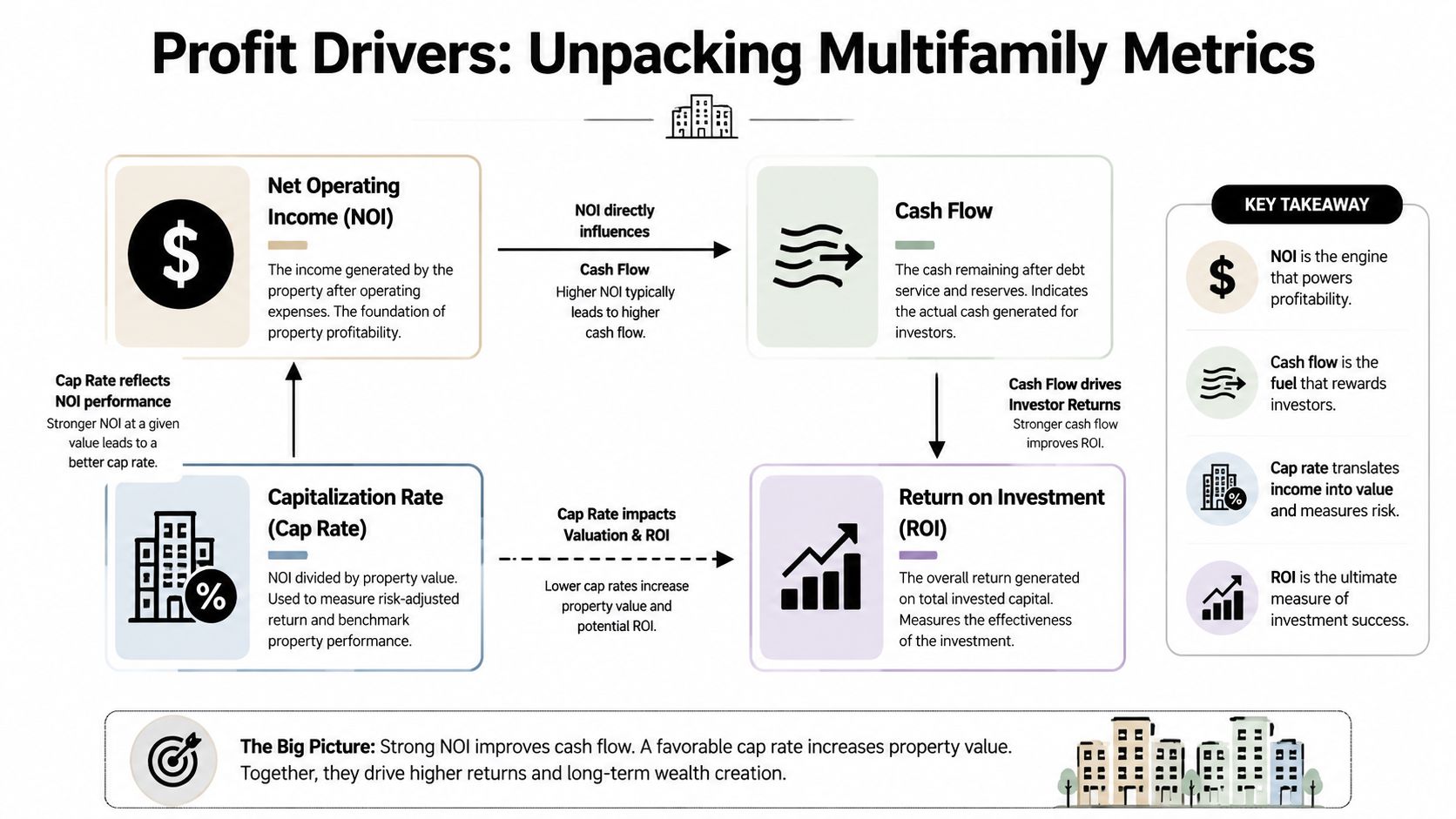
NOI is the property's operating paycheck
Net Operating Income, or NOI, is the income left after operating expenses are deducted, but before mortgage payments and taxes. JPMorgan explains that cap rate is calculated by dividing NOI by property value, and it also warns that using broker-estimated expenses instead of historical actuals can distort returns in its overview of what to look for when buying multifamily property.
A simple way to think about NOI is this: it's the property's annual salary before you factor in your financing. If the building were a worker, NOI would be its pay before personal debt obligations.
For a beginner, that framing matters because it separates two issues:
- Property performance: How much income the building produces after normal operating costs
- Financing choice: How you personally decide to borrow against that building
If you want a plain-language walkthrough, Edinhart has a straightforward explanation of what net operating income means for rental property analysis.
Cap rate is the comparison tool
A cap rate lets you compare one property to another without mixing in your personal loan terms. Since cap rate equals NOI divided by value, it works like a common yardstick. One building may have stronger rents but higher expenses. Another may look plain on paper but operate more efficiently. Cap rate helps you compare them on equal footing.
Here's the practical takeaway:
| Metric | What it answers | Why it matters |
|---|---|---|
| NOI | How much the property earns from operations | It drives valuation |
| Cap Rate | What return the property produces before financing | It helps compare deals |
| Cash Flow | What's left after debt service and expenses | It affects your monthly hold comfort |
A lot of bad purchases happen because buyers confuse a pretty building with a good investment. A newer exterior, fresh paint, and staged photos don't tell you whether the expenses are realistic.
Buy the numbers first. Then confirm the building condition supports those numbers.
Cash flow is your personal result
Cash flow is what remains after operating costs and debt payments. This is the number that affects your bank account each month.
Two investors can buy similar properties and have different cash flow because their financing is different. One buyer puts more down and has lower debt service. Another finances a larger portion of the property's cost and keeps more cash on hand. Same property. Different personal outcome.
That's why multifamily property investing requires you to read deals from two angles:
- Is the property sound?
- Does my financing structure still leave me enough room?
Taxes also affect your real return, especially when you start claiming eligible ownership expenses. If you want a useful summary of that side of the equation, Allied Tax Advisors offers a practical overview of real estate investor deductions.
The mistake that costs beginners money
Many new buyers trust the flyer too much. The broker sheet says projected rents, projected maintenance, projected utility costs. But underwriting should start with actual rent collections, actual bills, actual repair history, and actual turnover patterns whenever you can get them.
If the seller's story depends on “you can probably” and “it should be,” slow down. In multifamily, the difference between a workable deal and a painful one is often hiding inside the expense line.
Finding and Analyzing Investment Opportunities
Finding a multifamily deal in Central California isn't just about checking listing sites every morning. Good investors build a pipeline. They look at listed properties, talk with brokers, track neighborhoods, and learn which opportunities deserve real underwriting time.
The strongest deals often aren't the ones with the prettiest marketing package. They're the ones where your numbers stay solid even after you assume the seller left something out.
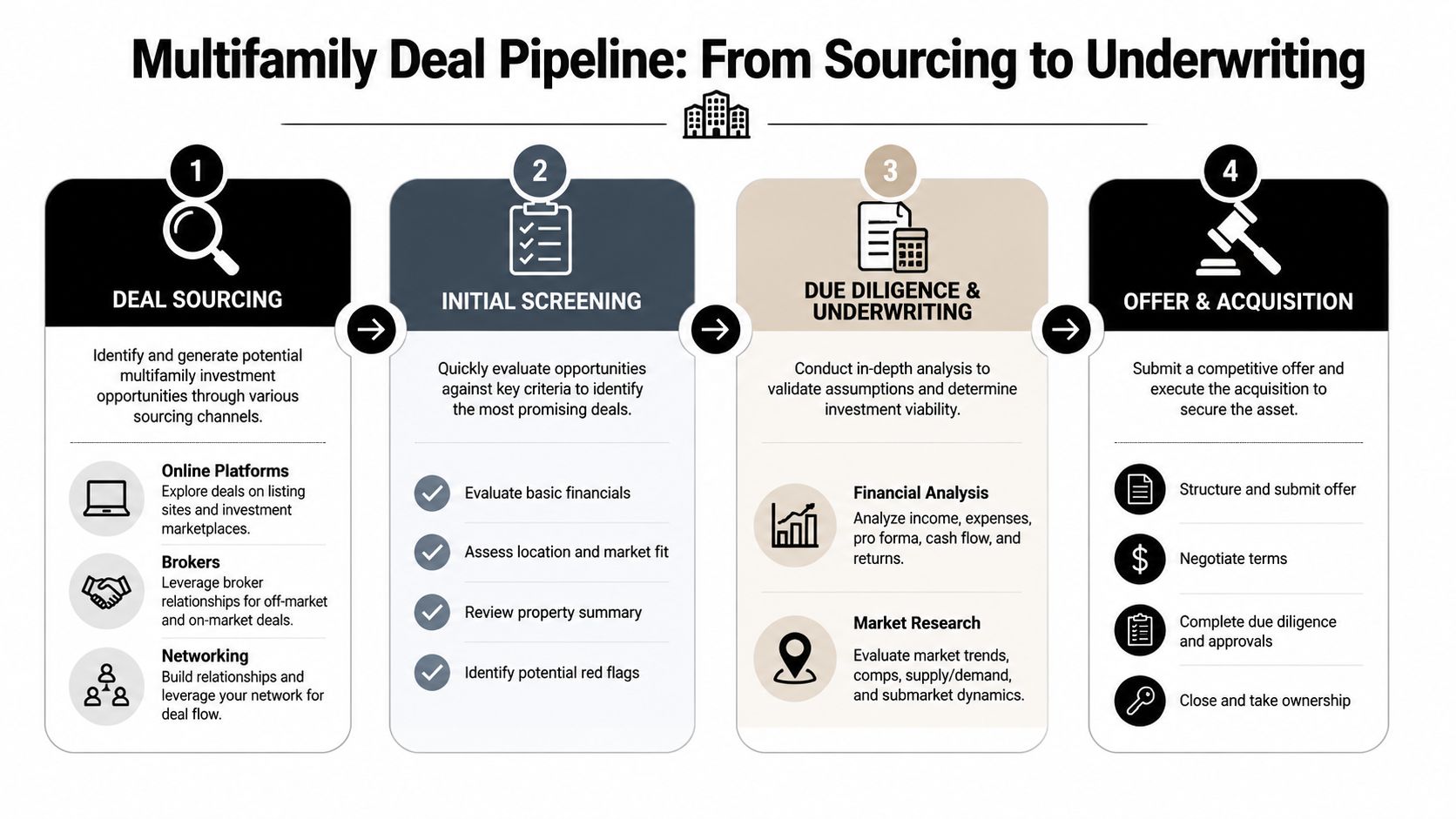
Where Central California investors usually find deals
In markets like Fresno and Clovis, most beginners start in three lanes:
- MLS listings: These are the easiest to access, but they're also the most visible. Expect competition and polished presentations.
- Broker relationships: Local brokers often know about sellers before the property is broadly marketed.
- Owner outreach and networking: Contractors, property managers, lenders, and local investors hear things early.
If you're still learning how to study a submarket, a broker-focused guide to real estate market analysis can help you organize what you're seeing around rents, inventory, and comparable sales.
What demand tells you right now
Your underwriting should reflect the local occupancy backdrop, not your optimism. Current market analysis from Origin Investments notes that multifamily occupancy has stabilized above 94.1% for seven straight months, while new construction starts fell 40% year over year, creating a stronger demand floor in many markets according to its multifamily inflection point analysis.
That doesn't mean you should underwrite aggressively. It means vacancy assumptions need to be grounded in actual demand conditions instead of fear or guesswork.
A simple fourplex underwriting example
Let's say you're reviewing a fourplex in Fresno County. Don't start with the asking price. Start with the story the income and expenses are telling.
Look at the property this way:
Income side
- In-place rent from each unit
- Laundry or other tenant-paid fees if they are present
- Vacancy allowance based on realistic local leasing conditions
Expense side
- Property taxes
- Insurance
- Maintenance and repair history
- Utilities the owner pays
- Property management
- Turnover and leasing costs
- Reserve for larger upkeep items
NOI
- Income minus operating expenses
Financing impact
- Debt service based on your likely loan structure
Here's a plain-language version of a pro forma review:
| Underwriting step | What to check | Common beginner mistake |
|---|---|---|
| Rent review | Verify leases and actual collections | Assuming all units can jump to market rent immediately |
| Expense review | Use trailing bills and statements | Trusting a broker's rounded estimate |
| Physical review | Roof, plumbing, HVAC, deferred maintenance | Treating cosmetic updates as full rehab |
| Exit review | Ask who would buy this from you later | Assuming every improvement raises value equally |
A fourplex can look profitable on paper and still be a weak deal if one major system is near failure, tenant turnover is chronic, or expense records are incomplete.
What to notice in Fresno and Clovis
In this region, beginners often get tripped up by properties that appear straightforward because they're small. A duplex or fourplex is not automatically simple. Older buildings can have hidden plumbing issues, patchwork electrical work, or maintenance that previous owners delayed.
The practical skill is learning to separate listing quality from asset quality. Strong photos tell you the seller hired a good photographer. Strong underwriting tells you whether the property can support your plan.
When you analyze enough opportunities, a shift happens. You stop asking, “Can I buy this?” and start asking, “Does this building deserve my capital?”
Securing Financing for Your Multifamily Deal
Financing is where many first-time multifamily buyers lose momentum. They find a decent duplex or fourplex, run the numbers, then discover the loan options aren't as simple as they expected.
The key is to match the loan type to the size of the property and your actual strategy. A buyer planning to house hack one unit has different options than an investor buying a non-owner-occupied fourplex strictly for income.
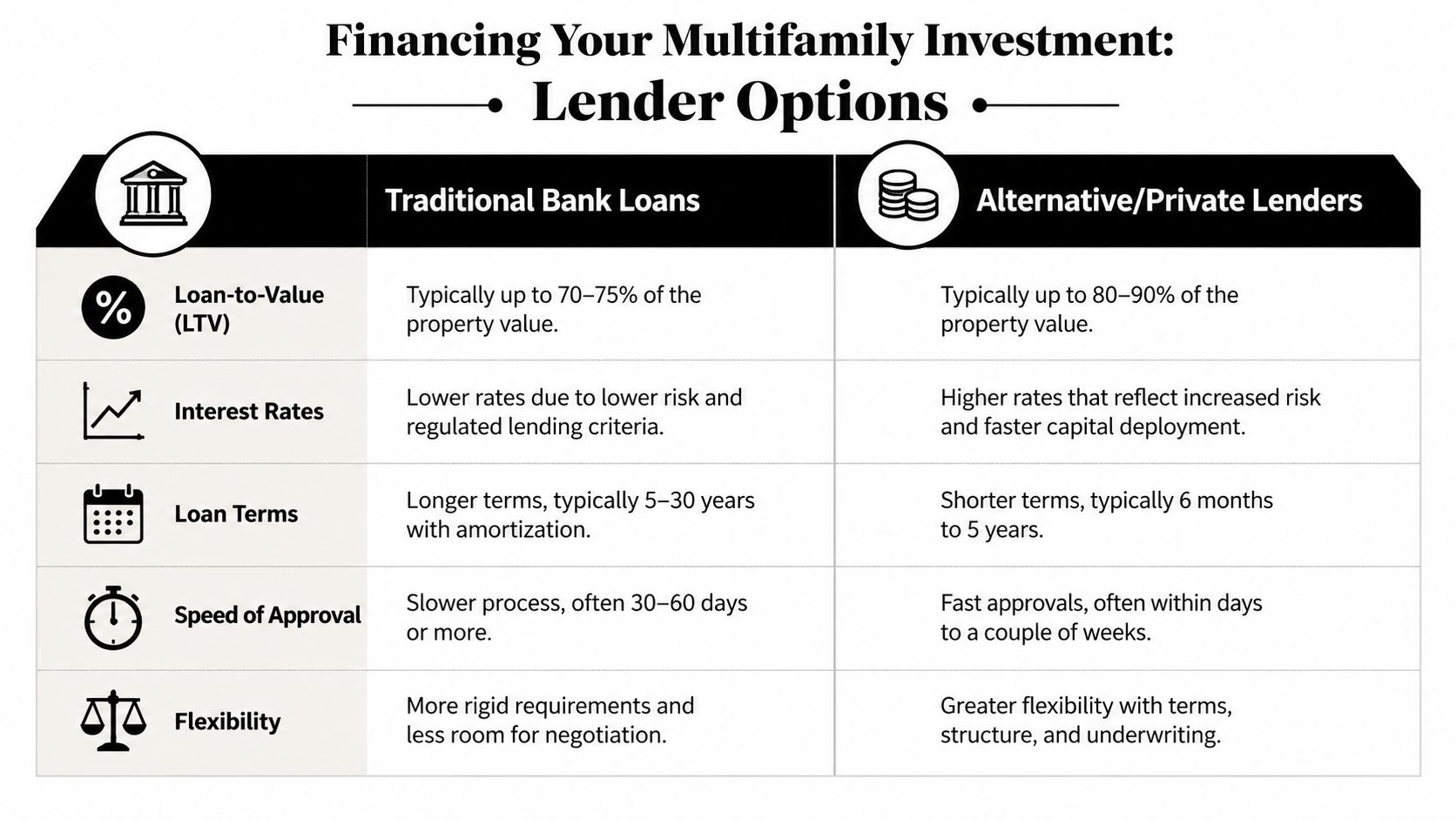
The main lending paths
For smaller multifamily properties, most investors compare a few broad routes:
- Conventional residential financing: Often used for duplexes, triplexes, and fourplexes. This can be more familiar to first-time buyers, but underwriting standards are still serious.
- FHA financing for owner-occupants: Relevant if you plan to live in one unit and rent the others.
- Commercial-style lending: More common as property size and complexity increase.
- Non-QM or alternative financing: Sometimes necessary when the file doesn't fit standard agency expectations.
Each option has tradeoffs around documentation, down payment, flexibility, and long-term cost. What matters is not just whether you can close. It's whether the financing leaves enough room for the property to perform.
The problem small investors run into
For properties under 10 units, agency-style access can be tighter than many beginners expect. Verified data shows that 40% of small multifamily loans now rely on non-QM lenders, with interest rates 1.5% to 2.0% higher than agency loans, a gap that directly affects cash-on-cash returns according to the financing summary in Source 5.
That matters a lot in Central California because many entry-level multifamily investors start with exactly these smaller properties. If your deal only works with unusually cheap financing, it may not be strong enough.
A helpful starting point is to review the financing environment through a local investor lens. Edinhart offers a practical resource on real estate investor financing options.
Here's a useful overview before you talk with lenders:
How to approach lenders without wasting time
You don't need a perfect deal before making lender calls. You do need a clean borrower profile and a clear strategy.
Bring these into the conversation:
- Your target property type: Duplex, triplex, fourplex, or larger
- Your occupancy plan: Owner-occupied or investment only
- Your cash position: Down payment, reserves, and repair budget
- Your credit and income picture: The lender will get there anyway, so lead with it
The best lender conversation is specific. “I'm looking for a fourplex in Fresno County, likely non-owner occupied, and I want to understand where my debt service lands before I write offers.”
Why local relationships still matter
National lenders can be useful, but local banks, mortgage brokers, and credit unions often understand neighborhood-level realities better. They may have more context for Central California inventory, appraisal challenges, and borrower profiles tied to local employers or self-employment income.
Financing isn't just a hurdle between offer and closing. It shapes your margin for error after closing. In multifamily property investing, a loan that looks acceptable on day one can become the reason the property feels tight every month after.
Professional Management That Maximizes Your Return
A lot of owners think property management is just an expense line. That's too narrow. Management affects leasing speed, tenant quality, repair coordination, records, renewals, and compliance. In other words, it affects the income side and the expense side of the property at the same time.
That makes management an operations decision, not just a convenience decision.

Self-management versus professional management
Some owners should manage their own building. Others shouldn't. The answer depends less on experience than on capacity.
| Option | When it fits | Where it gets risky |
|---|---|---|
| Self-management | You live nearby, know landlord responsibilities, and can respond quickly | You underestimate screening, documentation, or maintenance coordination |
| Professional management | You want systems, vendor coordination, and cleaner reporting | You hire based on price alone and ignore process quality |
Self-management can work well for a local owner with one small building and flexible time. It tends to break down when the owner has another job, lives out of town, or doesn't want tenant issues dictating the week.
Management changes NOI in real life
This is the part many new investors miss. Management isn't only about collecting rent. Better management can reduce vacancy downtime, improve tenant retention, catch maintenance earlier, and keep records organized enough that you can evaluate performance.
Poor management does the opposite. It turns a workable asset into a messy one. Units sit too long. Repairs get handled late instead of early. Tenant screening slips. Lease files become incomplete. Then the owner says the market is the problem when the operating system is the problem.
A property rarely performs better than the systems behind it.
A practical fit for different owner styles
In Central California, some owners want full operational help. Others only want help placing strong tenants and handling the lease correctly. That's why it's useful to work with firms that offer more than one model.
For example, Edinhart's Central California property management services include both full-service management and a placement-only approach. That structure fits two different investor profiles. One owner wants rent collection, maintenance coordination, accounting, and renewals handled. Another wants professional marketing, screening, and lease drafting but plans to manage the day-to-day personally.
What to ask before hiring any manager
Don't start with the fee. Start with the process.
Ask questions like these:
- Screening standards: How do they verify income, rental history, and application quality?
- Maintenance workflow: Who takes calls, who approves work, and how are vendors chosen?
- Reporting cadence: What financial statements will you receive and how often?
- Lease handling: Who prepares documents and tracks renewals, notices, and compliance issues?
A manager should be able to explain their system in plain English. If the answers sound vague before you hire them, they won't get clearer after the contract is signed.
The Investor's Edge in Central California's Market
Central California rewards local knowledge. A property that looks average to an out-of-area buyer can be a solid long-term hold if you understand the neighborhood, tenant base, commute patterns, and city rules. The reverse is also true. A property that looks like a bargain can become expensive fast if you miss what's happening around zoning, land costs, or competing rental product.
That's why broad national advice only gets you so far. Fresno, Clovis, and nearby communities have their own logic.
Zoning can create value and confusion
One of the clearest examples is density-bonus policy tied to affordable housing. In mid-sized markets like Fresno, verified HUD-based data shows that density-bonus zoning has led to a 12% to 15% near-term increase in property values, while also pushing land acquisition costs up 20%, creating what Source 6 describes as a value trap for investors who don't understand the delay between zoning approval and rent stabilization in these markets.
That's a very local kind of risk. On paper, the zoning change looks like upside. In practice, the land gets more expensive before the income benefit is fully realized. If you pay as if all the upside is immediate, your return can flatten fast.
Where newer investors get caught
A buyer sees a Class B asset in a growing corridor and thinks, “This area is improving, so I should stretch.” But stretching based on a future story is different from buying based on current performance.
Watch for these local pressure points:
- Entitlement enthusiasm: Zoning flexibility can attract buyers before rents fully support the premium.
- Land pricing pressure: Once more people chase the same development angle, acquisition math tightens.
- Competing rental formats: In some areas, newer rental housing can pull away the exact resident profile you expected to target.
A better way to read the market
Instead of asking whether an area is “hot,” ask narrower questions:
- Who is the likely tenant for this exact property?
- What competing housing options are opening nearby?
- Does the current rent roll support the price without heroic assumptions?
- If local policy shifts the opportunity, who captures the benefit first, the seller or the next owner?
Those questions matter in Central California because neighborhood performance can vary block by block, school zone by school zone, and product type by product type.
Local edge doesn't come from knowing the city name. It comes from knowing how one submarket behaves differently from the next.
Why local execution matters more than broad optimism
Multifamily property investing works best when your market knowledge is specific enough to protect you from paying for upside that someone else already priced in. In Fresno and Clovis, that often means being careful with small multifamily that looks easy to reposition. The building may be manageable. The surrounding economics may be less forgiving.
An investor who knows the local rent ceiling, repair expectations, permit climate, and tenant demand pattern will usually make a calmer decision than one buying from a statewide spreadsheet.
Your Next Steps in Multifamily Investing
It's not more motivation that's needed. It's a cleaner first move.
If you're serious about multifamily property investing, don't start by trying to find the perfect deal. Start by building a repeatable decision process. That's what separates curiosity from action.
Build your first working plan
A strong beginner plan is simple:
- Choose your entry point: Decide whether you're targeting a duplex, triplex, or fourplex.
- Set your buy box: Define neighborhood, condition level, and whether you'll owner-occupy.
- Talk with lenders early: Learn what financing structure is realistic before you write offers.
- Practice underwriting weekly: Even properties you don't buy will sharpen your eye.
- Decide your management model: Know whether you'll self-manage or delegate operations.
This doesn't need to be fancy. It needs to be honest. If you only have time to look at one deal a week, build around that. If you know you won't want tenant calls, plan for management from day one.
What a strong beginner actually does next
The investors who make progress usually do a few practical things right away.
First, they start reviewing actual listings in Fresno, Clovis, and nearby areas just to practice reading rent rolls, expense assumptions, and property photos with a critical eye.
Second, they keep a short deal sheet for every property they review. Not a complicated spreadsheet at first. Just purchase price, estimated income, main expenses, repair concerns, likely financing path, and one sentence on why they passed.
Third, they build a small local team. That can include a lender, an agent, a property manager, an inspector, and a contractor. You don't need all of them fully lined up on day one, but you do need names and conversations started.
A checklist worth keeping
Before you pursue your first serious deal, make sure you can answer these questions clearly:
| Question | Why it matters |
|---|---|
| Do I understand the property's actual income? | You can't value what you can't verify |
| Am I using real expenses instead of hopeful ones? | Optimistic underwriting is where beginners get hurt |
| Does the financing still work if the property needs more cash early? | Small multifamily often needs upfront attention |
| Who will manage leasing, repairs, and tenant issues? | Operations shape returns after closing |
| Do I understand the local submarket, not just the city name? | Central California performance is highly location-specific |
If you can answer those well, you're ahead of many first-time buyers already.
Keep your first deal boring
That may sound strange, but it's good advice. Your first multifamily purchase doesn't need to be flashy. It needs to be understandable.
A clean, well-located small multifamily property with verifiable rents, manageable deferred maintenance, and realistic financing is often a better first step than a “huge upside” building with a confusing story. Boring deals usually teach better lessons and create fewer expensive surprises.
The point isn't to buy quickly. The point is to become the kind of investor who can tell the difference between a good-looking listing and a sound investment.
If you're ready to move from research to real analysis, Edinhart Realty and Property Management is a practical next contact for Central California investors who want local insight on buying, leasing, and operating rental property. A conversation can help you pressure-test a target neighborhood, think through management options, and approach your first multifamily purchase with a clearer plan.


