

Owning a rental often looks simple from the outside. Collect the rent, handle the occasional repair, renew the lease, repeat. Then the actual work starts. A leaking water heater hits on a weekend, a prospect ghosts after a showing, a tenant pays late, and tax time arrives with a stack of receipts that should have been organized months ago.
That's usually when owners start searching terms like MPI rentals properties and discover that the language around rental housing can be confusing. Sometimes “MPI” refers to a market index. Sometimes people use it more loosely to describe a professionally managed portfolio of rentals operating under one system. What matters to an owner in Fresno is less the acronym and more the operating model behind it.
Professional management is already a major part of housing. The U.S. property management industry generates more than $130 billion annually, with residential management accounting for over 80% of the total, and typical management fees run about 8% to 12% of monthly rent, according to TenantCloud's property management statistics for landlords and tenants. That tells you this isn't a fringe service. It's a built-out industry with standard practices, systems, and expectations.
Your Guide to Professional Property Management
If you own one house, a duplex, or several rentals, you're already running a small operating business. The property is the asset, but the outcome depends on process. Leasing, screening, repairs, turnover work, rent collection, notices, accounting, and communication all need to happen on time and in the right order.
That's where many owners get stuck. They don't necessarily need more effort. They need a better system.
A managed rental works best when each recurring job has a playbook. Listing photos are consistent. Tenant inquiries get answered promptly. Vendors know how work orders are approved. Statements arrive in a format your accountant can use. Even support functions matter. For example, turnover cleaning can delay a listing or a move-in if it isn't scheduled tightly, which is why practical resources such as property manager cleaning solutions Madison are useful beyond their local market. The workflow lesson applies anywhere.
What owners are usually trying to solve
Most calls from owners come back to a few problems:
- Time drain: The property keeps interrupting work, family time, or travel.
- Risk exposure: Screening mistakes, poor documentation, and inconsistent follow-up create avoidable headaches.
- Income leakage: Vacancy stretches, repair delays, and weak rent collection erode returns.
- Operational clutter: Records, invoices, tenant communication, and lease paperwork live in too many places.
Practical rule: If the property only runs smoothly when you're personally watching every step, you don't have a durable management system yet.
A professional manager isn't just a rent collector. The job is to build repeatable execution around the property so the owner gets less drama and more predictability. If you want a plain-language breakdown of what falls inside that role, Edinhart's guide on what property management includes is a useful starting point.
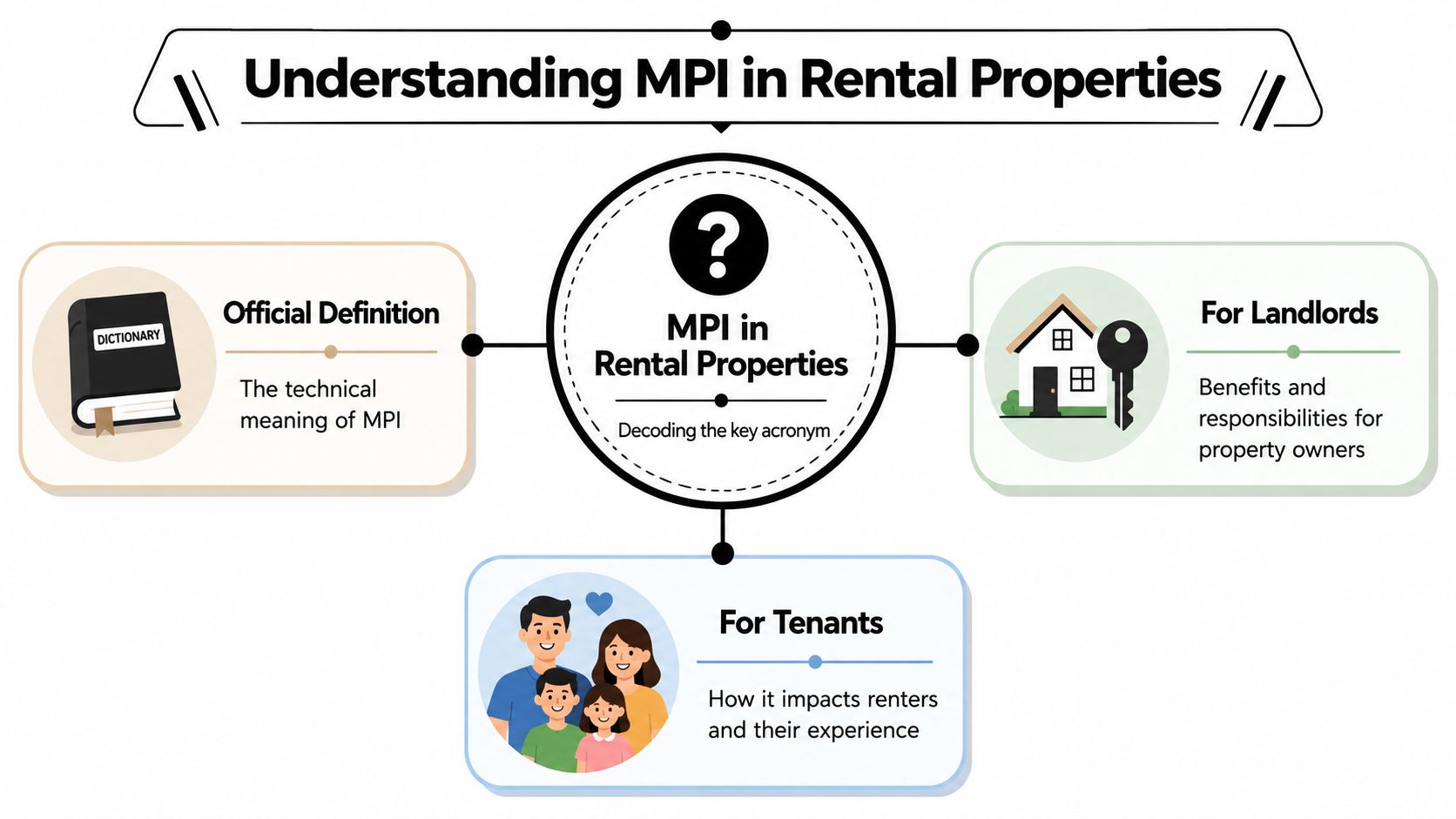
What Does MPI in Rental Properties Mean?
The phrase MPI rentals properties creates confusion because “MPI” has more than one meaning in real estate conversations. One is formal and industry-specific. The other is the practical meaning most owners are really asking about.
The official MPI meaning
In housing industry data, MPI commonly means the Multifamily Production Index from the National Association of Home Builders. It measures builder sentiment around multifamily production. Alongside it, the Multifamily Occupancy Index, or MOI, gives context on occupancy conditions.
The NAHB reported a first-quarter 2026 MPI reading of 44 and an MOI reading of 69, which indicated weaker production sentiment relative to occupancy conditions in that period, according to the NAHB Multifamily Market Survey. For investors, that kind of split matters. It suggests a market where operators still prioritize leasing performance and retention even when new development sentiment softens.
The meaning most owners care about
Outside formal market reports, people often use “MPI rentals” more loosely to describe a multi-property investment or multi-property investor approach. In practice, that means several homes, units, or buildings managed under one operating system instead of treating each rental as a standalone project.
That interpretation makes sense because portfolio operations behave differently from one-off self-management. The manager can use one process for:
- Leasing workflow: same inquiry handling, showing standards, and follow-up
- Screening rules: same criteria and documentation path across units
- Repair coordination: same intake method, approval flow, and vendor communication
- Accounting setup: same reporting logic across the portfolio
When owners say they want their rentals handled “professionally,” they usually mean they want this kind of consistency, not just someone available to answer the phone.
Why the distinction matters in Fresno
If you're choosing how to manage a house or a small portfolio in Fresno, the acronym itself isn't the decision. The decision is whether you want a property run with market awareness and a repeatable operating model. That's the useful takeaway behind MPI rentals properties. One meaning tells you what's happening in the broader apartment market. The other points to how disciplined rental operations are built.
How Tenants Find and Rent Managed Homes
A tenant can usually tell within minutes whether a rental is owner-run casually or managed through a system. The difference shows up before the first showing.

A managed listing starts with clean presentation. Good photography, complete details, a clear rent amount, policy notes, and a straightforward next step all matter. Most renters search major listing platforms, management company sites, and map-based apps. If your listing is missing basic information or the photos feel rushed, many qualified prospects move on without ever asking a question.
Owners often underestimate how much media quality affects the first step of leasing. Even lightweight tools and structured shot lists can improve consistency. For teams trying to create more polished walkthroughs, resources on real estate video templates are useful because they turn a vague “make a video” task into a repeatable listing asset.
The tenant journey in a managed property
A strong tenant experience usually follows a predictable sequence.
The prospect finds the listing.
The ad appears with professional photos, accurate features, and a realistic description.The prospect schedules a showing.
Response time matters here. Delayed replies lose interest fast.The application is standardized.
Every applicant moves through the same intake and screening path.The lease package is clear.
Terms, payment expectations, move-in requirements, and property rules are documented consistently.Move-in feels organized.
Keys, portal access, utility instructions, and condition documentation are handled without scrambling.
Owners can see where their own process breaks by looking at tenant friction. If applicants keep asking basic questions, your listing is incomplete. If approved tenants seem confused at signing, your lease workflow is too loose. If move-ins start with unresolved maintenance items, turnover coordination failed.
A good benchmark is simple. The tenant should feel like the home is ready and the process is under control.
To see where renters discover inventory, Edinhart's overview of the best rental listing websites for owners and landlords is worth reviewing before you market a vacancy.
Here's a short visual on how the rental search experience has shifted online and why presentation matters:
What tenants notice that owners miss
- Showing convenience: Hard-to-book showings shrink the applicant pool.
- Communication quality: Fast, direct answers build trust before a lease is signed.
- Consistency: Standard forms and clear next steps make the property feel stable.
- Maintenance readiness: Small unresolved issues at showing time raise larger doubts.
That tenant-side professionalism is one of the most practical reasons owners hire management. It supports occupancy and reduces the chaos that starts when the leasing process is improvised.
Key Management Processes for Property Owners
Owners usually see property management as one service. On the ground, it's a chain of separate functions that either reinforce each other or break down one by one.
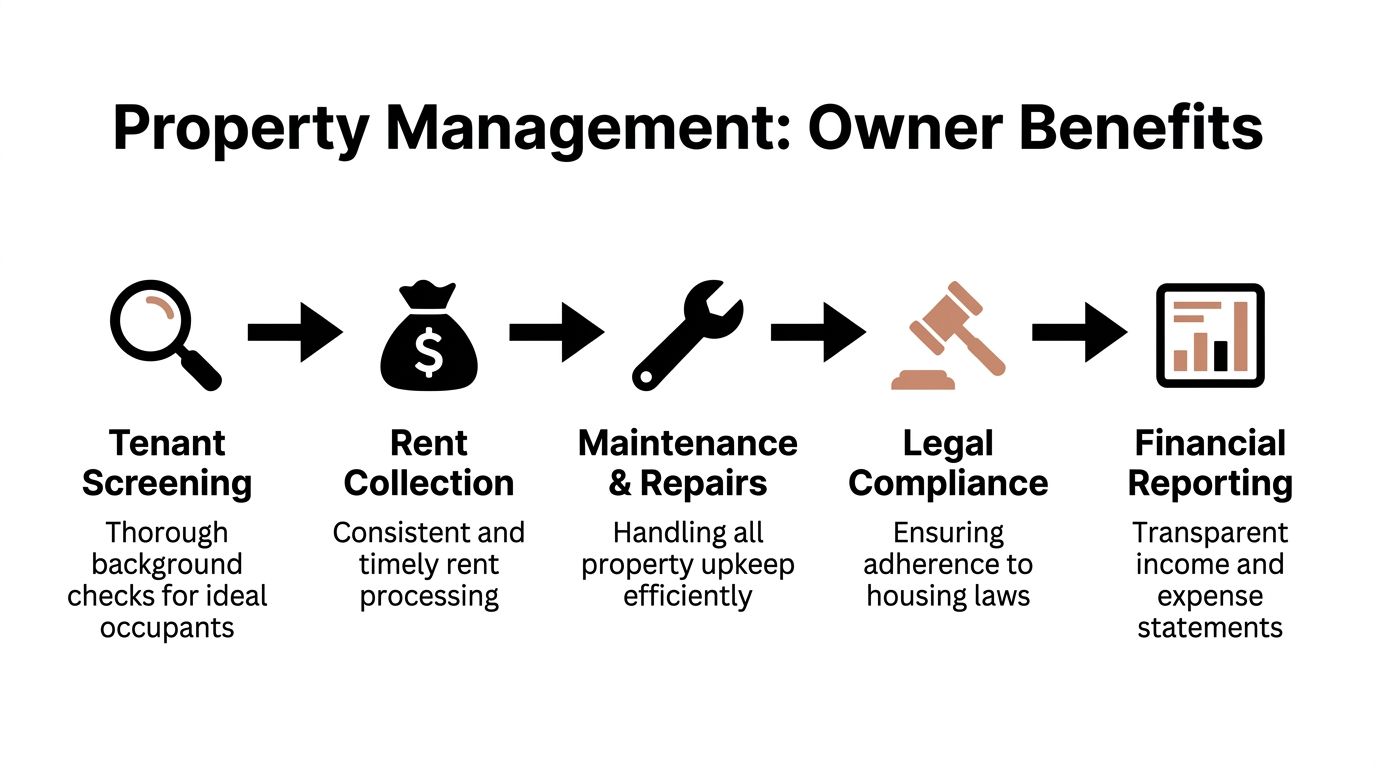
A solid operation includes several institutional-style elements: an in-house licensed broker, a dedicated maintenance team, online portals for owners and tenants, and broad showing availability such as personal showings 6 days a week and remote showings 7 days a week, as described by MPI Property Management. Those details matter because they reduce delay at the exact points where rentals tend to lose money.
Marketing that starts before the vacancy goes live
Good marketing isn't just posting a listing. It starts with rent positioning, property condition, photo prep, and timing.
A manager should look at the home the way a renter will. Is the front entry inviting? Are light bulbs matched? Do the photos show space accurately? Is the listing copy clear about pet rules, appliances, yard responsibility, and move-in requirements?
Weak marketing usually fails in one of two ways. Either the asking rent is detached from the actual condition and location of the property, or the listing doesn't answer enough questions to qualify leads.
Screening that protects the asset
Tenant screening is where many self-managing owners get too casual or too emotional. They either approve too fast because they want the vacancy filled, or they make inconsistent judgment calls that create compliance risk.
A better approach is structured and documented. The screening standard should be applied the same way every time. The point isn't just to find someone who can move in. The point is to find someone who is likely to perform well under the lease.
A vacancy feels expensive, but a bad placement is usually more expensive.
Rent collection and follow-through
Collecting rent sounds simple until it isn't. Professional systems reduce friction by giving tenants one payment path, one due-date rhythm, and one communication channel for account questions.
From the owner side, this also improves recordkeeping. When rent activity, charges, owner disbursements, and maintenance costs live in one system, month-end review is cleaner and tax prep gets easier.
Maintenance coordination and response standards
Maintenance is where management quality becomes visible. Fast intake, accurate dispatching, and clear owner approval rules keep small issues from turning into expensive ones.
Owners should pay attention to three practical questions:
- How are requests submitted: Portal, phone, email, or all three?
- Who triages urgency: Someone has to separate routine work from true emergencies.
- How is the repair documented: You want a record of the issue, action taken, and final billing.
The in-house maintenance model can be especially helpful because it shortens handoff time. That doesn't remove the need for outside specialists, but it often improves speed on common repairs and turnover work.
Reporting and owner visibility
Financial reporting is often the least exciting part of management, but it affects every ownership decision. Clear statements help you track rent received, repair costs, recurring expenses, and property performance without rebuilding the file every month.
A practical reporting setup should let an owner answer basic questions quickly:
| Owner question | What a good system should show |
|---|---|
| Did rent come in on time? | Payment status and posted date |
| What was spent on repairs? | Itemized maintenance charges |
| What do I need for bookkeeping? | Organized statements and transaction history |
| What changed this month? | Notes on vacancy, lease activity, or unusual costs |
When these five functions work together, a rental becomes easier to operate and easier to evaluate.
Why Portfolio-Style Management Works
The core advantage behind many MPI rentals properties is standardization at scale. That's the technical edge that makes portfolio management different from improvised self-management.
According to MUPM's discussion of MPI rentals, using the same workflows for screening, repairs, and lease administration across units reduces operational variance. In practical terms, that means fewer one-off decisions, fewer missed steps, and more consistent service across the portfolio.
One playbook beats five improvised ones
Owners often think scale only matters when they own a large number of units. That's not how operations work. Even one house benefits from a repeatable playbook.
If every vacancy gets a different pricing method, every applicant gets a different standard, and every repair request gets handled through a different channel, the property becomes hard to manage and harder to audit. Mistakes hide inside inconsistency.
Portfolio-style management fixes that by giving each recurring task a default process:
- Leasing stays consistent: same listing prep, same showing sequence, same lease workflow
- Repairs move faster: same intake path, same vendor coordination rules, same documentation habit
- Accounting stays cleaner: same charting logic, same statement format, same paper trail
Why owners feel the benefit quickly
The first benefit is usually reduced friction. Fewer text chains. Fewer “I thought you were handling that” moments. Fewer last-minute scrambles before move-in.
The second benefit is decision quality. When the manager runs a property through the same system each month, the owner gets cleaner information. Cleaner information leads to better calls on rent levels, repairs, renewals, and whether to keep or sell an asset.
Consistency doesn't make rental ownership passive. It makes it controllable.
That's why this model works for more than large investors. A homeowner renting out one former residence still gains from professional habits that were built for portfolios. The same discipline that helps a multi-property owner also protects the single-property landlord from preventable errors.
Full-Service vs Placement-Only What Owners Need
Most owners don't need every service in every season. They need the right level of involvement for their time, location, and tolerance for day-to-day management.
In Fresno, that usually comes down to two common models. One handles the full monthly operation. The other handles the front end of leasing and leaves the ongoing management with the owner. Edinhart Realty & Property Management offers both structures in that format, which makes the choice fairly practical rather than abstract.
Edinhart management models at a glance
| Service | Placement-Only | Full-Service Monthly Management |
|---|---|---|
| Marketing the vacancy | Included | Included |
| Professional photos and listing presentation | Included | Included |
| Applicant screening | Included | Included |
| Lease drafting | Included | Included |
| Rent collection after move-in | Owner handles | Included |
| Tenant communication during tenancy | Owner handles | Included |
| Repair coordination | Owner handles | Included |
| Move-in and move-out coordination | Owner handles | Included |
| Lease renewals | Owner handles | Included |
| Accounting statements | Limited to placement stage | Included on an ongoing basis |
Who placement-only fits
Placement-only works for a local owner who wants help with the hardest setup tasks but still plans to stay hands-on.
That owner usually wants professional marketing, strong screening, and a properly drafted lease, but doesn't mind taking calls, coordinating repairs, and tracking payments after the tenant moves in. It can be a good fit when the owner lives nearby, knows the property well, and wants direct control over maintenance spending and tenant communication.
Placement-only usually works poorly for owners who travel often, dislike confrontation, or already struggle with paperwork. If you don't have time for day-to-day follow-through, a strong placement can still unravel during the tenancy.
Who full-service tends to fit better
Full-service monthly management suits owners who want operations handled continuously rather than episodically.
That often includes:
- Out-of-area owners: They can't easily meet vendors, inspect work, or handle urgent issues in person.
- Busy professionals: They have the income to own rentals but not the time to run them.
- Portfolio investors: They need one reporting system across multiple units.
- Owners who want separation: They prefer a buffer between themselves and tenant disputes or maintenance calls.
The real trade-off
This isn't just a cost decision. It's a control-versus-workload decision.
With placement-only, you keep direct control over the tenancy after move-in, but you also keep the interruptions, the bookkeeping burden, and the responsibility for process discipline. With full-service, you delegate more of that operational load, but you need to be comfortable with a manager executing the playbook on your behalf.
A simple test helps. Ask yourself which of these you want to keep doing personally:
- Late-night maintenance calls
- Rent follow-up
- Vendor coordination
- Lease renewal conversations
- Move-out condition disputes
If your answer is “none of them,” full-service is usually the more honest fit.
Partnering for Peace of Mind and Profit
MPI rentals properties is a term that often requires decoding. A management framework is usually the underlying need. One meaning of MPI comes from industry market data. The other points to a portfolio-style operating approach built on consistency, centralized systems, and repeatable execution.
That matters because rental performance rarely improves through guesswork. It improves when listing quality, screening, communication, maintenance handling, and accounting all work together. Tenants get a smoother experience. Owners get fewer surprises. The property becomes easier to hold as an investment.
For Fresno-area owners, the practical question isn't whether property management exists as a service. It clearly does. The better question is which model fits your property, your time, and your risk tolerance. Before signing with any company, review a smart checklist such as these questions to ask a property management company so you can compare systems, not just promises.
If you own a rental in Fresno, Clovis, Friant, or elsewhere in Central California, the right management setup should give you clean operations and clear visibility, not more noise.
If you want help deciding whether placement-only or full-service management makes more sense for your rental, contact Edinhart Realty and Property Management. A good conversation should clarify your leasing strategy, your management workload, and the kind of system your property needs.


