

A highlight sheet of occupancy and net operating income can look finished and still hide a missing deposit. In 2024, 22% of property-management professionals reported experiencing fraud or security breaches during 2023, up from 14% the year before, according to AppFolio's 2024 Benchmark Report. That jump is why a monthly property management report template should read as an auditable owner ledger plus a short decision log with deadlines, not as a performance postcard.
Cash that moved, bills that did not, and choices that still need a signature belong on different lines. An owner should be able to trace every dollar to an invoice, a receipt, a bank record, or a tenant ledger entry, then see which open item needs a yes or a no by a named date.
The packet below is built for a single rented house and scales to a small portfolio without inventing new categories. Figures in the samples are a worked month you can replace. The field names should stay put.
Report Blocks Every Template Needs
Copy this map into a spreadsheet or a PDF packet before you enter a single dollar. Read the rows in order. Each block answers one question, and the next block does not reuse that question.
| Block | Question it answers | Required fields | Owner use |
|---|---|---|---|
| Header | Whose property and which month | Owner, property, unit, period start and end | Tie every figure to the right asset |
| Cash summary | Did cash rise or fall | Opening cash, deposits, disbursements, ending cash, reserves | See what can be distributed |
| Income | What was scheduled versus collected | Gross scheduled rent, rent collected, vacancy, concessions, other income | Separate collections from the rent roll |
| Operating expenses | Where operating money went | Repairs, utilities, landscaping, insurance, taxes, management fees, turnover | Compare categories, not one total |
| NOI and owner activity | What is left and what was paid out | NOI, distributions, reserve transfers, unpaid invoices | Avoid treating a distribution as profit |
| Bank reconciliation | Do the books match the bank | Beginning bank, deposits, cleared items, outstanding checks, transfers, reconciled ending balance | Catch a missing deposit or uncleared check |
| Tenant and work status | Who owes money and what is still open | Receivables, delinquency, lease dates, work-order status | Act before a vacancy or a past-due balance grows |
How to read the header and the cash lines
Every page opens with three identifiers: the owner, the property or portfolio, and the reporting period with a start date and an end date. If a unit number applies, put it on the header too. A figure without those three labels can be right and still belong to the wrong house.
The cash summary is a movement, not a profit line. Start with opening cash, add deposits, subtract disbursements, and land on ending cash. Keep reserves, security deposits, and operating cash in separate balances. A deposit held for a resident is not money you can send the owner.
Income lists gross scheduled rent, rent collected, vacancy or concessions (write zero when the house was full), and other income such as late fees or utility reimbursements. Operating expenses stay in categories. Repairs, utilities, landscaping, insurance, taxes, management fees, and turnover never collapse into one lump. Net operating income sits above owner distributions, reserve transfers, and unpaid invoices. A distribution reduces cash. It is not a second subtraction from profit.
Reconciliation, status, and the transaction line
The reconciliation block starts at the beginning bank balance, adds deposits, subtracts cleared disbursements, and then shows outstanding checks, transfers, and the ending reconciled balance. The status block covers tenant receivables, delinquency, lease dates, and open work orders. It is an operations snapshot, not a second income statement.
Each transaction line keeps a date, payee or source, amount, property or unit, account category, and a document reference. Label anything pending, accrued, or unpaid so it is not mixed with cash that already left the account. Attach invoices, receipts, work-order approvals, and bank-reconciliation exceptions. The Institute of Real Estate Management code of ethics expects accurate, auditable records available for client inspection and regular asset reports at the interval the management agreement sets.
California's Department of Real Estate reference book tells brokers who hold owner funds to keep proper trust-account records and to give owners regular, understandable reports, with a monthly accounting recommended for each property. That is the reason every figure on this map has to trace back. When the packet gets long, compress real estate document files so invoices and bank pages stay attached without a file the owner cannot open. If you are choosing where those lines live month to month, start from a short list of accounting software built for rental properties and keep the category names identical in the software and on the PDF.
The next blocks fill three of these rows with a worked month. Leave this table as the checklist you print beside the packet.
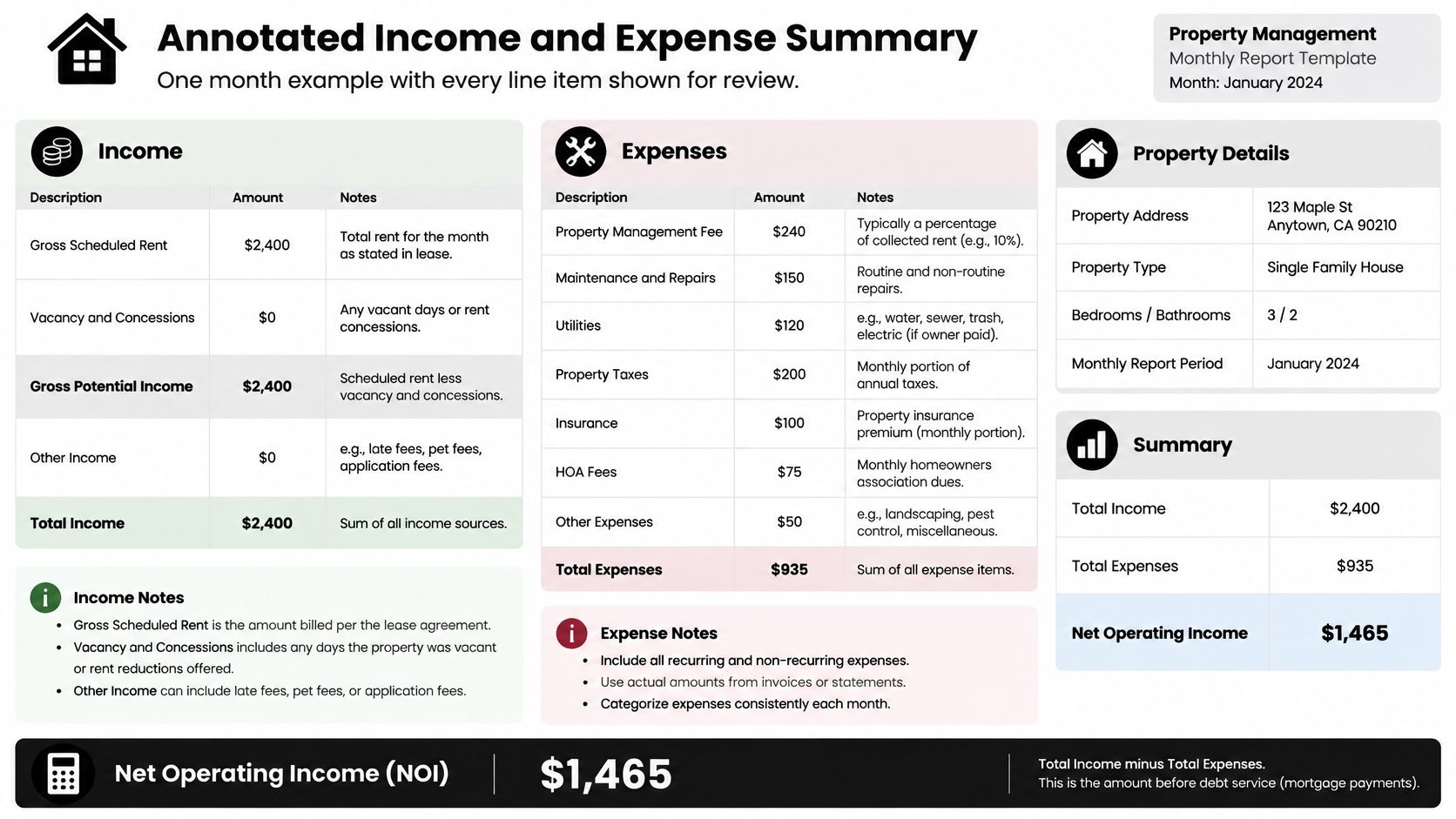
Annotated Income and Expense Summary
| Line | Sample or benchmark | How to read it |
|---|---|---|
| Gross scheduled rent | $2,400 | Rent the lease calls for this month, before vacancy |
| Vacancy and concessions | $0 | Show zero; do not leave the row off |
| Rent collected | $2,400 | Cash actually received, which can differ from scheduled rent |
| Other income | $75 late fees | Late fees and reimbursements, kept off the rent line |
| Total income | $2,475 | Rent collected plus other income |
| Total operating expenses | $912 | 38 percent of scheduled rent; replace with real bills |
| NOI before debt service | $1,563 | Total income minus operating expenses; mortgage principal is not in this line |
| U.S. median monthly rent receipt | $1,000 per unit | 2021 survey, up from $750 in 2018; not a local rent target |
| U.S. median monthly operating expense | $380 per unit | Excludes debt service; about 38 percent of median rent receipts |
Which sample lines are cash
Say the house is a single rental with a lease calling for $2,400. Gross scheduled rent is that lease amount. Vacancy and concessions are $0, written as zero so a later reader does not wonder whether the row was forgotten. Rent collected is also $2,400 because the payment arrived. Other income is $75 in late fees, kept off the rent line so the rent roll is not inflated. Total income is $2,475.
Total operating expenses in the sample are $912, which is 38 percent of the $2,400 scheduled rent. That share is a teaching device, not a Fresno target. Split the $912 across category rows you will not merge later: repairs, utilities, landscaping, insurance, management fees, and turnover. NOI before debt service is $1,563, which is total income minus those operating expenses.
Mortgage principal is not an operating expense, so it never sits inside the $912. A management fee already inside operating expenses must not be subtracted again under owner activity. If you pull it out twice, NOI looks weaker than the bills support, and the owner argues with a number the bank never saw.
What the national medians are for
Place the survey figures beside the sample as a sense check only. In findings from the 2021 Rental Housing Finance Survey, HUD and the U.S. Census Bureau reported a median monthly rental receipt of $1,000 per rental unit, up from $750 in the 2018 survey, and median monthly operating expenses of $380 per rental unit, excluding debt service. Those medians imply an operating-expense share of about 38% of monthly rental receipts before mortgage payments. They are U.S.-wide benchmarks. A Central California house at $2,400 can run a very different ratio and still be well run.
Columns that make a change explainable
For the template, give every category three columns: this month, year to date, and budget or prior month. A jump then traces to collections, occupancy, a maintenance spike, or a recurring bill that just posted. A one-column statement cannot tell those stories apart.
Replace the sample, keep the names: Swap $2,400, $75, and $912 for your rent and your bills. Do not rename “turnover” to “misc” in March and back to “turnover” in April. Stable category names are what let a year-to-date column mean anything.
Rent Roll and Tenant Ledger Fields
The rent roll and the tenant ledger feed the income block. They are not the income block. Mix them and you will double-count rent or treat a security deposit as earnings.
One row per unit on the rent roll
The rent roll is one row per unit for the reporting month. Columns are unit, resident name, lease start, lease end, monthly scheduled rent, any concession, status (occupied, notice, or vacant), and security deposit held. Label the deposit as the tenant's funds, not owner income.
A worked occupied row might read Unit A, lease through 31 August 2026, scheduled rent $2,400, concession $0, occupied, deposit $2,400. Add a vacant row on purpose. Scheduled rent stays on that row and collected rent is $0, so the income summary is allowed to diverge from the roll. If you omit the vacant row, a full collection looks like a data error.
For a fuller field list than this packet needs, use a dedicated rent roll report and keep the same column order here so the monthly packet and the standalone roll do not argue.
The ledger is one resident's history
The tenant ledger is the history behind one resident, not a second rent roll. Each line needs a date, a description, a charge or a credit, an amount, and a running balance.
| Record | Field or entry | Sample value |
|---|---|---|
| Rent roll, Unit A | Lease start to lease end | Through 31 August 2026 |
| Rent roll, Unit A | Scheduled rent and concession | $2,400 scheduled, $0 concession |
| Rent roll, Unit A | Status and deposit held | Occupied; deposit $2,400, labeled tenant funds |
| Rent roll, vacant unit | Status and collection | Vacant; scheduled rent shown, collected $0 |
| Tenant ledger, Unit A | 1 March entry | Charge rent $2,400 |
| Tenant ledger, Unit A | 3 March entry | Payment $2,400, balance $0 |
| Tenant ledger, Unit A | 10 March entry | Late fee only if the lease allows it and it was assessed |
| Delinquency aging | Buckets | Current, 1 to 30, 31 to 60, over 60 days |
On 1 March the ledger charges rent of $2,400. On 3 March a payment of $2,400 brings the balance to $0. A 10 March late fee appears only if the lease allows it and someone assessed it. A fee you might have charged is not a ledger line.
Delinquency aging uses four buckets: current, 1 to 30, 31 to 60, and over 60 days. Label the aging as an operations metric. It is not taxable income and it is not cash in the bank. Prepaid rent is a credit balance. On cash books, note that a prepayment is not extra income for a later month just because the cash arrived early. The note stops a reader from adding the same dollars to two months.
The cross-check is one number. Rent collected on the income summary must equal payments posted on the ledgers for that period. Scheduled rent must equal the rent-roll total, including the vacant row's scheduled amount and its zero collection. If those two pairs disagree, stop and fix the posting before you talk about performance.
Reconciliation and Cash Summary Worked Example
Use the same house so the cash tie-out can be checked by hand. Opening operating cash is $5,000. Deposits are $2,475, which is the $2,400 rent collected plus the $75 late fee. Book disbursements are $1,912: $912 of operating expenses, a $1,000 owner distribution, and a $150 check written but not yet cleared. Book ending cash is $5,563.
The bank statement shows $5,713 because that $150 check has not cleared. The books are not wrong. The bank is ahead of one payment.
- Start from the bank's ending balance of $5,713.
- Subtract outstanding checks, here $150, which gives $5,563.
- Add deposits in transit. This month there are none.
- Compare that result with the cash summary's ending cash of $5,563.
- Investigate any difference before you file the packet. A missing deposit or a duplicate payment shows up here first.
The $1,000 distribution reduces cash. It is not an expense, and it does not change the month's NOI. If you bury the distribution inside repairs, both the expense ratio and the cash balance lie.
Attach the bank statement page and the check register. The owner should confirm each figure without rebuilding the books from scratch.
If a difference will not clear, walk the accounts the way a bookkeeper would, using practical general ledger reconciliation tips before you “plug” a number to force a match. A plug hides the very item this block exists to catch. File only after the reconciled ending balance and the cash summary ending cash are the same figure.
Maintenance Log and Owner Decisions
A maintenance log shows which work needs an owner's decision, not just what has been paid. Use one row per work item, with the date opened, property or unit, vendor or trade, description, urgency, estimate, amount paid, status, and a repair or capital flag.
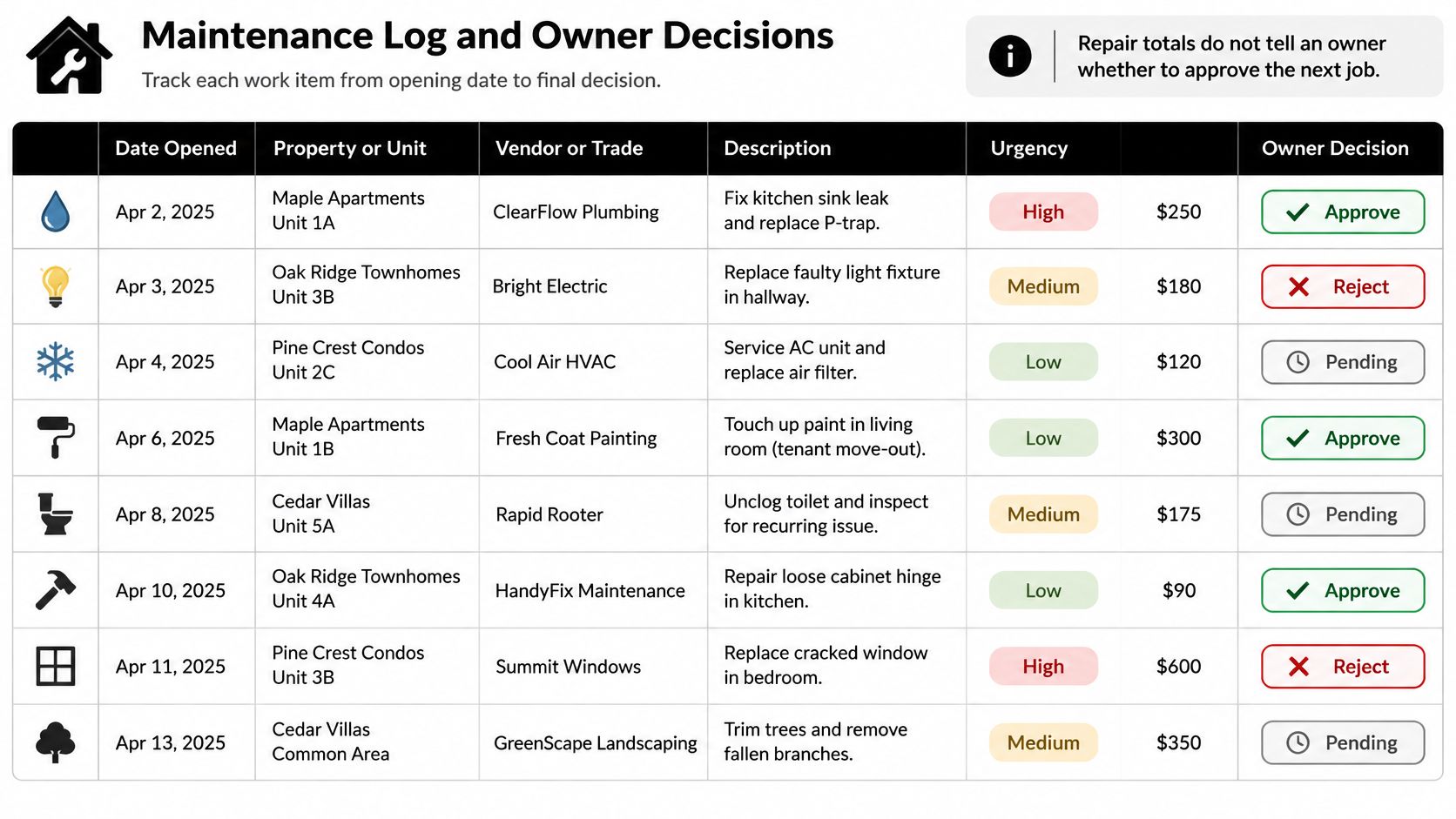
Three examples show how to record different work. A $180 clogged drain is a routine repair, paid and closed if the management agreement permits the work without owner approval. A $1,400 water-heater replacement is completed and flagged as likely capital because it replaces a failed system rather than repairing a part. An open roof leak quoted at $2,200 is urgent and awaiting approval, with a note that delay could cause further interior damage.
The decision line most packets skip
Pair the maintenance log with a short decision log for open recommendations. Each line should state the risk, estimated cost, expected return or cost avoided, the person who must approve, the decision deadline, and whether the manager recommends proceeding. Distinguish routine upkeep from a project intended to reduce vacancy, raise rent, lower operating costs, or keep the home habitable.
For the roof leak, the log row records the work item, quote, urgent status, and pending approval. The decision line names the owner responsible, sets a deadline, explains the risk of waiting, and records the recommendation. Once the owner responds, enter that approval decision and update the work status. The $2,200 remains a quote, not a paid expense, until the work is completed and billed.
NOI does not tell an owner whether to fund a specific repair. The expense context can help: NAA's 2025 look at where a dollar of rent went reported that 2025 operating expenses increased 4.6%, reaching $8,213 per unit annually. It also reported that mortgage costs represented about 43 cents of each rent dollar, while operating costs, including insurance, utilities, maintenance, and management, represented 27 cents.
Attach paid invoices to closed rows. Keep authorized work that has not yet been billed in a commitments note, not among cash expenses. This gives the owner a clear approval record without implying that quoted work has already affected the bank balance.
A useful monthly packet is an auditable owner ledger and a short decision log with names, deadlines, and responses. Routine work can close under the agreement's approval limit. Work outside that limit waits for the named owner's decision by the stated deadline.
Cash Activity and Tax Categories
A monthly packet confuses a CPA when cash movement and tax categories share one unlabeled total. The IRS guidance on rental income, deductions, and recordkeeping draws the line this way. Cash-basis taxpayers generally report rental income when it is received and deduct rental expenses when they are paid. Accrual taxpayers generally recognize income when it is earned and expenses when they are incurred. Most small rental owners are on cash. The template still needs both layers, because operations do not wait for the check to clear.
Two layers, not one blended total
The cash activity statement is what the bank did this month: deposits in, checks out, the distribution, the transfer to reserves. A second commitments or variance section lists unpaid vendor bills, approved work not finished, tenant balances, prepaid amounts, and capital projects still open. Those items explain next month's cash. They are not this month's deductions just because someone approved them.
Map lines to categories a Schedule E preparer expects to see in stable names: rent, late fees, reimbursed utilities, management fees, repairs, other operating expenses, insurance, property taxes, mortgage interest, and a placeholder note for depreciation. Do not compute a tax figure on the monthly packet. Depreciation is a tax computation, not a bank transaction.
Put month, year to date, and prior-period columns on both layers. Add a short note when a variance is material, such as a one-time turnover, so the CPA does not treat a spike as a new run rate.
Repairs are not improvements
The IRS treats an ordinary repair differently from a cost that adds value or extends useful life. The water heater from the log is the clean illustration. Cash left the account either way. If the replacement is capitalized, it does not sit on the repairs expense line. Leaving it in repairs makes the month look expensive and hands the CPA a deduction the return may not allow in full this year.
Occupancy, delinquency aging, lease expirations, work-order counts, and reserve adequacy stay on the report under an operations heading. They are management signals. They are not taxable net income, and monthly NOI is not the number that goes on the return.
Hand the categorized year-to-date statement to the CPA. Do not ask the monthly NOI line to serve as the tax return.
If you want the owner-side checklist before that handoff, how to prepare for tax season when you own a rental pairs well with a packet that already separates cash, commitments, and capital.
One Home or a Small Portfolio
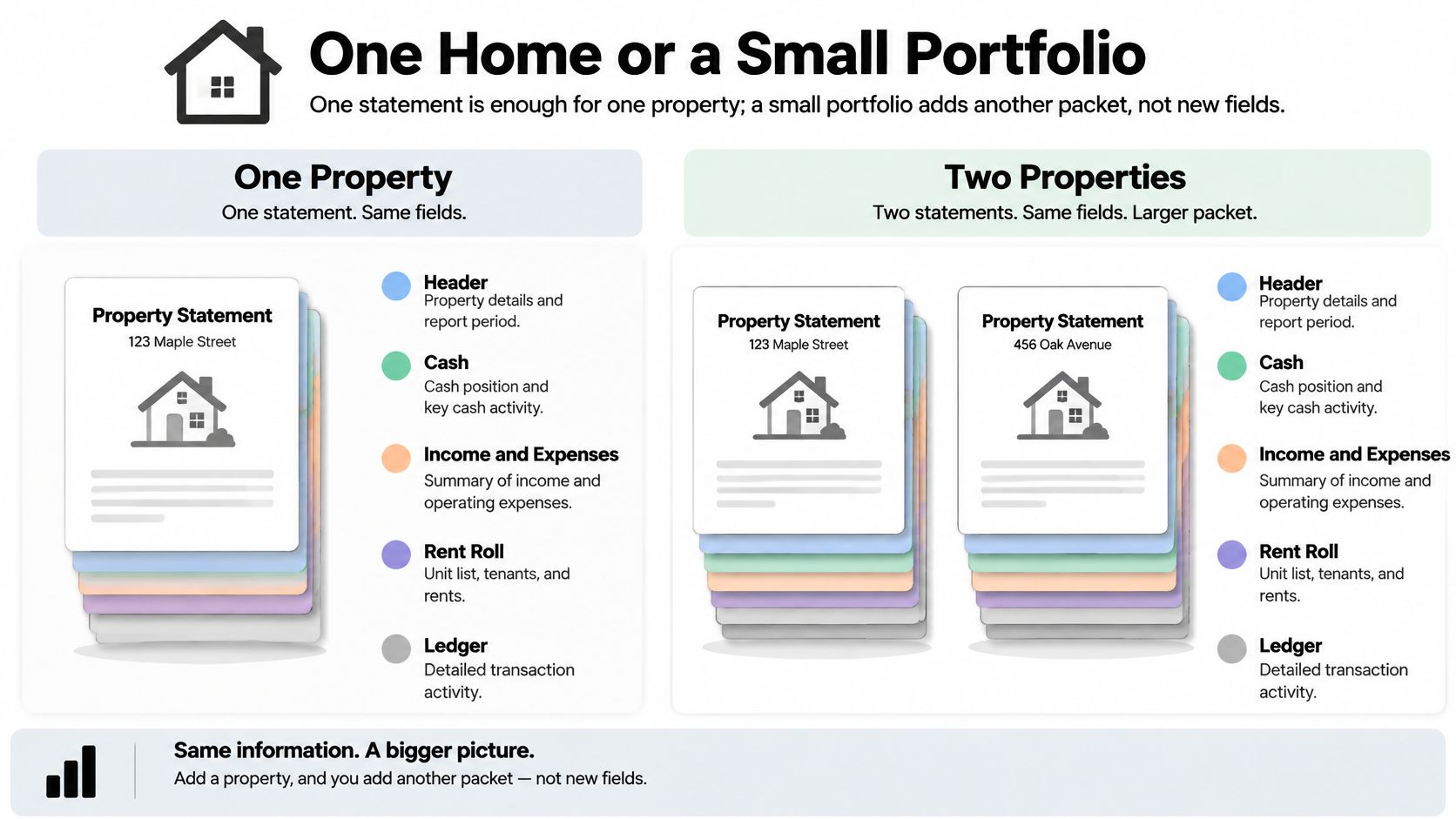
The fields do not change when a second house is added. The packet shape does. For one property, one statement is enough: header, cash, income and expenses, rent roll, ledger, maintenance, and a short action list. For several properties, put a one-page portfolio summary in front and repeat the same blocks per property. A high expense ratio should trace to a street address, not sit only on a blended total.
What changes and what must not
| Layout | What the owner opens first | What stays identical |
|---|---|---|
| One home | The single statement, header through action list | Category names, deposit labels, decision fields |
| Small portfolio | A one-page summary, then a full packet per address | The same blocks, repeated, not redesigned |
Do not pool reserves or security deposits into one unlabeled balance. A variance that matters should name the property. If the summary says “repairs up” and neither house's packet shows why, the summary failed. The test I use is simple. If the owner cannot tell which home needs a decision this month, the multi-property packet is only a longer version of the single-home one.
Keep recurring maintenance off the capital list on both layouts. A filter change at house two is not a capital project because the portfolio page has a capital column.
The forward window both layouts share
Historical templates stop at what already happened. Add a forward section on both versions covering the next 60 to 90 days: reserve balance versus bills already expected, leases expiring, vacancy risk, open work orders by urgency, and insurance or safety dates. A compliance note needs the item, the deadline, and the person responsible. That matters for California rentals, where state and local rules move, and for owners who live out of state and cannot see the house. RentalReady's monthly report guidance treats compliance updates and upcoming priorities as useful content, yet most packets leave them as a sentence at the bottom. Make them measurable: a date, a dollar exposure, and a name.
A proposed improvement in that window should say whether it is meant to reduce vacancy, increase rent, lower operating cost, or only preserve habitability. “Roof, $2,200, habitability, owner approval by the 12th” is a decision. “Capex TBD” is not.
Close the Month and Hand Off the Packet
Run the close as checks against the packet you already built. Do not retype the fields.
- Confirm the header names the owner, the property, and the exact period dates.
- Reconcile the bank to the cash summary. Stop if an outstanding check or a missing deposit is unexplained.
- Match rent collected to tenant ledger payments, and scheduled rent to the rent roll, including a vacant row.
- Scan expense categories for a bill posted to repairs that belongs with improvements.
- Read only the open rows of the maintenance log and the decision log. Approve or decline each item that has a deadline.
- Check the 60 to 90 day notes for a lease end, a reserve shortfall, or a compliance date.
- Export or print the packet with invoices and the reconciliation attached.
A self-managing owner gives that packet and the categorized year-to-date statement to the CPA, who prepares Schedule E. The monthly NOI line is not the tax return. The packet is complete enough to file only when the reconciliation balances, the ledger matches collections, and every approval has an answer.
We send property management clients monthly statements showing income and expenses, and we provide yearly 1099 forms, yearly reports, and those monthly statements so owners can hand them to their CPA without rebuilding a spreadsheet. If the close still eats a weekend, look at implementing automation in real estate for the repetitive export and filing steps, and keep the judgment calls, especially approvals and variance notes, in a person's hands.
Edinhart Realty and Property Management prepares monthly owner statements that show income and expenses in a form you can hand to your CPA, along with yearly reports and 1099s. If you want that packet built for a home in Fresno, Clovis, Friant, or the wider Central California area, visit Edinhart Realty and Property Management and send a note. A property management expert returns the call within one business day.


