

You're probably doing what most owners do when they start shopping for property management. You open five or six websites in separate tabs, skim the homepages, see the same promises, and realize they all blur together. Everyone says they collect rent, handle maintenance, screen tenants, and protect your investment. That doesn't help much when you're trying to decide who'll run your property well.
A management company website is more useful than most owners realize. If you read it like a diagnostic tool, not a brochure, it can tell you a lot about how that company operates behind the scenes. Sloppy structure, vague service language, weak tenant workflows, buried pricing, and missing compliance details usually point to the same thing offline: inconsistent processes.
The opposite is also true. A clear, functional site often signals a company that documents its work, thinks through handoffs, and respects the owner's need for visibility. That doesn't guarantee great service. But it gives you a practical way to predict what working with that company may feel like before you ever make the call.
How to Read a Management Company Website Like a Pro
A property owner evaluating management in Fresno, Clovis, or from out of state shouldn't ask only, “Does this website look nice?” The better question is, “What does this website reveal about how the company works?”
That matters because a website stopped being optional a long time ago. In 2023, 73% of U.S. small businesses had a website, and another 23.5% planned to get one, leaving only 3.5% with no intention of building a site at all, according to Wix's small business website statistics. For a property manager, that makes the website a baseline business asset, not an extra.
Start with what the site makes easy
Look at the first few clicks. Can you quickly tell what services are offered, who the company serves, and what happens after you submit an inquiry? If basic answers are buried, the company may not have thought through the client journey very carefully.
A strong site usually makes these things obvious:
- Service categories are distinct: Full management, placement-only, leasing, renewals, inspections, and sales support shouldn't be lumped into one vague page.
- Next steps are visible: You should know whether the company offers a consultation, rental analysis, callback, or online intake.
- The audience is clear: Owners, tenants, and applicants should each have an obvious path.
Watch for operational clues, not design trends
A fancy homepage doesn't impress me nearly as much as clean service detail. If a website uses polished language but doesn't explain process, that's a warning sign. Property management is an execution business.
Practical rule: If a company can't explain its workflow clearly online, expect confusion later around repairs, accounting, tenant communication, or lease renewals.
One useful cross-check is to compare the website with outside owner feedback. A review page won't answer everything, but it helps you see whether the public experience lines up with the company's claims. For example, you can compare site messaging with real property management reviews and see whether the tone and expectations feel consistent.
Read for specificity
Owners should favor websites that answer practical questions in plain language. Not “full-service solutions.” Instead, look for details like who handles repair coordination, how owner statements are delivered, whether lease renewals are included, and how applicant screening is described.
That's the shift. Don't treat the management company website as advertising. Treat it like an early inspection of the company itself.
Choosing Your Path Full Service vs Placement Only
The first real test of a management company website is whether it helps you choose the right service model. Many sites push one option as if every owner has the same goals. In practice, that's rarely true.
A useful website should help you think through the economics. The broad question isn't “Which package is better?” It's “Which package fits my property, my availability, and my tolerance for risk?” That's exactly the kind of market question strong positioning should address, as noted in this discussion of serving customers based on property type, distance, and risk tolerance.
The real difference
Full-service management works best when the owner wants a manager to run the property day to day. That usually includes rent collection, repair coordination, tenant communication, move-in and move-out handling, renewals, and accounting statements.
Placement-only service fits the owner who wants help getting the property leased but plans to take over once the tenant is in place. That can work well for local landlords who are organized, responsive, and comfortable dealing with maintenance and tenant issues directly.
Here's the side-by-side view.
| Responsibility | Full-Service Management | Placement-Only Service |
|---|---|---|
| Leasing and marketing | Company handles it | Company handles it |
| Applicant screening | Company handles it | Company handles it |
| Lease drafting | Company handles it | Company handles it |
| Rent collection after move-in | Company handles it | Owner handles it |
| Maintenance coordination | Company handles it | Owner handles it |
| Tenant communication after placement | Company handles it | Owner handles it |
| Renewals and notices | Company handles it | Owner handles it |
| Ongoing accounting statements | Company handles it | Owner handles it |
When full-service usually makes sense
Some owners underestimate the cost of staying hands-on. A lower monthly fee sounds attractive until the first after-hours plumbing call, late payment dispute, or renewal negotiation hits at the wrong time.
Full-service is usually the stronger fit when:
- You live far from the property: Distance turns routine issues into delays.
- You want less day-to-day involvement: That includes repairs, tenant follow-up, and collections.
- You own multiple properties or plan to scale: Systems matter more as the portfolio gets more complex.
When placement-only can work well
Placement-only isn't a lesser service. It's a different one. For the right owner, it's efficient and sensible.
It tends to fit landlords who:
- Want professional marketing and screening: But prefer to manage the relationship themselves.
- Know their local vendor network: Or already have trusted contractors.
- Have time to respond quickly: Slow owner response can undo the benefit of a good placement.
A website that explains these trade-offs clearly is doing something useful. A site that hides the distinction or treats every owner the same usually signals a sales-first mindset. If you want to see one example of how a company lays out that model, review a flat fee property management option and compare how responsibilities are defined.
A good website doesn't just sell management. It helps you decide whether you should buy full management at all.
Core Website Features That Reveal Operational Strength
The most revealing parts of a management company website aren't usually the slogans. They're the workflows.
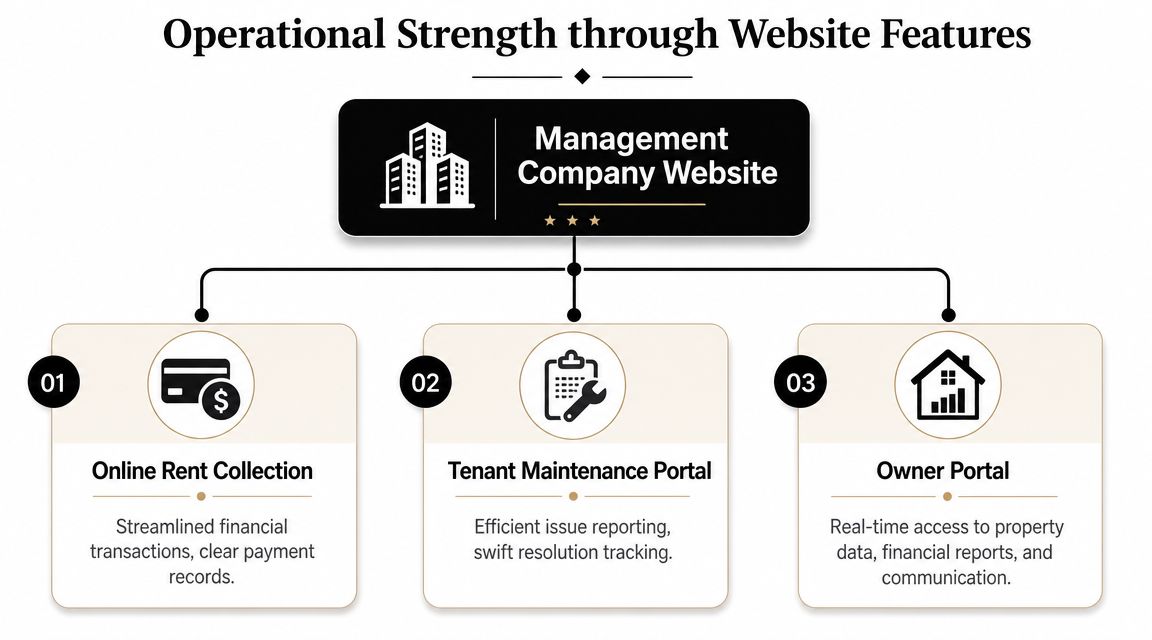
When a company offers online rent collection, maintenance request systems, applicant screening, and owner access, those aren't just conveniences for the user. They show how the company moves information, documents decisions, and reduces friction. That's why the most valuable website features are the ones that support secure, mobile-first workflows for leasing and service operations, as explained in this overview of technical specifications that reduce leasing friction.
Online rent collection tells you about discipline
If a website still pushes tenants toward loose manual payment methods without explaining a secure online process, I'd question how tightly that company manages receivables and records. Owners need consistency. Tenants need clarity.
What to look for:
- Secure payment workflow: The site should make it obvious that rent collection is structured, not improvised.
- Mobile usability: Tenants often pay and check balances from a phone.
- Clear separation of user paths: Owners, tenants, and applicants shouldn't be tripping over each other in the navigation.
Maintenance systems reveal process maturity
A maintenance page is one of the best diagnostic pages on the whole site. Does it merely state, “Call us for repairs,” or does it show a real intake process with categories, urgency guidance, and status expectations?
That difference matters because repair coordination is where many owner relationships break down. A proper online request system creates a record, sets expectations, and reduces back-and-forth.
The maintenance page often tells you more than the homepage. It shows whether the company runs on process or on interruption.
Owner portals show whether reporting is taken seriously
An owner portal signals more than convenience. It suggests the company expects owners to want ongoing visibility into statements, documents, and communication.
That's especially important for out-of-area investors. If the site talks about financial reporting but gives no hint of how owners access information, ask questions. Reporting should feel like part of the operating system, not a favor.
One practical way owners can evaluate this is by comparing how firms describe their software stack and workflows. A resource like this property management software comparison can help you understand what different platforms usually support and what that means for communication, payments, and reporting.
Good features still need good execution
Technology alone doesn't make a manager competent. I've seen companies buy decent software and still use it poorly. But when the website shows thoughtful workflows, role-based paths, and clear digital handoffs, that's usually a sign of stronger operations.
If you're also thinking about whether the site itself is maintained well enough to support visibility and usability over time, this guide on how to boost small business SEO and performance is worth reviewing. It's useful because property owners often confuse visual design with site quality, when speed, upkeep, and structure often tell you more.
One factual example in the market is Edinhart Realty & Property Management, which presents online contact options for management inquiries and describes automated rent collection and owner reporting as part of its service offering. That kind of functionality is more meaningful than broad promises because it points to an actual operating framework.
Finding Proof of Performance Beyond Testimonials
Testimonials have value, but they're easy to overrate. Every management company can choose a handful of happy comments and place them on a webpage. Owners need stronger evidence.
The better proof usually sits in the company's listings, photos, leasing presentation, and renovation examples. Those elements show the standard the company applies when money is on the line.

Study the rental listings as if they were your property
Open the active listings. Look at the photography, the written description, and the overall presentation. This is one of the clearest windows into how your property would likely be marketed.
If the photos are dark, crooked, incomplete, or clearly taken in a rush, that's not just a marketing problem. It suggests low standards. The same goes for vague descriptions that fail to highlight layout, upgrades, or practical tenant benefits.
Check for signs of care such as:
- Consistent photo quality: Sharp, well-lit images suggest planning and attention.
- Useful listing copy: Strong descriptions answer tenant questions before they're asked.
- Evidence of preparation: Clean spaces, staging touches, and organized presentation often reflect better turnover management.
Look for visual proof of judgment
Before-and-after remodel photos, staging galleries, and flip examples can be very informative when they're done well. They show whether the company understands what improvements help a property lease faster, present better, or sell more competitively.
That kind of proof matters because property management isn't only about collecting rent. It's also about preserving value and knowing where to spend money wisely. A company that demonstrates smart presentation choices usually has better instincts around make-ready work, rental positioning, and resale preparation.
If a company claims it maximizes value, its website should show the work, not just say the words.
Read case-style content carefully
You don't need hard numbers to learn from a project example. A useful case-style page can still show the sequence of decisions: what condition the property was in, what work was recommended, how it was marketed, and what type of owner it suited.
What doesn't help is empty storytelling. If a website says a property was “transformed” but gives no photos, no scope, and no explanation of what changed, treat that as weak evidence.
A management company website earns trust when the proof is concrete. Good listings, thoughtful visuals, and disciplined presentation tell you how the company behaves when it represents an owner's asset in public.
What the Fine Print Says About Trust and Transparency
Most owners spend too little time on the pages that matter most. They skim the homepage and gallery, then ignore the pricing, policy, and legal language. That's backwards.
The fine print often tells you whether the company treats property management like a serious fiduciary role or just a lead-generation business. A property management website should function as a trust-and-compliance system, with clear governance around screening criteria and rental policies, as discussed in this guidance on technical specifications for structured requirements and compliance.
Pricing clarity is a trust signal
A company doesn't have to put every possible fee on the front page. But the site should make the general pricing structure understandable. Owners should be able to tell whether they're looking at monthly management, placement-only, leasing support, or some combination.
When pricing language is slippery, problems usually follow. Watch for phrases that sound simple but hide moving parts. “Low monthly fee” means very little if the site doesn't also explain what's included and what triggers extra charges.
Questions the website should help answer:
- What service model am I buying?
- What work is included in that model?
- Where do owner responsibilities begin and end?
- Are accounting, renewals, and repair coordination treated as core work or extras?
Screening and policy pages matter more than most owners think
A website that says it screens carefully but never explains standards, process, or rental criteria leaves too much to assumption. Owners need to know the company has a documented, consistent approach.
For California owners, this issue carries extra weight. Screening, fair housing compliance, notices, forms, and lease handling all need disciplined execution. If the website never mentions policy consistency, documentation, or current forms, ask why.
Legal language should feel operational, not decorative
I trust websites more when compliance appears where it belongs: inside the operating details. That could mean published rental criteria, clear policy pages, secure form language, or specific references to standardized documentation practices.
What I'd consider good signs:
- Role-based access language: Separate owner, tenant, and staff functions suggest cleaner boundaries.
- Secure submission language: Especially for applications, financial details, and document exchange.
- Policy consistency: Screening criteria and rental policies shouldn't sound improvised.
- Maintenance and updates: A website that looks neglected may also reflect neglected documentation.
Owners should read the policy pages with one question in mind: “Will this company still feel organized when a situation becomes difficult?”
Transparency isn't about being wordy
Some sites bury owners in legal text and still fail to build trust. Clarity matters more than volume. The best websites explain enough to show discipline without making the owner decode every sentence.
A clean, transparent management company website usually points to a company that respects boundaries, keeps records straight, and understands that trust is built in writing before it's tested in conflict.
Putting It All Together for Your Fresno Property
A good management company website should help you answer four practical questions.
First, which service model fits your situation. A local owner with time and reliable vendors may do well with placement-only. An out-of-area investor, a busy homeowner, or an owner who wants less operational burden usually needs full-service support.
Second, whether the company's workflows are real. Rent collection, maintenance handling, applicant screening, owner reporting, and contact paths should feel organized. If the site creates friction before you become a client, expect more friction after you sign.
Third, whether the company can prove standards. Listing quality, photography, staging, and property presentation are not cosmetic details. They're visible evidence of how seriously the company treats leasing, turnover, and value preservation. For owners comparing ways to improve listing presentation before leasing or selling, resources like virtual staging services in Fresno can also help clarify what professional presentation should look like.
Fourth, whether the company is transparent when stakes are higher. Pricing structure, policy language, screening criteria, and document handling all show whether the company has a disciplined operating model.
A short checklist before you call
- Read the service pages fully: Don't stop at the homepage.
- Open the maintenance and tenant sections: They often reveal the company's real habits.
- Review active listings: Judge quality by how they market actual inventory.
- Check the policy and pricing language: Vague wording is rarely a good sign.
- Ask what happens next: The company should be able to explain onboarding clearly.
A website won't tell you everything. But it can tell you more than most owners think. If you know how to read it, you can usually spot the difference between a company that merely advertises management and one that has actually built a management system around clarity, accountability, and local execution.
If you want a local partner that offers both full-service management and placement-only support in Fresno and the greater Central California region, take a close look at Edinhart Realty and Property Management. The site lays out service options, owner-focused workflows, and the kind of practical detail that helps you evaluate fit before you commit.


