

A lot of Fresno landlords are staring at the same decision right now. Your tenant's lease ends soon, your costs are up, and you know the rent probably needs to move. But the minute you start working on a lease renewal rent increase, the simple question of “how much?” turns into two bigger ones: “Can I legally do it this way?” and “Should I?”
Most owners focus on the number and miss the process. That's where mistakes happen. In California, a rent increase can be within the legal cap and still be defective if you gave the wrong notice. And in a market where retention matters, the highest possible increase isn't always the smartest one.
Understanding Your Renewal Strategy Options
Your Fresno tenant's lease expires in 45 days. They pay on time, keep the property in good shape, and the current rent is below nearby asking rents. A lot of landlords see that gap and immediately aim for the highest increase they think the market will take.
That is the wrong starting point.
A lease renewal rent increase is a pricing decision, but it is also a timing decision. If you push rent aggressively without enough runway, you can back yourself into a bad choice. You either scale the increase down to fit the notice window, or you risk losing a good tenant and carrying a vacancy while you chase a higher number. Smart landlords decide both issues together.
The two paths most landlords choose
Some owners use renewals to close the gap to market as fast as possible. That approach fits a unit that is clearly underpriced, well-located, and likely to re-rent quickly if the tenant leaves.
Other owners use renewals to protect stability first. They accept a smaller increase because avoiding turnover, cleaning, repairs, showings, screening, and a few weeks of lost rent usually puts more money in their pocket over the year.
Here is the practical rule. If you would rather keep the tenant than test the market, price the renewal to keep them.
What the market data actually shows
Analysts cited in this industry report on apartment renewals and new-lease pricing found a clear spread between renewal pricing and turnover pricing in 2022. Renewing renters paid 10.7% more, while new renters paid 18.7% more than the prior residents in the same unit. They also found renewal increases were stronger in Class A and Class B properties, while Class C properties lagged. The takeaway is simple. Owners usually get the biggest jump at turnover, but that does not mean turnover is the better business decision for every Fresno rental.
That matters in Fresno because product type changes tenant tolerance fast. A renovated north Fresno house, a basic apartment in central Fresno, and an older workforce unit near major commuter routes do not support the same renewal strategy. Owners who apply one blanket increase policy across all three usually either leave money on the table or create avoidable vacancy.
How I'd handle it in Fresno
I split renewal decisions into three buckets.
- Stable tenant, rent is only modestly under market: Raise rent enough to keep pace, then renew early and keep the resident.
- Stable tenant, rent is far under market: Push the increase more firmly, but do it soon enough that your notice timing does not box you in.
- Problem tenant, repeated late pay or lease issues: Stop treating retention as the goal. Price the renewal based on the risk they bring.
Notice timing changes strategy more than landlords admit. If you review renewals too late, you lose flexibility. You cannot make a clean retention decision or a clean revenue decision because the calendar starts making the choice for you.
That is why I tell Fresno landlords to review renewals well before lease end, not at the last minute. Decide whether you want retention or market-rate maximization first. Then set the increase and timing to match that goal.
California and Fresno Legal Requirements
A Fresno landlord sends a renewal notice 30 days before lease end, bumps rent to what looks like a modest number, and assumes the file is clean. Then the tenant pushes back. The increase may fit the cap, but the notice timing may still be wrong. Or the notice may be long enough, but the increase itself may violate statewide limits. That mismatch is where landlords create avoidable problems.
California treats rent-cap compliance and notice compliance as two separate checks. Under the same California lease renewal and notice guide, increases of 10% or less over a rolling 12-month period require 30 days' notice, increases above 10% require 90 days' notice, and covered units remain subject to the AB 1482 annual cap.
That distinction matters more in Fresno than many owners admit. If you wait too long to review a renewal, the calendar starts limiting your options. You may want to push rent harder because the unit is under market, but late timing can force a smaller increase, a longer notice period, or a delayed effective date. That is not a pricing problem. It is an operations problem.
What to check before you send anything
Start with the property, not the tenant.
- Confirm whether the unit is covered by AB 1482. Fresno owners with single-family homes, condos, older multifamily stock, and mixed portfolios get this wrong all the time. Check the status of that specific property and keep the exemption notice in your file if it applies.
- Total every rent increase over the prior 12 months. Notice timing is based on the cumulative increase, not the latest number by itself.
- Match the proposed increase to the legal cap if the unit is covered. A market-rate target does not override the cap.
- Use the correct notice period for the actual increase. A legal amount sent on the wrong timeline still creates trouble.
- Document service. Keep the notice, date, method of delivery, and backup in one place.
Small owners get burned here. They use an old form, pull last year's increase percentage, and skip the rolling 12-month math. Then they find out too late that their renewal strategy and their compliance timeline were working against each other.
The Fresno issue that generic guides miss
A lot of lease-renewal advice acts like legal compliance is separate from business strategy. It is not. In Fresno, those two decisions are tied together.
If your resident is solid and only slightly below market, the legal takeaway is simple. Review early, keep the increase clean, and preserve the tenancy. If the unit is far below market, review even earlier. A landlord who waits until the last few weeks of the lease loses flexibility and often gives up either rent growth or procedural control.
For owners tightening up the admin side, especially across several properties, outside back-office support can help. Resources for California remote finance talent can improve recordkeeping, notice tracking, and renewal documentation if your current system is too loose.
If you need a practical timing check before serving a notice, use this guide on the lease renewal notice period for California rentals. Review the calendar first. Then set the increase.
My advice
Do not treat compliance as a last-step paperwork task. Set the legal timeline before you lock in the number. That is how Fresno landlords protect both options that matter at renewal. Retain a good tenant at a sensible increase, or push revenue without tripping over California notice rules.
Calculating Competitive Rent Increases
A Fresno landlord sees a nearby listing posted at a high asking rent and decides the renewal should match it. That is how owners overshoot.
Renewal pricing is its own decision. A tenant in place is not the same product as a vacant unit being pushed to market after paint, cleaning, photos, and showings.
Listing comps distort renewal pricing
Asking rents matter, but they are only one part of the math. They show what owners hope to get on turnover. They do not show what existing residents will accept, or what level of increase keeps a good tenancy in place.
One RealPage analysis found renewals and new-lease pricing do not move the same way. It also noted that renewal increases can still be common and meaningful even when market comparisons look mixed, including examples showing different spreads between renewal and new-lease growth and a separate median renewal pattern that was far lower than the extreme upper end, according to this RealPage renewal rent analysis. The practical takeaway is simple. Do not price every renewal like a full reset to top-of-market rent.
What Fresno owners should actually measure
Use three numbers.
First, identify true market rent for your unit type, condition, school area, and location within Fresno or Clovis. A tired unit near older inventory should not be priced off a renovated home in a stronger pocket. If you need a starting point, use a fair market rent calculator for Fresno rental pricing and then adjust from there based on real competing inventory.
Second, measure the gap between current rent and that market range. A small gap calls for a clean, moderate increase. A large gap requires a harder decision. You either phase the rent up over time to keep the resident, or you accept the risk that a market-rate push may lead to turnover.
Third, check whether your increase is normal or aggressive for a renewal. If your proposed number lands near the top of what competing owners are likely asking from existing tenants, expect resistance. If it only works on paper because the tenant has no time to react before lease end, you built the increase on bad timing, not good pricing.
A practical framework
I use this filter before recommending a renewal increase:
- Start with in-place rent: That is your base.
- Set a realistic market range: Use actual competing rentals, not the highest outlier listing.
- Price the tenancy, not just the unit: Payment history, upkeep, and turnover cost matter.
- Measure the rent gap: Small gap, small correction. Large gap, deliberate strategy.
- Stress-test the number: If the increase would only make sense after a vacancy turn, it is probably too aggressive for renewal pricing.
A one-line rule helps here. If your number assumes replacement-tenant pricing but ignores vacancy cost and friction, it is inflated.
My recommendation
For Fresno renewals, price from the middle of the market, then adjust based on tenant quality and how far below market the unit sits. Owners who copy active listings usually push too high. Owners who ignore the market stay too low. The right increase closes part of the gap without treating a stable resident like a fresh vacancy.
Retention Versus Revenue Strategies
Owners either act like investors or gamblers.
A lot of landlords say they want “market rent,” but what they really mean is “I don't want to leave money on the table.” Fair enough. But if your push for a bigger increase leads to vacancy, cleaning, repair coordination, showings, screening, and a weaker replacement tenant, you didn't win. You just delayed the pain.
When retention is the smarter play
Recent market commentary shows renewals are still rising around 3.5% to 4% even where new-lease asking rents have flattened or fallen, suggesting some landlords are using renewals to preserve occupancy rather than chase peak pricing, according to this 2026 apartment housing outlook commentary. That lines up with what practical operators already know. Sometimes the smaller increase is the better business decision.
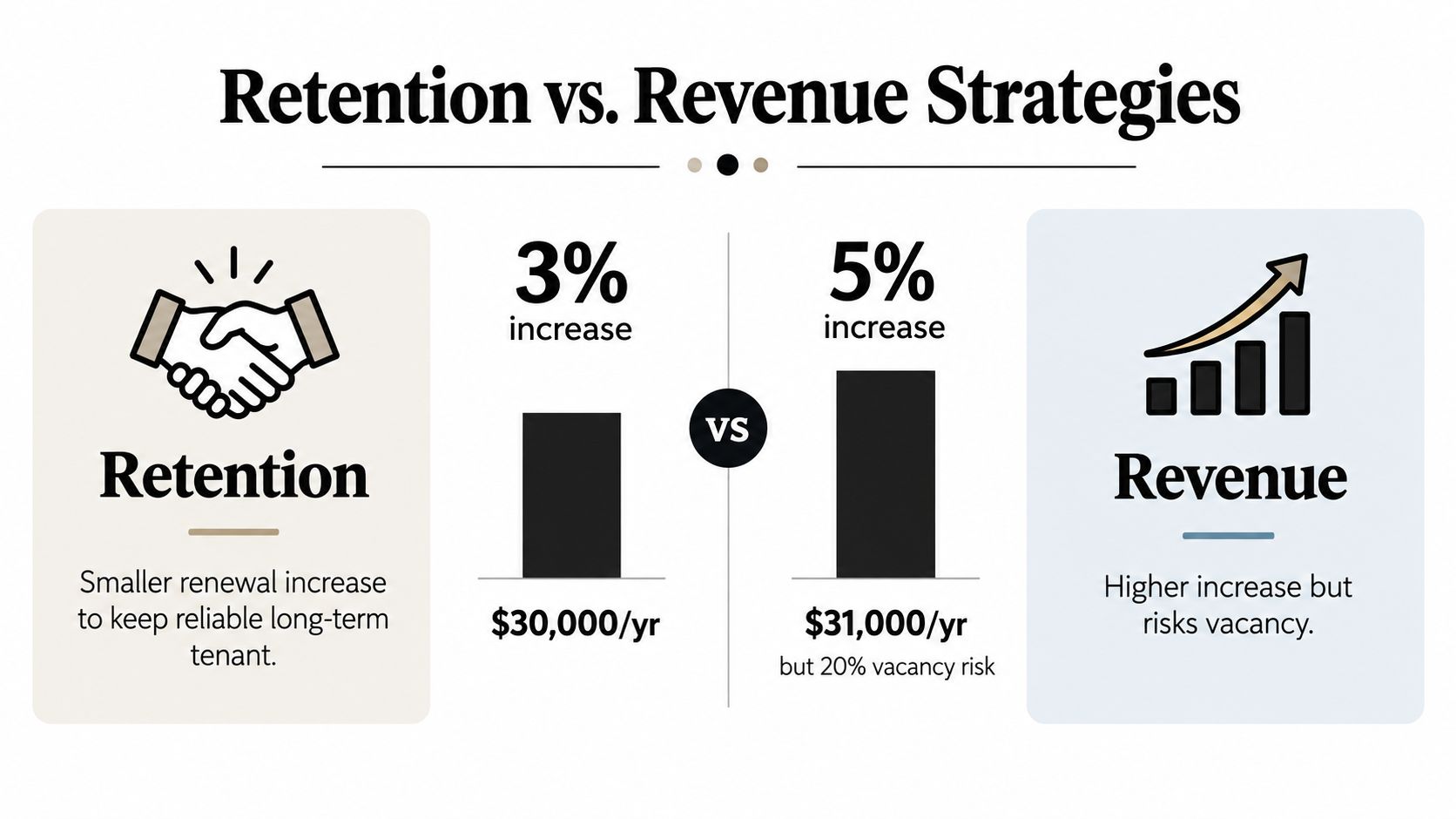
Retention-first pricing makes sense when:
- The tenant is dependable: On-time payment and low drama are worth protecting.
- The unit would need work before re-renting: Even minor turnover tasks can drag out vacancy.
- Competing inventory is active: Tenants have choices, and they know it.
- Your current rent is only moderately below market: Closing the entire gap in one renewal often backfires.
When a stronger increase makes sense
I'm not arguing for soft pricing across the board. Some tenants are far below market. Some properties sit in submarkets where replacement demand is stable. And some residents have already signaled they're likely to move regardless.
In those cases, a firmer increase is reasonable if you're prepared for turnover. That means the property condition, marketing plan, showing process, and screening criteria all need to be ready before you send the renewal.
Side-by-side decision test
Use this quick comparison before finalizing your offer:
| Situation | Better Strategy |
|---|---|
| Stable tenant, limited upside, costly turnover | Retention-focused increase |
| Tenant far under market, strong rental demand, ready-to-rent unit | Revenue-focused increase |
| Older unit with likely make-ready work | Retention-focused increase |
| Tenant likely to leave anyway | Revenue-focused increase |
Good landlords don't ask, “What's the most I can raise?” They ask, “What outcome am I buying with this increase?”
Don't copy generic landlord advice
National advice often tells owners to maximize every renewal because “the market supports it.” That's shallow. Your actual decision sits at the intersection of compliance, tenant quality, unit condition, and how quickly you can recover from vacancy if the tenant walks.
If you want a practical framework for reducing unnecessary turnover, this guide to tenant retention strategies for rental properties is worth reviewing. And if you prefer to hand off the renewal process entirely, Edinhart Realty and Property Management offers a full-service monthly management model that includes lease renewals, rent increases, and notice delivery as part of ongoing management.
Communicating Rent Increases Professionally
You can have the right number and still lose the tenant because you handled the conversation badly.
Most tenants don't like rent increases, but many will accept them if the message is clear, timely, and respectful. What triggers conflict is vague wording, last-minute delivery, or a tone that sounds careless. If you manage Fresno rentals long enough, you learn that presentation matters.
What to include in the notice and conversation
Keep the written notice clean and direct. It should state the current rent, the new rent, the effective date, and any renewal term being offered. Don't stuff the message with emotional justification or a long defense of your expenses.
Then follow up like a professional. If the tenant is solid, I prefer a short personal message after the formal notice goes out. That lowers the temperature and gives them a chance to respond before they start shopping.
A simple script works:
“We've sent your formal renewal offer and rent notice. We'd like to keep you in the home, and we're offering a renewal at the new rate effective on the date stated in the notice. If you want to renew, let's get it wrapped up early.”
How to handle pushback without losing control
Tenants usually push back in predictable ways. They'll say the increase feels too high, they've been good tenants, or they've seen cheaper listings. Don't argue. Don't get defensive. Bring the conversation back to the offer and the timeline.
Use responses like these:
- If they say the increase is unfair: “I understand the concern. We reviewed the rent carefully before sending the offer, and the written notice reflects the renewal terms we can approve.”
- If they ask for a lower increase: “If you want to propose a different renewal structure, send it in writing by the response deadline and we'll review it.”
- If they compare your home to cheaper listings: “Different homes lease at different rates based on condition, location, and terms. Our offer is based on this property and the renewal terms available.”
Timing and tone matter more than landlords think
Don't wait until the last minute and then act surprised when the tenant resists. Give yourself enough runway to send the legal notice correctly, answer questions, and decide whether you'll negotiate. Late notices make owners sound disorganized and make tenants feel cornered.
Also, stop using casual text messages as your whole renewal process. Text can support the conversation, but it shouldn't replace proper documentation. A rent increase is a business communication, not a quick favor request.
Clear notice and calm follow-up usually get better results than aggressive wording ever will.
Building Your Renewal Action Plan
The landlords who handle renewals well don't improvise. They use a repeatable system.
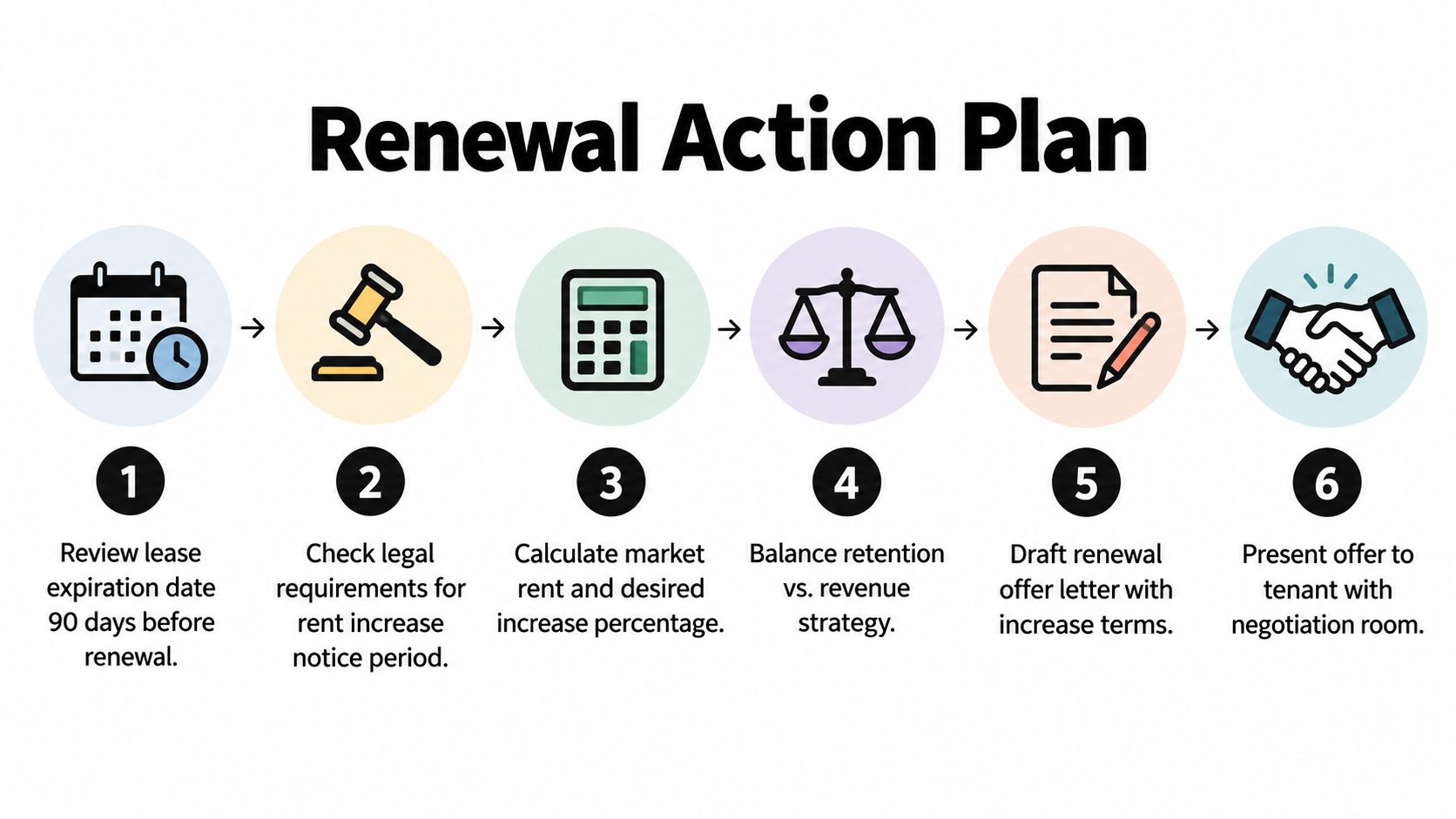
The checklist I'd use
- Review the lease early: Don't wait until expiration is close.
- Confirm legal status: Determine whether the property is subject to statewide cap rules or exempt.
- Run the pricing decision: Compare in-place rent, current competing inventory, and tenant quality.
- Choose a strategy: Decide whether this is primarily a retention renewal or a market-catch-up renewal.
- Prepare the notice correctly: Match the notice period to the increase size, and separately confirm cap compliance.
- Document every step: Keep proof of what you sent, when you sent it, and how the tenant responded.
The decision point that matters
If a good tenant pushes back a little, don't panic. Decide in advance where you'll hold firm and where you'll bend. A small concession can make sense. A chaotic back-and-forth usually doesn't.
This walkthrough can help reinforce the process side before you send your next renewal:
The big mistake to avoid is treating notice timing and rent caps like one checklist item. They aren't. They're separate gates, and you need to clear both. Get that right, pair it with grounded pricing, and your lease renewal rent increase process gets a lot more predictable.
If you want help handling renewals without guessing on pricing, notice timing, or tenant communication, Edinhart Realty and Property Management offers local property management support for Fresno-area owners who need a tighter process. Their services cover lease renewals, rent increase handling, tenant communication, and day-to-day management, which is exactly where renewal mistakes usually start.


