

A lease is ending in Clovis, and the calendar says the decision can't wait much longer. The owner has a rent figure in mind, but the tenant has unresolved maintenance concerns and may already be comparing other homes. Sending the usual renewal notice without checking either issue can turn a manageable conversation into a vacancy.
A well-built lease renewal offer is more than a rent demand. It gives the tenant clear choices, states the terms and timing, and records why the proposed price makes sense. The owner, meanwhile, can weigh legal limits, comparable rents, tenant history, and the cost of turnover before choosing what to offer.
The Moment a Renewal Offer Stops Being a Letter
A tenant in northeast Fresno opens the renewal notice and finds one number: the new rent. No deadline context, no options, no acknowledgment that the gate latch they reported twice is still broken. They start browsing listings that evening, and the owner never learns the rent wasn't the problem.
A one-line notice treats the tenant's choice as already made. It usually isn't. A meaningful share of renters reach the end of a lease undecided, weighing the proposed rent against how they were treated during the term. For the owner, that indecision is a retention window. Handled poorly, it's where turnover begins.
Treat the lease renewal offer as a decision document and a small experiment. It states the proposed rent and term, the response deadline, and at least one alternative, such as a longer fixed term paired with a smaller permitted increase. It also records why that price was chosen. If the tenant pushes back, or if a dispute surfaces months later, that written rationale is what separates a defensible business judgment from a number pulled off a listing site.
Segmentation comes before the number. The household with a clean payment record and an open repair ticket calls for a different package than the one with repeated documented lease violations. Same property, same market, different risk profile, different offer.
Practical rule: Separate the legal question from the business question. First confirm what you may offer. Then decide what makes financial sense and how to present it.
Run the four checks in order: confirm the applicable legal ceiling, price against relevant comparables, build the package around objective tenant indicators, and preserve the reasoning and communications in writing. That sequence keeps a routine renewal from turning into a compliance problem or an avoidable vacancy.
How AB 1482 Sets the Ceiling on a Renewal Offer
Before setting a proposed rent, determine whether the property is covered by California's Tenant Protection Act of 2019, commonly known as AB 1482. For covered properties, the annual rent increase is limited to 5% plus the applicable local inflation rate, or 10%, whichever is lower. The cap constrains the permitted increase; it doesn't automatically tell you what increase to choose. Coverage, exemptions, local rules, and the tenant's rent history all matter.
The distinction between a renewal and a new tenancy can materially affect the pricing comparison. UC Berkeley's Terner Center examined rental listings after one-year leases ended and found that 60% of California units relisted with an advertised rent above the applicable rent-cap threshold (Terner Center's AB 1482 analysis). That finding doesn't mean an owner can offer a renewing tenant the same price as a post-vacancy listing. For a covered unit, the renewal calculation must stay within the applicable legal limit, even when comparable advertised rents are higher.
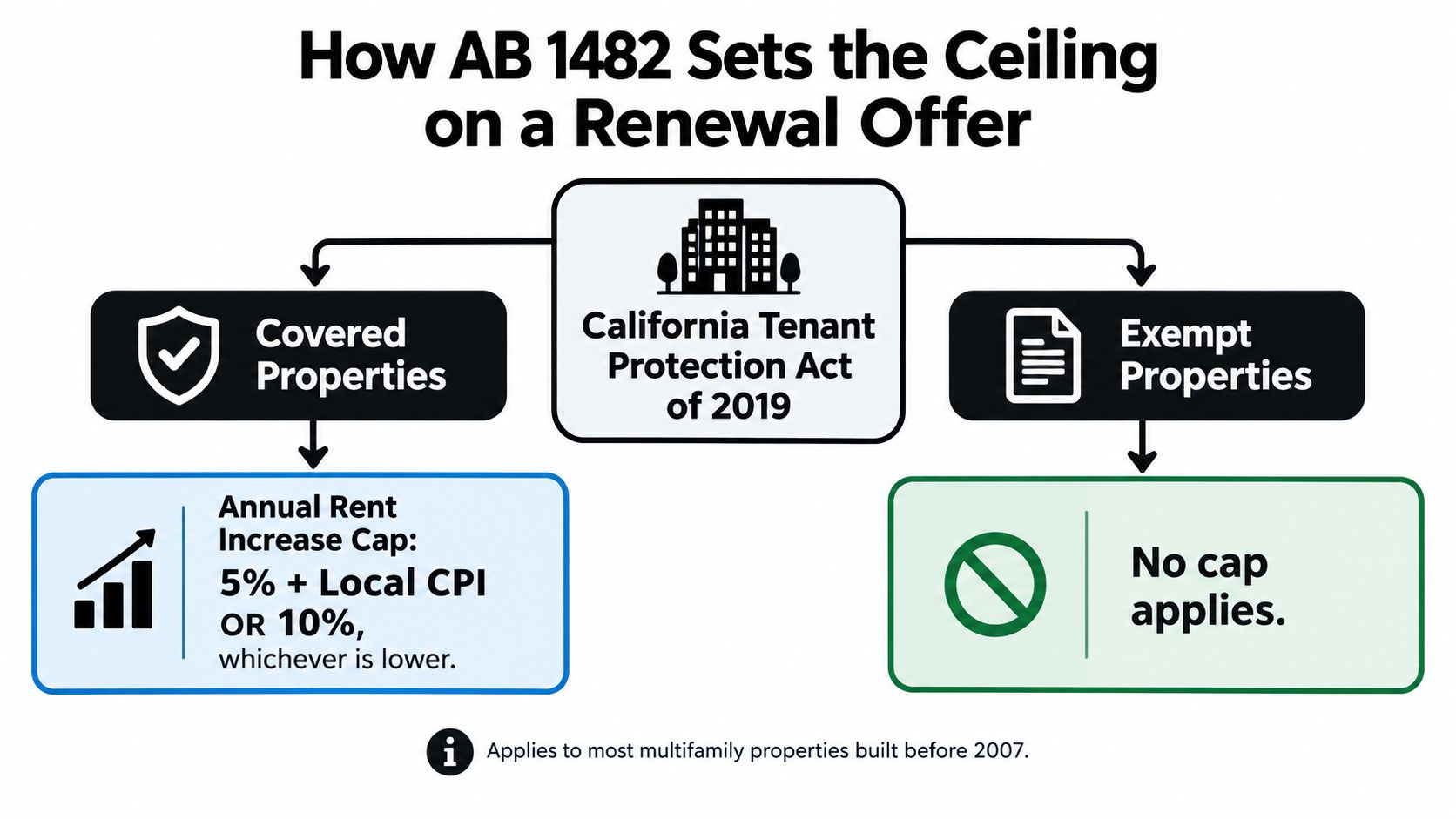
Put the legal check before the rent comparison
Build the rent worksheet around the lawful maximum, not around the highest listing you can find. Confirm whether AB 1482 applies, identify the relevant local inflation figure, account for prior increases, and record how you reached the proposed maximum. Some properties may be exempt, but an owner shouldn't assume that a property's type or age alone settles the question. Verify the specific property and any applicable local ordinance before making an offer.
A useful first step is to review California rent-control rules and coverage as part of the property-specific check. Then keep the supporting records with the renewal file. An exemption, if applicable, changes the analysis; it doesn't remove the need to check notice requirements or other lease obligations.
In the renewal worksheet, mark the cap as the upper boundary, not the target. The offer still needs a comparable-rent analysis and a turnover-cost comparison. That's how you avoid treating a legal maximum as a recommended price.
Building a Defensible Renewal Price in 90 Days
A defensible price comes from a sequence of checks, not a rent estimate pulled from a listing site. Start 90–120 days before expiration. Review payment history, lease compliance, maintenance requests, complaints, and unresolved habitability concerns. A tenant's experience with an unaddressed repair can matter as much to the renewal conversation as the rent itself.
Next, assemble comparable properties that match the rental's submarket, bedroom count, size, condition, amenities, and concessions. A renovated home in one part of Fresno may not be a useful comparison for a property with older finishes elsewhere. For a practical method of evaluating rental comparables, these rental analysis tips from PropLab can help structure the market review. Keep the date and the examples used so someone else can understand the basis for the offer.
Compare the paths, not just the asking rents
Model at least three outcomes: renew at the current rent, renew at a market-informed rent within legal limits, or allow turnover. For turnover, subtract expected vacancy loss, make-ready work, leasing costs, concessions, and downtime. The highest asking rent isn't necessarily the highest risk-adjusted net operating income.
An October 2015 MPF Research analysis of RealPage lease data found that 52.2% of expiring U.S. apartment leases were renewed, and renewed leases had an average 5.2% monthly rent increase, the largest reported in nearly a decade at that time (MPF Research lease-renewal analysis). Those historical national figures offer context, not a target for a particular Fresno-area home.
| Scenario | Proposed rent change | Key costs to subtract | Best used when |
|---|---|---|---|
| Renew at current rent | No increase | Any planned maintenance or improvements | Retention matters more than immediate rent growth |
| Renew near market | A supported increase within the lawful limit | Concessions or promised work | The tenant is a good fit and the price is competitive |
| Turnover | New lease at a market-informed rent | Vacancy, make-ready, leasing, concessions, and downtime | Expected net income justifies the turnover risk |
Deliver a written offer with rent, term options, deadline, utility responsibilities, any lawful renewal fees, and a clear way to respond. A considered rental pricing strategy keeps the decision focused on net income rather than a headline number.
Segmenting Tenants Before You Price Anything
Sending every tenant the same offer is simple, but it ignores meaningful differences in payment history, lease compliance, maintenance cooperation, and communication. Segment tenants before pricing, using objective, documented indicators. Don't use demographic or protected-class characteristics to classify renters or negotiate terms.
A practical working set is renew, renew with conditions, and non-renew. “Conditions” doesn't mean inventing a penalty or changing lease terms arbitrarily. It means identifying legitimate, consistently applied issues that need resolution, such as outstanding lease compliance concerns or required recertification, and deciding whether a renewal is appropriate under the owner's established policy.
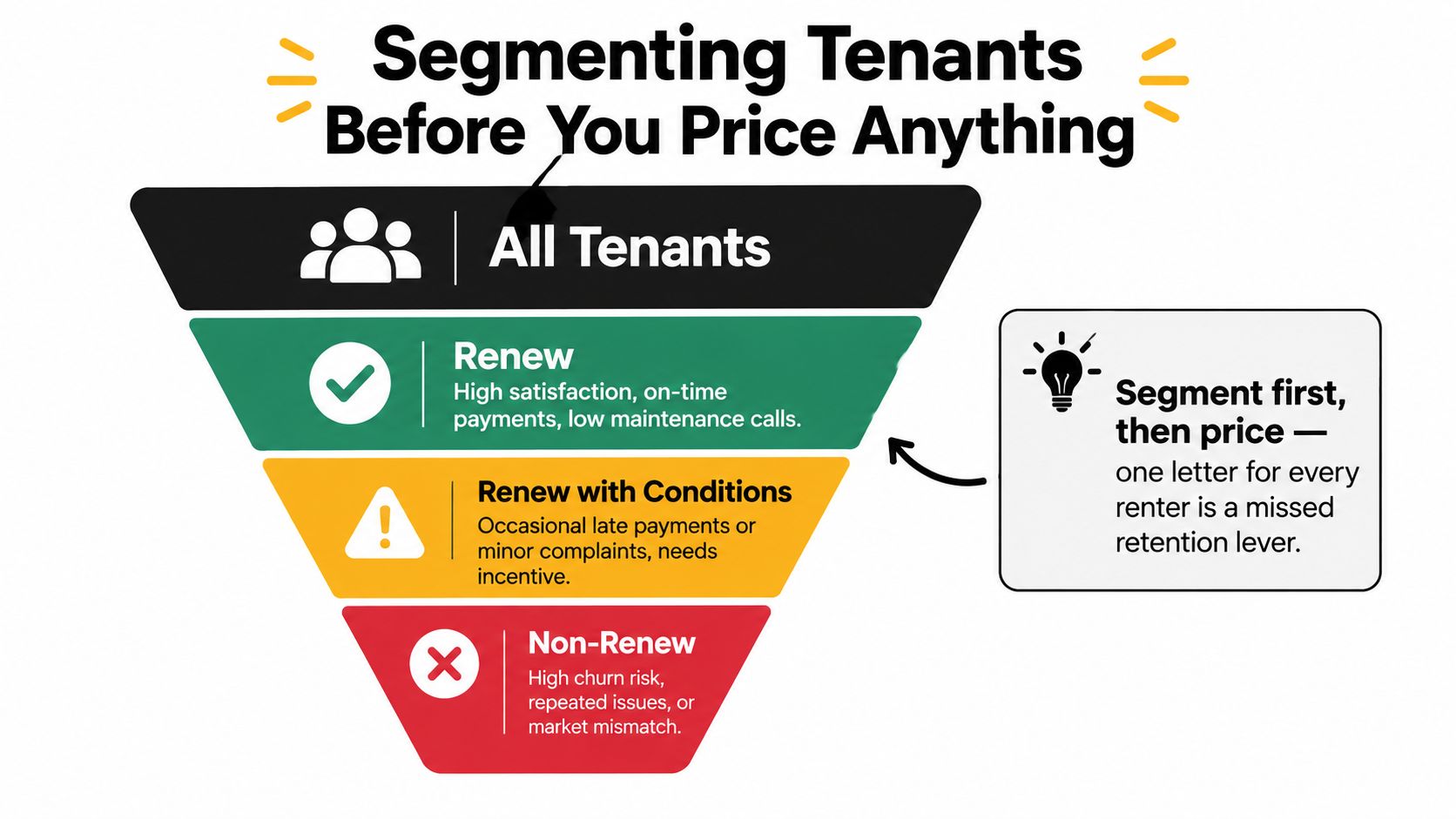
Match the package to the segment
For a reliable tenant, a 12-month term at the target rent may be straightforward. Another tenant may value a longer fixed term with a smaller increase. Where permitted and appropriate, an owner might consider a defined maintenance improvement alongside a rent adjustment. Keep the options standardized enough to apply consistently, while allowing documented exceptions to receive manager review.
A package should state what the tenant gets and what the owner expects. “Renew at this rent” is less useful than a clear offer that identifies the term, any specific improvement, and how and when the tenant must respond. Avoid informal promises that don't make it into the written agreement.
Track the result using renewal-conversion rate, time from offer to acceptance, effective rent after concessions, early delinquency, and turnover cost per decision. Those measures help identify whether the package worked without relying on impressions alone. They also make it easier to review exceptions and check that comparable tenants have been treated consistently.
Modest Increase or Market Jump
A vacant rental ignores what the listing across the street advertises. The right increase depends on the tenant, the property's position, and what it costs to replace the renter. A market jump can look attractive on paper when nearby advertised rents run higher. The owner still pays for the make-ready work, the marketing, and the weeks the home sits empty.
As noted earlier, one recent renter survey reports that renters may begin reconsidering renewal around an 8% increase, with monthly increases of roughly $90–$150 creating hesitation. Treat those figures as survey context rather than a universal threshold or a prediction for a particular household. Response depends on the tenant's circumstances, the home, competing options, and the complete terms of the offer.
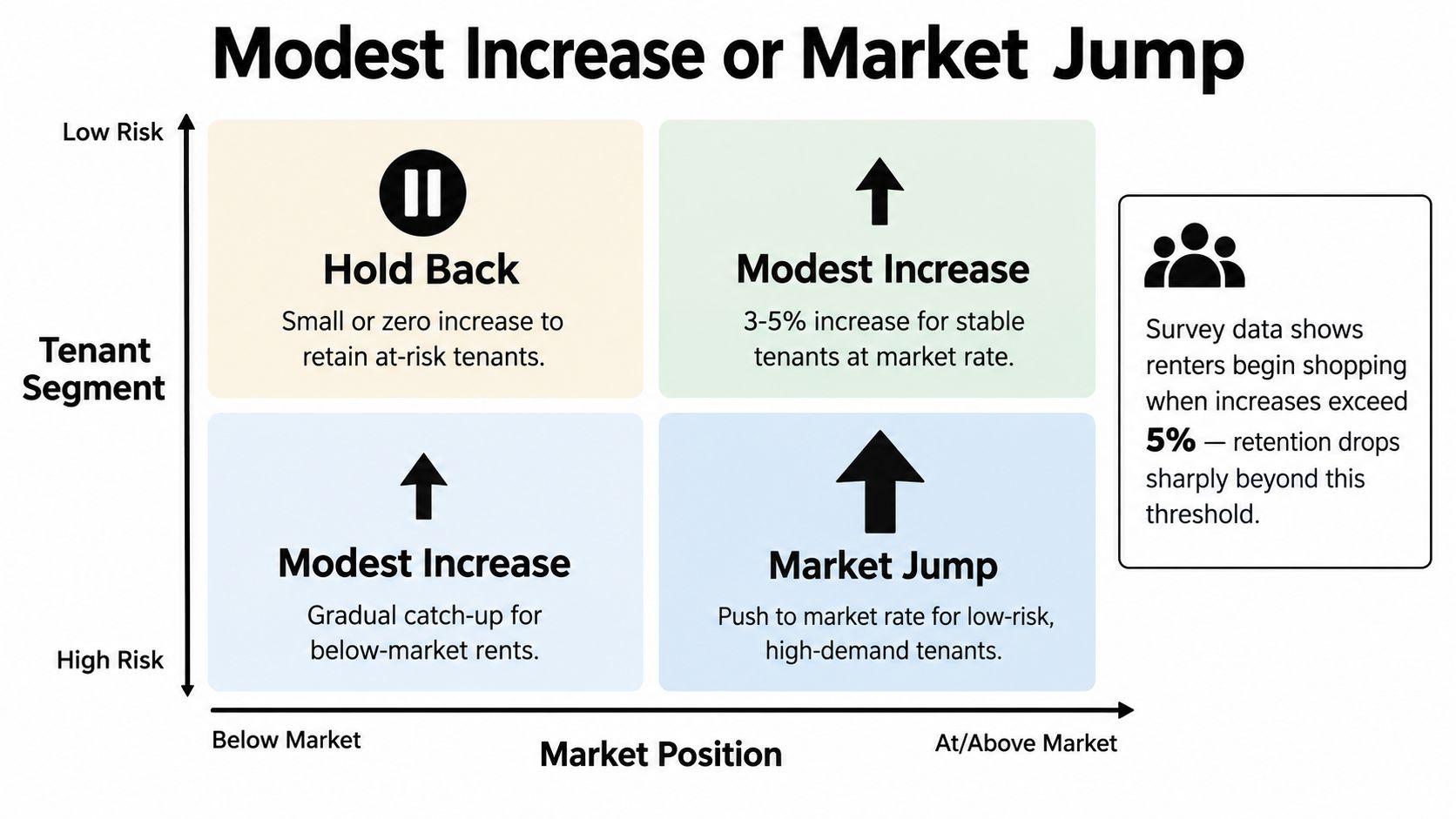
Choose the price by risk, not by habit
A modest increase paired with a longer term suits a stable tenant who pays near market and values predictability. A stronger adjustment may be appropriate when the rent sits materially below comparable properties, the property competes well, and the tenant's objective history supports a lower likelihood of turnover. For a tenant already dissatisfied over outstanding repairs, a large increase can push them out the door. Resolve the operational issue before deciding that price alone will retain them.
In Fresno or Clovis, compare against properties that compete with the rental: condition, features, concessions, and the likely cost of getting the home ready for another renter. A Friant renter weighing a commute against newer Clovis inventory responds to pricing differently than a tenant embedded in a neighborhood does. If the likely turnover costs erase the extra rent for a meaningful stretch, the market jump adds risk without improving the owner's outcome.
Pricing test: Compare the additional rent you expect to collect with the cost and risk of replacing the tenant. If the comparison fails to improve risk-adjusted net operating income, lower the ask or change the package.
The goal isn't to keep every tenant at any price. It's to make a consistent, documented decision that reflects both the property's competitive position and the true cost of replacing the tenant.
Writing the Renewal Packet and Hitting the Notice Clock
A good price won't fix an unclear packet or a missed notice deadline. Put the important terms in writing: rent, lease term, response deadline, utilities, any lawful fees, concessions, and material lease changes. Make the response process obvious, and retain a copy of what was sent and how it was delivered.
California Civil Code §827 sets notice thresholds for applicable rent increases: at least 30 days' notice when the cumulative increase is 10% or less, and at least 90 days when it exceeds 10%, subject to statutory, local, and property-specific exceptions (California Civil Code §827). Confirm the requirements that apply to the specific tenancy before sending the packet. A phone call, text, or email alone isn't a substitute for required formal written notice, according to the state Attorney General's tenant guidance (California Attorney General tenant guidance).
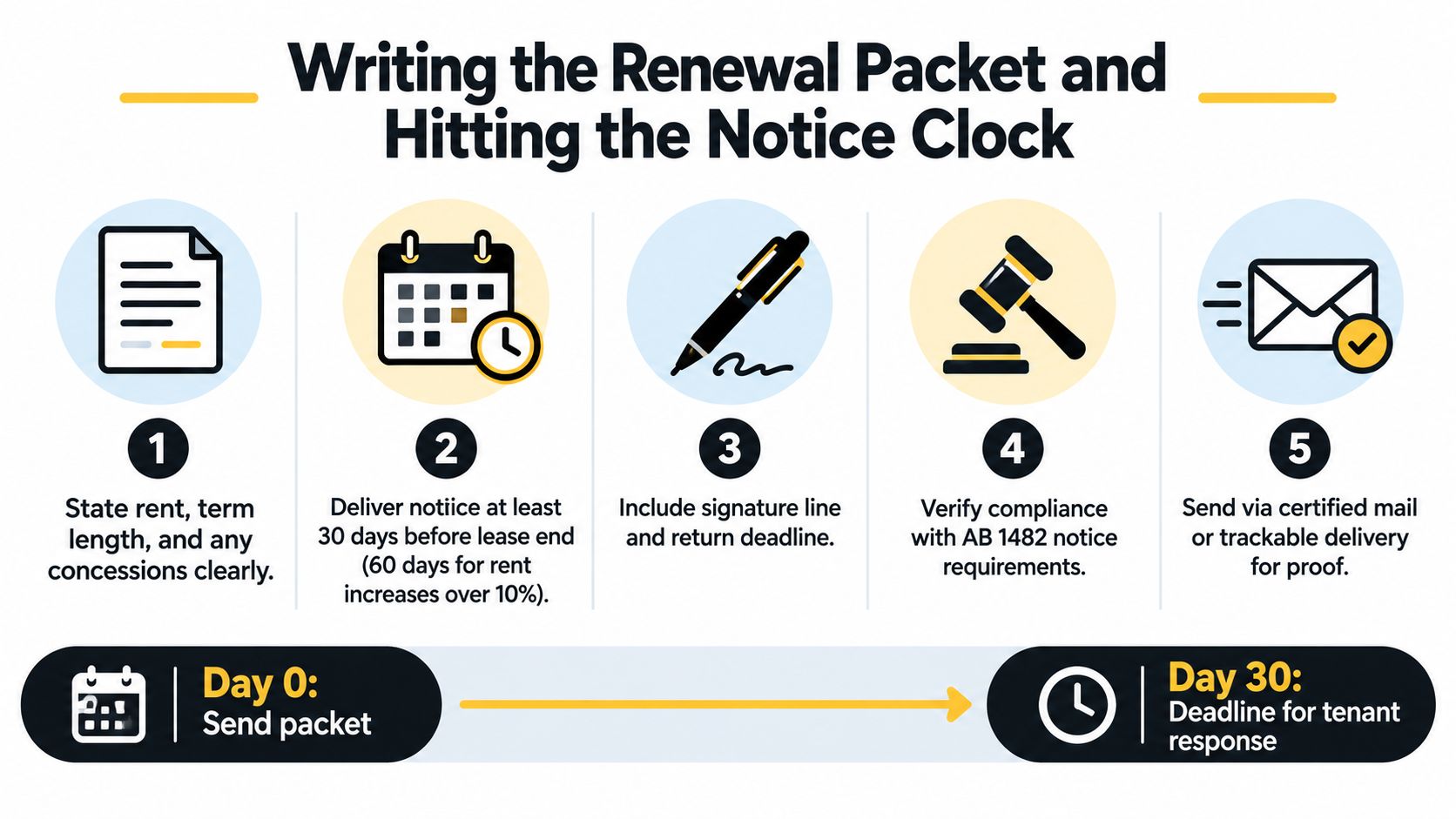
Keep the calculation and delivery trail
Two calculation errors can derail the process: using current rent when the applicable calculation requires the highest rent charged during the preceding 12 months, and failing to aggregate earlier increases. Either mistake can affect the notice period or the amount proposed. If the calculation is unclear, pause for legal review rather than relying on a template.
Keep the comparable set and its date, rent calculations, legal-review notes, final packet, delivery record, and the tenant's response together. A renewal calendar with a review checkpoint can prevent a manager from discovering a deadline after it has passed. For owners who need help reviewing contract questions, this overview of when to seek legal help for a contract offers context, but it doesn't replace advice from a qualified California attorney. You can also review the practical details of a lease renewal notice period before setting the delivery date.
After the Signature, The 30/60/90 Renewal Review
Acceptance isn't the end of the renewal process. It's the point to check whether the offer, paperwork, and follow-through worked as intended. At 30 days, confirm that the executed documents are complete, the rent and utility terms are set up correctly, and any promised work has been assigned. At 60 days, check for unresolved maintenance concerns or emerging payment issues. At 90 days, review the tenancy's performance and record any lesson that should influence future offers.
Make exceptions visible. If a manager approves a different package because of hardship or a documented property issue, record the reason and the approval. Consistent templates and comparable evidence help owners explain why similar cases received similar treatment, while a clear exception trail shows where circumstances differed.
Legal rules can change between the original signing and a later renewal. A 2026 legal tracker identified 19 renter-law changes across 13 U.S. states, noting that some rules apply when a lease is signed, amended, or extended (2026 renter-law tracker). That's a reminder to verify current state and local requirements before sending a renewal packet, rather than assuming the rules at the original lease date still govern.
Put the renewal cycle on one checklist
For a Fresno-area rental, the operating checklist is direct: calendar the 90-day review, inspect the file and property history, document comparable rentals, classify the tenant using objective criteria, model renewal and turnover outcomes, confirm the applicable notice window, and send a complete written offer. Then review the result after signing and record what happened.
Owners who prefer support with tenant communication, renewal documents, and property records can consider a management arrangement that includes those tasks. Edinhart Realty and Property Management provides lease-renewal coordination as part of its full-service management offering, alongside rent collection, repair coordination, and detailed accounting.
A reliable renewal system doesn't guarantee every tenant will stay. It does help owners make a measured offer, meet applicable requirements, and understand the financial result instead of reacting at the last minute.
If you're approaching a renewal in Fresno, Clovis, or Friant, review your timeline, pricing rationale, and notice requirements before sending the offer. Edinhart Realty and Property Management coordinates lease renewals and related tenant communication and records as part of its full-service property management.


