

Most Fresno lease renewals fail because the landlord misses a notice deadline or uses the wrong form, which can lead to an unintended month-to-month tenancy. In California, a month-to-month tenancy generally requires at least 30 days' written notice to terminate, extended to 60 days when the tenant has lived there for one year or more.
The problem usually appears on an ordinary weekday. A Fresno owner notices that a lease expires soon, assumes the tenant will sign again, and leaves the paperwork for later. By the time the owner decides whether to change the rent, renew for another term, or end the arrangement, the timing and documentation may no longer support the intended result.
California's lease renewal laws distinguish sharply between a fixed-term lease and a periodic tenancy. Local rules, state protections, the lease language, the tenant's length of occupancy, and the purpose of the notice can all affect the outcome. A reliable renewal process starts with identifying the tenancy correctly, calculating the deadline, selecting the proper notice, and preserving proof that the tenant received it.
The High Stakes of Missing Lease Renewal Deadlines
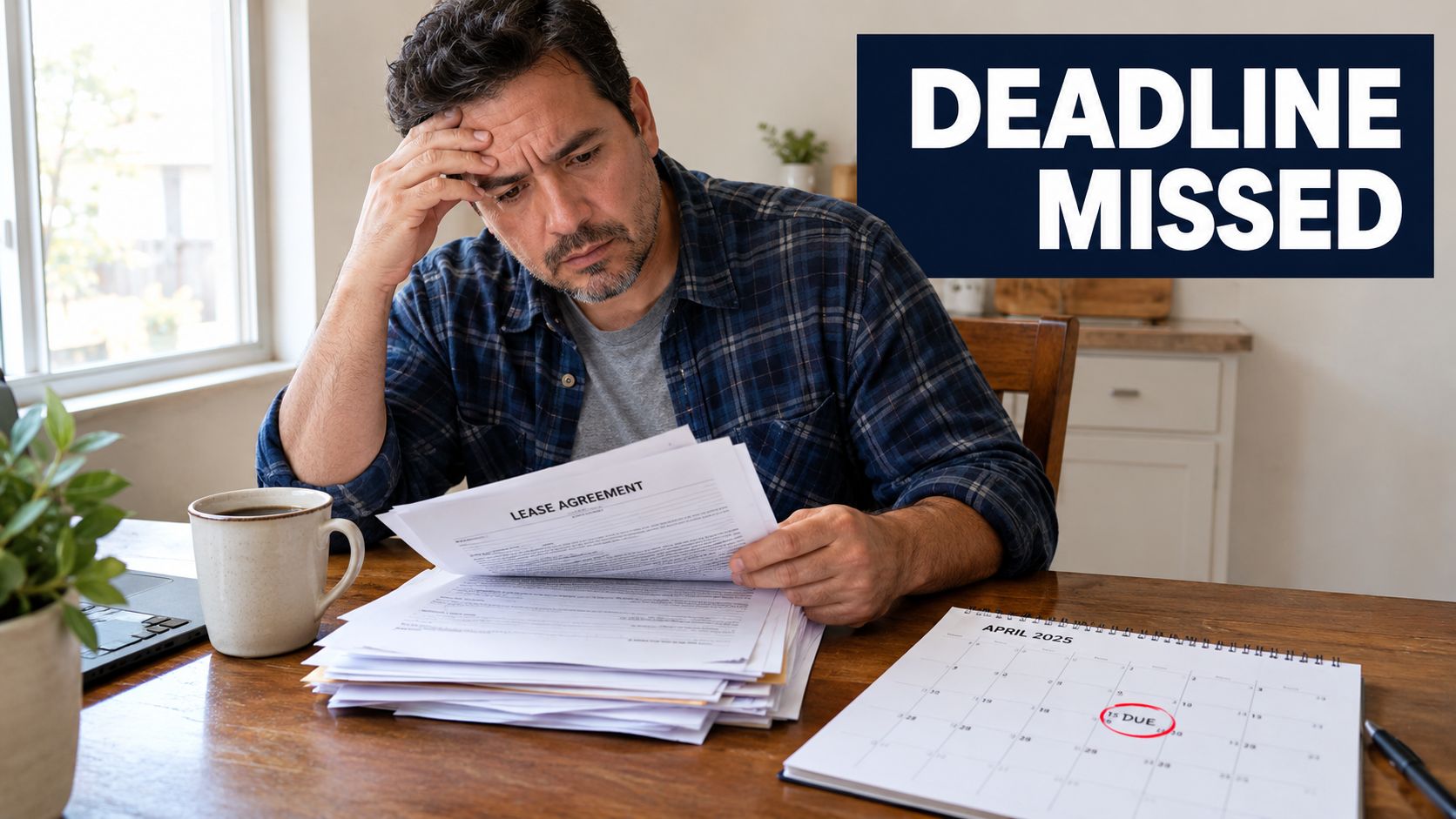
A Fresno landlord has a tenant whose one-year lease ends at the end of the month. The property has been well maintained, rent has been paid, and the owner expects the tenant to renew. Because the relationship is cooperative, the owner waits to discuss the next term until the last few weeks.
Then the owner decides the rent should change and wants a new fixed-term agreement. The tenant doesn't sign immediately. The owner also hasn't served a properly timed termination notice or confirmed whether local or state protections affect non-renewal. When the expiration date arrives, the tenant remains in possession and the owner accepts rent. The result may be a continuing tenancy rather than the clean transition the owner expected.
California Civil Code §1945 provides that when a tenant holds over and the landlord accepts rent, the tenancy is presumed to renew on the same terms. The statute is available through the California Legislative Information text of Civil Code §827, which also addresses written termination notice for periodic tenancies. The practical lesson is simple: accepting payment after expiration can carry legal consequences that aren't obvious from the original lease.
Why cooperative tenants still require formal handling
Good tenant relationships reduce friction, but they don't replace proper notice. A conversation about renewing isn't the same as a written renewal offer, and an email exchange may not satisfy the requirements that apply to a particular notice or protected tenancy.
The most expensive errors tend to happen when owners treat the renewal as a calendar reminder instead of a legal process:
- The deadline is estimated: The owner counts backward informally and sends the notice too late.
- The wrong document is used: A rent-increase notice, termination notice, and renewal offer serve different purposes.
- Service isn't documented: The owner knows the notice was sent but can't establish when or how it was delivered.
- Payment is accepted without a decision: Rent is collected after expiration while the parties still negotiate.
Practical rule: Don't let a tenant's apparent willingness to renew substitute for a completed notice and signature process.
For Fresno owners, the safest approach is to review every upcoming expiration early enough to identify the tenancy type, applicable protections, intended rent changes, and required delivery method. If the deadline has already passed, stop improvising. Review the lease, preserve the communication record, and obtain California-specific legal guidance before serving a replacement notice or accepting further rent under an uncertain arrangement.
Understanding Fixed-Term Leases vs Month-to-Month Tenancies
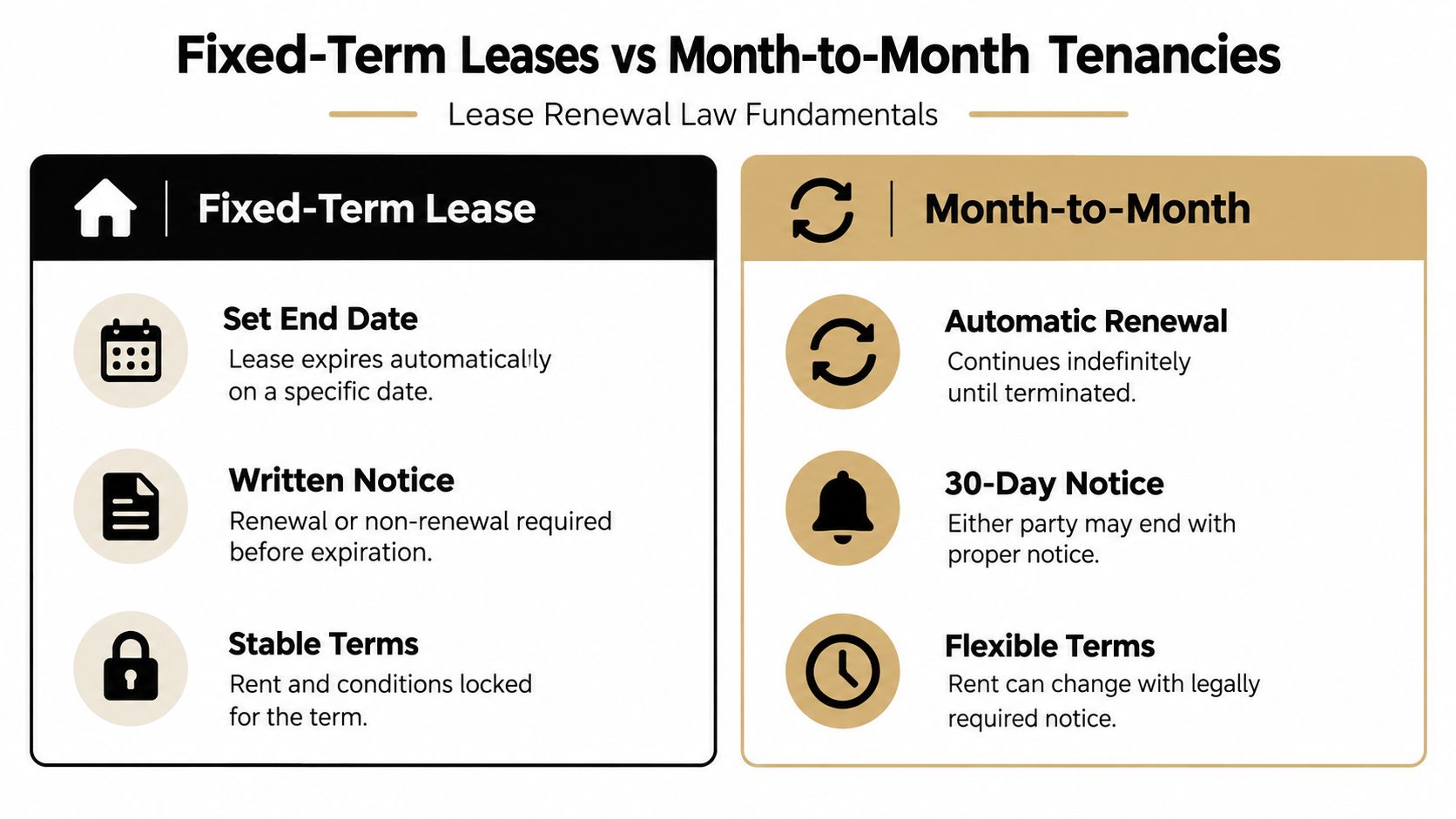
A fixed-term lease and a month-to-month tenancy aren't interchangeable. The first has a stated expiration date. The second continues from rental period to rental period until one party legally ends it or the parties create a different agreement.
Under California law, a fixed-term residential lease generally ends automatically on the date stated in the agreement, unless the contract or applicable just-cause protections require another process. That doesn't mean a landlord can ignore renewal planning. The lease may contain notice provisions, and state or local protections may limit the owner's ability to decline renewal or recover possession.
A month-to-month tenancy follows a different structure. Either party may terminate it with written notice, and the required period depends in part on how long the tenant has occupied the property. A landlord who mistakes a fixed-term expiration for an already-ended tenancy may accept rent, communicate inconsistently, or begin an eviction process without first establishing the correct legal status.
The legal distinction in daily management
| Fixed-term lease | Month-to-month tenancy |
|---|---|
| Runs through a stated expiration date. | Continues until properly terminated. |
| Terms generally remain in place during the agreed term. | Terms continue by rental period, subject to lawful changes. |
| The owner must review the lease and applicable protections before deciding what happens at expiration. | The owner must calculate and serve the correct termination notice. |
| Holding over can create a different tenancy relationship, particularly if rent is accepted. | The parties already operate under a periodic arrangement. |
California's notice rules illustrate why classification matters. A month-to-month tenancy can generally be ended by either party with at least 30 days' written notice, or 60 days' written notice when the tenant has lived there for one year or more, as described in the state statute linked above. Those figures don't turn every fixed-term expiration into a month-to-month termination situation. They apply to the periodic-tenancy framework and must be used with the correct facts.
The lease file should answer four questions before any notice goes out:
- What agreement is currently in effect?
- What date does it expire, or what rental period is ending?
- Has the tenant remained after expiration?
- Has the owner accepted rent or otherwise acted as though the tenancy continues?
The answers determine whether the owner is preparing a renewal, documenting non-renewal, changing a periodic tenancy, or correcting a holdover situation. Treating all four situations as “the lease is up” is how procedural mistakes begin.
California Notice Periods and Timing Requirements
Timing is where many renewal plans break down. A landlord may have a legitimate business reason to change terms, but a valid reason doesn't cure late service, an incomplete form, or a notice that doesn't match the tenancy.
For a month-to-month tenancy, start by identifying the intended termination date and the tenant's occupancy history. California's framework generally calls for 30 days' written notice, with the period extended to 60 days when the tenancy has lasted one year or more. The notice must also be served using a legally recognized method and should identify the premises, termination date, and other required information accurately.
Build the timeline backward
Don't begin with the day you want the tenant to leave. Begin with the date by which the notice must legally take effect, then work backward while allowing time for preparation, service, weekends, mailing issues, and correction if the document contains an error.
A workable Fresno process looks like this:
- Confirm the tenancy status: Read the current lease, amendments, addenda, and payment history.
- Identify the objective: Decide whether you're offering a renewal, proposing changed terms, or ending a periodic tenancy.
- Calculate the notice period: Apply the California rule that matches the occupancy and tenancy facts.
- Use the correct form: A renewal offer isn't automatically a termination notice, and a rent-change notice doesn't necessarily end the tenancy.
- Serve and record: Note the date, method, recipient, and person who completed service.
- Check local requirements: Fresno and Clovis properties may be affected by rules beyond the basic state framework, so verify current city and county requirements before relying on a general form.
The California tenant-notice process guide can help owners organize the operational steps, but a checklist can't resolve a disputed fact pattern or replace legal advice.
Mailing isn't the same as proving delivery
A notice can fail because the landlord can't establish when it was served, not only because the language was wrong. Keep a copy of the exact document, service details, tracking information when available, and related correspondence in the property record. If a tenant claims the notice arrived late, contemporaneous records are more useful than memory.
Don't backdate a notice, rely on an informal text message, or assume that a tenant's verbal acknowledgment eliminates the need for formal service. If a deadline was missed, document the mistake and reassess the process rather than sending a second notice with unexplained changes.
Rent Control and Just-Cause Renewal Rules
Renewal rights depend heavily on whether the unit is regulated or operating at market rate. In unregulated housing, tenants generally don't have an inherent right to a new fixed-term lease when the existing term expires, subject to the protections that apply to the property and tenancy. In rent-stabilized or rent-controlled housing, landlords often must offer renewal on legally defined terms.
New York provides a clear historical example. Its Rent Stabilization Law was enacted in 1969, followed by a major overhaul of the rent-control system in 1970. Under that framework, landlords must offer renewal leases and tenants may choose a one- or two-year renewal, while the former three-year option was eliminated in 1983. The system also uses a legal sunset structure, so lawmakers must periodically renew the rent laws. The historical overview of New York's rent-regulated renewal framework shows how detailed renewal obligations can become in a regulated market.
California landlords should draw the right lesson from that comparison. A Fresno owner shouldn't import New York's renewal forms or deadlines, but shouldn't assume that a market-rate label answers every question either. State just-cause protections, exemptions, local rules, the property's status, and the tenancy history can affect whether non-renewal is available and what notice must say.
Market-rate and regulated decisions
For a market-rate property, the owner usually has more flexibility to negotiate a new term, but that flexibility is still bounded by anti-retaliation, discrimination, contract, and applicable just-cause rules. A proposed rent change should be supported by a lawful written notice and handled separately from any communication that could appear retaliatory.
For a regulated unit, the owner may need to offer renewal, observe limits on rent changes, use prescribed forms, and attach required disclosures. The lease renewal and rent increase guidance is useful for organizing those documents, particularly when the owner must determine whether California protections such as AB 1482 apply.
A renewal decision isn't just a pricing decision. It's a property-status decision, a notice decision, and sometimes a just-cause decision.
When non-renewal is based on a claimed breach, keep the evidence organized. Payment records, inspection notes, notices to cure, repair requests, and tenant communications should tell the same factual story. A vague reason added after the fact creates avoidable risk, while a timely, accurate notice supported by the property file gives the owner a defensible process.
Sample Lease Renewal Clauses and Compliance Checklist
A renewal clause should make the parties' process clearer, not create a false sense of security. The language must fit the tenancy, comply with California law, and yield to protections that the parties can't waive by contract.
A practical clause can identify the existing lease, the proposed renewal term, the rent, the effective date, the deadline for acceptance, and the consequences of not signing. It should also state that any renewal becomes effective only after all required parties sign the written agreement. Avoid language that suggests a tenant loses statutory rights merely because a deadline in the lease was missed.
Clauses that support clean administration
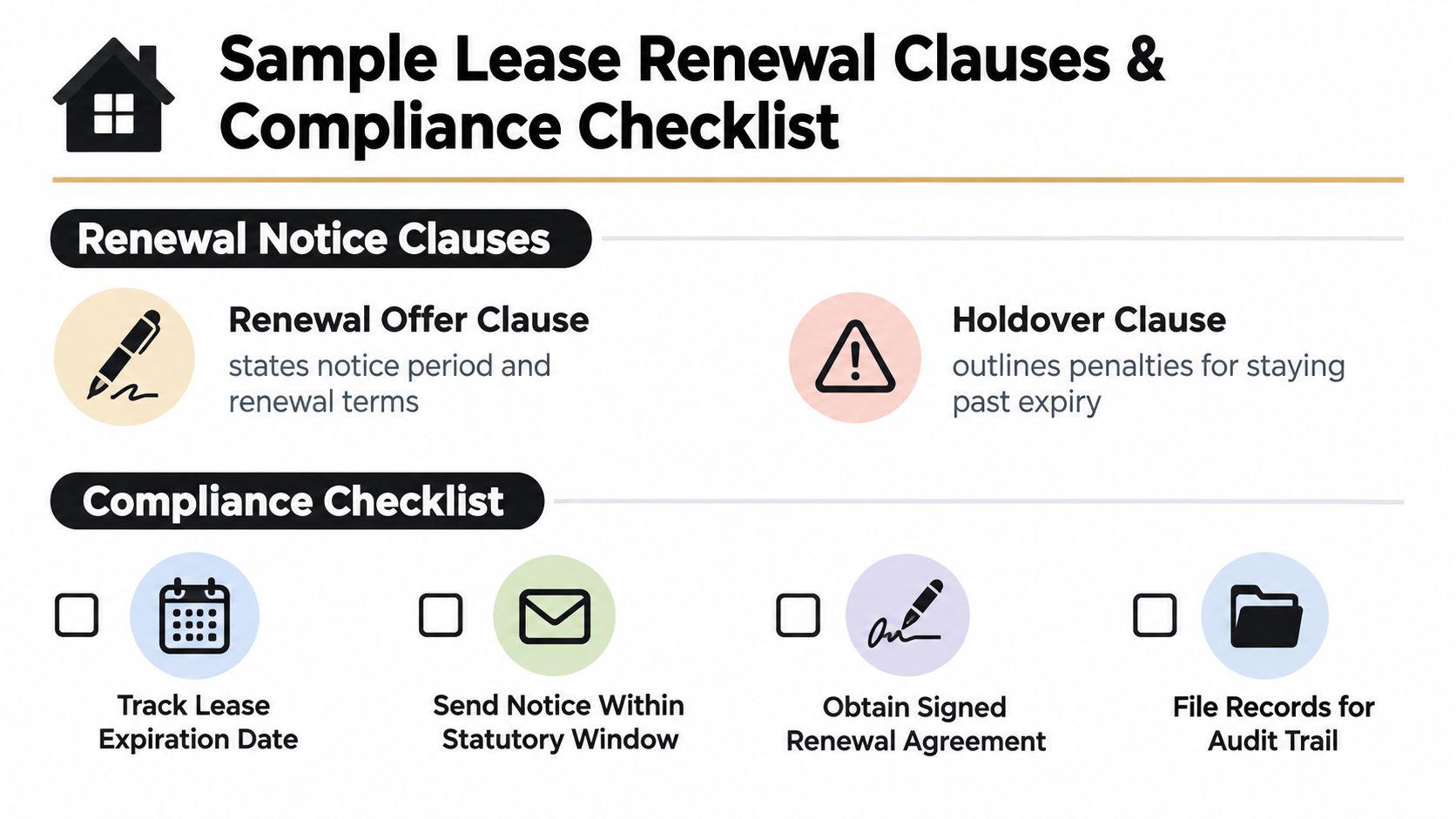
Renewal offer clause
“The landlord offers a renewal of the rental agreement for the term and rent stated in the attached agreement. The renewal is effective only when all required parties sign and return the agreement, subject to applicable law.”
This wording separates an offer from a completed contract. It also avoids promising an automatic extension when the owner still needs signatures, disclosures, or legally required notices.
Holdover clause
“If the tenant remains in possession after the stated expiration date without a fully executed renewal, the parties' rights and obligations will be determined by the rental agreement and applicable law.”
A holdover clause shouldn't purport to override California law. A landlord may want to state the intended consequences of remaining in possession, but the actual result can depend on acceptance of rent, the lease language, and statutory protections.
The working checklist
Use the lease renewal form resource as an administrative starting point, then adapt the document to the actual property and tenancy.
- Confirm the parties: Verify legal names, contact details, occupants, guarantors, and ownership or management authority.
- Read the existing file: Review the lease, amendments, notices, disclosures, payment history, and unresolved repair issues.
- Set the dates: Record the expiration date, proposed new term, response deadline, and every notice deadline in the property calendar.
- Select the document: Decide whether the tenant needs a renewal offer, rent notice, termination notice, or another legally appropriate form.
- Check protections: Determine whether rent-control, just-cause, state, local, or contractual restrictions apply.
- Serve correctly: Use the required delivery method and document who served the notice and when.
- Execute the agreement: Obtain signatures before treating the renewal as complete.
- Archive the record: Save the signed agreement, final notices, delivery proof, disclosures, and communications together.
The record should allow another manager to reconstruct the entire decision without calling the original owner. That standard catches missing signatures, conflicting dates, and unexplained changes before they become tenant disputes.
Common Misconceptions About Automatic Renewals
Many owners believe a tenant who stays after expiration automatically receives another fixed-term lease. That isn't the safe assumption. A holdover can create a continuing tenancy, but the legal result depends on the agreement, the parties' conduct, rent acceptance, and applicable California law.
Another common belief is that a friendly conversation is enough. It isn't. “We'll renew next month” may help preserve the relationship, but it doesn't identify the rent, term, disclosures, signatures, service method, or legal conditions needed for a dependable renewal file.
Three assumptions that cause trouble
“The original lease controls forever.”
The original lease may provide important terms, but continued possession after expiration can change the tenancy structure. Accepting rent after holdover is especially important because California law can presume renewal on the same terms in that situation.
“A text message is a renewal.”
A text may be evidence of negotiations, but it shouldn't replace a complete written agreement or a required statutory notice. Keep informal messages in the file, then finish the process with the document that matches the transaction.
“No notice is needed because the tenant knows the date.”
Knowledge of an expiration date doesn't prove that the owner complied with a notice rule. The tenant may understand the date and still dispute the form, timing, service, rent change, or reason for non-renewal.

The safest practice is to treat every expiration as a decision point. Either complete a written renewal, document a lawful non-renewal, or identify the tenancy that will continue and the terms that govern it. If the file is already unclear, don't try to fix it by sending contradictory notices or changing the story after the deadline.
Edinhart Realty and Property Management coordinates lease renewals, tenant communication, document execution, and property records for Fresno-area owners through its full-service management model. Visit Edinhart Realty and Property Management to discuss a renewal process that tracks deadlines, uses the appropriate paperwork, and keeps your compliance file organized.


