

Your Clovis tenant wants to stay, the lease is almost up, and you're deciding whether a rent increase is worth risking a vacancy. Say the house rents for $1,850 a month, has 18 days left on its fixed term, and you're considering a 12-month extension. Those are hypothetical figures, not a Fresno market quote, but they're enough to build a useful estimate of what the tenant pays and what the owner collects.
The important number isn't just the proposed monthly rent. It's the rent collected over the extension, after concessions, with the remaining current-term rent kept separate.
A Fresno Lease Extension Estimate You Can Use Today
$22,200 to $23,400 in extension-period rent is the working range for this hypothetical house, before operating expenses and any permitted one-time fee. The middle option gives the tenant a short concession while preserving the higher contract rent.
Sample Fresno lease extension estimate
| Line item | Hold rent | Market rent | Market rent minus concession |
|---|---|---|---|
| Current monthly rent | $1,850 | $1,850 | $1,850 |
| Days left on current term | 18 | 18 | 18 |
| Pro-rated rent for leftover days | $1,095 | $1,095 | $1,095 |
| New monthly rent | $1,850 | $1,950 | $1,950 |
| Concession (one week, 365-day basis) | $0 | $0 | $449 |
| One-time admin or lease fee if allowed | $0 to $50 | $0 to $50 | $0 to $50 |
| First full month the tenant pays | $1,850 | $1,950 | $1,501 |
| 12-month rent collected | $22,200 | $23,400 | $22,951 |
All table figures are hypothetical, rounded to whole dollars. The annual totals exclude the current-term stub and optional fee, and assume every scheduled payment is collected. They're gross rent receipts, not the owner's take-home profit.
Put dates and dollars in separate boxes
Current-term rent belongs to the existing agreement. Using the example's annualized convention, monthly rent multiplied by 12 and divided by 365 gives a daily rate of about $60.82; multiplying the unrounded rate by the remaining days produces approximately $1,095.
Extension rent starts on the stated extension date, not when the tenant receives the offer. At the hypothetical proposed rent, the same convention produces about $64.11 per day. This calculation method is an estimating assumption, not a substitute for the lease's proration provision.
The concession is a separate credit. A hypothetical free week costs approximately $449, credited once against the first full extension month identified by calendar name in the signed agreement, leaving approximately $1,501 payable.
The fee needs its own authorization and payer. Include the hypothetical preparation charge only if the writing permits it and it's otherwise lawful. Don't treat a California security deposit as renewal income or an opportunity to manufacture profit.
Establish the proposed rent before negotiating it
Use our guide to average rent in Fresno for broad orientation, then narrow the comparison to competing homes. A Fresno house with an older kitchen shouldn't inherit the asking rent of a remodeled Clovis property just because both have a garage.
For a structured comparison, BatchData explains how to compare rental comps for pricing. Record location, beds, condition, amenities, asking rent, and advertised concessions rather than copying the highest listing.
Working rule: Every credible estimate identifies the expiration date, days left, current rent, proposed rent, concession days, one-time fees, and who pays each charge.
This is a residential renewal calculation, not a UK leasehold valuation. UK premiums, marriage value, and the 80-year threshold don't transfer to a Fresno fee-simple rental renewal, a jurisdictional distinction discussed in the City, University of London leasehold analysis.pdf).
Legal Checks Before You Lock the Number
A spreadsheet can calculate a proposed increase without making it enforceable. Before treating the estimate as an offer, identify the tenancy, the property's legal coverage, and the documents that support the effective date.
Use this checklist to organize the review.
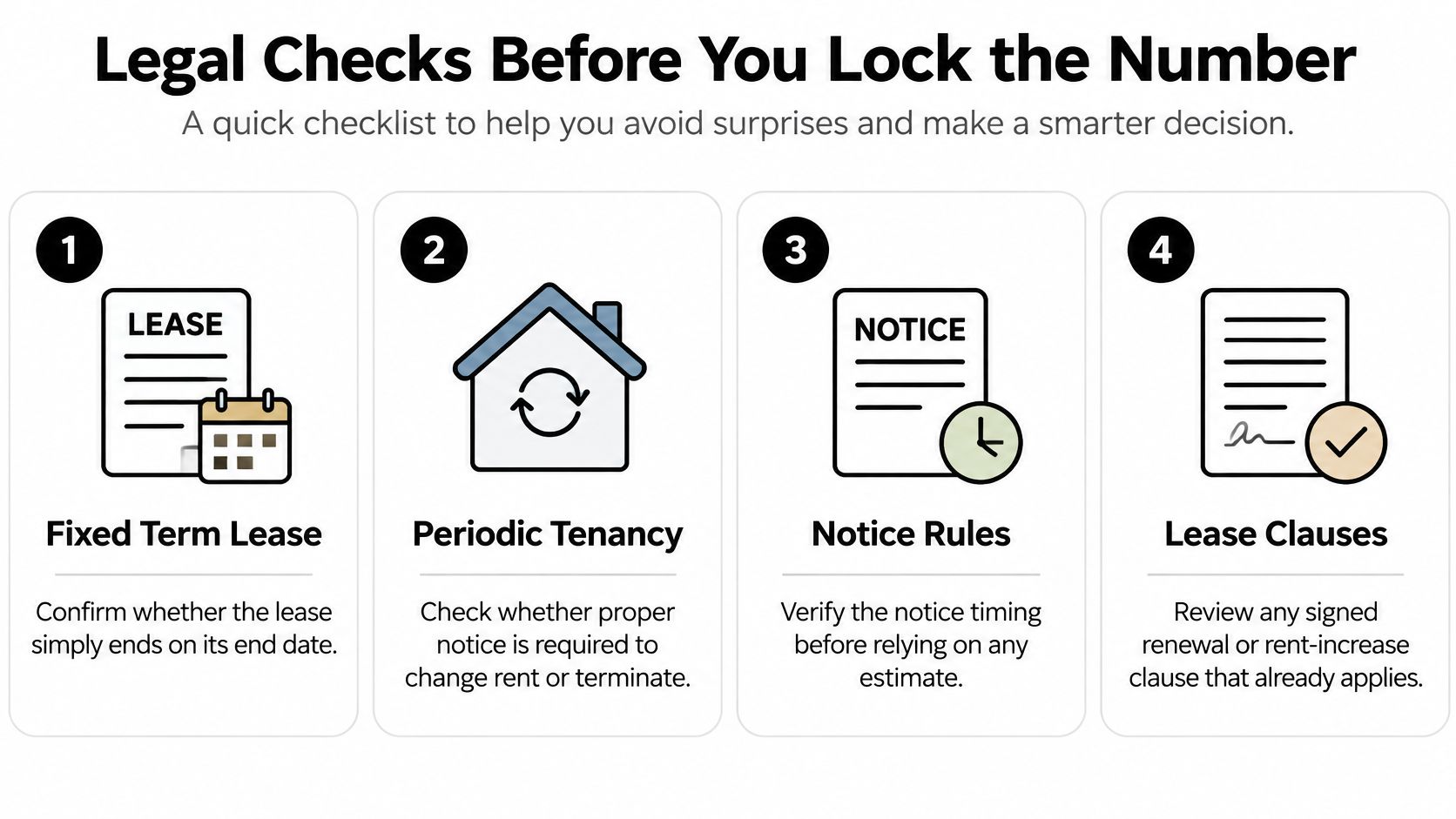
Identify the tenancy and coverage
- Fixed term: Read the expiration and holdover clauses together. Don't assume the printed end date alone authorizes a rent change, requires the resident to leave, or eliminates applicable tenant protections.
- Periodic tenancy: Verify the notice requirements for changing rent or ending the tenancy. An unsigned renewal proposal isn't a substitute for a required notice.
- Covered property: Check whether California rent-cap and just-cause requirements apply, along with any applicable local restriction. The proposed rent must fit the governing rules, not merely nearby asking rents.
- Potential exemption: Confirm ownership, property characteristics, and any required exemption notice. A single-family address alone isn't enough to establish the exemption.
Our explanation of rent control in California provides orientation, but the property file still needs a coverage determination. Put that determination in the estimate so the owner, manager, and person preparing the notice aren't working from different assumptions.
Check the charges and the effective date
Keep security deposits, pet-related charges, and administrative fees outside the base-rent calculation until each has been reviewed. A signed writing doesn't automatically make every charge lawful, and a renewal isn't permission to increase a deposit beyond the applicable limit.
Also distinguish a refundable deposit from rent and from a nonrefundable charge. Calling money something different in the ledger doesn't resolve how it must legally be handled.
For partial periods, check the lease's proration method before using an annualized daily rate. For concessions, identify the credit month and make clear whether the agreement changes the contract rent or merely gives a temporary credit.
Pause the number if coverage, exemption, or notice timing is unclear. Get the governing clause and current requirements checked before serving anything.
California real estate laws received a new set of updates for 2024, with revisions continuing during the year until the following annual set. That's why an old form or a remembered percentage isn't a reliable basis for a present offer.
Record the lease clause, review date, notice date, and proposed effective date in the file. Verify the current rules when preparing the actual documents rather than treating an estimate as legal approval.
Calculate and Lock the Extension Step by Step
A useful lease extension estimate should be reproducible. Another person should be able to open the signed lease, follow the assumptions, and reach the same proposed charges without guessing which dates or credits you intended.
This visual summarizes the workflow. Keep the existing-term proration separate from the new extension's full-term rent.
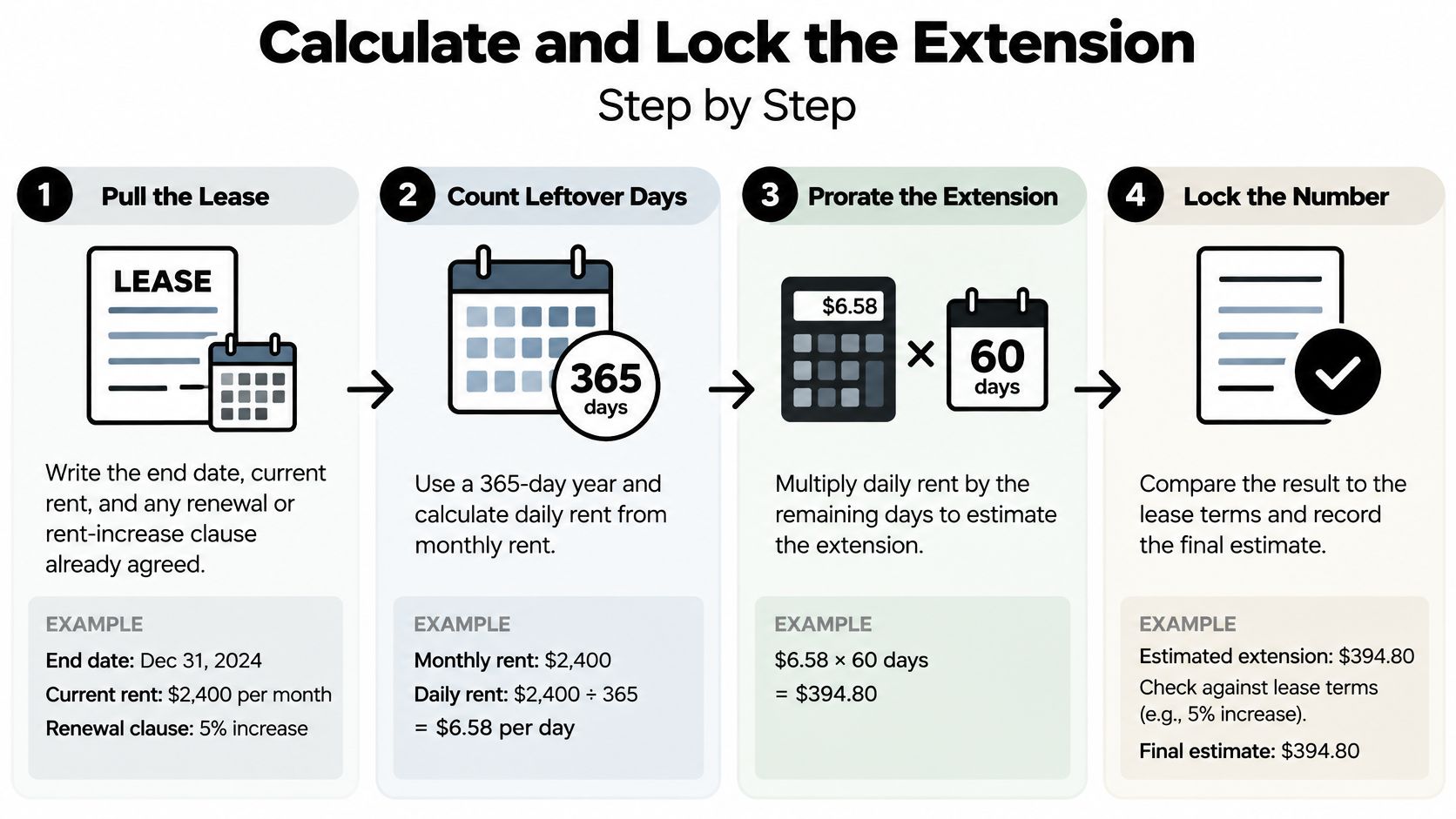
Build the calculation from the signed agreement
Pull the lease and all amendments.
Write down the actual expiration date and current contractual rent. Then find any renewal option, automatic increase, rent-review clause, or later amendment that changes the original document.
Don't work solely from the amount recently deposited into the owner's account. That payment may include a credit, an unpaid balance, or a separate charge. The signed agreement establishes the starting terms; the ledger shows whether those terms have been paid.
Count the remaining chargeable days.
For this hypothetical estimate, use monthly rent × 12 ÷ 365 × chargeable days. Keep full precision in the spreadsheet and round the resulting charge, rather than rounding the daily rate first and multiplying that rounded number.
Mark the first and last included dates on a calendar. If the tenant has already paid the current month, the calculated stub may be an allocation rather than additional money due. Don't bill the same occupancy twice.
When the extension begins mid-month, assign each day to the correct agreement and rate. Old-term days stay at the existing rate; extension days use the approved new rate from its effective date.
Support the proposed rent with comparable homes.
Build a short comparison sheet for the same pocket of Fresno or Clovis. Match bedroom count, usable layout, condition, parking, yard, cooling, and included services before deciding that a listing supports your proposed price.
Separate advertised rent from effective rent after concessions. A competing listing with a move-in credit may be less expensive than its headline rent suggests, while a listing that includes yard service may justify a different comparison.
The hypothetical proposed rent needs that support. Write whether it takes effect on the extension's first day or after a separately identified transition period, then use the same date in the agreement and ledger.
Convert the concession into a single dollar credit.
Price a days-based concession using the agreed convention and the new rent, then name the month receiving it. Don't leave “a free week” as the only instruction to whoever posts the charge.
Specify what happens if the extension begins partway through a month. A credit intended for the first full month shouldn't accidentally erase the partial-period charge as well.
Compare offers before preparing the final paperwork
Separate permitted charges from rent.
List each proposed fee, who owes it, when it becomes payable, and the clause authorizing it. Exclude owner expenses that can't lawfully be passed through, even if including them would improve the owner's projected return.
A late charge isn't guaranteed renewal income. Don't add a possible future penalty to the estimate as though the tenant will certainly pay it.
Our Full-Service Monthly Property Management includes the Placement-Only services plus rent collection, repair coordination, documented tenant communication, move-in, property condition images, exit reconditioning coordination, lease renewals, rent increases, specific notice delivery, monthly statements, and a 1099 with yearly property report. Automatic annual rental increases are included at no additional cost and are pre-accepted by tenants; Full-Service VIP Property Management has no lease renewal fee. Any increase still needs to comply with the agreement and applicable law.
Compare the full extension period, not just the first bill.
As another clearly hypothetical alternative, consider $1,900 per month with no concession. That produces $22,800 over 12 months, compared with approximately $22,951 for the higher-rent offer with the one-time credit, a difference of only $151 before expenses.
That small difference can make the simpler offer attractive if the resident prefers an even monthly payment. The higher contract rent may suit an owner who wants a temporary accommodation rather than a lower ongoing base, but the tenant still needs to understand the later payment amount.
Negotiation works better when both sides can compare concrete offers. RentReboot's lease negotiation advice for NYC renters offers another perspective on preparing a renewal discussion, though New York rules shouldn't be used to determine California obligations.
Freeze the charges before notice preparation.
Approve the remaining-term charge, new monthly rent, and one-time concession or fee before anyone prepares the notice. Put the same amounts and effective dates in the proposed extension and the management instructions.
Have both parties initial or acknowledge the financial terms in the signed extension or replacement lease. If negotiations change the rent or credit, update every affected document rather than relying on an email that contradicts the agreement.
Ledger test: A person who didn't negotiate the renewal should be able to post the charges correctly using the signed document alone.
Until the agreement is executed and applicable notice requirements are satisfied, label the calculation indicative, not finalized. Save the accepted version with the supporting comparison sheet so a later question doesn't require reconstructing the negotiation.
When the Estimate Does Not Match the Lease
Calendar errors and recurring credits can move more money than a small rent negotiation. In the hypothetical opening example, billing the full current monthly rent instead of the remaining-term charge overstates the rounded bill by about $755.
A February calculation can also drift. For a hypothetical 28-day charge at the example's current rent, dividing monthly rent by 30 produces approximately $1,726.67, while the annualized convention produces approximately $1,703.01, a difference of about $24. Neither convention should be selected because it produces more income; use the governing agreement and applicable requirements.
Correct the charge, not just the explanation
A concession error is more expensive. Applying the example's rounded $449 credit every month removes $5,388 over 12 months, rather than the intended single credit, an excess reduction of $4,939.
Estimate mistakes and the fix
| What looks wrong | Usual cause | Fix |
|---|---|---|
| Stub month equals a full rent charge | Leftover days ignored | Charge daily rate times days left only |
| February or 31-day month is off by a day or two | Divided by 30 | Recalculate using the lease-approved daily convention and actual chargeable dates |
| Concession slashes every month | Credit applied to the contract rent | Subtract it once from the named month |
| New rent far above nearby homes | Comp is newer or larger | Match beds, condition and area |
| Increase exceeds the lease | Printed renewal cap missed | Use the lower of cap and market |
| Surprise admin fee | Fee copied from another owner | Charge it only if the writing allows it and the charge is lawful |
| Start date rejected | Notice too short | Move the effective date and rerun the stub |
Reconcile the paperwork with the ledger
If the lease limits an increase, calculate the contractual ceiling before comparing it with the supported market rent. Use the lower figure, subject to any stricter legal limit, rather than assuming market evidence overrides the signed restriction.
If notice timing doesn't support the proposed start date, move the effective date to the first lawful date. Then recalculate the transition period instead of leaving the tenant with a correct notice and an incorrect bill.
For a questionable comparable, replace the property rather than adding an arbitrary discount. For an unsupported fee, remove it rather than renaming it.
Finish with a side-by-side review of the offer, signed agreement, notice, and scheduled ledger entries. Check the opening balance too, because an existing credit can change the first payment without changing the new contractual rent.
A clean estimate tells the tenant exactly what to pay and tells the owner exactly what the payment represents. Correct mismatches before signing, not after an automated collection has already withdrawn the wrong amount.
Concessions and Timing That Change the Offer
Keeping the tenant can outperform reaching the highest asking rent. The right choice depends on the rent you can collect, the tenant's likelihood of staying, and the cost of preparing and carrying an empty home.
The comparison is between an occupied renewal and a possible turnover, not between two advertised rents.
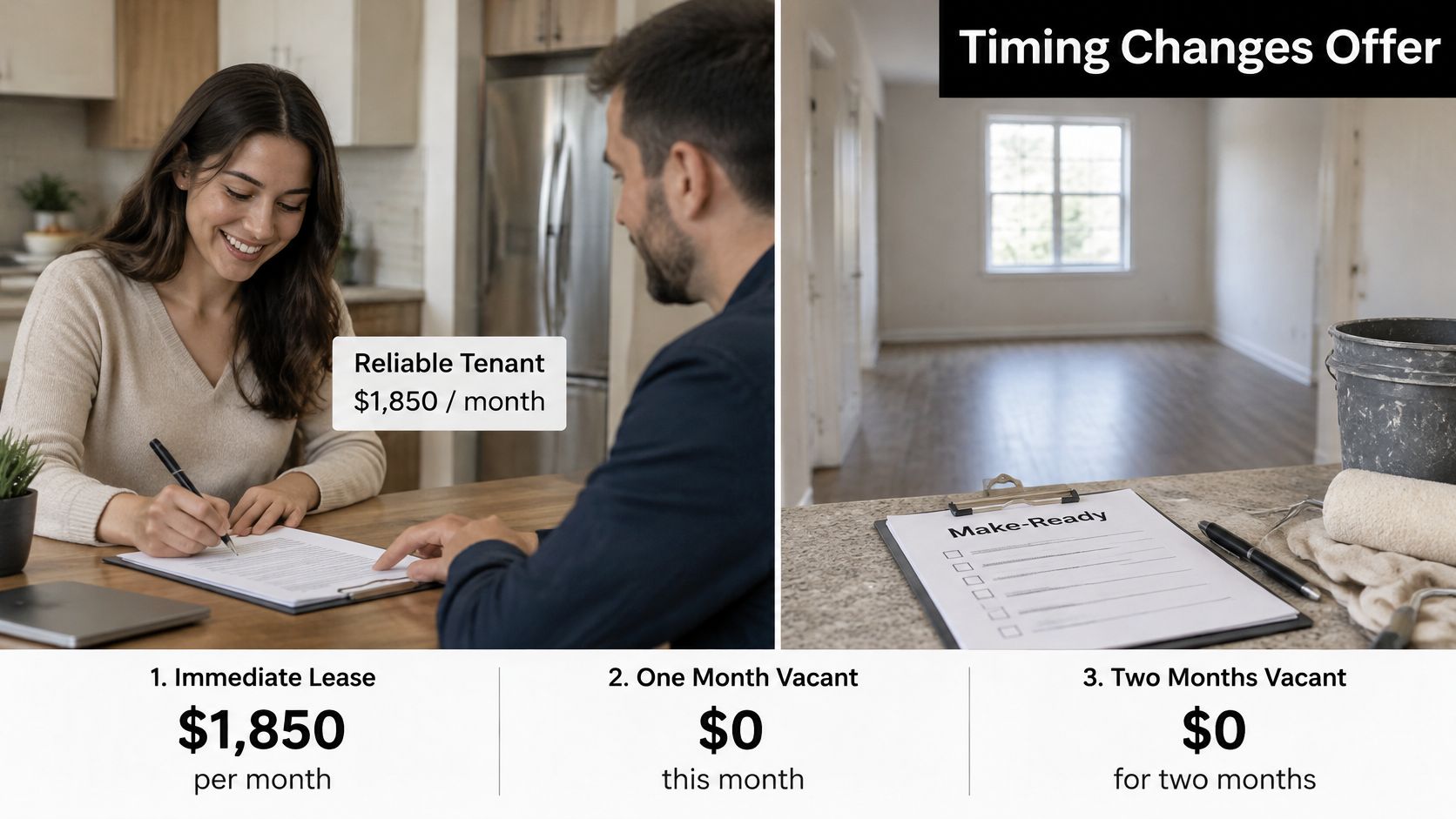
A reliable resident in an older Fresno house
Say the resident pays consistently and the house would need cleaning, paint touch-ups, and yard work before showing. Holding the hypothetical current rent produces $22,200 in annual gross rent, while the modest-increase alternative produces $22,800, before expenses.
Now assume a hypothetical 30-day vacancy at the proposed higher rent. Using the annualized convention, that costs approximately $1,923 in uncollected rent, exceeding the $1,200 annual uplift from moving directly from the current rent to the higher proposal.
With that vacancy, the higher-rent annualized comparison falls to approximately $21,477 before make-ready and other expenses. The owner keeps more gross rental income by retaining this resident at either occupied alternative.
A refreshed Clovis home below competing listings
A refreshed home with well-matched competing listings may support the higher proposal. In the hypothetical comparison, the owner collects $23,400 without a concession or approximately $22,951 with the short credit, before operating expenses.
The concession offer exceeds holding rent by approximately $751 while easing the tenant's initial payment. Whether that trade works depends on the resident's budget and the strength of the competing listings, not on whether the owner likes the headline price.
Check the same neighborhood pocket before substituting a Fresno, Clovis, or nearby Friant listing. Investors comparing locations can use resources such as Dream Destin Realty's Destin investment property for sale listings for a different market, but those properties aren't evidence of achievable Fresno renewal rent.
Keep the occupied-versus-vacant comparison in view while reviewing the offer.
Give the tenant time to respond
As a planning recommendation, start the hypothetical renewal conversation 60 to 90 days before expiration, without confusing that window with a legal notice requirement. Use a written lease renewal offer that identifies the proposed term and payment schedule.
If the tenant requests a roommate, a pet, or a hypothetical six-month term, rebuild the offer around the changed obligations and turnover timing. Don't divide the annual estimate and assume the owner's costs fall proportionately.
Edinhart Realty and Property Management offers renewal coordination, rent collection, documented tenant communication, and financial reporting for Fresno-area rental owners. Visit Edinhart Realty and Property Management to discuss your signed lease, comparable rents, and a renewal estimate that separates the tenant's payment from the owner's projected rental income.


