

When it comes to landlord insurance vs. homeowners insurance, the biggest question is simple: who lives in the house? Homeowners insurance is strictly for a home you live in yourself. Landlord insurance, on the other hand, is built to protect a property you rent out to tenants.
It’s crucial to get this right. If your policy doesn't match how the property is being used, you’re setting yourself up for a denied claim when you need it most.
The Critical Difference in Property Protection

The second you hand over the keys to a tenant, the risk profile of your property completely changes. In the eyes of an insurance company, your home has just become a business asset, and that’s the fundamental reason these two policies are so different.
A homeowners policy is designed with the understanding that you—the owner—are on-site. You’re there to handle minor maintenance, spot a small leak before it becomes a big one, and generally keep an eye on things. It bundles protection for the building itself with broad coverage for all your personal belongings inside.
A landlord policy, often called a Dwelling Fire policy (DP-3), works from a totally different assumption: someone else lives there. This introduces unique risks that a standard homeowners policy just isn't built for, like liability if a tenant gets hurt or covering your lost rental income if the place becomes unlivable after a fire.
The single most important thing to remember is this: A standard homeowners policy will almost certainly deny a claim for damage or liability that happens while a tenant is occupying your property. Relying on the wrong coverage can leave you with a massive bill and no safety net.
Let's break down exactly how these policies stack up in the real world.
Quick Comparison: Homeowners vs. Landlord Insurance
To get a clearer picture right away, this table gives you a high-level overview of the fundamental differences between a standard homeowners policy and a landlord policy.
| Coverage Area | Homeowners Policy (Owner-Occupied) | Landlord Policy (Tenant-Occupied) |
|---|---|---|
| Dwelling Protection | Covers the main structure of your home. | Covers the main structure of the rental property. |
| Personal Property | Covers your personal belongings (furniture, electronics, clothing). | Does not cover tenant's belongings. Only covers landlord-owned property used to service the rental (e.g., appliances, lawnmower). |
| Liability Coverage | Protects you if a guest is injured on your property. | Protects you if a tenant or their guest is injured on the property. |
| Loss of Use/Income | Covers your temporary living expenses if your home is uninhabitable. | Covers lost rental income if the property is uninhabitable due to a covered claim. |
As you can see, while both protect the physical structure, what they cover inside and for whom is worlds apart. This is where the details really start to matter for property investors.
Landlord vs. Homeowners Insurance: A Look Under the Hood
When you’re comparing landlord and homeowners insurance, it’s easy to get bogged down. The real difference isn't on the surface; it's in the fine print and what each policy is fundamentally designed to protect. Both cover the physical structure, sure, but their missions diverge completely based on a simple question: who lives there?
A standard homeowners policy, often called an HO-3, is built for one person: the owner who lives in the home. It’s a comprehensive package. For a deep dive, check out this a detailed explanation of homeowners insurance coverage that really breaks down the nuts and bolts. It protects the house itself, other structures on the property (like your shed or detached garage), and—critically—all of your personal belongings inside.
It also includes "loss of use" coverage. If a fire or some other disaster forces you out of your home while it's being repaired, this coverage pays for temporary living expenses, like a hotel or short-term rental. It’s a lifesaver for homeowners.
How Landlord Policies Flip the Script
A landlord insurance policy, typically a DP-3 policy, isn't about personal living; it's about protecting a business asset. It gives you robust coverage for the dwelling and other structures, just like a homeowners policy. But that's where the similarities hit a brick wall.
The biggest distinction is how personal property is handled. Landlord insurance does not cover your tenant's belongings. That’s on them, and it’s why smart landlords require tenants to have their own renters insurance. This point alone is why your old homeowners policy is useless for a rental.
A huge, and painfully common, mistake is thinking a homeowners policy will cover you if you rent out your property. If you file a claim and the insurer discovers a tenant is living there, they will almost certainly deny it. You’ll be left holding the bag for all the damages and any liability.
"Loss of Use" Becomes "Loss of Rental Income"
Instead of "loss of use," landlord policies have something far more valuable for an investor: loss of rental income coverage. If a covered event, like a fire, makes your property uninhabitable, this feature pays you the rent you would have collected while the home is being repaired. It's an absolute must-have to protect your cash flow and keep your investment from turning into a liability overnight.
Ultimately, this isn't just a simple choice—it's about making sure your insurance matches what the property is actually being used for. You can explore all the specific landlord insurance coverage options to see how to properly shield your rental business from risk.
A Detailed Comparison of Key Insurance Provisions
To really get the difference between landlord and homeowners insurance, you have to look past the surface and dig into the specific details of each policy. Sure, they both protect the physical building, but how they handle things like liability, intentional damage, and an empty property are worlds apart. These aren't just minor details—they're the very things that determine whether a claim gets paid or if you're left facing a massive financial loss.
The simplest way to think about it is this: a homeowners policy is built for personal risk, while a landlord policy is designed to cover business-related risks. As a homeowner, you're worried about your own stuff and your guests. But as a landlord, you have to account for tenants, their guests, and all the unique issues that come with a property you don't live in. That shift in perspective completely changes what's covered and what isn't.
This graphic really nails the main focus of each policy and where your protection is aimed.
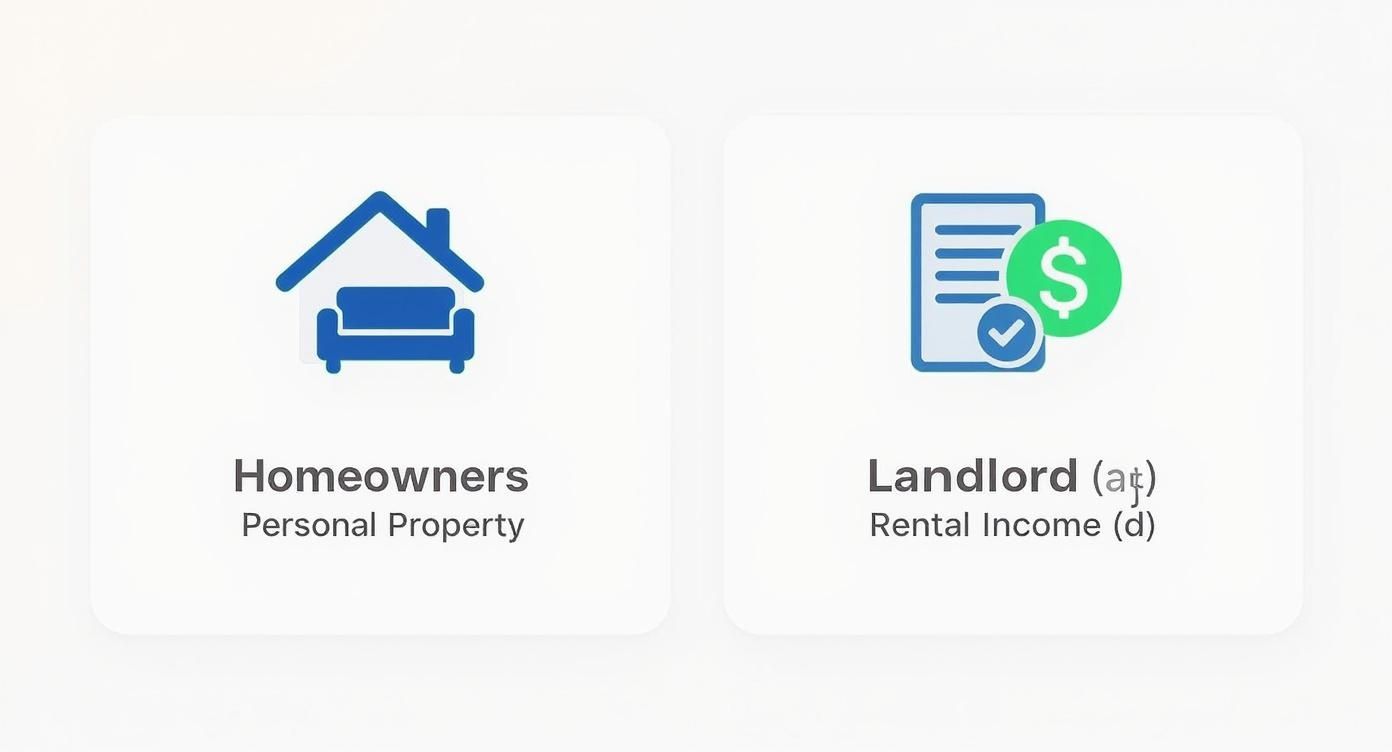
As you can see, homeowners insurance is all about protecting your personal belongings. For a landlord, the priority is protecting your rental income, which is the lifeblood of your investment.
To make this crystal clear, let's break down the key coverages side-by-side.
Coverage Breakdown Landlord vs Homeowners Insurance
| Coverage Feature | Homeowners Insurance (Owner-Occupied) | Landlord Insurance (Tenant-Occupied) |
|---|---|---|
| Dwelling Coverage | Covers the structure of the primary residence you live in. | Covers the structure of the rental property. |
| Personal Property | Covers your belongings (furniture, clothes, electronics). | Does not cover tenant's belongings. Covers landlord's property left for tenant use (e.g., appliances). |
| Liability Protection | Covers injuries to guests on your property. | Covers tenant or guest injuries due to property negligence. Typically has higher limits. |
| Loss of Use | Covers your living expenses if your home is uninhabitable after a covered loss. | Called "Loss of Rental Income." Reimburses you for lost rent while the property is being repaired. |
| Vandalism | Generally covered. | May require a specific endorsement, especially for damage caused by a tenant. |
| Vacancy Rules | Coverage may be limited if vacant for 30-60 days. | Stricter rules. Critical during tenant turnover. A vacancy endorsement is often needed. |
This table shows the fundamental shift from personal protection (homeowners) to business asset protection (landlord). Now let's explore a few of these in more detail.
Liability The Landlords Greatest Risk
Liability is, without a doubt, the biggest place these two policies go their separate ways. A homeowners policy gives you liability protection if a guest gets hurt at your house. It assumes you're living there and can keep an eye on risks like a slippery sidewalk or a wobbly handrail.
Landlord insurance, on the other hand, is built for a much bigger and more complicated liability picture. You're legally responsible for keeping the property safe for your tenants and their visitors, even when you aren't around. Because of this much higher exposure, landlord policies usually come with higher liability limits, often starting at $1 million. You can find a great breakdown that explains what landlord liability insurance covers in more detail to really grasp these expanded risks.
The legal responsibility for a tenant's injury can fall squarely on the landlord if negligence is proven. A simple slip-and-fall incident can quickly escalate into a costly lawsuit, making robust liability coverage the most critical component of any landlord policy.
Vandalism and Malicious Damage Coverage
Another major difference is how the policies handle intentional damage. A standard homeowners policy usually covers vandalism from an outsider. But if a tenant punches holes in your walls or smashes the bathroom fixtures, a homeowners policy would almost certainly deny that claim because the property isn't owner-occupied.
Landlord policies are built for exactly this kind of situation, but coverage isn't always a given. While many of the better policies (like a DP-3) include it, some basic plans might make you add a specific vandalism and malicious mischief endorsement. This add-on is absolutely essential for protecting your investment from a tenant who leaves on bad terms.
The Critical Rules of Vacancy Clauses
Both types of policies have vacancy clauses, but the consequences are way more serious for landlords. These clauses basically say that if a property is left empty for a certain amount of time, usually 30 to 60 days, some of your most important coverages—like for vandalism and theft—could be voided.
For a homeowner, this might only come up if you go on a long trip. But for a landlord, the time between tenants is a high-risk period. If your rental sits empty for more than two months and then gets vandalized, your standard policy might not pay a dime. You absolutely have to tell your insurance company about any extended vacancies and see about getting a vacancy endorsement to stay protected. This one rule alone shows why a simple homeowners policy just won't cut it for the realities of being a landlord.
Navigating Real-World Scenarios
Reading the fine print on an insurance policy is one thing. Seeing how it actually plays out in the real world is another. Let’s walk through a few common situations to make the difference between landlord insurance and homeowners insurance totally clear.
These examples really drive home why renting out your property completely changes your insurance needs. A homeowners policy is built for you living in your house—not for the business of being a landlord.
Scenario 1: The Kitchen Fire
A tenant accidentally starts a grease fire while cooking. It causes major damage to the kitchen cabinets and appliances, plus smoke damage throughout the unit. The property will be uninhabitable for two months during repairs, which means you're out $4,000 in rent.
- With Landlord Insurance: Your policy jumps in to cover the structural repairs. And, critically, the Loss of Rental Income coverage reimburses you for the $4,000 you lost while the unit was empty. Your cash flow is protected.
- With Homeowners Insurance: The claim is denied almost immediately. As soon as the insurer finds out the property is tenant-occupied, they'll point to the policy violation. You’re left paying for all the repairs and eating the lost rent yourself.
Scenario 2: The Visitor Slip and Fall
A tenant has a few friends over, and one of them trips on a loose step you’ve been meaning to fix. They break their ankle and decide to sue you for $50,000 to cover their medical bills and time off work.
- With Landlord Insurance: This is exactly what your liability coverage is for. It’s designed for this kind of incident. It will cover your legal defense costs and any settlement or judgment, right up to your policy limit.
- With Homeowners Insurance: Denied. Again. Your homeowners liability protection doesn't apply because you don't live there. You're now on the hook for the entire $50,000 lawsuit personally.
The massive liability exposure is one of the biggest risks landlords take on. A standard homeowners policy just isn’t built to handle the legal duties that come with having tenants and their guests on your property.
Scenario 3: The Vacant Property Vandalism
Your last tenant moved out, and the property has been empty for 90 days while you look for a new one. In that time, someone breaks in, steals all the copper piping, and spray-paints the walls. The damage adds up to $15,000.
- With Landlord Insurance: This gets tricky. Coverage here will depend entirely on your policy's vacancy clause. Most standard policies stop covering things like vandalism after 30-60 days of vacancy. Unless you bought a special "vacancy endorsement," your claim would probably be denied.
- With Homeowners Insurance: This policy was never valid for a rental in the first place. But even if it were, the same vacancy rules would apply, leading to a denied claim.
Scenario 4: The Short-Term Rental Mishap
You decide to list your property on a short-term rental site. A guest throws a huge, unauthorized party and causes widespread damage throughout the house.
- With Landlord or Homeowners Insurance: You can expect a denial from both. Short-term rentals are considered a commercial business activity, which falls outside the protection of both standard homeowners and long-term landlord policies. This kind of risk requires a specialized commercial or vacation rental policy.
When you're running a rental, keeping a detailed list of items you own—like appliances and fixtures—is crucial for both management and potential insurance claims. It’s worth exploring tools like rental property inventory software for landlords to make this process easier.
Why Landlord Insurance Costs More
If you've ever compared quotes for landlord insurance against a standard homeowners policy, the price difference probably jumped out at you. It’s not an arbitrary hike; insurers view a rental property as a completely different risk compared to a home you live in yourself, and that higher risk is reflected in the premium.
The simple truth is, when someone else lives in your property, the chances of a claim go up. Tenants, even great ones, just don’t have the same financial skin in the game as an owner. They're less likely to notice a slow leak under a sink until it's already caused thousands in water damage. That increased risk of delayed maintenance and accidental damage is a big reason for the higher cost.
On average, you can expect landlord insurance to cost 15% to 25% more than an equivalent homeowners policy. This added expense buys you critical business protections that are absent from a standard homeowner plan, safeguarding your investment from tenant-related risks.
The Geography of Risk
Beyond who lives in the house, where it's located plays a huge role in your premium. Insurance is a hyperlocal business. Insurers look at everything from regional weather patterns and local construction costs to state-specific landlord-tenant laws when they calculate your rate.
A property here in Fresno, for example, faces a different set of risks than one in a state with fewer natural disasters. California’s exposure to wildfires and earthquakes means insurers have to plan for catastrophic, widespread losses, which directly affects what every property owner in the state pays.
The cost differences across the U.S. really show how much location matters. For instance, Hawaii has some of the lowest rates, with landlord insurance projected around $766 a year. California is a more moderate market, with average home insurance costing around $1,405 annually, pushing typical landlord insurance up to about $1,756 per year. As you can see, geography is a fundamental piece of the insurance pricing puzzle, as you can discover more about how location impacts landlord insurance costs.
Liability: The Ultimate Cost Driver
At the end of the day, the single biggest factor driving up the cost is liability. As a landlord, you’re not just a homeowner; you’re running a business. You are legally responsible for providing a safe living environment for your tenants and their guests, and that opens you up to a much wider world of potential lawsuits.
Something as simple as a trip on an uneven sidewalk or a fall down a poorly lit staircase can easily turn into a massive lawsuit. Because the potential for these high-dollar liability claims is so much greater in a rental scenario, insurers charge more to cover that risk. That higher premium is a direct reflection of the expanded legal and financial shield a landlord policy must provide to properly protect your asset.
How to Choose the Right Insurance Policy

Trying to figure out the difference between landlord and homeowners insurance can feel like a maze, but picking the right one is actually pretty simple once you know what to focus on. It really all comes down to one thing: protecting your investment from the specific risks that come with renting out a property. A solid action plan here will save you from some serious and costly coverage gaps.
First things first, define how the property is being used. If you live in it, you need a homeowners policy. If you rent it out to someone else, you need a landlord policy. That’s the critical first step that everything else hinges on.
From there, get on the same page with your property manager. They need to know the ins and outs of your coverage, like your liability limits and exactly who to call when a claim needs to be filed. Having this sorted out ahead of time is absolutely essential for a fast, effective response when something goes wrong.
Your lease agreement is one of your best risk management tools. Always, always make it mandatory for tenants to carry their own renters insurance. It doesn't just protect their stuff—it gives them liability coverage, which makes it far less likely you'll face a claim against your policy for something they caused.
Asking Your Insurance Agent the Right Questions
Just having a policy isn't good enough; you have to understand where it falls short. When you talk to your insurance agent, show up with a list of specific questions to make sure your coverage is rock-solid. A little bit of prep now can prevent a nightmare claim denial later on.
Make sure you get clear answers to these critical questions:
- What are the exact terms of the vacancy clause? Find out precisely how many days the property can be empty before your coverage for things like vandalism or theft gets reduced or even canceled.
- Does this policy cover malicious damage caused by a tenant? Some policies actually exclude this. You might need a special endorsement to protect yourself from a nightmare renter.
- Is this a "named peril" or "open peril" policy? An open peril (often called "all-risk") policy is much broader. It covers everything except what’s specifically listed as an exclusion.
- Are there any essential endorsements I should add? Ask about extra coverage for common exclusions like water backup from sewers, building code upgrade requirements, or other specific risks.
Protecting your investment is about more than a piece of paper—it’s about securing its financial future. To see how different options compare, check out this detailed landlord insurance comparison to find the right fit for your Fresno or Clovis property.
Answering Your Top Insurance Questions
When you're trying to figure out the right insurance for your rental property, a lot of specific questions come up. Let's tackle some of the most common ones we hear from property owners just like you.
Can I Just Add a Rider for My Rental Property?
For a quick, one-off short-term rental, a rider or endorsement on your homeowner's policy might be enough. But if you have a long-term tenant, your insurer is almost certainly going to require a dedicated landlord policy. The risks are just too different—you're running a business, and that calls for business-level coverage.
How Do I Insure an Owner-Occupied Duplex?
This is a classic scenario for property investors. You'll need a standard homeowner's policy for the unit you live in, no question. For the other unit, you'll want a separate landlord policy to cover the unique risks that come with having a tenant next door.
Some insurance companies do offer a specialized policy that bundles both together. It’s absolutely critical to walk your agent through your exact living situation so you don't end up with any dangerous gaps in your coverage.
One of the biggest differences between landlord and homeowner's insurance is that a landlord policy specifically excludes coverage for your tenant's personal property—their furniture, electronics, clothes, and so on.
This is exactly why it’s a smart move to require your tenants to get their own renter's insurance. It protects their stuff, sure, but it also gives them liability coverage, which in turn reduces your own risk.
Does Landlord Insurance Cover Lost Rental Income?
Loss of rental income coverage is a cornerstone of most solid landlord policies (like a DP-3). However, it's often left out of the more basic, bare-bones policies to keep the price down. Always double-check that this protection is explicitly listed in your policy. It's the one thing that will protect your cash flow if a fire or other covered disaster makes your property unlivable.
Getting the right insurance is a crucial step in protecting your investment property. Here at Edinhart Realty and Property Management, we help owners navigate these details and manage their properties with confidence. Learn more about our services at https://edinhart.com.


