

When you start digging into landlord insurance, it can feel like a maze of jargon. But at its core, most policies are built on three fundamental protections. Think of them as the legs of a stool: property coverage for the building itself, liability coverage for accidents, and loss of rent coverage to protect your cash flow.
Getting a handle on how these three pieces fit together is the first step to making sure your investment is truly protected.
Understanding Your Core Landlord Insurance Protections
I like to think of a good landlord insurance policy as a three-layered shield. Each layer is designed to block a different kind of financial threat, and you really need all three to be secure. If you're missing one, you're leaving a pretty big gap in your defense.
This image gives you a quick visual breakdown of those three essential pillars.
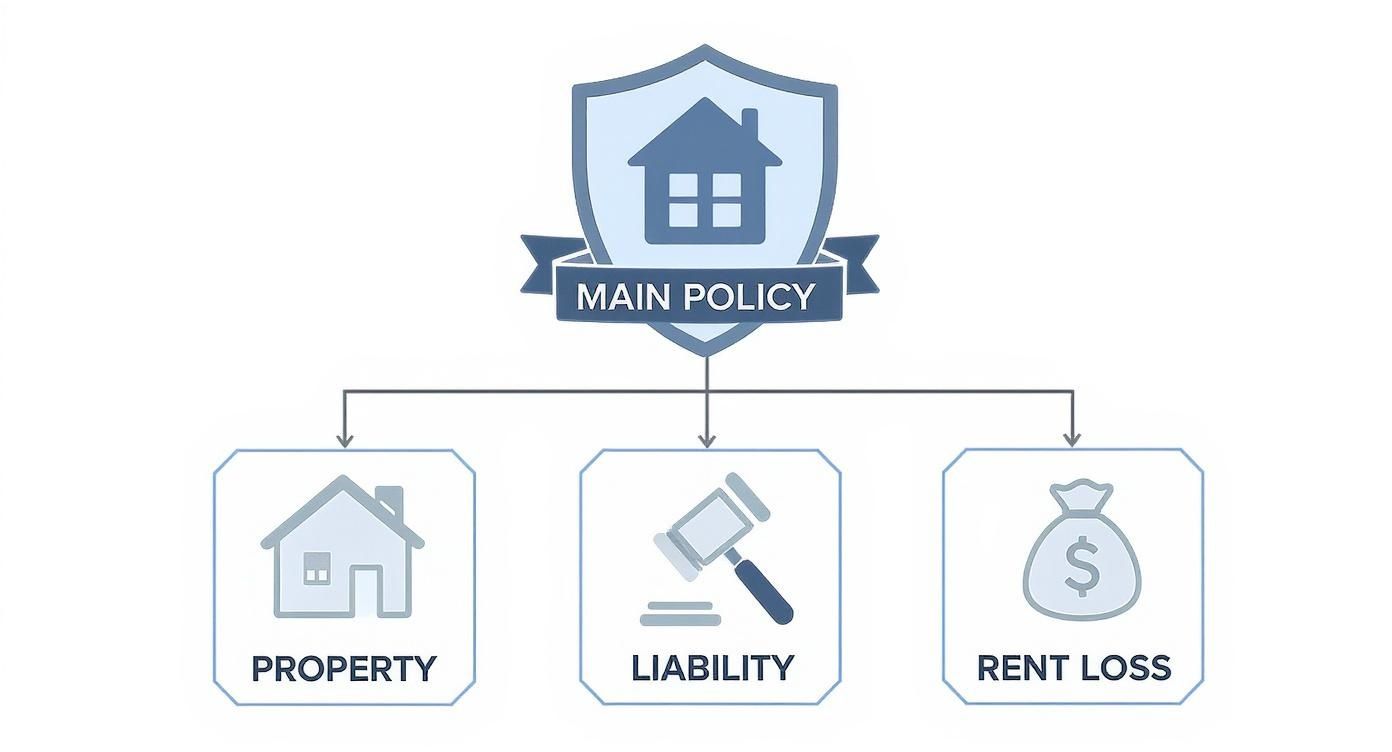
As you can see, a solid policy isn't just about the building. It’s about protecting the asset, your personal finances, and the income stream that makes it all worthwhile.
To make this even clearer, let's break down what each of these core protections does in a real-world scenario.
Your Core Landlord Insurance Protections at a Glance
This table gives a quick summary of the three fundamental types of protection you'll find in a standard landlord insurance policy.
| Coverage Type | What It Protects | Example Scenario |
|---|---|---|
| Property Coverage | The physical rental building and other structures on the property (garages, fences). | A heavy windstorm blows a tree onto your rental, damaging the roof. |
| Liability Coverage | Your personal assets from lawsuits related to injuries or property damage at your rental. | A tenant's guest slips on a wet step, breaks their ankle, and sues you for medical costs. |
| Loss of Rent | Your rental income stream if the property becomes uninhabitable due to a covered claim. | A kitchen fire makes the unit unlivable, and you lose rent for the three months it takes to repair. |
Now, let's dive a little deeper into how each one of these works for you.
Layer 1: Property Coverage for Physical Structures
This is the one everyone thinks of first. Dwelling and Other Structures Coverage is the part of your policy that pays to repair or rebuild the actual house, duplex, or apartment building if it's damaged by a covered event, or "peril."
What's typically covered? The big ones are almost always on the list:
- Fire and lightning
- Windstorms and hail
- Vandalism and malicious mischief
- Damage from a car hitting the building
Picture this: a freak hailstorm rolls through Fresno and shreds the roof of your rental property. Your property coverage is what kicks in to pay for a new roof, minus your deductible. It also covers other structures, like a detached garage or a fence, if they get damaged in the same event.
Layer 2: Liability Coverage for Legal Defense
Your second layer of protection is Landlord Liability Coverage, and honestly, it might be the most important. This is your financial bodyguard. If a tenant, their guest, or even the mail carrier gets hurt on your property and decides you’re to blame, this coverage is what stands between you and a potentially devastating lawsuit. It helps pay for their medical bills, your legal fees, and any court-ordered settlements.
Say a tenant trips on a cracked piece of sidewalk you've been meaning to fix. They could sue you for their injuries and lost wages. This is exactly what liability protection is for. We have a whole guide that goes deeper into this, which you can read here: https://edinhart.com/what-is-landlord-liability-insurance/
Liability claims are a serious risk for property owners. Jury verdicts in states like California can now exceed $1 million for certain disputes, making robust liability limits an absolute necessity for modern landlords.
Layer 3: Loss of Rent Coverage for Income Stability
The final piece of the puzzle is Loss of Rent Coverage (sometimes called Fair Rental Value). This is your business’s safety net. If a covered disaster like a fire or major water damage makes your property unlivable, you can't collect rent. But you still have to pay the mortgage, taxes, and insurance.
That’s where this coverage saves the day. It reimburses you for the rental income you lose while the property is being repaired. It keeps the cash flowing so one bad event doesn't derail your entire investment.
For landlords who see their rentals as a business (which you should!), it's also worth looking into What is a Business Owners Policy (BOP). A BOP often bundles property, liability, and business interruption (like loss of rent) into one package. But no matter how it's structured, these three pillars are the non-negotiable foundation of any good landlord policy.
Customizing Your Policy with Insurance Endorsements
A standard landlord policy is a great starting point, but it's never a one-size-fits-all deal. Think of it like a base model car—it has the essentials to get you on the road, but you add features like all-wheel drive or advanced safety sensors for specific road conditions. In the insurance world, these crucial add-ons are called endorsements or riders.
These are simply specialized amendments you can add to your policy to cover risks that are normally excluded. Choosing the right ones is a critical part of building your coverage, as it lets you strengthen your defense against threats unique to your property’s location, age, and type.

Without the right endorsements, you could face a devastating loss from something you thought was covered, only to find out it was buried in the fine print as an exclusion.
Essential Endorsements for High-Risk Perils
Certain catastrophic events are almost always excluded from standard policies because they are so geographically specific. If your property is in an area prone to these risks, adding the right endorsement isn't just a smart move—it's essential for survival.
Here in California, two endorsements are at the top of the list:
- Flood Insurance: Standard policies simply do not cover flood damage, whether it's from an overflowing river, a torrential downpour, or a storm surge. If your property sits in a designated flood zone, your lender will most likely require you to buy a separate policy, usually through the National Flood Insurance Program (NFIP).
- Earthquake Coverage: Similarly, damage from any kind of earth movement is a standard exclusion. In a seismically active state like California, this leaves a huge, gaping hole in your protection. You can close this gap by adding an earthquake endorsement or getting a separate policy from a carrier like the California Earthquake Authority (CEA).
A single earthquake or flood could wipe out your entire investment in minutes. Don't take that chance.
Vital Endorsements Landlords Often Overlook
Beyond the big natural disasters, several other crucial endorsements address common but often-forgotten risks. These add-ons can save you from massive out-of-pocket expenses that might blindside you after a claim.
Make sure you talk to your agent about these valuable additions:
- Sewer Backup Coverage: A standard policy won't touch water damage caused by a backed-up sewer line or drain. This endorsement covers the cost of cleanup, repairs, and replacing damaged property from this surprisingly common—and messy—event.
- Ordinance or Law Coverage: This is one of the most important and least understood endorsements out there. If your older rental home is damaged and needs to be rebuilt, current building codes might force you into expensive upgrades (think all-new wiring or plumbing). This coverage helps pay the extra cost to bring your property up to modern code during reconstruction.
- Vandalism Coverage: While many policies include this, the coverage can disappear if your property sits vacant for too long, typically 30 to 60 days. If you expect a longer gap between tenants, this endorsement keeps you protected against malicious damage.
Another common question from landlords is about coverage for pests like termites. While most policies exclude pest damage, knowing the potential financial hit is important. Getting familiar with understanding the cost of termite treatment can help you budget for this risk and decide if it’s worth seeking out a specialized rider, if one is even available.
Scenario Example: A fire badly damages a duplex built in the 1970s. During the rebuild, the city requires the landlord to upgrade the entire electrical system to meet 2025 codes. The base policy won't cover that expense. But with an Ordinance or Law endorsement, the insurance company steps in to help pay for those mandatory—and costly—upgrades.
How Coverage Limits and Deductibles Work
When you're buying landlord insurance, you're essentially deciding how much risk you're willing to take on versus how much you want the insurance company to handle. It’s a balancing act. The two most important dials you can turn are your coverage limits and your deductibles.
Think of your policy as a financial safety net stretched out under your rental property. The coverage limit is the size of that net—it’s the absolute maximum dollar amount the insurer will pay out if something goes wrong. Your deductible is how far you have to "fall" (pay out-of-pocket) before that net even starts to catch you.

Getting these two numbers right is the key to building a policy that actually protects you without breaking the bank.
Setting Your Property Coverage Limits
Your property coverage limit—often called the dwelling limit—needs to be enough to completely rebuild your rental property from a pile of ash. This isn't what you could sell it for tomorrow. It's the replacement cost: what it would take to hire contractors and buy materials at today's prices to build it back from the ground up.
Underinsuring your property is one of the costliest mistakes a landlord can make. If a fire levels your building and you're short on coverage, that financial gap comes straight out of your pocket.
To nail down the right limit, you need to think about:
- Local Construction Costs: What does it cost per square foot to build in the Fresno area right now? This number is always changing.
- Your Property's Details: Do you have custom cabinets, unique architectural features, or older construction that’s harder to replicate? These things add to the rebuild cost.
- Code Upgrades: As we talked about, building codes change. Your limit has to be high enough to cover rebuilding to today's much stricter standards.
Here's a pro tip: always ask for extended or guaranteed replacement cost coverage. This gives you a crucial buffer, usually an extra 20-25% on top of your limit, in case a major disaster (like a wildfire) causes local labor and material costs to skyrocket overnight.
Choosing the Right Deductible
The deductible is simply the amount of a claim you agree to pay first. Let's say a storm rips off your roof, causing $15,000 in damage. If your deductible is $2,500, you pay that first, and your insurance company covers the remaining $12,500.
It's a see-saw relationship. A higher deductible means you’re shouldering more of the initial risk, so your insurer gives you a lower premium. A lower deductible means you pay less out-of-pocket, but your annual premium will be higher.
The goal is to find your sweet spot. Pick a deductible high enough to keep your premiums reasonable but low enough that you could write a check for that amount tomorrow without causing a financial crisis.
Determining Your Liability Limit
This one is critical. Your liability limit has nothing to do with your property's value. It should be high enough to protect your entire personal net worth. A simple slip-and-fall lawsuit can easily blow past the value of your rental, putting your personal home, savings, and even future income on the line.
Most experts agree that a $1 million liability limit is the absolute minimum you should consider. If you own multiple properties or have significant personal assets, the smart move is to back that up with a separate umbrella liability policy. That’s how you build a real financial shield around yourself.
What Goes Into the Price of Your Landlord Insurance?
Ever look at two rental properties that seem almost identical and wonder why their insurance premiums are miles apart? It’s because insurers are essentially doing a deep-dive financial check on your property, and they look at way more than just square footage. They’re sifting through dozens of data points to figure out the odds of you filing a claim someday.
Getting a handle on these factors is a game-changer. When you know what insurers are looking for, you can start to see where you have some control. A few smart moves can potentially lower your annual costs and make your investment that much more profitable.
Your Property's Story
The physical facts of your rental are the starting point for your insurance premium. Insurers use these details to get a baseline read on the risk involved in covering the structure itself.
Here are the big ones they look at:
- Location, Location, Location: Is your property sitting in an area known for wildfires, floods, or high crime? Being close to known risks is a huge cost driver. A rental in a designated Very-High Fire Hazard Severity Zone in California is going to have a higher premium, no question.
- Age of the Building: Older homes, especially those with outdated plumbing, wiring, or a decades-old roof, are seen as a bigger gamble. On the flip side, installing a brand-new roof can often earn you a nice discount.
- How It's Built: A brick house is naturally more fire-resistant than a wood-frame one, and your premium will reflect that. The quality of the construction materials really matters.
The Value of Playing It Safe
Beyond the basics of the building itself, insurers love to see landlords who are proactive about safety. Think of it as earning discounts by making it less likely you'll ever need to file a claim in the first place.
Installing modern safety features can have a direct and positive effect on your premium. For instance, a property with a monitored, centralized fire and burglar alarm system is a much safer bet for an insurer. Even simple things like solid deadbolts, smoke detectors, and fire extinguishers can make a difference.
In a place like Fresno, where wildfire risk is always on the mind, showing you’re taking mitigation seriously is crucial. This means maintaining defensible space, installing fire-resistant vents, or using non-combustible siding. These aren't just good practices anymore; they’re becoming essential for finding affordable coverage.
We're seeing an interesting shift in the market. A global insurance market report from Marsh noted that while global property insurance rates actually dropped by 8% in 2025 because of more competition, casualty insurance (like liability) went up by about 3% in the U.S. This has created some favorable pockets in North America, with some property owners even seeing double-digit rate cuts and better policy terms.
How Your Policy Choices Shape the Price
At the end of the day, the landlord insurance coverage options you choose have the most direct impact on your final bill. The decisions you make when building your policy set the terms for how much financial risk the insurance company is taking on.
This really boils down to your limits and deductibles. The choices you make here are a balancing act between your monthly premium and your out-of-pocket risk.
Key Factors Influencing Your Landlord Insurance Premium
Here's a quick look at how different property details and policy decisions can push your annual premium up or down.
| Influencing Factor | Impact on Premium (Higher/Lower) | Reason |
|---|---|---|
| High-Risk Location | Higher | Greater likelihood of claims from natural disasters or crime. |
| Older Building Systems | Higher | Outdated plumbing, electrical, or roofing increases the risk of failure. |
| Wood-Frame Construction | Higher | Less resistant to fire compared to brick or masonry. |
| Monitored Security System | Lower | Reduces the risk of theft, vandalism, and fire damage. |
| Higher Coverage Limits | Higher | The insurer is taking on more potential financial responsibility. |
| Lower Deductible | Higher | You pay less out-of-pocket, so the insurer charges more upfront. |
| Frequent Claims History | Higher | Past claims suggest a higher probability of future claims. |
| Added Endorsements | Higher | Each additional coverage adds to the base premium. |
Understanding these trade-offs is key to building a policy that gives you peace of mind without breaking the bank.
Here’s how your choices play out:
- Higher Coverage Limits: If you bump up your liability limit from $500,000 to $1 million, your premium will go up. That's the price for having a much stronger financial safety net.
- Lower Deductibles: Choosing a $1,000 deductible instead of a $2,500 one feels great when you file a claim, but it means you'll pay more each year for that convenience.
- Endorsements: Every special add-on, like sewer backup or ordinance coverage, has its own price tag. They add to the total, but they also plug potentially devastating holes in your standard policy.
And don't forget your own track record. A landlord who has filed several claims in the past will be seen as a higher risk and will almost certainly face higher rates than one with a clean slate.
Navigating California and Fresno Insurance Needs
Landlord insurance isn't a one-size-fits-all product, especially in a state as unique and challenging as California. For property owners here in the Central Valley, generic advice just doesn't cut it. You need a strategy built for the realities of the Golden State, from the shaking ground beneath our feet to the ever-present threat of wildfires.
Understanding this local context is everything. It's a realization that's growing across the industry, with the landlord insurance market valued at $20.7 billion in 2023 and projected to nearly double by 2032. This boom is fueled by more rental properties and a sharper awareness of risk.
Facing California’s Unique Perils
Standard landlord policies are designed to cover the usual suspects—a fire from faulty wiring or damage from a heavy windstorm. But they almost always exclude two of California’s biggest threats: earthquakes and floods. This isn't a minor detail; it's a massive coverage gap that could lead to financial ruin.
Think of it this way: your base policy is a solid umbrella for rain, but it offers zero protection during a seismic event or a major flood. For those, you need separate, specialized gear.
- Earthquake Coverage: In a state crisscrossed with fault lines, this is non-negotiable. You’ll need to add it as an endorsement to your main policy or get a standalone policy from a provider like the California Earthquake Authority (CEA).
- Flood Insurance: Damage from overflowing rivers or severe rainstorms is another common exclusion. If your Fresno property is in a designated flood zone, a separate policy, often through the National Flood Insurance Program (NFIP), is a must.
Ignoring these exclusions is like leaving the two biggest doors to your financial house unlocked. It’s a gamble that few California landlords can afford to take.
In California, the stakes are simply higher. Jury verdicts for habitability disputes can now exceed $1 million. This, combined with high rebuild costs and unique natural disaster risks, makes robust and locally-attuned insurance an absolute necessity, not a luxury.
Hyper-Local Fresno Considerations
Zooming in on Fresno reveals another layer of complexity. Our city has beautiful, historic neighborhoods with older buildings that carry their own insurance challenges. An insurer will look at a Tower District property with original plumbing and wiring much differently than a new build out in Clovis.
On top of that, Fresno’s proximity to wildland-urban interface (WUI) zones means wildfire risk is a huge factor in both the availability and cost of insurance. Insurers use sophisticated mapping to assess this risk, and properties in high-risk zones might need coverage from specialized carriers or even the California FAIR Plan.
This is where local expertise becomes invaluable. Navigating the nuances of older homes, regional floodplains, and wildfire scores requires a deep understanding of the Central Valley landscape. Working with an expert in Fresno property management gives you a guide who can pinpoint these hyper-local risks and help you find coverage that truly protects your investment from the ground up.
Your Checklist for Choosing the Right Policy
Diving into the world of landlord insurance can feel like a lot to take on, but getting it right really just comes down to a solid, step-by-step game plan. This checklist cuts through the noise and gives you a clear path to follow.
Think of it as your final guide to locking in serious financial protection. Let's walk through the essential steps to make sure you choose a policy that truly has your back.
Evaluate Your Property and Risks
First things first, you need to know exactly what you're protecting. This isn't just about what the property might sell for; it’s a deep dive into its physical makeup and the potential risks that come with it.
Calculate Full Replacement Cost: Don't just pull the purchase price off a document. You need to know what it would actually cost to rebuild your property from scratch, using today's prices for labor and materials. A good insurance agent can help you pin this number down. Also, ask them about an extended replacement cost endorsement—it’s a great way to add an extra buffer just in case.
Assess Your Liability Needs: Your liability coverage should be big enough to protect your entire net worth, not just the value of the rental. We see $1 million as the absolute minimum starting point. If you have multiple properties or other significant assets, you should seriously consider an umbrella policy for that extra layer of protection.
Identify Location-Specific Endorsements: Your property is in Fresno, and that comes with its own set of risks. You need to figure out which add-ons are non-negotiable. For nearly every landlord in California, that means getting quotes for earthquake coverage and looking into a separate policy for flood insurance.
Compare Policies and Carriers
Once you have a clear picture of what you need, it's time to shop around. No two insurance companies or policies are the same, and looking at more than just the price tag is crucial for your long-term security.
It's wild, but pricing for the exact same coverage can vary by as much as 40% from one insurance carrier to another. Shopping around is hands-down the best way to get a good deal without skimping on what matters.
Your next move is to gather some quotes and read them carefully.
Gather at Least Three Quotes: Don't just go with the first offer you get. Contacting a few different reputable carriers gives you a much better feel for the market and some serious negotiating power. For a more streamlined process, a detailed landlord insurance comparison can show you how different providers stack up.
Review the Fine Print: This is where the details hide. Look specifically for what isn't covered in each policy. Pay close attention to any vacancy clauses—some policies can be voided if your property sits empty for too long, often just 30-60 days.
Ask About Discounts: Always ask what you can do to lower your premium. Insurers often give discounts for bundling your policies (like auto or your own home), installing security systems, having a newer roof, or taking steps to mitigate wildfire risk. California’s “Safer from Wildfires” framework actually requires many insurers to offer discounts for taking these proactive measures.
Following this checklist will give you the confidence to pick a policy that offers real peace of mind and keeps your investment safe.
Common Questions About Landlord Insurance
When you're diving into the world of landlord insurance, a few questions always seem to pop up. Getting clear, straight-to-the-point answers is the key to making a confident decision to protect your investment. Let's break down some of the most common things landlords ask about.
Is Landlord Insurance the Same as Homeowner's Insurance?
Nope, and this is probably the most important thing to get straight. A standard homeowner's policy is built for a property you live in yourself. It covers your personal stuff and liability for you as the resident.
Landlord insurance, on the other hand, is a business policy for a property you rent out. It's designed to cover risks that are specific to being a landlord, like a tenant suing you or losing rent money if the property becomes unlivable. Trying to use a homeowner’s policy for a rental is a massive gamble that could get your claim denied, leaving you holding the bag for everything.
Does My Policy Cover My Tenant's Belongings?
This is another big mix-up we see all the time. Your landlord policy covers the building itself—the walls, the roof, the fixtures—and your liability as the owner. What it does not cover is your tenant's personal property. We're talking their furniture, clothes, computers, all of it.
Imagine a pipe bursts or a fire breaks out. It could wipe out everything your tenant owns. If they don't have their own insurance, they're facing a huge financial hit, which creates a messy and stressful situation for everyone involved.
This is exactly why smart landlords require tenants to get their own renter's insurance. It protects their stuff and gives them liability coverage, which adds a valuable layer of protection for you, too.
Is Landlord Insurance Tax-Deductible?
Yes, it almost always is. Since your rental property is a business, the premiums you pay for your landlord insurance policy are usually considered a business expense. That means you can typically deduct the entire cost on your taxes.
This tax break helps take some of the sting out of the cost of good landlord insurance coverage options, making it an even smarter move for your rental business. Of course, you should always run this by your tax advisor to see exactly how it fits into your own financial picture.
Figuring all this out is a lot simpler when you have an expert in your corner. Here at Edinhart Realty & Property Management, we know the Fresno market inside and out and can make sure you have the right protections in place. To see how our experience can help safeguard your investment, check us out at https://edinhart.com.


