

If you own a rental property, landlord insurance isn't just a good idea—it's an absolute necessity. It’s a specialized form of protection designed specifically for the unique risks that come with having tenants, and it’s fundamentally different from a standard homeowner's policy. Think of it as the financial bedrock of your real estate investment.

Why Landlord Insurance Is Non-Negotiable
A typical homeowner's policy is built for a home you live in yourself. The moment you hand the keys to a tenant, the risk profile of that property changes completely. In fact, many standard homeowner's policies become void once a property is rented out, leaving you dangerously exposed. This is where landlord insurance steps in to fill those critical gaps.
It's vital to understand the distinction. An essential guide to homeowners insurance will show you how to protect a personal residence, whereas a landlord policy is engineered to protect a business asset from commercial risks.
Core Protections For Your Investment
Landlord insurance is structured to tackle the specific liabilities and potential financial hits that come with renting out a property. A solid policy is built on a few key pillars that work together to keep your investment secure.
Here’s what you can generally expect:
- Property Damage Coverage: This is the most foundational piece. It protects the physical structure of your rental from disasters like fire, lightning, windstorms, and vandalism. It also typically covers any of your personal property left on-site for tenant use, like refrigerators or washing machines.
- Liability Coverage: This is a big one. If a tenant or a visitor gets hurt on your property and you're found negligent (think a slip on an icy walkway or a fall down poorly lit stairs), liability coverage handles the legal bills and medical costs. Without it, your personal assets could be on the line in a lawsuit.
- Loss of Rental Income: What happens if a fire makes your property unlivable for a few months? This coverage reimburses you for the lost rent you would have collected during the repair period, helping you maintain consistent cash flow even when disaster strikes.
Key Insight: The minute you start renting out a property, you're running a business. Landlord insurance should be treated as a fundamental operating cost that safeguards your entire enterprise from the unexpected.
A Rapidly Growing Market
The real estate world is catching on. The global landlord insurance market was valued at an estimated $20.7 billion in 2023 and is on track to nearly double by 2032. This isn't just a random statistic; it shows a massive shift in awareness among property owners who now recognize that comprehensive coverage is essential for long-term success.
Managing these risks effectively is what separates a successful landlord from a struggling one. For investors who want to add another layer of protection and streamline their operations, exploring professional oversight like our approach to https://edinhart.com/fresno-property-management/ can offer invaluable security and peace of mind.
Comparing Core Coverage In Landlord Policies
Once you get past the basic definitions, it's time for a real-world landlord insurance comparison. When you're shopping for a policy, you’re not just buying a product; you’re investing in a financial backstop. The strength of that backstop hinges entirely on the fine print of its core features, which can differ dramatically from one insurer to the next, even when they look the same on the surface.
At the heart of any solid policy are three main components: property damage, liability protection, and loss of rental income. Getting a handle on the subtle differences between these is crucial for picking a policy that actually comes through when you need it. Let’s dig into how to compare these essentials like a seasoned pro.
Open Peril vs. Named Peril for Property Damage
Property damage coverage might seem simple, but the difference between an "open-peril" and a "named-peril" policy is massive. A named-peril policy is exactly what it sounds like: it only covers damages from events specifically listed in the policy, like fire, hail, or theft. If the cause of damage isn't on that list, you're out of luck.
On the other hand, an open-peril policy flips this on its head. It covers everything unless a cause is specifically excluded. This gives you far broader protection and is what most serious investors look for, as it shields you from those completely unexpected "what if" scenarios. When comparing policies, always demand to see the list of exclusions on an open-peril policy and see if the savings on a named-peril policy are worth the risk.
Pro Tip: An open-peril policy is almost always the better choice. With it, the burden of proof shifts. Instead of you needing to prove a disaster was covered, the insurance company has to prove it was specifically excluded.
To get a better sense of how these different coverage types stack up in a typical policy, it helps to see where the money goes.
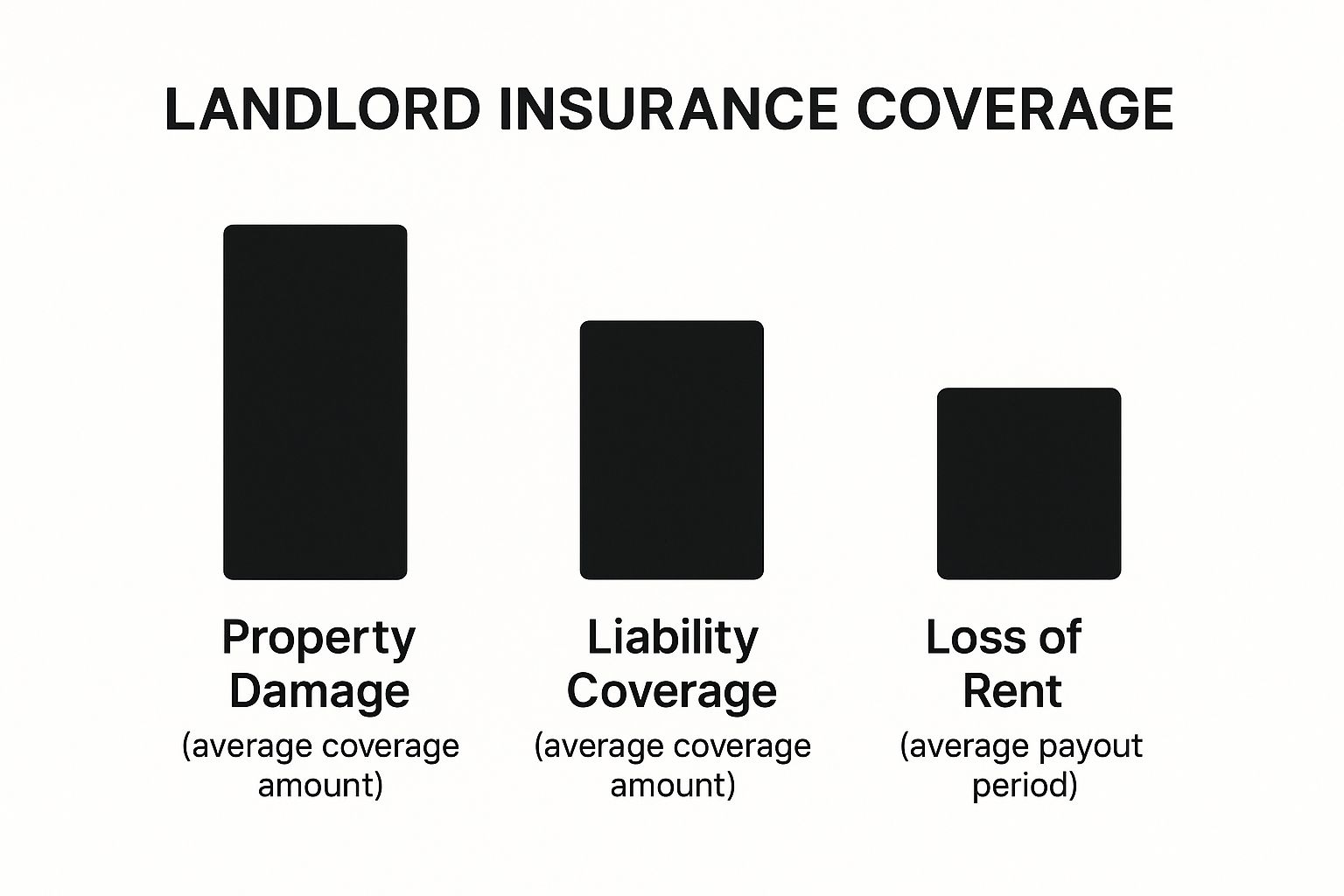
This visual really puts it into perspective. While property and liability offer huge financial safety nets, the loss of rent coverage is built to bridge shorter income gaps.
Comparing Core Landlord Insurance Coverage Features
When you're evaluating different policies, the details matter. A high coverage limit doesn't mean much if the policy is riddled with exclusions or has a slow trigger. The table below breaks down the core components to help you analyze what you're actually getting.
| Coverage Type | What It Typically Covers | Key Considerations for Comparison | Example Scenario |
|---|---|---|---|
| Property Damage | The physical structure (dwelling) and other structures (garages, fences). May include landlord-owned appliances. | Is it open-peril (all risks covered except exclusions) or named-peril (only listed risks covered)? What are the exclusions? Is it for Replacement Cost Value (RCV) or Actual Cash Value (ACV)? | A kitchen fire destroys cabinets and appliances. An RCV policy pays to replace them with new ones; an ACV policy pays their depreciated value. |
| Liability Protection | Legal and medical bills if someone is injured on your property and you're found responsible. | Look beyond the dollar amount ($500,000 vs. $1 million). Does it include coverage for wrongful eviction, wrongful entry, libel, or slander? | A tenant sues you, claiming you entered their unit without proper notice. A policy with wrongful entry coverage would cover your legal defense costs. |
| Loss of Rental Income | Reimburses you for lost rent while the property is uninhabitable due to a covered claim. | What is the trigger (e.g., a 72-hour waiting period)? What is the payout duration (e.g., 12 months, 24 months, or "actual loss sustained")? | A severe storm makes your rental unlivable for four months. This coverage pays you the $2,000/month rent you would have collected during repairs. |
Ultimately, a strong policy provides robust, clearly defined protection across all three areas. Don't let a low premium distract you from scrutinizing the payout triggers, durations, and exclusions.
The True Value of Liability Limits
Liability coverage is what stands between you and a financially devastating lawsuit. A tenant slipping on an icy patch or a guest tripping over an uneven paver can quickly escalate into a legal nightmare. But when you’re doing a landlord insurance comparison, just looking at the headline number—like $500,000 vs. $1 million—is a rookie mistake.
You have to dig deeper and see what actually triggers that coverage. A truly comprehensive policy will cover incidents that go way beyond a simple slip-and-fall, such as:
- Wrongful Eviction: Protects you if a tenant sues, claiming their eviction was unlawful.
- Wrongful Entry: Covers claims if you or a contractor enters the unit without giving proper notice.
- Personal Injury: This can include things like libel or slander if a heated dispute with a tenant gets out of hand.
A cheaper policy might dangle a high liability limit but quietly exclude these common landlord-specific risks, leaving you dangerously exposed.
Loss of Rental Income: Triggers and Payout Duration
Finally, let's talk about loss of rental income coverage. This is the feature that keeps your cash flow alive while your property is unlivable after a covered incident. When comparing policies, there are two critical factors to zero in on: the claim trigger and the payout duration.
Some policies won't start paying out until after a waiting period, such as 72 hours, has passed. Others might cap the payout period at 12 months, which might sound like a long time but often isn't enough for a major rebuild after a fire. A superior policy will have a shorter (or no) waiting period and a longer payout duration—sometimes 24 months or even for the "actual loss sustained"—making sure your income is protected for however long the repairs realistically take.
Choosing Optional Coverage That Makes Sense

Once you've got the basic protections squared away, it’s time to look at the optional coverages, or endorsements. This is where you can really tailor a policy to fit your specific rental property. These add-ons are designed to cover the unique risks that a standard policy just doesn't account for.
When you're comparing landlord insurance policies, the key is to weigh these options carefully. You don't want to overpay for coverage you'll never use, but you also don't want to leave a gaping hole in your protection because you skipped a small, inexpensive endorsement. The trick is to find that sweet spot.
Comparing High-Value Optional Endorsements
Let's break down some of the most common and valuable add-ons I see landlords consider. Each one solves a very specific problem, so its worth really depends on your property and your tenants.
Rent Guarantee Insurance: Don't mix this up with Loss of Rental Income. Rent Guarantee steps in when your tenant simply stops paying rent, even if there's no physical damage to the property. Think about it—in areas where the eviction process drags on for months, this coverage can be a financial lifesaver.
Malicious Tenant Damage: Most standard policies will not cover damage a tenant does on purpose. We’ve all heard the horror stories of a tenant punching holes in walls or deliberately flooding a bathroom on their way out. This endorsement covers those intentional acts. Without it, that repair bill is coming directly out of your pocket.
Building Ordinance Coverage: This is a big one for anyone with an older property. Let's say a fire damages your kitchen. When you go to rebuild, you find out the city now requires you to upgrade all the wiring and plumbing to meet new codes. A standard policy covers replacing what you had; Building Ordinance coverage pays for the extra cost of those mandatory, and often expensive, upgrades.
Key Takeaway: Optional coverages aren't a one-size-fits-all deal. You have to look at your local eviction laws, the age of your property, and how solid your tenant screening is. That's how you decide which add-ons are actually a smart investment for your situation.
Flood and Earthquake Insurance: A Situational Necessity
Here’s a critical point many new landlords miss: standard policies almost never cover damage from floods or earthquakes. That's a universal exclusion. If your rental is in a flood plain or an area prone to seismic activity, getting a separate, specialized policy isn’t just a good idea—it’s absolutely essential. One major event could financially ruin you otherwise.
When you compare quotes for these policies, pay close attention to the deductibles. They work differently and are usually much higher than on a standard policy. For example, earthquake insurance might carry a deductible of 10% to 20% of your property's total insured value, not just the cost of the damage. This makes a detailed landlord insurance comparison even more vital for these high-stakes risks. At the end of the day, building the right policy is all about balancing the premium cost against the real-world risks your investment faces.
Understanding What Drives Your Insurance Costs
When you start comparing landlord insurance quotes, the numbers can feel a bit random at first. But there's a method to the madness. Insurers rely on a predictable set of risk factors to figure out your premium. Once you understand what they're looking at, it not only explains the quote but also gives you a clear path to potentially lowering it.
Your property’s location is, without a doubt, the single biggest driver of your cost. A rental in a high-crime urban neighborhood or a coastal home sitting in a hurricane zone is always going to be more expensive to insure than a quiet suburban property in a low-risk area. Insurers have mountains of data tied to ZIP codes, tracking everything from local theft rates to severe weather patterns to predict the likelihood of a claim.
Key Factors That Shape Your Premium
Beyond just where your property is, a handful of other details come into play. The age and construction of your building get a close look; an older home with dated wiring or plumbing is seen as a higher risk for fire or water damage. It’s the same logic with construction materials—a classic wood-frame house will cost more to insure than one built with brick or masonry.
Other critical factors include:
- Number of Rental Units: It’s simple math for an insurer. A fourplex has four times the potential for a liability claim compared to a single-family home, so the premium will be higher.
- Your Claims History: If you’ve filed several claims in the past few years, you'll be flagged as a higher-risk client. Unfortunately, that means you'll be charged more.
- Amenities: Fun features for tenants can be a headache for insurers. Things like swimming pools, trampolines, or even a fancy playset dramatically increase your liability exposure and, you guessed it, your insurance premium.
Proven Tactics For Reducing Your Premium
The good news is you're not powerless here. You have more control over your premium than you might realize. By taking a few proactive steps, you can often bring down your costs quite a bit without having to gut your coverage.
For example, a simple move like raising your deductible from $1,000 to $2,500 can make a real dent in your annual premium. You're basically telling the insurer you're willing to cover a larger chunk of a small claim, which lowers their immediate risk. Another easy win is bundling. If you combine your landlord policy with your own home or auto insurance, you can often score multi-policy discounts of 10% or more.
Strategic Insight: At its core, insurance is all about risk management. Every step you take to make your property safer—from installing a modern security system to keeping a clean claims record—is a signal to insurers that you're a responsible owner. That translates directly into them seeing you as a lower risk, which often means lower premiums.
Of course, your insurance premium is just one piece of your overall property expenses. You might want to delve into the costs of home security systems to weigh the upfront investment against potential long-term savings. And remember, staying compliant with local rules is non-negotiable; our guide on landlord-tenant law in California offers essential information for anyone renting property in that state.
Luckily, market trends can sometimes work in your favor. Recent reports from early 2025 have shown that global insurance markets are either stable or seeing slight price declines. This could mean more competition among providers, which is great news for landlords shopping for a better deal. It suggests now is a very good time to get multiple quotes and see what's out there.
How Top Landlord Insurance Providers Stack Up
Picking a landlord insurance provider is about so much more than just snagging the lowest premium. A real comparison goes deeper, looking at the things that truly matter when a crisis hits your rental property. I'm talking about their financial stability, how they handle claims, and whether you can actually build a policy that fits your specific rental.
When it comes to protecting a valuable asset, not all insurers are the same.
The best companies stand out by actually delivering on their promises. You can see this in their financial strength ratings from agencies like AM Best, which basically tells you if they have the cash on hand to pay out claims. You can also look at customer satisfaction scores from sources like J.D. Power, which reveals how they treat people when things go sideways.
What to Look For: Key Performance Metrics
When you start comparing the top-tier providers, you'll notice a few patterns. Some are fantastic with digital convenience, offering sleek online dashboards for managing your policy or filing a claim. Others set themselves apart with incredible customer service, connecting you with agents who genuinely know their stuff and can walk you through complex coverage decisions.
Let's break down how to compare them using some practical metrics:
- Financial Stability (AM Best Rating): Don't even consider a provider with less than an "A" rating. This is your green light, signaling the company has the financial muscle to handle your claim, even if a major disaster affects a lot of properties at once.
- Claims Satisfaction (J.D. Power Score): A high score here is a good sign you can expect a smooth and fair claims process. A low score? That’s a huge red flag. It often means you're in for a world of frustration right when you need support the most.
- Policy Customization: The best insurers let you add on specific protections, or endorsements. Think coverage for malicious damage by a tenant or protection against new building codes after a loss. This flexibility is what allows you to create a policy that truly protects your investment.
- Digital Tools: For a busy landlord, being able to manage your policy, pay your bill, or file a claim from your phone or laptop is a massive advantage.
This focus on performance is a global trend. The landlord insurance market in Europe, for instance, is expected to reach nearly $27.77 billion by 2028. Over there, providers are increasingly competing on service quality and financial reliability, not just price. It’s a good lesson for us here.
Finding the Right Insurer for You
Honestly, the "best" provider really depends on your situation. A landlord with one single-family home has completely different needs than an investor juggling a portfolio of properties.
My Takeaway: Choosing an insurer isn't just about the policy—it's about finding the right partner. Your ideal company should align with your management style. Are you a hands-on owner who loves good digital tools, or are you an investor who wants top-notch service and an expert to call during a claim?
Scenario 1: The Multi-Property Investor
If you own several properties, your priorities are efficiency and savings. A provider with a powerful online portal that lets you manage all your policies in one place is a game-changer. You should also be on the lookout for insurers that offer substantial multi-policy discounts and maybe even a single, simplified bill for everything.
Scenario 2: The First-Time Landlord
New to the landlord game? You'll want an insurer with excellent educational resources and agents who are patient and responsive. A company that takes the time to clearly explain what each coverage option means is worth its weight in gold. This is where strong customer service ratings are absolutely critical. Local expertise matters, too. For example, our experience with Fresno property management has taught us just how much localized knowledge can protect an investment from regional risks.
At the end of the day, a proper landlord insurance comparison isn't about ticking boxes on a generic checklist. It's about matching a provider's strengths—whether that’s their tech, their service, or their custom options—to your unique needs as a property owner.
Common Questions About Comparing Policies

Even after you've spent hours comparing landlord insurance policies, a few nagging questions always seem to pop up. Let's tackle some of the most common uncertainties landlords face so you can make that final decision with confidence.
Think of this as the final once-over before you sign on the dotted line. You want to be sure you've covered all your bases.
How Much Landlord Insurance Coverage Do I Actually Need?
There’s no magic number here; the right amount of coverage comes down to your specific property. A solid rule of thumb is to make sure your dwelling coverage is enough to cover the full cost of rebuilding your property from scratch. Don't base it on the market value, which can be much lower or higher than actual construction costs.
When it comes to liability, I've always advised clients to aim for at least $1 million in coverage. That might sound like a lot, but a single, serious lawsuit can easily wipe out your personal assets if you're underinsured. An umbrella policy is often a surprisingly affordable way to get that extra layer of protection.
Is Landlord Insurance a Tax-Deductible Expense?
Yes, almost always. The premiums for your landlord insurance are typically considered a standard business expense for your rental property. That means you can generally deduct the cost from your rental income, which helps take some of the sting out of the price.
Of course, tax laws are notoriously complicated and can change. You should always run this by a qualified tax professional who can advise you on your specific financial situation. It's the only way to be certain you're staying compliant.
Expert Insight: Start thinking of your rental property as a true business. Deducting insurance premiums is a fundamental business practice, and it helps create a clear financial line between your personal life and your investment—a separation that’s critical for both tax and liability reasons.
What Is the Claims Process Like and How Can I Improve My Chances of Approval?
The claims process itself is pretty standard across the industry. You'll start by documenting the damage, then you’ll formally file the claim with your provider. From there, an adjuster will be assigned to come out and assess the loss.
The secret to a smooth process and getting your claim approved? It all comes down to preparation.
- Document Everything Beforehand: Don't wait for a disaster. Keep a detailed inventory of your property, complete with photos and videos, in its normal condition. This gives you a clear "before" picture.
- Provide Overwhelming Evidence: After an incident, go into overdrive with your camera. Take photos and videos of the damage from every angle. Collect police reports for theft or vandalism, and keep every receipt for emergency repairs.
- Keep Meticulous Records: Log every single interaction with your insurance company. Note the date, time, and the name of the person you spoke with. This paper trail is invaluable if disputes arise.
Simply put, a well-documented claim is hard to deny. Your job is to present a mountain of clear, organized proof that leaves no room for interpretation. It’s the fastest way to get from filing to payout.
At Edinhart Realty and Property Management, we believe a well-protected property is the cornerstone of any successful real estate investment. With our deep expertise in the Central California market, we help landlords manage risks and grow their returns. See how our professional services can offer you peace of mind by visiting us at https://edinhart.com.


