

Building lasting wealth through real estate is more accessible than ever, but navigating the market requires a clear plan. The right approach depends entirely on your available capital, risk tolerance, and long-term financial goals. Whether you're aiming for steady passive income through rentals or seeking quicker profits from flipping properties, understanding the diverse investment strategies in real estate is the critical first step toward building a successful and resilient portfolio.
This guide is designed to be your comprehensive roadmap. We will break down ten of the most effective and popular methods for generating returns from property. You will gain actionable insights into everything from the classic buy-and-hold approach to the more modern avenues of crowdfunding and real estate syndications. For a comprehensive look at various approaches you can take, explore this guide on 9 key types of real estate investing to broaden your perspective.
We’ll move beyond the basics to explore the specific mechanics, potential returns, and crucial risks associated with each strategy. Our goal is to equip you with the practical knowledge needed to confidently select and implement the investment path that aligns perfectly with your personal and financial objectives. This is your blueprint for making informed, strategic real estate decisions in 2025 and beyond.
1. Buy and Hold Strategy
The buy and hold strategy is a cornerstone of real estate investing, favored for its potential to build long-term wealth. This approach involves purchasing a property and retaining it for an extended period, typically five years or more. The core goal is twofold: generating consistent monthly income through rent and benefiting from the property's appreciation in value over time.
This method is one of the most foundational investment strategies in real estate because it allows market forces like inflation and appreciation to work in your favor. As tenants pay rent, they effectively cover your mortgage payments, building your equity in the asset. The strategy thrives in stable or growing markets with strong rental demand and is less about quick profits and more about patient, steady growth.
How to Implement This Strategy
Successful execution requires careful market analysis and financial planning. Focus on areas with positive job and population growth, as these indicators often precede rising rental demand and property values.
- Financial Planning: Use the "1% rule" as a preliminary filter. This guideline suggests the gross monthly rent should be at least 1% of the property's purchase price. Also, maintain cash reserves equivalent to 3-6 months of operating expenses to cover unexpected vacancies or repairs.
- Property Management: For investors managing multiple properties or those seeking a more passive role, professional property management is key. For instance, a firm like Edinhart Realty in Fresno can handle everything from rigorous tenant screening to ongoing maintenance, optimizing returns while minimizing your direct involvement. If you're considering this path, you can learn more about investment homes and management services.
- Market Monitoring: Regularly review local rental comps to ensure your rates are competitive, adjusting as needed to maximize cash flow without discouraging reliable tenants.
The infographic below summarizes the key pillars that make this strategy a powerful wealth-building tool.
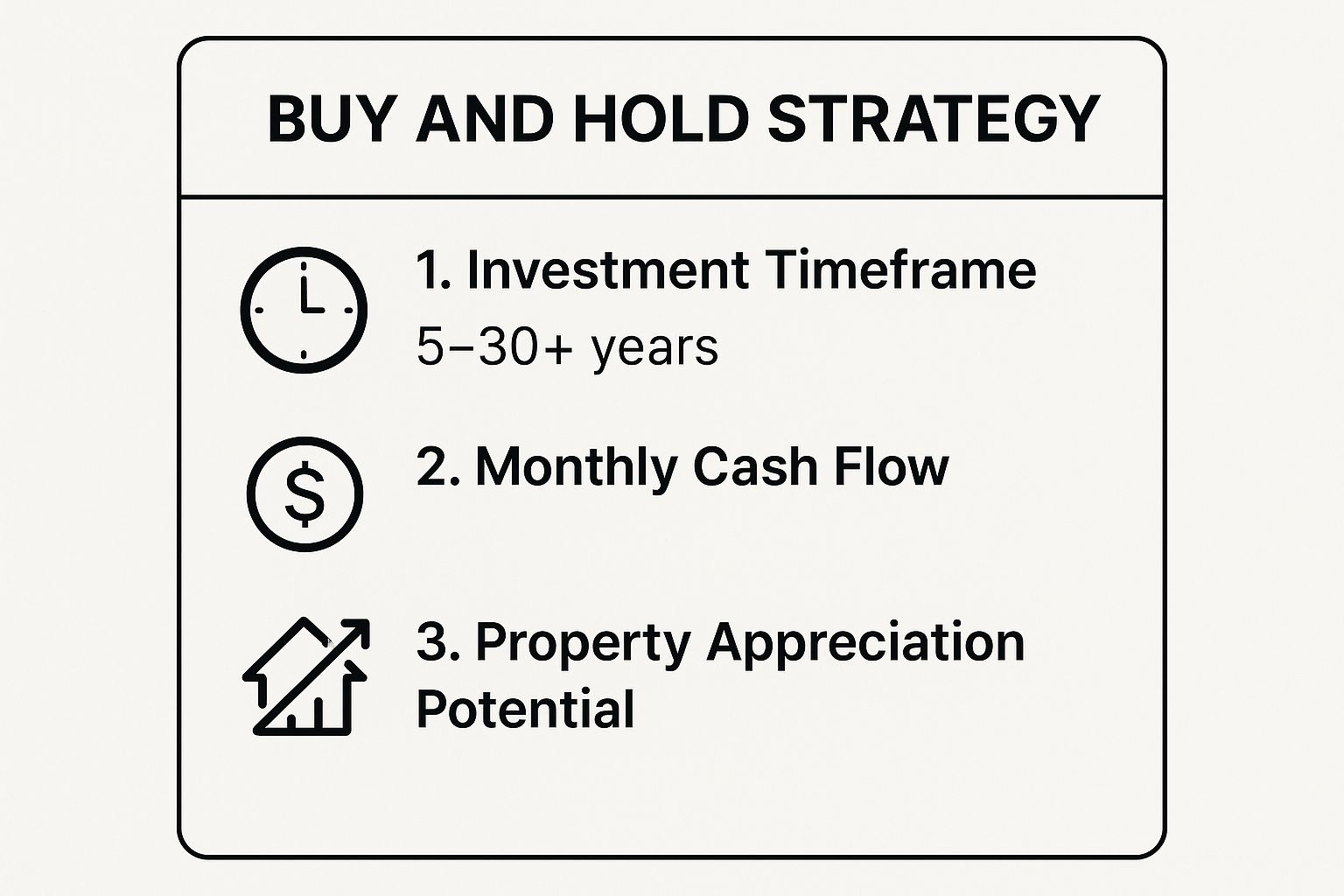
As visualized, the strategy's strength lies in combining a long-term hold period with the dual financial benefits of immediate cash flow and future appreciation.
2. Fix and Flip Strategy
The fix and flip strategy is a more active, short-term approach to real estate investing, focused on generating quick profits. This method involves purchasing a property, typically one that is distressed or undervalued, renovating it to increase its market value, and then selling it for a profit, usually within 6 to 12 months.

Unlike buy and hold, which builds wealth over time, flipping is about capital gains in the near term. It's one of the most popular investment strategies in real estate for those with construction knowledge or strong project management skills. Success hinges on accurately estimating repair costs, managing renovations efficiently, and understanding local market dynamics to ensure a profitable resale. This strategy was popularized by TV shows like HGTV's Flip or Flop and requires a hands-on approach.
How to Implement This Strategy
A successful flip requires meticulous planning, a reliable team, and strict budget adherence. The goal is to maximize the property's After Repair Value (ARV) while keeping costs low.
- Financial Discipline: Adhere to the "70% rule," which advises against paying more than 70% of the ARV, minus the estimated repair costs. This creates a built-in profit margin. For example, if a home's ARV is $300,000 and it needs $40,000 in repairs, your maximum purchase price should be $170,000 ($300,000 x 0.70 – $40,000).
- Team Building: Develop a network of reliable contractors, real estate agents, and lenders. Get multiple bids for every major job and always have a contingency fund of 15-20% of your total renovation budget to cover unexpected issues.
- Market Analysis: Focus on properties in stable or appreciating neighborhoods where there is strong buyer demand. Understanding what renovations yield the best return on investment in your specific market is crucial. You can learn more about how to get started buying homes to flip.
The video below offers a detailed look into the financial aspects of a real-world fix and flip project.
As the video illustrates, a successful flip is a numbers game that demands careful calculation and risk management from start to finish.
3. Real Estate Investment Trusts (REITs)
Real Estate Investment Trusts (REITs) offer a powerful way to invest in a portfolio of income-producing real estate without the complexities of direct property ownership. These entities own, operate, or finance real estate across various sectors, and investors can buy shares in them just like stocks. By law, REITs must distribute at least 90% of their taxable income to shareholders as dividends, making them an attractive option for income-focused investors.
This approach is one of the most accessible investment strategies in real estate, providing liquidity and diversification that is difficult to achieve with physical properties. Instead of buying a single building, you can own a piece of a vast portfolio, such as shopping malls managed by Simon Property Group (SPG) or apartment communities from Equity Residential (EQR). This strategy allows you to benefit from the real estate market with a much lower barrier to entry.
How to Implement This Strategy
Successfully investing in REITs requires due diligence similar to stock analysis, but with a focus on real estate-specific metrics. Your goal is to select REITs that align with your risk tolerance and investment objectives.
- Analyze Key Metrics: Instead of standard earnings, evaluate a REIT’s Funds From Operations (FFO), a measure of cash flow generated by its properties. A consistent and growing FFO often indicates a healthy, well-managed trust.
- Diversify Your Holdings: Don't concentrate on a single sector. Spread your investment across different types of REITs, such as residential, industrial (like Prologis, PLD), commercial, and even specialized areas like cell towers (American Tower, AMT), to mitigate sector-specific risks.
- Monitor Economic Factors: REIT performance, particularly for mortgage REITs, is sensitive to interest rate fluctuations. Stay informed about macroeconomic trends, as rising rates can increase borrowing costs and potentially impact profitability and dividend payouts.
4. Wholesaling Real Estate
Wholesaling is one of the more fast-paced investment strategies in real estate, ideal for those looking to generate profits without significant capital. This approach involves finding a distressed or undervalued property and getting it under contract with a motivated seller. Instead of purchasing the property, the wholesaler then assigns or "sells" the contract to another buyer, typically a real estate investor or flipper, for a higher price. The difference is the wholesaler's profit.
This strategy is fundamentally about deal-making and building a strong network. Wholesalers act as intermediaries, connecting sellers who need a quick, hassle-free sale with investors looking for their next project. The primary appeal is the low barrier to entry, as it doesn't require purchasing and holding an asset. Success hinges on the ability to find good deals and build a reliable list of cash buyers ready to close quickly.
How to Implement This Strategy
Effective wholesaling requires a systematic approach to finding leads and closing deals. It's less about property renovation and more about marketing, negotiation, and legal precision.
- Build a Buyer's List: Before you even look for properties, cultivate a robust list of cash buyers. These are often fix-and-flip investors and landlords who are actively seeking deals. Network at local real estate meetups and use online platforms to find serious investors.
- Find Motivated Sellers: Focus your marketing efforts on finding homeowners in situations that require a quick sale, such as pre-foreclosure, divorce, or inheriting an unwanted property. Direct mail, driving for dollars, and online ads are common lead generation tactics.
- Understand the Contracts: Ensure your purchase agreements contain an "and/or assigns" clause, which legally allows you to assign the contract to another party. It's crucial to understand local laws regarding contract assignments and to have a real estate attorney review your paperwork to protect your interests.
5. Real Estate Syndications
Real estate syndications offer a pathway for investors to access large-scale commercial properties that would typically be out of reach for an individual. This strategy involves pooling capital from multiple investors to acquire assets like apartment complexes or industrial warehouses. A sponsor, or general partner, manages the entire process from acquisition to disposition, while you act as a passive investor, or limited partner.
This approach is one of the most powerful investment strategies in real estate for those seeking passive income without the responsibilities of direct property management. Investors receive a share of the cash flow and profits upon sale, proportionate to their initial investment. It is an ideal method for diversifying a portfolio and leveraging the expertise of seasoned real estate professionals to access institutional-grade deals.
How to Implement This Strategy
Successfully investing in syndications hinges on rigorous due diligence, particularly regarding the sponsor managing the deal. Focus on sponsors with a proven track record of successful projects in your target asset class, such as apartment syndications in growing Sunbelt markets.
- Sponsor Vetting: Thoroughly investigate the sponsor’s history, experience, and past performance. A reputable sponsor will have a transparent track record and be willing to provide detailed financials and case studies from previous deals.
- Deal Analysis: Carefully review the private placement memorandum (PPM), which outlines the property’s financials, market analysis, business plan, and projected returns. Understand the proposed exit strategy, timeline, and fee structure before committing capital.
- Investor Requirements: Be aware that many syndications are open only to accredited investors. It is also crucial to maintain liquidity reserves, as these are long-term, illiquid investments. Diversifying across multiple sponsors and deals can help mitigate risk.
6. Buy, Rehab, Rent, Refinance, Repeat (BRRRR)
The BRRRR method is a powerful real estate investment strategy that combines active renovation with long-term rental income. It involves purchasing a distressed property, renovating it to increase its value, leasing it to a tenant, and then completing a cash-out refinance based on the new, higher appraisal. The capital pulled out is then used to acquire the next investment property, creating a repeatable cycle of portfolio growth.
This strategy is highly regarded among investment strategies in real estate because it allows an investor to build a portfolio with a minimal initial investment, potentially recovering all of the original capital to reinvest. Popularized by real estate communities like BiggerPockets, the BRRRR method effectively forces appreciation through strategic improvements rather than waiting for market forces. It’s an ideal approach for investors who are comfortable with hands-on project management and want to scale their holdings aggressively.
How to Implement This Strategy
Executing the BRRRR method requires a sharp eye for deals, accurate renovation estimates, and solid relationships with lenders. The success of each cycle hinges on the after-repair value (ARV) being high enough to recoup your initial investment and renovation costs during the refinance stage.
- Financial Analysis: Before purchasing, you must calculate the ARV. A common guideline is the 70% rule, where you should not pay more than 70% of the ARV minus the estimated repair costs. This creates a sufficient equity cushion.
- Lender Relationships: Cultivate relationships with portfolio lenders or local banks that are familiar with the BRRRR strategy. These lenders are often more flexible than traditional banks and understand the cash-out refinance process on newly renovated rental properties.
- Project Management: Maintain a detailed budget and a strict timeline for the rehabilitation phase. Focus on renovations that provide the highest return on investment, such as updated kitchens and bathrooms, to maximize the property's appraised value.
- Rental Market Knowledge: Ensure the property is located in an area with strong rental demand. Your ability to quickly place a reliable tenant is critical for securing the cash-out refinance and initiating cash flow.
7. Short-Term Rental Strategy (Airbnb)
The short-term rental (STR) strategy has surged in popularity, offering a high-yield alternative to traditional long-term leasing. This approach involves furnishing a property and renting it out for short periods, from a single night to a few weeks, primarily through platforms like Airbnb and VRBO. The primary goal is to maximize revenue by capitalizing on higher nightly rates common in tourist destinations and business hubs.
This method stands out among investment strategies in real estate for its potential to generate significantly higher cash flow compared to a standard rental. By catering to travelers, vacationers, or corporate clients, investors can often charge more per night, turning properties in desirable locations like a Florida beach town or a Colorado ski area into powerful income-generating assets. Success hinges on hospitality, dynamic pricing, and navigating a complex regulatory landscape.

How to Implement This Strategy
Executing an STR strategy requires a hands-on approach that blends real estate investment with hospitality management. From furnishing to guest communication, attention to detail is paramount for achieving five-star reviews and consistent bookings.
- Regulatory Compliance: Before purchasing, thoroughly investigate local zoning laws, HOA restrictions, and permitting requirements for short-term rentals. Many cities have strict rules, and understanding these regulations, including California's landlord-tenant laws, is the first step to avoiding legal issues.
- Guest Experience: Invest in quality furnishings, professional photography, and desirable amenities like high-speed Wi-Fi and smart locks. A positive guest experience directly translates to better reviews and higher occupancy rates.
- Operational Systems: Create streamlined processes for cleaning, restocking supplies, and guest communication. For those new to this model, learning how to become an Airbnb host can provide a roadmap for setting up these essential systems for success.
- Dynamic Pricing: Use tools like PriceLabs or AirDNA to analyze market data and adjust your nightly rates based on seasonality, local events, and demand. This ensures you are maximizing revenue potential throughout the year.
8. Commercial Real Estate Investment
Commercial real estate investment is a sophisticated strategy focused on properties designed for business purposes, such as office buildings, retail centers, industrial warehouses, and large apartment complexes (5+ units). This approach targets assets that generate income through leases with commercial tenants, often offering higher potential returns and longer lease terms compared to residential properties.
This method stands out among investment strategies in real estate due to its scale and complexity. Success hinges on a deep understanding of economic trends, as commercial property performance is directly tied to business cycles and local employment growth. Investors like Sam Zell and Donald Bren built empires by mastering this space, leveraging long-term leases and tenant credit quality to create stable, high-yield portfolios.
How to Implement This Strategy
Executing a commercial real estate investment requires significant capital, due diligence, and specialized knowledge. The focus is less on emotional appeal and more on cold, hard numbers like net operating income (NOI) and capitalization rates.
- Market and Tenant Analysis: Prioritize properties with strong, creditworthy tenants locked into long-term leases. A strip mall with a national grocery chain as an anchor tenant, for example, offers more stability than one with only small, local businesses. Carefully analyze rent rolls and lease expiration schedules to forecast future income stability.
- Due Diligence: Commercial properties demand rigorous inspections beyond the standard home check. This includes environmental site assessments, structural engineering reports, and zoning compliance verification. Overlooking these details can lead to costly surprises post-acquisition.
- Financing and Networking: Build relationships with commercial brokers and lenders who specialize in this asset class. Unlike residential loans, commercial financing is heavily based on the property's income-generating potential, not just the borrower's personal credit.
9. Real Estate Crowdfunding
Real estate crowdfunding democratizes property investment by allowing multiple investors to pool their capital through online platforms. This modern approach, enabled by regulations like the JOBS Act, breaks down the high financial barriers typically associated with real estate, making it possible to invest in large-scale commercial or residential projects with a relatively small amount of money.
This strategy is one of the most innovative investment strategies in real estate because it provides access to previously inaccessible deals, such as office buildings, multi-family complexes, or development projects. Instead of purchasing an entire property, you buy a share of it. Platforms like Fundrise or RealtyMogul vet the opportunities, handle the legal paperwork, and manage the assets, offering a passive investment experience.
How to Implement This Strategy
Success in crowdfunding hinges on due diligence and portfolio diversification. While platforms simplify the process, understanding the underlying investment is crucial for managing risk and maximizing returns.
- Platform Due Diligence: Thoroughly vet any crowdfunding platform before investing. Examine its track record, transparency, fee structure, and regulatory compliance. Each platform has a different focus; for instance, CrowdStreet often features syndicated commercial deals, while Yieldstreet may offer alternative debt or equity investments.
- Diversification: Do not concentrate all your capital in a single project or on one platform. Spread your investments across different property types (e.g., residential, commercial, industrial), geographic locations, and investment structures (e.g., debt, equity) to mitigate risk.
- Understand Liquidity and Risk: Crowdfunding investments are typically illiquid, meaning your money may be tied up for several years with limited options for early withdrawal. Carefully read all offering documents to understand the investment timeline, potential risks, and the terms for exiting the investment.
10. Land Banking and Development
Land banking and development is a long-term investment strategy centered on acquiring undeveloped or underdeveloped land in the direct path of future growth. This speculative approach involves holding the land until increased demand, often driven by urban expansion or new infrastructure projects, significantly raises its value. The end goal is to sell the land to developers for a substantial profit or develop the property yourself.
This method stands out among investment strategies in real estate because it offers the potential for exceptional returns, famously utilized by figures like Walt Disney when he assembled the land for Disney World. The strategy banks on foresight and patience, positioning an investor to capitalize on the predictable patterns of metropolitan expansion. It requires a deep understanding of market trends, zoning laws, and municipal growth plans.
How to Implement This Strategy
Successful land banking requires extensive due diligence and a long-term financial commitment, as the land typically generates no income while you hold it. The key is to identify and acquire parcels before their potential is widely recognized.
- Research and Due Diligence: Thoroughly investigate municipal general plans, zoning regulations, and proposed infrastructure projects like new highways or public transit lines. For example, purchasing farmland on the outskirts of a rapidly growing city like Austin or Phoenix could yield significant returns as the city expands.
- Manage Carrying Costs: This is not a passive investment. You must budget for ongoing expenses, including property taxes, insurance, and potential maintenance. These carrying costs are a critical factor in determining your overall profitability.
- Build Local Connections: Establish relationships with local city planners, developers, and real estate professionals. These connections can provide invaluable insights into future development trends and potential buyers when you are ready to sell.
Top 10 Real Estate Investment Strategies Comparison
| Strategy | Implementation Complexity 🔄 | Resource Requirements ⚡ | Expected Outcomes 📊 | Ideal Use Cases 💡 | Key Advantages ⭐ |
|---|---|---|---|---|---|
| Buy and Hold Strategy | Moderate 🔄 | High ⚡ | Steady cash flow + long-term appreciation 📊 | Long-term investors seeking passive income 💡 | Passive income, tax benefits, inflation hedge ⭐ |
| Fix and Flip Strategy | High 🔄 | Moderate to High ⚡ | Quick profit via resale 📊 | Investors with renovation skills and short timelines 💡 | High short-term returns, fast liquidity ⭐ |
| Real Estate Investment Trusts (REITs) | Low 🔄 | Low ⚡ | Dividend income + liquidity 📊 | Investors wanting exposure without property management 💡 | High liquidity, diversification, professional mgmt ⭐ |
| Wholesaling Real Estate | Low to Moderate 🔄 | Very Low ⚡ | Quick fees from transactions 📊 | Individuals skilled in negotiation and marketing 💡 | Low capital, fast profits, scalable ⭐ |
| Real Estate Syndications | High 🔄 | High ⚡ | Passive income + potential strong returns 📊 | Accredited investors seeking large commercial deals 💡 | Access to institutional assets, passive income ⭐ |
| BRRRR (Buy, Rehab, Rent, Refinance, Repeat) | High 🔄 | Moderate initially, scaling ⚡ | Portfolio growth + passive income 📊 | Investors combining rehab and rental strategies 💡 | Scalable, forced appreciation, tax benefits ⭐ |
| Short-Term Rental Strategy (Airbnb) | Moderate 🔄 | Moderate to High ⚡ | Higher rental income, seasonal fluctuations 📊 | Owners near tourist/business hubs preferring flexibility 💡 | Higher income potential, personal use flexibility ⭐ |
| Commercial Real Estate Investment | Very High 🔄 | Very High ⚡ | Stable cash flow + higher returns 📊 | Experienced investors targeting larger income properties 💡 | Higher returns, stable leases, economies of scale ⭐ |
| Real Estate Crowdfunding | Low 🔄 | Low ⚡ | Diversified passive returns 📊 | Small investors seeking easy access to real estate 💡 | Low minimums, passive, diversified portfolio ⭐ |
| Land Banking and Development | High 🔄 | Varies, can be high ⚡ | Long-term appreciation, speculative 📊 | Patient investors betting on future growth areas 💡 | Massive upside potential, low maintenance ⭐ |
Choosing Your Path to Real Estate Success
The journey into real estate investing is not a one-size-fits-all endeavor. As we've explored, the landscape is rich with diverse investment strategies in real estate, each offering a unique pathway to financial growth. From the hands-on, high-reward nature of the fix-and-flip model to the accessible, passive income stream of REITs, your ideal approach hinges on a clear understanding of your personal financial situation, risk appetite, and time commitment.
The key takeaway is that there is no single "best" strategy, only the one that is best for you. The BRRRR method demands significant effort and financial savvy but can rapidly scale a portfolio. In contrast, real estate crowdfunding opens doors to large-scale commercial projects with minimal capital and zero management headaches. Your first step is an honest self-assessment.
Synthesizing Your Strategy for Maximum Impact
Successful investors rarely stick to a single method. Instead, they build a resilient and diversified portfolio by strategically blending different approaches. This powerful technique, known as strategy stacking, allows you to balance your assets for optimal performance.
Consider these powerful combinations:
- Active and Passive Blend: Use the cash flow from a stable buy-and-hold portfolio to fund higher-risk, higher-reward fix-and-flip projects. This creates a self-sustaining investment engine.
- Liquidity and Growth Mix: Invest in liquid assets like REITs to provide a financial safety net, while simultaneously participating in less liquid but high-appreciation opportunities like real estate syndications or land development.
- Local and Digital Balance: Ground your portfolio with tangible local assets, like a short-term rental, while diversifying geographically and across asset types through real estate crowdfunding platforms.
By thoughtfully combining these methods, you mitigate risk and capitalize on different market conditions, creating a robust framework for long-term wealth creation.
Your Actionable Next Steps
Knowledge is only potential power; action is what builds empires. To move from reader to investor, you must translate these concepts into concrete steps. Start by mastering one strategy that aligns with your current resources. Deepen your education, network with seasoned professionals, and analyze potential deals in your target market.
Remember, the most critical element in any real estate venture is accurate market analysis and diligent management. The difference between a profitable investment and a costly mistake often comes down to local expertise and on-the-ground execution. Whether you're analyzing a potential rental in Central California or preparing a property for the market, having a trusted partner is invaluable. The world of real estate investing offers immense opportunity, and with the right strategy and support, you can build a future of lasting financial freedom.
Ready to turn your knowledge into action? Navigating the complexities of Central California's market requires a partner with deep local expertise. Contact Edinhart Realty and Property Management today to discover how our full-service solutions can help you identify, acquire, and manage profitable investment properties. Let us help you build your real estate portfolio with confidence.


