

Setting the right rent is part art, part science. You're trying to find that perfect balance between maximizing your profit and keeping your property attractive to great tenants. It really boils down to three core things: knowing your numbers, understanding the local market, and honestly valuing what your specific property offers.
Nail these three, and you'll land on that sweet spot that boosts your income and keeps vacancy rates low.
The Blueprint for Profitable Rent Pricing
Guesswork is your worst enemy in the rental game. Just picking a number out of thin air and hoping it works can lead to two very expensive problems. Price it too high, and you're stuck with an empty unit, bleeding money every day it sits vacant. Price it too low, and you're leaving cash on the table month after month.
A smart, calculated approach is the only way to make sure your property is a genuine asset, not a financial drain. This guide is your roadmap to ditching the guesswork and making decisions based on solid data. Setting the right rent is about more than just covering the mortgage—it's about building a profitable, long-term business.
Why a Strategic Approach Matters
A carefully researched rent price does so much more than just get a lease signed. It lays the groundwork for a good relationship with your tenants and protects the financial health of your investment for years to come.
The benefits are pretty clear:
- You Attract Better Tenants: A fair market price brings in a bigger, more qualified pool of applicants who see the value in what you're offering.
- You Minimize Vacancy Loss: A competitively priced unit simply rents faster. Data shows that even a couple of weeks of vacancy can completely erase the profit you’d make from a slight rent increase over an entire year.
- You Maximize Your Return: Every dollar counts. A precise price ensures you're getting the full market value your property is worth.
- You Reduce Tenant Turnover: When tenants feel they're paying a fair price, they're much more likely to stick around and renew their lease. That saves you a ton of money and headaches on turnover costs.
The goal isn't just to find any tenant; it's to find the right tenant at the right price. Your pricing strategy is your single most powerful tool for making that happen.
We've put together a simple table to summarize the core ideas we'll be diving into. Think of these as the essential pillars holding up your entire rental business.
The Three Pillars of Setting Your Rent Price
| Pillar | Key Action | Goal |
|---|---|---|
| Your Bottom Line | Calculate all property-related expenses and add your desired profit margin. | Ensure every lease is profitable and covers all costs. |
| Market Analysis | Research what similar, nearby properties are renting for right now. | Price your unit competitively to attract tenants quickly. |
| Property & Amenity Value | Adjust your price up or down based on your unit's unique features. | Capture the full value of upgrades, location, and perks. |
Ultimately, learning how to set your rent effectively is about taking firm control of your investment. It requires a methodical look at your costs, a clear-eyed analysis of the market, and an honest assessment of what makes your property stand out. For a deeper dive into the fundamentals, this expert [guide to accurately determine rental rates](https://join.globalvacationrentals.com/blog/how-to-determine-rental-rate/) is a fantastic resource.
This approach transforms pricing from a stressful guessing game into a repeatable, profitable process you can count on.
Getting to Your True Property Costs
Before you even think about profit, you need to know exactly what it costs to keep the lights on. The single biggest mistake I see landlords make is guessing their expenses. It's a surefire way to turn a promising investment into a financial headache. A smart, profitable rent price is built on a rock-solid understanding of every single dollar it takes to own and run your property.
Most new landlords just add up the mortgage, taxes, and insurance—the classic PITI. While that’s the biggest chunk, it's nowhere near the full story. It’s the hidden costs that silently chip away at your returns if you don’t plan for them.
This whole process has a logical flow, and it all starts with getting your costs straight.
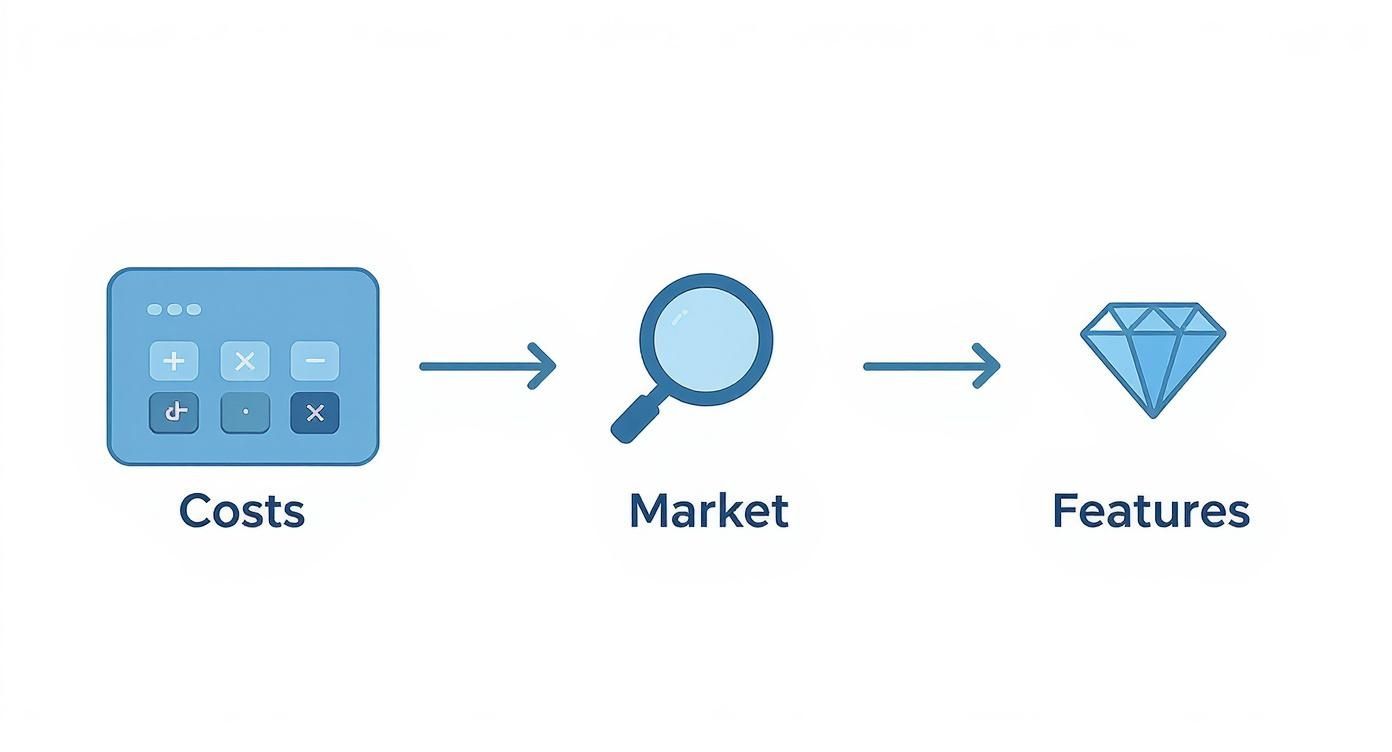
As you can see, you can't accurately compare your property to others or decide what to charge for its unique features until you’ve nailed down your cost analysis first.
Tallying Up Your Operating Expenses
To find your monthly baseline, you have to list out all the recurring costs. These are the predictable bills you'll pay every month, whether you have a tenant or not.
Let's break them down:
- Mortgage (PITI): This is your main payment covering the loan, property taxes, and homeowner's insurance.
- HOA Dues: If your property is in a homeowners association, these monthly or quarterly fees are a fixed cost you can't forget.
- Property Management Fees: Bringing in a pro? Expect to pay 8-12% of the monthly rent.
- Routine Maintenance: Think predictable services like landscaping, pest control, or maybe pool cleaning.
- Utilities: If you plan on covering water, trash, or anything else for the tenant, that cost goes on your side of the ledger.
Add those up, and you've got your basic operating cost. But here’s where seasoned investors separate themselves from the rookies: planning for the big-ticket items that don't hit every month.
Budgeting for Vacancy and Capital Expenditures
Smart investors know that things break and tenants eventually move out. You have to build these future costs into your monthly numbers now. This creates a "sinking fund" so a broken water heater doesn't become a five-alarm financial fire.
- Vacancy Fund: A good rule of thumb is to set aside 5-8% of the monthly rent to cover the time between tenants. Your property won't be occupied 100% of the time, so plan for it.
- Capital Expenditures (CapEx): This is the big stuff. We're talking about major replacements like a new roof ($10,000), an HVAC system ($7,000), or a water heater ($1,500). Budgeting 1-2% of the property’s value annually is a standard, safe practice.
By setting aside money for CapEx and vacancy each month, you transform unpredictable, massive expenses into manageable, planned-for costs. This financial discipline is the difference between a thriving investment and one that's constantly on the brink of a cash-flow crisis.
Once all your expenses are on paper, you can finally set a profit target. A detailed guide on rental property cash flow analysis can help you organize these numbers to get a clearer picture. To really dial in your potential earnings, it's worth plugging your numbers into a good ROI calculator. This ensures the rent you set not only covers every cost but also gives you the return you're looking for.
Mastering Your Local Rental Market Analysis
Alright, you've got your costs figured out. Now for the real fun: diving into the local market. While it’s good to know what’s happening nationally, rent is a hyperlocal game. What matters is what’s happening on your block, not across the country.
A sharp, street-level analysis is the only way to know what renters are actually paying for a place like yours, right now. This isn't about plucking a number out of the air. It’s a fact-finding mission to pinpoint your property’s sweet spot, attract great tenants fast, and keep those vacancy days to a minimum.
Identifying Your True Comparables
Finding the right "comps" (comparable properties) is more art than science, but you have to start with the data. It's about more than just matching the bedroom count—you need to get granular to make a true apples-to-apples comparison. Fire up a listing site like Zillow or Apartments.com and start filtering.
Get laser-focused on these details:
- Proximity: In a dense city, you might only look within a half-mile radius. In the suburbs, you can stretch that to a few miles, but keep it as tight as possible.
- Property Type: A single-family home rents differently than a condo. Stick to your property type.
- Size and Layout: Match the bed/bath count and square footage. A 3-bed, 2-bath ranch doesn’t compete with a 3-bed, 2-bath two-story home.
- Age and Condition: A brand-new build with stainless steel appliances will always get more than a 1970s original. Be brutally honest about where your property falls on this spectrum.
Looking Beyond the List Price
Here’s a pro tip: don’t get fixated on the list price. That’s just what a landlord wants to get. The real gold is in the rented price. Look for listings that were recently snapped up or are marked as "Rented." That’s your proof of what the market will bear.
A listing that’s been sitting on the market for over 30 days is a huge red flag. It’s almost always overpriced. The properties that rent in a week or two? That’s where the smart money is.
The rental market can swing wildly from one city to the next. In places like New York or Boston, a one-bedroom can easily top $3,000, while in West Virginia, you might see averages under $1,100. This is exactly why your local data is king. Nationally, a 17% jump in rental inventory has pushed the vacancy rate to 6.6%. If your area is flooded with options, you’ll need to be even more competitive on price to avoid sitting empty.
Once you’ve gathered a solid list of 3-5 strong comps, you’ll have a realistic price range. For an even clearer picture, a tool like our Fair Market Rent calculator can be a huge help. It crunches the local numbers to give you a data-backed starting point for your property’s earning potential.
Pricing Your Property’s Unique Features and Amenities
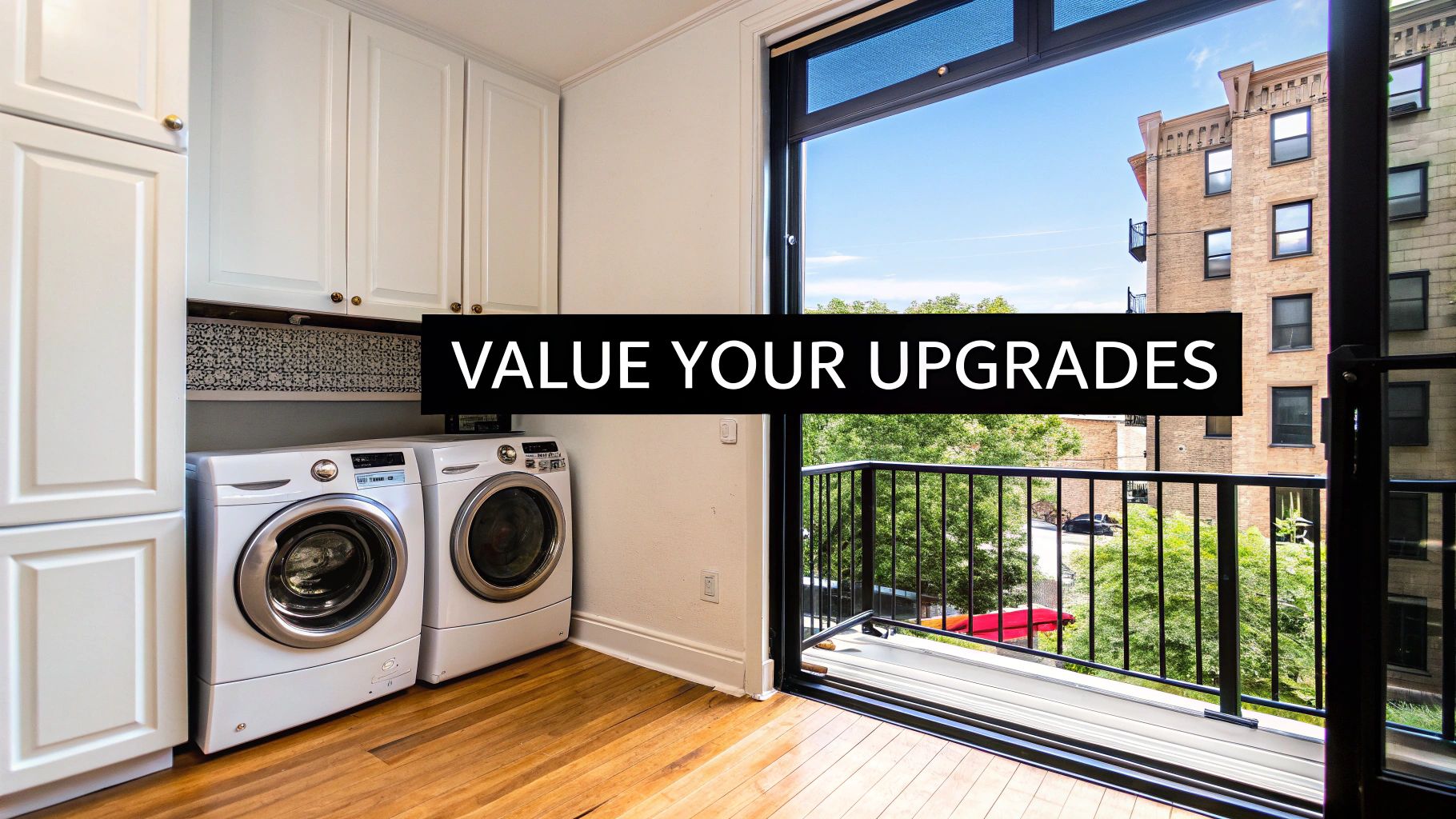
Once you’ve got a solid handle on the local market, it’s time to turn the focus inward and look at what makes your property special. Let's be real—two apartments on the same block, even with the same number of beds and baths, are almost never worth the exact same rent.
It’s the little details and unique perks that let you confidently ask for a premium. This is where you graduate from a general market rate to your specific, optimized rent price. You need to put a real dollar value on the things that make your unit stand out.
Putting a Price Tag on Your Upgrades
Start by walking through your property and making a list of everything that sets it apart from the basic units you found during your market research. Think like a renter. What feature would make their life easier, more convenient, or just plain better?
Here’s how you can start to quantify those features:
- In-Unit Washer/Dryer: This is a game-changer for most tenants. It’s a huge convenience that can easily justify an extra $50-$100 per month.
- Renovated Kitchen: Depending on how high-end the renovation is, shiny new appliances and modern countertops could easily add $75-$150 (or more) to your monthly rent.
- Private Outdoor Space: A balcony, patio, or a little fenced-in yard is pure gold. This is a high-demand feature that often warrants a $50-$125 premium.
- Dedicated Parking: In any urban or crowded area, a guaranteed parking spot is a massive selling point. A covered or garage spot can be worth $100-$200+ a month.
Pro Tip: These numbers aren't just pulled out of thin air. Go back to your market comps. Find a similar unit without a balcony and another one with one. That price gap between them? That’s the real-world market value of that specific amenity.
To give you a better idea, here’s a quick reference table for what different amenities could be worth.
Sample Rent Adjustment Values
| Amenity or Feature | Potential Monthly Rent Increase |
|---|---|
| In-Unit Laundry | $50 – $100 |
| Balcony or Patio | $50 – $125 |
| Dedicated Parking Space | $75 – $200+ |
| Garage Parking | $150 – $300+ |
| Modern Kitchen Appliances | $75 – $150 |
| Hardwood Floors | $50 – $100 |
| Walk-in Closet | $25 – $75 |
| Central Air Conditioning | $50 – $150 |
| Pet-Friendly Policy | $25 – $75 (plus pet rent/deposit) |
Remember, these are just estimates. The actual value will always depend on your specific location and what local renters are willing to pay.
Don’t Forget the Intangibles
Some of your property's best assets aren't things you can touch. These "intangible" benefits are a huge part of a tenant's decision-making process and absolutely need to be factored into your rent price.
Broader market forces also play a role here. For example, recent data shows that sustained demand in the U.S. single-family rental market pushed rent prices up 3.1% year-over-year in May 2025. What's more, higher-end properties saw an even bigger jump of 3.8%, proving that tenants are willing to pay a premium for quality. If you want to dig deeper into these trends, you can explore the full findings on rental market trends at Cotality.com.
Consider the value of these less obvious—but highly desirable—features:
- A Killer View: Does your unit look out over a park, the city skyline, or the water instead of a brick wall? That view is easily worth a $50+ premium.
- Top-Rated School District: For family-sized homes, being zoned for a great school can add hundreds of dollars to the monthly rent. It’s a massive draw for parents.
- Walkability: Being just a short walk from public transit, coffee shops, grocery stores, and restaurants is a lifestyle upgrade that justifies a higher rent.
By systematically adding up the value of both your tangible upgrades and your intangible perks, you can build on your base market price with confidence. This isn't just guesswork; it's a strategic way to make sure you’re capturing the full income potential of your property.
Staying on the Right Side of Local Rent and Landlord Laws
You can do all the math and market research in the world, but it all falls apart if your rent price isn't legal. This isn't just a friendly suggestion—navigating the maze of landlord-tenant laws is absolutely critical to protecting your investment and staying in business.
Get this part wrong, and you could be looking at some serious fines, expensive legal fights, or even losing your right to collect rent altogether.
Every part of your pricing strategy has to fit within the rules set by your state, county, and even your city. These local ordinances can control everything from your rent cap to how you handle a tenant's security deposit. Knowing the local playbook is a non-negotiable part of setting the right rent price.
Getting a Handle on Rent Control and Stabilization
The biggest legal hurdle you might face is rent control or rent stabilization. If your property is in an area with these laws, they put a firm ceiling on how much you can raise the rent each year. It’s their way of keeping housing affordable for tenants.
For example, your city might say you can only increase rent by a certain percentage tied to inflation, or maybe it’s just a flat rate like 3%. Trying to push past that cap is illegal and will land you in hot water. The first thing you should do is check your local housing authority’s website to see if your property falls under these rules.
Key Legal Areas You Can't Ignore
Beyond rent control, there are a few other financial rules that you have to be crystal clear on.
- Security Deposits: Most states limit how much you can collect for a security deposit. It’s often tied to the monthly rent, like a maximum of two months' worth. You also have to follow strict rules about keeping that money in a separate account and returning it on time when a tenant moves out.
- Late Fees: You can't just pull a late fee out of thin air. The law often defines what’s "reasonable," capping it at a small percentage of the rent (say, 5%) and usually requires you to give a grace period before you can even charge it.
- Notice for Rent Increases: You have to give your tenants a formal written notice before a rent increase kicks in. Depending on where you are and how much you're raising the rent, that notice period could be anywhere from 30 to 90 days.
I've seen it happen: a landlord's eviction case gets tossed out by a judge simply because they didn't give the proper 60-day notice for a rent change. Don't let a small paperwork mistake derail a big issue.
Staying informed isn't something you do once. Laws are always changing. Make it a regular habit to touch base with a local real estate attorney or join a landlord association. It's the best way to make sure your rental business is not just profitable, but built to last on a solid, legal foundation.
Testing and Finalizing Your Ideal Rent Price
You’ve already done the heavy lifting—running the numbers, calculating your costs, and digging into the local market. Now for the moment of truth. It's time to put your price out there and see how renters actually respond. This is where the rubber meets the road in setting your rent.
I always advise landlords to start with a price that's a touch ambitious, but still firmly planted in the reality of your research. This gives you a little breathing room. If you need to nudge it down, you can, but you haven't left money on the table right out of the gate. Your mission is to find that sweet spot, and trust me, the first two weeks your listing is live will tell you everything you need to know.
Reading the Market Signals
Once you hit "publish," you need to become a hawk, watching a few key metrics like a close game. These numbers are the market giving you direct, unfiltered feedback on your price. It’s a conversation—if nobody’s talking back, you’re probably not saying the right thing.
Here’s exactly what I watch for in the first 14 days:
- Inquiries: How many calls, emails, or messages are hitting your inbox? A nice, steady trickle is a great sign.
- Showing Requests: This is where things get serious. Are qualified people actually asking to come see the place?
- Applications: The ultimate thumbs-up. This is someone saying, "I want it." How many are you getting?
If you hear nothing but crickets after a week or so, your price is almost certainly too high for what the market will bear right now. On the flip side, if your phone is blowing up and you’re buried under dozens of applications from perfect tenants within the first 48 hours, you probably underpriced it. It’s a great problem to have, but it means you could be earning more.
The market is brutally honest. It doesn't care what you think your property is worth. The feedback you get in those first two weeks—or the lack of it—is the most accurate pricing tool you have.
This feedback loop is absolutely critical, especially when the market is in flux. For example, recent data shows that while U.S. apartment rent growth has slowed to just 0.9% year-over-year, the story is wildly different from city to city. San Francisco is seeing strong gains at +5.1%, while a market like Austin is actually seeing rents decline by -4.3%.
You can see more details on these nuanced market conditions on Costar.com. It just goes to show that a price that flies in one city could be a total dud in another, which is why testing it on your local market is non-negotiable.
By listening to these real-world signals, you can confidently lock in a final price that gets a great tenant in the door quickly. It turns pricing from a stressful guessing game into a smart, data-driven decision. To really dial in your numbers, plug your potential rent into our rental property ROI calculator and see exactly how different price points will affect your bottom line.
Have Lingering Questions About Setting Your Rent?
Even with a solid game plan, a few specific questions always seem to surface right when you're about to finalize a rent price. Let's tackle some of the most common ones I hear from landlords so you can move forward with total confidence.
How Often Should I Re-evaluate My Rent Price?
You should absolutely be running a fresh market analysis at least 60-90 days before any lease is set to expire. This isn't just a suggestion; it's a crucial part of smart management.
This window gives you plenty of time to see what's happening with local market rates and decide if an increase makes sense. More importantly, it ensures you can give your tenant the proper legal notice, which keeps everything professional, transparent, and above board.
Is It Better to Price High and Negotiate Down?
I get this question a lot, but in my experience, pricing competitively right out of the gate is almost always the winning strategy. When you overprice a unit, you risk scaring off excellent, qualified tenants before they even bother to send an inquiry.
Those extra weeks or even months of vacancy can quickly eat up any small gain you might have made from a slightly higher rent.
Think of a fair market price as a magnet. It pulls in a much larger pool of serious applicants, and it does it faster. This not only cuts down on costly vacancy days but also gives you a better selection of tenants to choose from.
Can I Charge Different Rents for Similar Units?
Yes, you can—as long as you have a legitimate business reason for the difference and it has absolutely nothing to do with discrimination. You can and should charge more for a unit that offers tangible benefits over another.
Just be ready to explain why one unit costs more than another based on real, physical differences. For example:
- A unit with a great view of the park versus one looking out over the parking lot.
- A recently renovated apartment with brand-new appliances and finishes.
- A more desirable location, like a top-floor corner unit compared to a ground-floor one.
- Premium features like a private balcony, in-unit laundry, or extra storage space.
Documenting these specific features for each unit ensures your pricing is not only fair but also legally defensible. It's the professional way to capture the unique value each property in your portfolio brings to the table.
Figuring out the sweet spot for rent and managing all the details can feel like a full-time job. At Edinhart Realty and Property Management, we lean on our deep-rooted knowledge of the local market to make sure your property is priced to maximize your return and keep vacancies to a minimum. See how our expert services can take the stress out of your investment by visiting us at https://edinhart.com.


