

When you inherit a house, you’re suddenly juggling grief with a whole new set of responsibilities. It can feel completely overwhelming. The path to eventually selling the property isn’t always straight, but it starts with one crucial phase: legally establishing your right to sell. This typically involves probate, but you also need to get a handle on tax implications, like the stepped-up basis, before you even think about pricing or listing.
Let’s walk through the first things you need to do to get control of the situation.
Your First Steps After Inheriting a House

Inheriting a property is a huge life event, and the initial weeks can be a blur of personal feelings and unexpected legal and financial duties. Your primary goal right now is to create a clear, legal path forward. In almost every case, that journey begins with the probate process.
Think of probate as the court’s way of supervising the settlement of an estate. It’s where a will is officially validated (if there is one) and assets, like the house, are legally transferred to the heirs. This is the critical step that gives you, or a court-appointed representative, the actual authority to sell the property.
Understanding Your Legal Authority to Sell
The exact path you'll take is determined by the estate plan your loved one left behind—or the lack of one. If there's a will naming you as the executor, the probate court will formalize that role. If there’s no will (a situation called “dying intestate”), California law decides who the heirs are, and the court appoints an administrator to handle everything.
But probate isn’t always mandatory. Some legal setups allow you to bypass the court system, which can save a tremendous amount of time and money.
- Property in a Trust: If the home was in a living trust, the person named as the successor trustee can usually manage and sell it according to the trust's instructions, no court required.
- Joint Tenancy with Right of Survivorship: If you owned the property with the deceased as a joint tenant, ownership automatically passed to you the moment they died.
Figuring out which of these scenarios applies to you is the very first thing you need to do. For a more detailed look at the process, our guide on navigating a probate sale is a great place to start.
Creating Your Initial Action Plan
With the legal side clarified, it's time to shift to the practical stuff. Securing the property and getting communication lines open are absolute musts, especially if other heirs are involved. Any hesitation or disagreement at this stage can snowball into expensive delays later.
To get organized before you even think about listing the home, use a simple checklist to track your initial tasks.
Inherited Property Initial Action Plan
| Action Item | Key Objective | Timeline |
|---|---|---|
| Locate the Will & Estate Docs | Determine if there's a will, trust, or other estate plan. | Immediate |
| Secure the Property | Change locks, forward mail, maintain utilities. | First 48 Hours |
| Notify All Heirs/Parties | Open communication to align on goals and expectations. | First Week |
| Consult a Probate Attorney | Get expert legal guidance on the specific requirements. | First Week |
| Gather Financial Documents | Find mortgage statements, property tax bills, insurance. | First Two Weeks |
| Obtain Death Certificate | You'll need multiple official copies for various filings. | First Two Weeks |
This checklist helps you build a solid foundation for everything that comes next.
Your initial goal is not to sell the house tomorrow, but to build a stable foundation for the entire process. This involves securing the asset, understanding your legal standing, and establishing clear communication with all stakeholders.
For instance, if you and two siblings inherit a home, the first chat shouldn't be about the list price. It should be an honest talk about what everyone wants. Does one person want to buy the others out? Does everyone agree to sell and split the proceeds? Getting these big questions answered early is the key to avoiding conflict down the road.
The Growing Impact of Inherited Real Estate
The situation you’re in is becoming more and more common. We’re in the middle of a massive global wealth transfer that's changing the real estate landscape. Between now and 2048, an estimated $124 trillion in assets will be passed down, making it the biggest wealth transfer in history.
Here in the U.S., baby boomers own a staggering $19.7 trillion in real estate, which is 41% of the country's total real estate value. As this property changes hands, it's directly impacting local markets. Research shows that areas with more inheritances see a noticeable spike in the number of homes listed for sale.
Before you get too deep into prepping the property, it’s helpful to understand the big picture. This guide on selling inherited property in Texas, including key legal considerations and probate requirements offers a solid overview of the types of legal steps you can expect, even though laws differ from state to state.
Decoding the Financials and Tax Implications

The financial side of selling an inherited property can feel like a minefield. But getting a firm grasp on the numbers is the best way to protect your assets. Let’s cut through the confusion and focus on the single most important concept you need to understand: the stepped-up basis.
Honestly, this tax rule is a massive benefit for heirs.
In simple terms, the stepped-up basis resets the property's "cost" to its fair market value on the date the original owner passed away. This one adjustment can dramatically reduce, or even completely wipe out, your capital gains tax bill when you sell.
How the Stepped-Up Basis Saves You Money
Normally, when you sell an asset that’s gone up in value, you owe capital gains tax on the profit. The profit is just the sale price minus what you originally paid. But with an inherited home, the IRS gives you a huge break.
Instead of using the price your loved one paid decades ago, your cost basis is reset to what the house was worth the day you inherited it.
Here's a real-world example I see all the time:
- Original Purchase Price: Your parents bought their Fresno home back in 1985 for $80,000.
- Value at Time of Death: When you inherited it, a professional appraisal pegged its fair market value at $450,000. This becomes your new stepped-up basis.
- Final Sale Price: You sell the property quickly for $455,000.
Without that step-up, your taxable gain would have been a staggering $375,000 ($455k – $80k). Ouch. But with it, your taxable gain is only $5,000 ($455k – $450k). This is an absolute game-changer for preserving what you've inherited.
The stepped-up basis is the IRS's way of acknowledging that you shouldn't be taxed on decades of appreciation that happened before you ever owned the property. Getting an official "date of death" appraisal is non-negotiable; you need it to establish this value.
Uncovering Hidden Financial Hurdles
Beyond capital gains, other financial responsibilities come attached to an inherited property. Overlooking them can lead to some nasty surprises that eat away at your final proceeds. One of the very first things you or your attorney must do is order a title search.
A title search is a deep dive into the property's public records to uncover any liens or judgments. These are legal claims against the property for unpaid debts, and they absolutely have to be settled before you can sell.
Common issues a title search might turn up include:
- Unpaid property taxes
- Outstanding mortgage balances
- Mechanic's liens from unpaid contractors
- Judgments from old lawsuits
These debts are tied to the property itself, not the person. That means they're now your responsibility to clear so the new buyer can receive a clean title.
Managing Ongoing Property Expenses
From the moment you inherit the house, you're on the hook for its carrying costs. Believe me, these expenses add up fast, which is why many heirs feel a real sense of urgency to sell.
You’ll need to budget for:
- Property Taxes: They don't stop just because the home is vacant.
- Homeowners Insurance: You must keep the property insured to protect against liability, fire, or other damage.
- Utilities: Even in an empty house, you’ll probably need to keep the lights and water on for maintenance and showings.
- Maintenance and Upkeep: This covers everything from lawn care and minor repairs to HOA fees, if there are any.
Understanding these costs helps you get a realistic picture of your net proceeds. If you're thinking of rolling the sale proceeds into another investment, you might want to look into tax-deferral strategies. For those considering another real estate purchase, it's worth learning how a 1031 exchange works to see if it aligns with your financial goals.
As inheritances become more common, navigating these financial details is more important than ever. The OECD projects that inheritances will keep rising in number and value through 2048, as the baby-boom generation ages. Wealthier households tend to benefit most from these transfers, which can further impact wealth distribution. To understand more about this trend, you can discover more insights about generational wealth transfers on Business Insider.
Getting the Property Ready for Market
Once you’ve navigated the legal and financial paperwork, it’s time to turn your attention to the house itself. Honestly, this can be the most emotionally taxing part of the whole process. You’re not just clearing out a house; you’re sorting through a lifetime of memories. The trick is to balance that sensitivity with a smart, business-focused mindset.
Your main goal here is simple: depersonalize the space so potential buyers can walk in and immediately picture their own lives unfolding there. This means making some tough calls about what stays, what gets sold, and what’s donated. It’s a huge job, but breaking it down makes it manageable.
Sorting Through Personal Items
Walking into a loved one's home, filled to the brim with their belongings, can feel like an impossible task. Before anyone starts grabbing things, it's a good idea to create a simple, fair system with the other heirs to sidestep any potential disagreements down the road.
We've found a categorization method works best to keep things organized and civil.
- Items to Keep: These are the mementos and sentimental pieces for family members. Give everyone a chance to do a walkthrough and lay claim to what’s meaningful to them.
- Items to Sell: Look for valuables like quality furniture, art, or antiques. You can bring in an estate sale company to handle it all, or use auction houses and online marketplaces for specific pieces.
- Items to Donate: Good-condition furniture, clothing, and other household goods can find a new home with local Fresno charities.
- Items to Discard: Anything that’s broken, expired, or just unusable needs to go. Seriously consider renting a dumpster for this—it makes the process so much faster.
This approach takes a monumental job and breaks it into a series of smaller, less overwhelming steps. More importantly, it helps ensure everyone involved feels their wishes are heard and respected.
Tackling the clean-out is far more than a physical chore; it’s an emotional journey. Give yourself and your family some grace. The goal is steady progress, not overnight perfection.
Deciding Between Repairs and Upgrades
Many inherited homes haven't been updated in years, but that doesn't mean you should start a full-blown renovation. You have to be strategic and spend money only where it counts. The key is knowing the difference between a necessary repair and a cosmetic upgrade that won’t pay off.
A necessary repair is anything that addresses a functional problem that a home inspector would definitely flag—think a leaky roof, a finicky HVAC system, or old plumbing issues. These are non-negotiable fixes that protect the property's value and keep a sale from falling apart.
A cosmetic upgrade, on the other hand, is all about aesthetics, like a gut-job kitchen remodel or swapping out fixtures for high-end ones. While these changes look great, they almost never recoup 100% of their cost. Your best bet is to focus on high-impact, low-cost improvements. A fresh coat of neutral paint or new, clean carpeting can completely transform a space without breaking the bank. For a deeper dive, our article on what to fix before selling a house can help you make the smartest choices.
Accurately Valuing the Property
Setting the right list price from day one is arguably the most critical step. If you price it too high, the house will just sit there, gathering dust and scaring off buyers. Price it too low, and you're leaving family money on the table. To hit that sweet spot, you really need to lean on two key valuation tools.
Professional Appraisal: A licensed appraiser gives you an unbiased, purely data-driven opinion of the home’s worth. They use the same methods a lender would, looking at recent comparable sales, the property's condition, and its location. You already have the "date of death" appraisal for tax purposes, but getting a fresh one for the current market is a smart move.
Comparative Market Analysis (CMA): This is where your real estate agent comes in. A good CMA isn't just a spreadsheet of comps. It tells a story about the current market—what buyer demand looks like, how much inventory we're up against, and how a home’s specific features will play to today's buyers in the Fresno area.
When you put the formal appraisal and your agent's CMA side-by-side, you get a realistic, defensible price. This data-backed approach is a lifesaver when multiple heirs have to agree on a number, as it takes the emotion and guesswork right out of the conversation.
Choosing the Right Way to Sell Your Property
When you inherit a property, one of the biggest decisions you'll face is how to sell it. The right path really depends on what you and your family prioritize. Are you looking for the highest possible return, or is a quick, hassle-free sale more important?
Each strategy comes with its own set of trade-offs, impacting your timeline, final profit, and the amount of work you'll need to put in. Let's break down the three main options for selling an inherited home here in Fresno and the Central Valley.
Working With a Real Estate Agent
For many families, partnering with a great local agent is the way to go, especially if you want to maximize the sale price. A seasoned agent takes the heavy lifting off your shoulders—they handle the marketing, coordinate showings, and navigate the often-tricky negotiation process.
You can typically expect to pay a commission of around 5–6% of the final sale price. This route is ideal if the home is in decent shape and you aren't in a huge rush, as a traditional sale can take anywhere from 60–90 days.
An experienced Fresno agent knows the local market inside and out. They can highlight the things buyers in our area care about, like specific school districts or proximity to local parks. The small, strategic upgrades they suggest can often boost offers by 3–5% or more. Plus, they're your guide through the maze of disclosures, escrow coordination, and any title snags that pop up, freeing you to focus on everything else.
Selling Without an Agent (FSBO)
Going the "For Sale By Owner" (FSBO) route can be tempting. The main draw? You save on the agent's commission. But that savings comes at a cost: you're now responsible for everything.
You'll be the one managing the MLS listing, scheduling every showing, poring over contract details, and making sure all the closing documents are in order. If you have a knack for marketing and plenty of time on your hands, it can work out.
Statistically, though, FSBO sellers in California might save around 5% in commission but often end up with a final price that's 10–15% lower than if they'd used an agent. That gap usually comes down to marketing reach and negotiation experience. If you do go this route, I strongly recommend investing in professional photography and paying for an MLS flat-fee listing service. And please, have a real estate attorney on speed dial to avoid any costly legal mistakes.
Selling Directly for Cash
Need to sell fast? Selling to a cash buyer or an iBuyer is by far the quickest option, with most being able to close in just 7–14 days. This speed is perfect for heirs who need the liquidity quickly or simply don't have the bandwidth to deal with a traditional sale.
The trade-off here is the price. Cash buyers typically charge fees ranging from 6–10% and their offers are often discounted by 10–20% below full market value.
The huge advantage is the simplicity. You completely skip the staging, repairs, open houses, and back-and-forth negotiations. There are no financing contingencies or appraisal delays to worry about. You just agree on a price, sign the contract, and you're done.
A Quick Comparison of Your Options
To make it a bit clearer, let's look at these three paths side-by-side. Think about your family's specific needs—what's most important to you right now?
Comparing Inherited Property Sale Methods
| Sale Method | Potential Price | Timeline | Effort Required |
|---|---|---|---|
| Real Estate Agent | Highest | 60-90+ days | Low to Medium |
| For Sale By Owner (FSBO) | Lower than Agent | Varies (often longer) | High |
| Cash Investor | Lowest | 7-14 days | Very Low |
Ultimately, the best choice is the one that aligns with your financial goals and personal capacity.
Visualizing Your Pre-Sale Prep
Before you even pick a sale method, there's some prep work to do. This infographic lays out a simple decision tree to help you get the property ready.
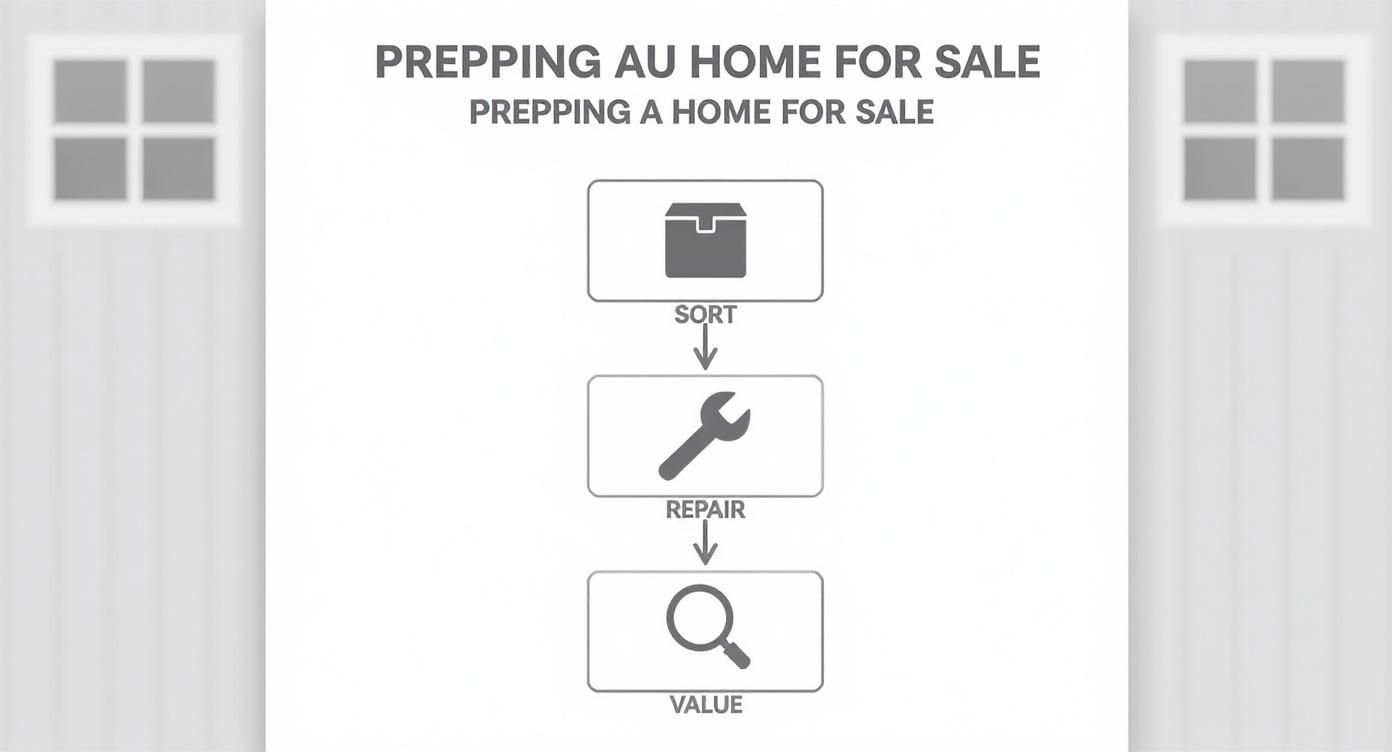
As you can see, each step—from sorting personal items to tackling essential repairs—builds a foundation for a successful sale, no matter which path you choose. It's important to be aware of one market quirk, though. Economic studies have shown that when several inherited homes hit the market at the same time in one area, this sudden inventory spike can actually push local prices down. You can learn more about this supply pressure effect in this IER study.
Making Your Decision
The best way forward is to get all the heirs together. Lay out the pros and cons of each option, run the numbers on potential net proceeds, and talk honestly about the timelines and effort involved.
Choosing the right sale method can save you thousands of dollars and weeks of stress. The key is to align on your goals, weigh the trade-offs, and keep the lines of communication wide open.
Take your time with this decision. Selecting the approach that best balances speed, profit, and effort for your family's unique situation is the most important step you'll take.
Successfully Navigating the Closing Process

Getting an accepted offer feels like a huge win, but you're not quite at the finish line yet. That period between the handshake and handing over the keys is where the real work happens. This is the closing process, often called being "in escrow," and it’s when all the final, critical details get locked into place.
The whole thing is managed by a neutral third party—usually an escrow or title company. Think of them as the referee. Their job is to hold all the funds and documents securely until every single condition in the purchase agreement has been met by both sides. It’s their role to guarantee a fair and legally sound transaction.
Preparing for Inspections and Appraisals
Soon after your offer is accepted, the buyer will bring in a home inspector. This person will go through the property with a fine-tooth comb, from the foundation to the roof, looking for any functional problems or safety hazards.
If the inspection report comes back with issues—let's say a leaky water heater or some sketchy old wiring—the buyer will likely come back to the table. They’ll usually ask for repairs or a credit to handle the costs themselves. Don't panic; this is a totally normal part of the dance. Your agent is there to help you negotiate a fair outcome, whether that means fixing the issues, offering a credit, or simply saying no if the requests are unreasonable.
At the same time, if the buyer is getting a loan, their lender will order an appraisal. The appraiser's only job is to confirm that the house is actually worth what the buyer agreed to pay. As long as you priced the home based on solid market data, this is usually just a formality.
Your Final Closing Checklist
As the closing date gets closer, the escrow company will have a stack of documents ready for your signature. The estate's executor or the primary beneficiary is typically the person who needs to sign off on all the final paperwork.
Here’s what you can expect to see in your closing packet:
- The Grant Deed: This is the big one. It’s the official legal document that transfers ownership from the estate to the new buyer.
- The Closing Statement (HUD-1): This is your financial breakdown. It’s an itemized list of every dollar, showing the final sale price, all the closing costs, and exactly what your net proceeds will be.
- Affidavits and Disclosures: You’ll sign a few other forms that confirm details about the property and your legal authority as the seller.
Closing on an inherited property is the final step in honoring your loved one's legacy. Stay organized, communicate clearly with your professionals, and focus on a smooth, transparent finish for all heirs involved.
Distributing the Sale Proceeds Fairly
Once the ink is dry and the buyer's funds are in, the sale is officially recorded with the county. The escrow company then disburses the money. This is the moment of truth, especially when there are multiple heirs waiting.
To keep things smooth and avoid any family drama, it is absolutely critical to follow the instructions laid out in the will or trust. If there was no will, you must divide the proceeds according to California's inheritance laws.
Transparency is key. Make sure every single beneficiary gets a copy of the final closing statement. This document leaves no room for questions, as it clearly shows how the net proceeds were calculated. From there, the funds are usually wired or sent via cashier's check to each heir, bringing the process to a clean and successful close.
Common Questions About Selling an Inherited Home
Selling a home you've inherited isn't like a typical real estate deal. It comes with its own unique set of questions and emotional hurdles. Even after you've got a grasp on the main steps, you'll probably still have a few specific concerns nagging at you.
Here are some direct answers to the most common questions we hear from heirs, designed to clear up any lingering confusion.
What Happens to the Mortgage on an Inherited Property?
When you inherit a house, you also inherit any debt attached to it, including the mortgage. That loan doesn't just vanish. You've got a few ways to handle this.
You could choose to assume the mortgage and just keep making the monthly payments. Another option is refinancing the loan into your own name, which might even land you a better interest rate. But for most families, the simplest path forward is selling the property. The proceeds from the sale are used to pay off the mortgage balance in full at closing.
Can I Sell My Share of an Inherited Property?
The short answer is yes, you can legally sell your individual share of a property you own with others. The long answer? It's almost never that simple.
This kind of move usually requires every single co-owner to agree. If you can't get everyone on the same page, you might have to take legal action, like a "partition lawsuit," to force a sale or have the others buy you out. To avoid that expensive and stressful legal battle, open communication is your best friend. Always try to talk it out with your co-heirs first—maybe one sibling can buy out the others—before you get the lawyers involved.
Do I Have to Fill Out Seller Disclosure Forms?
In most states, California included, sellers of inherited property get a bit of a break on the standard disclosure forms. These documents normally ask sellers to answer a ton of detailed questions about the home's condition and history. Since you probably haven't lived there, the law understands you just don't know the answers.
While you are exempt from many of the historical questions, you still have a legal duty to disclose any known material facts that could affect the property's value. When in doubt, honesty is the best policy.
For example, if you know for a fact that a big roof leak happened while the estate was being settled, you absolutely must disclose that to potential buyers. Your real estate agent is your best resource here to make sure you're meeting all your legal duties without oversharing.
How Do We Handle Disagreements Among Heirs?
Let's be honest: disagreements among siblings or other heirs are one of the biggest roadblocks to selling an inherited home. Clashing opinions on the sale price, what repairs to make, or even which agent to hire can bring the whole process to a screeching halt.
The best defense is a good offense. Setting up a clear plan from the very beginning is the only way to sidestep the drama.
- Appoint a Decision-Maker: If you can, get all the heirs to agree in writing to let one person—often the estate's executor—be the main point of contact and have the final say.
- Lean on the Experts: Use a professional appraiser's report and your agent’s market analysis to set the price. This takes emotion out of the equation and replaces it with cold, hard data.
- Consider Mediation: If things get really heated, bringing in a neutral third-party mediator can help everyone find common ground before relationships get permanently damaged.
Being proactive with communication is the most powerful tool you have. For a deep dive into the entire process and advice specific to another market, check out this expert guide on how to sell inherited property in Pittsburgh. While local laws differ, the core challenges families face are often the same.
Selling an inherited property in Fresno or Clovis has a lot of moving parts, from court filings to getting the home market-ready. Having an experienced team in your corner can make all the difference. At Edinhart Realty and Property Management, we specialize in helping families navigate these complex sales with confidence. When you're ready to take the next step or just need some expert advice, contact us today.


