

Let’s be honest: if you want to know how to prepare for tax season as a landlord, it all comes down to one thing.
Diligent, year-round record-keeping.
A proactive approach, not a last-minute scramble, is your secret weapon for a stress-free tax filing and maximizing every deduction you're entitled to. It really begins with treating your rental like a business from day one.
Your Foundational Guide to Rental Property Tax Prep

Navigating tax season as a landlord can feel like a maze, but it all starts with a solid foundation. Meticulous organization is your best defense against audits and the surest path to unlocking every dollar you're owed.
Before you even think about complex deductions, you have to get your core documents and income reporting in order. This is the non-negotiable first step.
Start By Gathering Your Essential Documents
First things first, you need to collect all the fundamental paperwork related to your property and its tenants. These documents are the backbone of your tax records and provide the proof you'll need to substantiate any claims.
Think of it as building your case file for the year. This isn't just about being organized; it's about having everything ready to hand over to your accountant or to input into your software without a frantic search.
To make sure you have everything covered, we've put together a checklist of the documents you absolutely need to pull together.
Essential Documents Checklist for Landlords
Gather these key documents and records to ensure a smooth and accurate tax filing process for your rental property.
| Document Category | Specific Items to Collect | Why It's Important |
|---|---|---|
| Lease & Tenant Records | Current and past lease agreements, tenant applications, move-in/out checklists. | Verifies rental periods, income amounts, and security deposit handling. |
| Financial Statements | Dedicated bank account statements for the rental, credit card statements used for expenses. | Creates a clean, undeniable paper trail of all income and expenses. |
| Property Ownership | Deed or title, property tax statements, mortgage interest statements (Form 1098). | Proves ownership and documents major deductible expenses like property taxes and mortgage interest. |
| Insurance Policies | Landlord insurance policy documents, liability insurance, flood or other special coverage. | Premiums are typically deductible, and policy details are crucial for claims. |
| Expense Receipts | Invoices and receipts for repairs, maintenance, supplies, utilities, legal fees, etc. | Provides direct proof for every single expense deduction you claim. |
| Capital Improvements | Contracts, invoices, and payment proof for major upgrades (new roof, HVAC, etc.). | These aren't just expenses; they are depreciated over time and require detailed records. |
Having these documents organized and accessible is what separates a stressful tax season from a smooth one. It makes the entire process significantly easier. A detailed https://edinhart.com/landlord-insurance-comparison/ can also help ensure you have adequate coverage at a competitive price, which optimizes this deduction.
Know Your Reporting Obligations
Once your documents are in order, you need to understand your reporting obligations. In the U.S., for instance, all rental income must be reported on your annual return, typically using IRS Form 1040 Schedule E.
If you own multiple properties, the income and expenses for each one are listed separately on this form. This is where that dedicated bank account really pays off.
Remember, the IRS can audit returns up to three years after filing. Your organized records are your best protection.
To efficiently manage your tax forms and ensure you file on time, you might consider exploring powerful tax preparation software. Tools like Drake Tax Hosting can be a huge help in keeping everything straight.
Getting a Handle on Your Rental Income and Expenses
Let's be honest, good tax prep isn't something you cram in a few weeks a year. For landlords, it's a constant habit built on solid organization. If you want to avoid that dreaded annual scramble, you need a system for tracking every dollar that comes in and every dollar that goes out.
The very first, and frankly most impactful, thing you can do is open a dedicated bank account for your rental business. This isn't just a friendly suggestion; it's a core strategy for sanity. It instantly draws a clean line between your personal and business finances, creating an undeniable audit trail. Every deposit is income, every withdrawal is a potential expense. It’s that simple.
Choose Your Tracking Method
Once that account is open, you need a way to log and categorize everything. What you choose really just depends on how many properties you're juggling.
- Got a single property? You can probably get by with a detailed spreadsheet. Just set up columns for the date, category (like rent, repairs, or insurance), amount, and a quick note. It’s cheap and you have total control.
- Managing multiple properties? Spreadsheets will quickly become your worst enemy. This is where property management software really proves its worth. Tools like AppFolio, Buildium, or TenantCloud can automate everything from rent collection to expense tracking. They spit out financial reports that are absolute gold when tax season rolls around, often saving you more in time and headaches than they cost.
No matter which path you take, you have to be consistent. Update your records monthly at the very least. You'll thank yourself later.
Key Takeaway: The single best thing you can do to simplify your rental taxes is to open a separate business bank account. It creates a crystal-clear financial record, making income and expense tracking easier and much more defensible in an audit.
Knowing the Difference: Repairs vs. Improvements
This is where a lot of landlords trip up. You have to understand the difference between a repair and an improvement, because the IRS sees them very differently.
A repair is something you do to keep your property in good, working order. Think of it as basic maintenance. You can deduct the full cost of a repair in the same year you pay for it. Fixing a leaky faucet or replacing a single cracked window pane? Those are repairs.
An improvement, on the other hand, is something that adds significant value to your property, extends its life, or adapts it for a new use. You can't just write these off in one go. Instead, you have to depreciate them over the property's useful life—which is typically 27.5 years for a residential rental. A complete plumbing overhaul or installing brand-new, energy-efficient windows throughout the house are classic improvements.
Keeping detailed records and receipts here is non-negotiable. A well-documented log of repairs proves your deductions are legitimate. And a list of your improvements is what establishes the correct basis for depreciation—a powerful tax benefit we’ll get into later.
Unlocking Every Landlord Tax Deduction You Deserve

Deductions are your single most powerful tool for legally lowering your taxable rental income. It’s a shame, but countless landlords leave serious money on the table every year. To really get a handle on preparing for tax season, you have to look beyond the obvious write-offs like mortgage interest and property taxes.
Let's pull back the curtain on the common—and often-missed—deductions that directly fatten your wallet. Nailing every single one is a critical part of a smart financial strategy for your property.
Your Comprehensive Deduction Checklist
It helps to think of your rental property as a small business. Just about every ordinary and necessary expense you pay to manage, maintain, and operate it can be deducted. The key is keeping meticulous records for everything.
Here are some of the most common deductible expenses you absolutely should be tracking:
- Insurance Premiums: This isn't just your main landlord policy. It also includes liability insurance and any special coverage like flood or fire policies.
- Maintenance and Cleaning: All those costs for routine upkeep between tenants, paying for landscaping, and general cleaning are 100% deductible.
- Property Management Fees: If you hire a professional company like Edinhart Realty & Property Management to handle the day-to-day, their fees are a straightforward business expense.
- Professional Services: Did you pay a lawyer to draft or review a lease? An accountant for tax prep? Those fees are deductible.
- Advertising Costs: Any money you spent marketing your vacant property to find new tenants—whether it was an online listing or a newspaper ad—is a write-off.
- Travel Expenses: You can deduct the mileage or actual costs of traveling to and from your rental property for management, maintenance, or showing the unit.
This list is just the beginning. For a much deeper dive, you might want to check out a complete guide to small business tax deductions, as many of the principles apply directly to your rental business.
Repairs vs. Improvements: The Critical Distinction
If there's one concept you need to master for rental property taxes, this is it. The IRS sees repairs and improvements very differently, and confusing the two can lead to a costly tax bill.
A repair is simply an expense that keeps your property in its current working condition. Think of it as maintenance. It doesn't add significant value or prolong the property's life; it just fixes something that broke. These costs are fully deductible in the same year you pay for them.
Scenario: Your tenant calls to report a broken window. You hire someone to replace that single pane of glass. That’s a repair. You deduct the full cost on this year's taxes.
An improvement, on the other hand, is something that enhances the property's value, extends its useful life, or adapts it to a new use. Instead of being deducted, these costs must be capitalized and depreciated over a set period—typically 27.5 years for residential rentals.
Scenario: Instead of fixing one broken window, you decide to replace all the old, single-pane windows in the house with new, energy-efficient models. This is a classic improvement. The total cost is spread out and depreciated, not deducted all at once.
Getting this right is crucial. A repair gives you an immediate, full tax benefit. An improvement gives you a much smaller deduction spread out over decades. This is why your record-keeping is so important—it helps you correctly categorize every expense so you can maximize your write-offs while staying perfectly compliant.
Understanding Depreciation for Your Rental Property
As a landlord, depreciation is probably the most powerful tax deduction you have. It’s often called a "phantom deduction" for a good reason—you get to deduct a slice of your property's value every single year, even though no cash is leaving your pocket.
It's the IRS's way of acknowledging that buildings and their major components wear out over time. This is a massive tool for lowering your taxable income annually. Getting a handle on how depreciation works is non-negotiable if you want to file your taxes correctly and build long-term wealth as a property owner.
Calculating Your Property's Cost Basis
It all starts with your property's cost basis. This isn't just what you paid for the house; it's the number the IRS uses to figure out your annual depreciation deduction.
To get your cost basis, you'll start with the purchase price and then add specific settlement fees and closing costs. Things like:
- Legal and recording fees
- Abstract fees
- Surveys
- Title insurance
- Transfer taxes
Here’s the critical part: you can't depreciate land. Only the building itself wears out in the eyes of the IRS. You have to split the value of the structure from the land, which you can usually do by looking at your property tax assessment. It almost always lists separate values.
Let's walk through an example: You buy a rental for $350,000. Your closing statement shows $5,000 in allowable costs, so your initial basis is $355,000. The tax bill says the land is worth $70,000 and the building is worth $280,000. Your depreciable basis is $285,000 (the $280,000 building value plus your $5,000 in closing costs).
The Depreciation Lifespan
Once you've nailed down your depreciable basis, you get to write off that amount over the asset's "useful life." For residential rental properties, the IRS has set this period at 27.5 years.
That means for the next two and a half decades, you’ll deduct a portion of your basis, directly reducing your taxable rental income. One quick note: if you operate a short-term rental where the average stay is 30 days or less, it might be classified as nonresidential property, pushing the depreciation schedule out to 39 years.
Handling Major Capital Expenses
Depreciation isn't just a one-time thing at purchase. It also comes into play for any significant capital improvements you make down the road. This is totally different from a simple repair, which you expense in a single year.
Capital improvements are major investments that add real value or extend your property's life. Think big projects:
- A full roof replacement
- Putting in a brand-new HVAC system
- A gut remodel of a kitchen or bathroom
- Adding a deck or a new room
You'll add the cost of these projects to your property's basis and depreciate them over their own useful life—also typically 27.5 years for residential upgrades. Keeping meticulous records of these expenses is vital for your annual tax filings and for calculating your gains when you eventually sell.
Navigating Essential Tax Forms and Deadlines
Having organized records is one thing, but knowing exactly where to put all those numbers is the other half of the battle. Let's walk through the key paperwork you'll be dealing with. Think of this as your roadmap to making the administrative side of tax season feel a lot less intimidating.
The star of the show for any landlord is Schedule E (Supplemental Income and Loss). This is the official IRS form where you'll meticulously list all your rental income, categorize your expenses, and most importantly, claim your depreciation deduction. If you own multiple properties, each one gets its own column, giving the IRS a crystal-clear financial snapshot of your portfolio.
Beyond Schedule E, you might have other forms to wrangle. Did you pay a plumber, painter, or landscaper more than $600 for their work during the year? If so, you’ll need to issue them a Form 1099-NEC. This form reports their nonemployee compensation to them and the IRS, which is why keeping detailed payment records for all your vendors is so critical.
Meeting Critical Tax Deadlines
Paperwork is only useful if it’s filed on time. As a landlord, you're earning business income, which means you can't just kick back and wait until April 15th to settle up with Uncle Sam. You will almost certainly need to make quarterly estimated tax payments throughout the year. This avoids a nasty surprise bill and potential underpayment penalties come tax time.
This simple flow chart can help you plan for these crucial payments.
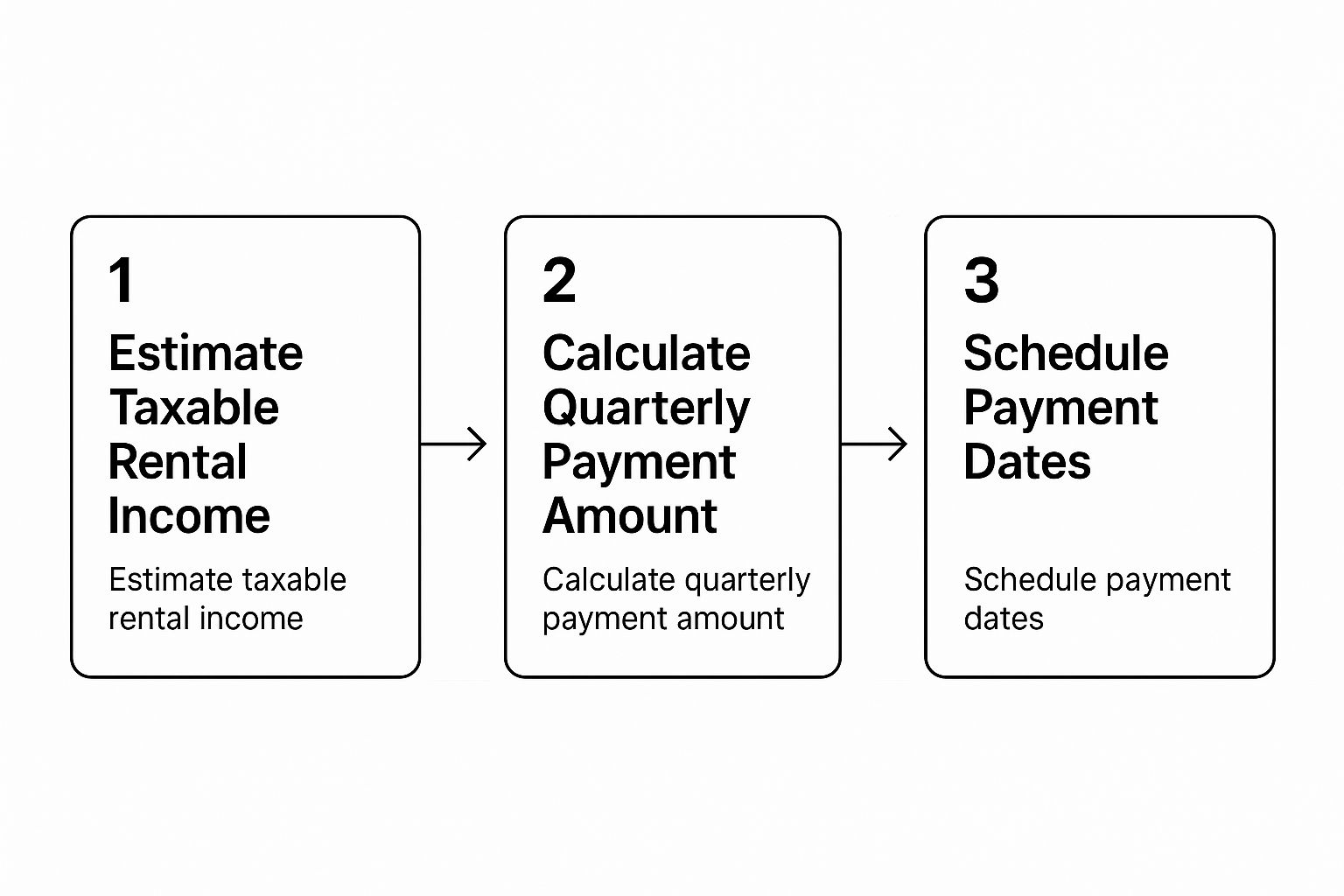
Following this process helps you stay ahead of your tax liability, turning what could be a year-end crisis into a manageable, routine task. Understanding your obligations is everything. Your rental profits are typically treated as ordinary income, putting them in the same graduated tax brackets as your other earnings—anywhere from 10% to 37%, depending on your total income.
The Truth About Filing an Extension
So, what happens if you just can't get it all done by the deadline? Filing for an extension with Form 4868 is a common move, but it's one of the most misunderstood concepts in taxes.
An extension gives you more time to file your return, but it does not give you more time to pay the taxes you owe. You must still estimate and pay your tax liability by the original deadline to avoid penalties and interest.
Whether you're filing the return itself or an extension with a payment, hitting that deadline is non-negotiable. In the crunch to submit documents, you might even find yourself wondering whether a fax is legally binding for tax records—a perfect example of how important it is to understand compliance at every single step.
On that note, don't forget that local and state rules are just as important. For instance, our guide on landlord-tenant law in California shows just how much state-specific regulations can impact your entire operation and financial picture. Staying compliant on all fronts is the key to a stress-free business.
Answering Your Biggest Landlord Tax Questions
Even after you've organized everything, some specific tax situations can still be confusing. We get it. When you're figuring out how to handle taxes for your rental property, getting clear answers to common questions makes all the difference.
Let's walk through some of the most frequent sticking points we see landlords face every year.
Can I Deduct the Cost of Driving to My Rental Property?
You sure can. The IRS actually gives you two different ways to write off vehicle expenses for your rental activities. You can pick the one that saves you the most money, but just remember, you have to stick with your chosen method for that vehicle for the entire tax year.
- The Standard Mileage Rate: This is the no-fuss option. You just need to log the miles you drive for your rental business—think trips to the property for a repair, showing the unit to a prospective tenant, or running to the store for supplies. Then, you multiply those miles by the IRS's official standard mileage rate for the year.
- The Actual Expense Method: This way requires more detailed tracking, but it can be worth it. You'll keep records of all your car-related costs: gas, oil changes, insurance, new tires, registration fees, you name it. You then deduct the percentage of those expenses that lines up with how much you used your car for the rental.
For example, if you find that 20% of your total driving for the year was for your rental, you can deduct 20% of your total car expenses.
How Are Security Deposits Handled for Tax Purposes?
This one trips up a lot of new landlords. When you first collect a security deposit, it is not considered taxable income. Why? Because you're legally obligated to return it when the tenant moves out (assuming they've held up their end of the lease). Think of it as a liability on your books, not income.
The game changes the moment you have a legal right to keep some or all of that deposit. At that point, it becomes taxable income. This usually happens in a couple of common scenarios:
- Covering Unpaid Rent: If a tenant skips out owing you a month's rent of $1,500 and you use their deposit to cover that loss, you must report that $1,500 as rental income for that tax year.
- Paying for Damages: Let's say you have to use $300 of the deposit to repair a hole in the wall after a tenant leaves. That $300 now becomes reportable income. The good news is, you'll also have a matching $300 repair expense to deduct, which typically cancels it out on your tax return.
The golden rule here is to only declare a security deposit as income in the year you actually establish the right to keep it. This is where meticulous bookkeeping really pays off.
What Happens If My Rental Expenses Exceed My Income?
It's not uncommon, especially in the early years of owning a property. When your total deductions are more than your rental income, you have a net rental loss. Whether you can deduct this loss against your other income (like your salary from a day job) is determined by what the IRS calls the "passive activity loss" rules.
For many hands-on landlords, a special allowance lets you deduct up to $25,000 in these passive losses against your regular, non-passive income. But there's a catch. This allowance starts to phase out once your modified adjusted gross income (MAGI) climbs over $100,000 and vanishes completely once your MAGI is $150,000 or more.
If your income is too high to claim the deduction right now, don't sweat it—the loss isn't gone. Any unused passive losses get suspended and carried forward to future years. You can use them to offset rental profits later on or to lower your taxable gain when you eventually sell the property. This is one of those complex areas where partnering with professional Fresno property management can be a huge help to make sure you're staying compliant and getting every benefit you're entitled to.
At Edinhart Realty & Property Management, we handle the complexities of financial reporting and record-keeping so you can approach tax season with confidence. Contact us today to learn how our expert services can streamline your operations and maximize your investment returns.


