

You don't win or lose a negotiation when you're sitting at the table. The real work—the stuff that actually gets you the best deal—happens long before the first offer is even on the table. It all comes down to thorough preparation, knowing the market inside and out, and having a crystal-clear picture of what everyone wants.
Get this part right, and you'll have all the leverage you need to come out on top.
Building Your Negotiation Foundation

Forget what you've seen in movies. A great negotiation isn’t about being aggressive or out-talking the other person. It’s about information. Plain and simple, the person with the most comprehensive data almost always has the advantage. Before you even think about talking numbers, your main job is to arm yourself with cold, hard facts.
For both buyers and sellers, this starts with a Comparative Market Analysis (CMA). This isn't just a quick glance at Zillow. A real CMA goes deep, analyzing recently sold properties that are genuinely similar in size, condition, and location.
Understand True Market Value
Sellers lean on a CMA to set a smart, competitive price right from the start. This attracts serious, qualified buyers and helps you avoid the dreaded price drop that just screams desperation to the market.
For buyers, the CMA is your reality check. It helps you figure out what a home is actually worth so your offer is based on data, not just emotion. This keeps you from overpaying or, on the flip side, leaving money on the table. A sharp real estate agent is your best friend here, and our guide on how to find a realtor can point you to the right expert for this critical step.
A well-researched CMA is your negotiation North Star. It provides an objective benchmark that both parties can refer to, shifting the conversation from "what I want" to "what the market supports."
Secure Your Financial Power
If you're a buyer, the single most powerful tool you have is a mortgage pre-approval letter. This piece of paper instantly transforms you from a casual looker into a credible buyer who's ready to make a deal. It shows the seller you have the financial muscle to see the purchase through, which is a massive advantage in any market.
A pre-approval letter tells the seller:
- You are a serious contender, not a tire-kicker.
- Your financing is lined up, which dramatically reduces the risk of the deal collapsing.
- You can close quickly—something every seller loves to hear.
Uncover Motivations and Leverage Points
At the end of the day, real estate is about people. Every sale has a human story behind it, and if you can figure out the other party’s motivations, you can find creative ways to win.
Is the seller moving for a new job and needs to be out by a specific date? They might value a quick, guaranteed closing more than squeezing out every last dollar. Are the buyers' apartment lease ending next month? They might be more flexible on inspection items just to lock down a home.
These little details are your leverage points. They let you craft an offer that solves the other person's problem, making them far more likely to agree to your terms.
Reading the Real Estate Market Climate
Trying to negotiate a home sale without a solid grasp of the current market is a bit like sailing without a compass. Your entire strategy needs to line up with the reality of supply and demand, because your leverage can shift dramatically between a buyer's and a seller's market.
Simply put, the playbook that gets you top dollar when homes are flying off the market will fall flat when properties are lingering for weeks. You have to become a student of your local market.
Focus on a few key indicators that reveal who truly holds the upper hand.
This kind of data helps you visualize what’s happening at a glance, showing you whether sellers can expect a bidding war or if buyers have room to push for a better deal.
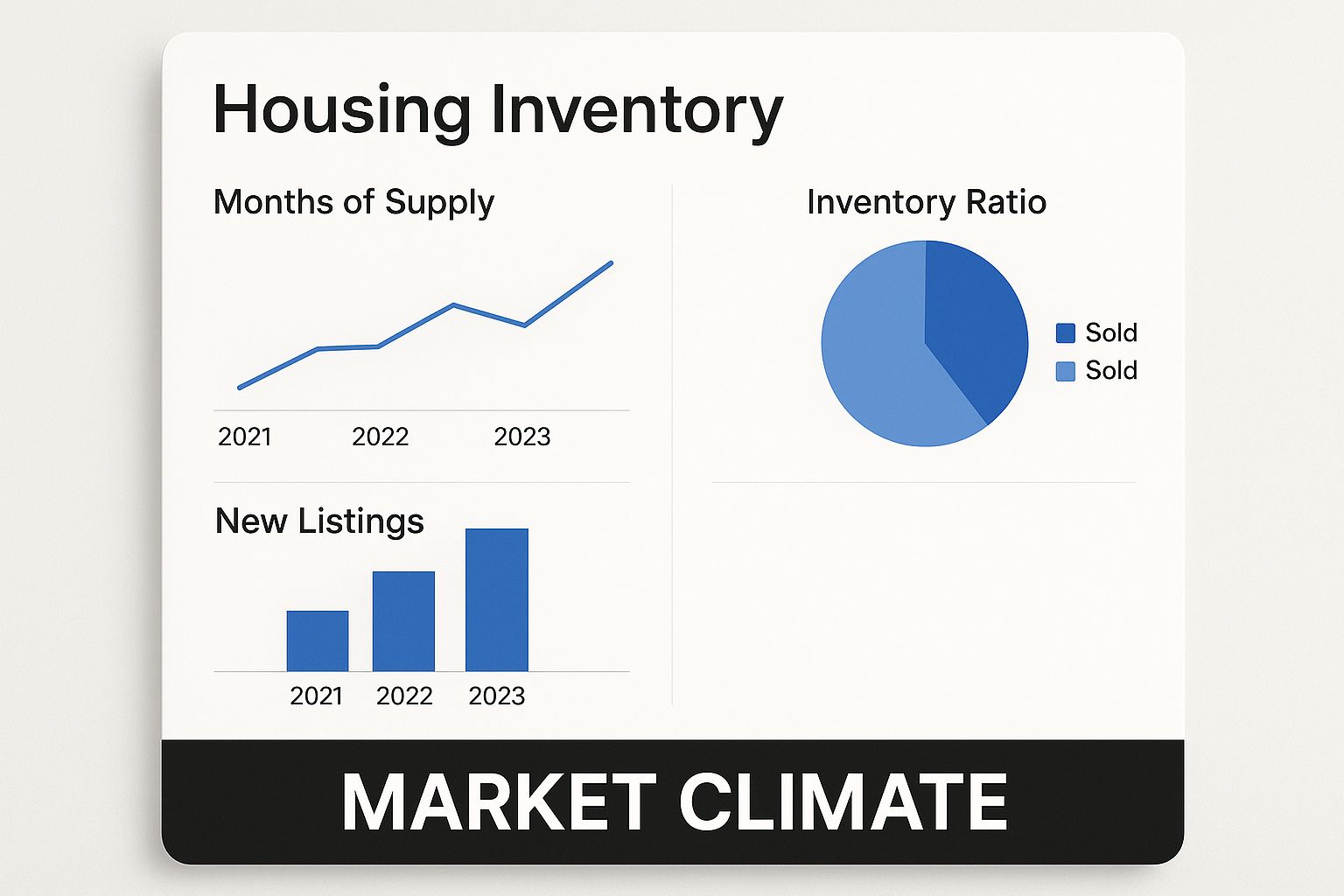
Key Market Indicators to Watch
Certain numbers paint a crystal-clear picture of market health. To really learn how to negotiate a home sale effectively, you need to pay close attention to these data points. Your agent can pull them for you directly from local MLS reports.
- Housing Inventory Levels: This is classic supply and demand. Low inventory means fewer homes are for sale, which sparks competition among buyers and gives sellers the advantage. High inventory flips the script, giving buyers more choices and, therefore, more negotiating power.
- Average Days on Market (DOM): This tells you how long it takes, on average, for a home in your area to go under contract. A low DOM—say, under 30 days—signals a hot seller's market where things move fast. When the DOM starts creeping up, it means the market is cooling, and sellers might be more open to a deal.
- Sale-to-List Price Ratio: This ratio reveals the average final sale price as a percentage of the original list price. A ratio over 100% means homes are consistently selling for more than the asking price. That's a huge sign of a seller's market. If the ratio drops below 98%, it suggests buyers have room to negotiate the price down.
The table below breaks down how these indicators generally impact the negotiating power of both buyers and sellers.
| Market Conditions and Negotiation Leverage | ||
|---|---|---|
| Market Indicator | Impact on Buyer's Leverage | Impact on Seller's Leverage |
| High Housing Inventory | Increases | Decreases |
| Low Housing Inventory | Decreases | Increases |
| Increasing Days on Market (DOM) | Increases | Decreases |
| Decreasing Days on Market (DOM) | Decreases | Increases |
| Sale-to-List Ratio Below 98% | Increases | Decreases |
| Sale-to-List Ratio Above 100% | Decreases | Increases |
Understanding where the market sits today helps you set realistic expectations and craft a strategy that actually works.
Knowing these numbers keeps you from making an unrealistic offer or holding out for terms the market simply won't support. It grounds your entire strategy in reality, not just wishful thinking.
We’re seeing this play out on a larger scale. In the first half of 2025, the U.S. housing market saw inventory climb by 17% year-over-year. At the same time, homes sold in an average of 17 days—four days slower than the prior year. This slight cooling trend gives buyers a little more breathing room and power to negotiate.
These dynamics are also critical for timing your sale. To dive deeper into how seasonality affects things, check out our guide on the best time to sell a home. For a broader perspective, you can also look at resources like a buyer's guide to new home sales in North Carolina, which covers different market trends.
Crafting Your Offer and Counteroffer Strategy

Alright, you’ve done your homework, analyzed the market, and figured out what makes the other side tick. Now it's time to make your move. This is where the deal really starts to come together, and trust me, a well-thought-out offer is much more powerful than just throwing a high number out there.
Think of your offer as a complete package—one designed to solve the other party's problems while hitting your own goals. The best ones are always a strategic mix of price and other compelling terms. For example, a solid earnest money deposit screams that you're a serious, committed buyer. In a hot market, putting down 2-3% of the purchase price can make your offer jump to the top of the pile.
Anatomy of a Compelling Offer
A winning offer is part financial muscle, part attractive terms. Every element is a lever you can pull to make the deal sweeter.
- Price: This is the big one, obviously. But your price should be rooted in your market analysis, not just wishful thinking. A price backed by data shows you're serious and informed.
- Contingencies: These are your safety nets. Common ones cover inspections, financing, and appraisals. While they’re there to protect you, showing some flexibility here can be a huge bargaining chip.
- Closing Date: This is often overlooked but can be incredibly valuable. A seller who’s relocating for a new job might jump at a quick 21-day closing, even if it’s for a bit less money than another offer with a 45-day timeline.
- Earnest Money: Like I said, a larger deposit shows you’re all in. It lowers the seller’s perceived risk and demonstrates your financial stability right from the get-go.
A buyer who can offer a quick, clean close with few contingencies is often more appealing than one who offers a higher price but comes with more uncertainty. Speed and certainty are currencies in real estate.
Let's play it out. Imagine a seller is looking at two very similar offers. The first is for $505,000, but it comes with a financing contingency and a 60-day close. The second offer is for $500,000, but it’s from an all-cash buyer who can close in two weeks and is willing to waive the appraisal contingency. Nine times out of ten, the seller is taking that second offer. It's a faster, surer path to the finish line.
The Art of the Counteroffer
Getting a counteroffer isn't a "no." It’s an invitation to keep talking. The trick is to respond strategically without showing all your cards at once. A good counter should bridge the gap while still protecting your bottom line.
When you counter, don't get hung up on just one thing. If the seller pushes back on your price, maybe you come up to their number but ask for a credit toward closing costs. This gives the seller the sale price they wanted, while you still get some financial relief.
Here’s a classic back-and-forth:
- Buyer's Initial Offer: $485,000 with an inspection contingency and a request for the seller to cover $5,000 in closing costs.
- Seller's Counteroffer: $495,000, they agree to the inspection, but will only kick in $2,500 for closing.
- Buyer's Final Move: The buyer could come back at $492,000 and accept the $2,500 credit, effectively meeting the seller in the middle.
This kind of give-and-take keeps the conversation moving. The goal is to avoid an endless volley that just wears everyone out. When you understand what’s most important to each person, you can find that middle ground where everyone walks away feeling like they got a win. The best deals are rarely about one side dominating—they’re about finding that mutual sweet spot.
Negotiating Terms Beyond the Final Price
The final sale price grabs all the headlines, but anyone who’s been around the block knows the real magic happens in the other terms. The truth is, some of the most significant wins for both buyers and sellers have nothing to do with that big number at the top of the contract. If you only focus on the price, you’re leaving a ton of value on the table and missing out on creative ways to get a deal done.
https://www.youtube.com/embed/BLBRRNwMZNE
Think of the entire contract as a series of levers. Every single term, from the closing date to whether the fancy refrigerator stays, can be adjusted to build a more appealing package. This is where a little flexibility and a genuine understanding of what the other side really needs can make all the difference.
The Home Inspection Response
After the offer is accepted, the home inspection almost always kicks off the second round of negotiations. An inspector's report is bound to find something, whether it’s a handful of minor fixes or a major system on its last legs. Your next move here is critical.
For buyers, you've got three main paths to take:
- Request Specific Repairs: This is the traditional route. You can ask the seller to bring in a pro to fix that leaky pipe or faulty wiring before closing. It’s straightforward, but you’re trusting them to manage the work.
- Ask for a Closing Cost Credit: This is often the cleanest option. Instead of the seller coordinating repairs, you ask for a credit. This puts cash in your pocket at closing so you can hire your own contractors and know the job is done to your standards.
- Negotiate a Price Reduction: If the inspection uncovers something big and expensive, knocking the cost off the sale price can make sense. This is common when the repair costs are pretty substantial.
A closing cost credit is frequently the cleanest solution. It avoids debates over the quality of the seller’s repairs and gives the buyer total control over the process after they take ownership.
Sellers should go into this expecting requests. Being proactive can save a lot of headaches. Offering a home warranty upfront or simply being open to a reasonable credit can keep the deal on track. Just remember, digging your heels in on legitimate issues discovered during an inspection is a great way to blow up the entire sale.
Strategic Use of Contingencies and Closing Dates
Contingencies are there to protect the buyer, but they can also be powerful bargaining chips. Let's say you're a buyer with rock-solid financing. Offering to shorten your financing contingency from the standard 21 days down to 14 days shows serious confidence and makes your offer look much more secure to a nervous seller.
The closing date is another hugely valuable, non-monetary term that people often overlook. A seller who has already bought their next house will see a quick close as a massive win. On the flip side, a seller who needs more time to pack up and move might gladly accept a slightly lower offer if it comes with a longer closing period or a short-term rent-back agreement.
And don’t forget the personal property! That high-end washer and dryer, the custom-built shed in the backyard, or even the stylish patio furniture can all be tossed into the deal. For a buyer, this can save thousands of dollars and the hassle of furnishing a new place. For a seller, leaving behind items you didn't want to move anyway is an easy, zero-cost way to make your home stand out and get the contract signed.
How Global Trends Influence Local Negotiations
It’s easy to get tunnel vision during a home sale, focusing only on the two parties in a single neighborhood. And while that’s where the deal gets done, you’re missing the bigger picture if you ignore the global forces quietly shaping the negotiation table in your own backyard.
Think of it this way: your local housing market is just one small pond connected to a massive economic ocean. Global economic health, international investment patterns, and even broad shifts in consumer confidence create ripples that eventually reach your shore, impacting everything from property demand to who has the upper hand.
Foreign Investment and Local Competition
In many major U.S. cities, foreign investment is a huge market driver. When international buyers see an American city as a stable place to park their money, they can inject a ton of capital into the local market. This flood of demand, often for high-end or new-construction properties, has a way of pushing up prices and making things more competitive for everyone.
If you're a seller, this can be fantastic news. A surge in foreign interest might mean more eyeballs on your listing and a better shot at landing a strong, all-cash offer.
But for local buyers? It means you could suddenly find yourself competing with investors who have deep pockets and aren't going to quibble over minor inspection issues. This completely changes the dynamic and can seriously weaken your bargaining power.
You have to know if your city is a global hotspot. If it is, you need to walk into negotiations ready for a fight, where the speed and certainty of your offer are your best weapons.
Economic Shifts and Buyer Psychology
Broader economic trends also play a massive role in how people feel and act. A global economic slowdown can make local buyers nervous and far more cautious. They'll likely lowball their offers and be much more demanding during inspections, simply because they're worried about their own financial future.
On the flip side, when the global economy is humming along, consumer confidence shoots up. This usually translates to a more active and aggressive housing market. Buyers are more willing to stretch their budgets, and sellers feel empowered to hold firm on their asking price.
These international factors also have a direct line to our domestic financial markets. For example, global economic pressures can influence the interest rates for homes in California and other key areas, making it cheaper or more expensive for a local buyer to get a loan. That directly impacts their purchasing power, and in turn, their strength at the negotiating table.
Don't underestimate the impact of international buyers. As of early 2025, they accounted for 1.9% of all home search traffic on major U.S. platforms. Buyers from Canada are leading the charge, making up a whopping 34.7% of that traffic. Watching these numbers rise or fall gives you a critical piece of intelligence when you’re figuring out how to negotiate your home sale.
Home Sale Negotiation Questions Answered
Even with the best game plan, tricky situations are bound to pop up during a home sale. Knowing how to handle the common curveballs can keep your deal on track and, more importantly, protect your bottom line. Think of this as your quick-reference guide for navigating those tough spots.
What Should I Do About a Lowball Offer?
Getting a shockingly low offer can feel like a slap in the face, but don't take it personally. It’s almost never the final word—it's just an opening move. Instead of getting emotional, see it for what it is: a tactic. The best response is a strategic, firm counteroffer backed by your market analysis.
An aggressive counter sends a clear message: you know what your home is worth and you aren't desperate. Say your home is listed at $500,000 and an offer for $450,000 comes in. Countering at $495,000 shows you’re willing to negotiate, but you won't be pushed around.
A lowball offer is often just a test to see if you’ve done your homework. A confident, data-backed counteroffer is the best way to reset the conversation and bring the buyer back to reality.
Which Repair Requests Are Reasonable?
The post-inspection repair request list is a classic part of the process. The real key here is knowing the difference between a reasonable request and a ridiculous one. Generally, you should expect to address major issues related to health, safety, or the home's core systems.
Here’s a quick way to think about it:
- Reasonable: Fixing a leaky roof, sorting out faulty electrical wiring, or repairing a broken HVAC system. These are major components essential for living in the home.
- Unreasonable: Asking you to repaint a scuffed wall, replace perfectly functional but worn carpeting, or fix a sticky cabinet door. This is just minor, everyday wear-and-tear.
As the seller, your focus should be on the big-ticket items. A smart move is often to offer a credit for repairs. This gives the buyer control over the work and lets you move on without the headache of coordinating contractors. It’s a clean approach that keeps the deal moving forward.
It’s also worth noting that broader market trends can make buyers a bit pickier. For example, global real estate investment volumes dropped 2% year-over-year in the first quarter of 2025 as investors got more cautious. That kind of uncertainty can trickle down, making buyers scrutinize every detail. Knowing where to draw the line becomes even more critical in that environment. You can read more on global real estate trends here.
Successfully navigating a home sale negotiation requires an expert in your corner. The team at Edinhart Realty and Property Management has the market knowledge and strategic skill to make sure you get the best possible outcome. Whether you're buying, selling, or managing property, find out how our professional services can maximize your real estate success at https://edinhart.com.


