

An owner in another state usually notices the problem through a text message: the tenant says the heater stopped working, rent hasn't arrived, and a contractor claims the repair is complete. None of these issues is difficult by itself. The trouble starts when every decision depends on the owner being awake, available, and able to trust information that hasn't been verified.
Managing rental property remotely works when distance is replaced with clear authority, documented evidence, and repeatable workflows. In Fresno and throughout Central California, that means coordinating people on the ground while keeping leases, payments, repairs, and compliance visible from wherever you are.
Why Remote Management Fails Without a System
A remote rental doesn't fail because the owner lives far away. It fails because nobody knows what happens next. A tenant sends a maintenance request by text, a vendor responds by phone, an invoice arrives by email, and the owner stores the lease in a different folder. Each person may be acting reasonably, but the property has no dependable operating record.
Distance magnifies those gaps. A local owner might notice a vacant home while driving past it or ask a contractor to show the finished work in person. An out-of-state owner needs a process that creates the same visibility without relying on a drive-by inspection. That process must cover the full operating chain, from applicant intake through lease execution, rent collection, maintenance, inspections, accounting, and renewal decisions.
Practical rule: Automate predictable transactions, but keep a human accountable for exceptions, judgment, and physical verification.
Separate the work that software handles from the work people govern
Online applications, screening orders, electronic signatures, recurring payments, reminders, document storage, and work-order status updates are strong candidates for automation. These tasks follow defined rules and create useful records when the system is configured correctly.
Urgent habitability complaints, reasonable-accommodation requests, suspected lease violations, disputed charges, eviction decisions, and vendor-quality disputes require human review. Automation can route the issue, preserve the communication log, and notify the right person. It shouldn't make a consequential decision without an escalation rule and a documented review.
California operations add another layer. Owners must account for state and local requirements, consistent screening practices, proper notices, habitability obligations, and approved forms. Edinhart's stated compliance approach uses California Association of Realtors forms and ongoing legal updates, but any owner or manager still needs a defined process for checking current requirements rather than assuming an old lease or familiar practice remains sufficient.
Build around three connected control loops
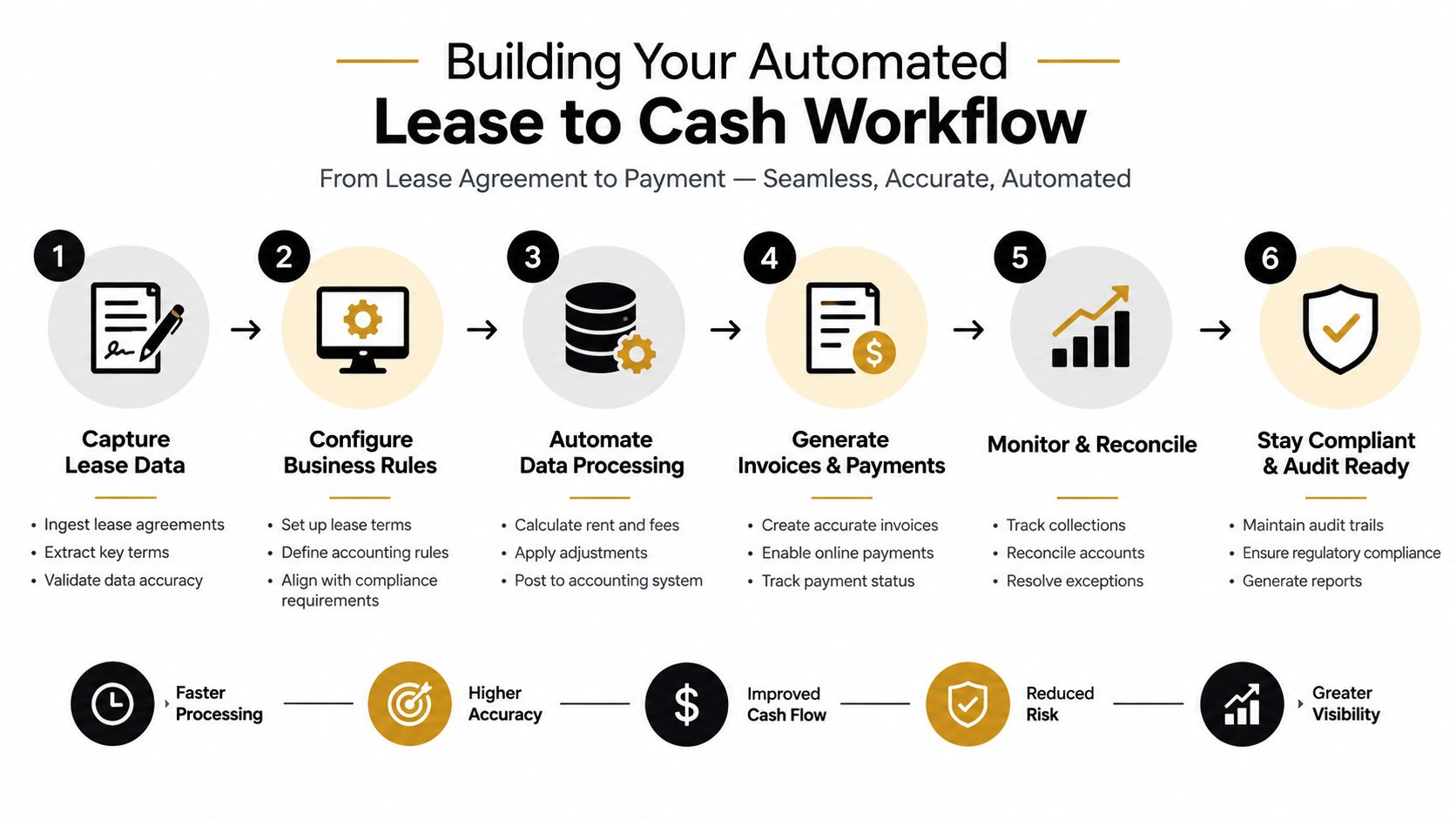
The first loop is lease to cash. It moves an applicant through intake, screening, approval, lease signing, payment setup, reminders, and accounting.
The second is request to resolution. It captures the tenant's complaint, classifies urgency, assigns a vendor, authorizes the work, collects evidence, and closes the invoice only after review.
The third is governance. It tracks vacancy, days on market, delinquency, work-order aging, inspections, notices, vendor performance, and unresolved exceptions.
Property-management software investment reflects this operating shift. One 2026 market estimate valued the global property management software market at US$4.1 billion, projecting US$7.6 billion by 2033 at a 9.2% CAGR (Persistence Market Research's property management software market estimate). The number matters less than the underlying lesson: remote ownership now depends on a mature category of cloud tools, not a collection of improvised spreadsheets.
Building Your Automated Lease to Cash Workflow
A reliable remote operation begins before a tenant pays rent. It starts with one standardized path that every applicant and resident follows. The fewer side channels you allow, the easier it becomes to identify missing information, enforce consistent rules, and reconcile money without being physically present.
Start with one applicant intake process
Publish the rental through your chosen listing channels, but send every prospect to the same application form. Standardize the information you request, identify required documents, and make the status of each application visible to the authorized team.
Next, configure screening so background and credit orders follow the same sequence for every applicant who meets the stated criteria. Consistency matters more than speed. A remote owner shouldn't be making informal exceptions because one applicant called at the right moment.
After approval, trigger digital lease execution from the approved record. Store the signed agreement, addenda, inspection documents, and payment instructions in one secure location. Don't let a signed lease sit in an inbox while the tenant waits for instructions about deposits, utilities, or recurring payments.
Make rent collection recurring and traceable
Set up online rent collection before move-in. Give the tenant clear payment instructions, enable recurring payments where appropriate, and configure reminders and late-fee rules according to the lease and applicable law. The system should record the payment, issue a receipt, flag an exception, and feed the transaction into accounting without manual re-entry.
Digital collection is now a mainstream operating practice. Rentec Direct's long-running dataset shows digital rent payments rising from 4% in 2014 to 51% by October 2025, making online payments the majority method in about 11 years (Rentec Direct's online rent payment data). The same source cites a market summary reporting that 74% of North American property managers use at least one digital rent-collection tool, compared with 53% in 2021. For a remote owner, that supports a simple conclusion: mailed checks and manual reconciliation shouldn't be the default system.
Connect payments to maintenance and accounting
Lease to cash doesn't end when rent posts. A resident should be able to submit a work order through the same operating environment, attach photos, receive status updates, and see when the issue is assigned or resolved. The owner should be able to connect the expense to the property, review the invoice, and retain the record.
Industry reporting associates software-managed portfolios with 95% on-time rent collection versus 80% for manual processes, a 15-point improvement, and reports that software users spend about 12 hours per week managing rent and expenses, a 40% reduction from manual workflows (World Metrics' property management software industry reporting). Treat those figures as an industry benchmark, not a promise for every owner. The practical lesson is to automate the complete chain, not only the listing.
Owners who need help with document-heavy leasing, notices, or administrative follow-up may also evaluate virtual legal assistants as part of a supervised support model. Before choosing any platform, review automation in property management with a focus on approvals, audit trails, and exception handling.
Partial digitization creates a polished front end with the same old bottleneck behind it. If tenants apply online but still chase you for payment instructions and repair updates, the workflow isn't automated.
Coordinating Vendors and Repairs From Afar
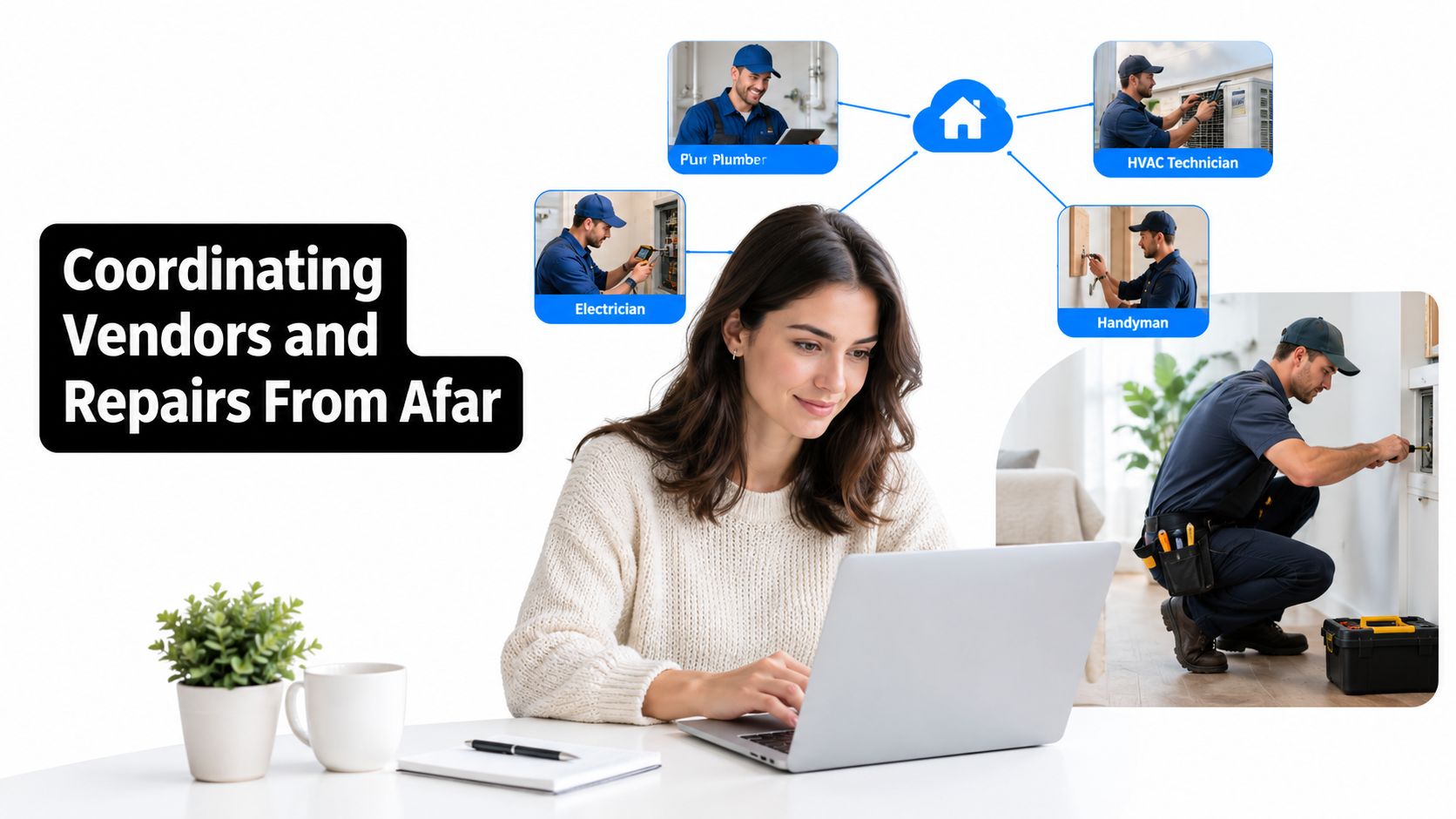
Remote maintenance needs more than a tenant portal. It needs a local service network, written response expectations, spending authority, and evidence standards. In Fresno, Clovis, and Friant, an owner should maintain dependable contacts for plumbing, electrical work, HVAC, general repairs, cleaning, and emergency response. A single contractor isn't a contingency plan.
Create a vendor control file
For each vendor, keep licensing and insurance information where applicable, service areas, trade specialties, contact details, pricing terms, emergency availability, and payment instructions. Record completed jobs, tenant feedback, invoice patterns, and whether the contractor supplies the requested evidence on time.
Set service-level expectations before the first emergency. Define how quickly the vendor acknowledges a request, when an initial diagnosis is due, which repairs require approval, and what qualifies as an emergency. Tenants need the same clarity. They should know where to report a problem, what information to include, and which situations require immediate emergency action.
Route approvals through one digital channel. Text messages can alert you, but they shouldn't become the permanent record for scope, price, authorization, or completion. A structured maintenance system makes it easier to review property maintenance management software against the actual controls your portfolio needs.
Require evidence that matches the job
Ask for time-stamped before-and-after photos for visible repairs. For concealed or technical work, request a written diagnosis, parts information, and a short video when it helps demonstrate the issue or resolution. The evidence should show the property location or identifiable feature when practical, without exposing private tenant information.
Don't approve an invoice solely because a vendor marked the task complete. Compare the original complaint, approved scope, evidence, invoice, and tenant confirmation. If the evidence doesn't match, pause payment and request clarification. This is not distrust for its own sake. It is how a remote owner replaces physical presence with an auditable quality-control loop.
Use a spending threshold that reflects the property and your risk tolerance. Routine work can follow preapproved rules. Unusual, expensive, or potentially consequential work should move to human review, even if software can technically approve it.
A vacancy deserves the same discipline. Remote portfolio guidance identifies days on market as a critical health metric because every vacant day reduces potential revenue. One benchmark calculates that a 1,000-unit portfolio with $2,000 average rent loses more than $66,000 in potential revenue for each day of vacancy using the formula described by LawDepot's remote rental management guidance. The specific portfolio may differ, but the operating principle applies to every owner: turnover tasks need owners, deadlines, photos, and escalation.
The following video can help owners think through the practical coordination required when they aren't physically at the property.
Tenant Communication Inspections and Compliance You Can Trust
Remote oversight doesn't require constant contact. It requires consistent contact that produces usable records. Give tenants one primary channel for routine requests, publish an emergency route, and explain what information helps the team respond. A tenant who submits a photo, location, and description of a leak gives the vendor a better starting point than a vague message saying something is broken.
Keep notices, approvals, repair updates, inspection records, and tenant responses in the property file. Don't rely on personal phones or scattered email threads. A clean record helps the owner understand what happened, helps the manager coordinate the next action, and supports consistent treatment across residents.
Use a dashboard instead of intuition
A monthly report should answer a small set of operational questions. Is the home vacant, listed, or occupied? Is rent current? Which work orders are open, aging, or waiting for approval? Did an inspection produce evidence of a condition that needs follow-up?
| KPI | What It Tells You | Remote Action |
|---|---|---|
| Vacancy days | How long the property has gone without rent-producing occupancy | Confirm listing status, showing activity, pricing review, and turnover blockers |
| Days on market | Whether the leasing process is moving at an acceptable pace | Review marketing quality, applicant flow, showing access, and approval delays |
| Delinquency | Whether expected rent has posted and which accounts need attention | Trigger the documented reminder and notice process, then escalate exceptions |
| Work-order aging | Which repairs remain unresolved and why | Identify vendor delays, approval bottlenecks, parts issues, or tenant-access problems |
| Inspection evidence | Whether the physical condition matches the reported status | Request clarification, schedule follow-up, or authorize corrective work |
Late-fee settings deserve careful configuration. The remote-management benchmark cited by LawDepot reports rent collection at 91.0% with late fees enabled versus 89.0% without, with a 6.2-point gap in portfolios of 51 to 200 units. The figures come from the cited industry material, and they don't replace California lease, notice, or legal review. They do show why clear fee language and automated reminders can support predictable compliance when applied consistently.
Make inspections evidence-based
Set an inspection cadence appropriate to the property, lease, and legal requirements. The important element isn't frequency. It is a repeatable checklist, lawful notice and access procedures, time-stamped images, condition notes, and an assigned follow-up for every unresolved item.
Use the same categories across properties. Exterior condition, water intrusion, HVAC operation, safety concerns, visible damage, cleanliness, and unauthorized alterations should be recorded in a way that allows comparison over time. Don't ask vendors or tenants to improvise the standard on each visit.
A remote inspection is useful only when another person can understand what was checked, what was found, and what happens next.
Compliance also depends on consistent decision-making. Screening, lease enforcement, accommodation requests, repair handling, and communications should follow written rules rather than the owner's mood or the tenant's persistence. AI and automated triage can route work faster, but every consequential decision needs an accountable human, consistent documentation, and an audit process.
Deciding Between Self Managing and Full Service Support in Fresno
Self-management can make financial sense when the owner has time, local knowledge, reliable vendors, and comfort with California compliance. Distance alone doesn't make self-management impossible. It does make every weak process more expensive because the owner must pay someone else in time, travel, delay, or emergency response to fill the gap.
A useful comparison starts with the work, not the management fee. List who will handle leasing, screening, lease drafting, rent collection, tenant communication, inspections, repairs, accounting, renewals, and urgent calls. Then identify what happens when the owner is unavailable. If the answer is “I'll deal with it when I see the message,” the property isn't ready for remote self-management.
Compare the operating models
Remote self-management provides direct control and may suit an experienced landlord with a modest local portfolio. The owner still needs a documented workflow, a Fresno-area vendor bench, secure records, and a backup decision-maker.
Full-service management shifts recurring operations to a local team. Edinhart Realty and Property Management describes its Full-Service Monthly Management package as covering rent collection, repair coordination, tenant communication, move-in and move-out coordination, lease renewals, and accounting statements. That model is designed for owners who want local execution paired with remote visibility.
Placement-only support sits between the two. Edinhart describes its Placement-Only Service as covering professional marketing, applicant screening, and lease drafting, while the owner retains day-to-day management. This can fit an experienced landlord who wants help with the highest-risk leasing steps but is prepared to handle repairs, payment follow-up, and resident communication afterward.
For a broader comparison of responsibilities, review property management versus landlord before deciding which tasks you want to retain.
Use a decision matrix
| Situation | Self-manage remotely | Consider full-service support |
|---|---|---|
| Location | You can reach Fresno or have dependable local coverage | You live out of state or can't respond to urgent issues |
| Time | You can review exceptions and reports consistently | Your work or travel makes response unpredictable |
| Vendor network | You already know responsive, properly documented contractors | You'd be finding a vendor during each emergency |
| Compliance | You understand the applicable rules and maintain current forms | You prefer local professionals to manage notices and recurring procedures |
| Portfolio needs | Leasing and maintenance volume remains manageable | Multiple units create overlapping vacancies, repairs, and tenant requests |
| Risk tolerance | You accept direct responsibility for operational mistakes | You value delegated execution and structured reporting |
The decision should also account for control quality, not only price. A low-cost system that leaves repairs unverified, notices inconsistent, or accounting delayed can cost more than professional support. Conversely, an owner with strong processes may not need a full-service arrangement for every task.
Your Remote Management Action Plan
A remote portfolio breaks when responsibility is vague. Each important event needs one owner, one record, a deadline, and an escalation path. Otherwise, the tenant uses a portal, the vendor sends text messages, the owner updates a spreadsheet, and the accountant sees only bank activity.
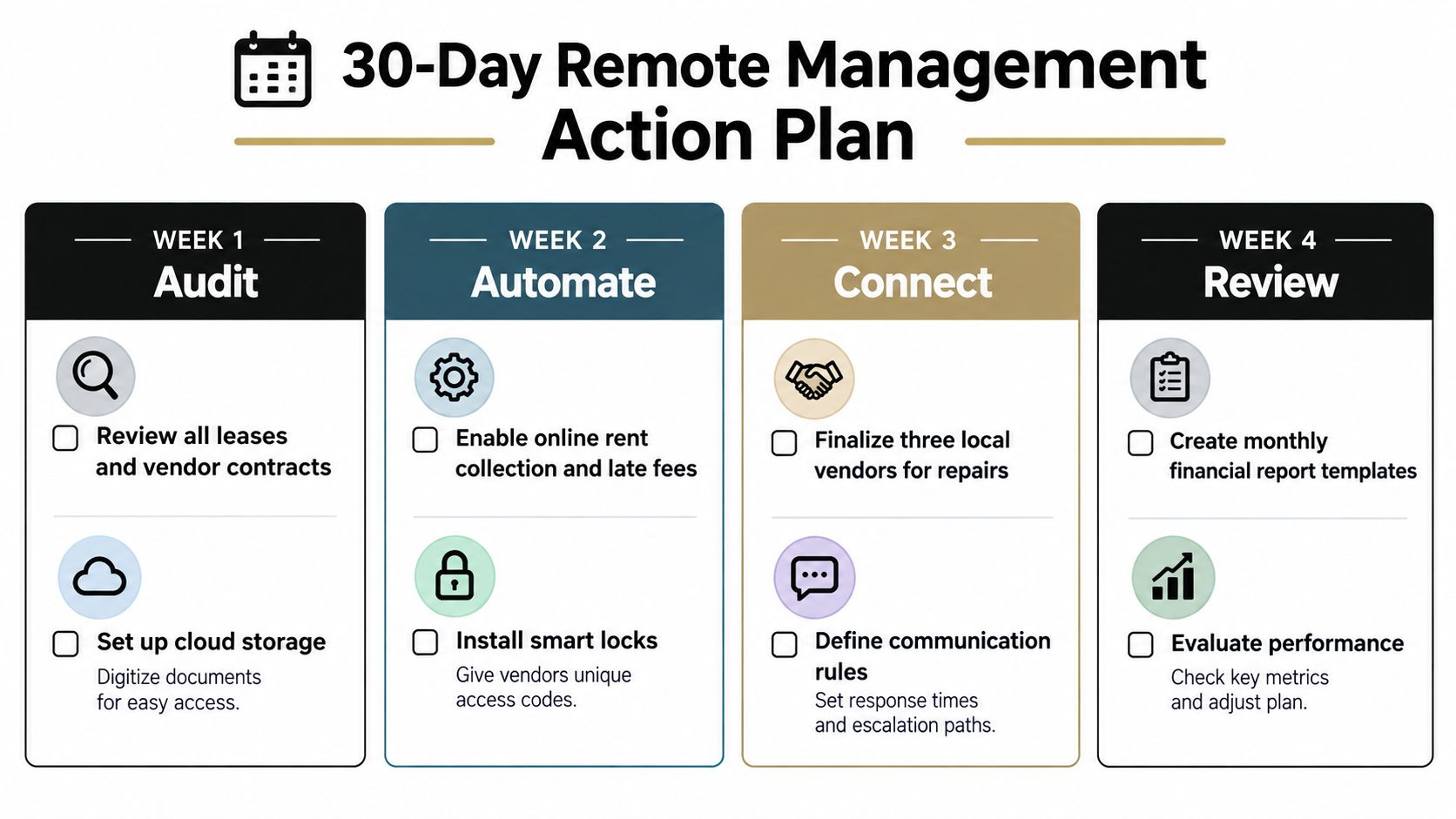
Start with the property file. Store leases, addenda, inspections, vendor agreements, invoices, notices, and owner statements in secure cloud storage. Mark missing documents before an emergency reveals the gap. This file also gives you a way to verify work without being onsite, because invoices, photos, inspection notes, and approvals remain together.
Test the complete lease-to-cash path before relying on it. Submit a test application, confirm screening permissions and approval controls, execute a sample digital lease, verify recurring rent instructions, and check that payment data reaches accounting. A software feature is not a working process until the team can follow it without improvising.
Put governance ahead of convenience
Create a short escalation policy that answers practical questions:
- Urgent maintenance: Who receives the alert, who can authorize immediate action, and how will completion be verified?
- Payment exceptions: When does an unpaid balance move from reminder to formal review?
- Vendor disputes: What evidence is required before an invoice is approved?
- Compliance questions: Who checks the current rule, form, or notice before action?
- Tenant concerns: Which messages require a human response rather than an automated reply?
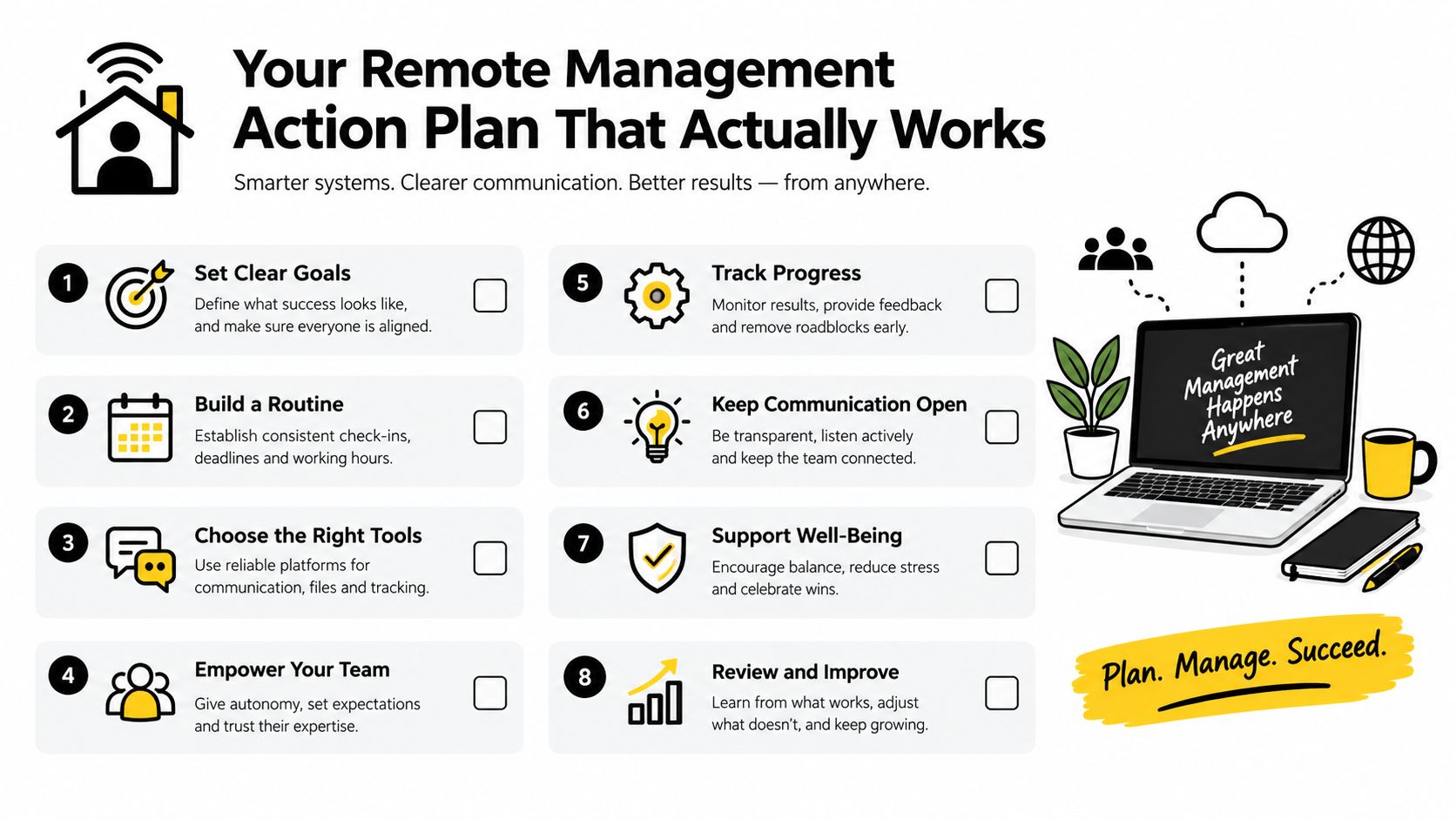
Use one communication channel for tenant requests, one work-order record for repairs, and one reporting rhythm for owner oversight. Automate routine reminders and status notices. Keep human control over exceptions, approvals, compliance questions, and work that cannot be verified from a document or photo.
Use the next month deliberately
During the first phase, audit leases, vendor contracts, records, and open issues. Next, automate payments, reminders, document storage, and task notifications. Then confirm local vendor coverage and response expectations. Finish by reviewing vacancy, days on market, delinquency, work-order aging, and inspection evidence, and adjust any step that still depends on memory.
If you cannot establish dependable local coverage, verify repairs, maintain consistent legally required communication, and review exceptions on schedule, self-management has become delayed administration rather than control. Compare professional support with the time, exposure, and coordination required to govern a Fresno-area property from a distance. The right choice depends on whether your system produces timely evidence, not only whether the monthly fee appears lower.
Edinhart Realty and Property Management provides full-service monthly management for rent collection, repair coordination, tenant communication, move-in and move-out coordination, renewals, and accounting, along with placement-only support for marketing, screening, and lease drafting. Visit Edinhart Realty and Property Management to discuss a remote-management setup for your Fresno, Clovis, Friant, or Central California rental.


