

Getting your financing in order for an investment property doesn't start when you fill out a loan application. It starts way before that. The real secret is building a financial profile that lenders can't say no to.
This is all about getting your credit, savings, and debt situation dialed in to meet the much tougher standards for investment loans. When you do this groundwork, you're not just hoping for an approval—you're positioning yourself for the best possible interest rates.
Building Your Foundation for Financing Approval

Long before a lender even glances at the property you want to buy, they’re looking at you. Getting a loan for an investment property is a totally different beast than buying your own home. Lenders see these loans as a bigger risk, which means they're a lot more demanding.
Your mission is to make your financial profile look as organized and reliable as possible.
Think of it like this: walking into a bank with your finances in perfect order gives you all the leverage. This goes way beyond just "saving up for a down payment." We're talking about digging into the nitty-gritty numbers that loan underwriters obsess over.
Get Your Credit Score Sparkling
Your credit score is the first hurdle. You might be able to get a mortgage for your own home with a score in the high 600s, but for an investment property, you need to aim higher. To get the best rates, you’ll really want a FICO score of 740 or more.
First things first, pull your credit reports from all three big bureaus: Equifax, Experian, and TransUnion. Go through them with a fine-tooth comb. Look for any errors, accounts you don't recognize, or incorrect late payments. Disputing just one little mistake can give your score a serious bump.
A huge mistake is just assuming your credit report is perfect. I worked with a client once who found a collection account from a utility company for an apartment he'd left years ago. We got it removed, and his score shot up almost 40 points. That single change got him a much better interest rate.
Beyond fixing errors, you need to practice good credit habits:
- Pay every single bill on time. No exceptions.
- Keep your credit card balances below 30% of your total limit.
- Don't open any new credit cards or take out big loans in the months before you apply.
Nail Down Your Debt-to-Income Ratio
Your Debt-to-Income (DTI) ratio is a big one. It tells lenders how much of your monthly income is already spoken for by debt payments. For investment properties, most lenders want to see a DTI of 43% or lower.
Calculating it is simple: add up all your monthly debt payments (mortgage, car loan, student loans, minimum credit card payments). Then, divide that number by your gross monthly income. So, if your debts are $2,500 and your income is $7,000, your DTI is around 36%. Knowing this number is everything—it directly controls how much a bank is willing to lend you.
Build Up Your Cash Reserves
Lenders need to know you can handle a few months of vacancy or a surprise roof repair without missing a mortgage payment. That's where cash reserves come into play.
Most banks will require you to have at least six months of PITI (Principal, Interest, Taxes, and Insurance) payments saved up for each property you own. This isn't a suggestion; for many, it's a hard rule.
These funds have to be liquid, meaning they’re in a checking or savings account, ready to go. They can't be tied up in your 401(k) or other investments.
Thinking ahead about the property's income potential is also a smart move. When you understand its financials, you can make a much stronger case to a lender. A great place to start is by learning what is net operating income with our detailed guide.
Your Financing Readiness Checklist
To put it all together, here’s a quick look at the key metrics lenders are checking and where you should aim to be. Think of this as your personal scorecard before you even talk to a bank.
| Financial Metric | Lender's Ideal Target | Your Action Step |
|---|---|---|
| Credit Score | 740+ | Pull all three reports and dispute any errors. Pay down balances. |
| Debt-to-Income Ratio | 43% or less | Calculate your DTI. Pay down high-interest debt to lower it. |
| Down Payment | 20-25% | Start a dedicated savings account specifically for your down payment. |
| Cash Reserves | 6+ months of PITI | Calculate your required reserves and make sure they're in a liquid account. |
Having these four areas buttoned up before you start shopping for loans will make the entire process smoother and save you a ton of money in the long run.
Decoding Investment Property Loan Options
Figuring out how to finance an investment property isn’t just about getting a check from a lender. It’s about choosing the right financial tool for the job. The loan you select will directly impact your cash flow, potential returns, and overall risk—think of it less as a hurdle and more as a strategic decision that shapes your entire investment.
Your goals, the property type, and your personal financial standing will all point you toward different loan products. A loan that’s perfect for a long-term rental might be a terrible fit for a quick fix-and-flip project. Let's break down the most common pathways to find the one that lines up with your plans.
Conventional Loans: The Go-To for Investors
For most seasoned investors, the conventional mortgage is the workhorse of real estate financing. These are the loans you get from traditional banks, and they’re popular for a reason: competitive rates and standard terms.
But lenders view investment properties as higher risk than a primary residence. To offset that risk, they tighten their requirements considerably. You'll almost always need a bigger down payment, typically 20-25% of the purchase price. Forget about those low down payment options you see for first-time homebuyers; they just don't apply here.
Lenders will also scrutinize your debt-to-income (DTI) ratio more intensely and look for a strong credit score—usually 740 or higher—to offer the best terms. On top of that, interest rates on investment property loans are typically 0.5% to 1% higher than those for a primary home.
To get a clearer picture of what lenders are looking for, it helps to understand their whole approval process. This guide on how to qualify for a mortgage is a great resource that covers the key financial metrics and steps to get prepared.
Government-Backed Loans: A Strategic Niche
While most government-backed loans are designed for owner-occupants, there’s a clever strategy investors use called "house hacking." This works especially well with an FHA loan, which allows for a down payment as low as 3.5%.
The catch? You have to live in the property.
This strategy is perfect for multi-unit properties (up to four units). You can buy a duplex, triplex, or fourplex, live in one unit as your primary residence for at least a year, and rent out the others. The rental income can help cover your mortgage, slashing your living expenses while you build your portfolio.
Similarly, VA loans are an incredible option for eligible veterans and service members. They offer the amazing benefit of 0% down and can also be used for multi-unit properties where you occupy one of the units.
Portfolio Lenders and Credit Unions: The Flexible Alternative
Once you start acquiring multiple properties, you might find that big banks get a little hesitant to lend to you. This is where portfolio lenders and local credit unions really shine. Unlike conventional lenders who sell their loans on the secondary market and have to follow strict guidelines, these institutions often keep the loans "in-house."
This gives them much more flexibility in their underwriting.
- Creative Underwriting: They can look at your entire real estate portfolio and experience, not just a rigid DTI ratio.
- Unique Properties: They’re often more willing to finance properties that don't fit the standard mold.
- Relationship-Based: Building a relationship with a local lender can open doors to future deals and more personalized terms.
For more insights on options beyond the big banks, check out our guide on real estate investor financing.
This infographic gives you a quick look at how traditional bank loans stack up against private lending, which includes options like portfolio lenders.
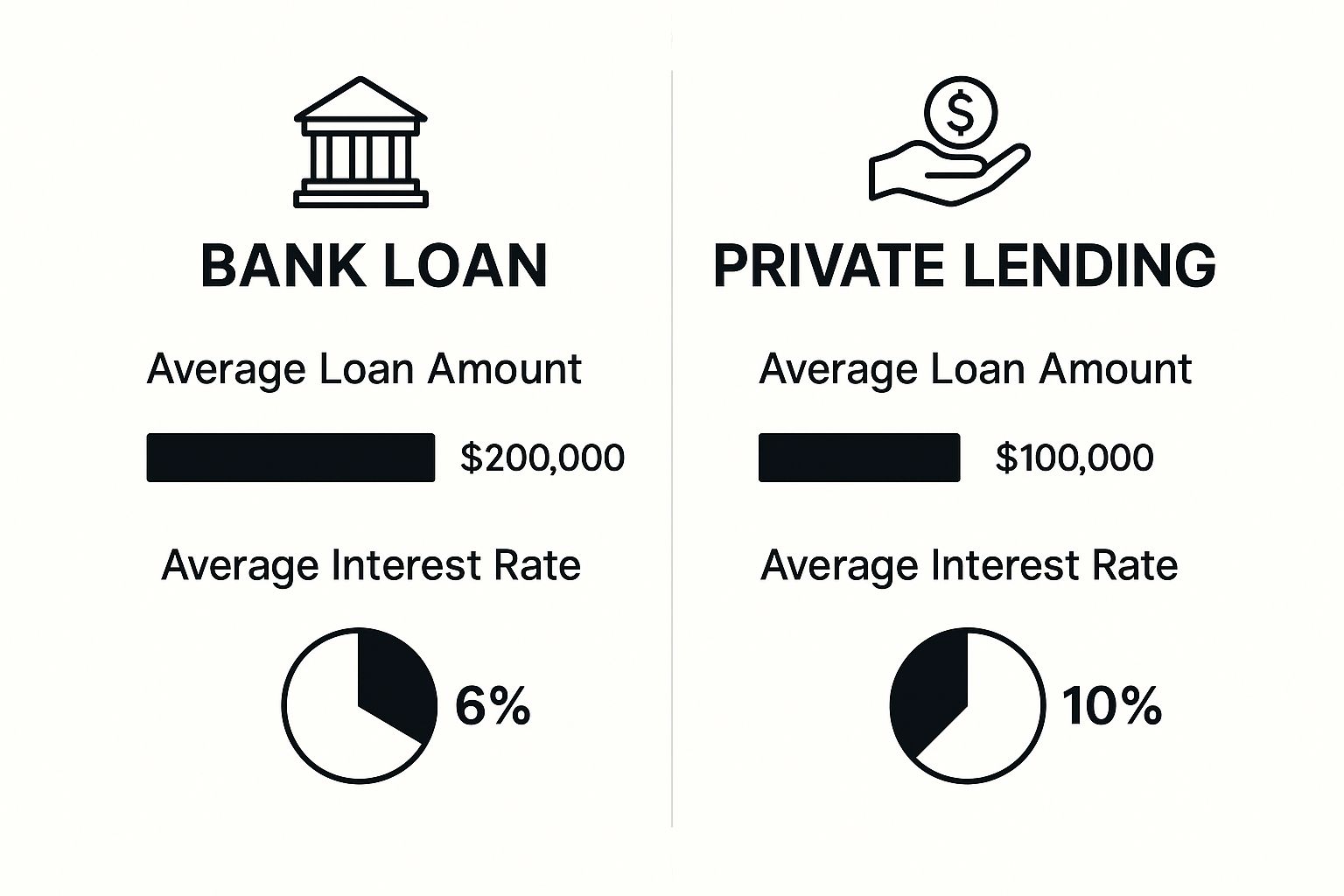
As you can see, while private lending might come with higher interest rates, it often provides access to larger loan amounts—a reflection of its flexibility for serious investors.
Comparing Your Investment Loan Options
To help you decide which path fits your investment strategy, here’s a side-by-side breakdown of the most common financing options.
| Loan Type | Best Suited For | Key Strengths | Potential Drawbacks |
|---|---|---|---|
| Conventional Loan | Long-term buy-and-hold investors with strong credit and capital. | Competitive interest rates and standard 30-year terms. | Strict DTI and credit score rules; high down payment (20-25%). |
| Government-Backed | First-time investors using the "house hacking" strategy. | Very low down payments (0-3.5%) and flexible credit requirements. | Must be an owner-occupant; limited to 2-4 unit properties. |
| Portfolio Lender | Experienced investors with multiple properties or unique financing needs. | Flexible underwriting based on your entire portfolio and experience. | Potentially higher interest rates and fees than conventional loans. |
| Hard Money Loan | Fix-and-flip investors who need to close a deal quickly. | Extremely fast funding; loan is based on the property's ARV. | High interest rates and short repayment terms (typically 1-3 years). |
Choosing the right loan is a foundational step. Don’t just look at the interest rate; consider how the loan’s structure, terms, and requirements align with your short- and long-term goals for the property.
Hard Money Loans: Speed for Short-Term Plays
What if you find an amazing deal on a distressed property that needs a quick renovation and won't qualify for a conventional loan? This is where a hard money loan comes in. These are short-term, high-interest loans from private investors or companies.
A hard money loan is a tool, not a trap. It’s expensive, yes, but for a fix-and-flip investor who needs to close in 10 days, the speed is worth every penny. The plan is never to hold this debt long-term; you use it to acquire and renovate, then either sell the property or refinance into a traditional mortgage.
These loans are based on the property's after-repair value (ARV), not your personal credit score. This asset-based approach is gaining traction across the industry. For example, global real estate fundraising hit $77.1 billion in the first half of 2025, with investors favoring value-add and debt funds—strategies that, like a hard money loan, focus on unlocking a property's hidden potential.
Navigating the Loan Application and Underwriting Maze

This is where the rubber meets the road. After all your prep work, securing the loan comes down to the underwriting process. It can feel a bit like a final exam, but getting that approval isn’t about luck. It’s about being incredibly organized and presenting a crystal-clear financial story.
Think of it this way: lenders will ask for what feels like a mountain of paperwork, but they aren’t just checking boxes. They’re piecing together a narrative about you. Your tax returns, W-2s, and bank statements are all chapters in the story of your reliability as a borrower. Let's make sure it's a bestseller.
The Art of Digital Document Organization
When an underwriter asks for a document, the clock starts ticking. I learned early on that responding in minutes instead of days shows you’re a professional they want to work with. Over the years, I've perfected a simple digital filing system that has saved me countless headaches.
It’s easy to replicate. Just create a master folder on your computer or a cloud drive (like Google Drive or Dropbox) and label it with the property address. Inside, make subfolders for each document category.
- Income Verification: This is where you’ll keep your last two years of W-2s, 1099s, and complete tax returns—and I mean complete, with all the schedules attached.
- Asset Statements: Get the last two or three months of statements for every single checking, savings, and investment account. And make sure you download the full, official statements, not just a transaction history printout.
- Debt & Liabilities: Pop copies of your current mortgage statements, car loans, student loan docs, and anything else you owe into this folder.
- Personal ID: Have a crystal-clear scan of your driver's license and Social Security card ready to go.
Having everything filed and ready means you can fire off a response to any lender request almost instantly. This one simple habit demonstrates your competence and keeps the entire process moving without any frustrating delays.
Writing a Compelling Letter of Explanation
Underwriters are trained to spot anything out of the ordinary. A recent large deposit, a weird blip on your credit report, or a gap in employment will immediately raise a red flag. Don't panic. This is actually your chance to get ahead of the story with a Letter of Explanation (LOE).
A good LOE is short, direct, and sticks to the facts. For instance, if you have a big cash deposit, your letter might just say: "The $10,000 deposit into my savings account on May 15, 2024, was a gift from my parents to assist with the down payment. A signed gift letter has been provided." That's it.
Address the issue head-on, give a clear reason, and attach any supporting documents you have. A well-written LOE stops the underwriter from guessing and gives them the logical answer they need to stamp your file "Approved."
The goal is to answer the underwriter's question before they have to ask it twice. Being proactive with explanations for anything out of the ordinary builds trust and shows you have nothing to hide.
The Investment Property Appraisal Hurdle
The property appraisal is a massive milestone in the underwriting process, and for investment properties, it's a whole different ballgame. The appraiser isn’t just figuring out what the property is worth today; they're also judging its potential rental income.
For this, they'll use a specific form called the Small Residential Income Property Appraisal Report (Form 1025). This includes a Comparable Rent Schedule, where they analyze what similar, nearby properties are renting for to make sure your projections are realistic.
So, what do you do if the appraisal comes in low?
First, breathe. Don't assume the deal is dead. You've got options:
- Review the Report: Comb through the appraisal for any mistakes. Did they list the wrong square footage? Did they miss the brand-new roof you know is on there? It happens.
- Challenge the Appraisal: You can submit a "reconsideration of value." This is where you provide the lender with better, more accurate comparable sales that the appraiser might have overlooked.
- Negotiate with the Seller: A low appraisal is powerful leverage. You can go back to the seller and renegotiate the price, because they know the next buyer’s lender will likely have the same issue.
- Bring More Cash: If you're still completely sold on the deal and the seller won't budge, your final option is to cover the difference between the appraised value and the sales price out of pocket.
To get through the loan application successfully, you have to be the CEO of your own financing journey. By staying organized, communicating clearly, and understanding these key milestones, you can turn a stressful ordeal into a smooth closing.
What To Do When Traditional Loans Aren't An Option
So, what happens when a killer deal falls into your lap, but it just doesn't tick all the boxes for a traditional lender? Maybe the property needs a little too much TLC, or your debt-to-income ratio is already stretched a bit thin. This is exactly where smart investors find their edge—they know how to get creative.
Knowing how to secure financing outside of the big banks can open up a world of opportunities that most people have to walk away from. These alternative strategies are incredibly powerful for building a portfolio, often with more flexible and better terms than you'd ever expect.
The Magic of Seller Financing
One of my absolute favorite creative financing methods is seller financing, sometimes called an owner carry-back. Simply put, the seller of the property becomes your bank. Instead of you trekking to a mortgage lender, the seller finances the deal for you, and you send your monthly payments directly to them.
This can be a true win-win. The seller gets a reliable income stream and often offloads their property much faster. And for you, the buyer, the benefits are huge:
- Flexible Down Payment: You can often negotiate a much lower down payment than the standard 20-25% the banks demand.
- Negotiable Interest Rates: The rate, the term, the amortization—it's all on the table for you and the seller to agree on.
- Way Faster Closing: Without a bank's endless underwriting process, these deals can close in a fraction of the time.
I once found a duplex that was an absolute gem, but the owner was an older gentleman who was far more interested in steady monthly checks than a big lump sum. We worked out a seller-financed deal with just 10% down and a very fair interest rate. It let me add a great cash-flowing asset to my portfolio without tying up all my capital.
Seller financing is the perfect play when you find a motivated seller who owns the property outright and isn't desperate for a huge cash-out. It’s a brilliant way to get a "yes" when the traditional lenders say "no."
Tapping into Your Home's Equity
If you own your primary residence and have some equity built up, you’re sitting on a powerful financing tool: a Home Equity Line of Credit (HELOC). A HELOC basically works like a credit card that's secured by your house, letting you borrow against your home's equity up to a pre-approved limit.
This gives investors incredible flexibility. You can pull out funds for a down payment, buy a property all-cash to beat out the competition, or even finance the renovations on your next flip. The interest rates are usually much better than hard money loans, and the best part is you only pay interest on what you actually use.
But, and this is a big but, this strategy doesn't come without risk. You're literally betting the house. If your investment goes sideways and you can't pay back the HELOC, you could lose your primary residence. Only go down this road if you have a rock-solid plan and are extremely confident in the property’s potential.
Partnering Up with a Joint Venture
You don’t have to do this all on your own. Teaming up with another investor in a joint venture (JV) is a fantastic way to pool your resources and get a deal across the finish line. In a common JV setup, one partner might bring the cash for the down payment while the other finds the deal and manages the project.
A successful partnership all comes down to a clear, written agreement. Before you even think about looking at properties, you need to hammer out the details:
- Roles and Responsibilities: Who’s handling tenants? Who’s calling the contractors? Who’s managing the books?
- Profit and Equity Splits: How is the monthly cash flow getting divided? What about the appreciation when you sell? Is it a straight 50/50, or does it vary based on each person's contribution?
- The Exit Strategy: What’s the plan if one partner wants out? How will you handle a sale or refinance down the road?
Getting everything in writing from the start protects everyone involved and prevents major headaches later. Partnering up lets you get into deals you couldn't swing by yourself, combining your strengths to build wealth together.
Understanding Today's Real Estate Financing Climate

Getting a loan for an investment property doesn't happen in a vacuum. The interest rate you're quoted, the down payment a lender demands, and even their basic willingness to approve you are all tied directly to what's happening in the broader economy. To get the best deal, you have to understand these market forces.
This isn’t just some abstract economic theory; it’s boots-on-the-ground intelligence every investor needs. Knowing the current climate helps you set realistic expectations, negotiate from a position of strength, and ultimately, know exactly when to make your move.
How Big Picture Economics Affect Your Loan
Decisions made by the Federal Reserve have a very real and direct impact on your wallet. When the Fed raises interest rates to cool down inflation, borrowing money simply gets more expensive for everyone, and that means higher mortgage rates on investment properties.
On the flip side, when they lower rates to give the economy a jolt, financing gets cheaper. Suddenly, a deal that was just so-so can start to look a whole lot more profitable.
During periods of economic jitters, you can bet that lenders will get more cautious. They often tighten up their lending standards, which means you might need a higher credit score or a lower debt-to-income ratio to even get in the door. They're just managing their own risk, which means you need to show up with an even stronger financial game plan.
Following Capital Flows and Market Momentum
Keeping an eye on where the money is going gives you a massive advantage. It tells you whether the market is heating up or cooling down, which in turn gives you a sense of your own negotiating power.
For example, after a bit of a slow spell, global real estate is starting to show some real energy again. Recent data shows that in 2024, global real estate deal value saw its first jump in three years, climbing by 11% to hit $707 billion. That growth was mostly driven by more stable interest rates and a serious lack of supply in key areas like multifamily housing.
What does that tell us? It means big money is flowing back into real estate. While that might create more competition, it also confirms that real estate remains a rock-solid asset class.
Understanding market momentum is your secret weapon. When deals are flying and capital is flowing, lenders are often more competitive with their loan offers. But when the market cools off, sellers might be more willing to talk about creative financing.
To make the right call on financing, staying current is non-negotiable. It's crucial to stay updated on what's happening in the wider market, like by understanding current mortgage rate trends. This knowledge lets you see shifts coming and tweak your strategy before it's too late.
Drilling down into local market conditions is just as vital. For instance, knowing the specific trends that are impacting interest rates for homes in California can give you a huge leg up if you're investing in the state. National trends paint the big picture, but local data is what dictates your reality. By combining both, you put yourself in the best possible position to make smarter, more profitable financing decisions.
Your Top Questions About Investment Property Loans
If you're asking a lot of questions about financing an investment property, you're on the right track. It shows you’re thinking like a serious investor. We hear the same questions pop up time and again, so we've put together some straight-to-the-point answers to help you get moving.
How Much Cash Do I Really Need for a Down Payment?
This is the big one, and the short answer is: more than for your own home. Most lenders are going to want a 20% to 25% down payment for a conventional investment property loan.
There are creative ways around this, like "house hacking" with an FHA loan where you can get in for as little as 3.5% down. But that comes with a big string attached—you have to live in one of the units. For a straightforward rental where you don't live on-site, you should be ready to bring at least a fifth of the purchase price in cash.
Why so much? Lenders see investment properties as riskier. If you hit a rough patch financially, you're far more likely to miss a payment on a rental before you miss a payment on your own house. The bigger down payment is their safety net.
On the bright side, putting that much down means you get to skip Private Mortgage Insurance (PMI), which is a nice little bonus that lowers your monthly expenses.
Can I Use the Property's Future Rent to Help Me Qualify?
Yes, you absolutely can—but there are a few hoops to jump through. Lenders will often count a portion of the projected rental income toward your qualifications, which can be a total game-changer for getting your Debt-to-Income (DTI) ratio in line.
They won't just take your word for it, though. Here’s the proof they’ll want to see:
- A Signed Lease: If there’s already a tenant in place, a signed lease agreement is golden.
- An Appraisal with a Rent Schedule: Your appraiser will fill out a specific form (the "Comparable Rent Schedule" or Form 1007) that estimates the fair market rent by looking at similar local properties.
- A Vacancy Factor: Lenders play it safe. They'll typically only count about 75% of the gross monthly rent to account for times the property might sit empty between tenants.
So, if the appraiser says the property should rent for $2,000 a month, the bank will likely only add $1,500 to your income when running the numbers.
What’s This “2% Rule” I Keep Hearing About?
The 2% rule is a quick-and-dirty tool investors use to screen deals. It's not a law, just a guideline. The idea is that the gross monthly rent should be at least 2% of the total purchase price, including any immediate repair costs.
Let's say you're looking at a property for $150,000. The 2% rule says it should rent for $3,000 a month or more ($150,000 x 0.02).
Now, in pricier markets, this rule is nearly impossible to hit—many investors use a "1% rule" as a more realistic benchmark. Think of it as a first-pass filter. If a property isn't even in the ballpark, it’s a red flag that your cash flow might be squeezed pretty tight once all the bills are paid.
How Many Investment Properties Can I Actually Finance?
This is another area where a lot of new investors get tripped up. For years, the limit was four mortgages. Thankfully, things have changed.
Today, most conventional lenders will let one person finance up to 10 properties. Be aware, though, that after you get past your fourth property, the rules get tougher. Lenders will probably want to see a higher credit score and proof that you have more cash reserves for each new property you add.
Once you’re ready to scale beyond ten properties, you’ll be moving out of the conventional loan world. At that point, you'll start working with portfolio lenders or commercial banks that cater to experienced, large-scale investors.
Navigating the complexities of property investment is much simpler with an expert partner. The team at Edinhart Realty and Property Management specializes in helping investors maximize their returns, from finding the right property to managing it for optimal cash flow. Visit us at Edinhart.com to learn how our real estate and property management services can help you achieve your investment goals.


