

Before you even think about starting an eviction, you need to understand one crucial thing: this isn't a simple disagreement. It's a formal, step-by-step legal procedure. If you want to remove a tenant, you have to have a legally valid reason, known as "just cause," and follow the process to the letter.
The Reality Of A Legal Eviction
Let's be blunt. You can't just change the locks, turn off the water, or haul your tenant's belongings to the curb. Those moves are illegal "self-help" evictions, and they will land you in a world of legal and financial trouble.
Following the law isn't just about being fair; it’s about protecting yourself and your investment. One misstep—like an improperly served notice or a mistake on the paperwork—can get your entire case thrown out of court. That means you're back to square one, losing even more time and rent money.
Why You Need A Valid Legal Reason
The entire eviction process hinges on having a "just cause." This isn't just any reason; it has to be a specific, legally recognized justification for removing a tenant. In California, these reasons are sorted into two main buckets:
- At-Fault Just Cause: This is when the tenant has done something wrong. Think non-payment of rent, breaking a major term of the lease (like sneaking in a pet when the lease says no), or causing serious damage to your property.
- No-Fault Just Cause: This is when the tenant hasn't violated the lease, but you, the landlord, need the property back for a specific, legally-approved reason. This could be because you or a close family member plan to move in, you're taking the property off the rental market for good, or you need to do substantial renovations that require the unit to be empty.
It's absolutely critical to know the difference. An at-fault eviction usually involves a shorter notice period. A no-fault eviction, on the other hand, almost always requires a longer notice (like 60 days) and may even force you to pay the tenant relocation assistance.
To make it clearer, here's a breakdown of some common reasons under California law.
Valid Reasons for Eviction in California
| Reason Type | Example | Typical Notice Required |
|---|---|---|
| At-Fault | Failure to pay rent | 3-Day Notice to Pay Rent or Quit |
| At-Fault | Breach of a lease term (e.g., unauthorized occupants) | 3-Day Notice to Cure or Quit |
| At-Fault | Committing waste (property damage) or a nuisance | 3-Day Unconditional Quit Notice |
| No-Fault | Owner or relative move-in | 60-Day Notice to Terminate Tenancy |
| No-Fault | Withdrawing the unit from the rental market | 60-Day Notice (or 120-Day for long-term tenants) |
| No-Fault | Substantial remodel or demolition | 60-Day Notice to Terminate Tenancy |
This table is just a summary; the specifics can vary based on your local city ordinances, especially in places like Fresno.
The Scale Of Evictions In The US
The need for a rock-solid legal framework becomes obvious when you look at the national numbers. Before recent laws changed the landscape, landlords across the U.S. were filing an average of 3.6 million eviction cases every single year. That's a staggering figure that impacted roughly 2.7 million households annually. These statistics from the National Low Income Housing Coalition highlight just how common this issue is and why state and local laws are so vital for protecting everyone involved.
As a landlord, your responsibilities are significant, and knowing the law inside and out is your greatest asset. For a deeper dive, our guide on landlord-tenant law in California covers the essential obligations property owners have. From serving the right notice to handling security deposits correctly, any misunderstanding can lead straight to a costly legal battle. This guide will walk you through it all, step by step.
Preparing and Serving the Eviction Notice
Let's be blunt: the entire eviction process lives or dies by one single document—the written notice. I've seen countless cases thrown out of court because of a simple mistake. An incorrect date, a miscalculated rent amount, or improper delivery can completely invalidate your efforts.
This forces you to start from square one, all while the tenant continues to occupy your property, often without paying rent. This isn't a step where you can afford to wing it.
Ditching the generic online templates is your first move. In California, the specific notice you use has to perfectly match the tenant's violation. Using the wrong form is an immediate red flag for a judge and almost guarantees your case will be dismissed before it even starts. You have to select the right tool for the job.
There are three main types of notices you'll work with, and you need to know exactly when to use each one for a specific "at-fault" situation.
- 3-Day Notice to Pay Rent or Quit: This is your go-to, but only for nonpayment of rent. It gives the tenant three business days to pay what they owe in full or move out.
- 3-Day Notice to Cure or Quit: Use this one for fixable lease violations. Think unauthorized pets, unapproved alterations to the property, or a guest who has overstayed their welcome. The tenant gets three days to "cure" (fix) the issue or vacate.
- 3-Day Unconditional Quit Notice: This is reserved for the most serious violations where the tenant gets no second chances. We're talking about illegal activity, creating a major nuisance, or causing significant property damage (legally called "committing waste").
Getting the Details Right
Accuracy here is absolutely non-negotiable. Your notice has to include very specific information to hold up in court. If you leave anything out, you're handing the tenant an easy way to challenge the eviction.
For example, a 3-Day Notice to Pay Rent or Quit cannot demand late fees, utilities, or other charges. It must only state the exact rent owed. If you demand $1,550 when only $1,500 is rent and $50 is a late fee, the notice is defective. It’s a common mistake that proves fatal in court.
Key Takeaway: The clock for your notice period doesn't start until the day after it's served. You also can't count weekends or court holidays. Serve a 3-Day Notice on a Friday? The clock starts ticking Monday, and the tenant has until the end of business Wednesday to comply, assuming no holidays.
For a deep dive into what each notice must contain, we've put together a full breakdown in our guide on how to properly issue a notice to a tenant. Understanding these details is the foundation of a solid eviction case.
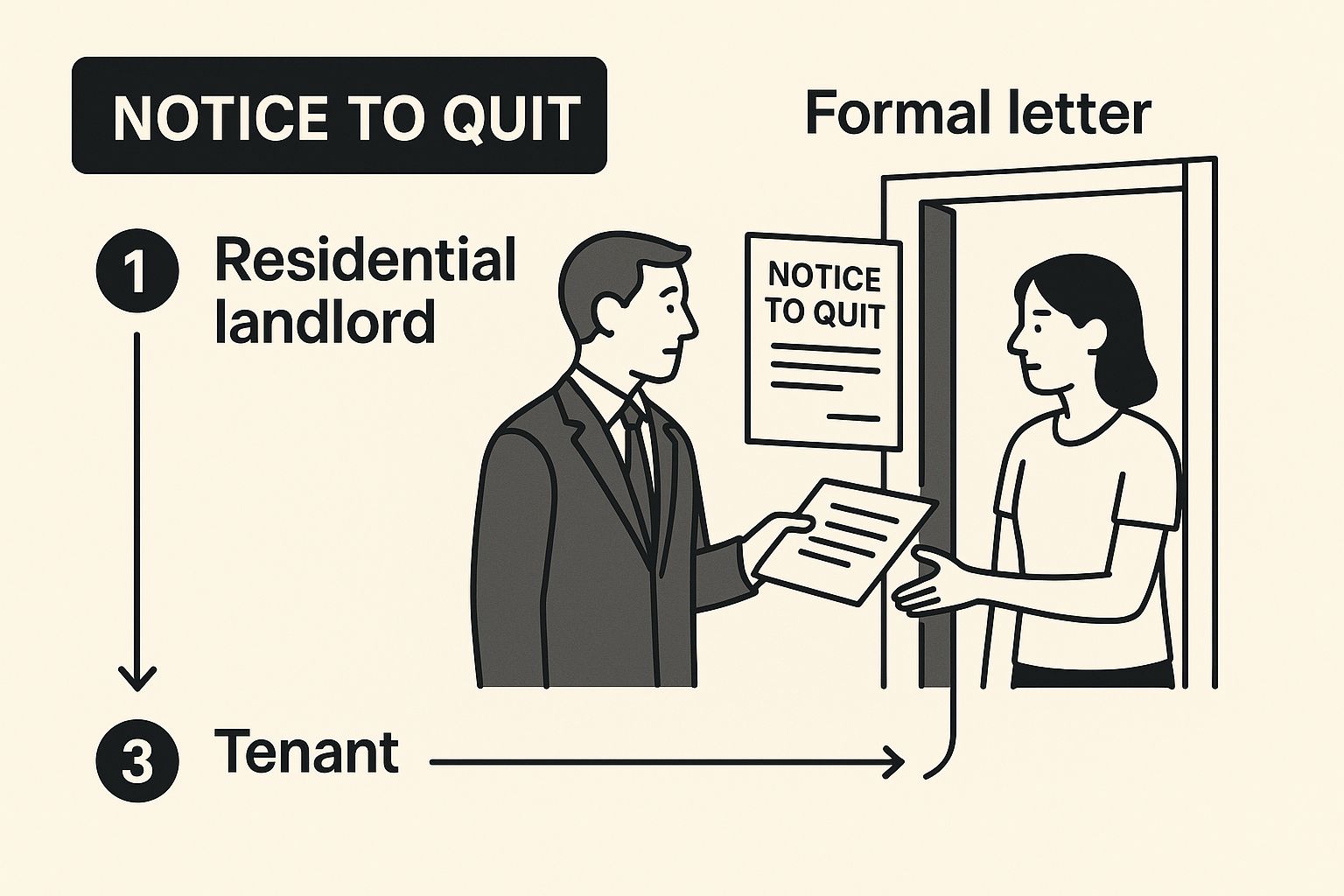
This image shows a landlord correctly serving a notice—a critical step that must be handled with legal precision. It's a formal action, not a casual request.
The Rules of Serving the Notice
Once your notice is drafted perfectly, you have to "serve" it to the tenant according to very strict legal rules. You can't just text them a picture or slide it under the door when they're not around. California law gives you three valid ways to do it.
- Personal Service: Handing the notice directly to the tenant. This is always the best method because it's the hardest for a tenant to dispute.
- Substituted Service: If the tenant isn't home, you can leave the notice with a competent person of suitable age (usually 18 or older) at the property and mail a second copy to the tenant.
- "Post and Mail" Service: This is a last resort. Only if you've tried and failed with personal and substituted service can you post a copy in a visible spot (like the front door) and mail another copy.
After serving the notice, you immediately need to fill out a Proof of Service form. This document is your official record detailing when, where, how, and by whom the notice was served. Without it, you have no evidence you legally notified the tenant, and your Unlawful Detainer case will be dead on arrival.
Filing the Unlawful Detainer Lawsuit
The deadline on your eviction notice has come and gone, but your tenant is still there. Now what? Your only legal option at this point is to take the matter to court. This isn't just a simple disagreement anymore; it's a formal lawsuit known as an Unlawful Detainer.
The name might sound a little intense, but it's just the official legal process for proving the tenant no longer has the right to live in your property. This is the moment your dispute moves from a private issue into the public court system, and it demands absolute precision. One wrong move with the paperwork or timelines, and your entire case could get thrown out.

Preparing the Initial Court Forms
Getting the ball rolling on an Unlawful Detainer lawsuit means filling out two critical forms: the Summons (SUM-130) and the Complaint (UD-100). These aren't optional—they are the official documents that kick off your case in the eyes of the law.
Think of the Complaint as your side of the story. It’s where you lay out all the facts for the judge. You’ll need to detail who you are, who the tenant is, the property address, the basics of the rental agreement, and exactly why you're evicting them. Don't forget to attach a copy of the eviction notice you served and its Proof of Service form.
The Summons is much more direct. It's the court's official notice to the tenant that a lawsuit has been filed against them. It also informs them that they have just five business days to file a formal response with the court. This incredibly short timeline is specific to eviction cases, designed to keep things moving.
Serving the Lawsuit and The Tenant’s Response
Once you've filed the Summons and Complaint with the court clerk, the documents have to be legally delivered to the tenant. This is called "service of process," and it’s a step you absolutely cannot skip or do yourself. The papers must be served by someone who is over 18 and not involved in the lawsuit.
Improper service is one of the most common—and frustrating—reasons landlords lose eviction cases. To avoid this headache, it's wise to hire a professional process server or have the Sheriff's Department handle it for a fee. Just like with the initial notice, a new Proof of Service (form POS-010) must be completed and filed with the court.
After being served, the tenant has a few choices:
- File an Answer: This is the most common path. The tenant formally disputes your claims, which triggers the court to set a trial date.
- File a Motion: They might try to get the case dismissed on a technicality, like a mistake in your paperwork or improper service.
- Do Nothing: If the tenant ignores the lawsuit and the five-day deadline passes, you can ask the court for a "default judgment," which means you win by default.
Pro Tip: Don't assume a default judgment is a sure thing. A tiny error on your initial Complaint or Summons can be enough for the clerk to deny it. I've seen it happen. Double- and triple-check every single detail before you file.
Facing Common Tenant Defenses
If your tenant files an Answer, you need to be ready for the arguments they'll make in court. Knowing what to expect gives you a huge advantage, allowing you to gather the right evidence to shut down their claims.
Here are some of the most common defenses I see:
- Breach of the Warranty of Habitability: The tenant claims the unit was unlivable because of major problems you didn't fix, like a broken heater in winter or a serious roof leak. Your best defense is a meticulous log of all repair requests, work orders, invoices, and photos showing the completed work.
- Retaliatory Eviction: The tenant alleges you're evicting them as punishment for exercising a legal right, such as reporting a code violation. To beat this, you need a crystal-clear paper trail proving a legitimate reason for the eviction, like documented non-payment of rent that started before their complaint.
- Improper Notice: The tenant argues the eviction notice was flawed—it had the wrong dates, an incorrect rent amount, or wasn't served correctly. This is exactly why getting that first notice perfect is non-negotiable.
It’s also important to realize that more tenants are getting access to legal aid, which can dramatically change the game. Research shows that when tenants have a lawyer, their chances of staying in the home skyrocket. In one city, an incredible 86% of tenants with counsel avoided an eviction filing.
This data underscores just how closely judges are scrutinizing landlords' actions. You can read more about how tenant right-to-counsel initiatives contribute to housing stability. Your documentation and preparation have to be flawless to win.
Regaining Possession After a Court Judgment
Winning your case in court is a huge step, but don't pop the champagne just yet. A judgment in your favor doesn't mean the tenant will magically pack their bags and hand you the keys. The final stretch of the eviction process involves legally removing the tenant and taking back your property, and this part has its own strict set of rules.
The judge's ruling gives you the legal right to the property, but you absolutely cannot enforce it yourself. For that, you need a specific court order called a Writ of Possession. Think of it as the official instruction manual from the court to the Sheriff's Department, telling them to carry out the final eviction.
Getting the Writ of Possession
Right after the judge rules for you, your first move is to take that signed judgment to the court clerk's office. You'll need to formally request that they issue the Writ of Possession. It’s not an automatic process—you have to ask for it and pay a fee, which is usually around $40.
Once you’ve paid, the clerk will process your request and hand you the official Writ. This document is powerful, but it’s not for you to use. It’s directed specifically to law enforcement.
Critical Point: Never, ever try to remove the tenant yourself, even with a court judgment. Only a sworn Sheriff's deputy can legally perform the lockout. Taking matters into your own hands is an illegal "self-help" eviction and can land you in serious legal trouble, potentially undoing everything you've worked for.
The Sheriff's Role in the Lockout
With the Writ of Possession in hand, your next stop is the civil division of your local Sheriff's Department. You’ll deliver the Writ and pay their service fee, which typically runs between $100 and $150. The Sheriff's office will then get the eviction on their schedule.
The first thing the Sheriff will do is post a Notice to Vacate on the tenant's door. This is a bright, official-looking notice that gives the tenant five days to move out on their own. This is their final, formal warning.
During this five-day waiting period, your job is simple: do nothing.
- No Contact: Don't talk to the tenant, text them, or even make eye contact.
- No Money: Accepting any form of payment, especially rent, can be seen as reinstating the tenancy, which could void the entire eviction.
- Stay Away: Keep your distance from the property. This prevents potential confrontations and false accusations. Let the process play out.
If the tenant is still there after five days, a Sheriff's deputy will return on the scheduled date for the lockout. You or your property manager must be there to meet the deputy. They will then legally remove the tenant and officially turn possession of the property back over to you.
What to Do with Abandoned Personal Property
It’s common to find that the tenant has left personal items behind. Be careful here. California law has very specific rules about handling abandoned property, and one wrong move could trigger a new lawsuit.
You can't just toss everything in a dumpster. First, you need to assess the value of what was left.
- If the items are clearly trash or have a combined value of less than $700, you can dispose of them.
- If the property appears to be worth $700 or more, you must store it in a safe place.
Next, you are legally required to send a formal "Notice of Belief of Abandonment" to the tenant's last known address. This notice gives them a deadline (usually 15-18 days) to claim their belongings and pay for reasonable storage costs. If they don't respond or fail to collect their property, you can then sell the items at a public auction. Completing this final step ensures you’ve fulfilled all your legal duties and can finally move on.
Avoiding Costly Landlord Mistakes
I've seen it happen more times than I can count. A landlord has every legal right to evict a tenant, but they lose their case in court. It’s almost never because their reason was wrong; it’s because they made a simple, preventable procedural mistake.
The eviction process in California is a legal minefield. One wrong move can send you right back to square one, costing you thousands in lost rent and mounting legal fees. Think of this as your guide to navigating that minefield safely.
The "Self-Help" Eviction Trap
The single biggest—and most destructive—mistake a landlord can make is what the courts call a "self-help" eviction. This is when you get frustrated and decide to take matters into your own hands instead of letting the legal process play out. I get it, the frustration is real, but the consequences are severe.
What does a self-help eviction look like?
- Changing the locks.
- Moving the tenant’s belongings out of the unit.
- Shutting off the water, power, or gas.
- Physically removing the front door or a window.
Attempting any of these is a fast track to disaster. A judge can order you to pay the tenant's actual damages, slap you with penalties up to $100 per day for the violation, and force you to pay their attorney fees. It’s a guaranteed way to lose your case and end up owing the very tenant you were trying to evict. It's also critical to understand what tenants can do, like changing locks without landlord permission, to stay on the right side of the law.
The Danger Of Accepting Partial Rent
Here’s a classic scenario that trips up landlords all the time. You’ve served a 3-Day Notice to Pay Rent or Quit. On the last day, your tenant shows up with half the rent and a promise to pay the rest next week. It’s tempting to take it, but doing so can legally void your eviction notice.
By accepting that partial payment, you’ve essentially created a new agreement and invalidated the original notice. If they don't pay the rest as promised, you can't just pick up where you left off. You have to start the entire process over again with a new 3-day notice for the remaining balance.
Key Takeaway: Once you serve a notice to pay or quit, do not accept any money unless it is the full amount owed. If you decide to create a payment plan, get it in writing and understand you’ll need to serve a new notice if they break that new agreement.
Poor Record-Keeping Will Sink Your Case
In court, your documentation is everything. A judge isn't going to rely on your memory or take your word for it—they want to see proof. A messy or non-existent paper trail is a golden opportunity for a tenant to poke holes in your case.
Your records need to tell the complete story of the tenancy. This isn't optional.
Your file should include:
- A clear ledger of every rent payment, noting the date received and payment method.
- Copies of all lease agreements, addenda, and renewals.
- A written log of communications, including saved texts and emails.
- Dated photos and invoices for all repairs and maintenance work.
When a tenant claims you're evicting them in retaliation for a repair request, a detailed maintenance log becomes your best evidence. If you're struggling with a tenant who isn't caring for the property, our guide on how to deal with a neglectful tenant offers more strategies that hinge on solid documentation.
Navigating the eviction process requires more than just following steps; it demands a proactive approach to avoid these common but costly errors. A small oversight can lead to significant financial and legal headaches.
To help you stay on track, we've put together a quick-reference checklist of common mistakes and their potential consequences.
Costly Eviction Mistakes Checklist
| Mistake | Why It's a Problem | How to Avoid It |
|---|---|---|
| "Self-Help" Actions | Illegal in California; leads to penalties, lawsuits, and automatically losing your case. | Always use the formal court process. Never change locks, shut off utilities, or remove tenant property. |
| Accepting Partial Rent | Voids your "Pay or Quit" notice, forcing you to start the eviction process over. | Refuse any payment that isn't the full amount owed after a notice has been served. Get any new plans in writing. |
| Flawed Eviction Notice | A notice with errors (wrong amount, incorrect dates) will be dismissed by the court. | Double-check every detail. Use a legally compliant template or have an attorney review the notice before serving. |
| Bad Record-Keeping | Weakens your case and makes it easy for a tenant to dispute your claims. | Maintain detailed, organized records of everything: payments, communications, leases, and maintenance requests/repairs. |
Reviewing this checklist before and during the eviction process can help you sidestep the most common pitfalls that landlords face. Staying diligent and following the law to the letter is your best strategy for a successful outcome.
Common Eviction Questions Answered
Even with a perfect roadmap, the eviction process is full of twists and turns. As a landlord, you're bound to hit a few "what if" scenarios that leave you wondering what to do next. Let's tackle some of the most practical questions that come up when you find yourself needing to evict a tenant.
Can I Evict a Tenant in California if They Don't Have a Lease?
Yes, you can, but you have to follow a specific set of rules. When a tenant doesn't have a formal written lease, California law views them as a "month-to-month" tenant. You can't just show them the door tomorrow.
To end this kind of tenancy without a specific reason (like not paying rent), you must serve them with a proper written notice. The timeline depends entirely on how long they've been there.
- If the tenant has lived in your property for less than one year, a 30-Day Notice to Vacate is required.
- If they've been a resident for a year or more, the law mandates a longer 60-Day Notice to Vacate.
Now, if you're evicting for a specific fault—say, they haven't paid rent—the standard process kicks in. You'd serve a 3-Day Notice to Pay Rent or Quit, exactly like you would for a tenant with a signed lease. The lack of a lease doesn't create a shortcut; it just changes the notice you need for a no-fault termination.
What Is the Average Cost to Evict a Tenant?
Pinning down an exact number is tricky because every situation is different. It’s best to break down the expenses into two buckets: the direct, out-of-pocket costs and the often-larger indirect costs.
The direct costs are the clear-cut fees you'll pay along the way.
- Court Filing Fees: You can expect to pay between $240 and $450 just to get the Unlawful Detainer lawsuit filed with the court.
- Sheriff's Fees: The Sheriff’s Department charges for serving the lawsuit and, later, for performing the final lockout. This typically runs about $40 to $150.
- Attorney Fees: If you hire a lawyer, these fees can start around $500 for a straightforward, uncontested case but can soar into the thousands for a complicated eviction that ends up in a trial.
Don't forget the indirect costs, which can really add up. We're talking about months of lost rent, the cost of repairing potential property damage, cleaning expenses, and all the fees that come with finding a new, qualified tenant.
An uncontested eviction might cost you under $1,000 in direct fees, but a hard-fought case can easily blow past $5,000, and that’s before you even factor in the lost rental income.
What if the Tenant Damages the Property Before They Leave?
This is an incredibly frustrating but unfortunately common problem. The second you legally get the property back and find damage, your first job is to document everything. I mean everything.
Take clear, dated photos and videos of every single problem. Your phone is your best tool here. Then, get detailed, written estimates from professional contractors for all the repairs needed. This paperwork is absolutely essential.
You are legally allowed to use the tenant's security deposit to pay for damages that are more than just normal wear and tear. If the deposit doesn't cover the full repair bill—and for major damage, it often won't—your next step is to file a new case against them in small claims court to get the rest. This is a totally separate legal action from the eviction itself.
Can I Still Talk to My Tenant After Serving an Eviction Notice?
You can, but you have to be incredibly careful. Every conversation you have from this point on has potential legal consequences. The best practice is to keep all communication in writing, whether it’s through email or a tenant portal, so you have a solid paper trail.
The biggest risk here is accidentally saying or doing something that voids your eviction notice. For instance, if you serve a 3-Day Notice and then verbally agree to let them pay in two weeks, you’ve probably just invalidated your notice. Accepting a partial rent payment is another classic mistake that can send you right back to square one.
The safest bet is to limit communication. If the tenant has questions, politely refer them to the written notice they already received. If you're open to negotiating a deal like a "cash for keys" agreement, get the final terms down in a formal written agreement, signed by both of you, that explicitly states it resolves the pending eviction.
Navigating the complexities of tenant screening, lease agreements, and, when necessary, the eviction process requires expertise and diligence. Edinhart Realty and Property Management provides professional, legally compliant services to protect your investment and give you peace of mind. To learn how our experienced team can help you manage your Fresno-area properties effectively, visit us at https://edinhart.com.


