

Figuring out how much to charge for rent isn't just a guessing game. It starts with digging into what similar local properties—what we call comps—are currently renting for. From there, you can nail down an average rent per square foot and then fine-tune that number based on your property's specific perks, its condition, and any standout amenities. It's a data-first approach that gets you a competitive price.
The Foundation of Profitable Rent Pricing
Setting the right rent is a balancing act. If you aim too high, you're looking at a vacant property that bleeds money. Go too low, and you're leaving cash on the table every single month. This guide gives you a solid framework to figure out your property's real market value, so you can set a rent that pulls in great tenants while maximizing your profit.
A big part of smart rent pricing is understanding how that income plays into your bigger investment picture. For a deeper look at the numbers, it's worth reading up on Calculating Return on Investment (ROI) for Real Estate.
The whole process really boils down to three key stages: analyzing the market, adjusting for your property, and then finalizing your price.
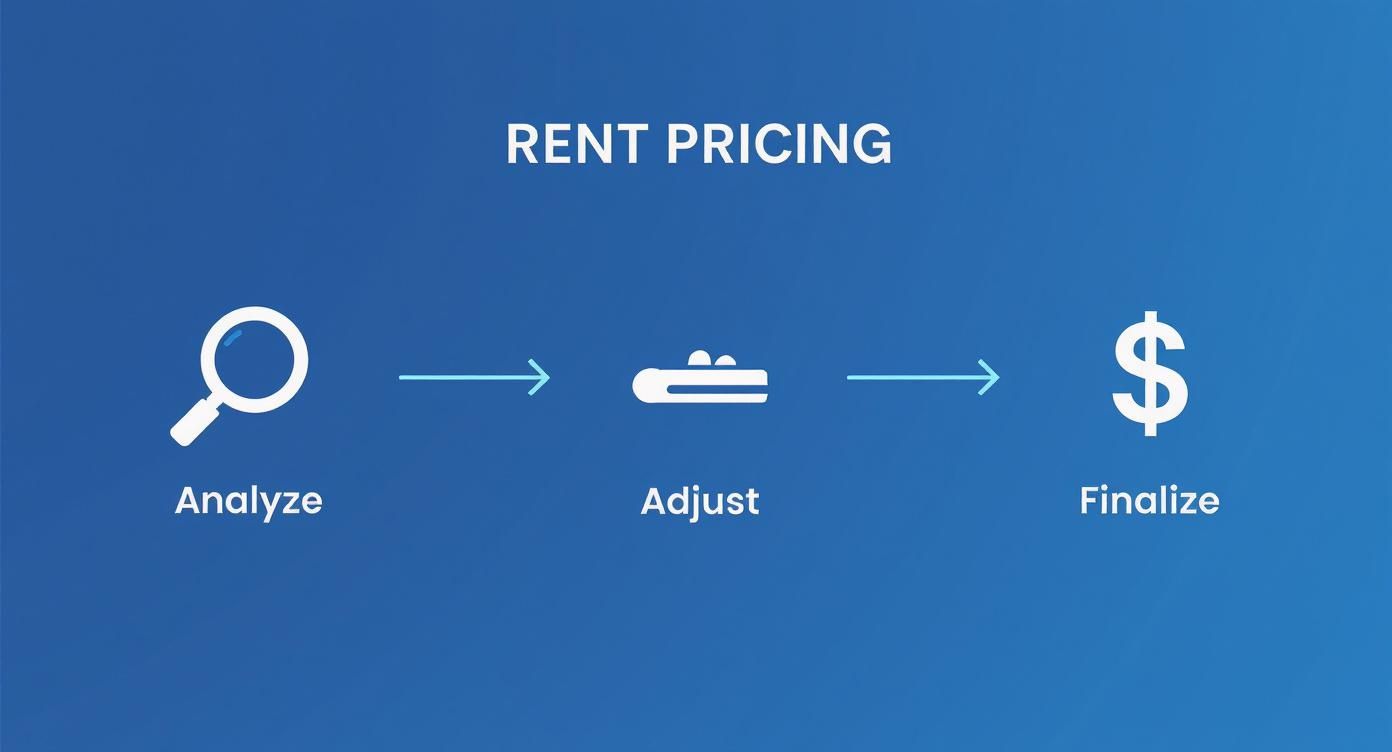
This visual really drives home the point: a solid valuation always starts with the hard market data before you start making tweaks for your property's unique features. Getting this flow right is how you land on a price that's both competitive and profitable.
Why Accurate Pricing Matters Now More Than Ever
The rental market is always moving, pushed and pulled by inflation, tenant demand, and the local economy. And things can change fast. Since 1980, the average annual rent increase has hit 8.86%, a huge jump from what we used to see. Between 2020 and 2021 alone, rent-per-square-foot shot up by an incredible 15.3%, showing just how wild the ride can be for investors.
Setting the right rent isn't just about covering your mortgage—it's about maximizing your asset's performance. Every dollar below market rate is a permanent loss of potential income.
At the end of the day, an accurate rental estimate is the bedrock of a healthy investment. It has a direct line to your bottom line and your ability to keep the property filled with reliable tenants. To get a better handle on your property's financial health, check out our guide on doing a full rental property cash flow analysis.
To make this easier, here’s a quick rundown of the main strategies we'll be covering to help you lock in that perfect rental price.
Quick Guide to Estimating Rental Value
| Method | What It Is | Best For |
|---|---|---|
| Comparative Market Analysis (CMA) | Analyzing rents of similar, nearby properties (comps). | Getting a real-world, current market baseline for standard rental units. |
| Rent Per Square Foot | Calculating an average price based on the property's livable space. | Comparing properties of different sizes and establishing a consistent metric. |
| Income-Based Valuation | Using the property's potential income (Gross Rent Multiplier or Cap Rate). | Investors evaluating a property's financial performance and potential ROI. |
| Online Rent Estimator Tools | Using algorithms and large datasets to generate a quick rent estimate. | A fast, initial gut-check before diving into a more detailed analysis. |
Each of these methods offers a different lens through which to view your property's value. The real magic happens when you use them together to get a well-rounded and defensible final number.
Running a Comparable Market Analysis
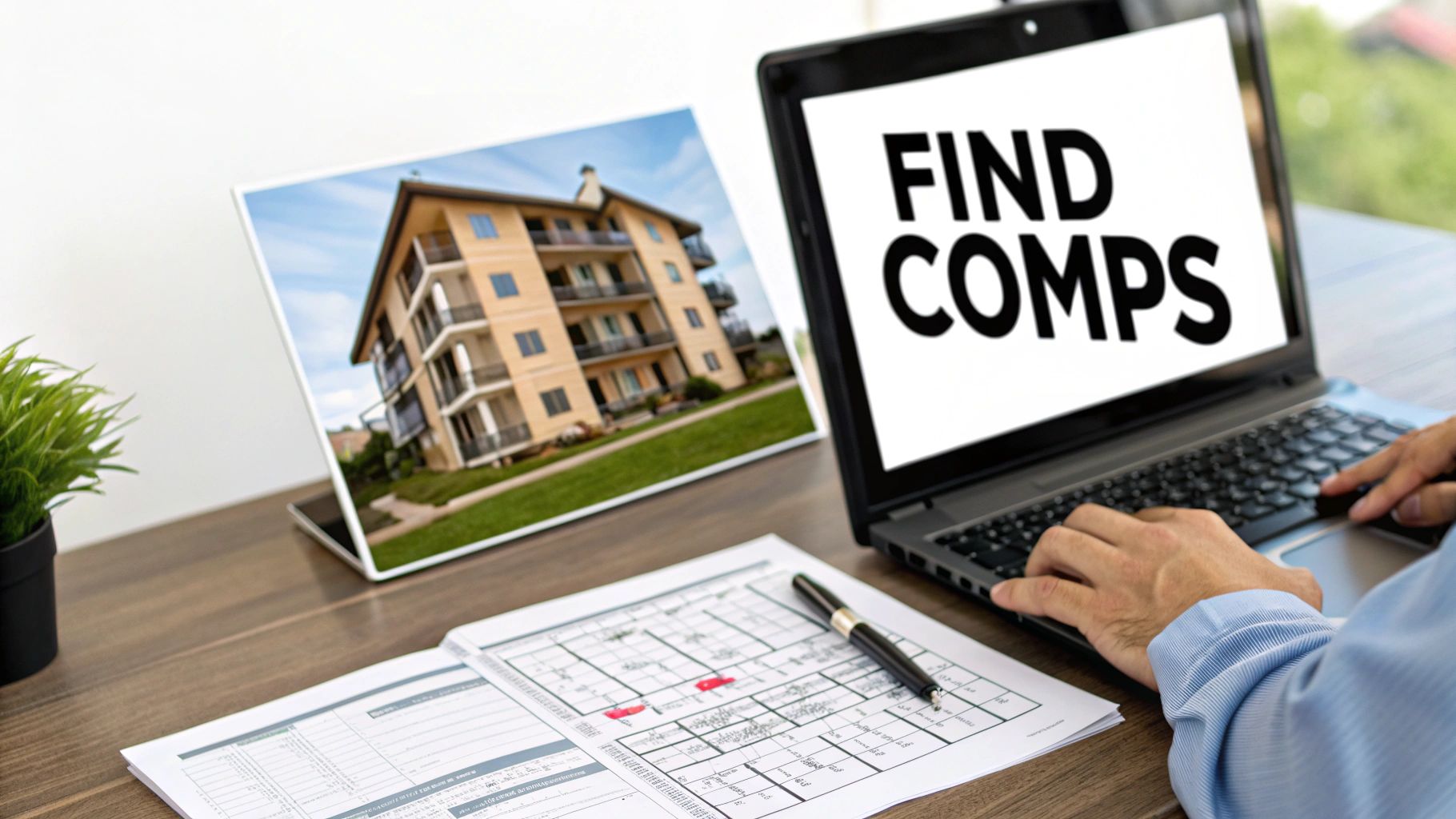
The most reliable way to figure out your property's rental value is to start with a comparable market analysis, often called a CMA. This just means finding “comps”—similar properties in your immediate area that have rented recently. This isn't about throwing a dart at a board; it's about grounding your price in hard, local data to get a solid baseline.
Your first move is to track down listings for properties that are genuinely like yours. You're looking for the same places a prospective tenant would be comparing your property to.
Finding True Comparables
You need to get laser-focused here. Look for properties that have been rented out within the last 30 to 90 days. Anything older than that is probably stale data, as the market can turn on a dime.
Here's what makes a comp a strong comp:
- Location: It has to be within a half-mile of your place, ideally in the same neighborhood or even on the same street.
- Property Type: Compare apples to apples. Single-family homes to other single-family homes, condos to other condos.
- Bedrooms & Bathrooms: The bed/bath count should be identical. A 3-bed, 2-bath home is a completely different market from a 2-bed, 1-bath.
- Square Footage: Stick to properties within 10-15% of your home's size.
- Age and Condition: A brand-new build is not a fair comparison to a 50-year-old home unless you're prepared to make some major adjustments.
Websites like Zillow, Realtor.com, and Apartments.com are great starting points. But don't sleep on the websites of local property management companies—they often have the most accurate, up-to-the-minute rental data for your specific pocket of the city.
I see this mistake all the time: landlords pulling comps from too wide of an area. Rental rates can swing wildly from one zip code to the next. Staying local is absolutely crucial for accuracy.
You can get a better handle on these differences by checking out our guide on average rental rates by zip code. This kind of hyper-local focus makes sure your analysis actually reflects what renters are paying right there, right now.
Making Sense of the Data
Once you’ve found at least three to five solid comps, pop them into a simple spreadsheet. Track the address, rent price, square footage, bed/bath count, and any special amenities. Having it all laid out like this makes it much easier to spot trends and nail down a clear rental range.
It's also worth knowing that tracking rental data has gotten way more sophisticated. The Bureau of Labor Statistics actually had to overhaul its methods after 1978 because its old system had a downward bias—it wasn't properly accounting for rent hikes between tenants. This just goes to show how complex it is to measure rent accurately and why using fresh, high-quality data is so important. You can read more about these measurement challenges if you want to geek out on the details.
At the end of the day, your CMA gives you an evidence-based starting point. It's the foundation for everything else. Once you have this, you can start making adjustments for your property's specific amenities, condition, and other unique features. By starting with solid, relevant comps, you’re already halfway to setting a competitive and profitable rent.
Calculating Rent Per Square Foot
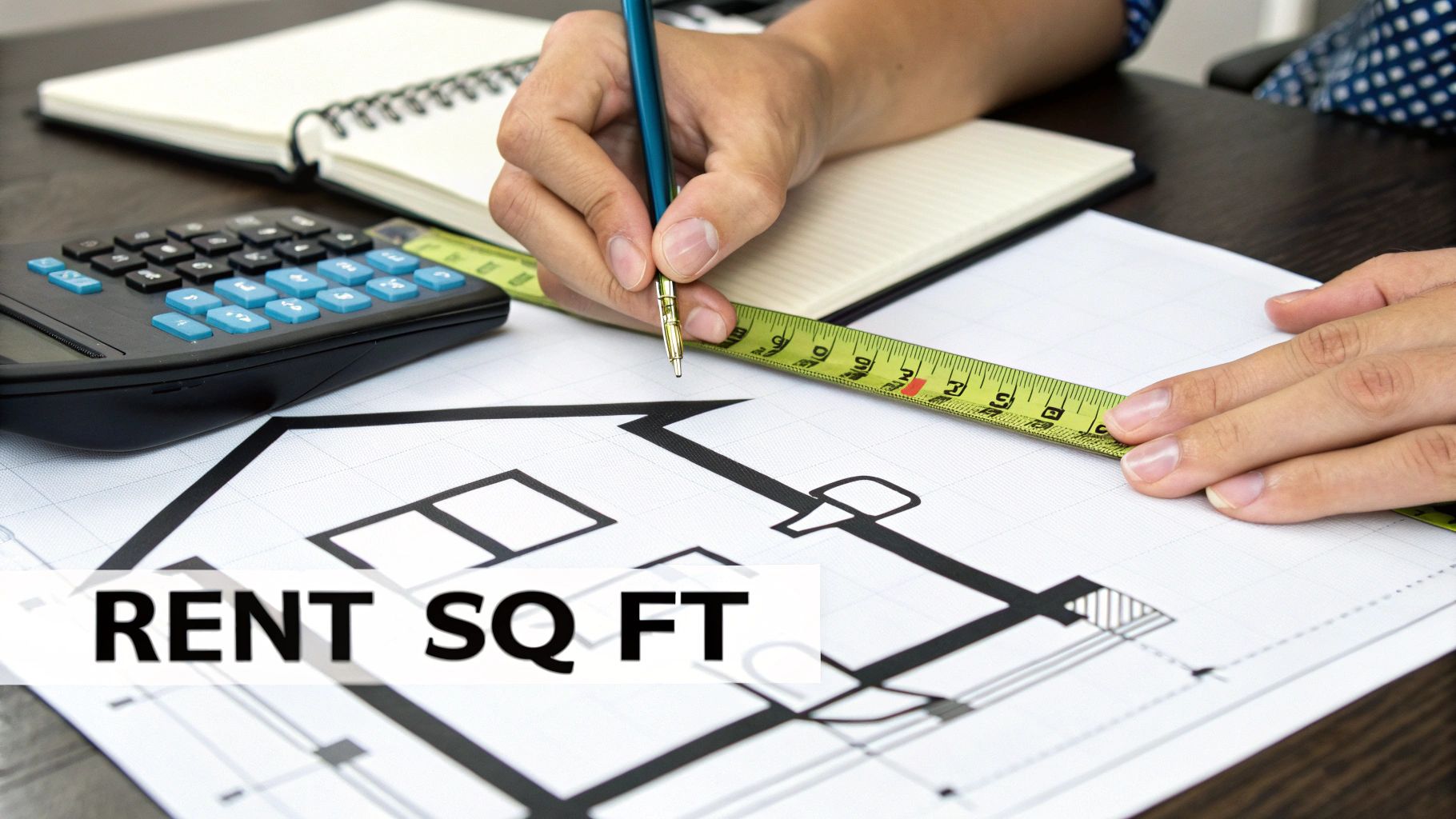
Okay, you’ve gathered your comps. Now it's time to dig a little deeper with a metric that seasoned landlords rely on: rent per square foot. This simple calculation cuts through the noise and lets you make a true apples-to-apples comparison, even when properties aren't exactly the same size.
It’s a really straightforward formula. Just take a comp’s monthly rent and divide it by its total square footage. The result is the dollar amount tenants are willing to pay for each square foot in your neighborhood.
Formula: Monthly Rent / Total Square Footage = Rent per Square Foot
Let’s say a house down the street is 1,500 square feet and rents for $2,400 a month. The math is $2,400 / 1,500 sq. ft. = $1.60 per square foot. Now you can take that rate and multiply it by your property's square footage to get a solid, data-driven starting point for your own rent price.
It's Not Just Simple Multiplication
But hold on. If you just slap that number onto your property without any other thought, you might be leaving money on the table—or pricing yourself out of the market. Real estate has its quirks, and the price-per-square-foot metric is no exception.
One of the biggest factors I see trip people up is the weird relationship between a property’s size and its per-square-foot rent. You’d think bigger is always better, but smaller units—like a studio or one-bedroom apartment—almost always pull in a higher rent per square foot than a big single-family home. Why? Because every unit needs a kitchen and a bathroom, and those high-cost areas get spread over less square footage in a smaller space.
Here’s a classic example I see all the time:
- A 700 sq. ft. one-bedroom apartment rents for $1,600/month. That's $2.28 per sq. ft.
- A 2,000 sq. ft. three-bedroom house nearby rents for $3,000/month. That's only $1.50 per sq. ft.
That little apartment is commanding a rate that’s nearly 52% higher per foot! This is exactly why it’s so critical to only compare your property to others that are truly similar in size and type.
How the Floor Plan Changes Everything
Another thing raw numbers won't tell you is how a property feels. The layout itself plays a huge role in what a tenant is willing to pay. A smart, efficient floor plan can make a home feel way more spacious and functional, justifying a higher rent even if it has the same square footage as a poorly designed competitor.
An open-concept design where the kitchen, dining, and living areas all flow together is what everyone wants these days. It just feels more modern, social, and full of light. This layout will always get a premium over an old-school, choppy floor plan with a bunch of small, walled-off rooms.
So when you're looking at your comps, don't just stop at the numbers. Click through the listing photos. If you can find a floor plan, even better. A home with a logical flow, good storage, and usable space is always going to have an advantage. This qualitative gut check is how you adjust your per-square-foot math to reflect what your property is really worth to a renter.
Adjusting Rent for Features and Amenities
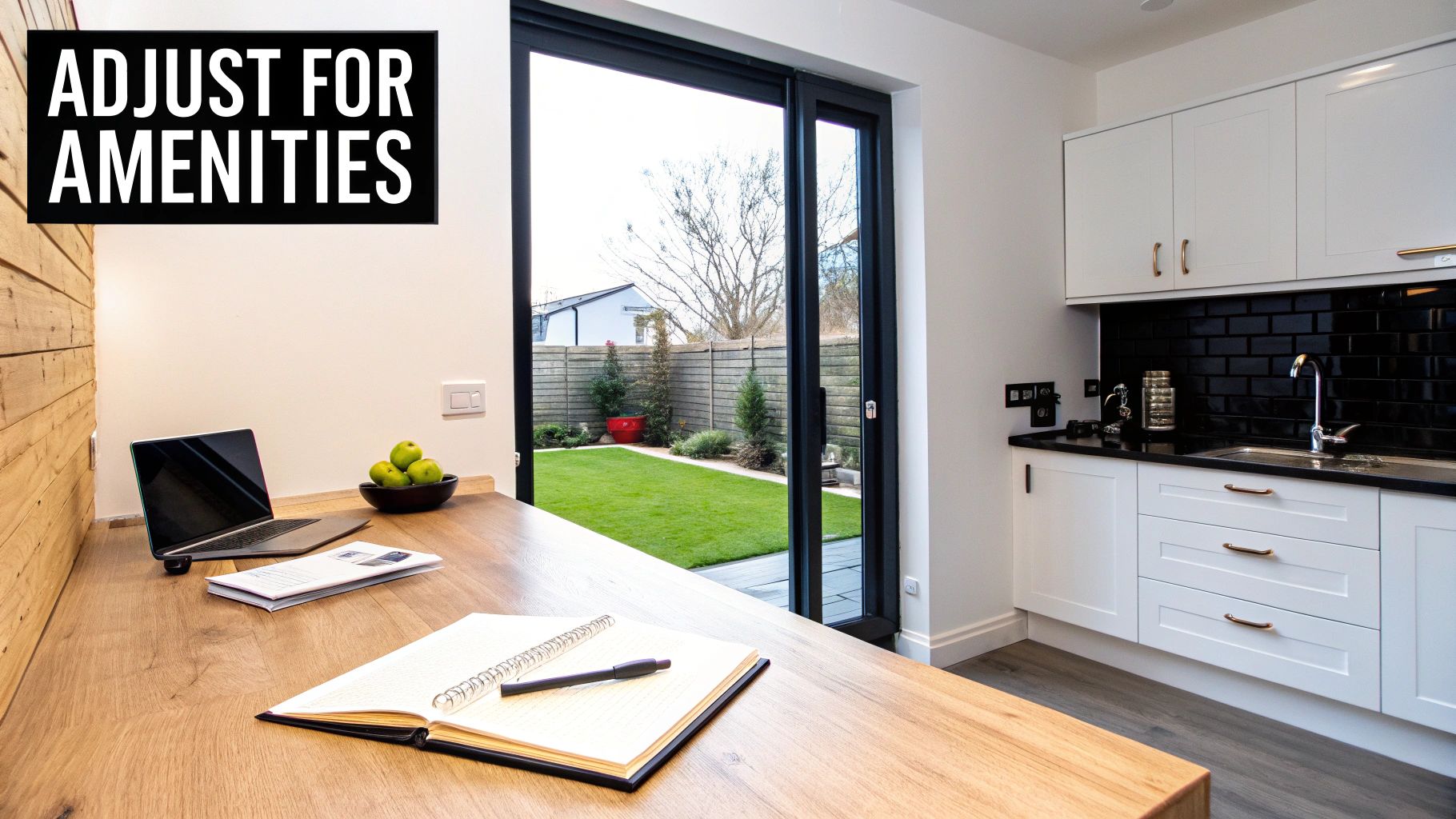
Once you’ve got your raw numbers from comps and square footage, you have a solid starting point. But this is where the real art of pricing your rental comes in. You have to translate your property’s unique personality—its features and quirks—into actual dollars.
Think about it: not all three-bedroom homes are created equal. One might have a kitchen straight out of the 1980s, while another down the street flaunts a fresh remodel with quartz countertops and shiny new appliances. A renter will absolutely pay more for the modern unit, and your rent needs to reflect that.
This part of the process is all about systematically adding or subtracting value based on what your property offers versus the competition. Even a simple fresh coat of paint and new flooring could add $50-$75 a month. A full kitchen renovation? That could easily justify an extra $150 or more, depending on your local market.
Quantifying High-Value Amenities
Certain features are just slam dunks. They’re the things tenants actively look for and are happy to pay a premium to have. Nailing down what these are in your area is key to maximizing what you can charge.
A few amenities consistently pull in higher rent:
- Central Air Conditioning: Here in Central California, central AC isn't a luxury; it's a near necessity. A property with it can command $75-$150 more per month than one with just window units.
- In-Unit Washer and Dryer: The convenience factor is huge. Not having to haul laundry to a shared room or a laundromat is a massive selling point, often adding $50-$100 to the monthly rent.
- Private Outdoor Space: A fenced-in yard, a decent-sized balcony, or a private patio can easily bump the rent by $100-$200, especially for tenants with pets or kids.
- Dedicated Parking: In neighborhoods with tight street parking, a guaranteed spot in a garage or driveway is gold. It can add an extra $50-$150 or even more.
Of course, you have to be honest about the other side of the coin. If your unit lacks covered parking while all your comps have it, you'll need to trim your asking price to stay competitive.
My personal rule is simple: if a tenant sees it, touches it, or uses it daily, it has a significant impact on perceived value. Upgraded appliances, modern light fixtures, and durable flooring directly enhance the living experience and justify a higher rent.
To help you put a number on these things, here’s a quick-reference table for common upgrades.
Sample Rent Value Adjustments for Features and Amenities
The table below offers some general guidelines for how much you might adjust your monthly rent for specific features. Remember, these are estimates—the actual value will depend entirely on your local market demand.
| Feature/Amenity | Potential Monthly Rent Adjustment | Notes |
|---|---|---|
| New Stainless Steel Appliances | +$50 to +$100 | Full suite (fridge, stove, dishwasher). High perceived value. |
| Hardwood or LVP Flooring | +$50 to +$75 | Compared to old, worn carpeting. Easier to clean. |
| Fenced-In Backyard | +$75 to +$150 | Especially valuable for pet owners and families. |
| Garage Parking (1-car) | +$50 to +$100 | Can be higher in urban areas with limited street parking. |
| Walk-in Closet | +$25 to +$50 | A desirable feature, particularly in primary bedrooms. |
| Updated Bathroom | +$50 to +$100 | Modern vanity, new fixtures, and clean tile work. |
| Fireplace | +$25 to +$50 | More of an aesthetic/comfort feature, value varies by climate. |
| Pool Access (Community) | +$50 to +$100 | Depends on the quality and accessibility of the facility. |
Use this as a starting point to quantify the unique appeal of your property.
Making Fair Deductions for Drawbacks
Just as premium features add value, you have to be realistic about any shortcomings. A property with dated fixtures, worn-out carpeting, or an awkward layout simply won't fetch the same price as a pristine unit, even if the location and square footage are identical.
For instance, if the average two-bedroom in the area goes for $1,800, but yours has a 20-year-old kitchen, you might need to list it at $1,700 to get it rented quickly. The key is to be objective. Do a walkthrough and see your property through a renter's eyes, noting anything that might be a turn-off.
This balancing act—adding for the good, subtracting for the not-so-good—is the final touch on your rent estimate. It ensures your price is backed by data and accurately reflects the real-world living experience your property offers. When you've meticulously accounted for every detail, you can set a price that's both profitable for you and fair for your next tenant.
Putting Your Price to the Test with Online Tools
Okay, you've done the legwork. You’ve walked the neighborhood, crunched the numbers on comps, and factored in your property's unique charm. Now it's time for a quick gut-check.
This is where online rent estimators come in handy. I always treat them as a final validation step—a second opinion to make sure my own analysis isn't way off base. They aren't a magic bullet, but they are another valuable data point.
These platforms pull from huge databases of active and recent listings, giving you an instant estimate. Running your numbers through them is a smart way to gain an extra layer of confidence before you post that "For Rent" sign.
Top Tools for a Quick Sanity Check
When it comes to getting a reliable online estimate, a few platforms have consistently proven their worth. My advice? Don't just rely on one. Check two or three to see if their numbers align, which will give you a much tighter, more dependable range.
Here are a few of the go-to options I recommend:
- Rentometer: This is my favorite for a fast, visual snapshot. It actually grades your proposed rent against local comps, showing you if you're landing in the low, medium, or high end for the area. It’s incredibly straightforward.
- Avail (part of Realtor.com): For those who want more detail, Avail provides a full rent analysis report. It breaks everything down by distance, property type, and when the comps were last on the market.
- Zillow Rental Manager: Zillow's "Zestimate" for rent is a solid starting point. Given their massive database, it’s a number you can’t ignore, even if you just use it as a baseline.
Just remember, these tools are driven by algorithms. They can’t see the brand-new quartz countertops you just installed or appreciate that your backyard is double the size of the comp down the street. That’s precisely why your own hands-on research has to come first.
If you're looking for something that ties all these steps together, a more comprehensive rental property value estimator can help streamline the entire process.
Old-School Rules for a Reality Check
Beyond the fancy new platforms, some tried-and-true real estate metrics can give you a quick reality check on your numbers.
The most famous is probably the 1% Rule. It’s a simple guideline suggesting your gross monthly rent should be at least 1% of what you paid for the property. For a $300,000 house, that would mean you're aiming for $3,000 a month in rent.
But you have to take this rule with a huge grain of salt. Here in California, hitting that 1% mark in high-cost areas is often a pipe dream. On the flip side, in more affordable markets, you might blow past it. It’s a benchmark, not a law.
Another great metric to keep in your back pocket is the price-to-rent ratio. It’s a broader economic indicator that compares median home prices to median annual rents, helping you gauge if the local market is potentially over or undervalued.
This isn't just a new fad; historical data shows that price-to-rent ratios were a remarkably stable benchmark for decades. Using these classic rules of thumb alongside modern tools gives you the final assurance you need to set a rent that’s both competitive and profitable.
Answering Your Top Questions About Setting Rent
Even after you've run the numbers and pulled your comps, a few practical questions always pop up. It’s those gray areas and unique situations that can make you second-guess yourself.
Let's walk through the common challenges every landlord runs into. Think of this as the final gut-check to make sure you're pricing your rental with total confidence.
How Often Should I Re-Evaluate My Property's Rental Value?
The market is a moving target, so your rent price can't be a "set it and forget it" number. Staying on top of current rates is how you make sure your investment is actually working for you.
As a rule of thumb, plan on doing a full market analysis once a year. The sweet spot is about 90 days before a lease is scheduled to end. This gives you plenty of time to research new comps, decide if a rent adjustment is needed, and give your tenant the proper legal notice without feeling rushed.
But don't just mark your calendar for an annual review. You'll want to take another look if something big happens in your area, like:
- A major company opens a new headquarters nearby, flooding the area with new renters.
- The city or state passes new rent control laws that impact your property.
- You start seeing "For Rent" signs lingering for weeks on your street when they used to disappear in days.
Staying proactive means your rent never gets stale. You’ll keep the property competitive enough to attract great tenants and profitable enough to be a worthwhile investment.
The biggest mistake landlords make is pricing with their heart, not their head. They set the rent based on their mortgage payment or what they just spent on a kitchen remodel. The market doesn’t care about your costs—it only cares about what other similar rentals are going for.
This is why you have to trust the data. Your personal finances are irrelevant to a prospective tenant who is just comparing your place to three others down the street.
What if My Property Is Truly One-of-a-Kind?
So you own a historic loft with original brickwork or a place with a massive rooftop deck. Finding a perfect apples-to-apples comparison can feel impossible. When you can’t find a direct comp, you have to get a little more creative. The trick is to build a baseline and then make clear, justifiable adjustments for what makes your place special.
Start by finding the closest comps you can, even if they're missing your property's standout feature. Look for a similar bed/bath count and square footage in the same neighborhood to establish a baseline rent.
Then, you have to assign a real dollar value to that unique feature. Don't just pull a number out of thin air. You need to be able to explain your logic. For example, your notes might say, "Similar 2-bedroom units are renting for $2,200. Rooftop decks are exceptionally rare in this downtown area and are estimated to add $250/month in rental value, based on high tenant demand for private outdoor space."
When you're in a situation like this, it’s a great idea to call a local property manager. Their on-the-ground knowledge is invaluable for validating the premium you think your unique feature deserves.
This approach turns a subjective feeling ("my place is nicer!") into a tangible number, ensuring your unique property is priced for what it’s actually worth on the open market.
Are you looking for an expert opinion on your property's rental value in the Fresno area? The team at Edinhart Realty and Property Management leverages deep local market knowledge and data-driven analysis to help you set the optimal rent. We ensure your property is priced competitively to attract high-quality tenants and maximize your return on investment. Visit us at https://edinhart.com to learn more about our property management services.


