

Setting the right rent really comes down to two things: figuring out what similar properties are renting for and making sure your own numbers work. You have to balance what the market will bear with what you need to make to be profitable. It’s this mix of outside market facts and your own financial goals that helps you find that sweet spot—a price that brings in great tenants without leaving cash on the table.
The Blueprint for Smart Rental Pricing
Trying to nail down the perfect rent can feel like a shot in the dark, but it doesn't have to be. It's not about gut feelings or what you think your place is worth. The whole game is about using solid data to guide your decision.
Think of it like building a house. You wouldn’t just start nailing boards together without a blueprint, right? Same goes for your rent. Your pricing blueprint needs a few key pillars to make sure your investment is stable and, most importantly, profitable.
What Really Drives Your Rental’s Value?
Before you start crunching numbers, you have to get a feel for what tenants are actually looking for. These are the big-ticket items that people size up, whether they realize it or not, when deciding if your rent is fair.
- Location, Location, Location: It’s a cliché for a reason. Being close to good schools, parks, shopping, and major job hubs in areas like Fresno or Clovis makes a huge difference.
- Property Size and Layout: Of course, the number of bedrooms, bathrooms, and total square footage sets the baseline. But a smart, open layout often feels more valuable than a bigger, clunkier space.
- Condition and Age: A modern, well-kept property will always pull in more rent than a dated one that’s seen better days. Never underestimate the power of a good first impression from the curb.
- Amenities: Things like a pool, shiny new appliances, an in-unit washer and dryer, or even just dedicated parking can seriously boost your property's appeal and let you ask for a higher price.
The single biggest mistake I see new landlords make is basing their rent solely on their mortgage payment. Your personal costs don't set the rent—the market does.
The first real step in this process is doing a Comparative Market Analysis (CMA). This just means you’re looking at what similar, nearby properties have actually rented for recently.
For example, on a national level, asking rents for apartments grew by only 0.6% year-over-year in the third quarter of 2025. That shows you how much local competition can limit how much you can charge. If you’re a landlord in Fresno, you’d be smart to jump on Zillow and see what similar places in Clovis are listed for, comparing everything from square footage to amenities.
This kind of detailed, data-first approach is what ensures your price is competitive from day one. To get a head start, you can use a tool to find the fair market rent for your property. For a broader perspective on how global trends affect local pricing, the analysis on Savills.com is a good read.
Nailing Your Market Analysis
Alright, you understand the theory behind what makes a rental valuable. Now it's time to roll up your sleeves and get into the nitty-gritty with a Comparative Market Analysis (CMA). This isn't just about a quick peek on Zillow. We're talking about a methodical hunt for truly comparable properties—we call them "comps"—to set a rental price that's backed by solid, real-world data.
Getting this right is, without a doubt, the most critical part of the entire pricing process. A sharp CMA keeps you from leaving money on the table by underpricing. It also saves you from the headache of a vacant property bleeding cash every month because you priced it too high. The whole point is to find an apples-to-apples comparison to see what tenants are actually willing to pay for a home like yours, right here and right now.
This simple flowchart breaks down how market research, your specific property details, and the final analysis all work together to build a smart, effective pricing strategy.

As you can see, a winning price comes from layering these three stages. It’s about being informed and competitive.
Finding and Picking the Right Comps
Your analysis is only as strong as the comps you choose. A "comparable" property isn't just any rental in town; it has to mirror your property as closely as possible. Think of it like a laser-focused search.
Start by digging up properties that were rented in the last three to six months. The rental market, especially in a dynamic area like Fresno, shifts fast. Data from a year ago is ancient history.
Next, you need to think geographically. Your best comps are almost always within a half-mile to one-mile radius of your rental. They should be in the same school district and have a similar neighborhood vibe. A house in the Tower District has a completely different feel—and tenant appeal—than one in Woodward Park, even if they have the same number of bedrooms.
Here’s your checklist for matching attributes:
- Property Type: Single-family homes get compared to other single-family homes. Condos to condos. You get the idea.
- Bedrooms and Bathrooms: This is one of the biggest drivers of rent, period.
- Square Footage: Stick to comps within 10-15% of your property’s size.
- Age and Condition: A brand-new build will always command a higher price than a 30-year-old home, unless the older one has been completely renovated.
How to Adjust for Differences
Let's be real: no two properties are ever exactly the same. This is where the real "analysis" part of the CMA kicks in. Once you've found 3-5 solid comps, you have to start tweaking their rental prices to account for the ways they differ from your property. It’s all about adding or subtracting value based on specific features.
For example, if your place has a two-car garage but a nearly identical comp only has a carport, you've got an edge that justifies a higher rent. On the flip side, if their kitchen is decked out with brand-new appliances and yours is straight out of the 90s, you'll need to knock your price down from their benchmark.
Pro Tip: Tenants will absolutely pay a premium for certain upgrades. From our experience managing properties all over Fresno and Clovis, a modern, updated kitchen can easily add $100-$200 to the monthly rent. A private pool? That could be another $150-$250, depending on the neighborhood.
To make this crystal clear, here’s a common scenario. Imagine you’re listing a 3-bed, 2-bath home in Clovis. You find a great comp nearby that just rented last month for $2,300. It's almost identical, but it features a stunning, fully remodeled kitchen with quartz countertops. Your kitchen is clean and works perfectly fine, but it’s 15 years old.
You can't realistically ask for $2,300. You have to subtract the value of that high-end kitchen—let’s call it $150—from the comp's price. That simple adjustment tells you a much more accurate starting point for your property is around $2,150.
This process is how you turn raw data into a smart price. Here’s a worksheet to help you visualize it.
Rental Rate Adjustment Worksheet
Use this simple table to start with a baseline rent from your best comp and then add or subtract value based on key features. This helps you calculate a more precise and defensible rent for your own property.
| Feature | Your Property | Comparable Property | Value Adjustment ($) |
|---|---|---|---|
| Baseline Rent | $2,300 (Rented last month) | ||
| Kitchen | 15 years old, functional | Fully remodeled, quartz counters | – $150 |
| Garage | 2-car attached | 2-car attached | + $0 |
| Backyard | Fenced yard, concrete patio | Unfenced, no patio | + $75 |
| Flooring | Carpet in bedrooms, tile | New LVP throughout | – $50 |
| Adjusted Rent | $2,175 |
By going feature-by-feature, you can see how a few key differences can shift the final price. This method moves you from guessing to a data-driven strategy.
For landlords who want to take their analysis even further, we’ve put together a guide on the best real estate market analysis tools available.
Calculating Profitability to Meet Your Goals
You've sized up the market, but the next step is just as critical: turning the focus inward to your own numbers. A rental rate might look great compared to the house next door, but if it doesn't cover your own expenses and actually make you money, it's the wrong price. This is where we shift from what the market says to what your investment needs.
Don’t worry, this isn’t about becoming a CPA overnight. It’s about getting a handle on a few key metrics that tell the real story of your property's financial health. Once you nail these, you can set a rent that not only wins over tenants but also hits your personal financial targets.

Uncovering Your Net Operating Income
The bedrock of any solid rental analysis is your Net Operating Income (NOI). Just think of NOI as your property's pure, raw profit before you factor in your mortgage or income taxes. It’s a clean, simple number that shows whether the property itself is making money on its own.
To get your NOI, you just subtract all your operating expenses from your total rental income.
- Gross Rental Income: This is the best-case-scenario rent you'd collect over a full year. If you're aiming for $2,200 a month, your annual gross income is $26,400.
- Operating Expenses: These are all the non-negotiable costs of keeping the lights on and the property running. Get detailed here—every single dollar matters.
Typical operating expenses you can't forget:
- Property Taxes
- Landlord Insurance
- Repairs and Maintenance (A good rule of thumb is budgeting 5-10% of the annual rent)
- Property Management Fees (Usually 8-10% of the monthly rent in our area)
- Landscaping or HOA Dues
- Pest Control
- Vacancy Costs (I always tell owners to budget for at least one month's rent per year, or about 8%, just to be safe)
Quick Example:
Let's say your Fresno rental brings in $2,200/month ($26,400/year). After adding up taxes, insurance, management fees, and maintenance reserves, your annual expenses come to $8,500. Your NOI would be $26,400 – $8,500 = $17,900.
That single number, $17,900, is the engine powering your investment. It’s the cash the property generates on its own, and it's what you’ll use to pay down your loan and—ideally—put some profit in your pocket.
From NOI to Cap Rate
With your NOI figured out, you can quickly find your Capitalization Rate (Cap Rate). It sounds technical, but it’s really just a simple way to compare the earning potential of different properties, no matter what they cost. It tells you the return you’d get if you bought the property with all cash.
The formula is a breeze: Cap Rate = NOI / Property Value.
Using our example, if that same property is worth $300,000 and your NOI is $17,900, your Cap Rate is 5.97% ($17,900 / $300,000).
This percentage is a powerful comparison tool. If you see other similar rentals in Fresno trading at 6-8% cap rates, your 5.97% might be a little on the low side. That's a clear signal you might need to nudge the rent up or find ways to trim expenses to boost your return. To really get into the weeds on this, our guide offers a complete rental property cash flow analysis.
What Is Your Cash-on-Cash Return
Cap Rate is great for comparing deals, but let's be real—most of us use financing. That’s where Cash-on-Cash Return shines. It measures the return you’re getting on the actual, out-of-pocket cash you invested. This metric is all about your money and how hard it's working for you.
First, you need to find your annual cash flow. That's simply your NOI minus your total annual mortgage payments.
Let's assume your mortgage payments (principal and interest) are $14,400 for the year ($1,200/month).
- Your Annual Cash Flow = $17,900 (NOI) – $14,400 (Mortgage) = $3,500.
Now, let's say your total cash to get into the deal (down payment, closing costs, etc.) was $65,000.
- Cash-on-Cash Return = Annual Cash Flow / Total Cash Invested
- $3,500 / $65,000 = 5.38%
This tells you that for every dollar you put down, you're getting back nearly 5.4 cents each year. That's a powerful number that connects all the dots right back to your bank account.
Landlords focused on maximizing their income live and die by these metrics. For context, Fresno's typical cap rates of 6-8% are what help justify median rents hovering around $2,200 for a standard three-bedroom home in 2025. With experts pointing to a potential 2% national rent increase in 2026, pricing your property correctly now is key to riding that wave. You can learn more about the 2026 apartment housing outlook and see how these big-picture trends should inform your strategy today.
Reading the Tea Leaves: Local Economic and Vacancy Trends
Your rental property doesn't exist in a bubble. It's deeply connected to the economic heartbeat of your city. Getting a handle on the bigger picture—things like job growth, unemployment rates, and new construction—is crucial if you want to set rental rates that are both smart and profitable.
Here’s how to think about it: when a new tech company moves to town, that means more people with good jobs are looking for housing. That surge in demand gives you, the landlord, more leverage on pricing. On the flip side, if a major local employer packs up and leaves, you'll suddenly see a lot more "For Rent" signs, forcing you to get more competitive with your price.
That’s why keeping an eye on your local market’s health isn't just a suggestion—it's a core part of any savvy pricing strategy.
The Real Story Behind Vacancy Rates
If you want one number that tells you almost everything you need to know about a rental market's health, look at its vacancy rate. This simple percentage—the number of empty units divided by the total—is a powerful signal about the supply and demand seesaw. It tells you whether it's time to raise rents, hold firm, or maybe even sweeten the deal for new tenants.
A low vacancy rate is what every landlord hopes for. It's a clear sign of high demand and not enough supply to go around.
- Under 5% Vacancy: This is what we call a "tight" market. In this climate, you can feel pretty confident about bumping up the rent at renewal time because you know there are more tenants out there than available units.
- 5% to 8% Vacancy: This is a more balanced market. Pricing here is a bit more sensitive, and any rent increases need to be weighed carefully against what your direct competitors are doing.
- Over 8% Vacancy: When vacancy numbers get this high, the power shifts to the tenants. Landlords often have to offer concessions—like a free month of rent or a reduced security deposit—or even lower their asking price to attract good applicants.
The vacancy rate isn't just a statistic; it's a direct measure of your negotiating power. When it's low, you're in the driver's seat. When it's high, you’ve got to be more strategic to fill your property without delay.
Economic health and vacancy rates are two sides of the same coin. For instance, in late 2025, the U.S. saw median rents dip 1% between October and November as the national multifamily vacancy rate hit 7.2%. For us here in Central California, it’s a reminder to watch local job growth in Fresno’s key sectors, like agriculture and logistics, which helps keep our rental absorption from falling off a cliff. As the market stabilizes, some projections show U.S. rent growth could bounce back to 2.0% in 2026, with markets like Fresno potentially seeing hikes in the 2-3% range. You can dig into more of this data on the rental market industry outlook on RENTEC Direct.
Timing is Everything: Working with Market Seasonality
Just like retail, the rental market has its seasons. Paying attention to these annual cycles can make a real difference in how long your property sits empty and the final price you get.
The peak season for rentals generally kicks off in May and runs hot through September. This isn't a coincidence; it's driven by a few key things:
- Good Weather: Let's face it, nobody enjoys moving in the rain or cold.
- School's Out: Families with kids almost always plan their moves for the summer to avoid disrupting the school year.
- Student Rush: College towns, like Fresno, see a massive wave of renters looking for housing right before the fall semester starts.
If you can time your listing to go live during these high-demand months, you'll likely find a tenant faster and might even be able to ask for a slightly higher rent. Trying to fill a vacancy in the dead of winter, on the other hand, is a different ballgame. Demand plummets, and you often have to price more aggressively to avoid having the property sit empty until spring. It’s not impossible to rent in the off-season, but you have to be realistic and strategic.
Justifying a Higher Rent with Strategic Upgrades
You’ve analyzed the market and have a solid, data-backed baseline for your rent. Now for the fun part: how can we do better? A competitive rent is good, but a premium rent is the real goal. This is where smart, value-adding upgrades come in, turning your property from just another listing into a place that truly commands a higher price.
This isn’t about just throwing money at projects and hoping for the best. The key is to zero in on high-return improvements that tenants genuinely notice and are more than willing to pay extra for. Think of it as investing directly in your property's earning power, where even a small upfront cost can lead to a significant and lasting bump in your monthly income.
Prioritizing High-ROI Improvements
Let’s be honest: not all upgrades are created equal. Some give you a much bigger bang for your buck by directly appealing to what today’s renters are actually looking for. It's all about finding that sweet spot between what it costs and what a tenant perceives as added value.
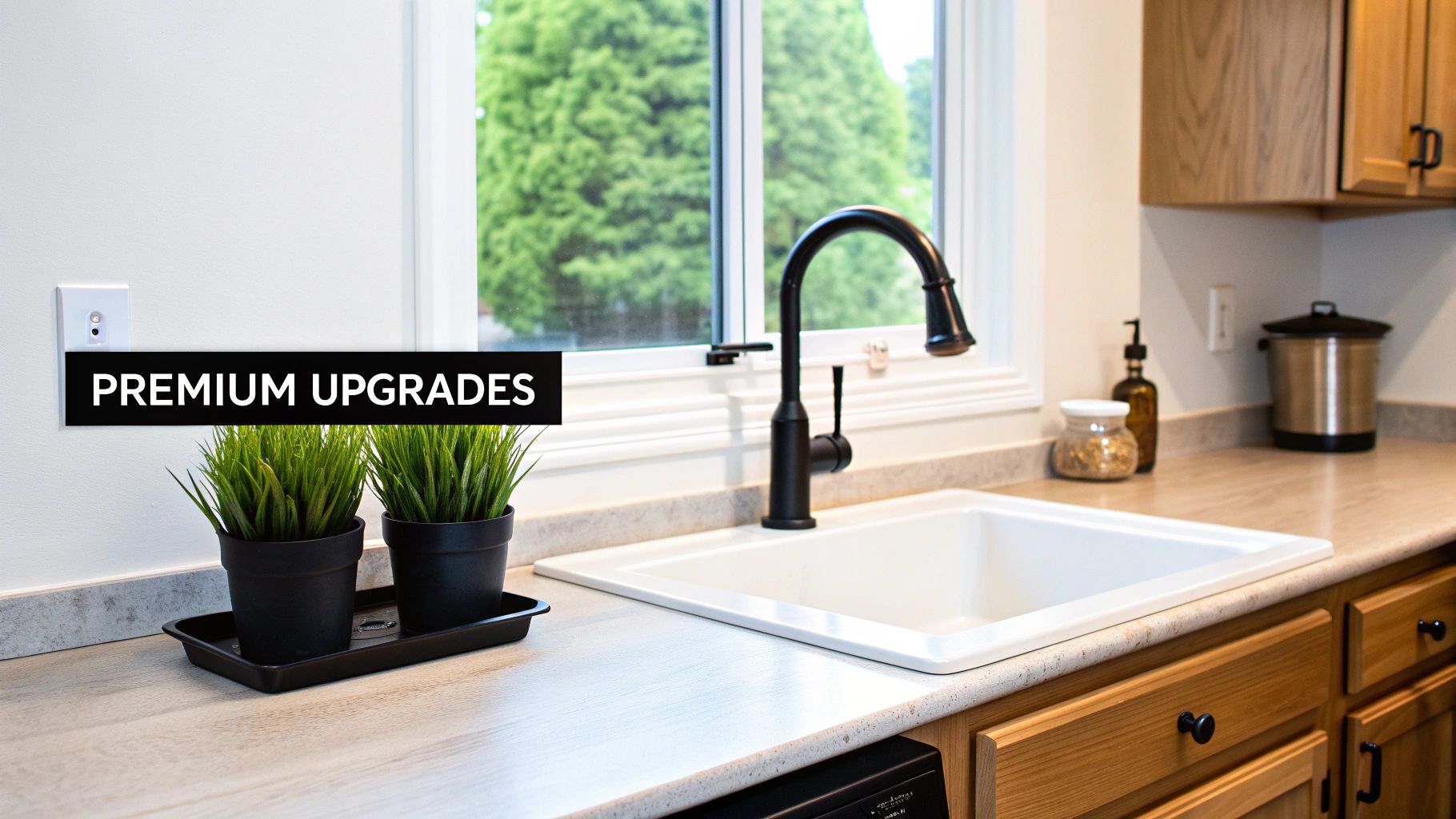
Cosmetic updates are often the fastest and most affordable way to boost your rent. A fresh coat of neutral paint, some modern light fixtures, and updated cabinet hardware can instantly make an older property feel brighter and more contemporary. We’ve seen these small changes alone justify a $50-$100 monthly rent increase with very little investment.
For a more substantial impact, your focus should be on the two rooms that renters scrutinize the most: kitchens and bathrooms. You don't always need a full gut-and-remodel. Sometimes, simple upgrades like new countertops, a modern faucet, or a stylish backsplash can completely transform the feel of a kitchen. In the bathroom, just replacing an old vanity or re-glazing a tired-looking tub can make a world of difference.
Investing in specific amenities can increase what you can charge by 3-15%. Enhancing your property with features like smart home technology, dedicated parking, and pet-friendly policies are often in high demand and can directly translate to higher rental income.
Tangible Returns from Strategic Renovations
Let’s talk real numbers. From our experience managing properties all over Fresno and Clovis, a minor kitchen remodel—think resurfacing cabinets, putting in new countertops, and updating appliances—can often justify a rent increase of $150-$250 per month. If that renovation costs $7,000, it could pay for itself in just over two years and then continue generating pure profit for years after.
Here are a few upgrades that consistently deliver strong returns:
- Durable, Attractive Flooring: Getting rid of old, stained carpet and installing luxury vinyl plank (LVP) flooring is a total game-changer. It's tough, looks modern, and is a huge selling point for tenants, especially those with allergies or pets.
- Enhanced Curb Appeal: First impressions are everything. Simple landscaping, a freshly painted front door, and updated house numbers create an inviting vibe that signals a well-cared-for home from the moment a prospect pulls up.
- In-Unit Laundry: If your property doesn’t have a washer and dryer, adding hookups or the appliances themselves is one of the most sought-after amenities you can offer. It can easily set your unit apart and support a higher rent.
Showcasing Your Upgrades for Maximum Impact
Making these improvements is only half the battle. The other half is marketing them so they get noticed. You can have the most beautifully updated rental in the neighborhood, but if your listing photos are dark and blurry, you'll never attract the kind of tenants who are willing to pay a premium.
This is where professional photography becomes non-negotiable. Crisp, well-lit photos will highlight those new quartz countertops, showcase the gleaming LVP floors, and make the entire space feel bright and welcoming. It’s the single most effective way to communicate the value you’ve added.
When you write your listing description, don't just list features—sell the benefits. Instead of just saying "new windows," write "new energy-efficient windows that will lower your monthly utility bills." Instead of "fenced backyard," say "private, fenced-in backyard perfect for summer barbecues." This approach helps potential tenants actually picture themselves living in and enjoying the space, which makes them far more willing to meet your asking price. By tying your strategic upgrades to powerful marketing, you close the loop, justify that higher rental rate, and ensure your investment performs at its absolute peak.
Nailing Down and Fine-Tuning Your Rental Price
After you've done the hard work of analyzing the market and running the numbers, it's time to put it all together and land on a final, confident rental price. This isn't about plucking a number out of thin air. It’s about synthesizing all those data points—your comps, NOI, local vacancy rates, and the value of your recent upgrades—into a single, strategic figure.
The trick is to find that sweet spot: a price competitive enough to draw in a great pool of qualified tenants, but also high enough to hit your financial goals. This is where the science of your calculations meets the art of positioning your property in the market.
Smart Pricing Tactics That Work
Once you’ve got a target range in mind, you can use a few subtle psychological tricks to make your price more attractive. One of the most common—and effective—strategies is to price your unit just below a major mental threshold.
For example, if your research points to a rent of $2,200, think about listing it for $2,175 or $2,195 instead. It seems like a small change, but it can dramatically boost your property's visibility in online searches. So many renters set their filters at round numbers (like "$2,200 max"), so sliding in just under that mark gets your listing in front of a much larger audience. That means more interest and, ultimately, filling vacancies faster.
Keeping Your Finger on the Pulse and Knowing When to Adjust
Setting your rent isn't a "set it and forget it" task. The rental market is always shifting, and your pricing strategy needs to be just as flexible. To keep your property performing at its best, you have to constantly monitor its performance and what's happening in the market around you.
Keep a close eye on these key signs:
- Time on Market: How long are similar places in your neighborhood staying vacant? If your unit is sitting empty for weeks while others are getting snapped up, your price is probably too high.
- Applicant Quality and Quantity: Are you getting a healthy flow of well-qualified applicants? If you’re getting crickets or only hearing from tenants who don't meet your criteria, it’s another red flag that you’ve overpriced the unit.
- Local Economic Shifts: Stay plugged into what’s happening locally. Big news about job growth, major new developments, or city-wide changes in vacancy rates can all swing rental demand in your neighborhood.
Setting rent is an ongoing conversation with the market. Your initial price is just the opening line. The market will always give you feedback, and being ready to listen and respond is what separates savvy investors from those who get stuck with costly, long-term vacancies.
This same strategic mindset applies when it's time for lease renewals. Before a lease is set to expire, run a fresh market analysis. See if a rent increase is not only possible but justified by the current conditions. Here in California, you've got to follow specific laws about notice periods and how much you can raise the rent, so staying compliant is absolutely critical. By treating your rental pricing as a continuous cycle of analysis and adjustment, you’ll ensure your investment stays profitable and competitive, year after year.
Got Questions About Setting Rent? We’ve Got Answers.
Even with all the data crunched and the comps reviewed, landlords usually have a few lingering questions. That's completely normal. Nailing down the perfect rental price is part art, part science, and getting clear on the details is what separates a good strategy from a great one.
Let’s tackle a few of the most common questions we hear from property owners here in Fresno. These are the practical, real-world concerns that pop up right before you put that "For Rent" sign up.
How Often Should I Re-Evaluate My Property's Rental Rate?
The sweet spot for a full-blown market analysis is about 60-90 days before a lease is up for renewal. This gives you plenty of time to see where the market is, decide if a rent adjustment makes sense, and give your tenant the proper legal notice.
I also recommend keeping a casual eye on the market every quarter. You don’t need to do a deep dive, but just being aware of any major shifts in your neighborhood means you’ll never be caught flat-footed.
What Are the Biggest Mistakes Landlords Make When Setting Rent?
Hands down, the two costliest mistakes we see are pricing based on emotion and pricing too low out of fear.
- Overpricing: This is a classic. An owner looks at their mortgage payment and thinks, "I need to cover my costs." The problem is, the market doesn't care about your mortgage. This leads to long, painful vacancies that bleed way more money than just setting a competitive rate from the start.
- Underpricing: This one is a silent profit killer. A landlord gets nervous about a potential vacancy, so they don't bother to check the latest comps and just keep the rent the same. They're unknowingly leaving a significant chunk of cash on the table, month after month.
The only way to win is to be data-driven. Your personal expenses don't set the rent—the local market does. It’s as simple as that.
Should I Include Utilities in the Rent?
Tossing in utilities can definitely make your property more attractive to renters, but you have to be smart about it. If you're going to go this route, you need to calculate the average monthly utility cost over the last 12 months, then add a small buffer—think around 10%—to that number before adding it to the rent.
Make sure you spell out exactly which utilities are included in the lease agreement. You don’t want any confusion. That said, in most areas, the standard is for tenants to handle their own big-ticket utilities like electricity and gas.
Determining the right rental rate isn't a one-time task; it requires local know-how and a constant pulse on the market. Edinhart Realty and Property Management equips landlords in Fresno and Clovis with detailed, data-driven rental analysis to boost income and slash vacancy times. Learn how our professional management services can optimize your investment.


