
Choosing a property management company isn't just about hiring someone to collect rent. It’s about finding a genuine partner who understands and supports your investment goals. Think of it less like hiring a vendor and more like bringing on a key team member.
Defining Your Needs and Starting the Search

Before you even type "property manager near me" into Google, you need to get crystal clear on what you actually need. The right choice for an out-of-state, hands-off investor is going to be completely different from what a local, hands-on landlord might look for.
Are you looking for a full-service firm to handle every single detail, from marketing and tenant screening to late-night emergency calls? Or do you just need help with one or two specific tasks, like finding a great tenant? Nailing this down first is the single most important step. It's your primary filter.
Building Your Initial Candidate List
Once you know what you’re looking for, it's time to see who's out there. And you’ll have plenty of options. The property management industry is booming—the global market is expected to rocket from $24.01 billion to a staggering $52.99 billion by 2033.
Here in the U.S., there are over 325,000 property management businesses. That massive, fragmented market can feel overwhelming, but it also means the perfect fit for your property is definitely out there. You just have to find them.
Your goal right now is to build a solid shortlist of 3-5 promising local companies. Here’s how I always recommend starting:
- Go Digital: A quick online search is your starting point. Dive deep into Google Reviews and look for consistent themes. Is everyone raving about their communication, or are there repeated complaints about maintenance delays? Patterns tell a story.
- Tap Your Network: Nothing beats a word-of-mouth referral. Ask other investors, your real estate agent, or even your CPA for recommendations. A trusted suggestion is pure gold.
- Check the Forums: Websites like BiggerPockets are full of local investors sharing real-world experiences. Hop into a local forum and ask for suggestions—you'll get unfiltered feedback you won't find anywhere else.
Vetting Your Candidates from Afar
With a list in hand, you can start doing some initial vetting without ever picking up the phone. A quick digital once-over can tell you a lot.
A professional, modern website is a good starting point. If their online presence looks like it hasn't been updated since 2005, how on top of modern marketing and tenant communication are they likely to be? Look for red flags in reviews—things like poor communication, hidden fees, or high tenant turnover are major warning signs.
Interestingly, the core principles for vetting a professional service are pretty universal. Think about the process of how to choose a wedding photographer; you’d look at their portfolio, read reviews, and assess their professionalism. You're doing the exact same thing here.
This early research helps you weed out the duds and focus your energy on truly reputable firms, like those offering top-tier https://edinhart.com/fresno-property-management/.
To help streamline this initial vetting, I've put together a quick checklist you can use.
Quick Vetting Checklist for Potential Managers
Use this checklist during your initial research to quickly evaluate potential property management companies.
| Vetting Criteria | What to Look For | Why It Matters |
|---|---|---|
| Online Presence | A professional, updated website; active social media profiles. | A modern online presence often reflects a well-run, professional operation. |
| Google Reviews | An overall rating of 4.0 stars or higher; look for recurring themes in recent reviews (both positive and negative). | Shows a track record of client satisfaction and highlights potential strengths or weaknesses. |
| Local Specialization | Do they focus specifically on your city or neighborhood? Do they manage your type of property (e.g., single-family homes, multi-family)? | Local expertise means they understand market rates, local laws, and have a network of reliable vendors. |
| Professional Licensing | Is the company and its broker properly licensed? (You can usually check this on your state's real estate commission website). | This is non-negotiable. It ensures they meet legal and ethical standards for handling your investment. |
This simple check will save you a ton of time and help ensure you only spend your valuable time interviewing the most qualified candidates.
Getting to the Bottom of Management Fees and Contracts

The fee structure is where a good partnership can turn sour, and it's where your investment's profitability often hangs in the balance. I've seen countless owners make the classic mistake: they fixate on the monthly management percentage and nothing else. This tunnel vision can end up costing you dearly.
To really get a handle on the true cost, you have to be willing to dig into the fine print.
Many owners get blindsided by fees that pop up beyond the standard 8-12% of the monthly rent. A company might dangle a low percentage in front of you, but it’s often just a smokescreen for a contract loaded with extra charges. Knowing what to look for is a huge part of figuring out how to choose a property management company that actually helps your bottom line.
Breaking Down the Fee Structure
That headline monthly fee? It's just the starting point. A transparent, trustworthy company will hand you a clear schedule of every potential cost without you even having to ask. When you're interviewing potential managers, insist on seeing a complete fee list.
Here are the usual suspects you need to ask about:
- Tenant Placement Fee: This covers the legwork of marketing, screening, and leasing. Expect it to be around 50-100% of the first month's rent.
- Lease Renewal Fee: When a great tenant stays, some managers charge a fee to handle the renewal paperwork. It could be a flat rate, like $250, or a percentage.
- Maintenance Markup: This is a big one. Some companies add a 10-20% surcharge on top of what a vendor charges for repairs. You need to know if they have their own maintenance crew or use outside contractors, and exactly how that gets billed back to you.
- Vacancy Fee: What happens when the property is empty? Some companies charge a flat fee, while others will keep charging you the full management percentage based on the expected rent. Get this clarified.
- Eviction Fee: Hopefully, you never need it, but you need to know the cost. Handling an eviction can run anywhere from a few hundred to several thousand dollars, not including court costs.
"A low monthly management fee doesn't guarantee a better deal. The true cost of a property manager is the sum of all fees over an entire year, including vacancies and tenant turnover."
Reading Between the Lines of the Management Agreement
Once you've got a handle on the fees, the management agreement itself is your next mission. This is the legally binding document that dictates your entire relationship. Glazing over the details here can lead to some major headaches down the road.
Zero in on the termination clause. How much notice do you have to give to end the contract? Are there steep penalties for leaving early? A company that's confident in its service will usually offer a more flexible exit strategy.
Also, look for a maintenance spending limit. This is a pre-approved amount the manager can spend on a repair without needing to call you first. It's a great protection against getting hit with a sudden, massive bill for a non-emergency fix.
Keep in mind, the property management industry is feeling the squeeze of rising operational costs, just like everyone else. The 2025 Property Management Industry Report highlights how firms are trying to grow revenue, which can sometimes lead them to bump up fees or let service quality slide. As a smart owner, your job is to scrutinize the total value you're getting, not just the price tag.
By doing your homework on both the fee schedule and the contract, you’re not just protecting your investment—you're laying the groundwork for a transparent and successful partnership from day one.
Evaluating Their Tenant Screening Process
Let's be blunt: a property manager's most important job isn't collecting rent. It's placing quality tenants.
A vacant unit is a slow financial bleed, but a bad tenant? That’s a full-blown catastrophe. We're talking thousands in damages, drawn-out legal fights, and months of lost income. This is why digging deep into a company’s tenant screening process is a non-negotiable step when you're figuring out how to choose a property management company.
A flimsy, superficial screening process is a massive red flag. You aren't just looking for someone who runs a basic credit check. You need a partner with a systematic, legally sound, and thorough method for vetting every single applicant. Any weakness here puts your entire investment on the line.
Marketing and How Quickly They Fill Vacancies
Before a manager can screen anyone, they have to attract a pool of qualified applicants in the first place. Start by asking about their marketing strategy.
Where do they actually advertise properties? A top-tier manager should be listing on the MLS, Zillow, Trulia, and other high-traffic rental sites. And not just slapping up a few phone pictures—they should be using professional photography and writing compelling descriptions that sell the property.
Next, ask for their average "days on market." A well-oiled machine should be able to fill a vacancy in under 30 days. If their average is creeping up towards 45 or 60 days, it could point to problems with their pricing, marketing effectiveness, or just a bogged-down screening process.
This snapshot helps visualize how different companies stack up on key metrics that influence their effectiveness.
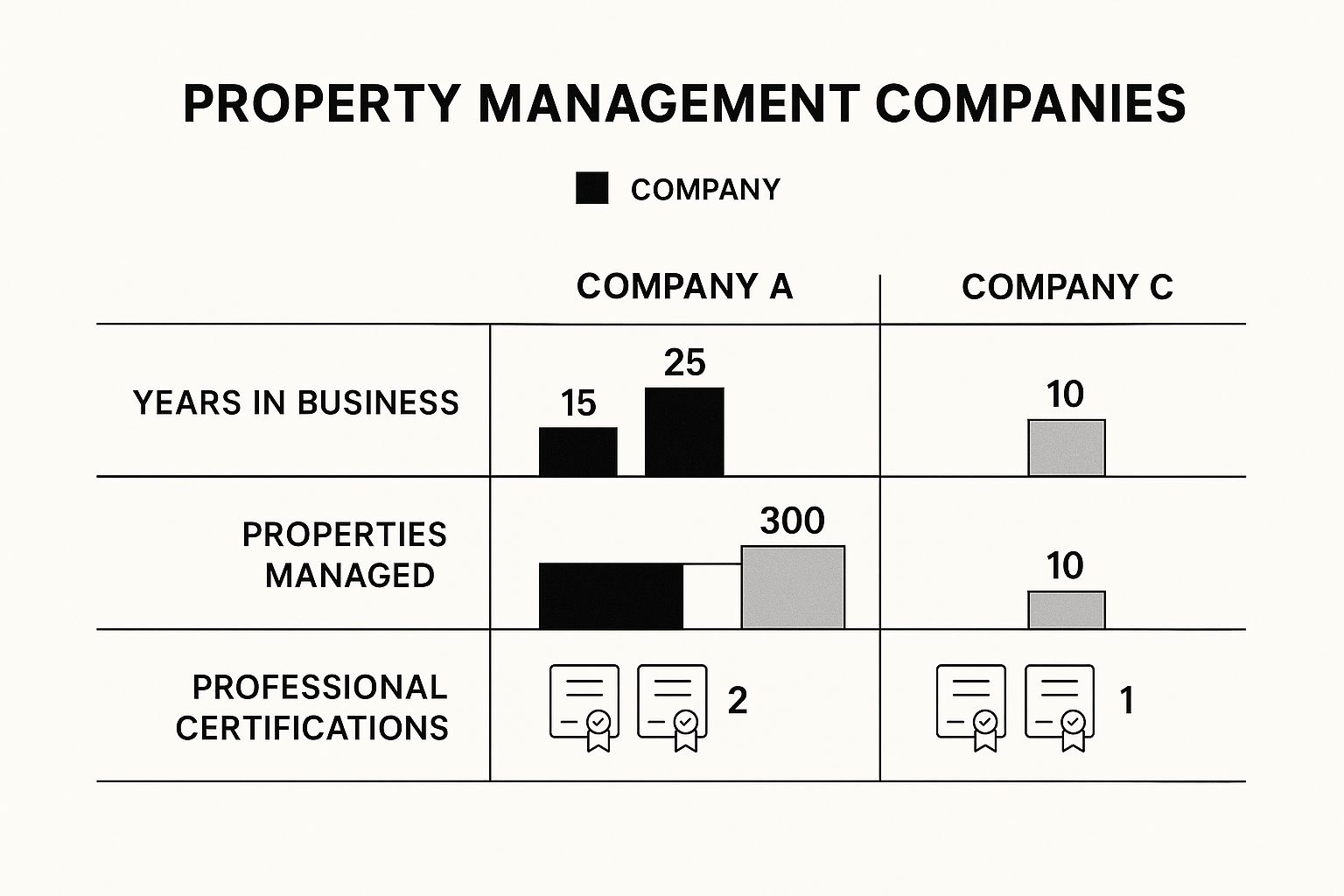
As you can see, a company's experience and the number of doors they manage can vary widely, which often directly impacts how much time and resources they can dedicate to critical processes like tenant screening.
The Nuts and Bolts of Screening
Once they have applicants lined up, the real work begins. Your interview should feel like you're auditing their screening criteria. Vague answers are completely unacceptable.
Here are the specific things you need to grill them on:
- Credit Score Minimums: What is their absolute minimum credit score? Anything below 620 should give you pause, as it often correlates with a higher risk of late or missed payments.
- Income Verification: How do they actually verify income? The industry standard is that an applicant's gross monthly income should be at least 3x the monthly rent. They must be asking for pay stubs, bank statements, or official offer letters to prove it—not just taking an applicant's word for it.
- Criminal Background Checks: A comprehensive check is essential. It should scan national databases for any relevant criminal history that could pose a risk to your property or the neighborhood.
- Eviction History: Do they specifically check for prior evictions? This is one of the single best predictors of future rental problems. Don't skip this one.
- Fair Housing Compliance: Ask how their team stays current on Fair Housing laws. A mistake here can land you in a costly discrimination lawsuit.
A rigorous, multi-layered screening process is your best defense against future problems. It’s the firewall that protects your asset from costly evictions, property damage, and chronic vacancies.
Finding a company that takes this seriously is paramount. For a deeper dive into the specific tools and methods they should be using, take a look at some of the best tenant screening services on the market. This will give you a solid benchmark for what a truly professional process looks like. A great manager will have a system that is just as robust, making sure only the most qualified tenants ever get the keys.
Assessing Maintenance and Repair Systems
How a property manager handles maintenance tells you everything you need to know about how they'll protect your asset. A leaky faucet isn't just a minor drip. It's the first step toward water damage, mold growth, and a repair bill that could have been avoided. When you're learning how to choose a property management company, a solid, transparent maintenance system is absolutely non-negotiable.
A slow or sloppy repair process doesn't just hurt your property—it actively drives away your best tenants. In a tight rental market, a bad reputation for maintenance spreads fast, leading to longer vacancies and a direct hit to your bottom line. You need to find a manager who treats your property’s upkeep with the same urgency you would.
In-House Team vs. Vetted Vendors
One of the first things I always ask is how they structure their maintenance team. Do they have their own maintenance staff on the payroll, or do they work with a network of outside vendors? Honestly, there are pros and cons to both.
An in-house team can often get to minor issues faster and maybe even save you a few bucks on simple jobs. But a company that uses a deep bench of vetted, licensed, and insured contractors brings specialized expertise for the tricky stuff—think complex plumbing or electrical work. You get a specialist for the job every time.
Here's the critical part: ask them point-blank if they add a markup to vendor invoices. A 10-20% surcharge is pretty standard in the industry, but it must be disclosed. This kind of transparency is key. It prevents nasty surprises on your monthly statement and starts the relationship off on a foundation of trust.
Clarifying the Repair Process
A professional operation runs on systems, not guesswork. You need to know exactly what happens from the second a tenant reports a problem until the job is done and the invoice is paid.
Your property's physical condition is a direct driver of its financial performance. A proactive and transparent maintenance system isn't just about fixing things; it's about preserving value and maximizing tenant retention.
To really understand their process, get answers to these questions:
- What’s your emergency protocol? What happens when a pipe bursts at 2 AM on a Sunday? I want to hear a guaranteed response time, not a vague promise. A fuzzy answer here is a massive red flag.
- What’s the owner's spending limit? This is your financial safety net. You need to set a maximum amount they can spend on a single, non-emergency repair without getting your approval first. A common threshold is somewhere between $300-$500.
- How are invoices handled? Will you get copies of the original vendor invoices with your owner statement? This is non-negotiable for verifying costs and ensuring total transparency.
A manager who can give you clear, confident answers has a system built to protect your investment. That's the kind of partner you want—someone who handles issues promptly and cost-effectively, safeguarding your property's value and keeping your tenants happy.
A Look Under the Hood: Their Technology and Communication

A property manager's tech stack isn't just a bell or a whistle; it's the engine that drives their entire operation. If a company is still mailing out paper checks and tracking maintenance requests on a clunky spreadsheet, they're stuck in the dark ages. That kind of inefficiency will eventually become your problem.
When you're trying to figure out how to choose a property management company, pay close attention to their technology. A company’s investment here speaks volumes about how much they value transparency and efficiency.
Things are moving fast in this space. In just one year, innovators filed over 3,900 patents related to property management, with the US and China leading the pack. This tech arms race means the gap between a modern manager and an old-school one is massive.
What to Look for in an Owner Portal
The owner portal is your dashboard, your real-time window into how your investment is doing. You shouldn't have to call or email to get basic information. A good portal should be intuitive and give you instant clarity on your property’s financial and physical health, 24/7.
Here’s what you should absolutely expect to find:
- Financial Reports on Demand: Can you pull up a profit and loss statement right now? What about viewing paid vendor invoices or tracking your draws? This is non-negotiable.
- Live Maintenance Updates: The portal should let you see the status of any open work order. You should be able to see who was assigned, read their notes, and view the final invoice once it's closed. No more guessing games.
- Easy Document Access: Your portal should act as a secure digital filing cabinet for everything important—your management agreement, the current lease, inspection reports, and more.
A great owner portal eliminates surprises. If you ever find yourself wondering what’s going on with your property’s money or maintenance, their technology is failing you.
Tenant Tech and Communication Protocols
It's not just about you. How does the company use technology to interact with your tenants? Remember, happy tenants are the ones who pay on time and renew their leases. Convenient tech is a huge part of keeping them satisfied.
Tenants today expect to pay rent online, submit maintenance requests through an app, and have a simple way to communicate with staff. It’s the standard.
But technology is just a tool; it doesn't replace good old-fashioned communication. You need to know how the humans operate, too. Ask them directly: How often will I get updates? Who is my main point of contact?
A top-tier company will have clear protocols for every scenario. Do they use a professional property management answering service to handle those 2 AM emergency calls? A solid communication plan, powered by modern tech, is the hallmark of a company that will keep you informed and in control of your asset.
Making the Final Decision with Confidence
You’ve done the legwork. You’ve sifted through companies, asked all the right questions, and checked every reference. Now you have a clear front-runner, and it's time to shift from investigator to partner. This last step is all about crossing the t's and dotting the i's to make sure your decision is rock-solid.
Before you sign anything, your single most important task is to meticulously review the management agreement. This isn't just paperwork; it's the legal foundation of your entire relationship. Every single thing you discussed—from the $500 maintenance approval limit to the specific fees for leasing—needs to be spelled out in black and white.
If it's not in the contract, it's not real.
The Final Contract Review
Think of this as the final exam. Pull out your notes from the interviews and put them side-by-side with the contract. Get a highlighter and go line by line.
Pay extra close attention to the termination clause, the full fee schedule (no hidden costs!), and exactly what authority the manager has. If you see any gray areas or language that feels fuzzy, you must get it clarified and amended before your pen ever touches that paper.
A solid property management agreement is crystal clear. It outlines everyone's duties, protects both you and the manager, and acts as a transparent guide for how things will work. Trust me, ambiguity in a contract only ever helps one person, and it’s usually not the property owner.
Don't ever feel hesitant to ask for changes. Any company worth its salt wants a long-term, positive relationship and will be happy to work with you to make the contract fair and clear. This is your last chance to button everything up.
Preparing for a Smooth Onboarding
Once the ink is dry, the real work begins with onboarding. A pro-level firm won’t just wing it; they'll have a structured system to make the handover seamless. You should expect a detailed checklist of everything they need to hit the ground running.
Typically, they'll ask for things like:
- Property Access: Every key you have—for the house, mailboxes, gates, and any garage door openers.
- Existing Leases: A complete copy of the current lease if you already have a tenant.
- Tenant Information: Contact info for the current resident and a copy of their original application.
- Property Documents: Proof of ownership and a copy of your landlord insurance policy are non-negotiable.
- Vendor Contacts: Got a landscaper or plumber you love? Share their details.
Getting these items gathered ahead of time will prevent any frustrating delays and shows you're ready to be a great partner. A smooth start is almost always a sign of a well-oiled machine, setting the right tone for managing your investment. To make sure you've covered all your bases, double-check these crucial questions to ask a property management company one last time.
At Edinhart Realty and Property Management, we pride ourselves on a transparent, structured process that gives property owners complete peace of mind from day one. If you're ready for a partnership built on clarity and trust, let's connect. Learn how we can protect and grow your investment at https://edinhart.com.


