

Picking the right realtor isn't just a step in the process; it's the single most critical decision you'll make when selling your home. This goes way beyond a quick Google search. It’s about finding a strategic partner with serious local expertise, a real marketing plan, and a commitment to transparent communication.
The agent you choose directly shapes your final sale price, your timeline, and honestly, your stress level.
Laying the Groundwork to Find Your Ideal Agent

Let's be real: selling your home is one of the biggest financial moves of your life. Your agent is your guide, your advocate, and your strategist all rolled into one. In a market as unique as Fresno and the Central Valley, the gap between an average agent and a great one can mean tens of thousands of dollars left on the table.
This guide is designed to get you past a simple gut feeling. We're giving you the tools to make a smart, data-driven decision and partner with a pro who’s actually aligned with your goals. It all starts with knowing what to look for before you even pick up the phone.
What Truly Matters in an Agent
Forget about focusing on commission rates or who throws out the highest, pie-in-the-sky list price right away. The real value comes from the foundational skills a top agent brings to the table—things that go far beyond just putting a sign in the yard.
Here’s what you should be laser-focused on:
- Hyper-Local Market Knowledge: You need someone who lives and breathes Fresno neighborhoods, from the established charm of the Tower District to the newer developments in Clovis. They’ll know exactly how to position your home for local buyers.
- A Modern, Multi-Channel Marketing Plan: In 2024, a yard sign and an MLS listing are the bare minimum. Look for agents who invest in professional photography, create buzz on social media, and run targeted digital ads to get your home in front of qualified buyers.
- Proven Negotiation Skills: The best agents have a track record of fighting for their clients. They don't just take the first offer that comes in; they know how to secure the best possible terms.
- A Clear Communication Style: You need an agent who picks up the phone, provides regular updates without you having to ask, and can explain complex situations in plain English.
The right agent doesn't just list your house; they create a market for it. Their job is to drum up maximum interest from the most qualified buyers, which is what gives you the leverage to get the best price and terms.
Getting a handle on these core qualities sets you up for success. It helps you ask better questions and compare agents based on what actually drives results. And before you start those interviews, it’s a smart move to get your home show-ready. Our guide on preparing to sell your home has a great checklist to get you started. A little prep work now means you can have much more productive conversations with potential agents later.
For a quick overview, here's a breakdown of what we've just covered. Think of it as your cheat sheet for evaluating potential partners.
Key Realtor Evaluation Criteria at a Glance
| Evaluation Area | What to Look For | Why It Matters |
|---|---|---|
| Local Experience | Deep knowledge of your specific Fresno/Clovis neighborhood, recent sales, and current market trends. | An agent who knows the local pulse can price your home accurately and market it to the right buyers, maximizing its value. |
| Marketing Strategy | A comprehensive plan including professional photos, online listings, social media, and targeted ads. | A strong, modern marketing plan exposes your home to the largest pool of qualified buyers, increasing competition and driving up offers. |
| Communication | A clear, proactive communication style. Do they listen? Are they responsive? Do they provide regular updates? | You need a partner who keeps you in the loop, answers your questions, and makes you feel confident and informed throughout the process. |
| Negotiation Skills | A proven track record of successfully negotiating on behalf of sellers to get the best price and terms. | Strong negotiation can mean the difference between a good offer and a great one, protecting your financial interests. |
Preparing for Productive Realtor Interviews
Before you even start chatting with potential real estate agents, the most important work happens right at home. Walking into these meetings unprepared is like showing up for a job interview without a clue what’s on your own resume. You want to be the one driving the conversation, not just sitting back and listening to a sales pitch.
A little prep work arms you with the right questions to ask—the kind that truly reveal an agent’s skill and strategy. It all begins with figuring out what a successful sale actually means to you.
What's Your Main Goal?
Every seller’s situation is different. Seriously, what does a win look like for your family? Are you aiming to squeeze every last dollar out of the sale, even if it takes a few more weeks on the market? Or do you need to sell fast because of a job relocation?
Getting crystal clear on your top priority is the key to finding an agent whose game plan actually matches your needs. An agent who excels at quick, as-is sales for investors probably isn't the best fit if your goal is to get top dollar for your beautifully updated home in the Tower District.
Think about what matters most:
- Getting the Highest Price: This usually means a bit more prep work, maybe some staging, and a marketing plan designed to wait for that perfect buyer.
- A Quick Sale: This might involve pricing your home more aggressively right out of the gate to drum up immediate interest and offers.
- A Stress-Free Process: For some folks, avoiding headaches and having an agent handle everything is worth more than chasing the highest possible number.
When you know your non-negotiables, you can tell right away if an agent's strategy makes sense for you. This clarity is a huge first step when you're figuring out how to choose a realtor to sell your home.
Get Your Home's Details in Order
Any great agent will show up with a stack of market data, but they can’t possibly know the story of your home. Having all the key details ready not only makes the interview more productive, but it also signals that you’re a serious and organized seller.
Just pull together a simple folder (digital is fine!) with this info:
- A List of All Your Upgrades: Jot down every significant improvement you’ve made and the year you did it. New HVAC in 2022? Kitchen remodel in 2020? These things add real value.
- Recent Utility Bills: Having an average for your monthly PG&E and water bills is a huge help. Smart buyers, especially here in the Central Valley, will definitely ask.
- Age of the Big Stuff: How old is the roof? The water heater? Knowing the age of your major systems is vital for disclosures and gives buyers confidence.
When you come prepared with these details, an agent can give you a much more accurate price estimate and a tailored marketing plan from day one. It changes the conversation from generic advice to a specific plan for your home.
Do a Little Homework on Your Home's Value
Finally, before agents start throwing numbers around, spend 30 minutes doing your own research. You don’t need to become an expert overnight, but having a ballpark idea of your home's worth keeps you grounded. It protects you from an agent who either promises an unrealistically high price just to get your listing or suggests a lowball price for a quick sale.
Take a look at recently sold homes right in your Fresno or Clovis neighborhood that are a similar size, age, and condition. Focus on the final sold price, not the list price. This little bit of research gives you a solid benchmark to measure against the professional Comparative Market Analysis (CMA) each agent will present, making you a much savvier seller.
Asking Questions That Reveal True Expertise

Alright, the initial meet-and-greet is done. Now for the important part. This is where you separate the agents who coast on a charming personality from the true pros who operate with a real, data-backed strategy. Asking flimsy questions like "How long have you been in business?" will only get you canned, generic answers.
To really get a feel for an agent’s skill, you need to ask pointed, specific questions. You want to see their process, their local knowledge, and how they think on their feet. Their answers will tell you everything you need to know about how they'll handle the sale of your biggest asset.
Gauging Hyper-Local Market Knowledge
An agent who says they work across the entire Central Valley might sound impressive, but what you really need is someone who understands your specific zip code like the back of their hand. A great agent can tell you not just what's happening in Fresno, but what's happening on your street.
Let's probe their local expertise with questions that demand more than just a quick, surface-level response.
Question: "What are the current inventory trends in my specific zip code, and how does that affect our pricing strategy?"
- What to listen for: A top agent will immediately start talking about months of supply, absorption rates, and recent sales within a one-mile radius. They should be able to point to specific comps and explain why they’re relevant, noting adjustments for your home's unique features. A weak answer sounds like, "It's a seller's market, so we can price high."
Question: "Who is the most likely buyer for my home, and where are we going to find them?"
- What to listen for: They should be able to paint a clear picture of your target demographic. Are they first-time buyers from Madera? A family looking to upgrade within the Clovis Unified School District? Maybe an investor? This insight is what should be driving the entire marketing plan.
A truly knowledgeable agent gives you micro-level data. They won't just say the market is hot; they'll tell you that three-bedroom homes in your neighborhood are selling 12% faster than four-bedroom homes and explain how to use that information to your advantage.
This level of detail proves they're not just pulling numbers from the MLS. They are actively analyzing the market to build a custom strategy just for you. It’s this deep understanding that helps you make an informed decision when you choose a realtor to sell your home.
Unpacking the Marketing and Sales Plan
In today's market, just sticking a "For Sale" sign in the yard and listing on the MLS is the absolute bare minimum. A proactive agent will have a detailed, multi-channel marketing plan designed to create a buzz and attract the most qualified buyers possible. This is how you find out if they are a passive lister or an active marketer.
Ask them to pull back the curtain on their process.
Question: "Can you show me a digital marketing plan for a recent, similar listing? I want to see what you do beyond the MLS."
- What to listen for: You're looking for a comprehensive approach. A great answer involves professional photography, video tours, targeted social media ads on platforms like Facebook and Instagram, and maybe even a dedicated property website. The real kicker? Ask them to explain the results of those campaigns.
Question: "How do you handle open houses and private showings to maximize impact and keep my home secure?"
- What to listen for: An experienced agent has a system. They should talk about how they collect visitor feedback, follow up with interested parties, and pre-qualify potential buyers so only serious prospects are walking through your door.
Evaluating Pricing and Negotiation Strategy
This is where a great agent’s experience truly shines and can make a huge difference in your net proceeds. Pricing a home is part art, part science, and negotiation is a skill honed over hundreds of transactions. Recent surveys show that seasoned agents maintain a career length of about 17.44 years and tend to sell homes for approximately 5.67% above the asking price, which significantly boosts a seller's bottom line even after commission. You can find more details about how an experienced agent impacts your sale in this real estate agent commission breakdown.
Your goal is to find an agent who can not only justify their recommended list price but also has a clear plan for navigating offers when they start coming in.
Here are the critical questions to ask:
"Walk me through the data you used to arrive at my home's suggested list price."
They should present a detailed Comparative Market Analysis (CMA), but don’t let it end there. Make them defend their choices. Why did they include one comp but leave another out? A sharp agent will have a logical reason for every decision."What's your strategy if we get an offer that’s way below our asking price?"
A passive agent might just forward you the lowball offer and ask what you want to do. A strategic agent will explain how they'll vet the buyer's qualifications, talk to the buyer's agent to understand their position, and then formulate a counter-offer that protects your interests without killing the deal."If we get multiple offers, how will you help me evaluate them to pick the best one?"
Remember, the highest price isn't always the best offer. A skilled agent will create a spreadsheet comparing the key terms side-by-side: financing type, contingencies, closing date, and even the buyer's agent's reputation. They’ll advise you on the strengths and weaknesses of each, helping you see the full picture, not just the dollar amount.
Comparing Agent Proposals and Commission

Okay, the interviews are done. You’ve probably got a few proposals sitting on your kitchen table, each one painting a picture of how that agent will get your home sold. Now, it's time to get past the sales pitch and really dig into the details.
It’s completely natural to want to flip straight to the commission page. We all do it. But I’ve seen time and time again how focusing only on the lowest rate can backfire spectacularly. This part of the process is about understanding the value you’re getting, not just the price you're paying. A slightly higher commission could easily fund a marketing blitz that nets you an extra $20,000 at closing.
Let's break down how to read between the lines and compare these offers like a pro.
Demystifying Real Estate Commission
First things first: what are you actually paying for? The commission is the fee that covers the services of both brokerages involved—your agent's and the buyer's agent's. Here in the Fresno market, that total commission is almost always negotiable.
While 6% used to be the old-school standard, the industry is changing. Today, average commissions tend to fall somewhere between 4.9% and 6%, depending on the market. This shift is happening thanks to new platforms and business models giving sellers more options.
Every agent should give you a crystal-clear breakdown of their proposed rate. If you want to dive deeper into how these fees work, we put together a straightforward guide on real estate agent commission rates.
Looking Beyond the Commission Percentage
So, is an agent charging 5% automatically a better deal than one charging 6%? Not necessarily. The real question is what you get for that money. A top-tier agent isn't just pocketing that commission; they're reinvesting a chunk of it directly into selling your property.
A comprehensive service package should look something like this:
- Professional Photography & Videography: In today's market, blurry phone photos are a deal-breaker. You need stunning visuals to stop scrollers in their tracks.
- Staging Consultation: An expert eye can make all the difference in helping buyers envision themselves living in the space.
- A Real Digital Marketing Budget: This means paid, targeted ads on social media and top real estate sites—not just a post on their personal Facebook page.
- High-Quality Print Materials: Professionally designed flyers for open houses and showings still matter.
Think of the commission as an investment in a dedicated marketing and sales engine for your home. An agent who invests more upfront is far more likely to spark a competitive bidding situation that drives up your final sale price.
Imagine one agent offers a rock-bottom rate but their plan is to snap a few pictures and throw it on the MLS. A second agent’s slightly higher fee covers professional staging, a cinematic video tour, and a targeted ad campaign. Which one do you think is going to attract serious, high-quality offers?
Analyzing the Proposed Strategy and Contract Terms
Once you have a handle on the fees, it’s time to scrutinize the actual plan. A great agent doesn’t just give you a number; they give you a roadmap from "For Sale" to "Sold."
Here’s what to look for in their written proposal:
The Pricing Strategy: A solid proposal won't just suggest a list price—it will back it up with a detailed Comparative Market Analysis (CMA). This should include recent, truly comparable sales from your specific Fresno neighborhood. Be very skeptical of an agent who promises a sky-high price without the data to support it. That’s a classic tactic called "buying the listing."
The Marketing Budget: A transparent agent will have no problem telling you exactly where the marketing dollars are going. Ask them. How much is budgeted for social media ads? Which websites will it be featured on? A clear budget isn't just a line item; it's proof of their commitment.
Contract Terms and Flexibility: Look closely at the listing agreement term, which is typically 90-180 days but is often negotiable. Most importantly, ask about their cancellation policy. An agent who is truly confident in their ability to get the job done will usually let you cancel the agreement if you're unhappy with their service. That’s the sign of someone who stands by their word.
Checking References and Spotting the Red Flags
An agent can talk a good game, but their track record is what really counts. This is your final bit of homework—the part where you confirm their claims and look for any warning signs before signing a legally binding contract. Think of it as the final quality check.
Any agent worth their salt will have a list of recent clients ready for you. Don't just file it away; actually make the calls. Online reviews are a good starting point, but a real conversation can tell you so much more than a five-star rating on Zillow.
What to Ask Their Past Clients
When you get a past client on the phone, your mission is to find out what it’s really like to work with this person day in and day out. Go deeper than just, "Were you happy with them?"
Get specific. Try asking a few of these:
- "Can you tell me about a problem that popped up during your sale and how the agent handled it?"
- "How was their communication? Did you feel like you were in the loop and a priority?"
- "Did the marketing and pricing strategy they used match what they told you in the beginning?"
- "Did you feel like they were a strong negotiator fighting for your best interests?"
Pay close attention to how they answer. If you get detailed, enthusiastic stories, that’s a fantastic sign. But if their praise sounds generic or they seem hesitant to go into detail, that’s a signal to dig a little deeper.
The best reference you can get isn't from a sale that went perfectly smooth. It’s from the one where things went sideways—the buyer's loan fell apart last minute, or the inspection turned up a nasty surprise—and the agent navigated the mess with total professionalism. That’s the expert you want in your corner.
Big Red Flags to Watch For
As you wrap up your evaluation, keep your eyes peeled for behavior that screams "problem ahead." Catching these now can save you a world of frustration and potentially thousands of dollars down the road.
Be wary of an agent who:
- Pitches an Unrealistic Sale Price: This old trick is called "buying the listing." They throw out a huge number to get you to sign, knowing full well it’s not achievable. A true professional will back up their suggested price with cold, hard data from recent, comparable sales right here in your Fresno neighborhood—not just wishful thinking.
- Uses High-Pressure Sales Tactics: You should never, ever feel rushed to sign a listing agreement. A great agent wants you to be 100% confident and comfortable with your choice. If they’re pushing you to sign on the spot or creating a phony sense of urgency, that's a massive red flag.
- Shows Poor Communication Habits: Did they show up late for your meeting? Take three days to call you back? These little things are often a preview of their professional habits. Selling a home is stressful enough; you don't need to be chasing down your agent for updates.
- Lacks a Clear, Proactive Marketing Plan: If their entire strategy is to just "put it on the MLS and pray," you're not getting your money's worth. A dedicated agent—like our team here at Edinhart Realty—will lay out a detailed plan with professional photography, targeted digital ads, and a real budget to get your home in front of the right buyers.
At the end of the day, trust your gut. If something feels off, it probably is. This is a partnership, and it has to be built on trust and transparency from the very beginning.
Making Your Final Decision with Confidence
You’ve done the legwork, sat through the interviews, and now you’re down to the wire. This isn't a decision to make lightly or based on a gut feeling alone. It’s about carefully weighing everything you've learned to see which agent truly gets your financial goals and personal needs.
Think of it this way: you're hiring a CEO for the sale of your most valuable asset. You need to lay their proposals out side-by-side—the marketing plans, the pricing strategies, the communication styles—and see which one gives you the most confidence. The right choice is the agent who provides a clear, data-backed plan to get your home sold.
Your Final Checklist Before Signing
Before you put pen to paper, run through one last mental checklist with your top pick. This ensures nothing was missed and you’re starting this partnership on the right foot.
- Rapport and Trust: Do you genuinely feel heard? This is a close partnership, and you need to feel comfortable that they have your best interests at heart.
- Strategy Alignment: Does their plan for pricing and marketing line up with what matters most to you—a fast sale, the highest possible price, or a balance of both?
- Clear Communication: How have they been so far? Their responsiveness now is a dead giveaway for how they’ll communicate once you’re under contract.
- Contract Clarity: Have you actually read the listing agreement? Pay close attention to the commission, the contract length, and any clauses about cancellation.
Choosing the right realtor to sell your home has a huge impact on your bottom line. The average real estate commission is around 5.44% to 5.57% of the sale price. On a median-priced U.S. home of $367,969, that’s over $20,000 in fees. You absolutely have to get maximum value for that investment. You can discover more insights about regional commission rates to see how these costs vary.
This flowchart is a simple way to spot the red flags you might have noticed during your interviews.
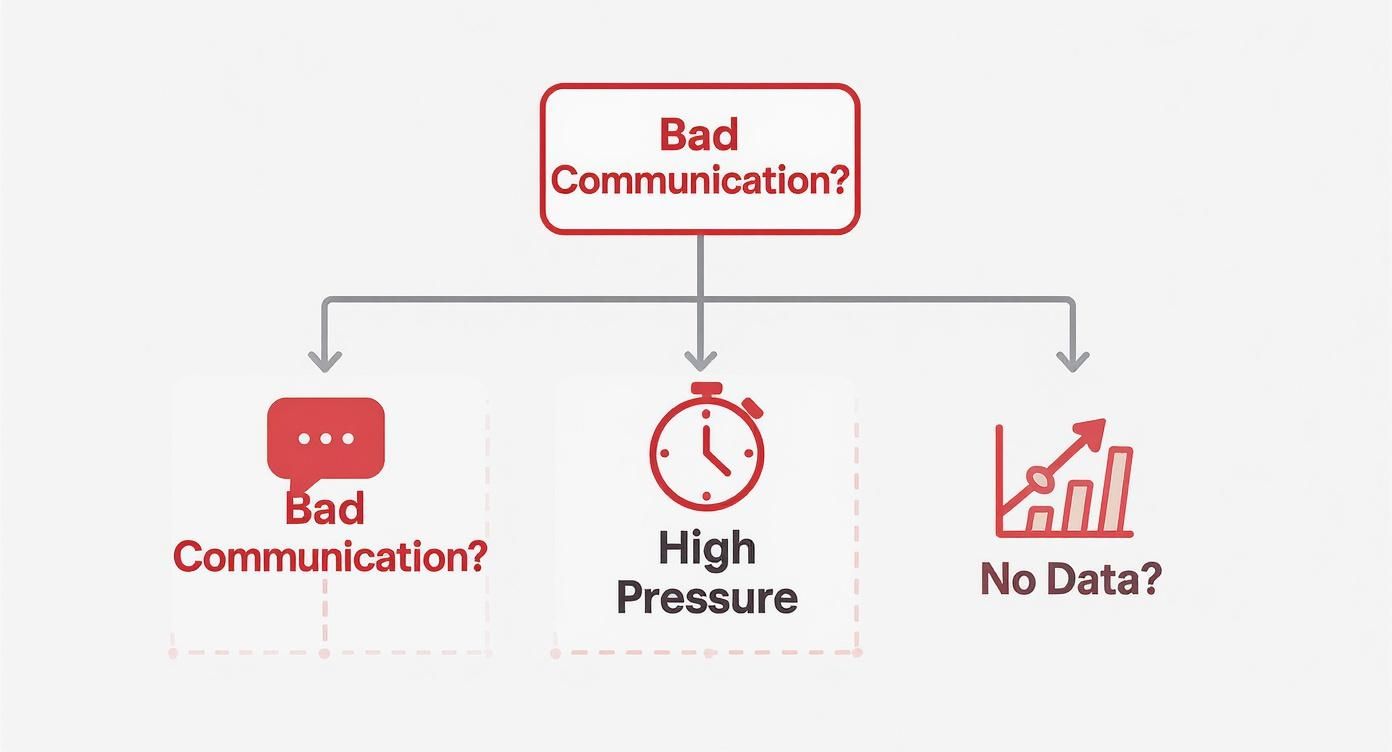
If you’re seeing poor communication, feeling high-pressure sales tactics, or getting fuzzy answers instead of hard data, those are serious warnings. Don't ignore them.
What to Expect in the First Few Weeks
Once that listing agreement is signed, things should kick into high gear immediately. A proactive agent won’t wait around; they’ll lay out a clear timeline of what’s happening next.
The first week is all about execution. Expect your agent to schedule professional photography, finalize marketing copy, and prepare for the official launch on the MLS. This initial momentum sets the tone for the entire sale.
Within the first 72 hours, you should know the exact schedule for photos, any staging consultations, and the target "go-live" date. That level of organization is what separates the pros from the rest. It’s what gives you peace of mind and sets you up for a successful sale right from day one.
A Few Common Questions When Picking a Realtor
When you start the process of choosing a real estate agent, a few key questions always seem to pop up. Getting straight answers to these is crucial—it helps you move ahead with confidence and sidestep some of the common traps sellers fall into.
Should I Just Pick the Realtor Who Gives Me the Highest Price?
Not so fast. It's incredibly tempting to go with the agent who throws out the biggest number for your home, but you have to be careful. This is a classic tactic some agents use called "buying the listing," where they over-promise on the price just to get you to sign with them.
A truly professional agent will come prepared with a realistic, data-backed Comparative Market Analysis (CMA). They’ll sit down with you and walk through what homes like yours in your specific Fresno neighborhood have actually sold for recently. They’ll show you their work and explain exactly how they landed on their suggested price. An over-inflated price tag almost always leads to your home sitting on the market, getting stale, and needing price cuts down the road.
Is It Better to Work With a Solo Agent or a Big Team?
Honestly, there are pros and cons to both, and the right answer really boils down to what you're most comfortable with.
- A Real Estate Team: The big advantage here is coverage. Teams often have specialists for different parts of the process—one person for marketing, another for showings—so there's always someone available.
- An Individual Agent: With a solo agent, you get a much more direct, one-on-one relationship. You’ll have a single person you call, text, and meet with for everything.
If you're leaning toward a team, just make sure you’re clear on who your main point of contact will be. You want to feel good about how they’ll keep you in the loop. A great agent will also connect you with other pros you’ll need, like those who handle title services. If you want a bit more background on that part of the sale, you can check out resources for understanding real estate title services.
How Long Is a Standard Listing Agreement?
Most listing agreements run somewhere between 90 and 180 days, but here’s the important part: this is almost always negotiable. The right timeframe often depends on what's happening in the local market. You can get a better sense of this by understanding the average time to sell a house in our area. No matter what, read the contract from top to bottom, paying special attention to any cancellation clauses before you put pen to paper.
Here at Edinhart Realty & Property Management, we’re all about building a partnership based on complete transparency and trust. Our strategies are driven by real data, and we make clear communication our top priority every step of the way. If you’re thinking about selling your home in the Fresno area and want a team that puts your goals first, get in touch with us today.


