

Property management for a residential rental usually costs 8% to 12% of monthly rent, and the total annual cost can climb to 18% to 20% of gross rent once you include leasing, maintenance coordination, inspections, and other add-ons. If you're a Fresno landlord comparing self-management to hiring help, the monthly fee is only the starting point.
Most owners I talk to aren't just asking, "What does a manager charge?" They're asking a more practical question. "What will this cost me over a full year, and is it worth it?" That's the right question, because the answer isn't just about a headline percentage. It's about vacancy, repairs, tenant quality, compliance, and how much of your own time you're prepared to give up.
A new landlord often starts with the visible number. Maybe it's a quote based on monthly rent, or maybe it's a flat monthly fee that looks simpler. But the true test of that initial choice usually shows up later, when the first tenant moves out, a repair comes in, or the lease needs to be renewed and the agreement suddenly matters more than the marketing pitch.
Why Understanding Property Management Costs is Crucial for Your ROI
If you own a rental in Fresno, Clovis, Friant, or anywhere in Central California, you're balancing two costs at the same time. One is the fee you pay a management company. The other is the cost of doing the work yourself, including after-hours maintenance calls, tenant follow-up, rent collection, paperwork, and legal risk.

Nationally, residential property management fees typically run 8% to 12% of monthly rental income, with single-family homes often near 10%, while larger portfolios can drop to 4% to 7% because scale lowers overhead, according to this breakdown of percentage-based property management fees. That gives you a starting benchmark, not a full financial picture.
The sticker price is not the investment decision
A landlord can save the monthly fee and still lose more money overall. One bad tenant, one extended vacancy, or one preventable maintenance issue can erase what looked like savings on paper. That's why smart owners calculate management as part of return on investment, not as a standalone expense.
If you want a simple framework for that decision, the opportunity costs formula is useful because it forces you to compare what you give up by managing yourself. That includes your time, your weekends, and the business or personal work you could be doing instead.
Practical rule: Don't compare management fees only against zero. Compare them against the cost of vacancy, mistakes, delayed repairs, and your own time.
What Fresno owners should focus on
In this market, the right question isn't "Who is cheapest?" It's "Who gives me the clearest all-in cost and the strongest operational value?" A cheaper manager who handles leasing poorly or communicates badly can cost more than a higher-priced manager who fills the property with a qualified tenant and keeps things moving.
That matters most for owners with a single-family rental. Those homes usually carry more fixed work per door than a larger apartment portfolio, which is why rates for single-family management often sit at the higher end of the typical range.
Decoding the Core Fee Structures
There are two common ways property managers charge. One is a percentage of rent. The other is a flat monthly fee. Both can work, but they create very different incentives.
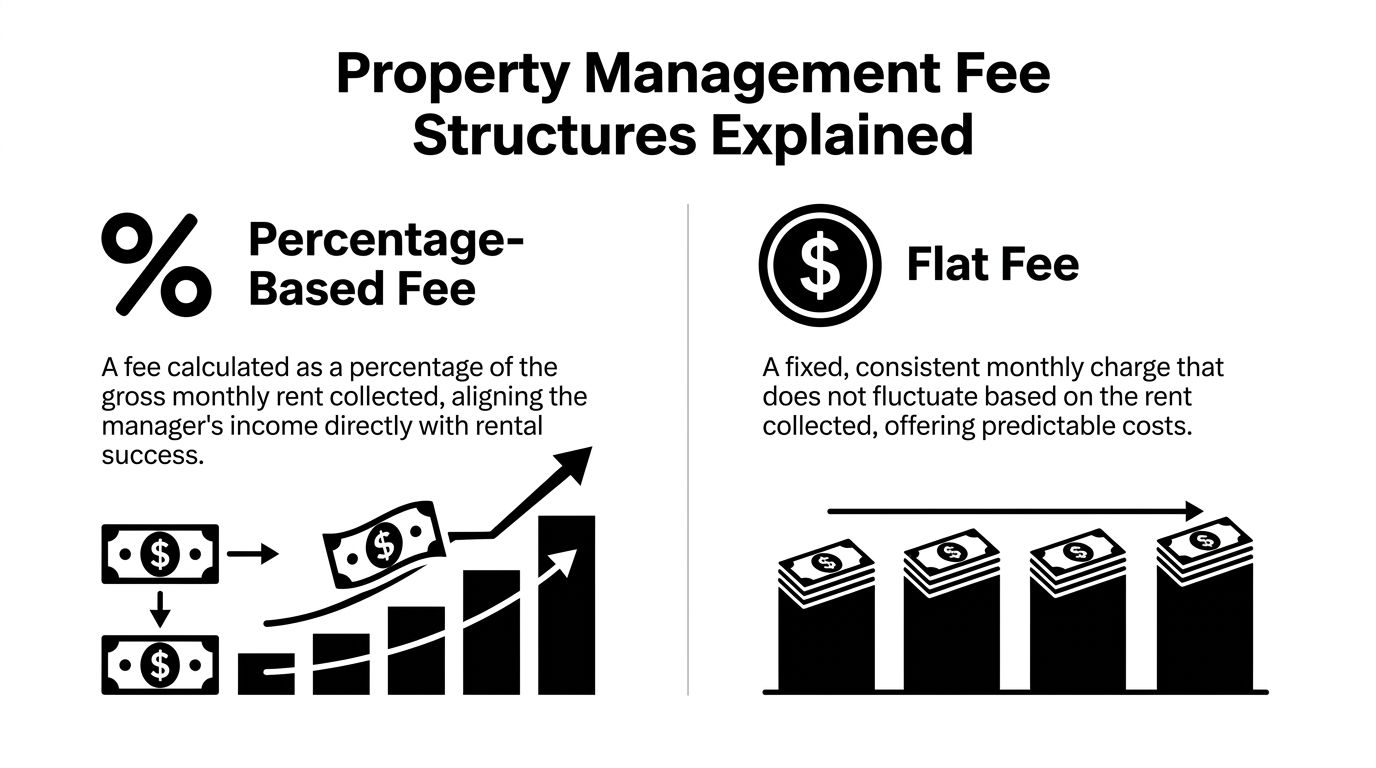
For single-family homes and small portfolios, management fees usually fall in the 8% to 12% range, and the percentage model ties the manager's income directly to rent collection and occupancy, as explained in this review of property management cost structures.
Percentage-based pricing
This is the model most landlords will see first. If rent comes in, the manager earns their fee as a percentage of that rent. The appeal is simple. Your manager has a direct financial reason to keep the property occupied and the rent collected.
That alignment matters more than many owners realize. If the home sits vacant, both owner and manager feel it. If rent collection slips, both sides are affected. That's why percentage pricing often works best for full-service management, where the company is handling day-to-day operations and performance really does matter.
A practical example helps. On a home renting for $1,500 per month, an 8% to 12% management fee works out to $120 to $180 per month, or $1,440 to $2,160 annually, based on the national benchmarks discussed in the earlier source about percentage pricing.
Flat-fee pricing
A flat fee feels cleaner. You pay the same amount every month whether rent is low or high. For some owners, especially those with stronger systems and more hands-on involvement, that predictability is attractive.
The trade-off is incentive. A flat-fee manager may do solid work, but the pricing structure itself doesn't naturally reward rent growth or stronger collections the way a percentage model does. That's the reason many owners use flat-fee arrangements for lighter-touch service rather than for true full-service oversight.
If you want to see how one company frames that approach, this flat fee property management overview gives a helpful example of the model in practice.
When a flat fee starts looking better
Flat fees become more interesting as rents rise. Verified pricing guidance notes that flat-rate fees can land around $100 to $200 per unit, while percentage fees on a $1,500 rental equal $150 per month at 10% and jump to $300 per month on a $3,000 rental, making flat fees materially cheaper in some high-rent situations, according to this discussion of flat-fee versus percentage pricing.
A percentage model acts like a partnership. A flat fee acts more like a subscription.
What works and what doesn't
Here's the simplest way I explain it to new landlords:
| Fee model | Usually works best for | Main advantage | Main drawback |
|---|---|---|---|
| Percentage of rent | Owners who want full-service management | Better alignment with occupancy and collections | Monthly cost rises with rent |
| Flat monthly fee | Owners who want predictable billing or lighter support | Easy to budget | Weaker incentive alignment |
What doesn't work is choosing a fee structure without checking what is included. A lower monthly price means very little if leasing, renewals, inspections, and maintenance coordination all sit outside the base contract.
Beyond the Monthly Fee Leasing and One-Time Charges
The monthly management fee gets the attention. The one-time and event-driven fees are what usually surprise people.
That's where many new landlords misread the economics of management. They compare one company's monthly rate to another's and stop there. Then a tenant turns over, a repair gets coordinated, or a renewal comes up, and the full cost picture changes fast.
Leasing, renewals, and vacancy-related costs
Some of the most important charges happen when a property is empty or changing hands. Verified cost guidance shows that hidden total costs can include vacancy charges of $50 to $150 per month, renewal fees of $200 to $500, and eviction-related costs of $500 to $1,000, according to this breakdown of hidden property management fees.
Leasing is the biggest one most owners should expect. Separate verified industry data shows leasing fees often run 25% to 100% of one month's rent, with 50% to 75% commonly cited, and placement-only service often uses that kind of one-time structure rather than an ongoing monthly fee.
If you're in Fresno and your rental turns over, that fee is paying for the work owners usually underestimate:
- Marketing the vacancy: Photos, listing setup, inquiry handling, and showing coordination.
- Screening applicants: Income review, application processing, and qualification checks.
- Lease execution: Drafting, signatures, deposit handling, and move-in coordination.
Maintenance coordination and the fine print
Repairs are another area where the agreement matters. The same verified source on hidden fees notes that maintenance markups often fall between 10% and 15%. Another verified source estimates annual maintenance coordination and related charges can materially push the all-in cost above the base management fee.
That doesn't automatically mean a markup is bad. Good maintenance coordination has value. Someone is taking the call, dispatching the vendor, following up, documenting the issue, and closing the loop with the tenant and owner. The problem isn't the fee itself. The problem is when the fee isn't disclosed clearly.
Ask whether maintenance coordination is included, marked up, or billed separately. Those are three very different pricing models.
What to look for in the agreement
Not every company charges every fee, but every owner should scan for the same categories:
- Leasing fee: Is it charged on every new tenant placement?
- Renewal fee: Is there a separate charge when the same tenant signs again?
- Inspection cost: Included, or billed per visit?
- Vacancy oversight: Is there a charge while the property is empty?
- Eviction handling: What is included before outside legal work begins?
A transparent contract makes these easy to identify. If the pricing sheet looks simple but the agreement is vague, slow down.
What Determines Your Property Management Rate
Two owners can each ask how much should property management cost and get different answers for good reason. Rates change based on the property, the workload, and the service expectations.

For multifamily and commercial property, management fees commonly range from 4% to 12% of monthly rental revenue, with the low end around 3% for large-scale operations and the high end reaching 15% for more complex assets, as outlined in this multifamily management fee analysis.
Property type changes the workload
A single-family home and a larger apartment property don't create the same kind of work. A single house still needs advertising, tenant communication, rent collection, lease administration, vendor coordination, and compliance oversight. There are no neighboring units to spread those fixed tasks across.
That is why larger portfolios often secure lower effective rates. The workload per unit changes when systems, reporting, and maintenance coordination can be spread across multiple doors.
Location affects management intensity
A well-located Fresno or Clovis rental with strong demand may lease faster than a property in a less active pocket. Faster leasing and stronger applicant flow can make management simpler. A property in a tougher location often needs more showing coordination, more screening discipline, and closer oversight.
Location also affects vendor response and maintenance logistics. A home near the manager's operating area is easier to service than a property that sits farther out and needs more travel coordination.
Condition and service scope matter
A newer home usually creates fewer headaches than an older one with recurring repair issues. The monthly rate isn't just about rent. It's about the amount of operational friction behind that rent.
Then there's the scope of service. Some owners want rent collection and basic coordination. Others want fully hands-off service, including statements, renewals, maintenance follow-up, move-in and move-out handling, and compliance-minded documentation.
A manager isn't pricing the building alone. They're pricing the amount of work your property is likely to create.
Here's a quick view of the biggest rate drivers:
| Factor | Why it changes the quote |
|---|---|
| Property type | Single-family and small portfolios usually carry more fixed work per unit |
| Number of units | Larger portfolios spread overhead across more doors |
| Location | Leasing pace, vendor access, and oversight demands vary by area |
| Condition | Older or maintenance-heavy properties require more coordination |
| Service level | Full-service support costs more than limited or placement-only help |
Full Service Management vs Placement Only Services
Not every owner needs the same level of help. Some want complete day-to-day management. Others just want a qualified tenant placed and prefer to handle the rest themselves.
The financial difference matters. Verified cost data shows the true all-in cost of professional management often reaches 18% to 20% of gross annual rent, and on a property renting for $1,500 per month, that can total $3,225 to $3,525 per year, including $1,800 in management, $1,125 in leasing, $200 to $400 in maintenance markup, and $100 to $200 in inspections, according to this all-in property management cost breakdown.
What full-service really means
Full-service management is for owners who want to step back from the daily work. In practice, that usually includes rent collection, tenant communication, repairs, accounting, lease administration, and ongoing issue handling.
This model makes the most sense when you're out of town, short on time, or you don't want a second job. It can also make sense when you know you won't be consistent about follow-up, documentation, or maintenance coordination.
When placement-only makes sense
Placement-only service is narrower. The manager markets the property, screens applicants, prepares the lease, and gets the tenant into place. After that, the owner takes over.
This can work well for experienced landlords who are comfortable fielding maintenance calls, enforcing lease terms, and handling the routine back-and-forth that comes with occupancy. It can also be a fit for local owners who want help at the front end but don't want an ongoing monthly management relationship.
If you want convenience, consistency, and distance from tenant issues, full service usually fits better. If you want control and lower recurring costs, placement-only is often the cleaner option.
Comparing the two side by side
| Feature | Full-Service Management | Placement-Only Service |
|---|---|---|
| Primary purpose | Ongoing operational management | Tenant placement only |
| Best for | Hands-off owners, remote owners, busy landlords | Experienced local landlords |
| Typical cost pattern | Monthly fee plus additional event-based charges | One-time leasing or placement fee |
| Tenant communication | Manager handles it | Owner handles it after move-in |
| Repairs and maintenance | Manager coordinates | Owner coordinates |
| Accounting and statements | Usually included in ongoing service | Usually limited to setup and leasing documentation |
| Renewals and ongoing compliance | Manager typically handles | Owner typically handles |
The wrong fit isn't about price alone. It's hiring full-service when you really wanted control, or choosing placement-only when you don't have the time or systems to manage well once the tenant is in place.
Key Questions to Ask a Potential Property Manager
A landlord who only asks, "What's your monthly fee?" usually misses the most expensive part of the conversation.
The better approach is to ask questions that expose how the company operates. That's how you find out whether the proposal is transparent or just cheap-looking.
Questions that reveal the real cost
Use these when you're interviewing a manager:
- What's included in the monthly fee? Ask them to separate routine management from leasing, renewals, inspections, and maintenance coordination.
- How do you charge for repairs? You want a direct answer on markups, vendor billing, approvals, and communication.
- What does your screening process look like? Strong screening standards protect income and reduce avoidable problems.
- Who handles tenant communication after hours? A company needs a real process, not a vague promise.
- How do you document inspections, notices, and lease compliance? Good managers leave a paper trail.
- Can you walk me through your management agreement line by line? If you want context before that conversation, this guide to a property management agreement is a useful starting point.
Listen for clarity, not polish
A reliable manager should answer plainly. If every answer sounds like a sales script, keep pushing.
Look for specifics such as when fees apply, how owner approvals work, how funds are disbursed, and what happens during a vacancy. A solid company won't dodge those details.
The right manager can explain their fee structure in normal language. If you need a translator to understand the contract, that's a warning sign.
One final test
Ask them how they would handle your exact property. A single-family house in Fresno with an older HVAC system and an owner who lives out of state should produce a different conversation than a local landlord with multiple doors and their own contractors.
That answer tells you whether they understand management, or whether they're just quoting a template.
Maximizing Your Return The True Value of Professional Management
The cheapest management option rarely produces the best return. The strongest return usually comes from a manager who keeps the property occupied, screens carefully, documents everything, and handles maintenance before small issues become expensive ones.
That's why the total effective cost matters more than the advertised monthly fee. A manager's value shows up in cleaner leasing, steadier collections, better tenant communication, and fewer operational surprises. Even something as basic as using a clear maintenance request form template can improve how repairs are documented and resolved, which protects both the owner and the resident.
For some landlords, professional management is worth it because it saves time. For others, it's worth it because it reduces mistakes. If you're still weighing that decision, this look at whether property management is worth it is a helpful companion read.
The right way to judge cost is simple. Don't ask only what you'll pay. Ask what you'll get, what you'll avoid, and what your property is likely to earn with steady professional oversight.
If you want a straightforward quote and a clear explanation of what is and isn't included, Edinhart Realty and Property Management serves Fresno, Clovis, Friant, and the greater Central California region with both full-service management and placement-only options. Reach out if you'd like help comparing your likely all-in costs against the time, risk, and workload of managing the property yourself.


