

Figuring out how much to charge for rent is more than just pulling a number out of thin air. It’s a delicate balancing act, a strategic mix of solid market research, a hard look at your expenses, and a genuine understanding of what makes your property special.
The sweet spot balances maximizing your income with minimizing vacancy, making sure your investment actually stays profitable. It's part science, part art—you need the hard data, but you also need a gut feeling for your neighborhood.
The Landlord's Dilemma: Setting the Right Rent
Pricing your rental is easily one of the most critical calls you'll make as a landlord. It hits your cash flow and long-term success directly. If you get it wrong, it can get expensive, fast.
Price it too high, and you're looking at long, painful vacancies. Every month that unit sits empty is a 100% loss of potential income for that month. Go too low, and you're literally leaving cash on the table, which can even make your property look less valuable in the market's eyes.
The real challenge? The rental market is always on the move. Just look at the recent swings across the U.S. As of May 2025, the median asking rent in the 50 biggest metro areas was $1,705. That’s actually a 1.7% dip from the year before.
But here's the kicker: even with that dip, rents are still a whopping 19.6% higher than they were just six years ago. This shows just how crucial it is to have current, local data on your side.
Finding Your Pricing Sweet Spot
To nail down how much rent you should charge, you have to ditch the guesswork. A winning strategy is methodical and built on a few key pillars. You need to dig into what comparable properties right in your area are going for, get an honest tally of all your costs, and then figure out how to value your property's unique perks.
For a quick overview of what you should be looking at, here’s a simple table to guide you.
Quick Guide to Setting Your Rent Price
| Factor | Key Action | Why It Matters |
|---|---|---|
| Market Research | Analyze at least 3-5 comparable local listings (comps). | Sets a realistic baseline for what tenants in your area are willing to pay. |
| Expense Calculation | Total all costs: mortgage, taxes, insurance, maintenance, etc. | Determines your break-even point and minimum profitable rent. |
| Property Value | Adjust for amenities, condition, and specific location features. | Quantifies the premium (or discount) your property commands over the competition. |
| Vacancy Rate | Factor in a buffer for potential empty months (e.g., 5-8%). | Creates a more accurate annual income projection and financial safety net. |
This process ensures your final price is backed by data, not just a hunch.
This flowchart lays out the core steps visually. It's a simple but effective roadmap.
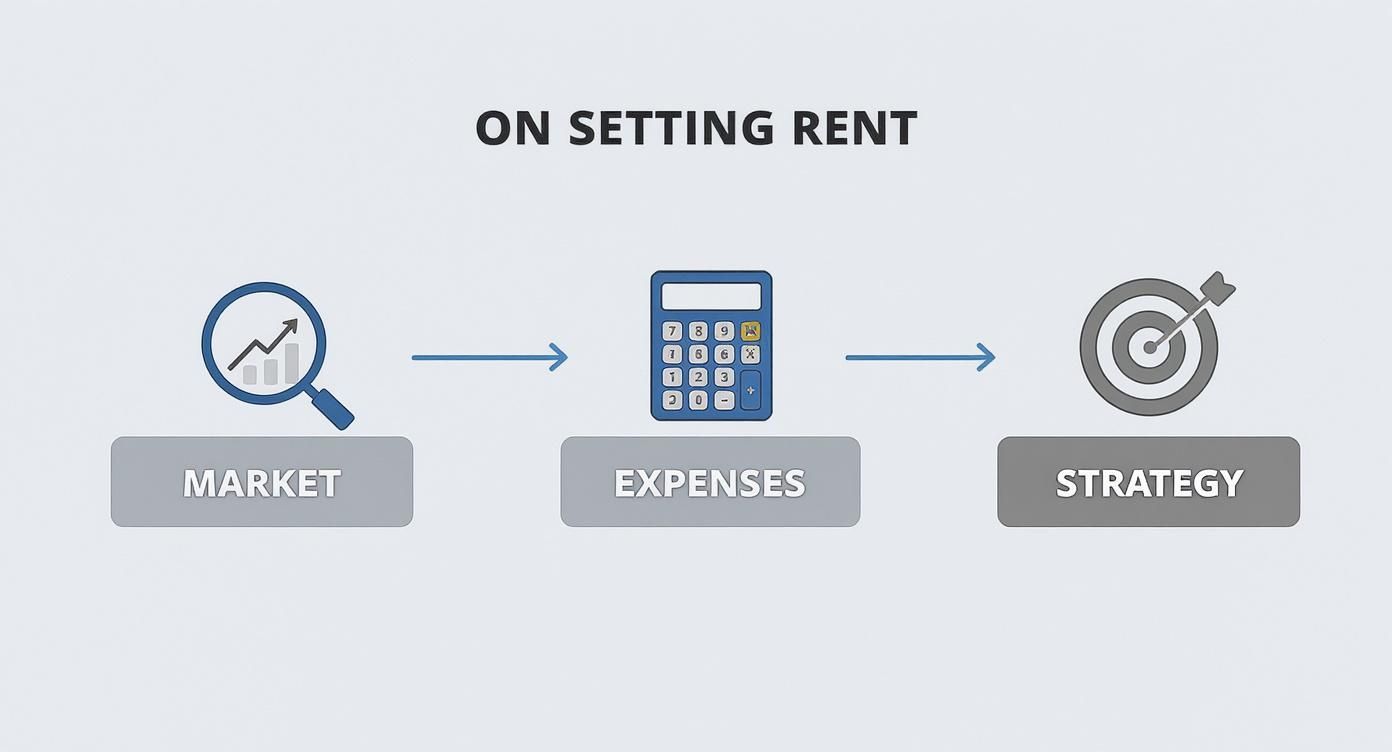
As you can see, you start with market data, ground it in your own financial reality, and then land on a strategic price.
Juggling all these moving parts is what being a landlord is all about. To get a handle on the complexities and make sure you’re getting the best return, exploring effective property management solutions can be a game-changer.
Think of your rental price as a powerful marketing tool. It tells a story about your property's value, shapes the kind of applicants you attract, and ultimately defines your investment's performance.
This guide will walk you through each of these stages. We'll give you actionable steps and real-world tips to help you set a competitive and profitable rent with confidence.
Finding Accurate Rental Comps in Your Market
Before you can land on the right rent price, you need to put on your detective hat and investigate your local market. Your pricing strategy is only as good as the data behind it, and the best information comes from digging up accurate comparable properties, or "comps." This is more than just a quick scroll through online listings; it's about building an evidence-based case for what your property is truly worth.
Think of comps as your property's direct competition. These are units that have recently been rented or are on the market right now that mirror yours in size, features, and most critically, location. A solid analysis of these properties tells you what local renters are actually willing to pay today.
Where to Uncover Reliable Rental Data
Your search will probably start with the big online listing platforms. Sites like Zillow, Apartments.com, and Realtor.com are fantastic for getting a bird's-eye view of the rental landscape. They give you a quick snapshot of what's available in your property's ZIP code. For an even more detailed breakdown, our guide on how to analyze the average rental rates by ZIP code is a great next step.
But don't stop there. To get the real story, you have to dig deeper:
- Local Property Management Websites: Go straight to the pros. Property management companies in your area, like Edinhart Realty, list their available rentals on their own websites. You can bet these are professionally priced, making them excellent benchmarks.
- Craigslist and Facebook Marketplace: You'll need a discerning eye to spot scams, but these platforms show you what independent landlords are charging. It's a different, often more immediate, slice of the market.
- Connect with Real Estate Professionals: Local agents and property managers live and breathe this stuff. They often have access to Multiple Listing Service (MLS) data for rentals, which can include details you won't find anywhere else.
Tools like Zillow Rental Manager can give you an initial rent estimate based on broad market data, which is a decent starting point.
Just remember, an automated estimate can't see the brand-new quartz countertops you just installed or the worn-out carpet in the unit down the street.
Analyzing Comps Like an Expert
Once you've gathered a list of 3-5 strong comps, the real work begins. The asking price is just the surface. You need to dissect each listing to understand what a tenant is really getting for their money.
A classic mistake I see is a landlord comparing their newly renovated unit with premium finishes to a place that hasn't been touched in a decade. Even if they're next door to each other, they're playing in two completely different leagues.
Fire up a simple spreadsheet to stack your property against the competition. You'll want to track these key factors:
- Location: Get specific. It's not just about the neighborhood, but the actual block. Is the comp on a noisy main street while yours is on a quiet cul-de-sac? Is it closer to the park or train station?
- Size and Layout: Compare square footage, bed/bath count, and the overall floor plan. An open-concept layout can often fetch a higher rent than a dated, choppy one.
- Condition and Age: Be honest with yourself. Note the age of appliances, the quality of the flooring, and when your unit and the comps were last renovated.
- Amenities: This is where you can really set yourself apart. Does your property have in-unit laundry, a dishwasher, central air, a private balcony, or dedicated parking? Each of these adds real, quantifiable value.
- Utilities Included: Always check if the comp's rent includes water, trash, or internet. If you offer these, you need to factor that into your price.
Adjusting for Market Dynamics
You also have to understand the bigger picture. After a period of crazy-fast increases, national rent growth has slowed down quite a bit. In the second quarter of 2025, the national effective rent landed at $1,869—a modest 2.1% increase from the year before. That’s a world away from the 18% average rent hikes we saw between 2021 and 2022.
This cooling trend means that pricing too aggressively could leave you with a vacant unit for months. You can read more about the latest apartment market pulse from Summer 2025 to see how these trends might impact your strategy.
Taking this detailed approach moves you from guessing to strategizing. It gives you the hard data you need to justify your price and ensures you're positioned to win in your specific market.
Calculating Your True Costs and Desired ROI
Market research gives you a fantastic picture of what tenants are willing to pay, but your own numbers tell the real story—what you need to charge to actually make money. Before you slap a price on your listing, you have to get an honest, unflinching look at every single cost. This step is all about setting your financial baseline, the absolute rock-bottom number you need to break even. From there, we can build in a healthy profit.
Getting a handle on your numbers is what separates a successful, cash-flowing investment from a stressful, money-pitting headache. So many landlords, especially when they're new to the game, just look at their mortgage payment and call it a day. The real costs run so much deeper than that.

Uncovering Every Hidden Expense
To figure out the right rent, you have to add up every expense tied to owning and running that property. This kind of detailed accounting is your best defense against nasty financial surprises popping up later.
Your cost checklist needs to be thorough. Here’s what we always look at:
- PITI: The big one—Principal, Interest, Taxes, and Insurance. This is usually your largest monthly expense.
- HOA Fees: If you're in a community with a homeowners association, don't forget these mandatory monthly or annual dues. They're a fixed cost you can't avoid.
- Vacancy Fund: Let's be realistic, no property stays occupied 100% of the time. Smart investors stash away 5-8% of the monthly rent to cover the gaps between tenants.
- Maintenance and Repairs: Things break. It's just a fact of life. A good rule of thumb is to budget 1-2% of the property’s value each year for the small stuff, like leaky faucets or a finicky dishwasher.
- Capital Expenditures (CapEx): These are the major, wallet-busting replacements—a new roof, an HVAC system, or a water heater. Saving another 1-3% of the property's value annually for these big-ticket items is crucial for long-term financial health.
- Property Management Fees: If you partner with a pro like Edinhart to handle the day-to-day, factor in those fees. They typically run between 8-12% of the monthly rent collected.
To help you visualize this, here’s a breakdown of what a monthly expense sheet might look like.
Sample Monthly Expense Calculation for a Rental Property
| Expense Category | Example Cost ($) | Notes & Considerations |
|---|---|---|
| PITI (Mortgage) | 1,200 | Principal, Interest, Taxes, and Insurance. Your biggest fixed cost. |
| HOA Fees | 75 | Can vary widely depending on the community and its amenities. |
| Vacancy Fund (8%) | 160 | Based on a hypothetical rent of $2,000/month. Set aside every month, even when occupied. |
| Maintenance (1%) | 208 | Based on a $250,000 property value. This covers small, routine repairs. |
| CapEx (2%) | 417 | Also based on a $250,000 value. This is your savings for big-ticket replacements down the road. |
| Management Fee (10%) | 200 | Calculated from the gross rent. Only paid when the property is occupied and rent is collected. |
| Total Monthly Expenses | $2,260 | This is your break-even point. Any rent above this amount is your potential cash flow. |
This table makes it clear just how quickly costs can add up beyond the mortgage. Aiming for a rent price that only covers PITI is a surefire way to lose money over time.
Setting a rent price without a full expense breakdown is like navigating without a map. You might be moving, but you have no idea if you're headed toward profitability or financial trouble.
Using Rules of Thumb to Guide Your Numbers
Once you’ve tallied your costs, you can use a couple of old-school investor formulas to do a quick gut check on your numbers. Think of these as guardrails, not unbreakable laws. They provide a valuable reality check.
The 1% Rule: This classic guideline suggests your monthly rent should be at least 1% of what you paid for the property. If you bought a house for $250,000, this rule would point you toward a rent of $2,500 per month. It’s a great tool for quickly screening potential deals, but it often doesn't hold up in expensive markets. Never let it replace a proper market analysis.
The 50% Rule: This one helps you estimate your operating expenses (everything except the mortgage). It assumes your non-mortgage costs will eat up about 50% of your gross rental income. So, if you're collecting $2,000 a month in rent, you can ballpark about $1,000 for things like taxes, insurance, repairs, and vacancy. It's a handy way to create a quick budget.
The interplay between income, expenses, and profit is the heart of a successful rental business. To really get into the weeds, you can check out our complete guide on how to perform a rental property cash flow analysis and master these numbers.
Calculating Your Investment Return
With your costs and potential rent figured out, you can finally see if the investment actually meets your financial goals. These next metrics show you how hard your money is really working for you.
- Capitalization Rate (Cap Rate): This is a quick way to measure a property's profitability. You find it by dividing your Net Operating Income (NOI) by the property's current market value. Generally, a higher cap rate signals a better return.
- Cash-on-Cash Return: This is my personal favorite. It tells you the return you’re getting on the actual cash you put into the deal. Just divide your annual pre-tax cash flow by your total cash invested (down payment, closing costs, upfront repairs). It’s a powerful metric for comparing one property's performance against another.
These calculations are more important than ever as operating costs keep climbing. Landlords everywhere are feeling the squeeze of inflation on everything from maintenance supplies to labor. In fact, projections show the annual rent per square foot could hit $27.67 in 2025—a massive 47.3% jump from 2020. You can see more on these global rent trends over at Nasdaq's financial analysis site.
When you ground your rent price in a solid analysis of your costs and return goals, you build a sustainable business that can handle market shifts and deliver the profits you’re looking for.
How Amenities and Condition Impact Your Rent
You’ve run the comps and crunched the numbers on your expenses. Now comes the part where the real art of rent setting comes into play. It's time to fine-tune your price based on what makes your specific property stand out from the pack.
It’s a simple truth: two identical apartments in the same building can fetch wildly different rents. Why? It all boils down to their amenities and overall condition. Tenants aren't just paying for square footage; they're paying for a lifestyle, and they will absolutely pay a premium for features that make their lives easier and more comfortable.
Quantifying the Value of Premium Amenities
Not all upgrades are created equal. Some are nice-to-haves, while others are absolute game-changers that can add serious money to your monthly income. You have to figure out which features really move the needle in your specific market.
The amenities that save a tenant time, money, or a major headache are the ones that consistently deliver the biggest returns.
In-Unit Washer and Dryer: This is the holy grail for most renters. The sheer convenience of doing laundry at home is massive, easily adding $75 to $150 per month to what you can charge.
Updated Kitchen and Baths: Nobody gets excited about dated kitchens and bathrooms. Modern touches like stainless steel appliances, granite or quartz countertops, and a dishwasher are huge selling points that can justify a rent bump of $100 to $250 or even more.
Private Outdoor Space: A balcony, patio, or small yard is a huge draw, especially in more crowded urban areas. Having that personal slice of the outdoors can boost your rent by 5-10%.
Dedicated Parking: Where street parking is a constant battle, an off-street spot is gold. Depending on the city, this single amenity can be worth anywhere from $50 to over $300 a month.
These aren't just guesses. Look at your comps again. You'll see exactly how much more a unit with a renovated kitchen and in-unit laundry is getting compared to a similar one without those perks.
The Power of Property Condition
Beyond the list of amenities, the general condition of your property sends a strong signal about its worth. Simple things like a fresh coat of paint, clean floors, and modern fixtures show that a home is well-cared-for, making it much easier to justify a higher price.
Let's look at a real-world scenario.
Two Identical Apartments, Two Different Rents
Imagine two 2-bed, 1-bath units in the same building. Same layout, same square footage. The baseline market rent for a standard unit here is $1,800.
Unit A (The Dated One): It has 15-year-old carpet, original laminate countertops, and older appliances. Everything works, but it looks tired. This unit will probably rent right at or just under the market rate, maybe around $1,775.
Unit B (The Renovated One): This unit just got new vinyl plank flooring, quartz countertops, stainless steel appliances, and a modern light fixture. The whole place feels fresh and premium. This one can easily be listed for $1,950 to $2,000, pulling in a $175-$225 premium over its identical neighbor.
That investment in Unit B pays for itself pretty quickly, leading to higher monthly cash flow and attracting a better pool of tenants who appreciate a well-maintained home.
Leveraging Micro-Location and Seasonality
Finally, don't overlook the little details that can give you a pricing edge. Even within the same neighborhood, small differences in location matter.
A property that's a five-minute walk from a popular coffee shop or the main subway line has a distinct advantage over one that's fifteen minutes away. Highlight these micro-location perks in your listing to justify your price.
The time of year also makes a huge difference. The rental market is hottest in the spring and summer when more people are moving. If you have a vacancy in June, you have much more pricing power than you would in December. If you can, try to time your lease end-dates to hit that peak season and maximize your rent.
Navigating Rent Control and Local Regulations
So you’ve run the comps, crunched your numbers, and have a good idea of what your property should rent for. That's the business side of things. Now comes the part that can trip up even seasoned landlords: the legal side.
Setting the right rent isn’t just about maximizing profit; it’s about doing it legally. Overlooking local and state laws isn't just a simple mistake—it can lead to hefty fines, drawn-out legal battles, and a black mark on your reputation. The rules are there to keep the housing market fair and stable, and while they can feel like a headache, they’re the guardrails that keep your investment safe.
Understanding Rent Control and Stabilization
The biggest players in the legal game are rent control and rent stabilization. These laws, usually found in cities with high housing costs, put a hard cap on your pricing strategy. Even if the market says you can charge more, these rules are non-negotiable.
- Rent Control: This is the more restrictive version. It often sets a specific maximum rent for a unit and only allows for tiny, pre-approved increases, sometimes even when a new tenant moves in.
- Rent Stabilization: This is what you see more often today. It doesn't set a fixed price, but it does limit the percentage you can raise the rent each year for an existing tenant. That percentage is typically decided annually by a local rent board.
If your property falls under these laws, they are the final word on your maximum rent.
One of the most costly assumptions a new landlord can make is thinking their property is exempt from old rent control rules. Always, always verify the property's regulatory status before you even think about setting a price.
Complying with Fair Housing Laws
Beyond pricing, there's the federal Fair Housing Act. This is a big one. It prohibits any kind of housing discrimination based on seven protected classes: race, color, religion, national origin, sex, disability, and familial status.
What does this mean for your rent? It means you can't have different prices or different rules for different people. Your rent has to be based on objective factors like market data and property features, and it must be applied the same way to every single qualified applicant. Even a casual remark or a tiered pricing system could be seen as discriminatory, opening you up to serious legal trouble.
Researching Local Landlord-Tenant Laws
Every city and state has its own unique playbook for landlord-tenant laws. These rules cover everything from how much you can charge for a security deposit to how much notice you have to give for a rent increase.
While not direct price controls, they set the legal stage for your entire operation. To get a handle on the rules in your area, this comprehensive guide to rental regulations is a great place to start.
Because these laws change so drastically from one town to the next, what’s standard practice in one area could be illegal just down the road. This is why we highly recommend talking to a local real estate attorney. Having a professional review your lease and pricing is a small investment that can save you from a world of legal pain later.
You've done the math, you've scoured the comps, and now it's time to take your price live. This is where the rubber meets the road—the moment your strategy collides with the real-world rental market. A few smart moves here can mean the difference between a quick lease-up and weeks of costly vacancy.
It’s not just about picking a number; it’s about presenting it in a way that gets tenants in the door.
One of the oldest tricks in the book is still one of the best: pricing psychology. There’s a powerful reason you see so many items listed for $1,995 instead of a flat $2,000. We call it charm pricing, and it works because it makes the rent feel significantly lower, even if it’s just a few bucks shy of the next hundred. A bonus? It also ensures your property shows up in searches for rentals "under $2,000," instantly widening your audience.
Building Value Directly Into Your Lease
Think of your lease agreement as more than just a legal document—it's a sales tool. You can use its terms to reinforce the value of your asking price, making your rental far more attractive than the competition next door.
A few ideas to get you started:
- Offer a Longer-Term Lease: Many tenants crave stability. Offering a 15 or 18-month lease at a fixed rate can be a huge win-win. They get peace of mind knowing their rent won't jump, and you lock in a great tenant, saving yourself the headache and cost of turnover.
- Include a Strategic Utility: If most landlords in your area make tenants pay for everything, including a utility like water or trash can be a major differentiator. It simplifies their monthly budgeting and can easily justify a slightly higher rent.
- Be Ready to A/B Test: If you launch your listing and all you hear are crickets after the first week, don't panic and don't be stubborn. A small price drop of $25 or $50 can be all it takes to open the floodgates of inquiries. That's a much smarter move than letting the property sit empty for another month.
Your initial asking rent isn't set in stone. It's your opening bid to the market. Pay close attention to the feedback you get—whether it's a flood of applications or dead silence—and be ready to adjust.
Making Your Rental Listing Do the Heavy Lifting
The final piece of the puzzle is the listing itself. It has to do more than just announce a price; it needs to sell the property and convince potential tenants it's worth every penny.
Killer photos are a must-have, no question. But the description is where you make a personal connection and spell out exactly what makes your rental a great deal.
This is your chance to justify the price. Talk about the brand-new stainless steel appliances, the easy walk to the local park, or the convenience of having dedicated off-street parking. A well-written ad is what bridges the gap between your price and a signed lease. For a deeper dive into this, check out our guide on how to market your rental property effectively to get qualified renters through the door fast.
Frequently Asked Questions About Setting Rent

Even after doing all your homework, some specific questions always seem to pop up when it's time to actually set the rent. I've been there. Let’s tackle some of the most common dilemmas landlords face so you can make confident decisions.
How Often Should I Re-evaluate My Rental Price?
As a rule of thumb, you should be doing a full market analysis once a year. The sweet spot is about 60-90 days before a lease is due to expire. That window gives you plenty of time to research current rates, run the numbers, and present a fair, data-backed renewal offer to your tenant.
That said, don't just set it and forget it for a year. I recommend keeping a pulse on the local market at least quarterly. You never know when a big local event—like a major company moving to town or a new transit line opening up—could shift the market and make you rethink your pricing strategy.
Is It Better to Have a Slightly Lower Rent for a Great Tenant?
In my experience, the answer is almost always a resounding yes. Finding a high-quality, long-term tenant who pays on time and respects your property is gold. They can save you thousands in turnover costs—think deep cleaning, repairs, marketing, and the crippling income loss during vacancy.
Offering a modest rent reduction, maybe $50-$100 per month, is often a brilliant financial move to keep a reliable tenant. It ensures consistent cash flow and protects your asset, which is far more valuable than squeezing out a few extra dollars each month.
Should I Include Utilities in the Rent Price?
Including utilities can definitely make your listing more attractive. It simplifies the monthly budget for tenants, which they appreciate. The catch? This strategy opens you up to financial risk, especially if utility costs spike out of nowhere.
A balanced approach usually works best.
- Include the predictable stuff: Roll fixed expenses like water, sewer, and garbage into the rent.
- Let the tenant handle variables: Have them set up and pay for their own electricity and gas, since those costs fluctuate with their personal usage.
If you do decide to go all-inclusive, make sure you bake the average monthly utility cost plus a small buffer into your price. You have to protect your bottom line.
Is the 1% Rule Still Relevant for Setting Rent?
Ah, the 1% Rule. This one comes up a lot. The idea that your monthly rent should be 1% of the property's purchase price is best viewed as a quick-and-dirty screening tool for buying an investment property, not for setting rent on a property you already own.
Frankly, it’s a relic from a different market. In today's high-priced real estate markets, sticking to this rule will almost guarantee you overprice your rental. Always, always prioritize current market comps and your own detailed expense calculations over this overly simplistic guideline.
Figuring out the perfect rental price is part art, part science. If you're looking for an expert hand to maximize your property's profitability in the Central California market, Edinhart Realty and Property Management is here to help.
Learn more about our professional property management services today!


