

You've just inherited a rental in Fresno, perhaps a bungalow near Fig Garden or a duplex in Clovis. The rent looks straightforward, but the first management statement arrives with charges for leasing, inspections, repairs, and accounting. You start asking the practical question every first-time landlord asks: how do property management companies make money when the monthly fee is only one line on the statement?
The answer is a layered service model. A manager earns recurring income for operating the rental, then adds carefully defined charges for events such as placing a tenant, renewing a lease, coordinating repairs, or handling an eviction. The economics make more sense when you separate the work from the revenue attached to it.
What a Property Management Company Actually Sells
At a Fresno kitchen table, a landlord slides a monthly statement across the counter. The property is on Maroa Avenue, the tenant paid rent, and the owner expected one management percentage. Instead, the statement has several lines that stack up like a sandwich.
Each line usually connects to a different deliverable. A property management company isn't selling one vague promise to “look after the house.” It's selling a bundle of operating tasks that can be combined or purchased separately. A useful overview of property management services includes rent collection, tenant screening, maintenance, inspections, accounting, and compliance.
Eight services behind the statement
Tenant placement means marketing a vacant Clovis bungalow, answering inquiries, scheduling showings, screening applicants, preparing the lease, and coordinating move-in.
Monthly rent collection covers payment processing, late-payment follow-up, tenant communication, and the ledger work behind owner distributions.
Maintenance coordination starts when a Sierra Sky tenant reports a leaking water heater. The manager decides how urgently to respond, contacts a vendor, obtains approval when required, reviews the invoice, and confirms completion.
Accounting turns rent, repairs, deposits, and owner payments into statements you can understand at tax time.
Legal compliance includes using appropriate notices, maintaining records, and applying California landlord-tenant rules to leasing, deposits, rent changes, and termination.
Inspections document condition at move-in, move-out, and any agreed periodic visit. Good photographs matter, especially when comparing ordinary wear with tenant-caused damage. Owners preparing a listing may also find it useful to enhance property photos using AI before marketing the home.
Eviction handling involves notices, documentation, attorney coordination, court-related administration, and communication with the owner.
Owner reporting gives the landlord a record of income, expenses, work orders, vacancies, and lease activity.
Those services create several revenue streams:
- Monthly management fees tied to rent collected or a stated minimum
- Leasing and placement fees when a new tenant signs
- Renewal fees when an existing tenant extends the lease
- Maintenance coordination charges or markups
- Setup and onboarding fees
- Inspection and project supervision charges
- Administrative or resident-related add-ons
- Eviction, vacancy, or other event-based fees
The monthly percentage is the foundation, but it rarely represents the entire commercial relationship. A transparent proposal should show which tasks it covers and which events create an additional charge.
The Monthly Management Percentage and How It Scales
The recurring management fee is usually the easiest part of the economics to understand. In U.S. residential property management, typical fees are about 8% to 12% of collected rent, and one independent industry study cited by iPropertyManagement's fee research reported an average of 8.49% across 722 branches in 80 metro areas.
Take a Clovis duplex with two sides renting for $1,950 each. Gross monthly rent is $3,900. At an 8% fee, the manager's baseline monthly revenue is $312, before any placement, renewal, or maintenance-related charges. A Fig Garden single-family rental at $2,400 produces $192 at the same rate.
That percentage doesn't always tell the whole story. A contract may include a $150 monthly minimum, so a lower-rent property still supports rent collection, accounting, tenant communication, and compliance work. You can review the fee structures landlords commonly compare in this property management fees guide.
Vacancy language changes the result
Read the definition of “rent” carefully. Many Fresno agreements calculate the fee on rent collected, which means the manager earns less when a unit is vacant or a tenant doesn't pay. Other agreements calculate the charge against gross scheduled rent, even during a vacancy. Those clauses produce very different owner outcomes.
A simple table makes the comparison visible:
| Property Scenario | Gross Rent | Fee Rate | Monthly Fee | With 1 Month Vacancy |
|---|---|---|---|---|
| One Clovis duplex side | $1,950 | 8% | $156 | $0 on collected-rent basis |
| Two Clovis duplex sides | $3,900 | 8% | $312 | $0 on collected-rent basis |
| Fig Garden single-family rental | $2,400 | 8% | $192 | $0 on collected-rent basis |
The vacancy column assumes a collected-rent agreement and no minimum fee. If the contract uses a minimum or bills against scheduled rent, the result changes. That's why you should ask whether the management fee applies during a vacant month, after a partial payment, or while a tenant is in the eviction process.
Portfolio pricing can also change as an owner adds doors. Some companies reduce the percentage to 6% or 7% after a portfolio reaches a negotiated threshold such as 10 doors or $20,000 in monthly collections. The napkin formula is simple: gross rent multiplied by the fee rate, adjusted for vacancy terms, equals baseline management revenue.
Leasing Placement and Renewal Fees
A Fresno rental sits empty after a tenant leaves. The manager advertises it, answers inquiries, schedules showings, screens applicants, prepares the lease, and coordinates move-in. A placement fee pays for that concentrated work. In the 93704 and 93727 areas, a common benchmark is 50% to 75% of one month's rent, according to the property management fee overview from Baselane.
For an $1,800 rental, the one-time charge is roughly $900 to $1,350. The owner is paying for a completed leasing process, not merely a listing upload. The work resembles a short project with several handoffs, and each handoff carries time, coordination, and compliance responsibilities.
Renewal work has a different purpose
A renewal starts with an occupied home, so the manager does not repeat the full leasing process. The work may involve reviewing market rent, discussing terms with the tenant, updating the agreement, and confirming compliance. DoorLoop's property management revenue guide cites average setup fees of about $185.24 and renewal fees of about $211.92.
| Fee Type | Typical Range | Example on $1,800 Rent | When It Applies |
|---|---|---|---|
| Placement fee | 50% to 75% of one month | $900 to $1,350 | New tenant signs |
| Renewal fee | Fixed or percentage add-on | Around the cited benchmark | Existing tenant renews |
| Lease preparation | Contract-specific | Depends on agreement | Lease or addendum is prepared |
Turnover creates a financial tension. A new placement can produce a fee for the manager, while the owner faces vacancy, cleaning, repairs, marketing, and lost rent. One industry estimate places average tenant turnover cost at $1,750 per unit, including marketing, screening, cleaning, repairs, and lost rent. That estimate appears in the Baselane property manager fee analysis.
Practical rule: A manager should earn from competent placement and tenant retention, not from encouraging unnecessary turnover.
Ask whether the agreement includes a lease-up guarantee. Some contracts waive the next placement fee when a tenant leaves within 60 or 90 days. The clause does not remove every risk, but it gives the manager a financial reason to screen carefully and place a tenant who can perform.
Lease wording also shapes later disputes. For broader drafting considerations, landlords can review the David J. Greiner Law Corp lease tips and have California-specific documents reviewed appropriately.
Maintenance Markups and Ancillary Charges
A Fresno water heater fails on a Friday evening. The tenant calls the management office, a technician diagnoses the problem, and the owner pays the repair invoice. The manager may also earn money for arranging access, dispatching the vendor, reviewing the invoice, and confirming completion. That revenue is separate from the monthly management percentage.
A common maintenance markup benchmark is 10% to 20%, according to Bluefield Group's transparent fee guide. On a $400 repair, 10% adds $40 and 20% adds $80. The owner should receive the vendor invoice, see the markup calculation, and know whether the manager or an affiliated company has a financial relationship with that vendor.
Coordination is different from supervision
A minor repair may involve scheduling, tenant access, invoice review, and a completion check. A larger rehabilitation can require site visits, material decisions, progress updates, and coordination among several trades. The first service is usually maintenance coordination. The second is project supervision or project management, and it should be priced and described separately when the work is more involved.
Some companies use an in-house maintenance team. That may reduce vendor costs or improve response time, but it does not remove the need for clear disclosure. The agreement should state whether the company charges labor, marks up materials, adds a coordination fee, or combines those amounts into one rate. Owners can use this property management maintenance overview to prepare questions before approving repair work.
Other ancillary charges may include:
- Late-payment fee shares, when permitted and clearly disclosed
- Pet rent administration, if the agreement assigns a service charge
- HOA violation coordination, when the manager handles notices and responses
- Utility administration, when the manager processes or allocates utility charges
- Lease preparation, when it falls outside the base package
- Inspection charges, if move-in, move-out, or periodic visits are not included
| Charge Type | Typical Range | What It Covers |
|---|---|---|
| Maintenance markup | 10% to 20% | Coordination and administrative overhead |
| Flat work-order charge | Contract-specific | Scheduling and invoice processing |
| Inspection fee | Contract-specific | Move-in, move-out, or periodic documentation |
| Project supervision | Contract-specific | Oversight of larger repairs or renovations |
| Renewal or administrative fee | Fixed or percentage-based | Lease or account work outside the base service |
A repair reserve gives the manager an approved amount for routine work. It can shorten response times for tenants while preventing surprise invoices. The proposal should still explain approval limits, documentation, markups, and any related-party vendor arrangements, so the owner can judge the true cost of maintenance before signing.
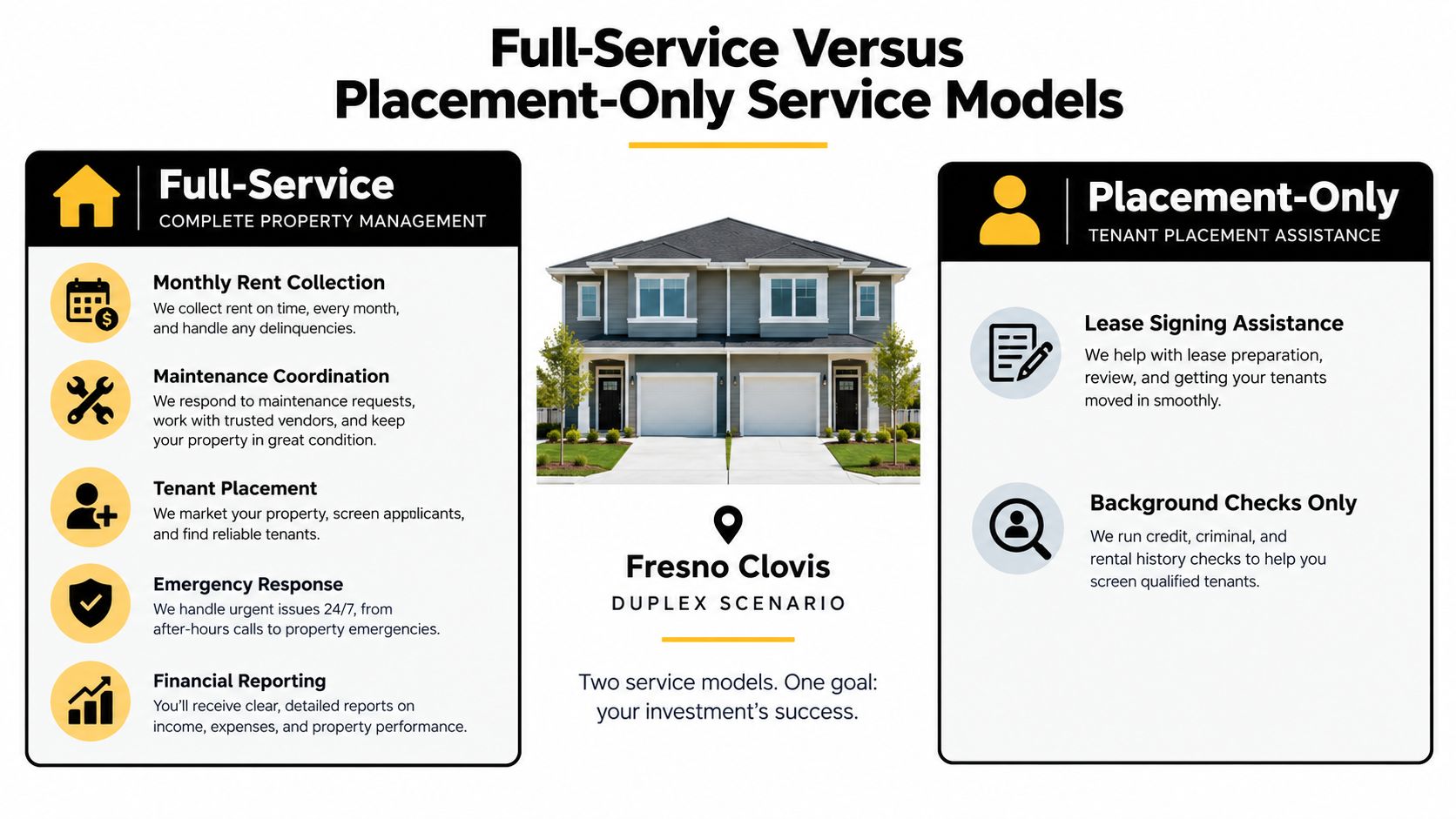
Full-Service Versus Placement-Only Service Models
A Clovis duplex owner has two distinct choices. She can pay a company to operate the rentals after the lease is signed, or she can hire the company only to find and place the tenants, then manage the property herself.
Full-Service management combines rent collection, tenant communication, maintenance coordination, accounting, inspections, renewals, and eviction administration. The typical structure described in industry summaries is 7% to 10% of rent plus 50% to 100% of one month's rent at signing, although each contract sets its own terms.
Placement-Only service concentrates the charge at the front. The manager markets the property, screens applicants, prepares the lease, and transfers daily responsibilities back to the owner. The upfront charge is often 75% to 100% of one month's rent, and sometimes higher in competitive Central Valley submarkets.
| Service model | Revenue pattern for the manager | Owner responsibility after signing |
|---|---|---|
| Full-Service | Recurring percentage plus placement and possible add-ons | Limited day-to-day involvement |
| Placement-Only | Larger upfront placement fee, no recurring management fee | Rent, repairs, notices, and tenant communication |
At $1,800 monthly rent, a full-service arrangement might produce approximately $2,700 in first-year revenue per door for the manager when recurring management and placement revenue are combined. A placement-only arrangement might produce $1,800 upfront and no recurring management revenue, based on the scenario described in the service comparison. Those figures are illustrations, not a quote, and the agreement may include other charges.
The right choice depends on your operating role:
- Out-of-state owners often need full service because they can't respond quickly to leaks, notices, or emergency calls.
- Local DIY landlords may prefer placement-only if they can handle tenant communication and repairs.
- Portfolio owners may favor full service as administrative work expands across multiple properties.
Managers may prefer full service because recurring revenue is more predictable and grows with the number and rent level of managed units. Owners should choose based on the work they want removed from their schedule, not just the lowest advertised percentage.
A short visual comparison can also clarify what transfers back to the owner in each model:
How California Fee Rules Shape Ethical Pricing
California pricing isn't only a business question. It's also a compliance and trust question. A manager may be able to describe a charge as administrative, but the label doesn't make an unsupported or undisclosed fee fair.
California's tenant screening rules limit how screening charges can be handled. Recent updates summarized by LeaseRunner's tenant screening law coverage include a $65.86 screening-fee cap in California, alongside fee restrictions in other states. The practical lesson for a Fresno landlord is straightforward: a manager shouldn't treat applications as a quiet profit center. Screening costs and the related service should be disclosed accurately.
California's broader tenant-protection framework also affects turnover decisions. Rent limits, just-cause requirements, notice rules, security-deposit accounting, and disclosure duties mean a manager must document why an action is being taken and which rule supports it. A fee proposal should identify what the company does to maintain compliant records rather than charging a vague “legal” amount whenever a question arises.
A defensible charge has a clear reason
A transparent charge should connect to at least one of these:
- A documented service, such as lease preparation or inspection
- An owner-approved vendor invoice, with any markup separately shown
- A permitted pass-through, described before the expense occurs
- A defined event, such as a renewal, placement, or eviction administration
Watch for phrases such as “standard administrative adjustment,” “miscellaneous processing,” or “market-based service charge” without a description. Those terms may conceal legitimate labor, but they don't let you evaluate the price. Ask for the trigger, calculation, included work, and cancellation treatment in writing.
An ethical proposal makes signing easy because the owner understands the money flow before the relationship begins. Disclosure establishes the expectation, and accountability requires statements and invoices that match it.
A Landlord Checklist for Reading a Fee Proposal
Three proposals can look similar until you compare the fine print. One may advertise a low percentage but charge separately for inspections, renewals, and maintenance coordination. Another may have a higher base rate but include more of the work you would otherwise handle yourself.
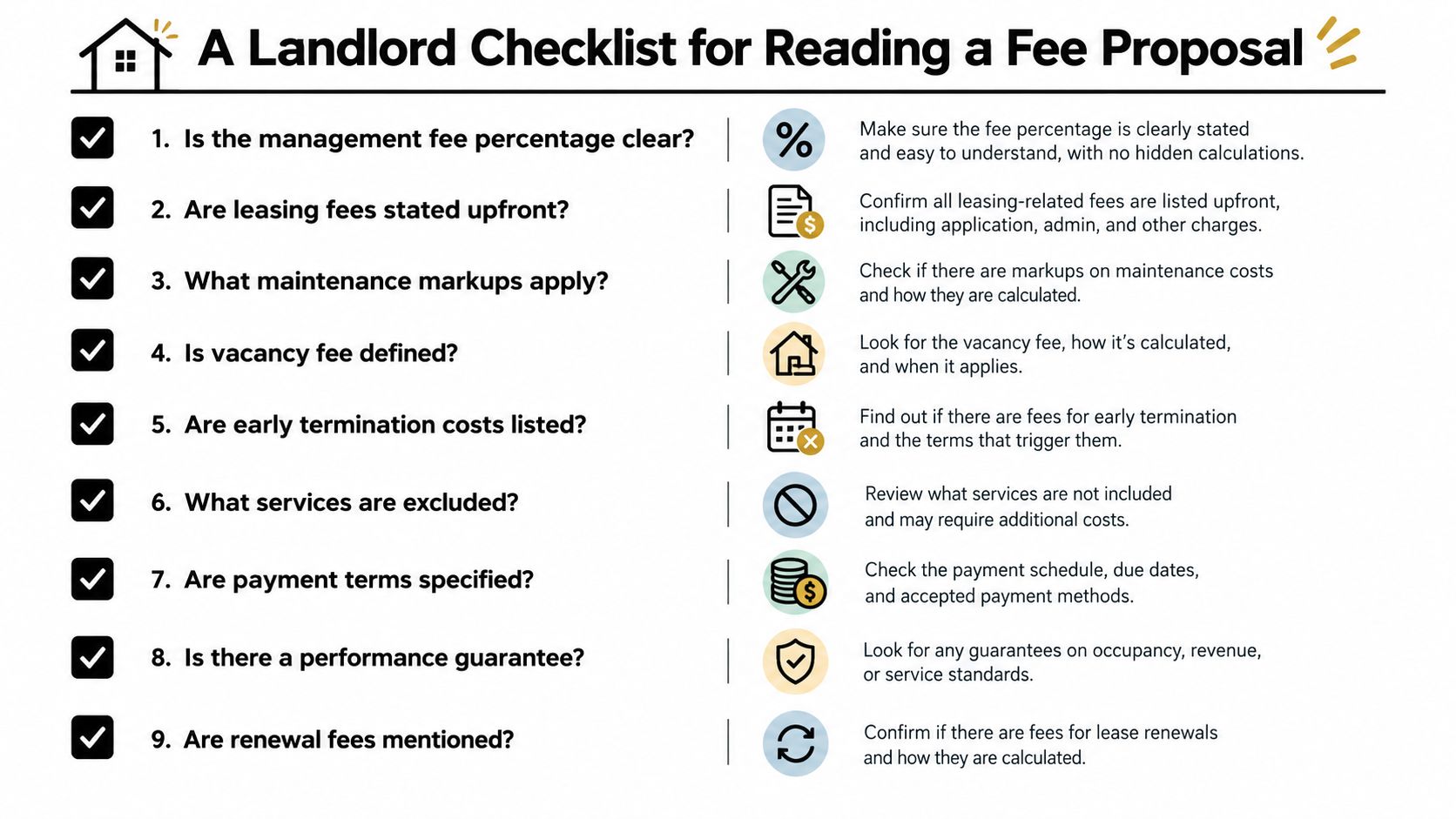
Use this checklist at the kitchen table:
- Is the management percentage clear? Confirm whether it applies to collected rent, scheduled rent, or a minimum charge.
- Are leasing fees stated upfront? Ask whether placement is calculated as one-half to one full month of rent and when the fee becomes payable.
- What maintenance markup applies? Require the percentage, flat charge, or labor structure in writing.
- Is vacancy defined? Find out whether the manager charges during an empty month or only after collecting rent.
- Are early termination costs listed? Check the cancellation clause and any charge for ending the agreement before its stated term.
- Which services are excluded? Look specifically for eviction administration, inspections, capital-project supervision, and after-hours work.
- Are payment terms specified? Ask when owners receive funds, how invoices are approved, and how reserve balances work.
- Is there a performance guarantee? If there's a lease-up guarantee, identify the time limit and the conditions for a waiver.
- Are renewal fees mentioned? Confirm whether renewals are free, fixed, percentage-based, or subject to escalation.
Circle every vague line and request a written explanation before signing. You're not being difficult by asking how a manager gets paid. You're testing whether the company can connect its revenue to real work, accurate records, and lawful treatment of your tenants.
For Fresno and Central California owners, Edinhart Realty and Property Management offers both Full-Service Monthly Management and Placement-Only Service, with services such as rent collection, applicant screening, lease drafting, maintenance coordination, renewals, and financial reporting defined by the selected model. Visit Edinhart Realty and Property Management to compare the service structure with the responsibilities you want to keep or hand off.


