

Home staging works mainly by making a home easier to picture, with 49% of sellers' agents reporting faster sales and 29% reporting 1% to 10% higher offers, but results vary by home and market. That's a narrower claim than most staging pitches make, and it's the useful one. Staging isn't a price guarantee. It's a tool for reducing buyer uncertainty, and uncertainty is what slows offers, invites discounts, and keeps a listing sitting while carrying costs accumulate.
For a Fresno seller, the right question isn't whether staging sounds attractive. It's whether a specific amount of preparation can plausibly save time or improve offers by more than it costs.
Does Home Staging Work? The Evidence in Plain Numbers
The survey evidence supports a clear conclusion: home staging works most reliably as a speed and confidence tool, not as a guaranteed price boost. It can help buyers understand a room's size and purpose and picture how it might be used. Reported price effects are less consistent than the time effect, so a seller should treat them as possible upside, not an expected result.
The NAR 2025 Profile of Home Staging reported that 29% of sellers' agents said staging produced a 1% to 10% increase in the dollar value offered by buyers. That figure reflects agents' reports, not a prediction for any individual home. The same survey includes cases with no measurable impact, uncertainty, or occasional negative results.
What the 2025 NAR staging survey measured
| Measure | Share of Agents | How to Read It |
|---|---|---|
| Sellers' agents reporting a 1% to 10% higher dollar offer after staging | 29% | Offers can rise, but this is a share of agents, not a guaranteed outcome |
| Buyers' agents reporting a 1% to 5% higher offer than similar unstaged homes | 17% | A more conservative measure, based on comparison with similar unstaged homes |
| Sellers' agents reporting staged homes spent less time on the market | 49% (30% slight, 19% significant) | Speed is the most consistent benefit reported in the survey |
The two offer measures point in the same direction, but not with the same strength. Sellers' agents reported the wider gain, while buyers' agents reported a smaller increase when comparing staged homes with similar unstaged ones. A prudent seller can use the conservative figure as a planning reference and regard larger gains as uncertain.
Why speed carries the stronger case
Nearly half of sellers' agents reported that staged homes spent less time on the market. That finding is more consistent than the reported offer increases. Staging may help buyers assess a home sooner, but it does not establish that every buyer will respond or that the listing will sell faster in every market.
Practical rule: Evaluate staging first by whether it could shorten the wait for a serious offer. Treat a higher offer as a possible bonus, not the basis for spending.
Fewer weeks on the market can reduce the time a seller pays mortgage, tax, insurance, and utility costs. It may also reduce pressure to cut the price to renew buyer interest. Even at the same sale price, an earlier sale can make the staging expense more worthwhile if the carrying costs avoided exceed the amount spent.
Staging is a weak investment when presentation is not the main obstacle. Furniture cannot make an above-market list price fit comparable sales, or substitute for needed repairs to the roof, systems, or layout. It has a stronger case when the home is priced and repaired sensibly and presentation remains the issue. For a Fresno or Central California seller, the practical test is to compare the staging cost with the carrying costs it could save, while treating any higher offer as uncertain.
What Staging Changes for Buyers and Which Rooms Come First
Staging works like set dressing in a film or a food photo on a menu. The subject doesn't change, but it's presented so you can believe in it immediately. Home staging means arranging furniture, decor, and lighting so a property reads as a finished, livable home rather than a collection of empty dimensions.
Buyers struggle with vacant rooms because a photograph gives them walls and flooring but little sense of scale. They can't tell whether a king bed fits with nightstands, whether a sofa blocks the walkway, or whether an odd corner is a desk nook or wasted space. Online, where buyers judge a listing in a quick scroll before requesting a visit, that confusion is enough to move on.
In the National Association of Realtors' 2025 Profile of Home Staging, 83% of buyers' agents said staging made it easier for buyers to imagine the property as their future home. The same report found 60% said staging affected some buyers' view of the home, while 26% said it affected most buyers' view of the home, although not consistently in every case.
That distinction matters. Staging shapes perception and understanding. It doesn't guarantee a particular price, and it won't affect every buyer in the same way.
Take a 12-by-14-foot living room as a hypothetical example. Photographed empty, it can look smaller than it is because there's nothing to measure against. Put a sofa floating in the middle and it still looks awkward. Anchor a seating group on a rug, leave a clear path to the hallway, and the same room suddenly explains itself.
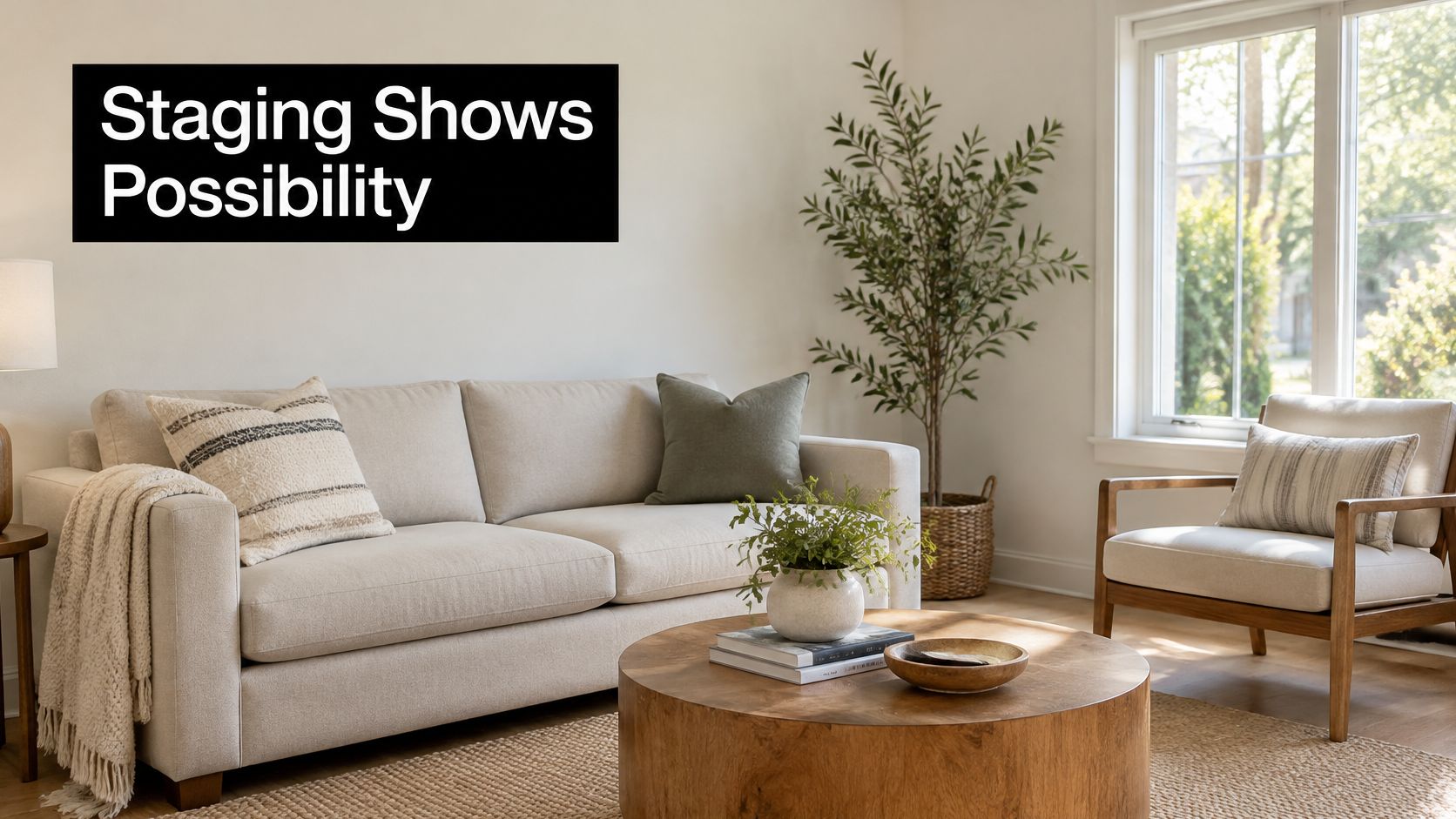
Stage rooms in the order agents prioritize them
The report gives a clear hierarchy. 91% of sellers' agents staged living rooms, 83% staged primary bedrooms, and 69% staged dining rooms. If your budget won't cover the whole house, spend it in that order.
- Living room first: Place a sofa and two chairs around a coffee table, keep about 36 inches of walkway, and use a rug large enough that the front legs of the seating sit on it. Add two lamps so evening photos don't depend on a harsh ceiling light.
- Primary bedroom second: Center the bed on the main wall, use matching nightstands, and remove about half the closet contents. Buyers read a half-full closet as storage that works, even when the closet itself hasn't changed.
- Dining room third: Use a table sized for six with about 36 inches behind the chairs so buyers can see people can sit down and stand up comfortably. An oversized table makes an adequate room look cramped.
Kitchen, entry, and exterior areas support those three rooms rather than competing with them. Clear kitchen counters down to one or two useful items, put a fresh mat at the entry, and trim the front beds so the first exterior photo looks cared for. You don't need to furnish every corner.
The underlying insight is simple. Buyers don't pay for throw pillows. They respond when a home stops making them work to understand it, and that clarity is what the room hierarchy is designed to produce.
Typical Staging Steps From Walkthrough to Photos
Good staging follows a sequence, and skipping early steps usually makes later ones wasteful. Decorating before you've repaired a leaking faucet or decided which rooms matter just means moving furniture twice.
Run the six steps in order
- Walk the home and name the target buyer: Go room by room with your agent or stager and decide who is most likely to buy, which rooms they'll judge hardest, and what should be removed before anything is added.
- Repair and touch up first: Patch walls, fix broken fixtures, replace burned-out bulbs, and address anything an inspector would flag. Staging can't hide defects, and buyers who spot deferred maintenance start discounting for problems they can't see.
- Depersonalize and declutter: Pack family photos, collectibles, excess furniture, and most closet contents. You're selling usable space, so every item that stays should help explain a room.
- Arrange furniture to the layout: Size pieces to the room, define seating and sleeping areas, and keep walkways open. If a chair forces buyers to turn sideways, it's making the home feel smaller.
- Add decor and lighting: Bring in rugs, lamps, neutral textiles, and a few plants. Match bulb warmth across a room so photographs don't show one yellow corner and one blue one.
- Photograph after final placement: Schedule photos only when furniture is settled, then recheck for cords, dusty surfaces, crooked art, and mismatched pieces. The practical guidance on preparing a house for a photography session is useful for that final pass.
Say a vacant three-bedroom living room starts with one lamp on the floor and bare gray walls. After staging, a sofa and two chairs sit around a rug, two lamps are lit, a plant stands by the window, and a clear 36-inch path leads to the hallway. Nothing structural changed, but buyers can now judge scale and imagine their own furniture in the same arrangement.
If your budget is tight, handle the walkthrough, decluttering, and photo check yourself. Pay for help only where your own furniture can't define the room, usually the living room. That's a better allocation than spreading a small budget thinly across every bedroom.
Staging Costs, Pricing and the Break-Even Math
The National Association of Realtors reports a median professional staging cost of approximately $1,500 in its news report on staging. Treat that figure as a reference point, not a quote: the total depends on the home, the rooms involved, and how long any rented furniture stays.
Staging options and typical costs
| Option | Typical Cost | Best Fit | Main Trade-Off |
|---|---|---|---|
| Self-staging with owned furniture | Cleaning, storage, and small purchases only | Sellers with decent furniture and time | Limited to what you already own |
| Seller's agent staging | Often lower than a full professional package; confirm whether the agent's fee includes staging | Sellers whose agent offers staging help | Quality depends on the agent's skill |
| Professional consultation only | Consultation fee plus your purchase costs | Sellers who will do the work themselves | You still buy and move the pieces |
| Full professional staging, occupied home | About $1,500 median | Mid-price homes listed for sale | Cost rises with home size and room count |
| Vacant home furniture rental | Monthly rental plus delivery and pickup | Empty homes that need full rooms | Monthly rental, delivery and pickup add up |
The options are not directly interchangeable. A consultation gives you guidance, while full staging supplies furniture and room arrangements. For an occupied home, the service may focus on selected rooms; an empty property may need furniture rental, delivery, and pickup. Ask for quotes that separate service fees, rental periods, delivery, and pickup so you can compare the actual scope.
Run the break-even test before you sign
Use a hypothetical $450,000 home. A 1% offer increase equals $4,500, so a $1,500 staging bill breaks even at about a 0.33% gain. The calculation sets a threshold, not a forecast. It shows the improvement required to cover the bill, but does not establish that staging will produce it.
A break-even calculation tells you what staging must achieve to pay for itself. It never tells you that it will.
Speed can change the calculation. Each extra month on the market may bring mortgage payments, property taxes, insurance, utilities, and maintenance. If staging helps the home sell several weeks sooner, reduced carrying costs may cover some or all of its expense even if the final price stays the same.
Use your own numbers to test that possibility:
- Estimate the expected sale price: Base it on recent comparable sales and a comparable market analysis, rather than a neighbor's asking price.
- Calculate one month of carrying costs: Add mortgage, taxes, insurance, utilities, and routine upkeep, then divide by four to estimate a weekly figure.
- Compare the staging quote with time saved: Divide the quote by your weekly carrying cost. The result is the number of weeks sooner you would need to sell for speed alone to break even.
Use the result to set the scope. If the quote requires an implausibly fast sale, with a price gain on top, consider staging fewer rooms. If one week of reduced carrying costs covers much of the expense, the case for staging is clearer. In either case, compare the likely benefit with the cost, rather than treating a faster sale or higher offer as guaranteed.
Staging for Sale Versus Staging for Rent
Sale staging and rental staging solve different problems, so copying one approach into the other wastes money. A buyer is deciding whether to commit to a home for years. A tenant is deciding whether daily life will work there at a given rent.
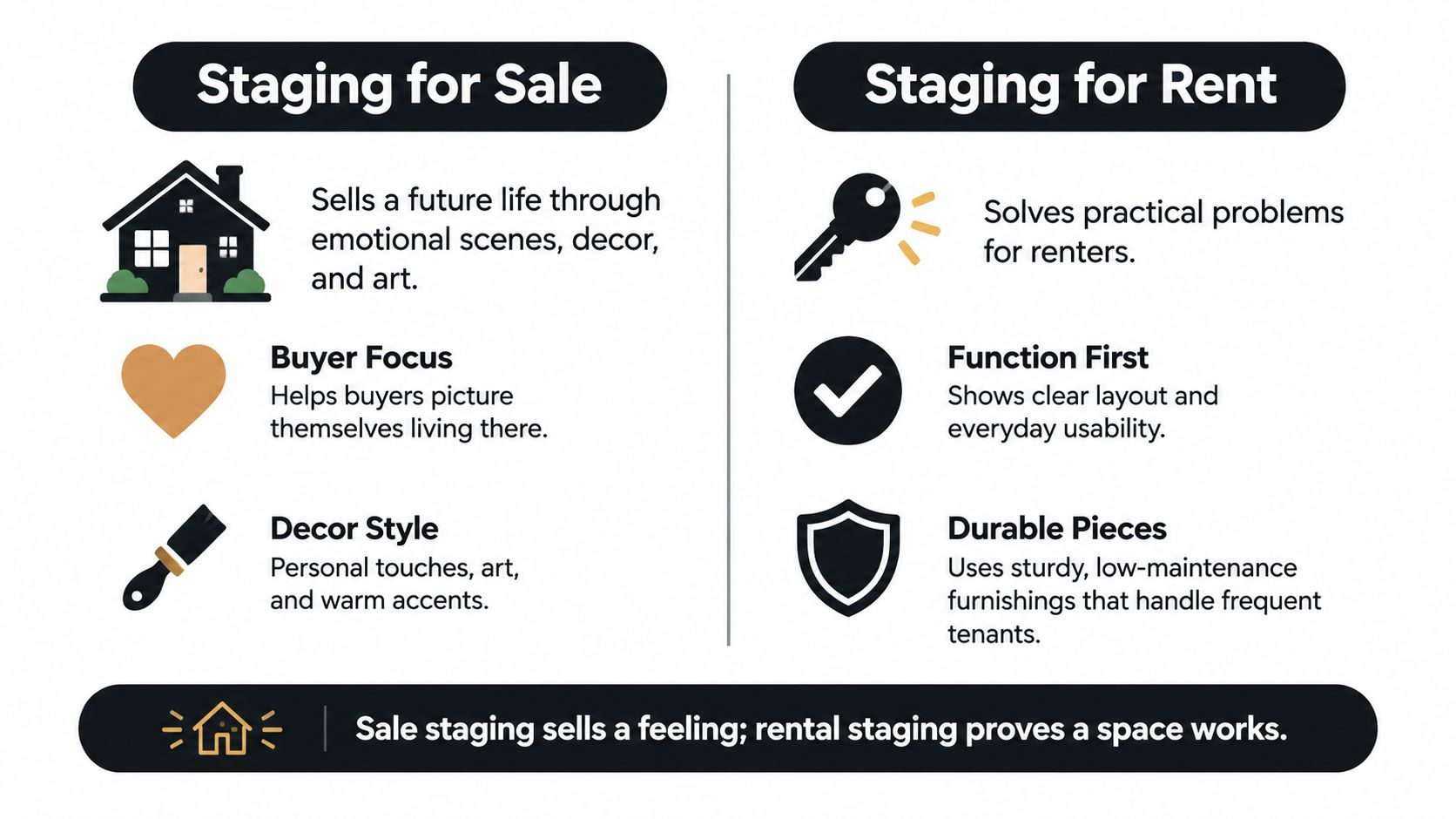
Staging to sell versus staging to rent
| Factor | Staging to Sell | Staging to Rent |
|---|---|---|
| Main goal | Win the offer and shorten time on market | Lease quickly at a fair rent |
| Furniture level | Full room scenes with decor, art and textiles | Functional, durable pieces sized for storage and layout |
| Focus | Emotion and imagination | Function, storage and daily use |
| Typical duration | Until closing, often weeks to a few months | Until the next lease begins |
| Photography | Staged photos are the main listing tool | Clear photos that show layout and storage |
Sale staging sells a future life. Art, layered textiles, and a set dining table help buyers imagine hosting, relaxing, and settling in. Those emotional cues are appropriate because the purchase itself is emotional as well as financial.
Rental staging sells clarity. Tenants look for storage, light, room for a bed and desk, and furniture that looks clean and durable. Fragile decor adds little and can raise replacement costs between tenancies.
Say you own a three-bedroom house near Fresno State aimed at students or traveling workers. Beds, desks, a practical dining set, and kitchen basics answer the questions those tenants ask. Decorative trays and throw pillows don't. Photograph closets, laundry space, and the kitchen layout as carefully as the living room.
The hybrid case needs planning. If you may rent after a slow sale, stage for the sale first but choose neutral, durable core pieces you can keep. Before you pivot, assess the risks of renting out so you compare expected rent, vacancy, maintenance, and management against a price adjustment. Stage for the buyer or tenant you want in the photos, then favor durability when a lease becomes the goal.
Fresno and Central California Staging Tips
Central California conditions change small presentation decisions. Heat, strong afternoon sun, dust, and outdoor living all show up in photos and showings, so local preparation isn't just generic cleaning with a Fresno label.
The checklist below covers sun, fabric, and dust control for Valley homes.
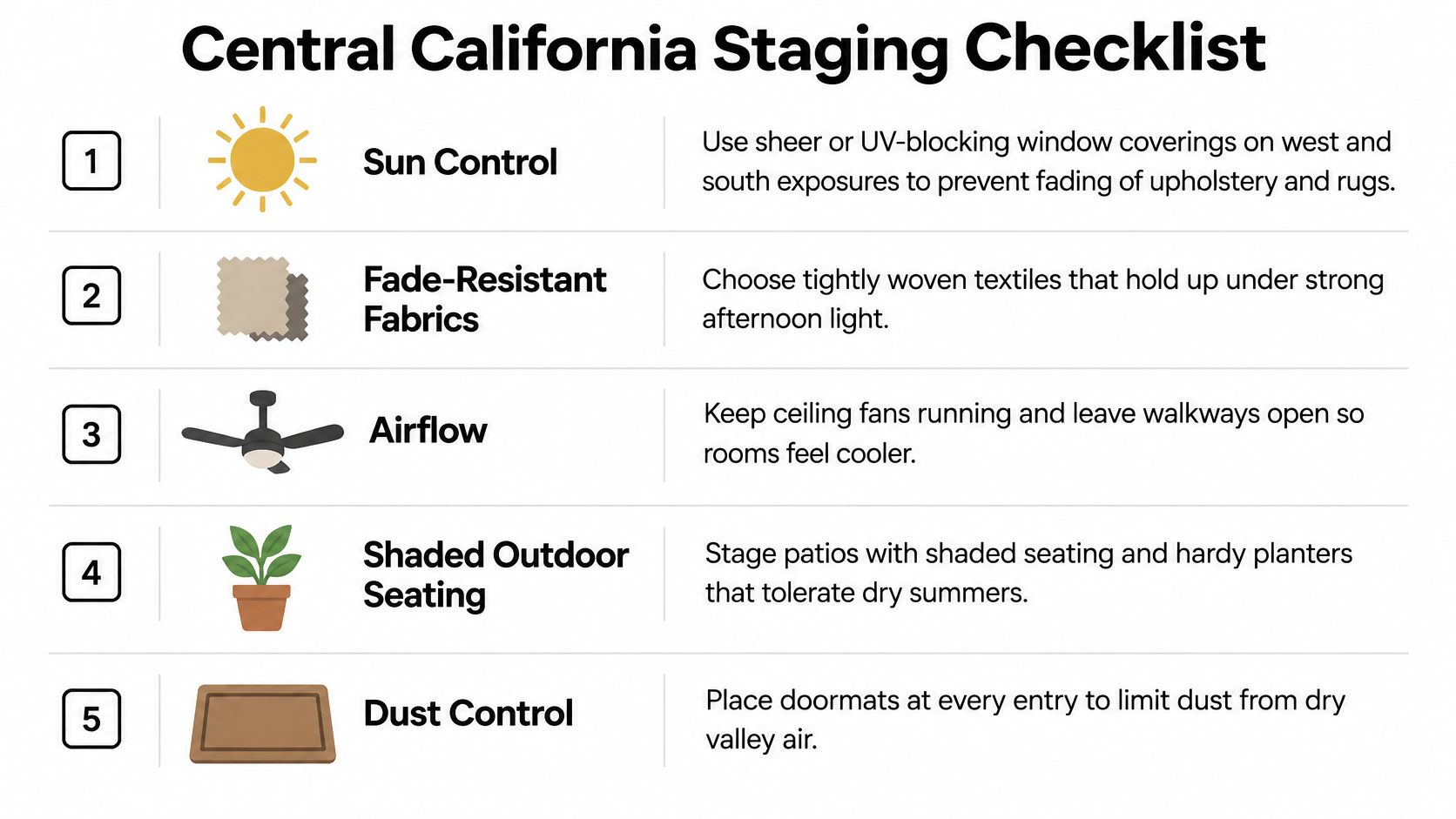
- Control west and south sun: Use sheer or UV-blocking window coverings where afternoon light fades upholstery and rugs, and move a good rug away from the brightest window.
- Make cooling visible and comfortable: Replace the HVAC filter, run ceiling fans, and set the thermostat before showings so buyers feel a cared-for system instead of a hot interior.
- Stage shade outdoors: A shaded patio seat signals usable summer space. If you're testing layouts before buying furniture, a patio design ai tool can help you visualize scale and shade placement first.
- Use drought-tolerant curb appeal: Clean mulch, trimmed edges, and healthy drought-tolerant plantings look intentional without promising a water-heavy yard.
- Beat Valley dust at the last minute: Wipe sills, door frames, and exterior surfaces just before photos, and place mats at entries. Dust settles quickly enough that cleaning a week early won't hold.
- Brighten darker rooms: Neutral paint and a well-placed mirror help rooms with limited natural light. Check lamps again at dusk because that's when uneven lighting becomes obvious.
These details also connect with broader housing trends in Fresno, where buyers pay close attention to comfort and maintenance during hot months. Schedule listing photos in the morning or near midday for even light, then do the one-day prep in this order. Clear clutter, clean windows and sills, set thermostat and fans, and finish at the front entry.
This short video walkthrough shows how those final checks come together before a showing.
Decide Whether Staging Pays for Your Home
Staging fails when sellers ask it to hide the wrong problem. It can't conceal a failing roof, foundation movement, outdated systems, or a price that recent comparable sales don't support. Inspectors and appraisers still do their work after the furniture impresses a buyer.
Stage or skip by situation
| Situation | Recommendation | Why |
|---|---|---|
| Vacant or dated home | Stage it | Empty rooms are hard to read in photos and tours |
| Home needs roof, foundation or system repairs | Repair first, then stage | Staging cannot hide failing systems from inspectors |
| List price above recent comparable sales | Fix the price first | Staging cannot close a pricing gap |
| Already furnished, clean and well presented | Light touch-up only | Extra staging adds cost without a clear gain |
Ask three questions before you approve a quote. Will staging likely help this home sell faster or for more, given its condition and competition? Is the cost lower than the carrying cost it could plausibly save? Are repairs and pricing already right?
If two answers are no, fix those issues first. If two or three are yes, staging has a defensible business case rather than just a hopeful one. When you then market the finished rooms, resources that help you create compelling real estate ad visuals can support the same goal, clear presentation that earns a showing.
Do one useful thing this week. Compare your intended list price against recent comparable sales and write down every repair an inspector would flag. Edinhart Realty and Property Management offers staging consultations and pricing reviews for Fresno-area sellers, including a comparison of expected sale value with projected rent for owners still choosing between selling and leasing.
Request a walkthrough of your Fresno, Clovis, or Central California home to get a room-by-room staging scope, a pricing review, and a clear break-even estimate before you spend on furniture or decor. Visit Edinhart Realty and Property Management to schedule your consultation and decide, with numbers in hand, whether staging will pay for your home.


