

You've cleaned the house, repaired the obvious defects, and listed it with confidence. Then the online response disappoints. Buyers scroll past rooms that look perfectly acceptable in person because the photographs feel cold, undersized, or difficult to understand. The question becomes less about whether the property is attractive and more about whether its presentation is helping buyers justify a showing.
Home staging services address that gap. They use furniture, scale, lighting, color, and room purpose to make the property easier to read and easier to imagine as a future home. The financial decision isn't whether staging looks better. It's whether the likely improvement in buyer response can outweigh staging fees and the cost of carrying an unsold property.
Why Empty Rooms Fail to Convert Buyers
A vacant living room often looks larger to the seller and smaller to the buyer. Without a sofa, rug, or table to establish scale, viewers can't easily judge whether their furniture will fit or where people would gather. Online, the problem becomes sharper because a wide-angle photograph may show an expanse of flooring without communicating how the room functions.
A professional stager gives that space a job. A sectional can define the seating area, two chairs can create a secondary conversation point, and a rug can connect the arrangement without blocking the room's natural path. In an awkward room, the right placement can show that the space works as a reading area, home office, or dining zone instead of leaving buyers to solve the layout themselves.
Practical rule: Staging shouldn't hide a defect. It should make the property's strengths obvious before a buyer has to work them out.
The same principle applies to an occupied home. Too much furniture narrows circulation, personal collections compete with architectural details, and oversized pieces make a useful room appear cramped. Good staging removes visual uncertainty. It doesn't turn an ordinary house into a different property, and it can't compensate for serious condition problems or an unrealistic price.
Staging is marketing, not decoration
Decorating reflects the owner's taste. Staging serves the buyer's decision-making process. Neutral artwork, restrained accessories, and carefully selected furniture create visual anchors that guide attention toward windows, fireplaces, ceiling height, renovated flooring, or an attractive connection between rooms.
The distinction matters because a beautiful arrangement can still be ineffective if it photographs poorly or makes the floor plan confusing. Before hiring a provider, sellers should understand what home staging involves and decide whether they need a consultation, partial furnishing, or full installation.
Virtual staging can help a vacant listing communicate potential online, but digitally added furniture doesn't change the in-person experience. Sellers comparing that option should review the pros and cons of AI staging, especially the difference between attracting an initial click and creating confidence during a showing.
The Psychology of Space and Buyer Perception
Buyers process a listing quickly. First, they notice whether a photograph feels bright, orderly, and inviting. Then they look for clues about scale, movement, maintenance, and the kind of life the property could support. Staging works when it reduces the mental effort required to answer those questions.
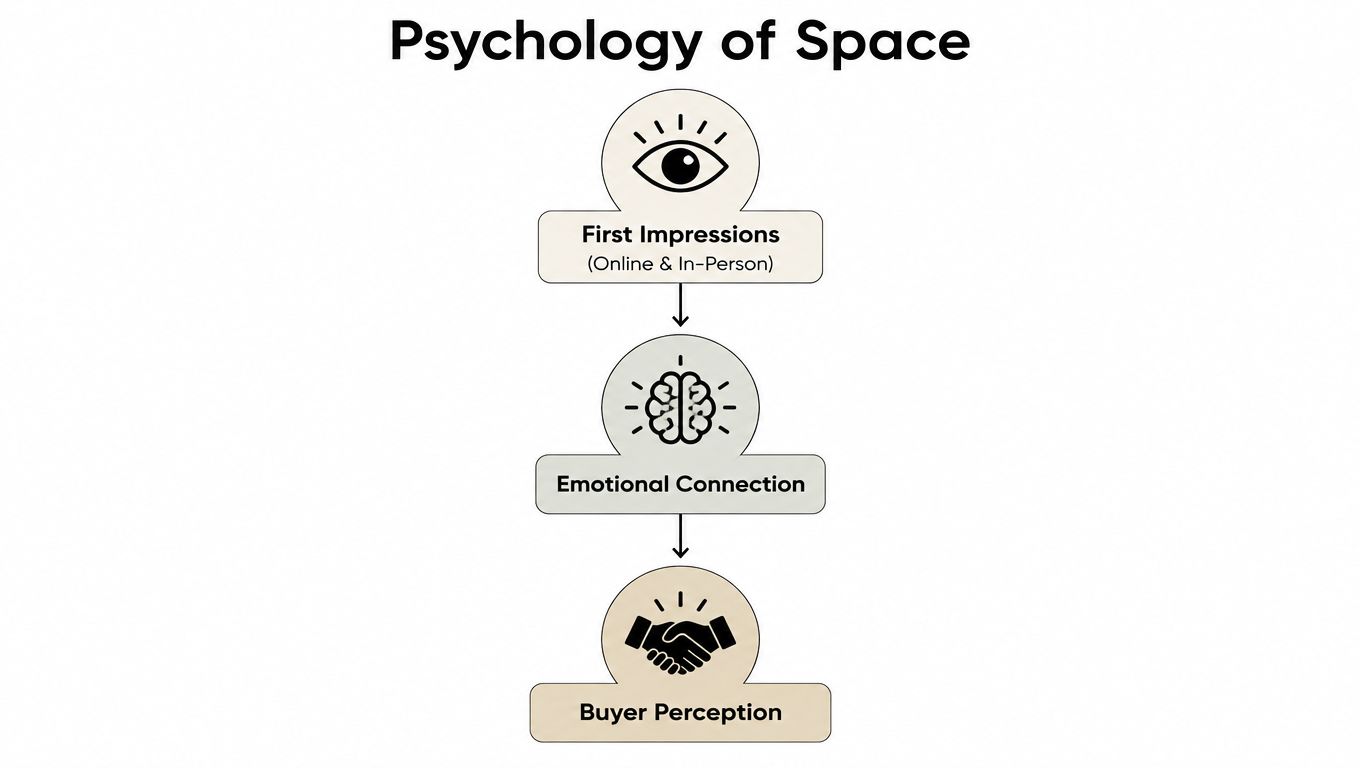
Where staging earns attention
Furniture placement creates visual anchoring. A pair of chairs can direct the eye toward a view, while a properly sized bed establishes the proportions of a primary bedroom. The arrangement should support the architecture rather than compete with it.
NAR's 2025 Profile of Home Staging found that 83% of buyers' agents said staging made it easier for buyers to visualize a property as a future home. The report also found that 60% said staging affected some buyers, while 26% said it affected most buyers' view of the home. Those findings support a practical conclusion: staging helps most when it turns an abstract floor plan into a believable daily experience.
Room priority should follow buyer attention and the property's strongest selling features. NAR's room-by-room data shows that the living room was staged in 91% of cases, followed by the primary bedroom at 83% and the dining room at 69%. Sellers with a limited budget should usually begin with the living room and primary suite, then consider the dining area if it helps clarify an open plan.
Use the budget to answer buyer questions
A staged living room should answer, “Where would we sit and host people?” A staged bedroom should answer, “Will our furniture fit, and does this feel restful?” In a dining area, the arrangement should show circulation and proportion, not just fill an empty corner.
Personal taste still matters, but broad appeal matters more during a sale. Highly distinctive colors or oversized decorative pieces may photograph dramatically while narrowing the number of buyers who can picture their belongings in the home. The strongest arrangements feel intentional without becoming the subject of the photograph.
The visual sequence is straightforward:
- First impression: Bright, balanced photographs earn attention.
- Spatial understanding: Furniture establishes scale and circulation.
- Emotional connection: Buyers can imagine routines, guests, and belongings.
- Perceived value: A coherent presentation supports confidence in the property.
Staging won't create demand where the location, condition, or price fails to support it. It can, however, make the existing value easier for buyers to recognize.
Measuring the Impact on Price and Market Time
The financial case for staging depends on two possible gains, a stronger offer and a shorter marketing period. Sellers often focus on the first and overlook the second. Every additional period before closing can carry mortgage, tax, utility, insurance, maintenance, and opportunity costs, although the exact burden varies by property and owner.
NAR's report on home staging and market time, based on a survey of about 1,200 real estate professionals, found that 29% of agents said staging increased the dollar value offered by 1% to 10%, while 49% said staging reduced the time homes spent on the market. These are reported outcomes, not a promise for every listing.
The tipping-point calculation
Start with the expected staging bill. Then estimate the carrying cost of remaining on the market for longer than necessary. Finally, compare those costs with the likely benefit of improved buyer response, using recent local sales and your agent's pricing analysis rather than a national assumption.
For example, a seller may choose between:
| Option | Likely advantage | Main risk |
|---|---|---|
| Full-service staging | Stronger scale, cohesive design, less work for the seller | Higher upfront and possible extension fees |
| Agent-led staging | Familiarity with the listing and lower direct expense | Existing furniture may photograph poorly or fit badly |
| DIY staging | Maximum control over spending | Personal taste and blind spots can weaken the result |
| Virtual staging | Faster digital presentation for vacant rooms | The physical showing may not match the photographs |
RESA's published market statistics report an average sale-to-list ratio of 109% across 129 homes and average days on market of 19, with quarterly figures as low as 9 to 12 days. That dataset is useful as an industry benchmark, but it also demonstrates why sellers shouldn't treat staging as a fixed uplift. Execution, inventory selection, timing, property type, and local demand all affect performance.
Judge speed as carefully as price
A faster sale can protect flexibility when the seller is buying another property, relocating, or managing a vacant home. Yet staging only makes financial sense when it addresses a real presentation problem. If comparable homes are moving quickly because demand is already strong, the seller may recover more value by correcting deferred maintenance or setting a sharper launch price.
The right question is not, “Will staging guarantee more money?” It's, “What buyer objection will staging remove, and what will that improvement need to achieve to cover the cost?”
Understanding Staging Costs and Fee Structures
Staging quotes often combine several services, so sellers should ask for each component separately. A consultation may involve advice using existing furnishings. Full-service work can include design, furniture selection, delivery, installation, accessories, removal, and extensions if the property remains listed beyond the initial term.
Historical guidance from the National Association of REALTORS® places a staging service fee around $800 to $1,000, with staging fees of approximately $400 to $700 per room for the first month. The same guidance states that staging for two to three months typically equals about 1% of a home's list price, so a $300,000 home may cost roughly $3,000 to stage.
More recent NAR reporting gives useful context but shouldn't be treated as a quote for your property. The median dollar value spent on a staging service was $600 in 2023, compared with $400 when sellers' agents personally staged the home. The 2025 profile reported a median of $1,500 for professional staging versus $500 for agent-staged homes.
Typical Home Staging Cost Benchmarks
| Service Component | Estimated Cost Range | Pricing Model |
|---|---|---|
| Staging service fee | $800 to $1,000 | One-time service charge |
| Furniture staging per room | $400 to $700 for the first month | Room-based rental |
| Two to three months of staging | About 1% of list price | Term-based estimate |
| Professional staging median | $1,500 in the 2025 profile | Reported median |
| Agent-staged home median | $500 in the 2025 profile | Reported median |
These figures describe historical and reported benchmarks, not guaranteed local prices. Your cost to stage a home for sale will depend on whether the property is vacant, the number of rooms selected, furniture quality, delivery distance, and the contract's extension terms.
Questions that prevent budget surprises
Ask whether the quote includes delivery, installation, removal, accessories, damage coverage, and additional rental time. Confirm whether the company stages the entire house or concentrates on the rooms that appear in the listing photographs. Also ask what happens if the home receives an offer quickly, since early removal may affect the buyer's final walkthrough experience.
A seller should calculate the net effect, not just the invoice. Subtract staging expenses from the expected sale proceeds, then compare that figure with the estimated cost of a longer listing period. If the property already presents well with suitable furniture, a consultation and selective rental may be more rational than a complete installation.
The Advantage of In-House Design and Property Management
Staging becomes more efficient when the same real estate operation can coordinate preparation, photography, marketing, and property logistics. A seller doesn't benefit from a beautifully furnished room if the photographer arrives before installation, the listing launches with outdated images, or furniture remains in place after the property is under contract.
An integrated team can create a preparation calendar that assigns responsibility for each stage:
- Property review: Identify repairs, clutter, furniture changes, and rooms that need staging.
- Design direction: Match furnishings and accessories to the home's architecture and likely buyer.
- Installation: Coordinate delivery, placement, lighting, and final presentation.
- Photography: Capture the finished rooms from useful angles.
- Listing launch: Publish consistent images and property details across the selected channels.
- Removal or turnover: Clear the property for closing, leasing, or the next operational phase.
The rental and investment connection
The same design discipline applies when a property is being prepared for tenants rather than buyers. A rental needs clear function, clean presentation, and photographs that accurately represent the available space. Overdesign can be wasteful, while under-presentation can make a well-maintained property look ordinary.
For owners with several responsibilities, integrated property management can also connect staging decisions with move-in coordination, repair scheduling, lease preparation, and ongoing maintenance. That alignment helps avoid duplicating inspections or delaying a listing because vendors work from different timelines.
Edinhart Realty and Property Management offers staging guidance and professional staging support for homes prepared for sale, including decluttering, deep cleaning, sourcing furniture and decor, and arranging the property. For owners who rent instead, its management services include marketing, applicant screening, lease drafting, rent collection, repair coordination, and move-in or move-out coordination.
The advantage of an in-house approach isn't that it removes every cost. It reduces handoffs, keeps the presentation aligned with the listing strategy, and gives the owner one coordinated plan for preparing the property.
Pairing Staging with Professional Photography
Staging and photography are complementary services. Furniture gives the camera scale and depth, while photography determines whether buyers notice those improvements during the online search. A staged home photographed from the wrong corner can still look narrow, dark, or cluttered.
A professional real estate photographer understands sightlines, vertical correction, exposure, and the order in which buyers experience the listing. The stager can prepare for that work by keeping pathways open, positioning furniture to create depth, and placing lamps or accessories where they support the composition rather than obscure it.
Build the room for the lens
A living room may feel comfortable from the doorway but appear crowded from the camera position. A dining table that works during a showing can block the strongest view in a photograph. Staging decisions should therefore be tested from the angles the photographer is likely to use, not judged only while standing inside the room.
Details matter, but they need restraint. A carefully selected piece of canvas wall art from Jessie's Home may give a blank wall scale and character, while too many decorative objects create noise. The artwork should support the room's proportions and color scheme, not become a product display.
The digital listing is the first showing
Smartphone photos often introduce uneven lighting, distracting perspective, and inconsistent color. They may document the property, but they don't necessarily sell the experience of moving through it. Sellers evaluating the relationship between the two services can review home staging photography as a planning discipline rather than treating photography as an afterthought.
Before the photographer arrives, complete the preparation:
- Remove unnecessary furniture and personal items.
- Open blinds and replace failed or mismatched bulbs.
- Clear counters, floors, and shower ledges.
- Confirm that staged furniture doesn't block doors or major features.
- Review each room through the camera, not only by eye.
Professional photographs won't rescue a badly priced or poorly maintained property. They can ensure that the investment in staging appears clearly enough online to earn the private showing that matters.
When to Stage and When to Rely on Pricing Strategy
Full-service staging isn't automatically the right answer for every listing. A home with attractive, appropriately scaled furniture may need only decluttering, deep cleaning, minor repairs, and a candid rearrangement plan. A property with serious condition issues may need a pricing adjustment before it needs rented furniture.
NAR's coverage of the shift toward picture-perfect homes reports that about half of agents said buyers expect homes to look professionally staged. It also found that 83% said staging helps buyers visualize the property as a future home and 86% said staging affects buyer perceptions. At the same time, only 29% of sellers' agents saw a 1% to 10% increase in offers, and 49% reported reduced time on market.
Those findings support a selective approach. Staging is helpful, but it isn't a guaranteed premium lever.
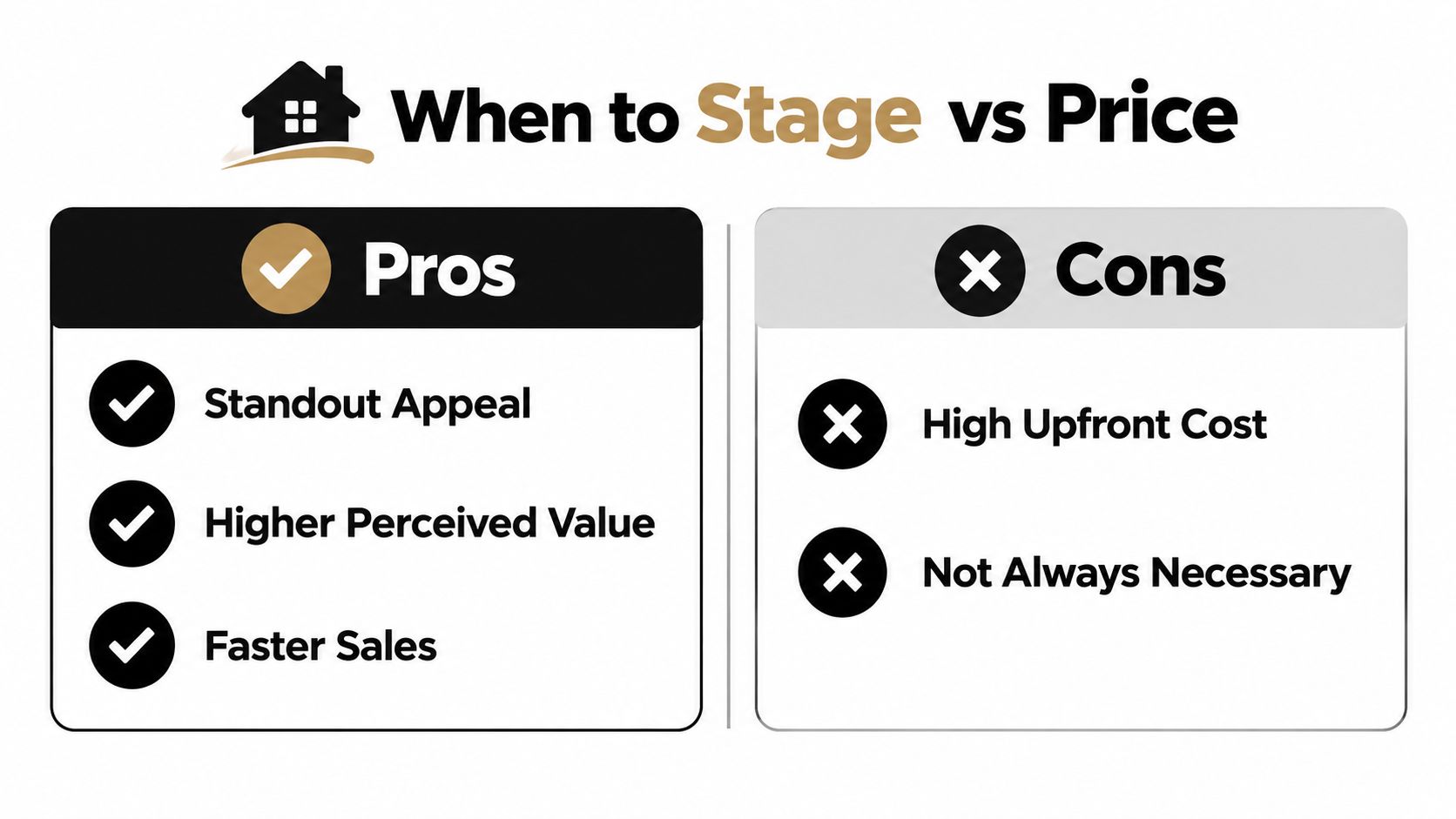
Choose the right level of preparation
A practical decision can start with four questions:
- Is the property vacant? Empty rooms often need physical furniture to establish scale and warmth.
- Does the existing furniture fit? If pieces are worn, oversized, or heavily personalized, selective rental may improve the photographs.
- What does the local competition show? Compare current listings and recent sales, not generic staging advice.
- What is the property's main weakness? If buyers will object to condition or price, address that problem first.
NAR's 2025 profile found that 21% of sellers' agents staged all seller homes before listing, while 10% staged only homes that were difficult to sell. The pattern indicates that staging has become an established but selective marketing tool, not a mandatory expense for every property.
When pricing should lead
A clean, well-maintained home with clear room functions may not need full furnishing. In that situation, a strategic price, professional photography, and targeted repairs can produce a better net result. Conversely, a distinctive or high-value property may lose more through an unclear presentation than it spends on a carefully scoped staging plan.
Get a written recommendation that separates essential preparation from optional enhancement. Then compare the staging quote with the expected carrying cost of a slower sale, the strength of competing listings, and the buyer objections your agent hears locally.
Edinhart Realty and Property Management can help homeowners evaluate staging, coordinate preparation, arrange professional photography, and apply a pricing strategy for a sale or rental. Visit Edinhart Realty and Property Management to request a property review and discuss the preparation plan that fits your home, timeline, and budget.


