

You're scrolling listings on your phone late at night, comparing two Fresno homes at nearly the same price. One shows an empty living room with echoing walls and no sense of scale. The other shows a sofa that fits, clear walking space, and light that makes the room easy to read. You don't need to love the furniture to get it. You can instantly picture your own evening there, and that's where the home staging benefits begin. Staging doesn't add square footage or fix a bad price. It removes guesswork, and guesswork is what makes buyers and renters hesitate, skip a showing, or offer less than they otherwise might.
Why Home Staging Changes Buyer Confidence
A Clovis seller recently walked through a competitor's listing before pricing her own home. The staged house wasn't larger or newer. It was legible. She could tell where a dining table belonged, whether the primary bedroom fit a king bed, and how traffic moved from the entry to the kitchen. In her own vacant rooms, by contrast, every buyer had to do that mental work alone, and buyers rarely do it well under time pressure.
That's the core job of staging. It's mental simulation, not decoration for its own sake. Buyers are asking three questions in every room. What is this space for? How big is it really? Can I live here without friction? Decluttering, right-sized furniture, and consistent finishes answer those questions before a buyer has to ask them out loud.
Empty rooms create a specific problem. Without reference points, people misjudge scale in both directions. A generous living room can look cold and undefined, while a small bedroom with no bed looks bigger in photos than it feels in person, which sets up disappointment at the showing. Crowded rooms create the opposite problem. Oversized sectionals, packed shelves, and personal collections force buyers to look past your life to imagine theirs, and many won't.
The concept map below breaks that confidence problem into the four jobs staging has to do.
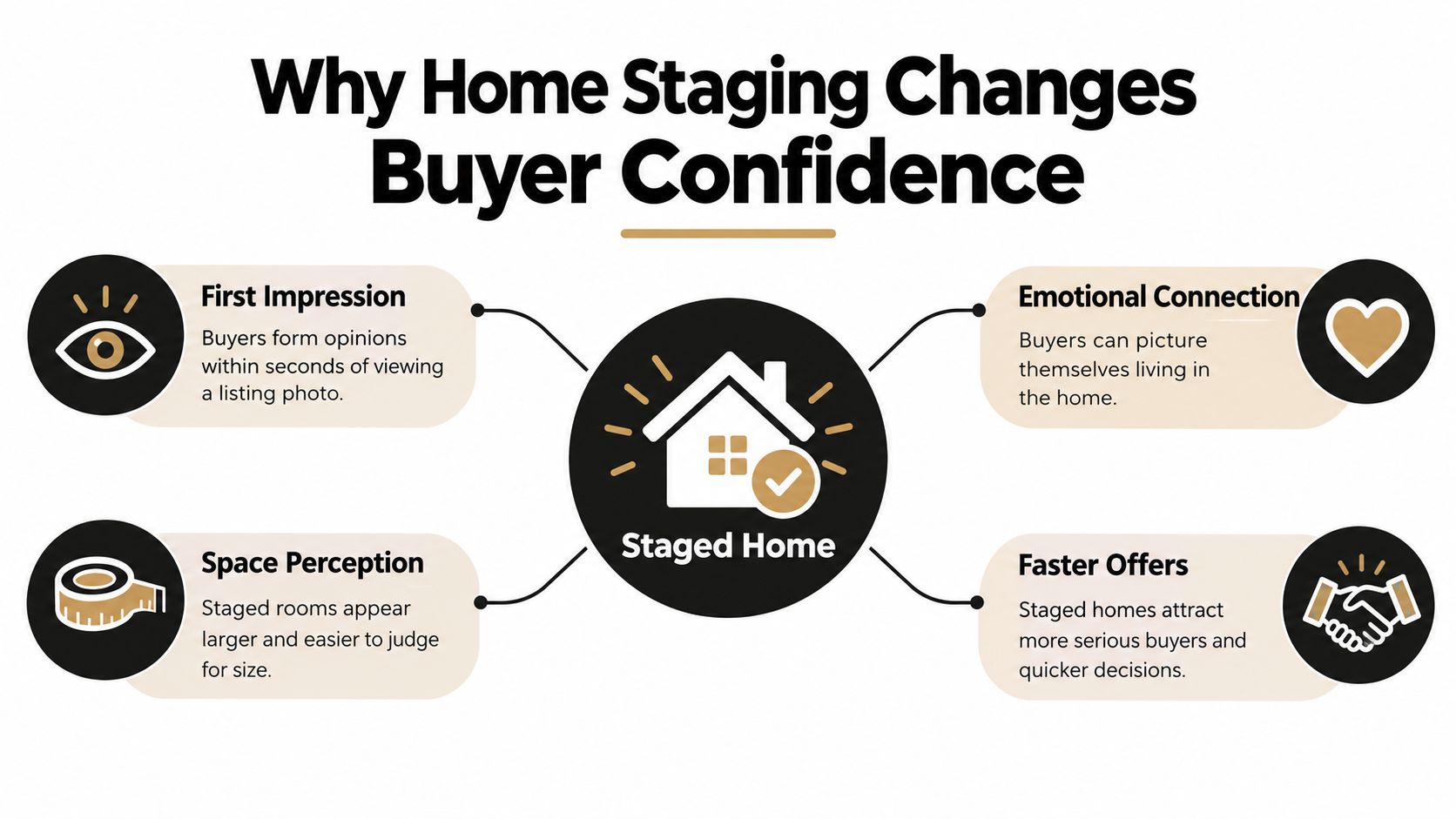
What the Evidence Actually Shows
The strongest documented benefit is visualization, and you shouldn't oversell it beyond that. In the National Association of Realtors 2025 staging survey findings, 83% of buyers' agents said staging made it easier for buyers to visualize the property as their future home, while 60% said it affected some buyers' views and 26% said it affected most buyers' views. Those are agent perceptions, not controlled before-and-after sale prices. They tell you staging changes how people process a home. They don't prove every staged home sells for more.
That distinction matters because four different outcomes get lumped together in most sales pitches.
- Buyer confidence: The home feels understandable and low risk, so a buyer moves from browsing to serious consideration.
- Perceived value: The presentation feels cared for and complete, which can support a stronger offer.
- Market velocity: Clearer photos and showings can produce inquiries and decisions sooner.
- Appraisal value: This is based on comparable sales and physical characteristics, and staging doesn't change it directly.
Confusing perceived value with appraisal value is the most expensive mistake sellers make here. An appraiser isn't paying for a rented sofa. A buyer, however, may act faster and negotiate less aggressively when the home feels ready.
Staging earns its keep when it solves a visualization problem. If there's no visualization problem, you're buying decoration.
Where Confidence Breaks Down
Think about the rooms that stall buyers. A long, narrow living room with furniture pushed against every wall reads as a hallway. A primary bedroom crammed with exercise equipment and storage bins reads as a storage problem, not a retreat. A dining area used as a home office leaves buyers wondering whether there's room for both. In each case, the house may be perfectly functional. The presentation is what's failing.
Staging also creates consistency between the online listing and the in-person tour. Buyers form an expectation from photos, then test it at the front door. When the rooms match what they saw online, trust builds. When a bright, tidy photo turns into a dim, cluttered showing, buyers start wondering what else doesn't match, and that suspicion follows them into pricing conversations.
Be clear about the limits. Staging can't conceal deferred maintenance for long, and it shouldn't try. A styled bathroom with a leaking faucet, stained grout, or a musty smell still reads as a repair bill. It also can't rescue a mispriced listing. If comparable homes in your Fresno or Clovis neighborhood tell a different price story, better pillows won't close that gap. Fix what's broken first, price from the comps, then use staging to make the value you've already established easy to see.
Used that way, staging is a marketing intervention with a documented purpose. It helps buyers interpret function, scale, and lifestyle fit quickly, especially in vacant, dated, or awkwardly furnished homes. It doesn't guarantee a premium. It gives a well-priced, well-maintained home a fair chance to be understood on the first viewing, online and in person.
How Staging Can Reduce Time on Market
Speed is money, even when the sale price doesn't move. Every extra week on market brings financing, insurance, taxes, utilities, and maintenance costs, plus the risk that buyers assume something's wrong with a home that's been sitting. In the 2025 NAR staging survey reported by MPA Magazine, 49% of sellers' agents observed reduced time on market for staged homes, and 29% reported a 1% to 10% increase in the dollar value offered. Treat those figures as agent-reported benchmarks, not causal proof. Agents are describing what they observed, and many factors move at once.
The mechanism is straightforward. A home that's easy to read online earns showings sooner. A home that's easy to read in person produces cleaner feedback and faster decisions. Buyers don't need a second visit just to figure out whether their furniture fits. That early momentum also protects you from the price-reduction spiral, where a stale listing invites low offers because it's stale.
Track Velocity, Not Vibes
If you stage, measure whether speed improves. Don't rely on compliments from showing agents.
- Days to first inquiry: Record when serious interest starts, not just when the listing goes live.
- Showing volume and conversion: Count showings and how many turn into offers or, for rentals, applications.
- Price reductions: Note whether you hold price or start cutting, and when.
- Offer quality: Look at terms, contingencies, and earnestness, not headline price alone.
Practical rule: If staging doesn't change inquiries, showings, or offer quality within your normal feedback window, the problem is probably price, condition, or photos, not a lack of throw blankets.
For rentals, run the same logic with different labels. Track inquiries, tour-to-application conversion, and days vacant. A staged or well-presented rental that leases sooner saves vacancy cost even if the rent itself doesn't change. Speed is a legitimate financial benefit on its own. You don't need a price premium to justify staging if avoided carrying costs cover the bill, but you do need the numbers to show it.
Choosing Professional or DIY Home Staging
Start with the size of the visualization problem, not with a stager's price list. A vacant home with odd room proportions needs more help than an occupied home with good furniture that's just too personal. The comparison below lays out where each approach tends to win.
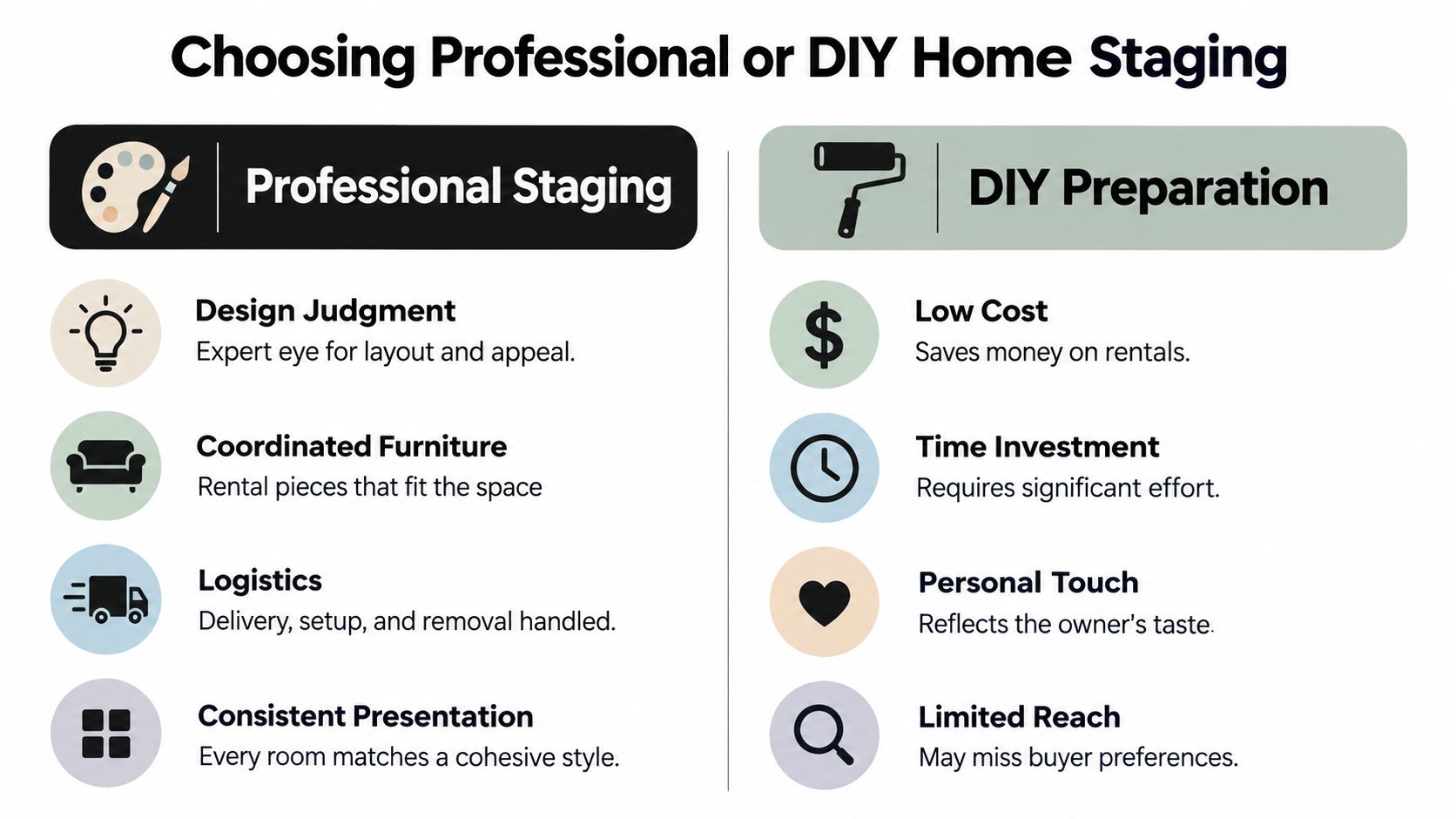
Professional staging brings four things most owners can't easily replicate. There's design judgment about scale and layout, coordinated rental furniture that fits the rooms, logistics for delivery and removal, and a consistent look across every photographed space. That consistency matters more than any single piece. In the National Association of REALTORS 2021 Profile of Home Staging, buyers' agents cited the living room at 46%, primary bedroom at 43%, and kitchen at 35% as the most influential rooms, which tells you a professional's value is concentrated where buyers focus first.
DIY preparation works well when the home is occupied, the furniture is roughly the right scale, and you have time and a reasonably neutral eye. Decluttering, deep cleaning, rearranging for circulation, improving lighting, and removing personal items cost mostly effort. Where DIY falls short is objectivity. Owners stop seeing the crowded corner, the dated bedding, or the chair blocking the walkway because they live with it daily.
A Simple Decision Filter
Choose professional staging when the home is vacant, visually dated, competing against polished nearby listings, or difficult to read from photos. Choose DIY when the home is well maintained, already photographs cleanly, and needs editing rather than furnishing. Choose a hybrid, often the smartest spend, when you need a stager's consultation and a few rental pieces for the living room and primary bedroom while you handle cleaning and decluttering yourself.
One warning. Staging, photography, repairs, and pricing aren't interchangeable. A stager can't fix a broken water heater, and a fresh coat of paint can't define an empty great room. Sequence the spending. Repairs first, then presentation, then photos, with price set from comparable sales throughout. If budget forces a choice between fixing a visible defect and renting furniture, fix the defect every time.
Target High-Impact Spaces Without Overspending
You don't need to stage every square foot. You need the rooms buyers judge first to be unmistakable, and the rest of the home to be clean and consistent with them. The staged living room below shows the target. Furniture fits the space, surfaces are clear, and there's an obvious path through the room.
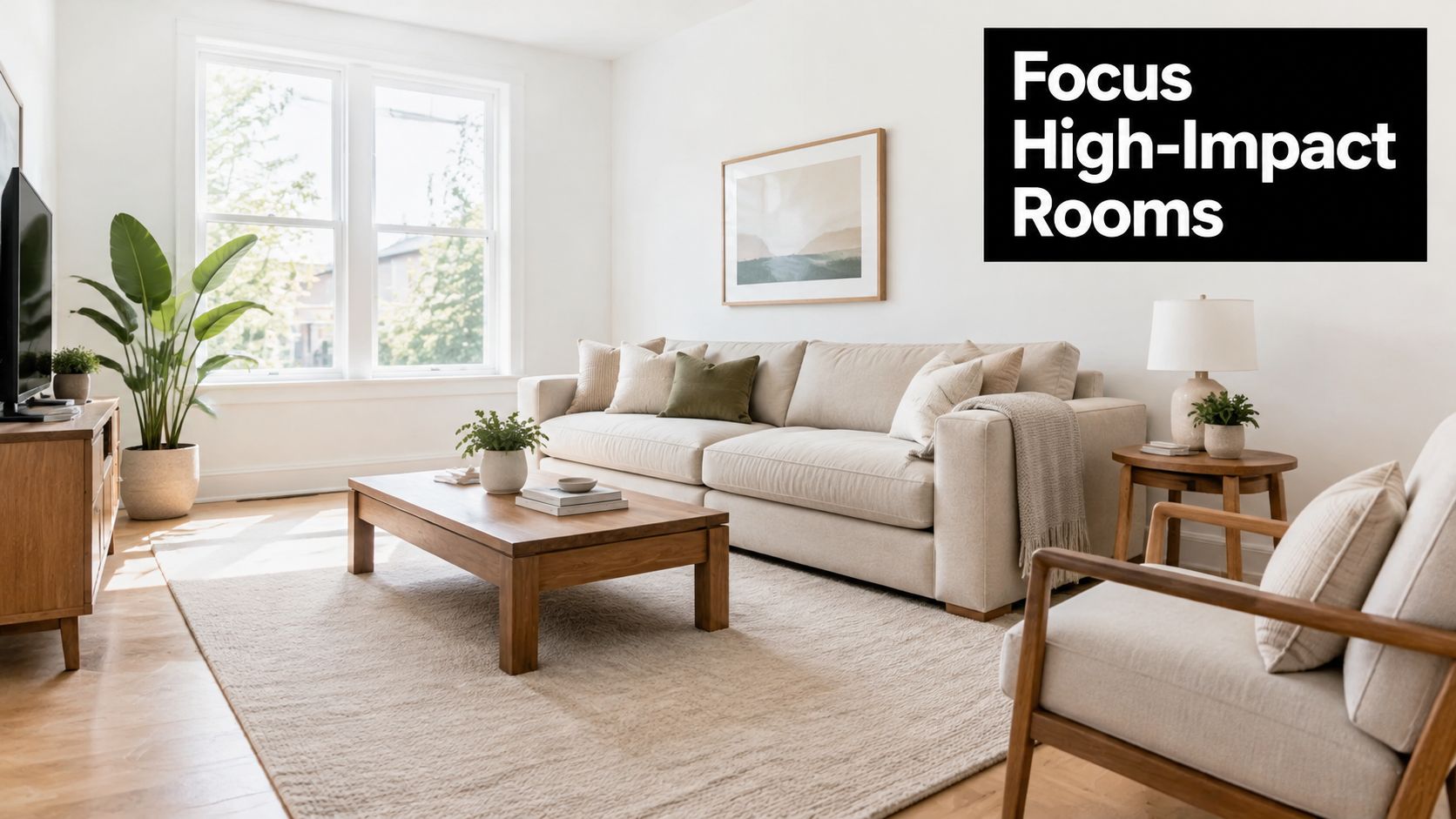
Sellers' agents already work this way. In the National Association of Realtors 2025 Profile of Home Staging, 91% reported staging living rooms, 83% staged primary bedrooms, and 69% staged dining rooms, while only 21% staged every seller's home and 10% staged only homes that were difficult to sell. Staging is selective in practice. Yours should be too. If you want room-level ideas before you spend, start with practical living room staging ideas and apply the same editing logic to the bedroom.
A Priority Checklist That Controls Cost
- Repair first: Fix leaks, sticking doors, cracked tiles, burned-out bulbs, and anything that signals neglect.
- Open circulation: Remove excess furniture so buyers can walk every room without turning sideways.
- Neutralize the palette: Choose bedding, towels, and accessories that work for a broad audience, not your personal taste.
- Fix the light: Replace dim or mismatched bulbs, open window coverings, and add lamps where corners go dark in photos.
- Hide storage pressure: Clear counters and closets enough that storage looks adequate, using off-site storage if needed.
For finer points on how styled interiors read through a lens, photographers who shoot editorial interiors think about sightlines and negative space the same way stagers do, and this interior staging advice for editors is a useful reference for how small placement choices change a finished image.
The short video below is worth watching before you buy accessories, because it reinforces sequencing. Edit and arrange first, then add temporary pieces only where a room still lacks a clear purpose.
Avoid irreversible changes made only for staging. Don't rip out functional features or commit to a renovation to chase a look. Temporary, removable, and repairable wins. Spend first where the camera and the buyer go first, keep secondary rooms clean and simple, and stop when every priority room answers the scale and function questions without explanation.
Use Photography to Carry the Staged Story
Your first showing happens on a phone screen. If the photos don't communicate scale, light, and purpose in a few seconds of scrolling, the in-person showing never gets requested, and your staging investment sits in an empty house doing nothing. Photography isn't an add-on to staging. It's the delivery system.
Sequence the work correctly. Repair and clean first. Stage second. Photograph the finished presentation last, and don't rearrange afterward. The home a buyer tours should match the home in the listing, room by room. Mismatches erode trust fast. A buyer who loved a bright, open living room online and finds furniture shifted, lamps removed, and counters cluttered again will discount everything else you say about the property.
What Good Listing Photos Must Do
Strong photos answer the same three questions staging answers in person. They show what each room is for, how big it is relative to normal furniture, and how rooms connect. That means shooting from doorways and corners that reveal layout, keeping vertical lines straight, balancing window light so interiors don't go dark, and ordering the photo set so a viewer can mentally walk the home from entry to living spaces to bedrooms without getting lost.
Weak photos undo good staging in predictable ways. Phone snapshots taken at chest height in dim light make staged rooms look smaller and dingier than they are. Wide-angle distortion stretches rooms into shapes buyers can't match to reality, which backfires at the showing. Random photo order, starting with a bathroom or a hallway, wastes the first impression on your least persuasive space. If you're evaluating your own listing set, guidance on home staging photography covers how composition and sequencing decisions support the staged presentation.
A beautifully staged room with poor photos is a secret. Buyers can't fall for a home they never click on.
Apply This Differently in Fresno and Clovis Sales and Rentals
Sale listings and rental listings ask photos to do slightly different jobs. A buyer needs to picture ownership, daily routines, furniture they already own, and whether the home fits the next several years of their life. A prospective tenant needs to judge usable space, condition, storage, and whether the home looks professionally managed and ready on the stated date. Both audiences punish uncertainty. They just define risk differently.
For a sale, lead with the living room and kitchen relationship, then the primary bedroom, because those images carry the lifestyle story. For a rental, don't hide the practical spaces. Show the kitchen storage, laundry area, bathrooms, and yard clearly and accurately, because tenants screen for livability and maintenance standards. A rental photo set that only shows styled glamour shots and skips functional rooms invites unqualified inquiries and disappointed tours.
Compare your presentation against visible competing inventory, not against your memory of the market. Pull up similar Fresno and Clovis listings at your price or rent level and scroll them the way a stranger would. If competitors' photos are brighter, clearer, and easier to move through, that's your gap, regardless of how your home feels in person. Document your starting point with before photos taken from the same angles you'll use after staging. You'll need that baseline later to judge whether inquiries and conversions improved.
Match the intervention to the property. A dated home with dark finishes and awkward furniture may need staging plus professional photography to compete. A well-maintained home with good natural light may need only decluttering, minor edits, and a competent photographer. Don't buy the full package by default. Owners who want that judgment made for them can work with a local team such as Edinhart Realty and Property Management, which offers staging guidance alongside photography and pricing support for sales and rentals, or they can hire a stager and photographer separately and coordinate the sequence themselves.
Finally, test rather than assume. After launch, watch inquiry volume, showing requests, and conversion to offers or applications against your baseline expectations for comparable listings. If clicks are healthy but showings are weak, your photos may overpromise or your price may be off. If showings are healthy but offers don't follow, the in-person experience or the price is the problem, and re-shooting won't fix it. Photography carries the staged story to the market. It can't rewrite a story the property itself doesn't support.
Calculate Staging ROI Before You Invest
Stop asking whether staging pays in general. Ask whether it pays on your property, at your price, with your carrying costs. Use a simple net-benefit equation and force every cost into it.
Staging ROI equals incremental proceeds plus avoided carrying costs, minus staging, storage, labor, and repair costs.
Run an illustration, not a promise. On a hypothetical $400,000 listing, a 1% improvement in offer value equals $4,000 before expenses. If your staging, storage, and preparation bill approaches that figure, a small price improvement alone doesn't justify the spend. The case has to come from speed, avoided price reductions, or both. That's arithmetic, not a local result, and you should run it with your own quotes. If you need a starting point for those quotes, review what it costs to stage a home for sale before you commit.
Count the Carrying Costs Honestly
- Financing and taxes: Monthly interest, property taxes, and insurance continue whether the home is staged or not.
- Utilities and maintenance: Keep the home conditioned, lit for showings, and maintained outside.
- Vacancy cost for rentals: Every vacant week is lost rent you never recover.
- Price reduction risk: A stale listing often costs more in eventual concessions than staging would have.
Document your baseline before launch. Record the list price or asking rent, expected days on market for comparable properties, and your total presentation spend by category. After launch, compare inquiries, showings, conversion, final terms, and net proceeds after expenses. For a rental, swap sale proceeds for signed rent and days vacant saved. If the net benefit is positive, staging earned its keep. If it isn't, you've learned something specific about your property and price point instead of repeating a headline return claim that was never yours.
Examples of Staging Decisions in Practice
These are illustrative scenarios, not documented local case studies. Use them as decision tools and notice how the right answer changes with the problem.
Scenario one, the vacant home. Photos show empty rooms and buyers can't judge whether the living room fits normal furniture. The uncertainty is scale. The intervention is targeted rental furniture for the living room, primary bedroom, and dining area, plus professional photos. Cost categories are rental, delivery, and photography. Success looks like faster first inquiries and better showing-to-offer conversion. If the home also needs a roof repair, that repair comes first and may consume the budget instead.
Scenario two, the crowded occupied home. The furniture is good quality but there's too much of it, and circulation is blocked. The uncertainty is function and storage. The intervention is editing, off-site storage, rearrangement, and a deep clean, with no rental furniture at all. For practical guidance on arranging what you already own, this furniture staging advice for homes walks through placement and editing decisions room by room. Success looks like stronger showing feedback and fewer comments about size.
Scenario three, the well-maintained rental. The home is clean, updated, and easy to read. The only gap is presentation online. The intervention is decluttering, minor touch-ups, and professional photography. Full staging would be hard to justify unless competing rentals are staged and leasing faster. Success looks like more qualified applications per tour and fewer vacant days.
The pattern is consistent. Name the uncertainty, choose the smallest intervention that removes it, list every cost, and define the metric that would prove it worked. When you can't name the uncertainty, staging probably isn't your first investment.
Build a Measurable Staging Plan
Start with the goal in one sentence. Sell at a defensible price within a target window, or lease to a qualified tenant with minimal vacancy. Every staging decision after that either serves the goal or gets cut.
Your Launch Sequence
- Repair visible defects: Handle maintenance, cleaning, and minor cosmetic fixes before any styling.
- Select priority rooms: Focus spend on the living room, primary bedroom, kitchen, and dining space as your property requires.
- Choose your level: Decide between professional staging, DIY preparation, or a hybrid based on vacancy, condition, and competition.
- Document the baseline: Take before photos, record your budget by category, and note comparable listings and their presentation.
- Photograph and launch consistently: Shoot the finished home and keep showings matched to the photos.
- Measure and decide: Track inquiries, showings or applications, conversion, price changes, and net proceeds, then adjust price or presentation based on evidence.
Decision standard: Stage when a real visualization or presentation problem is costing you inquiries, showings, or offer quality. Otherwise, put the money into repairs, cleaning, photography, or a price correction.
That standard protects you from both errors. You won't skip staging on a vacant, hard-to-read home where it could change buyer behavior, and you won't rent furniture for a clean, well-priced home that only needed better photos. The home staging benefits that matter are the ones you can trace in your own numbers, inquiries that arrive sooner, showings that convert, price reductions you avoid, carrying costs you don't pay, and net proceeds that beat the unstaged alternative. Everything else is decoration, and decoration alone isn't worth your money.
If you're preparing a home to sell or rent in Fresno, Clovis, or the surrounding Central California area, Edinhart can help you decide where staging, photography, and pricing work will pay, and where they won't. Visit Edinhart Realty and Property Management to talk through your property, your timeline, and a measurable plan for presenting it to buyers or tenants.


