

You've repainted the living room, replaced the cabinet hardware, and spent a weekend making the house look more finished. Then the listing goes live, the showing requests stay quiet, and you start wondering whether the property needed better design or just better preparation. In the Fresno region, that distinction matters because the same home may need to look compelling in sale photos today and remain durable enough to support rental income later.
Home staging and interior design use many of the same tools, but they solve different problems. Staging prepares a property for the market. Interior design shapes a home around the people who'll live there. Owners who confuse those assignments often spend on attractive changes that don't improve the listing, the rent, or the long-term usefulness of the property.
Why Fresno Sellers and Landlords Keep Mixing These Up
A Sanger tract home from the 1990s can expose the difference quickly. An owner may repaint the living room sage green, replace every piece of hardware, and hire a designer to curate a custom console table. Those choices can be tasteful, but they still may not answer the buyer's first questions: Does the room feel open? Can a sofa fit without blocking the walkway? Will the house look bright and inviting in the listing photos?
Across the street, a similar home might need less personality and more editing. Clear furniture placement, clean windows, neutral bedding, working lights, and professional photography can communicate the property's strengths without asking buyers to appreciate a particular design style. A seller who invests in personal upgrades without correcting clutter or weak presentation can end up waiting while a less decorated competitor attracts attention.
Landlords make the opposite mistake. A Clovis owner may buy expensive staging furniture before marketing a rental, assuming a polished interior will support a higher rent. If the neighborhood, floor plan, finishes, and tenant profile don't justify that positioning, the furniture becomes an expense rather than an income-producing improvement. A rental usually needs clean, functional, durable presentation more than a showroom identity.
Practical rule: Prepare the property for the decision someone else is about to make, not for the design board you want to complete.
The confusion is understandable. Both disciplines involve color, furniture, lighting, accessories, and layout. The difference is the person at the center of the decision. Staging serves the buyer or renter evaluating an available property. Interior design serves the occupant building a life inside it. Sellers need market readiness and a clear path to an offer. Landlords need an attractive, maintainable unit that supports qualified applications and future turnover efficiency.
That distinction also explains why one property may need both services. An investor might use design expertise to select durable flooring and lighting during a renovation, then use staging and photography to market the finished home. The work connects, but the purpose changes at each stage.
Home Staging vs Interior Design and What Each Really Does
Home staging is temporary market preparation. A stager edits personal items, arranges furniture around sightlines and traffic flow, improves visual balance, and helps the property appeal to a broad audience. The emphasis is on what people can understand quickly from photographs and a walkthrough. Rented furniture, artwork, lamps, rugs, towels, and accessories may be installed for the listing period and removed after the property sells or leases.
Interior design is an occupant-focused plan. A designer considers routines, storage, pets, children, entertaining, comfort, durability, and personal taste. The work can include paint specifications, lighting, fixtures, furnishings, window treatments, built-ins, and finish selections. It often develops over weeks or months because the decisions need to serve daily life rather than a short marketing window.
For owners preparing a listing, practical staging guidance such as these articles on home staging techniques can help identify changes that improve presentation without turning the project into a full remodel. The useful question isn't whether the room looks beautiful in isolation. It's whether the room makes its purpose, size, light, and condition easy to grasp.
The difference in one view
| Dimension | Home Staging | Interior Design |
|---|---|---|
| Primary audience | Prospective buyers or renters | The people who'll occupy the home |
| Main objective | Create broad appeal and support marketability | Improve long-term function, comfort, and expression |
| Typical duration | Temporary, tied to the listing or lease-up period | Longer-term, often developed across a substantial project |
| Typical deliverables | Furniture rental, accessories, editing, layout, styling | Paint, fixtures, furnishings, materials, lighting, and built-ins |
| Personalization | Limited, because broad appeal matters | Intentional, because the occupant's preferences matter |
| Best fit | A home being sold or an empty rental being marketed | A home being lived in or renovated for long-term use |
A simple rule works for most Fresno owners. If the immediate goal is a faster offer or a qualified tenant, choose staging. If the goal is a home you'll live in for years, choose interior design. Investors often need both, but they shouldn't pay for the full version of each at the same time. Design the improvements that protect the asset, then stage the finished property for its audience.
What Staging Returns Actually Look Like in the Numbers
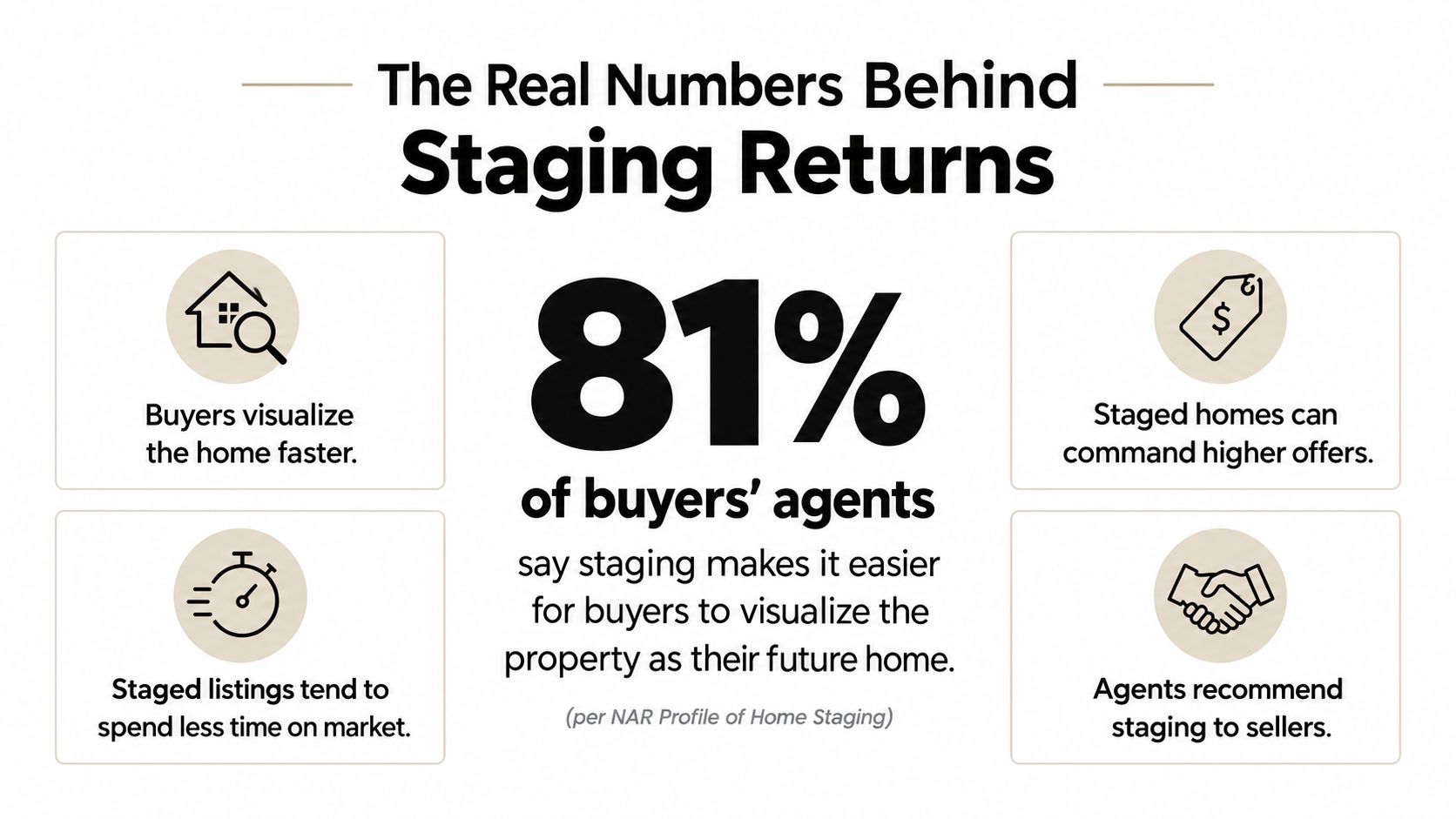
A vacant or heavily personalized room can be difficult to judge in listing photos. The National Association of Realtors' 2025 Profile of Home Staging reports that 83% of buyers' agents said staging made it easier for buyers to visualize the property as a future home. That finding does not guarantee a particular sale price. It shows why a furnished, edited room can communicate scale, use, and value more clearly than an empty one.
The same NAR report found that 49% of agents said staging reduced the time a home stayed on the market, while 29% said staging a seller's home increased the dollar value offered by 1% to 10%. Results vary with condition, pricing, location, competition, and execution. Still, the figures support treating staging as a marketing expense that may protect time on market and the seller's negotiating position.
What the numbers mean locally
On a $400,000 listing, a 1% to 10% offered-value range equals $4,000 to $40,000, based on the NAR figures above. That range is not a forecast for a specific Fresno property. It gives owners a way to compare staging costs with the expense of carrying a listing, accepting a weaker offer, or making a price adjustment.
The report also identifies the living room, primary bedroom, and dining room as the most commonly staged rooms, at 91%, 83%, and 69% respectively. These rooms help buyers judge scale, lifestyle, and movement through the home. An empty living room may appear smaller than it feels, while an overfilled primary bedroom can conceal storage and circulation.
Staging ROI is measured by whether the presentation protects attention, time, and negotiating position, not by whether a room belongs in a magazine spread.
For rentals, the calculation changes. A landlord should compare preparation costs with the carrying expense of an empty unit, the quality of applications, and whether durable improvements can reduce future turnover work. In Fresno, a clean, bright, accurately photographed rental may outperform a heavily decorated one because renters need to see where their belongings and routines will fit. The same property may need to look inviting in sale photos while remaining durable enough to support rental income.
Budgeting Staging and Design Work That Actually Pays Back
A workable budget starts with the property's audience and condition, not with a designer's catalog. Central Valley homes generally benefit from a focused presentation plan: remove distractions, repair visible defects, improve light, and furnish the rooms that help people understand the floor plan.
| Property Type | Budget Range | Best Spend Categories | Skip |
|---|---|---|---|
| Rental refresh | Under $1,500 | Deep cleaning, touch-up paint, lighting, simple accessories, photography preparation | High-end furniture packages and decorative remodels |
| Typical Fresno listing | $1,500 to $4,000 | Living room and primary bedroom furniture, entry edits, neutral paint, lighting, photography | Custom pieces and trend-heavy room makeovers |
| Vacant luxury or investor turnaround | $4,000 to $8,000+ | Full furnishing plan, repairs, coordinated styling, premium photography, targeted design upgrades | Spending beyond what the location and property can support |
The budget ranges above are planning categories, not guaranteed prices or returns. Before approving work, list the visible problems that could distract a buyer or renter. Cleaning, paint touch-ups, working light fixtures, clear pathways, and correctly scaled furniture usually carry more practical value than a designer object that appears in one photograph.
For an occupied rental, the best investment may be less dramatic. Remove excess furniture, store personal items, clean grout and appliances, replace damaged bulbs, and use professional photography. A landlord can review a more detailed cost to stage a home for sale while separating temporary staging costs from permanent repairs and improvements.
A simple decision calculation
Use this comparison:
Potential financial benefit = projected price or rent improvement plus avoided carrying cost, minus preparation cost.
Keep the estimate conservative. If a vacant property needs work before it can be photographed, spend first on conditions that appear in every image and every showing. If the property already photographs well and the neighborhood attracts renters without furniture, full staging may be unnecessary.
A landlord should often skip a complete furniture installation when the unit is occupied, the floor plan is obvious, and the main problems are dirt, dated bulbs, or weak images. In that case, cleaning and photography-only preparation can preserve cash while still giving applicants a clear view of the home. Interior design makes more sense when a durable upgrade will serve tenants over multiple lease cycles, not merely when the owner wants a more fashionable listing.
A Step by Step Plan to Prepare Your Home for Listing
For a typical 2,000-square-foot Central Valley house, preparation goes faster when the work follows the way buyers approach the property. Start outside, remove distractions inside, then finish with the details the camera will expose.
Start at the curb and entry
Allow a few hours for the exterior. Trim or remove obvious overgrowth, sweep the porch, clean the front door, confirm that entry hardware works, and replace a dim porch bulb. The goal isn't an outdoor redesign. It's a clean threshold that tells visitors the property has been maintained.
Walk from the driveway to the front door with a phone camera. Remove bins, hoses, toys, excess planters, and vehicles that block the approach. A homeowner can handle most of this work, but hire help for tree trimming, pressure washing, or repairs that create a safety concern.
Make the living areas readable
Set aside several hours for the living room, family room, and dining area. Remove family photos, collections, oversized furniture, and wall décor that competes with the room's features. Arrange seating to show conversation and circulation, rather than pointing every chair at a television.
Heavy window coverings can reduce the sense of light. Open blinds, clean the glass, and use simple panels if privacy requires them. If the existing furniture is too large or worn, rent only the pieces needed to define the room. Owners who want a more detailed preparation sequence can use this guide to prepare a house for a photography session.
Edit the kitchen and bathrooms
Give the kitchen a focused cleaning block. Clear counters except for a small, intentional grouping, clean appliance fronts, remove magnets and paper, and check that cabinet doors sit properly. A bowl of fresh produce or a simple centerpiece is enough. Don't fill the counters with decorative objects that make storage look limited.
Bathrooms need privacy and visual cleanliness. Hide toiletries, plungers, brushes, medications, wastebaskets, and personal décor. Deep clean mirrors, fixtures, grout, and floors, then use fresh white or light-neutral towels. Repair failed caulk rather than hiding it with accessories.
Finish bedrooms and the photo-day punch list
Use neutral bedding, clear dressers, reduce closet overflow, and add lamps where overhead lighting feels harsh. A bedroom should show scale and storage, not the occupant's entire routine. Expect several hours for bedrooms if sorting and packing are involved.
The day before photography, complete this short list:
- Remove daily evidence: Put away dishes, toiletries, mail, pet items, and laundry.
- Control the environment: Handle pets, set the HVAC comfortably, and replace burned-out bulbs.
- Prepare the windows: Clean glass and angle blinds consistently.
- Reset every surface: Wipe counters, mirrors, tables, appliances, and visible trim.
- Check the exterior again: Move trash bins, hoses, cars, and temporary tools.
Virtual tours and digital edits can supplement physical preparation. This virtual staging AI guide is useful for understanding where digital furnishing may help, but virtual images shouldn't disguise condition problems or replace accurate marketing.
How Staging and Photography Work Together in the Listing
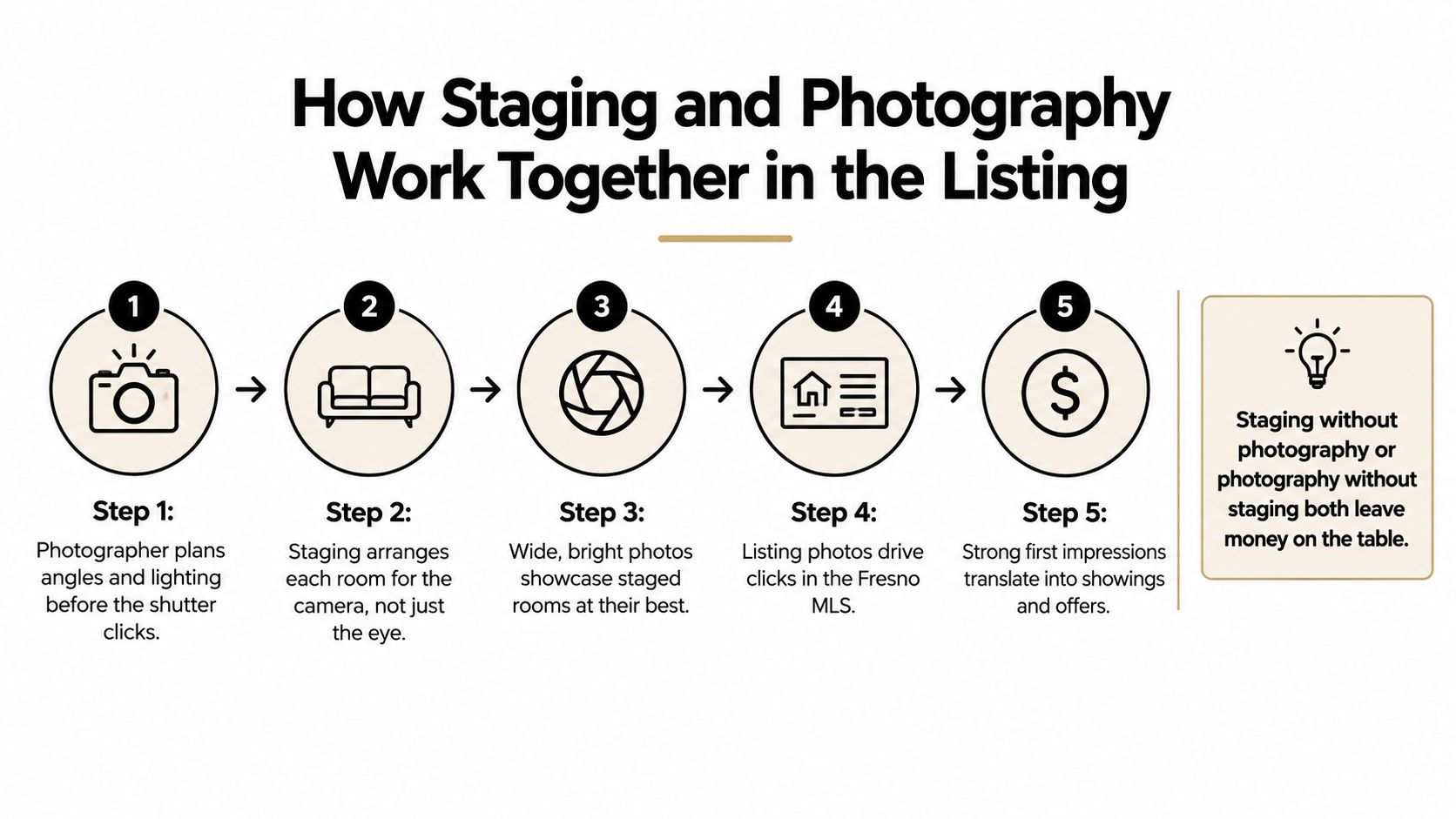
Staging and photography are one production, not two unrelated appointments. A furnished room can still look cramped if the photographer chooses the wrong corner, while excellent photography can't make an unclean bathroom or blocked walkway feel inviting.
The photographer should review light direction, room order, and likely hero images before the camera comes out. In a Fresno home, that may mean photographing a bright front room at one time of day and delaying a darker rear room until the available light supports it. The team should also identify which spaces deserve emphasis and which need only a clear establishing image.
Small styling choices have a large visual effect
The camera notices details owners often ignore. Remove loose stems and excess items from counters, fold towels cleanly, place pillows with consistent spacing, and turn on lamps so the room reads warmly. Keep light sources consistent where possible because mixed color temperatures can make one side of a photograph look cold and another look yellow.
Don't over-stage a small room. A compact Clovis condo can look smaller when every corner contains a chair, basket, plant, and accent table. Choose furniture that shows function while preserving a clear route through the room. Family photographs should also be removed because they draw attention toward the current occupants instead of the home's layout.
For owners comparing service options, this overview of home staging photography reinforces the practical sequence. Style first, then photograph. Never reverse those appointments. The photos are the first showing for many buyers and renters, so they need to match the property people encounter in person.
A listing can lose momentum when the photographs promise a spacious, polished home but the walkthrough reveals crowded furniture or neglected maintenance. Accurate images build confidence. Staging gives the photographer a coherent subject, and photography distributes that presentation to the people deciding whether to schedule a visit.
When to Ignore the Trends and Choose Practical Over Pretty
Pinterest can make a design choice look universal when it only suits one room, one camera angle, or one homeowner. A bold accent wall may photograph as the main event instead of a supporting feature. Mismatched boho layers can obscure the floor plan. A gallery wall can make a buyer focus on the art rather than the wall space, windows, or ceiling height.
Ask two questions before approving a styling idea:
- What must the listing photo communicate in the first three seconds?
- What must the showing confirm in the first ten minutes?
If the answer is space, light, function, and condition, choose materials and furniture that make those qualities obvious. In a small Clovis condo, dark feature paint can make the room feel more enclosed. In a family rental, ornate furniture placed in front of windows can block natural light and make a useful common area feel difficult to live in.
Warmth without narrow appeal
Current design coverage points toward warmer, more functional, collected interiors rather than perfectly sterile rooms. The 2026 home design trends covered by Houzz discusses directions such as natural materials, warm wood tones, curved forms, biophilic elements, and vintage or repurposed pieces. Those ideas can inform a palette, but they don't automatically improve a listing or justify a higher rent.
Use a restrained version of a trend when it supports the property. A warm wood accent can make a neutral room feel welcoming. One plant can soften a hard entry. A curved chair can improve a conversation area if it doesn't interrupt circulation. Avoid turning the home into a style demonstration.
Choose the finish a buyer or renter can live with for the next 24 months, not the one that wins attention for one weekend.
Durability matters more than novelty in rental property. A washable paint, sturdy hardware, practical lighting, and easy-to-clean flooring can serve occupants across multiple leases. For a sale, broad appeal usually beats a highly personal signature. The strongest staging choice may be the least personalized one that still signals warmth, care, and function.
How Edinhart Brings Staging Design and Photography Under One Roof
Owners usually feel the coordination problem before they identify it. One person recommends furniture, another schedules installation, and a third photographer arrives without knowing which room was intended to lead the listing. The result can look acceptable in person but inconsistent online.
Edinhart's service lines map to different property needs. Full-Service staging supports vacant listings that need a turnkey setup. Placement-Only suits occupied homes where existing pieces need targeted editing or selected additions. In-house interior design can guide longer-term upgrades before a sale or lease, while professional real estate photography captures the finished presentation for marketing.
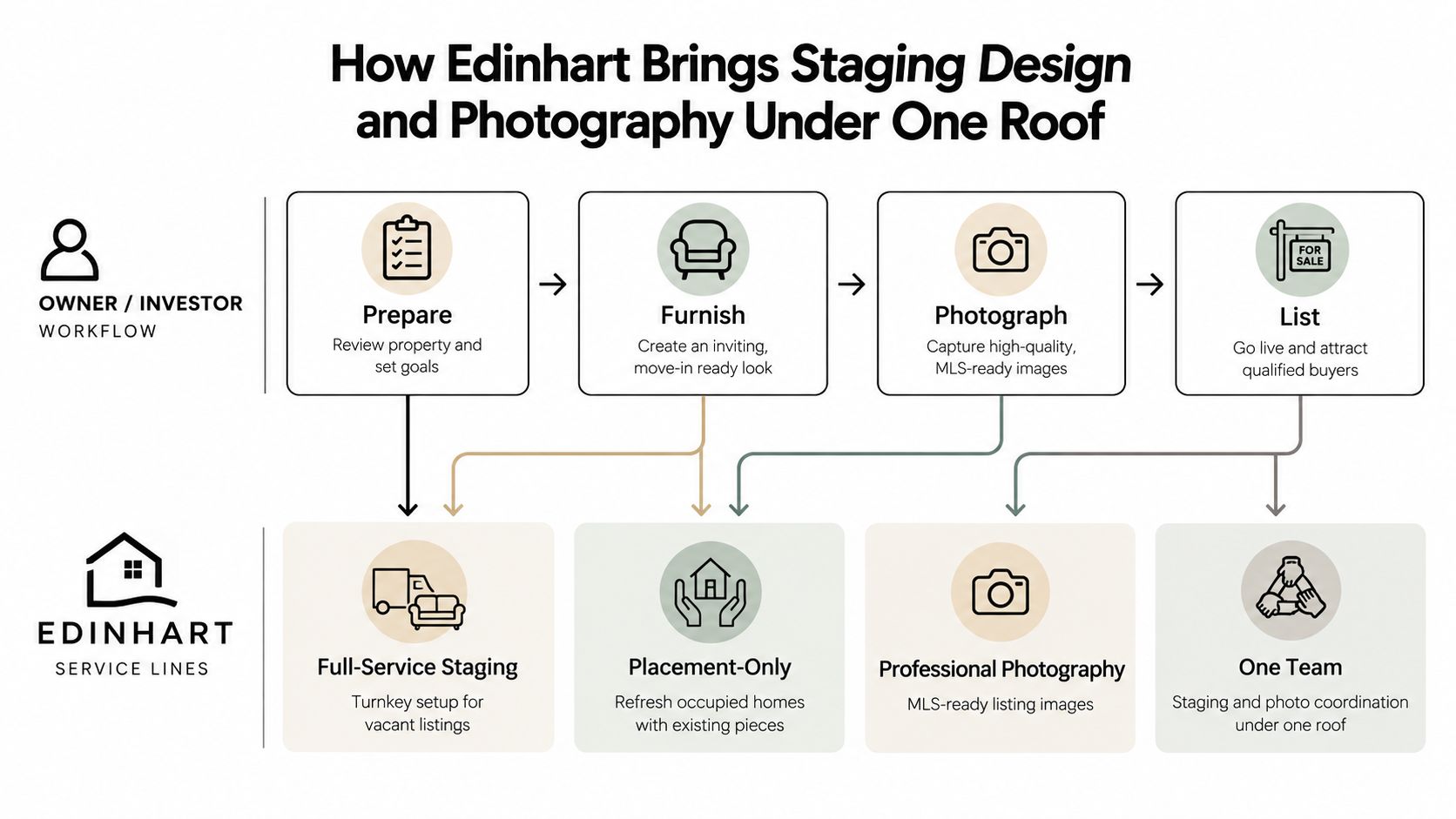
That integrated workflow reduces handoff gaps. The team selecting the sofa can account for the camera angle, the room's traffic path, and the way the furniture will appear in the listing images. For an investor managing several Fresno, Clovis, or Central California properties, using coordinated services can make the preparation process easier to repeat across a portfolio.
The same principle applies to rentals. A property needs presentation that attracts attention, but it also needs honest photography, durable choices, and a layout applicants can understand. Combining staging guidance, interior design decisions, and photography keeps the marketing promise aligned with the actual walkthrough.
Edinhart Realty and Property Management offers Full-Service Monthly Management, Placement-Only marketing and screening, in-house interior design, staging guidance, and professional real estate photography for owners preparing homes to sell or rent. If you're deciding where a Fresno-region property needs editing, durable upgrades, or a coordinated listing launch, visit Edinhart Realty and Property Management to discuss the property and the right level of preparation.


