

You're probably doing the math in your head right now.
You've looked at homes in Fresno, Clovis, or nearby parts of the Central Valley. The monthly payment might feel possible. The down payment and closing costs are the part that stops you cold. That's where many first-time buyers get discouraged, even when their income is steady and their credit is decent.
The good news is that being short on upfront cash doesn't automatically mean you're not ready to buy. A lot of buyers get into homes with some form of home buying assistance. The trick isn't just finding a program. It's understanding what kind of help you're getting, what strings come with it, and whether it still makes sense for your life two or five years from now.
The Dream of Homeownership in California
A first-time buyer in Fresno often starts with the same thought: “I can handle a mortgage, but how am I supposed to come up with all the money before closing?”
That's a real concern. California prices put pressure on buyers fast, even in markets that still look more approachable than coastal counties. You might be earning enough to qualify for a loan, but still feel stuck because the cash needed upfront seems out of reach.
Home buying assistance exists for exactly that gap.
There are more programs out there than commonly realized. The number of available homebuyer assistance programs in the United States reached 2,466 as of Q4 2024, and 81% are currently funded and active, according to Down Payment Resource's 2025 program update. That matters because it shifts the question from “Is there any help?” to “Which help fits my situation?”
Why buyers miss opportunities
Many buyers assume assistance is only for very low-income households. Others think it's only for people with perfect credit, or that using it makes their offer look weak. Some don't even ask because they're worried they'll waste time applying for something they won't qualify for.
In practice, the process is more nuanced than that.
A buyer in Fresno might qualify for a state program through a participating lender. Another buyer might fit a local or county-based program with different income rules, property rules, or occupancy requirements. A third buyer may technically qualify for help, but choose a different route because the repayment terms don't work for their plans.
Home buying assistance isn't one product. It's a group of programs with very different rules.
That's why broad advice only gets you so far. If you're just getting started, it helps to first understand the moving parts of buying, financing, and preparing for closing. A practical place to start is this guide to first-time home buyer tips in Fresno and beyond, especially if you're trying to separate internet noise from what matters in a California transaction.
A smarter way to think about assistance
Instead of asking, “Can I get free money?” ask these questions:
- What part of the purchase needs help most? Down payment, closing costs, or both.
- Is the assistance a grant or a loan? That changes your long-term obligation.
- What happens if I sell, refinance, or move? Hidden problems usually emerge in these situations.
When buyers understand those three things early, they make calmer decisions and avoid expensive surprises later.
Decoding the Types of Home Buying Assistance
The phrase home buying assistance sounds simple, but it covers several different tools. If you mix them together, the whole process feels confusing. If you separate them, it becomes much easier to evaluate what you're being offered.
In plain language, most assistance falls into three buckets: grants, loans, and tax-related help.
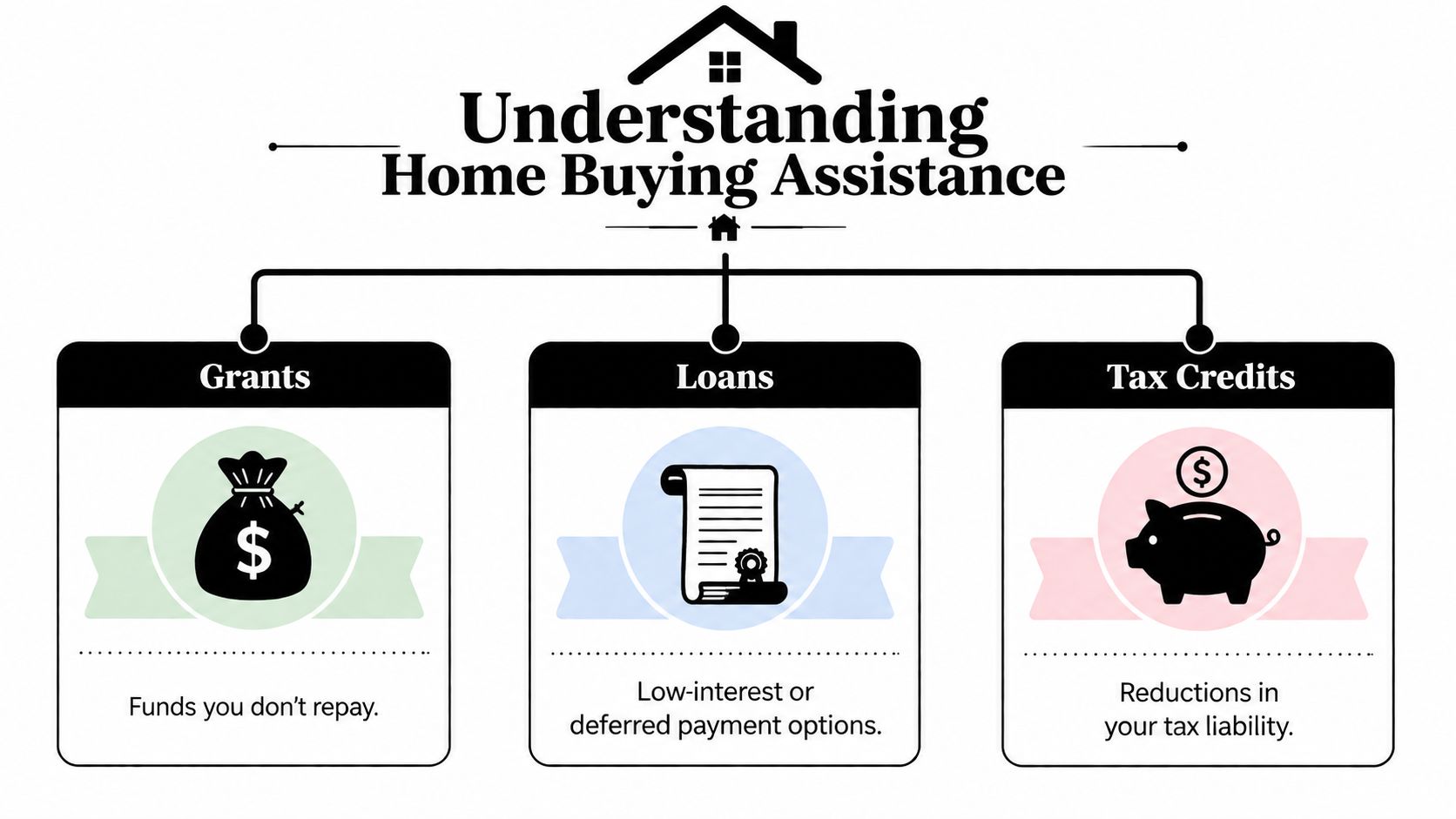
Grants are the simplest to understand
A grant is the version buyers hope for. It's money applied toward eligible costs, usually the down payment, closing costs, or both. In the simplest version, you don't repay it as long as you follow the program rules.
That last part matters. Some buyers hear “grant” and stop reading. But some grants still come with occupancy requirements or recapture clauses if you move too soon, refinance too soon, or stop using the property as your primary residence.
So the question isn't only “Is this a grant?” It's also “What must I do to keep it from turning into a repayment problem?”
Deferred loans are common in California
A lot of California buyers run into deferred-payment assistance loans. Think of these as a quiet second loan sitting behind your main mortgage. You usually don't make monthly payments on it while you live in the home, but it doesn't disappear.
Instead, repayment often gets triggered when you sell, refinance, transfer title, or move out.
That structure can be helpful because it lowers the cash you need today. It can also surprise buyers who assumed “no payment now” meant “no repayment later.”
Practical rule: If the assistance is called a loan, treat it like debt even if the monthly payment is zero.
Tax credits work differently
The third category is tax-related support, often discussed as a mortgage credit certificate. This isn't cash handed to you at closing. It works more like a tax benefit tied to homeownership, if the program allows it and you qualify.
That means it helps in a different way. Grants and deferred loans help you get in the door. Tax credits may help with the cost of owning after you've already bought.
Why this matters for real buyers
Assistance has become normal, not unusual. In 2024, 40% of U.S. homeowners received financial help with their down payment. Among Gen Z homeowners, that number rose to 78%, and nearly 80% of those Gen Z owners said they could not have bought their home at that time without it, according to LendingTree's down payment help survey.
That tells you two things at once. First, many buyers need help. Second, you shouldn't feel embarrassed about using it.
Here's a simple comparison:
| Type of help | Best used for | Main question to ask |
|---|---|---|
| Grant | Reducing upfront cash needed | Do I ever have to repay it if my plans change? |
| Deferred loan | Covering down payment or closing costs now | When does repayment get triggered? |
| Tax credit | Lowering ownership cost over time | How does this affect my taxes and eligibility? |
If you keep those categories straight, lender conversations get much easier.
Spotlight on California and Fresno Programs
California programs often look attractive at first glance because they can reduce the money you need upfront. But each one solves the problem in a different way. Some help by adding a second loan. Others narrow eligibility based on income, location, lender participation, or property type.
One of the best-known examples is CalHFA's MyHome Assistance Program.
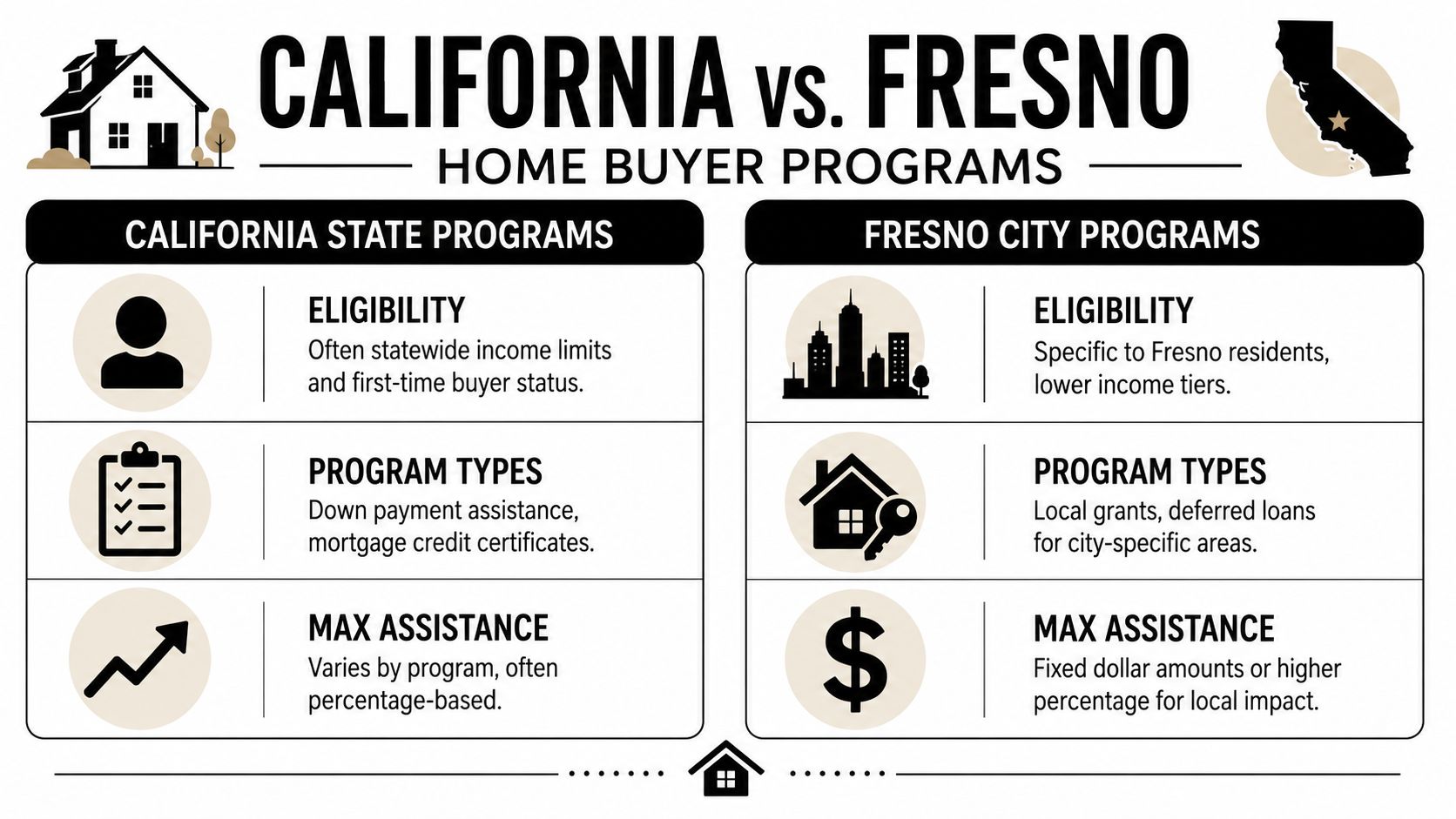
How a statewide program works
CalHFA's MyHome Assistance Program provides a deferred-payment junior loan up to 3.5% of the purchase price for certain loans, requires a minimum 660-680 credit score, and is available only through approved lenders. Repayment is triggered upon sale or refinance, and there are no monthly payments required while you occupy the home, according to this California MyHome program overview.
That structure makes sense for many first-time buyers. If cash is your main obstacle, a deferred junior loan can bridge the gap without increasing your monthly payment right away.
But “helpful” doesn't always mean “best.” A buyer who expects to refinance soon, move for work, or sell within a short period should look closely at what repayment will look like when that trigger event happens.
State programs and local programs solve different problems
Statewide programs usually come with broader reach and clearer lender pathways. Local programs often try to solve neighborhood-level affordability issues. In Fresno and the Central Valley, that local angle matters because the reality on the ground can vary a lot by city, by census tract, and by income tier.
A simple comparison helps:
| Program level | What it usually emphasizes | What buyers should watch |
|---|---|---|
| State program | Standardized rules, approved lender network, broad availability | Credit standards, purchase limits, repayment trigger |
| Local city or county program | Targeted community impact, area-specific eligibility, local funding priorities | Occupancy rules, funding availability, resale restrictions |
If you're trying to sort through local housing options, public agencies are often part of the picture. This roundup of housing authorities in Fresno, CA can help you identify some of the organizations and systems that influence local housing support.
Here's a quick explainer that can help you visualize how assistance programs fit into the broader buying process:
A Fresno buyer should ask different questions than a national guide suggests
Generic articles often stop at “you may qualify for assistance.” That's not enough in a California market.
A Fresno-area buyer should ask:
- Is this assistance tied to a specific lender network? Some programs only work through approved lenders.
- Will this affect how quickly I can close? Seller expectations still matter.
- What happens if I refinance later? Deferred help can come due at that point.
- Does the program cap purchase price or income in a way that cuts me out unexpectedly? This is common.
A statewide option like CalHFA can be a strong fit. A city or county program may be even better for the right buyer. But neither should be chosen just because the headline benefit sounds big. The best choice is the one that fits your timeline, your income profile, and how long you expect to stay in the home.
Qualifying for Home Buying Assistance
Eligibility is where many buyers get overwhelmed. The rules can feel personal, but they aren't. Programs use filters because they're designed to target limited funds toward certain households, property types, and financing profiles.
The easiest way to approach qualification is like a checklist.
The four screens most programs use
First comes income. Many programs use Area Median Income, often shortened to AMI. That means your eligibility may depend not just on what you earn, but how your household income compares with local median income levels. In a Fresno-area conversation, this is one of the first things I'd want clarified because even a small change in qualifying income can affect what programs stay on the table.
Second is credit profile. Some assistance programs require a minimum score, and lenders also want to see whether your broader credit history supports mortgage approval. You don't need a perfect file, but you do need a file that tells a coherent story.
Third is first-time buyer status. That sounds obvious, but it often causes confusion. A program's definition of “first-time” may not mean “never owned a home in your life.” It can depend on the program's own rules.
Fourth is property eligibility. The home itself has to fit the program. Owner-occupancy rules, location rules, and home condition rules can all matter.
Bring up your income, credit, and expected purchase area early. Buyers lose time when they wait until after pre-approval to ask basic eligibility questions.
The paperwork usually tells the story
Most programs and lenders want the same core set of documents because they're verifying identity, income, assets, and debt.
Common items include:
- Income records like pay stubs and tax returns, which help confirm whether your household income fits the program.
- Bank statements to show where your funds are coming from and whether you have required reserves or minimum contributions.
- Debt information so the lender can evaluate your obligations alongside the proposed mortgage.
- Identification and employment verification to confirm who you are and whether your income is stable enough for the loan structure.
One area buyers underestimate is debt-to-income ratio. You don't need to become a spreadsheet expert, but you do need to understand how lenders evaluate monthly obligations. This plain-English guide on how to calculate debt-to-income ratio is worth reviewing before you talk with a lender.
A clean file beats a rushed file
If you're serious about using home buying assistance, organize documents before you start touring homes heavily. Programs can involve extra review steps. A buyer who can produce clean records quickly usually has a smoother experience than a buyer who's still searching email threads for missing statements after an offer is accepted.
Your Step-by-Step Application Workflow
Once you know assistance might be possible, the process becomes operational. At that point, buyers need a sequence, not just encouragement.
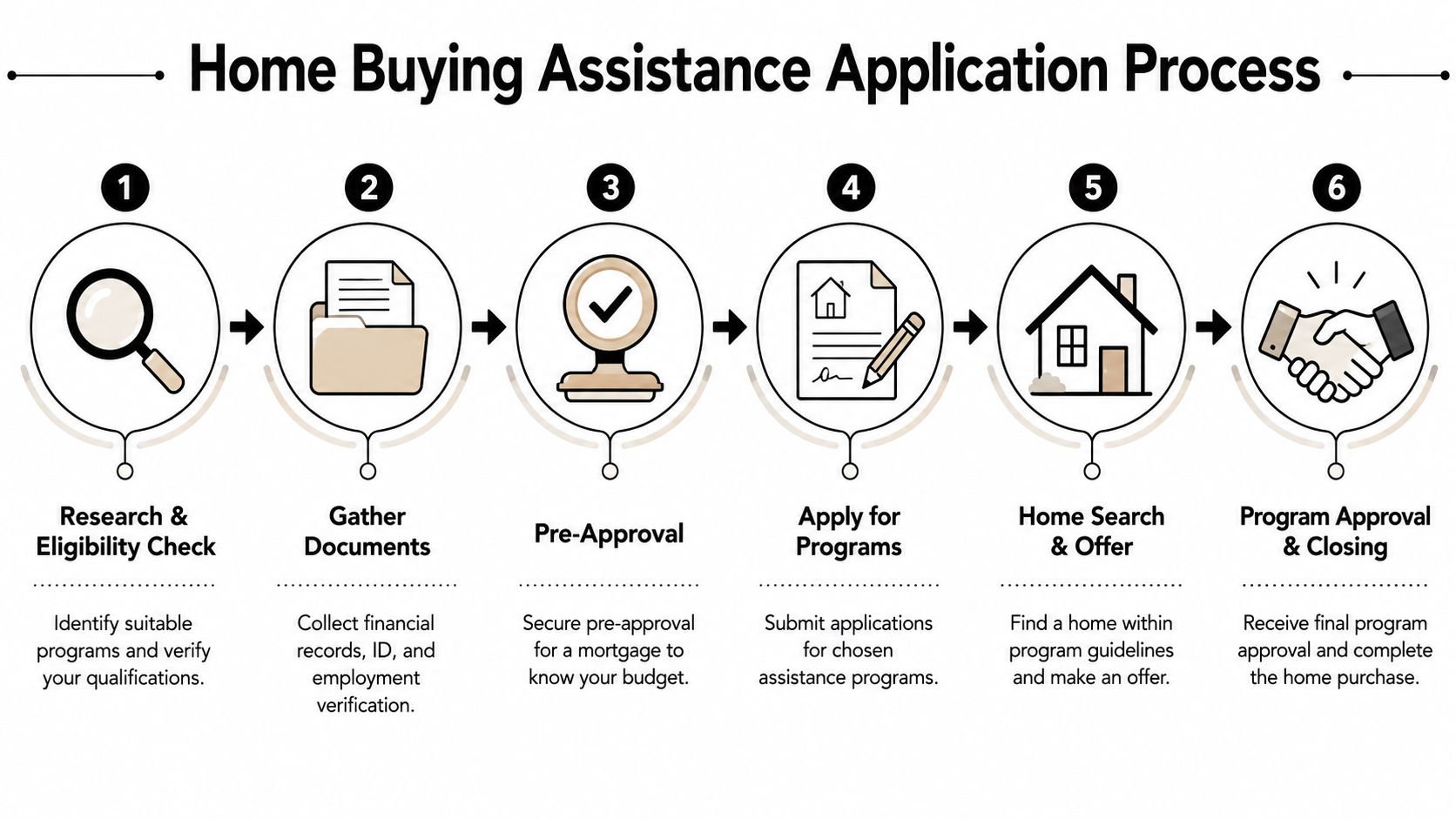
Step one and step two
Start by narrowing your target programs and checking basic eligibility. Don't apply blindly. Match your rough income, credit range, intended occupancy, and location against programs that serve those buyers.
Then gather documents early. This is the unglamorous part, but it saves deals. If your pay structure is unusual, if you've changed jobs, or if funds are moving between accounts, get those records organized before a lender asks.
A simple early checklist:
- Review likely programs based on where you want to buy.
- Collect financial documents in one folder.
- Flag any quirks like gift funds, self-employment income, or recent large deposits.
Step three and step four
Get pre-approved with a lender who understands the program you're targeting. That matters more than buyers think. A lender who regularly works with assistance programs will usually spot issues sooner, explain timing better, and structure the file more cleanly.
After pre-approval, complete the program application process itself. Sometimes the lender initiates that pathway. Sometimes another agency or administrator reviews part of the file. Either way, the assistance piece needs to line up with the mortgage, not sit off to the side as an afterthought.
Local reality: In competitive California transactions, the stronger file is often the one where mortgage approval and assistance approval are coordinated from the beginning.
Step five and step six
Once your financing path is clear, search for homes that fit the program's rules. Practical discipline is essential here. Falling in love with a property outside the purchase cap, outside the geography rules, or with condition issues can waste precious time.
When you go under contract, the assistance approval moves from “possible” to “must be finalized.” Final underwriting, program sign-offs, and closing coordination all need to stay aligned.
Here's the workflow in everyday terms:
| Stage | What you're doing | Why it matters |
|---|---|---|
| Research | Identifying viable assistance options | Saves time and avoids dead-end applications |
| Document prep | Proving income, assets, and debts | Keeps the file moving |
| Pre-approval | Confirming loan readiness | Sets a real budget |
| Program application | Locking in the assistance path | Prevents late surprises |
| Home search | Targeting eligible properties | Keeps the contract workable |
| Closing | Finalizing loan plus assistance | Turns approval into ownership |
If one of those steps gets skipped or rushed, the whole timeline can wobble.
Avoiding Common Home Buying Assistance Pitfalls
This is the part many glossy guides leave out.
Assistance can be useful. It can also create pressure points later if you don't understand the terms. In high-cost California markets, where buyers are already stretching carefully, those details matter even more.

The income cliff is real
Many programs don't phase out smoothly. They drop.
A frequently missed issue is the cliff effect, where grant amounts fall sharply once income crosses a threshold. One example cited in a Chicago-focused industry write-up shows a buyer at 100% of Area Median Income receiving a $30,000 grant, while a buyer at 101% AMI drops to $20,000, as discussed in this analysis of zone-based assistance tiers. The article frames this as especially important in appreciating markets like Fresno.
That doesn't mean Fresno uses the exact same program structure. It means the problem is familiar. Buyers near income cutoffs need careful screening before assuming they'll receive a certain amount of help.
Deferred doesn't mean harmless
A second trap is misunderstanding what “no monthly payment” means. Some buyers treat deferred assistance like free money because nothing is due right away. But repayment can still hit at sale, refinance, title transfer, or loss of owner-occupancy.
That changes your future options.
If you plan to keep the home long term, that may be acceptable. If you expect to refinance once rates improve, turn the home into a rental, or relocate for work, the deferred balance can become a real decision point.
Occupancy rules can become expensive
Some programs forgive aid only if you remain in the property for a set period. Others require immediate repayment if you sell or refinance too soon.
Questions to ask before accepting any assistance:
- What event triggers repayment? Sale, refinance, move-out, or all three.
- Is there a forgiveness schedule? If so, how does it work in real life?
- Does the program share in appreciation? This can affect your equity later.
- Will this second obligation affect future borrowing? It might.
Buyers usually focus on “Can I close?” Smart buyers also ask, “What does this program do to me if my life changes?”
The offer side matters too
Even when you qualify, assistance can affect contract strategy. Sellers care about certainty and timing. If your file is disorganized, a listing agent may worry your closing will drag. If your financing team knows the program well and your paperwork is clean, that concern is much easier to manage.
The pitfall isn't assistance itself. It's going in without understanding the fine print.
Frequently Asked Questions About Assistance
Does using assistance make my offer weaker?
Not automatically. Sellers respond to the full picture, not just the word “assistance.” A clean pre-approval, solid earnest money, realistic timelines, and a lender who knows the program can keep your offer competitive. Trouble usually starts when the financing path is vague or the buyer learns program rules too late.
Can I combine more than one type of help?
Sometimes, yes, but only if the programs allow it and the lender can structure them together. That's where buyers need to slow down. Combining assistance can improve affordability, but layering programs can also create overlapping restrictions, extra approvals, or conflicting timelines.
What's the biggest risk people miss?
The long-term repayment terms.
A common pitfall is the hidden debt trap. Some programs involve a $10,000 interest-free loan repaid over 10 years, which can affect future debt-to-income ratios. Others require immediate repayment of grants up to $70,000 if the owner sells or refinances within a set period like five years, according to Bankrate's overview of Illinois first-time homebuyer assistance programs. Even though those are out-of-state examples, they show why buyers should read repayment clauses carefully instead of focusing only on the upfront benefit.
Will assistance slow down the purchase?
It can, but it doesn't always. Some programs add paperwork and approval layers. That's manageable when the buyer, lender, and agent are aligned early. It becomes stressful when buyers wait until they're already under contract to figure out what they qualify for.
If you're thinking about buying in Fresno, Clovis, Friant, or the surrounding Central California area, Edinhart Realty and Property Management can help you sort through the world of home buying assistance, compare your options, and build a buying plan that fits both your budget today and your flexibility later.


