

You've got a signed purchase agreement in hand. Maybe you're buying a home in Clovis, selling a rental in Fresno, or adding another door to your Central Valley portfolio. Then a new party steps into the transaction and the questions start fast. Who is the title company? What are they doing? Why are they asking for documents, wiring instructions, and signatures when you already have an agent and a lender?
That confusion is normal. Title and escrow sit at the point where legal ownership, money movement, and risk management all meet. If you don't work in real estate every day, it can feel like the most opaque part of the deal.
In practice, this part of the transaction doesn't need to be intimidating. It needs to be understood. Once you know what fresno title companies do, what they check, and where deals usually slow down, the process becomes much easier to manage. That matters whether you're a first-time buyer trying to avoid surprises or a landlord focused on keeping a closing on schedule.
For newer buyers, the learning curve is steep enough that it helps to start with a practical homebuying foundation like these first-time home buyer tips for Fresno-area buyers. For experienced owners and investors, the title side of a deal usually becomes less about definitions and more about timing, document quality, and problem prevention.
Your Guide to a Stress-Free Closing in Fresno
A common Fresno scenario goes like this. A seller has already handled showings, negotiated repairs, and accepted an offer. A buyer has loan paperwork underway and starts thinking the hard part is over. Then the preliminary title work begins, escrow opens, and suddenly the deal depends on details nobody was talking about during the open house.
That's where the title company becomes the quiet center of the transaction.
They aren't just pushing paperwork. They're helping verify that the property can legally transfer, that the right money goes to the right parties, and that unresolved issues from the property's past don't follow the buyer into the future. In a clean transaction, their work feels invisible. In a complicated one, their competence can make the difference between a smooth close and a delayed mess.
Why this part feels harder than it should
Many buyers understand the visible parts of a sale. They know what inspections are. They know what a mortgage payment is. Title work is different because it deals with ownership history, recorded documents, liens, easements, and escrow instructions. Those terms sound technical because they are technical.
Still, the practical question is simple. Can this property transfer cleanly, and are all parties protected when it does?
A calm closing usually starts long before signing day. It starts when the title and escrow side is organized early.
What clients usually need most
In my experience, buyers and sellers don't need more jargon. They need a clear read on three things:
- What's being checked: ownership history, recorded claims, and items that could affect transfer.
- What could slow closing: missing payoffs, unresolved liens, document errors, or financing delays.
- What needs a decision: insurance coverage, escrow instructions, and response time when an issue appears.
Once those are clear, the rest becomes manageable.
Guardians of Your Transaction What Fresno Title Companies Do
The easiest way to understand fresno title companies is to think of them as a property historian and a financial bodyguard.
As the historian, the company researches the property's record. As the bodyguard, it helps protect the parties from financial damage tied to title defects. At the same time, the escrow side acts as a neutral holder of money and documents until the contract conditions are met.
California's title insurance market is highly competitive, including in Fresno, and that competition supports broad protection through title policies and related services, as described in the California title competition report.
The property historian role
A title company searches public records to build the legal story of the property. That means checking whether the seller has the right to transfer ownership and whether any recorded issue could interfere with the sale.
This work often turns up items that buyers never see in listing photos or disclosures. A prior deed may have been recorded incorrectly. An old lien may still need payoff or release. An easement may affect how part of the property can be used. On agricultural-adjacent or older Central Valley properties, the title history can be especially layered.
A useful way to think about it is this: the title search is looking for anything that could make ownership less clear, less transferable, or less valuable.
The financial bodyguard role
Even a careful search can't guarantee that every hidden issue will surface before closing. That's where title insurance comes in. The policy protects against covered title problems that existed before closing but weren't discovered in time.
That's what separates title insurance from many other forms of insurance. It's not mainly about future events. It's about past defects that could create future losses.
Practical rule: If the property's past hasn't been checked and insured correctly, your closing isn't really finished. It's just temporarily quiet.
The escrow side of the file
The escrow officer is the neutral coordinator. They don't advocate for buyer or seller. Their job is to follow the written instructions of the transaction and release money and documents only when those instructions have been satisfied.
That usually includes:
- Holding funds securely: deposits, loan proceeds, and any other transaction money stay in escrow until release is authorized.
- Collecting required documents: grant deed, payoff demands, lender packages, and signed instructions all have to line up.
- Managing final disbursement: once the file is ready, escrow sends funds where they belong and coordinates recording.
If a legal question goes beyond routine title or escrow handling, buyers and sellers sometimes also need guidance on when to involve a real estate attorney in Fresno.
Understanding Your Title Insurance Policy in California
Most buyers first hear about title insurance because the lender requires part of it. That's only half the picture. The practical question is who the policy protects.
In Central Valley markets, title companies perform underwriting that includes searches for prior mortgages, tax liens, and boundary disputes. That work matters in a region where land transfers may reach back more than 100 years, and it helps protect both buyer equity and lender security by supporting a marketable title, as noted by FNT Fresno.
Lender's policy versus owner's policy
These two policies are often discussed together, but they serve different interests.
| Policy | Who it protects | Why it matters |
|---|---|---|
| Lender's Policy | The mortgage lender | Protects the lender's secured interest in the property |
| Owner's Policy | The buyer or property owner | Protects the owner's equity and ownership rights |
A buyer can close with only the lender's policy in some transactions if that's all that is required by the loan. But that leaves the owner without the same direct protection for their equity. For a homeowner planning to stay put or an investor expecting to refinance or sell later, that distinction matters.
What covered issues can look like in real life
The most useful way to evaluate an owner's policy is to stop thinking about it as a line item and start thinking about the kinds of defects it's designed to address.
Examples include:
- Forged or defective prior documents: if a past deed or signature turns out to be invalid, ownership can be challenged.
- Undisclosed liens: a contractor lien, tax issue, or other recorded claim from a prior owner can cloud title.
- Boundary or easement conflicts: these are especially important in older neighborhoods and in areas where residential property borders agricultural uses.
A buyer rarely discovers those problems at the showing or even during inspection. They usually surface in title review, refinancing, resale, or a dispute after closing.
Why investors should treat title insurance as operational protection
For owner-occupants, title insurance protects peace of mind. For investors, it also protects exit strategy.
A flip depends on clean resale. A buy-and-hold rental depends on stable ownership and marketable future transfer. If title problems appear later, they can interfere with resale timing, financing, or dispute resolution. That's why experienced investors usually look past the premium itself and focus on whether the policy supports long-term control of the asset.
If you're buying for yield, title insurance isn't just about today's closing. It protects tomorrow's options.
The Escrow and Closing Process Step by Step
When buyers and sellers feel overwhelmed by escrow, it's usually because too many tasks arrive at once. The file itself is more orderly than it looks from the outside.
Here's the big picture.
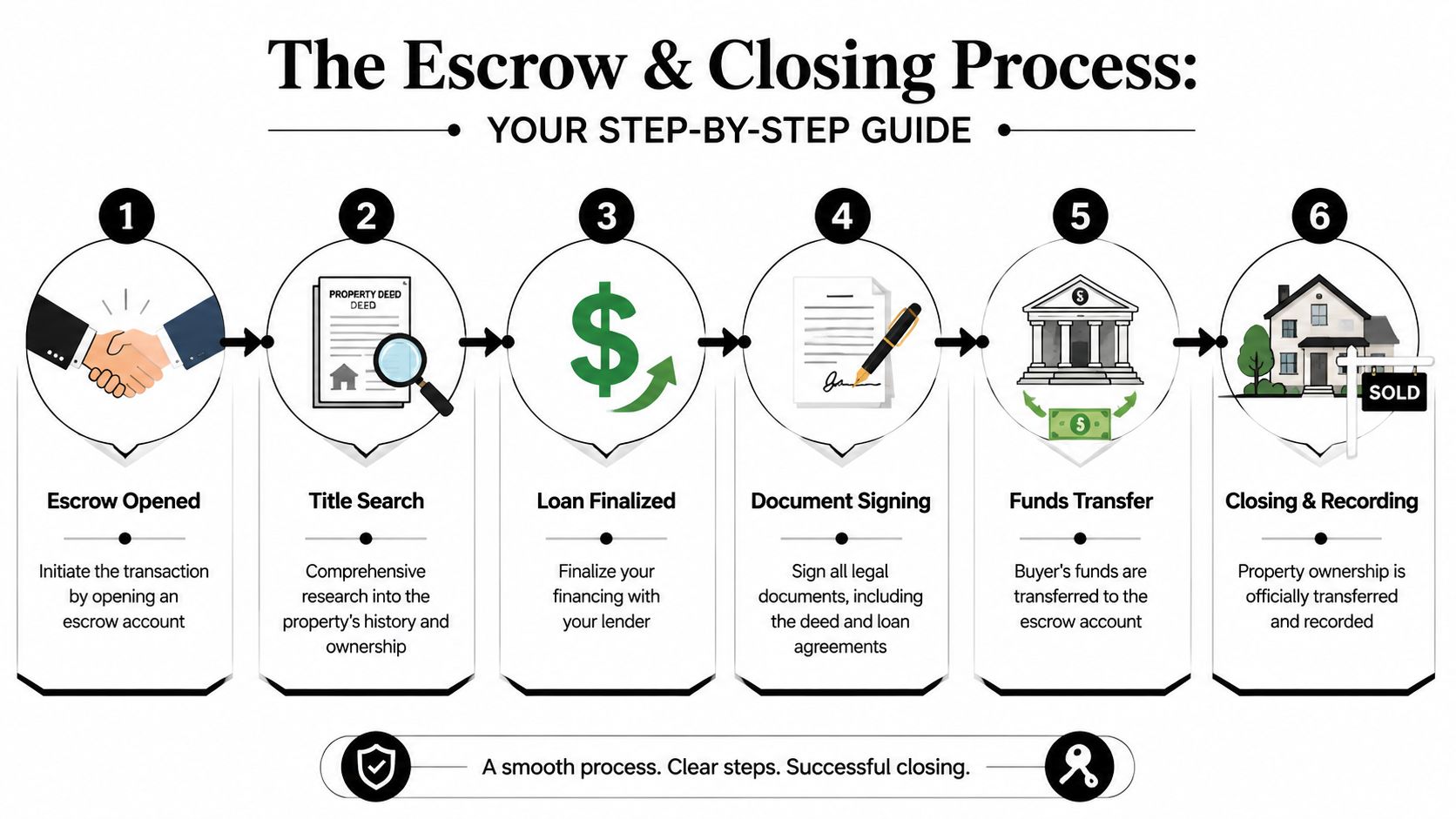
In Fresno, standard residential transactions typically run on 14 to 21 day escrow cycles, and the title company's ability to coordinate funds, liens, and documents directly affects closing dates, according to Lennar Title's Fresno information.
Step one through three
Escrow opens after contract acceptance
The signed purchase agreement is sent to escrow. The file gets opened, the parties receive instructions, and the buyer typically submits the initial deposit according to the contract terms.Title work begins The title side reviews the property record and prepares a preliminary report. During this process, existing liens, easements, vesting issues, or other clouds on title can come into view.
Contingencies move toward removal
During this phase, the buyer handles inspections, appraisal, and final loan approval. The seller may need to provide payoff information, disclosures, or signatures for requested corrections.
Step four and five
The signing stage often arrives fast after a quieter middle period. Buyers receive final loan documents. Sellers review payoff figures and net proceeds. Both sides need to check names, vesting, and property details carefully.
A lot of this process now happens electronically. If you want a practical breakdown of how remote document execution works, this guide to mastering digital signatures for real estate transactions is useful because it focuses on workflow and compliance rather than hype.
Later in the file, escrow also prepares the final settlement figures. Sellers who want a rough planning tool before that point can review a California seller closing costs calculator, which helps frame the discussion before the official numbers arrive.
Final funding and recording
Money and signatures alone do not complete a sale. The deed must record.
Once lender funds are in, buyer funds are received, and documents are cleared for release, escrow authorizes recording with the county. After recording confirmation, money is disbursed and the transfer becomes official.
That last stretch is where delays often show up. Common friction points include:
- Missing payoff demands: an old loan or lien can't be cleared without current payoff instructions.
- Signing errors: inconsistent names, incomplete notarization, or vesting mistakes can stop recording.
- Funding timing: lenders, banks, and escrow all have cutoffs. Late wires can push closing.
Good escrow officers don't just process forms. They sequence the file so one unresolved item doesn't derail the whole closing.
For investors, this part matters more than it may seem. A delayed closing can affect contractor schedules, lease starts, exchange timing, and carrying costs. That's why experienced buyers judge title and escrow teams as much by responsiveness and coordination as by price.
A Practical Checklist for Choosing a Title Company
Not all fresno title companies are the right fit for every transaction. A straightforward owner-occupied purchase is one thing. A portfolio acquisition, inherited property sale, or deal involving prior ownership across county lines is something else.
That's why the best selection question isn't “Who's cheapest?” It's “Who handles my kind of file well?”
A major issue for Central California investors is title verification across multiple counties. That's why buyers should ask specifically about protocols for out-of-county liens or historical claims, a point reflected in the Fresno County Recorder's common questions.
Questions worth asking before escrow opens
Use this as a working checklist, especially if you're buying outside your home county or managing several properties.
- Ask about multi-county research: If a property's ownership history touches Fresno, Madera, Tulare, or another county, ask how the company handles cross-county verification and what internal process they use when records are fragmented.
- Ask who will communicate with you: Some offices assign one point of contact. Others move the file between departments. Investors and out-of-state owners usually do better when communication responsibility is clear from day one.
- Ask how they handle problem files: Every company can close a clean deal. The better question is how they respond when a lien payoff is stale, a vesting issue appears, or a prior deed needs correction.
- Ask about remote convenience: If you're not local, find out whether they can support digital workflows, mobile notary coordination, and secure document exchange.
- Ask for fee clarity: Even when exact costs vary by file, the company should explain what categories of charges you should expect and where separate services may apply.
For landlords and repeat investors
A landlord buying one additional rental often gets treated like a standard residential buyer unless they ask better questions. That's a mistake.
If you have repeat transactions, ask about service consistency across files. You want to know whether the company can keep naming conventions, vesting details, entity documents, and communication preferences organized over time. That saves friction later.
You should also pay attention to reputation, but do it with some nuance. Online reviews are useful for spotting communication patterns, not just star ratings. A good framework is the same one businesses use when managing negative online reviews. Look for how complaints are handled, whether the criticism is about real process failures, and whether the office responds professionally.
What usually doesn't work
The wrong way to choose a title company is to rely on brand familiarity alone or to assume every office handles investor files with the same depth.
Here are common missteps:
| Misstep | Why it causes problems |
|---|---|
| Picking based only on name recognition | A known brand can still vary by office, team, and escrow officer |
| Failing to ask about county complexity | Cross-county issues can add research and delay if not addressed early |
| Ignoring communication style | Quiet files are fine until something breaks and nobody updates you |
| Treating all transactions the same | Rental portfolios, trusts, LLCs, and inherited property need different handling |
The strongest title relationship usually starts with one thing: specific questions before the file gets complicated.
How Edinhart Realty Partners with Title Companies for You
A real estate transaction gets easier when someone is watching the title and escrow side with the same care they give price, repairs, and timing. That's especially true when the deal involves an investor, a rental conversion, or a seller trying to keep multiple moving parts aligned.
For landlords with several properties, one of the smartest questions is whether bundling title-related services produces better economics than handling each file separately. That portfolio-level ROI question is often underexplained, as discussed in these questions to ask a title company.
Where experienced coordination helps most
The practical value of a strong real estate partner isn't that they replace title or escrow. It's that they help the client interpret, prioritize, and respond.
That usually means:
- Reviewing the preliminary report with context: not every title item is a crisis, but some need immediate follow-up.
- Watching the calendar aggressively: financing, repairs, disclosures, and payoff coordination all affect escrow readiness.
- Catching mismatches early: names, vesting, entity documents, and occupancy details need to match across the file.
- Thinking beyond one closing: investors need title and escrow decisions that still make sense at refinance, lease-up, or resale.
Why this matters for repeat clients
A one-time buyer can tolerate a little inefficiency. A portfolio owner usually can't.
If you're closing multiple properties over time, the better approach is consistency. That includes consistent communication, repeatable document handling, and a realistic look at whether bundled relationships improve service or overall transaction economics. Sometimes they do. Sometimes they don't. The point is to evaluate that deliberately instead of assuming every transaction should be built from scratch.
Referrals also matter in this part of the business, but the best referral systems are built on trust and follow-through, not just name-dropping. The same principles show up in HearBack's guide on referrals. In real estate, a referral has value only if the referred professional can execute when the file gets difficult.
The best closing teams don't remove every issue. They identify issues early enough that the client still has options.
FAQ About Fresno Title and Escrow
| Question | Answer |
|---|---|
| Do fresno title companies and escrow companies do the same thing? | They often work together in the same transaction, but the roles are different. Title focuses on ownership history and title insurance. Escrow holds funds and documents and releases them according to the transaction instructions. |
| How long does a normal Fresno closing take? | Standard residential escrow in Fresno typically runs 14 to 21 days when the file is straightforward and financing is moving on time. |
| Do investors need anything different from a title company? | Yes. Investors should ask about experience with entity purchases, repeat closings, remote signings, and properties with records in more than one county. |
| Is owner's title insurance worth it if the lender already has a policy? | The lender's policy protects the lender. An owner's policy protects your ownership interest and equity. Those are not the same thing. |
| What usually delays closing at the last minute? | Wiring timing, unresolved payoff issues, signing mistakes, and title items that weren't addressed early are frequent causes of delay. |
| Can a title company help with older or agricultural-adjacent property issues? | Many can, but you should ask directly about experience with easements, boundary concerns, and long ownership histories before choosing the company. |
If you're buying, selling, or managing property in Fresno, Clovis, Friant, or the surrounding Central California market, Edinhart Realty and Property Management can help you through the title and escrow process with clear guidance and practical support. Whether you need full-service property management, placement-only leasing help, or experienced real estate representation, Edinhart brings local market knowledge that keeps transactions organized, compliant, and easier to close with confidence.


