

You've got an offer accepted. Everyone congratulates you. Then the emails start. Wire instructions, disclosures, title paperwork, loan conditions, insurance questions, inspection reports.
For most first-time buyers in Fresno, this is the point where “we bought a house” suddenly turns into “wait, who is handling what?”
That gap is where escrow lives.
If you've searched for the escrow process explained, most articles give you a tidy checklist. In real California transactions, escrow is more than a checklist. It's the controlled handoff between buyer, seller, lender, title, and the county recorder. It works well when everyone delivers what they promised. It gets stressful fast when financing stalls, repairs turn into arguments, or title issues show up late.
A good way to think about escrow is this. It's the holding area where the deal stays suspended until the paperwork, money, and conditions all line up. Nobody gets to skip ahead. That's exactly why it matters.
What Is Escrow and Why Does It Matter
The moment a seller accepts your offer, the transaction moves out of the negotiation phase and into performance. In plain English, that means both sides now have to do what the contract says.
Escrow is the neutral system that holds the deal together while that happens. In U.S. residential real estate, it usually begins right after the purchase agreement is signed and runs until closing. The buyer's earnest money often equals 1% to 3% of the purchase price and is placed into escrow during that period, as described in this buyer escrow overview.
In California guidance, the escrow holder is a “neutral and disinterested third party.” That's the key idea. The escrow officer isn't your advocate, and isn't the seller's advocate either. They're there to follow the written instructions and hold funds and documents until the conditions of the deal are satisfied.

Think of escrow as a referee
The easiest analogy is a referee holding the ball until everyone is lined up and the rules are clear.
The buyer brings deposit funds, loan documents, insurance information, and contingency removals. The seller brings disclosures, repair responses, payoff information, and signed transfer documents. The lender brings loan approval and funding. The title side checks whether ownership can transfer cleanly.
Escrow sits in the middle and says, in effect, “Nobody gets the money and nobody gets the deed until the written conditions are met.”
That structure exists for a reason. It lowers counterparty risk. Buyer and seller don't exchange money and title directly. A neutral party holds everything until the contract requirements are done.
Practical rule: Escrow isn't a “fee” in the everyday sense buyers imagine. It's a controlled process that protects the transaction while several moving parts finish at the same time.
Who does what in a California transaction
Here's where first-time buyers often get tripped up. People use “escrow” as if it means one office handling everything. In practice, several parties touch the file.
| Party | Main role during escrow |
|---|---|
| Buyer | Delivers deposit, completes inspections, secures financing, signs loan and closing documents |
| Seller | Provides disclosures, cooperates with agreed repairs, signs transfer documents |
| Lender | Underwrites the loan, orders required items, issues final approval, funds the loan |
| Escrow holder | Holds funds and documents, follows instructions, coordinates disbursement and closing |
| Title company | Reviews title condition and helps clear issues before transfer |
If you remember only one point, remember this. Escrow matters because accepted offers are not closed sales. Escrow is the bridge between “yes” and “here are your keys.”
The Escrow Timeline From Opening to Closing
Buyers usually want a calendar. That makes sense. The escrow process feels less intimidating when you can see the sequence.
This visual gives the big picture first.
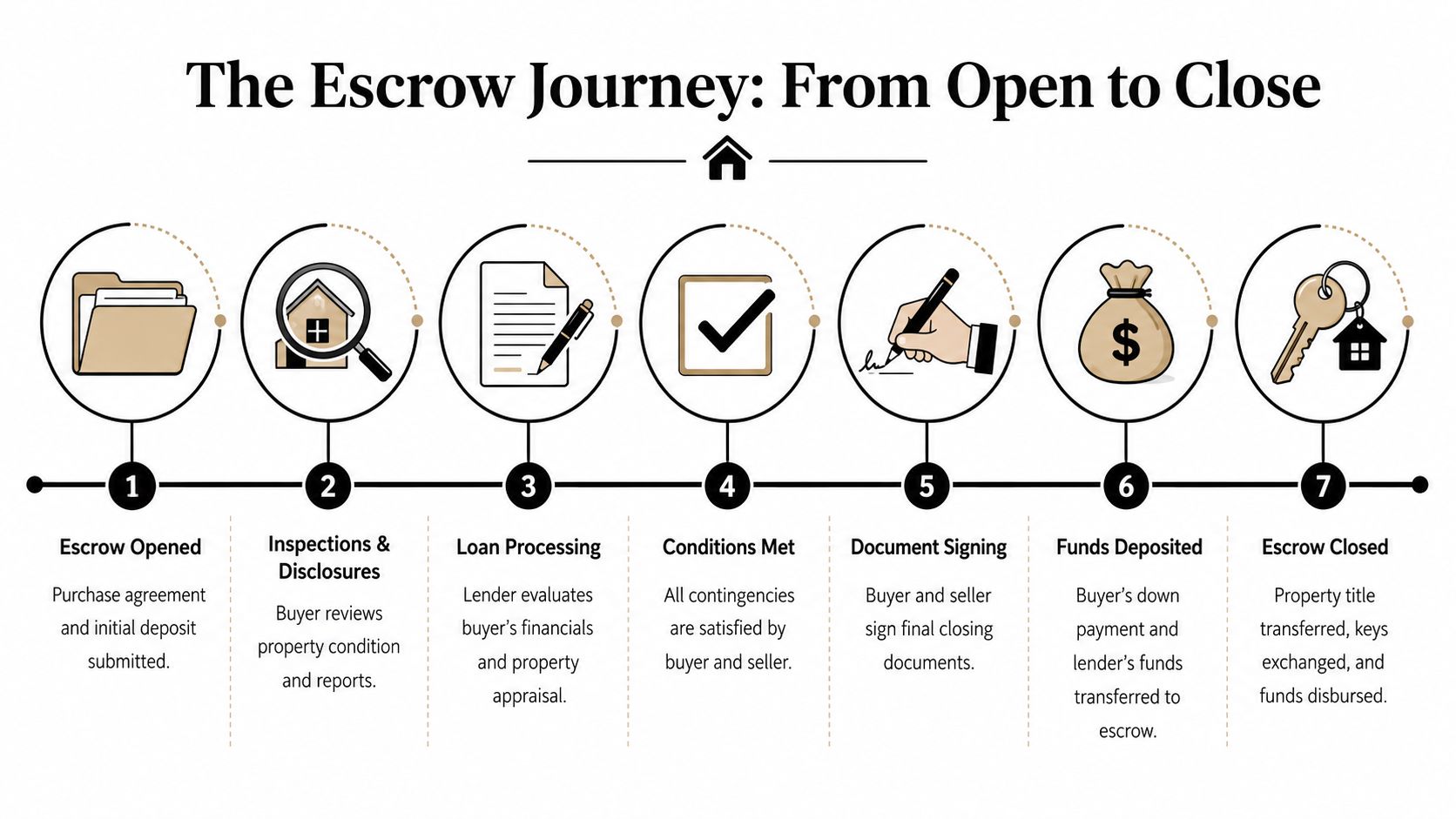
Opening escrow
Escrow opens after the contract is fully signed. The file gets set up, the parties receive initial instructions, and the buyer submits the earnest money deposit.
At that point, the transaction becomes procedural. Deadlines start to matter. Inspection scheduling matters. Lender document requests matter. Delays that seem small in the first few days can create pressure near closing.
Review and investigation
Early escrow is about finding out whether the property and the paper match the deal.
The buyer reviews seller disclosures and inspection opportunities. The title side reviews public records. The lender starts underwriting. If the property is financed, the lender also evaluates whether the home supports the loan they're about to make.
A useful way to understand this phase is to see escrow as a control system. Funds are not released until inspections, title review, financing, insurance, and the final walk-through are cleared, according to this escrow process definition.
For buyers who prefer video, this walkthrough helps make the sequence easier to follow.
The middle of escrow is where most deals wobble
This is the phase buyers underestimate.
Inspections can reveal problems. The appraisal can come in lower than expected. The lender may ask for updated bank statements, payroll records, or explanation letters. Homeowners insurance has to be lined up. If any one of those items lags, escrow doesn't move forward just because everyone wants it to.
That's why I tell Fresno buyers to stop thinking of closing as a single event. It's a chain. Every link has to hold.
Clearing conditions and signing
Once the outstanding conditions are satisfied, the file moves toward signing. Buyer and seller sign their final documents. The lender prepares to fund. Escrow prepares the final accounting.
This accounting work is one of the least visible but most important parts of the file. The escrow holder also prorates taxes, interest, and insurance, handles payoffs and commissions, and prepares final statements for accuracy.
The cleanest closings usually aren't the fastest ones. They're the ones where every condition was cleared in the right order.
Funding and recording
The end of escrow has two separate pieces that many first-time buyers blend together.
First, funds must arrive and be verified. Second, documents must record. Only after recording does ownership legally transfer.
That's why agents often say a buyer has “signed” but not yet “closed.” Signing alone doesn't hand over title. Recording does.
A simple version of the timeline looks like this:
- Contract accepted and escrow is opened
- Deposit submitted into escrow
- Disclosures and inspections are reviewed
- Title and loan work move forward
- Conditions are cleared by buyer, seller, and lender
- Final documents are signed
- Funds are deposited and verified
- Deed records and the sale closes
If you want the escrow process explained in one sentence, it's this: escrow keeps the money, title, and paperwork in suspension until the transaction is ready to transfer without guessing or shortcuts.
Navigating Escrow Costs and Required Documents
The paperwork side of escrow feels heavier than most buyers expect. That's normal. A California purchase creates a stack of documents because the transaction has to prove ownership, document disclosures, satisfy the lender, and show exactly how money moved.
What buyers and sellers usually see in the file
Some documents arrive early and shape your decisions. Others arrive near the end and confirm the final terms.
Common items include:
- Purchase agreement: The contract that sets price, timelines, contingencies, and responsibilities.
- Escrow instructions: The written directions the escrow holder follows for handling money and documents.
- Preliminary title report: A report that flags ownership issues, liens, easements, or other recorded matters.
- Seller disclosures: Property condition and other required disclosure forms.
- Loan documents: The lender's package for the mortgage, if financing is involved.
- Final closing statement: The accounting summary showing credits, debits, prorations, and who receives what.
For first-time buyers, the deposit is usually the first major payment they focus on. If you want a plain-English overview of how that deposit works, this guide on earnest money deposit basics is a good companion to the escrow timeline.
What escrow costs actually cover
Escrow doesn't just “hold the money.” It coordinates the money.
Costs flowing through escrow often include the escrow fee itself, title-related charges, lender charges, prepaid items, prorated property expenses, payoff amounts, and commissions. Which party pays which item depends on the contract terms, lender requirements, and local custom.
What works well is asking for categories, not just totals. Buyers make better decisions when they know which costs are one-time closing items and which connect to future ownership, such as taxes and insurance.
A practical resource for that broader picture is this California home purchase expense guide, which helps buyers understand how closing charges fit into the full cost of purchasing a home.
Watch for this: The final numbers may shift from early estimates because prorations, lender updates, insurance choices, or negotiated credits can change before closing.
How to stay organized
The easiest way to reduce stress is to keep one running checklist with three columns:
| Item | Who needs it | Status |
|---|---|---|
| Deposit and proof of funds | Buyer and escrow | Submitted or pending |
| Insurance information | Buyer and lender | Bound or in progress |
| Signed disclosures | Buyer and seller | Reviewed or outstanding |
| Loan conditions | Buyer and lender | Cleared or requested |
| Final wire amount | Buyer and escrow | Confirmed before closing |
Most escrow confusion isn't legal confusion. It's document confusion. Buyers think something is done because they signed one form, while the lender still needs another. Sellers think a repair credit settled the issue, while escrow still waits for updated instructions.
The practical fix is simple. Don't rely on memory. Track every requested item until someone confirms it's complete.
Common Escrow Delays and How to Avoid Them
The ideal escrow timeline looks clean on paper. Real files rarely do.
In California, one of the biggest misunderstandings is who controls the clock when something goes off schedule. The escrow officer does not decide whether to extend, cancel, or rewrite the deal. Escrow is governed by specific, mutual written instructions, and changes happen only through those instructions and the parties' agreement, as explained in this California DRE consumer guide.
That matters because when financing stalls or repairs drag on, buyers and sellers often look to escrow for answers escrow can't legally invent.
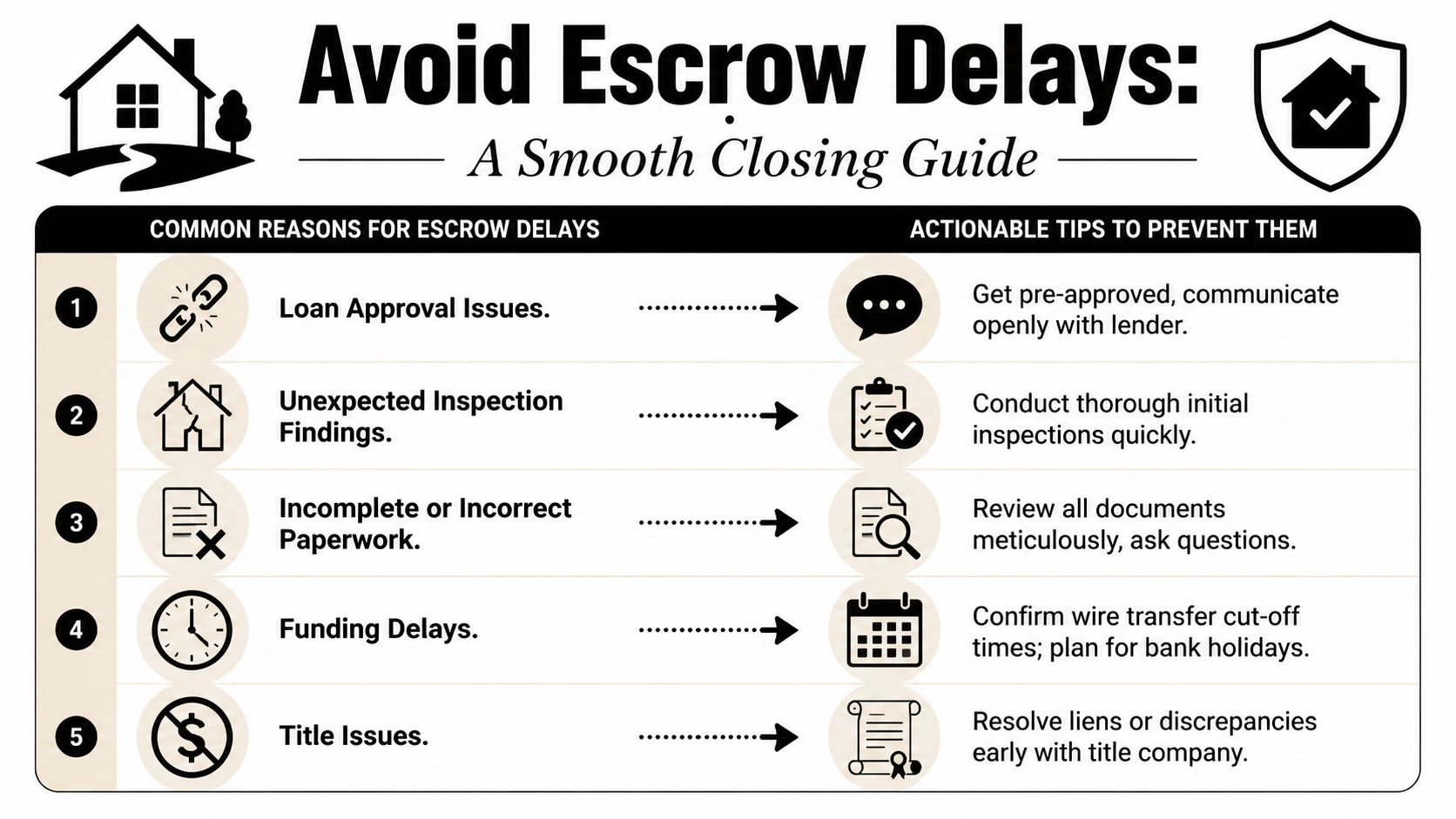
Financing delays
This is the most common stress point I see in practice. A buyer may be preapproved, but underwriting still asks for updated documents, explanations of account activity, proof of insurance, or corrections to prior submissions.
What works:
- Respond the same day: Loan conditions don't improve by sitting in your inbox.
- Keep your finances stable: Don't create new questions for underwriting if you can avoid it.
- Ask your lender what is still outstanding: “Are we waiting on me, on underwriting, or on the property?” is the right question.
What doesn't work is assuming silence means progress.
Appraisal shortfalls and repair disputes
An appraisal shortfall changes the economics of the deal. A tough inspection changes the negotiation. Neither issue resolves itself because the closing date is approaching.
If the value comes in low, the parties usually have to renegotiate, bring in additional cash, challenge the valuation through the lender's process, or walk away if the contract allows it. If repairs become contentious, the file may need credits, additional bids, amended terms, or cancellation.
When escrow slows down, the real issue usually isn't “escrow.” It's a contract issue, a lender issue, or a property issue showing up inside escrow.
Title and paperwork problems
Some delays are less dramatic but just as damaging. A name mismatch, an old lien, missing signatures, stale HOA information, or incomplete disclosures can hold up closing late in the game.
These are the files that frustrate everyone because the buyer may be packed, the seller may be moving, and the missing item looks minor. Legally, though, minor doesn't matter if the file can't close cleanly.
A practical way to think about common delay points:
- Loan issue: Buyer and lender need to clear conditions
- Property issue: Buyer and seller need to resolve value or condition disputes
- Title issue: Seller, title, and escrow need curative documents
- Timing issue: Both parties need written agreement to extend if deadlines have passed
Who has leverage when things go wrong
This is the part simple explainers usually skip.
Influence in the transaction arises from the contract, the contingency status, and the willingness of each side to close. If contingencies are still in place, the buyer generally has more room to object or cancel based on the contract terms. If contingencies have been removed, the buyer has less flexibility. If the seller hasn't delivered what the contract requires, the seller can lose influence too.
The practical lesson is straightforward. Read deadlines early, not after they expire. The escrow process explained properly isn't just about steps. It's about understanding who can say yes, who can say no, and who carries out instructions.
California Specifics and Local Market Notes
A Fresno escrow file can look clean on paper and still get messy fast. I see that most often when a buyer is new to California and expects the closing process to work like it does in another state.
California puts a lot of control in written escrow instructions, title work, and signed amendments. That protects both sides, but it also means casual side conversations do not carry a transaction very far. If the buyer, seller, lender, and escrow officer are not working from the same written terms, the file can stall even when everyone thinks they have an agreement.
In Fresno and the surrounding Central Valley, local conditions add another layer. A house in town may move through escrow with routine title and loan work. A property outside city limits can bring well records, septic inspections, boundary questions, flood concerns, or insurance problems into the mix. Those are not rare exceptions here. They are common reasons a closing date gets tighter than people expected.

Why local escrow coordination matters
The practical issue is not just paperwork. It is knowing which party has to act first when a problem shows up.
For example, I have seen Fresno area escrows slow down because an insurer would not bind coverage on an older roof, or because a rural property needed more clarity on water, access, or septic. In those files, the calendar is not controlled by escrow alone. The timeline shifts based on how fast the buyer can get answers, how prepared the seller is with records, and whether the lender will keep pace once new information hits the file.
Title and escrow companies also vary in how they communicate, how quickly they clear conditions, and how familiar they are with the issues that come up in this market. If you are comparing local options, this roundup of Fresno title companies gives a useful starting point.
California buyers should expect paperwork and clear documentation
California transactions run on signed forms, disclosures, and written changes. That structure helps when a deal gets tense because the file shows what was agreed, who signed, and when it changed.
The trade-off is simple. Verbal assurances do not fix a closing statement, extend a contingency, or authorize escrow to release funds. A buyer may believe a repair credit is coming. A seller may assume a late close is acceptable. Until that change is documented correctly, escrow has very little room to act.
That is why local representation matters in a practical sense, not a sales sense. Someone needs to catch the gap between what the parties meant to do and what escrow is allowed to do. Edinhart Realty and Property Management is one local company buyers, sellers, and landlords use for sales, purchases, and management-related coordination across Fresno, Clovis, Friant, and surrounding Central California areas.
Practical Tips for Buyers Sellers and Landlords
Escrow advice gets more useful when it matches the role you're in. A buyer, seller, and landlord do not experience the same pressure points.
For the buyer
Be fast and boring. That sounds odd, but it's the right approach.
Fast means returning lender and escrow requests quickly. Boring means don't create new problems during escrow if you can avoid it. Keep your document trail clean, review disclosures carefully, and ask direct questions when a number or term changes.
Two habits help most:
- Keep cash accessible: Don't wait until the last minute to understand where your closing funds are coming from and how they'll be transferred.
- Read before signing: Especially on disclosures, credits, and final figures.
For the seller
Your best advantage often comes from preparation before escrow even opens. Complete disclosures thoroughly, gather repair records if you have them, and be realistic about issues a buyer is likely to raise.
If you're unsure what belongs in the disclosure package, this guide to seller disclosure requirements is worth reviewing before the property goes active.
Sellers keep deals together by doing three things well:
- Answer requests clearly
- Document agreed repairs or credits
- Stay available for signatures and updates
The seller who disappears for three days during escrow creates avoidable friction.
For the landlord or investor
Investors need to think beyond closing day. Escrow is where ownership transfers, prorations get handled, and occupancy details become practical issues.
If the property is tenant-occupied, verify what transfers to the buyer, what notices matter, what credits apply, and what the lease file says. If the purchase is financed, remember that monthly housing expense can shift after closing because taxes and insurance don't stay static forever.
For landlords, the useful mindset is this. Don't treat escrow as only a sales event. Treat it as the handoff point between acquisition and operations.
Frequently Asked Escrow Questions
Is transaction escrow the same as a mortgage escrow account
No. These are related ideas, but they are not the same thing.
Transaction escrow is the neutral holding process used during the sale itself. It handles the purchase contract, deposit, title coordination, signing, and final transfer.
A mortgage escrow account is an ongoing lender-managed account after closing for items like property taxes and homeowners insurance. Lenders typically collect about 1/12 of annual escrowed expenses each month, and servicers must provide an annual escrow account statement within 30 days of completing the escrow computation year, as summarized in this homebuyer escrow explanation.
That's why your monthly payment can change even when your loan terms haven't. Taxes or insurance may change, and the servicer adjusts the escrow portion.
What happens if the deal falls apart
It depends on the contract terms, the contingency status, and the cancellation instructions signed by the parties.
If a buyer cancels within the rights allowed under the agreement, the deposit may be returned according to those instructions. If there's a dispute, escrow doesn't just pick a winner. The escrow holder follows the written instructions and the governing process.
This is one reason deadlines and contingency removals matter so much. The same cancellation looks very different before and after those protections are removed.
Does the escrow officer decide disputes
No. The escrow officer is an intermediary, not the deal's judge.
If the buyer and seller disagree about repairs, extensions, credits, or deposit release, escrow does not invent a solution. The parties have to reach agreement through the contract process and provide proper instructions.
Why did my monthly escrow payment change after closing
Because post-closing mortgage escrow is a living account, not a fixed estimate forever.
If taxes rise, insurance premiums change, or the account shows a shortage or surplus after annual analysis, the servicer can adjust the monthly amount. First-time buyers often confuse that later adjustment with something that happened during the sale, but it belongs to the loan-servicing side of escrow.
What if I'm worried my credit will delay financing
Then deal with it before you're deep in escrow. A shaky loan file creates more stress once deadlines are already running.
If you're trying to understand qualification issues before making offers, a practical starting point is this guide on how to get FHA approved with Superior Credit, especially for buyers working to improve loan readiness.
Escrow works best when the file is predictable. The transaction doesn't need perfection. It needs clear documents, realistic expectations, and quick responses from the people who control the moving parts.
If you're buying, selling, or managing property in Fresno or the surrounding Central California market, Edinhart Realty and Property Management can help you work through the local process with clearer expectations around escrow, disclosures, title coordination, and next steps.


