

When you start looking at homes, you'll quickly see that the biggest difference between a townhome and a condo boils down to one simple thing: what you actually own.
With a townhome, your ownership is pretty straightforward. You own the building itself and the plot of land it’s built on, just like a single-family house. But with a condo, you're buying the airspace inside your unit. Everything else—the building exterior, the hallways, the land—is owned collectively by everyone in the complex.

Comparing Townhomes and Condos at a Glance
At first glance, townhomes and condos can look pretty similar, but the legal and financial reality is totally different. The choice you make will ripple through your entire homeownership experience, affecting your monthly costs, how much maintenance you’re on the hook for, and how much freedom you have to make changes.
For anyone jumping into the market, especially for the first time, this is a huge decision. If you're feeling a bit overwhelmed, our first-time home buyer tips can help clear things up. Getting these core differences straight from the start is the key to finding a place that truly fits your life.
The most significant distinction is what you actually own. A townhome gives you ownership of a piece of land, however small, while a condo gives you ownership of the airspace within your unit's walls.
To make things clearer, let's break down the essential distinctions so you can see how these two options really stack up against each other.
Key Differences Between Townhomes and Condos at a Glance
Here’s a simple table to quickly reference the main points of comparison.
| Feature | Townhome | Condo |
|---|---|---|
| Ownership | You own the interior, exterior, and the land underneath the unit. | You only own the interior space ("walls-in") of your unit. |
| Structure | Multi-level home that shares one or more walls with adjacent units. | A single unit within a larger building or complex with multiple units. |
| Maintenance | You are responsible for your own interior and exterior maintenance. | The Homeowners Association (HOA) manages all exterior and common areas. |
| HOA Fees | Generally lower; may cover landscaping or trash removal in common areas. | Typically higher to cover building insurance, amenities, and all exterior upkeep. |
| Privacy | More private, often with a separate entrance and small private yard. | Less private, with shared hallways, elevators, and common entrances. |
This side-by-side view gives you a great starting point, but as we'll see, the real-world implications of these differences are where the decision gets interesting.
How Ownership and Property Lines Differ
The biggest difference between a townhome and a condo isn't the architectural style—it's what you actually own when you get the keys. This one distinction is the foundation for everything else, from your rights and responsibilities to your monthly budget.
When you buy a townhome, you’re getting what’s called fee simple ownership. This is the exact same kind of ownership you’d have with a standalone house. It means you own the whole structure—interior, exterior, roof—and, crucially, the parcel of land it sits on.
Your deed will spell out the specific piece of real estate you own, which usually includes a small yard or patio. The property lines are yours and yours alone, giving you direct control over your home and a slice of outdoor space.
Understanding Townhome Ownership
Living in a townhome feels a lot like owning a traditional house, just with closer neighbors. Since you own the land, you're on the hook for everything from mowing the lawn to fixing a leaky roof. This direct responsibility is a defining feature that separates it from condo living.
Here's what townhome ownership boils down to:
- Deeded Land: You own the ground your home is built on, a major factor in how a property appreciates over time.
- Exterior Responsibility: Siding, windows, the roof—it's all yours to maintain and repair.
- More Freedom: While an HOA might still have rules on things like paint colors, you generally have far more leeway for exterior changes compared to a condo owner.
Defining Condo Ownership
Condo ownership is a whole different ballgame legally. When you purchase a condo, you're buying the airspace inside your unit's perimeter. It's often called "walls-in" ownership for a reason. You don't own the land under the building or the physical structure itself.
Instead, all the exterior elements and common areas—think hallways, elevators, the gym, pool, and surrounding grounds—are owned collectively by every resident. This shared ownership is managed by a Homeowners Association (HOA), and your ownership includes a shared interest in all those common elements.
Here’s a simple way to think about it: A townhome owner buys a box and the ground it sits on. A condo owner buys the space inside one of many boxes and shares ownership of the entire shelf they all rest on.
This "walls-in" setup means the HOA takes care of everything outside your front door. If the main roof needs replacing or the building's exterior needs a new coat of paint, the HOA manages it using the fees it collects from everyone. It's a convenient trade-off, but it comes at the cost of individual control.
Costs and Fees: A Financial Comparison
When you're weighing a townhome against a condo, the sticker price is just the beginning of the story. It’s easy to get drawn in by a seemingly lower purchase price on a condo, but the real financial picture only comes into focus when you dig into the long-term costs. You have to look at everything from monthly fees to property taxes to truly understand what you'll be paying.
This is especially critical when you're getting your initial financing in order. Knowing these future expenses helps you budget for things like your initial down payment and earnest money. If you're new to the process, we have a great guide that breaks down what an earnest money deposit is and how it fits into your home purchase.
The infographic below really nails the core difference in ownership that drives these financial variations.
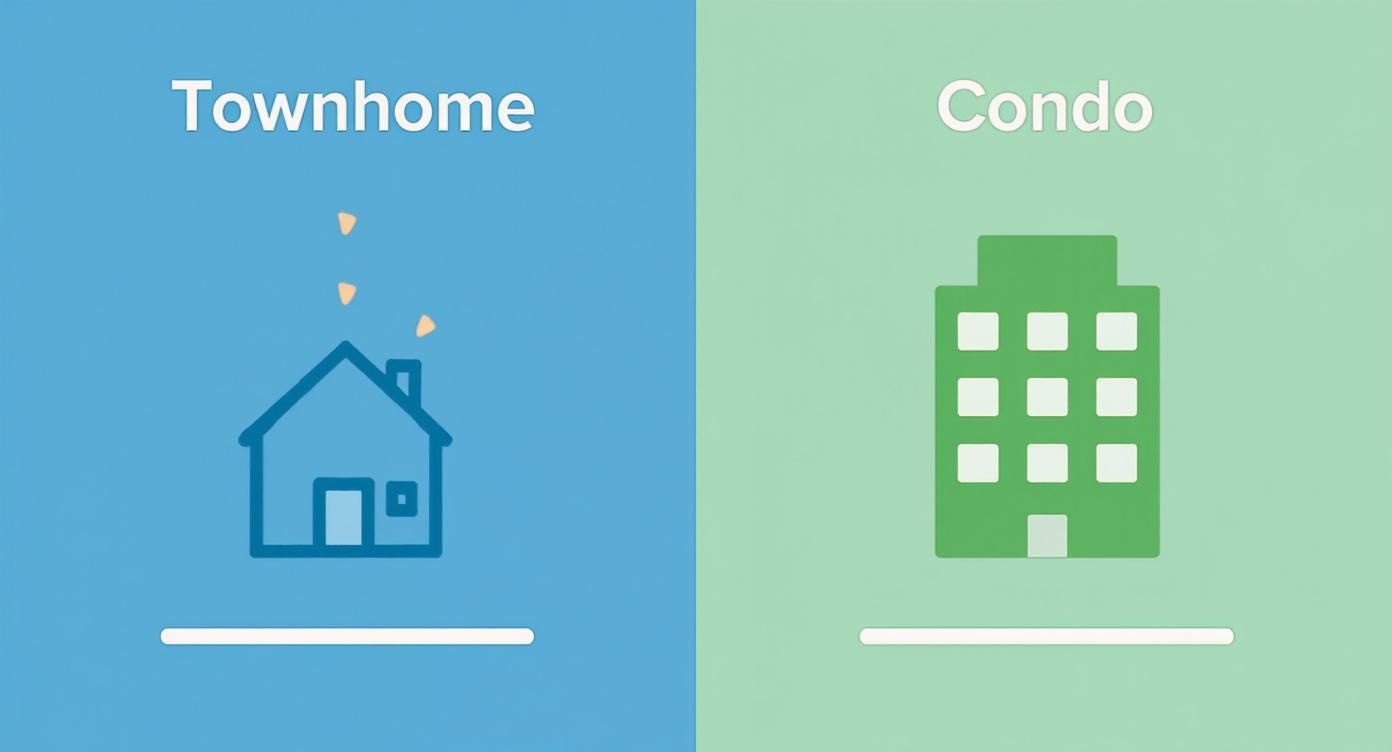
As you can see, owning a townhome means you own the land it sits on. That’s a game-changer for property taxes and appreciation. With a condo, your ownership is all about the interior space.
Unpacking HOA Fees
Homeowners Association (HOA) fees are where you’ll see one of the biggest and most consistent financial splits. Condo owners almost always pay more, and for good reason. Those higher fees are covering the maintenance, insurance, and upkeep for the entire building, the grounds, and all the shared perks like pools, gyms, or security.
Townhome HOAs, on the other hand, tend to have a much lighter touch. Fees usually just cover things like landscaping in common areas, trash pickup, or maybe snow removal on shared roads. As the owner, the responsibility for your unit's exterior, from the roof to your private yard, falls squarely on your shoulders.
The trade-off is pretty straightforward: Condo owners pay higher fees for a "lock-and-leave" lifestyle with minimal maintenance worries. Townhome owners enjoy lower fees but take on more personal responsibility for upkeep and future repair costs.
Purchase Price and Property Taxes
Looking at the upfront numbers, condos often appear more affordable. Recent data shows the median condo price hovering around $355,491, while townhomes are a bit higher at $380,602. That initial savings is a huge plus for many buyers.
But here’s where the recurring costs come back into play.
Those higher condo HOA fees can run anywhere from $300 to $400 a month. Townhome fees are typically much lower, often in the $200 to $300 range. Plus, because townhome ownership includes the land, your property taxes will almost always be higher than for a condo of a similar size in the same neighborhood. This tax difference can add a significant chunk to your annual expenses, so it's a crucial number to factor into your budget from day one.
Who Fixes What? A Guide to Maintenance and Repairs
Let's get down to what really matters: who’s on the hook when things break? This is a huge factor that hits your wallet and your free time, and it's where townhomes and condos are worlds apart. Honestly, this is often the make-or-break issue for many buyers.
When you buy a townhome, you’re stepping into a role that looks a lot like being a single-family homeowner. You own the building and the ground it sits on, which means you're in charge of everything—inside and out. If the roof starts leaking or the fence in your backyard gets knocked over, that's on you to coordinate and pay for.
The Townhome To-Do List
That freedom you get with a townhome comes with a pretty hefty list of responsibilities. Your HOA might mow the big common lawn, but your specific property is all yours to manage.
- Exterior Work: Think roof, gutters, siding, and windows. They're all your responsibility.
- Your Personal Slice of Nature: Any yard, patio, or driveway attached to your unit needs your attention.
- The Big Stuff: From the foundation all the way up to the attic, any major structural work is your financial problem to solve.
The Condo "Lock-and-Leave" Life
Condo living is the complete opposite—it’s designed to be hands-off, which is a massive plus for a lot of people. The HOA takes care of all exterior and common area maintenance, and your monthly dues pay for it. Your job is to handle the interior of your unit, often called everything "walls-in."
So, if a pipe that serves three different units bursts inside your wall, the HOA is on it. But if your own dishwasher floods your kitchen floor, that repair bill is yours. This setup offers incredible peace of mind because you won't get hit with a sudden, $15,000 bill for a new roof.
The bottom line is simple: Townhome owners accept more personal responsibility for maintenance in exchange for lower HOA fees and more control. Condo owners pay higher fees for the convenience and predictability of having the HOA manage all the big-ticket items.
Let's paint a picture. A massive hailstorm rolls through and damages every roof in the neighborhood.
- If you own a townhome, you're filing your own insurance claim, vetting contractors, and managing the entire roof replacement project for your unit.
- If you own a condo, the HOA handles it all. They'll manage one massive claim under their master policy and use reserve funds to get the entire building's roof repaired.
It all comes down to a personal choice: Are you a hands-on person who doesn't mind managing repairs, or would you rather pay a bit more each month to have someone else take care of it for you?
Choosing a Lifestyle That Fits You
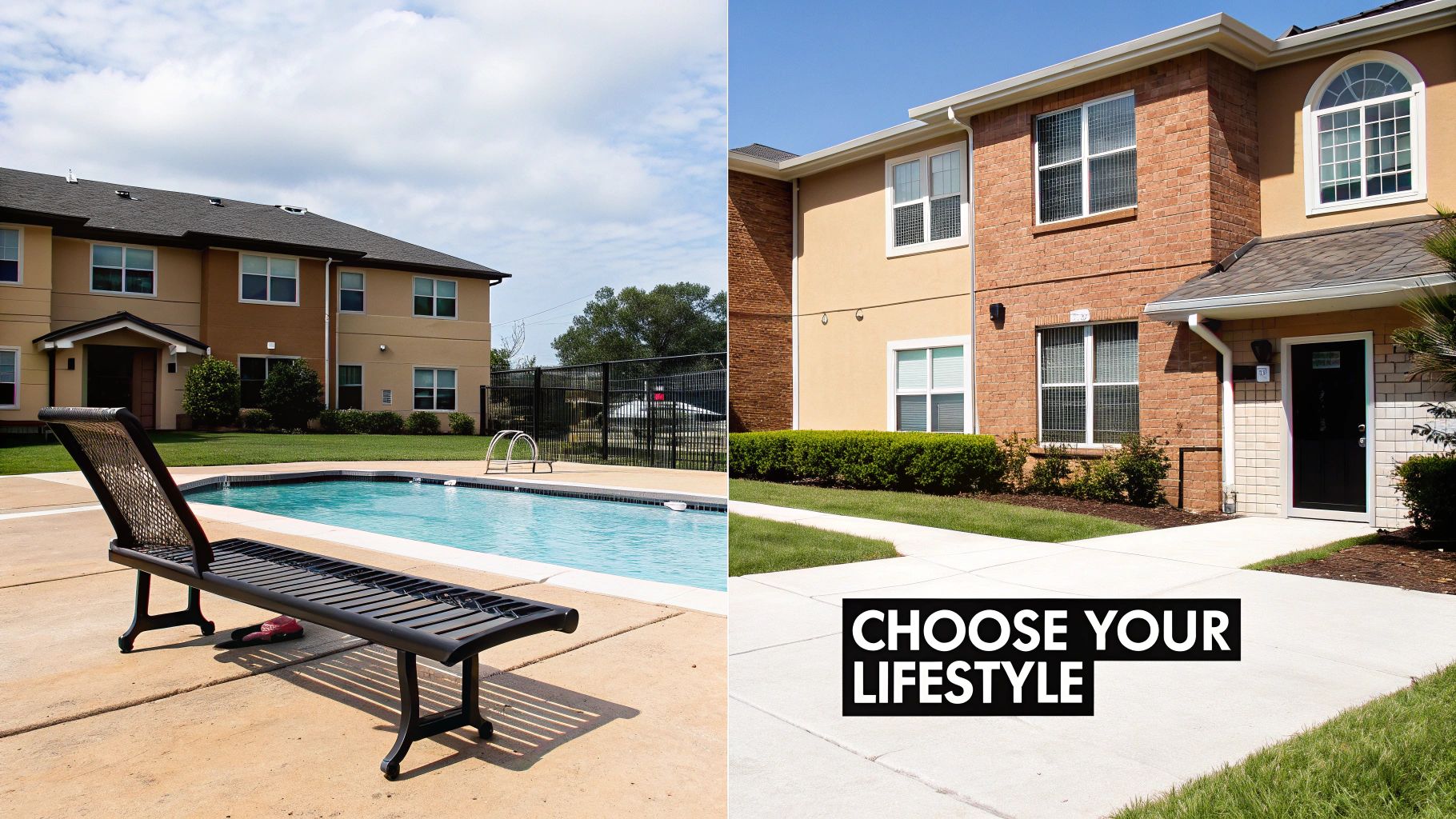
Picking between a townhome and a condo is about more than just deeds and HOA fees. It’s a decision that really shapes your day-to-day life. You're not just buying property; you're choosing a lifestyle.
Condo living often means being part of a close-knit community. You're sharing entrances, hallways, and amenities like pools or gyms, so you naturally run into your neighbors all the time. This can build a real sense of community, which is perfect if you’re a social person who enjoys that kind of built-in, vibrant atmosphere.
Of course, that closeness means less privacy. You're much more likely to hear your neighbors through shared walls, floors, and ceilings. Townhomes, on the other hand, offer an experience much closer to a traditional single-family house.
Privacy and Personal Space
A townhome almost always gives you more privacy and a stronger sense of your own space. You get your own front door—no bumping into neighbors in a shared hall. Most townhomes also come with a small private yard or patio, giving you your own little slice of the outdoors for grilling, gardening, or just relaxing.
This setup creates a feeling of independence that you just don't get in a condo. While you’re still sharing a wall or two, the experience is far less communal. The real difference hits you the moment you step outside your front door.
Ultimately, it comes down to this: Do you want the built-in community and shared perks of a condo, or do you value the privacy and personal outdoor space that a townhome offers?
Rules, Regulations, and Freedom
Both condos and townhomes have an HOA, but how those rules affect you can be worlds apart. Condo HOAs are usually more restrictive because they're managing a single, shared building. They can have tight rules on everything from the size of your dog to what hours you can move furniture to keep the noise down.
Townhome HOAs have rules too, but they’re often more focused on keeping the outside of the homes looking uniform. You’ll probably find you have a lot more freedom with interior renovations and fewer rules dictating your daily life. For anyone thinking about renting their place out, it's critical to check the HOA rules. We cover this in detail in our guide on whether you can rent a condo out, which breaks down common restrictions.
In the end, it’s a trade-off:
- Condos: You get amazing convenience and amenities, but you sacrifice some privacy and have to follow stricter rules.
- Townhomes: You get more space, privacy, and freedom, but you lose the shared perks and have more maintenance to handle yourself.
The right choice comes from being honest about what you value most. If a "lock-and-leave" lifestyle with minimal chores and plenty of social opportunities sounds perfect, a condo is probably your best bet. But if you crave more space, a private yard, and the feel of a real house, a townhome is likely where you'll be happiest.
How Resale Value and Investment Potential Stack Up
For just about everyone, buying a home is the biggest financial move they'll ever make. That makes its long-term performance a pretty big deal. When you're weighing a townhome against a condo, you'll find their investment potential can head down two very different roads, and it all comes back to ownership.
Townhomes often see appreciation that looks a lot more like a single-family home. The reason is surprisingly simple: you own the dirt it sits on. Real estate value, at its core, is tied to the land, which has a long history of appreciating over time. Since a townhome purchase includes that deeded piece of land, its value is powered by both the structure itself and the ground underneath it.
Condos, on the other hand, play by a different set of financial rules. You only own the airspace inside your unit, so your investment’s growth is much more connected to how desirable the building is and how well the HOA is managed. A condo association with its act together—think healthy financial reserves and awesome amenities—can seriously boost property values.
The real investment difference comes down to land versus management. A townhome's value is anchored to the land it occupies, which tends to appreciate. A condo's value hinges on the quality of its shared amenities and the financial stability of its HOA.
Market Dynamics and Appreciation Rates
Depending on market trends and where you're buying, the long-term return on your investment can look wildly different.
Historically, townhomes have shown stronger appreciation. They deliver a "house-like" experience that just clicks with a wider group of buyers, from families needing more space to downsizers who aren't ready to give up a private entrance and a small yard.
Condo appreciation, in contrast, can be a bit more of a rollercoaster. If a city suddenly sees a huge boom in new condo construction, it can saturate the market and slow down value growth for everyone else.
While condos often come with a lower price tag to get in the door, their long-term gains don't always keep pace with townhomes. For instance, condos have traditionally appreciated at an average of 3-4% annually in stable markets, but local conditions can flip the script. In the Midwest, condo prices recently shot up 78.3% over a decade, just edging out the 70.7% increase for townhomes. It just goes to show how local demand can upend the usual patterns. You can discover more insights about these regional property trends to see how your own area compares.
At the end of the day, both can be fantastic investments. A townhome might offer more predictable, land-driven appreciation, making it feel like a safer long-term bet in many places. But don't count out condos—a unit in a hot urban area with top-notch management and amenities can deliver a fantastic return, especially if lifestyle and convenience are at the top of your list.
Got Questions? We've Got Answers.
Even after laying it all out, you probably still have a few questions rolling around in your head. That’s normal. Deciding between a townhome and a condo is a huge step, and it’s smart to get all the facts straight. Let's tackle some of the most common things buyers ask.
Which Is a Smarter Buy for a First-Timer?
Honestly, it really depends on what you're looking for in your first home.
Condos are often the go-to for first-time buyers because the price tag can be a little easier to swallow. Plus, if you have a demanding job or just hate the idea of weekend yard work, the low-maintenance lifestyle is a massive win.
But, if you crave a bit more breathing room—maybe a small patch of grass for a dog or a tiny garden—a townhome might be the better fit. You'll take on more of the exterior upkeep yourself, but that control often keeps the monthly HOA fees down.
Is It Harder to Get a Loan for One Over the Other?
It can be, yes. Getting a mortgage for a condo is sometimes a trickier process. Lenders aren't just looking at your financial picture; they're digging into the health of the entire condo association. They'll scrutinize things like how many units are rented versus owner-occupied and whether the association has enough cash in its reserve funds for major repairs.
Financing a townhome, on the other hand, is usually much more straightforward. The process looks almost identical to getting a loan for a traditional single-family house.
The bottom line is that lenders see a condo as a shared investment, which means shared risk. A shaky or poorly run HOA can actually derail your loan approval—a headache townhome buyers almost never have to deal with.
Whether you're ready to buy, looking to sell, or need an expert to manage your property, the team at Edinhart Realty and Property Management has the local know-how to guide you. See how our services can help you make the most of your investment at https://edinhart.com.


